http://dx.doi.org/10.4236/msa.2016.71003
Carbon-13 Solid State NMR Techniques to
Evaluate the Morphology of PP/TiO
2
Composites
Igor Lopes Soares1, Maria Inês Bruno Tavares1, André Luis B. B. e Silva2,3, Antonio Gabriel Malagueta Feio3
1Instituto de Macromoléculas, Universidade Federal do Rio de Janeiro, Rio de Janeiro, Brazil 2Instituto Federal do Mato Grosso, IFMT, Mato Grosso, Brazil
3CENIMAT/I3N, Departamento de Ciência dos Materiais, Faculdade de Ciências e Tecnologia, Universidade Nova de Lisboa, Caparica, Portugal
Received 22 October 2015; accepted 26 January 2016; published 29 January 2016
Copyright © 2016 by authors and Scientific Research Publishing Inc.
This work is licensed under the Creative Commons Attribution International License (CC BY). http://creativecommons.org/licenses/by/4.0/
Abstract
Solid state NMR was successfully used to determine the proton spin-lattice relaxation time in the rotating frame (T1ρH) for systems based on polypropylene (PP) and PP with titanium dioxide (TiO2) organically modified or unmodified incorporated, in order to understand the molecular behavior of these systems. These techniques were employed in the samples organically modified and unmodified TiO2 to investigate the effect of organic modification on the dispersion and distri-bution of the particles in the PP matrix. The results were analyzed in terms of the effect of the par-ticles organic modified or not according to the intermolecular interaction in the composites. Ac-cording to the T1ρH values, all composites showed at least two domains: the short values were re-lated to the rigid part, which included the crystalline and amorphous phase constricted in it, while the longer times were attributed to the amorphous region, which had higher molecular mobility compared to the rigid region of the materials. The increase in the relaxation time parameter in the composites compared to the pure PP was associated to the strong interaction between titanium dioxide particles and the polymer chains. This effect was more pronounced for the systems con-taining organically modified TiO2. According to the results, it could be inferred that intermole-cular interaction occurred in the CH2 and CH groups, being more intense with CH2 groups. Final-ly, the solid state NMR techniques were able to evaluate the molecular dynamics of those sys-tems.
Keywords
1. Introduction
Solid-state nuclear magnetic resonance is a non-destructive spectroscopy and it comprises many techniques and also permits us to analyze several nucleuses that contain different information on materials, especially polymer and their derivative materials [1]-[5]. Carbon-13 is an important nucleus that gives many responses on polymer chemical structure, arrangements, configurational and is specific to evaluate the molecular dynamics of poly-mers and materials based on it [6]-[11]. According to this statement, in this work, we have chosen to use the solid-state carbon-13 NMR spectroscopy as a tool to evaluate the systems formed by PP and titanium oxide modified or not, in order to obtain response on the molecular interaction between polymer and particles and also the way that the particles are dispersed and distributed.
The combination of solid state carbon-13 NMR techniques such as: magic angle (13C MAS); spinning cross polarization magic angle spinning (13C CPMAS) and variable contact time (VCT) together with the measure-ment of proton spin-lattice relaxation time in the rotating frame, with a time constant T1ρ, will give many im-portant information on polymer systems about intermolecular interactions and particles dispersion and distribu-tion. The spin-lattice relaxation in the rotating frame can be determined through the decay of the resolved car-bons during the variable contact time experiment under spin-lock conditions that generate a rotating magnetic field near the resonant frequency perpendicular to the static magnetic field [12]-[18].
The hydrogen MAS also is an important technique to help the evaluation of chains molecular dynamics and together with the carbon-13 NMR responses allow to understand the behavior of polymer systems [19][20].
The first objective of this work is preparing PP/TiO2 composites and nanocomposites using TiO2 with or without organic surface modification with hexylamine, seeking materials with characteristics of photodegrada-tion or photostabilizaphotodegrada-tion. The second main objective is to use the combinaphotodegrada-tion of solid-state nuclear magnetic resonance techniques as a tool to evaluate the PP/TiO2 systems, in their forms, according to the particles disper-sion, distribution and their influence on polymer systems organization and morphology.
2. Experimental
2.1. Sample Preparations
The PP/TiO2 composites and nanocomposites were initially prepared by physical mixing of the polymer and particles in a Tepron mixer at a rotation speed of 5 rpm for 30 min, using different TiO2 particle concentrations: 0.25% (w/w), 0.50% (w/w), 0.75% (w/w), 1.0% (w/w). Modified and unmodified TiO2 particles were used to assess the influence of the chemical modification in the compatibility of polymer and particle, to disperse and distribute them in the polymer matrix. The sample codes are listed in Table 1. The composites and nanocompo-sites were prepared by the melt method in a single-screw extruder (AX Plásticos model AX 1626) with L/D ratio of 26 and screw diameter of 16 mm, containing three heating zones, coupled to a traditional bath and pelletizer. The processing parameters were temperatures of 160˚C, 170˚C and 190˚C, referring to the feed, compression and homogenization zones, respectively, rotation of 40 rpm and pelletizing rate of 19%. The matrix used was the conventional type for production of pellets. The pure PP was prepared in the same way to provide a standard for comparison with the nanocomposites obtained [21].
2.2. Characterization
2.2.1. Differential Scanning Calorimetry (DSC)
The DSC curves of the samples were obtained under N2, calibrated with an indium standard. The analysis
Table 1. T1H values for TiO2, TiO2 modified with propionic acid and TiO2 modified with propionic acid and octadecyl amine.
Samples T1H
TiO2 14
TiO2 modified with propionic acid 12
involved a first heating from 10˚C to 200˚C followed by fast cooling (100˚C/min), followed by another heating cycle of 20˚C/min, from 20˚C to 240˚C.
2.2.2. X-Ray Diffraction (XRD)
X-ray analyses were done in a Rigaku D/Max 2400 diffractometer, with nickel-filtered CuKα radiation of wa-velength 1.54 Å, at room temperature. The 2θ scanning range varied from 2˚ to 30˚, with 0.05˚ steps, operating at 40 KV and 30 mA.
2.2.3. Nuclear Magnetic Resonance Spectroscopy (NMR)
The NMR acquirements were obtained using a Bruker 300AVANCE NMR spectrometer, operating at 75 MHz for carbons detection and 300 MHz for proton detection. Protonspectra were obtained by accumulating 8 K data points over a spectral width of 4400 Hz, using a 7.0 μs, 90 pulse with a recycle delay of 4 s between acquisitions. 13
C NMR, spectra were obtained with accumulation of 32 K data points covering a spectral width of 22 000 Hz, and a 5 μs, 90 pulse.
3. Results and Discussion
3.1. DSC
Based on DSC results, the melting temperatures (Tm) and the crystalline temperature (Tc) of the studied PP systems were determined to evaluate the possible changes in their values related to PP. The values of these thermal parameters for pure PP were 161˚C and 121˚C, respectively. Analyzing the materials prepared with PP and TiO2 modified or not, the thermal parameters of the polymer matrix did not change, which is an indication that the particles did not influence processing stability and no degradation was detected.
[image:3.595.185.439.485.693.2]2.2. XRD
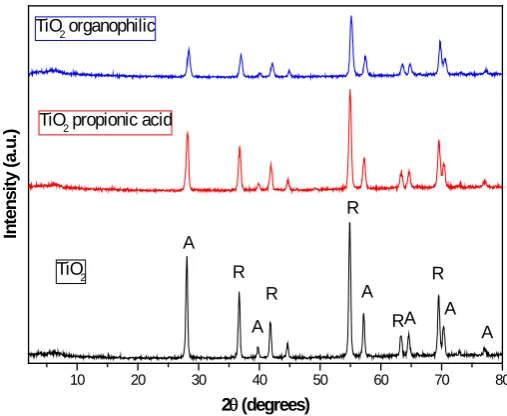
Figure 1exhibits the X-ray diffratograms of TiO2, unmodified particle and particle modified with propionic ac-id and octadecyl amine.
The crystallinity degree of the materials containing unmodified TiO2 did not change significantly, in a while for the materials prepared with organically modified TiO2 changes, it increases for the samples containing 0.25% of organic modification and for the others proportions does not change significantly. We believe that the small proportion of organically modified TiO2 could act as a nucleant particles, being nuclei for the matrix growth.
Figure 1.X-ray diffractogram of TiO2, unmodified particle and par- ticle modified with propionic acid and octadecyl amine.
10 20 30 40 50 60 70 80
R
R A
A R
A A A
R A
In
ten
si
ty (
a.
u
.)
2θ (degrees)
TiO2 organophilic
TiO2 propionic acid
TiO2
2.3. NMR
Organically modified and unmodified TiO2 nanoparticles were used to investigate the effect of organic modifi-cation on their dispersion and distribution in the PP matrix. The molecular dynamic behavior of the PP/TiO2 composites gives information on the microstructure of the composites. The NMR results were analyzed in terms of the effect of the organic modification of the particles and the intermolecular interactions within the compo-sites.
Table 1 listed the T1H values for TiO2, TiO2 modified with propionic acid and TiO2 modified with propionic acid and octadecyl amine (C-18).
The proton spin-lattice relaxation time values presented the same behavior than X-ray and thermal degrada-tion temperature.
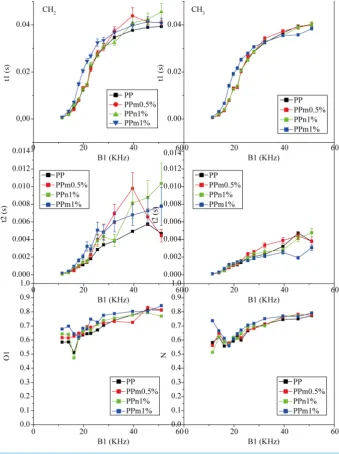
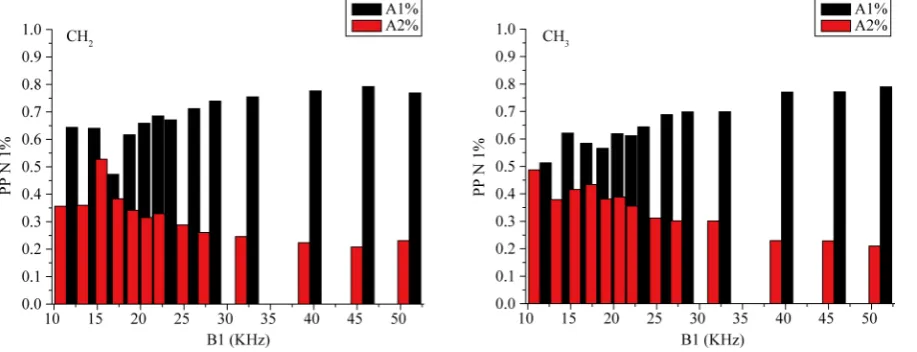
The behavior of T1ρH for CH2 and CH3 group for all samples is shown in Figure 2, while that Figure 3 and
Figure 4 shown the behavior of T1ρH decay for CH2 and CH3 groups as function of B1 strength for sample
[image:4.595.143.483.257.712.2]PPm0.5% and for sample PPN1%, respectively.
Figure 3. The behavior of T1ρH decay for CH2 and CH3 groups as function of B1 strength for sample PPm0.5%.
Figure 4. The behavior of T1ρH decay for CH2 and CH3 groups as function of B1 strength for sample PPN1%.
According to the measured T1ρH values, all composites showed at least two dynamic domains: the short val-ues were related to the rigid part of the system, which includes the crystalline and the highly constrained amorphous phase, while the longer relaxation times were attributed to the less constrained amorphous region, which has higher molecular mobility compared to the rigid region of the materials.
For all systems, the dispersion and distribution of the particles in the polymer matrix was detected. The in-crease in the relaxation time parameter in the composites compared to the pure PP was associated to the strong interaction between titanium dioxide particles and the polymer chains. This effect was more pronounced for the systems containing organically modified.
The increase of relaxation times values in the composite materials compared to the pure PP was associated to the strong interaction between titanium dioxide nanoparticles and the polymer chains. This effect was more pronounced for the systems containing organically modified TiO2.
Conclusions
TiO2 particles were organically modified; these treatments promoted an improvement in the interaction and consequently the dispersion of this nanoparticle in the polymer system. Thus, the best PP/TiO2 sample contained with 0.50% of modified particles.
[image:5.595.90.549.291.467.2]Finally, the solid state high resolution NMR techniques were able to evaluate the proton resolved molecular dynamics of those systems.
Acknowledgements
The authors thank you the CAPES, CNPQ and FAPERJ for all financial support of this work and for the scho-larship.
References
[1] Abragam, A. (1996) Principles of Nuclear Magnetism. Oxford Science Publications, Oxford.
[2] Chandrakumar, N. and Subramanian, S. (1987) Modern Techniques in High-Resolution FT-NMR. Springer-Verlag,
New York, 388. http://dx.doi.org/10.1007/978-1-4612-4626-8
[3] Gil, V.M.S. and Geraldes, C.F.G.C. (1987) Ressonância Magnética Nuclear: Fundamentos, Métodos e Aplicações.
Fundação Calouste Gulbenkian, Lisboa, 1012.
[4] Slichter, C.P. (1990) Principles of Magnetic Resonance. Springer-Verlag, New York, 665.
http://dx.doi.org/10.1007/978-3-662-09441-9
[5] Stejskal, E.O. and Memory, J.D. (1994) High Resolution NMR in the Solid State., New York, 189.
[6] Bovey, F.A. and Mirau, P.A. (1996) NMR of Polymers. Academic Press.
[7] Koenig, J.L. (1992) Spectroscopy of Polymer. American Chemical Society, Washington, 328.
[8] Komoroski, R.A. (1986) High Resolution NMR Spectroscopy of Synthetic Polymers in Bulk. Methods in
Stereochem-ical Analysis, 7, 379.
[9] Lyerla, J.R. and Yannoni, C.S. (1983) High-Resolution Carbon-13 NMR of Polymers in the Solid State. IBM Journal
of Research and Development, 27, 302-312. http://dx.doi.org/10.1147/rd.274.0302
[10] Schmidt-Rohr, K. and Spiess, H.W. (1994) Multidimensional Solid-State NMR and Polymers. 1st Edition, Vol. 1,
Academic Press, London, 478.
[11] Silvestri, R.L. and Koenig, J.L. (1993) Applications of Nuclear Magnetic Resonance Spectrometry to Solid Polymers.
Analytica Chimica Acta, 283, 997-1005. http://dx.doi.org/10.1016/0003-2670(93)80261-I
[12] Berns, A.E. and Conte, P. (2011) Effect of Ramp Size and Sample Spinning Speed on CPMAS 13C NMR Spectra of
Soil Organic Matter. Organic Geochemistry, 42, 926-935. http://dx.doi.org/10.1016/j.orggeochem.2011.03.022
[13] Silva, N.M., Tavares, M.I.B. and Stejskal, E.O. (2000) 13
C-Detected 1H Spin Diffusion and 1H Relaxation Study of
Multicomponent Polymer Blends. Macromolecules, 33, 115-119.
[14] Tavares, M.I.B. (2000) NMR Molecular Dynamic Study of High Crystalline Polymers. Polymer Testing, 19, 899-904.
http://dx.doi.org/10.1016/S0142-9418(99)00060-4
[15] Nogueira, M.C.J.A., Tavares, M.I.B. and Nogueira, J.S. (2004) 13
C NMR Molecular Dynamic Investigation of Tropical Wood Angelin Pedra (Hymenolobium paetrum). Polymer, 45, 1217-1222.
http://dx.doi.org/10.1016/j.polymer.2003.12.031
[16] Nogueira, R.F., Tavares, M.I.B. and San Gil, R.A.S. (2004) Carbon-13 Solid State NMR Study of Polypropylene/Clay
Nanocomposite. Journal of Metastable and Nanocrystalline Materials, 22, 71-76. http://dx.doi.org/10.4028/www.scientific.net/JMNM.22.71
[17] Tavares, M.I.B, Nogueira, R.F., San Gil, R.A.S., Preto, M., Silva, E.O., Silva, M.B.R. and Miguez, E. (2007)
Polypropylene-Clay Nanocomposite Structure Probed by H NMR Relaxometry. Polymer Testing, 26, 1100-1102. http://dx.doi.org/10.1016/j.polymertesting.2007.07.012
[18] Monteiro, M.S.S.B., Silva, E.O., Rodrigues, C.L., Cucinelli Neto, R.P. and Tavares, M.I.B. (2012) The Structure of
Polycaprolactone-Clay Nanocomposites Investigated by 1H NMR Relaxometry. Journal of Nanoscience and
Nano-technology, 12, 7307-7313. http://dx.doi.org/10.1166/jnn.2012.6431
[19] Passos, A.A., Tavares, M.I.B., Cucinelli Neto, R.P., Moreira, L.A. and Ferreira, A.G. (2011) Preparation of EVA/Silica
Nanocomposites Characterized with Solid State Nuclear Magnetic Resonance. Polímeros, 21, 98-102. http://dx.doi.org/10.1590/S0104-14282011005000023
[20] Olejniczak, S., Kaźmierski, S., Pallathadka, P.K. and Potrzebowski, M.J. (2007) A Review on Advances of High-Res-
olution Solid State NMR Spectroscopy in Structural Studies of Polymer/Clay Nanocomposites. Polimery, 52, 713-792.
[21] Soares, I.L., Chimanowsky, J.P., Luetkmeyer, L., Silva, E.O., Souza, D.H.S. and Tavares, M.I.B. (2015) Evaluation of