Hybrid Stochastic Framework
for Freeway Traffic Flow Modelling
Lyudmila Mihaylova
SYSTeMS, Universiteit Gent
B-9052 Zwijnaarde, Belgium
[email protected]
Ren´e Boel
SYSTeMS, Universiteit Gent
B-9052 Zwijnaarde, Belgium
[email protected]
Abstract
Traffic flow is an interesting many-particle phenomenon, with nonlinear inter-actions between the vehicles. This paper studies highway traffic and presents a
general framework for traffic modelling as astochastic hybrid system(with
contin-uous and discrete dynamics and some interactions between its components). The freeway is considered as a network of components, each component modelling a different section of the traffic network. A model is developed in order to design stochastic predictors of the flows. The different traffic modes and transitions be-tween them are detected and analyzed in real data, collected by induction loop detectors from Belgian and Dutch freeways.
1
Motivation
A freeway network consists of many interacting components. Traffic flow on each compo-nent is a complex system, with highly variable demand patterns, traffic jams, stop-and-go waves and hysteresis phenomena. Experimental studies [6, 7, 9, 10] based on traffic data have shown that traffic flow in different sections of a freeway possesses distinct dynamic modes (phases), such as: free flow traffic that is similar to the laminar flow in fluid systems: cars do not interact much with each other and each car approaches its own desired speed; synchronized traffic flow, a mode in which drivers move with nearly the same speed on the different lanes of the highway; congested mode in which the speed is quite low and can fluctuate very much while flow does not vary significantly; andjammed
mode, where vehicles almost do not move and the flow is very low. Some changes in the section mode, for example from “free flow” to “congested”, are induced by the traffic dynamics themselves, while others are due to external events such as accidents, road works or weather conditions.
the average speed and the average density. Discrete state variables in a section are the number of lanes, traffic modes (free flow, synchronized, congested, jammed) and external conditions like weather. The traffic dynamics is described in this model by macroscopic
variables, i.e. in terms of the collective vehicle dynamics, by aggregated variables and treating the traffic as a fluid flow. Various macroscopic models have been developed over the last 60 years for the deterministic or stochastic evolution of the three main variables of aggregated traffic: flow, speed, and density (for a recent survey, see [2, 3, 5, 8, 7]). The majority of the proposed in the literature macroscopic models are deterministic. Until now macroscopic models are predominantly used to simulate the traffic dynamics, less for traffic states estimation and control. Compared to the other types of models with higher level of details, such as microscopic (particle-based) and mesoscopic (gas-kinetic) [3], the macroscopic (fluid-dynamic) models are more suitable for theon-line description of traffic states in order to make predictions with real data. These predictions are then useful for model based feedback control, which is the ultimate motivation of our work.
The remainder of the paper is organized as follows. Section 2 presents the framework for modelling of the traffic flow as a stochastic hybrid system. The freeway network is divided into components. Each component is described by its dynamic mode and by aggregated traffic variables. Section 3 is focussed on analysis of the transitions between different traffic modes and their on-line detection, based on real data from freeways. Finally, conclusions are given in Section 4.
2
Traffic Flow Considered as a Hybrid System
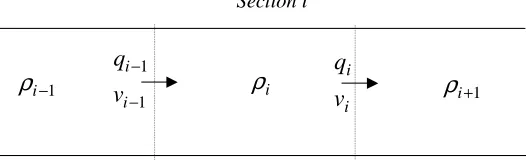
The network of freeways under study is divided into many sections, as indicated in Fig. 1. Each section corresponds to a stretch of a freeway where the behavior is fairly homogeneous. The traffic vehicular flow on the freeways is described as a stochastic hybrid system
xi,k+1 =fi(xdi,k, xi−1,k, xi,k, xi+1,k, di,k, ηi,k), (1)
where the state vectorxi,k = (ρi,k, vi,k)T contains the average trafficdensity (the number
of vehicles per length unit, [veh/km]) and the average speed, [km/h]. The state vector
xi,k+1 of the i-th section at time k+ 1 is a function of state vectors at time k, from
the i-th, and neighbor sections, i−1 and i+ 1. xi,k contains the continuously evolving
variables at several equidistant points along the stretch of the freeway; xd
i,k = m is the
vector of discrete variables (e.g. the number of lanes, the traffic mode, the weather) that describes a particular traffic mode; di,k is the vector of demands (on-ramp and
off-ramp flows); ηi,k is a disturbance vector, with a known probability distribution pηi,k(ηi).
ηi,k reflects the fluctuations in the speed selected by different drivers under the same
conditions. The traffic mode makes sudden transitions, jumps to a different mode with a rate that depends onxi,k, xi+1,k. Using traffic modes as discrete state variables allows
for much simpler form of fi (e.g. affine function). In the first and the last zone of a
section,di,k acts as a part of boundary conditions. These first and last zones are special
1 1
− −
i i
v q
Section i
i i
v q 1
−
i
[image:3.595.163.426.75.155.2]ρ ρi ρi+1
Figure 1: Freeway divided per sections. The flow qi and the speed vi are at the outflow
boundary, ρi is within the section.
The measurement equation is of the form
zi,k =hi(xi,k, ξi,k), (2)
where the measurement vector zi,k = (qi,k, vi,k)T comprises the average flow (the number
of vehicles: cars and trucks, passing a specific location in a time unit, [veh/h]) and the average speed, measured by induction loop detectors at the boundary between some sections. The data are averaged over an interval of fixed length, e.g. one minute. They are corrupted by noise due to sensor calibration errors, communication link errors, sensor failures. The measurement noise ξi,k is assumed uncorrelated with di,k and ηi,k, with a
known probability distribution pξi,k(ξi). Functions fi and hi are nonlinear in general. We are building up efficienthybrid traffic models (with continuous and discrete com-ponents and some interaction between them) in order to solve the problems of: i) estima-tion of the traffic variables, i.e. in finding ofE(xk/Zk) by using all available information,
Zk={z
j,l,∀j = 1,2, . . . , i, . . . , N, l= 1,2, . . . , k}fromN sections, andii)prediction of
a future state, i.e. E(xk+1/Zk), where xk stacks all vectors xi,k, E(.) denotes the
math-ematical expectation operator. The posterior probability density function of the state
P(xk/Zk) is recursively updated from the sensor information, using the state update
and the measurement update steps, aiming respectively the computation of the proba-bility density functions P(xk+1/xk) and P(Zk/xk). The recursive Bayesian approach is
a suitable framework (e.g. particle filtering [1]). One of the challenges in these tasks is the need for on-line solutions, quickly after a new observations come in.
3
Traffic Analysis and Classification of its Modes
We investigate the transitions between the traffic modes empirically and theoretically. The traffic phenomenon is analyzed taking into account various upstream and down-stream conditions and after splitting up the data according to the different phases. The data are collected from Belgian and Dutch freeways, respectively in June 2001 and Au-gust 2002. The transitions between the different modes may happen in a very irregular way: for instance the transition between free flow and synchronized traffic is of hysteretic nature, which means that the inverse transition from congested to free flow traffic occurs at a lower density and at a higher speed [4, 7].
0 10 20 30 60 70 80 90 100 110 120 130 Speed, [km/h] Density, [veh/km]
0 10 20 30 0 500 1000 1500 2000 2500 Density, [veh/km] Flow, [veh/h]
5.5 6 6.5 7 7.5 8 8.5 60 80 100 120 140 Time, [h] Speed, [km/h]
5.5 6 6.5 7 7.5 8 8.5 0 500 1000 1500 2000 2500 Time, [h] Flow, [veh/h]
10 20 30 60 70 80 90 100 110 120 Speed, [km/h] Density, [veh/km] 1 2 3
5 10 15 20 25 30 500
1000 1500 2000 2500
Density, [veh/km]
Flow, [veh/h]
1 2
3
14 14.2 14.4 14.6 14.8 15 40 60 80 100 120 140 Time, [h]
Speed, [km/h] 1 2 3
14 14.2 14.4 14.6 14.8 15 0 500 1000 1500 2000 2500 3000 Time, [h] Flow, [veh/h] 1 2 3
a) Free-flow traffic: middle lane, 2 b) Synchronized mode : 1 - the rightmost lane, 2
[image:4.595.90.501.76.237.2]- the middle one, and 3 - the fastest lane
Figure 2: Traffic on a freeway in Belgium near Antwerpen (Kennedy tunnel)
congested (Fig. 3, Fig. 4a), and jammed (Fig. 4b). In this section we present results based on the fundamental diagram (flow-density plot,qi,k(ρi,k)), the flow-speed diagram
qi,k(vi,k), as well as the evolution of the speed vi,k and flowqi,k as a function of time. In
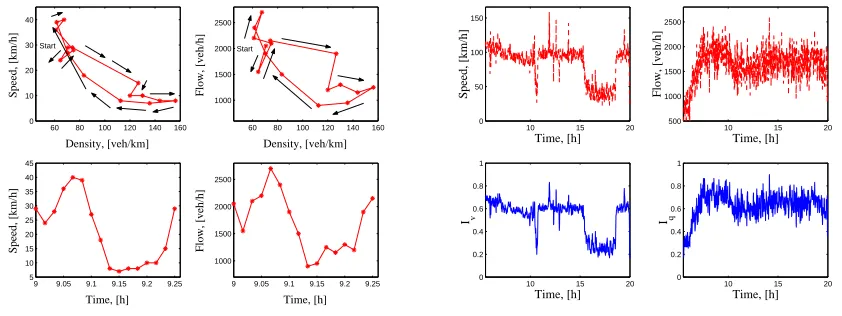
a free-flow mode a clearly expressed tendency of linear dependence between the density and flow is present, except few outliers (Fig. 2a). In (Fig. 2b) the synchronization of the speed between the middle and the fastest lanes is obvious. Hysteresis cycles can be seen in the plots of Figs. 3a and 5a both in the speed-density and in the flow-density diagram. In the congested mode a large scattering effect is observed in the flow-density diagram Fig. 3b. In the jammed mode (Fig. 4 b) the vehicles are moving with a speed
vi,k <15 [km/h] and the flow is qi,k <800 [veh/h].
10 20 30 40 50 20 40 60 80 100 120 140 Speed, [km/h] Density, [veh/km]
10 20 30 40 50 1000 1200 1400 1600 1800 2000 Density, [veh/km] Flow, [veh/h]
10.40 10.5 10.6 10.7 10.8 50
100 150
Time, [h]
Speed, [km/h]
10.4 10.5 10.6 10.7 10.8 1000 1200 1400 1600 1800 2000 2200 Time, [h] Flow, [veh/h] Start
0 20 40 60 80 20 40 60 80 100 120 Speed, [km/h] Density, [veh/km]
0 20 40 60 80 500 1000 1500 2000 2500 Density, [veh/km] Flow, [veh/h]
15 16 17 18 20 40 60 80 100 120 Time, [h] Speed, [km/h]
15 16 17 18 0 500 1000 1500 2000 2500 Time, [h] Flow, [veh/h] Start
a) Transition from a synchronized to a b) Transition from a free-flow to a
[image:4.595.305.499.490.642.2]congested mode : middle lane congested mode: middle lane
Figure 3: Traffic on a freeway in Belgium near Antwerpen (Kennedy tunnel)
change detection ratios: Iv = (vi,k+vi,k−1)/2vmax, Iq = (qi,k+qi,k−1)/2qmax, where vmax
[image:5.595.83.499.180.337.2]and qmax are the maximum values of the speed and flow, respectively. As seen from
Fig. 5 b, this indicator reflects the transitions of the speed and the flow exactly. Both flow and speed have to be observed, because in some modes only the speed changes abruptly, whereas the flow remains relatively constant, nevertheless the mode is com-pletely different.
0 20 40 60 80 0 20 40 60 80 100 120 140 Speed, [km/h] Density, [veh/km]
0 20 40 60 80 500
1000 1500 2000 2500
Density, [veh/km]
Flow, [veh/h]
18.5 19 19.5 20 0 50 100 150 Time, [h] Speed, [km/h]
18.5 19 19.5 20 500 1000 1500 2000 2500 Time, [h] Flow, [veh/h] Start Start
0 50 100 150 200 2 4 6 8 10 12 Speed, [km/h] Density, [veh/km]
0 50 100 150 200 0 100 200 300 400 500 600 700 Density, [veh/km] Flow, [veh/h]
15 15.1 15.2 15.3 15.4 15.5 2 4 6 8 10 12 Time, [h] Speed, [km/h]
15 15.1 15.2 15.3 15.4 15.5 0 100 200 300 400 500 600 700 Time, [h] Flow, [veh/h]
a) Transition between free-flow and two b) Jam : middle lane
congested regions : middle lane
Figure 4: Freeway in Belgium near Antwerpen (Kennedy tunnel)
60 80 100 120 140 160 0 10 20 30 40 Density, [veh/km] Speed, [km/h]
60 80 100 120 140 160 1000 1500 2000 2500 Density, [veh/km] Flow, [veh/h]
9 9.05 9.1 9.15 9.2 9.25 5 10 15 20 25 30 35 40 45 Time, [h] Speed, [km/h]
9 9.05 9.1 9.15 9.2 9.25 1000 1500 2000 2500 Time, [h] Flow, [veh/h]
Start Start
10 15 20 0 50 100 150 Time, [h] Speed, [km/h]
10 15 20 500 1000 1500 2000 2500 Time, [h] Flow, [veh/h]
10 15 20 0 0.2 0.4 0.6 0.8 1 Time, [h] Iv
10 15 20 0 0.2 0.4 0.6 0.8 1 Time, [h] Iq
Figure 5: a) Transition from a congested to a jammed mode (data from a freeway A1 in
the Netherlands: aggregated data from two lanes) b) Detection of the changes in traffic
modes (data from Belgium, Kennedy tunnel): data from the middle lane
[image:5.595.82.503.441.599.2]4
Conclusions
Experimental investigations of traffic modes and the transitions between them are pre-sented. This paper develops a modelling approach of freeway traffic flow, in order to describe the traffic states with on-line data for the goals of prediction of future traffic states and application to traffic control systems. The freeway traffic is modelled as a hybrid stochastic system with different components.
References
[1] Doucet, A., N. Freitas, and N. Gordon, Eds., Sequential Monte Carlo Methods in Practice,
New York: Springer-Verlag, 2001.
[2] Gartner, N., C. Messer, and A. Rathi, Eds., Revised Monograph on Traffic Flow Theory,
USA, 2002, http://www.tongji.edu.cn/∼yangdy/its/tft/.
[3] Helbing, D., Traffic and Related Self-Driven Many-Particle Systems, Review of Modern
Physics, Vol. 73, pp. 1067-1141, 2001.
[4] Helbing, D., and M. Treiber, Critical Discussion of “Synchronized Flow”, Cooper@tive
Tr@nsport@tion Dyn@mics, XX, 2002.
[5] Hoogendoorn, S., and P. Bovy, State-of-the-art of Vehicular Traffic Flow Modelling,Special
Issue on Road Traffic Modelling and Control of the Journal of Systems and Control Eng. Proc. of the IME I, 2001.
[6] Kerner, B. S., Theory of Congested Traffic Flow: Self-Organization Without Bottlenecks, Proc. of the 14th Int. Symp. on Transportation and Traffic Theory, Israel, pp. 141-171.
[7] Kim, Y., Online Traffic Flow Model Applying Dynamic Flow-Density Relations, PhD
dissertation, Technische Universit¨at M¨unchen, 2002.
[8] Kotsialos, A., M. Papageorgiou, C. Diakaki, Y. Pavis and F. Middelham, Traffic Flow Modeling of Large-Scale Motorway Using the Macroscopic Modeling Tool METANET, IEEE Transactions on Intelligent Transportation Systems, Vol. 3, No. 4, pp. 282-292, 2002
[9] Lee, H. Y., H.-W. Lee, and D. Kim, Origin of Synchronized Traffic Flow on Highways and
Its Dynamic Phase Transitions, Phys. Rev. Letters, Vol. 81, No. 5, pp. 1130-1133, 1998.
[10] Neubert, L., L. Santen, A. Schadschneider and M. Schrechenberg, Single-Vehicle Data of
Highway Traffic: A Statistical Analysis, Phys. Review A, Vol. 60, No. 6, pp. 6480-6490,
1999.