Computer aided tool management system : an
implementation model.
SHAFAGHI, Mohammad
Available from Sheffield Hallam University Research Archive (SHURA) at: http://shura.shu.ac.uk/3186/
This document is the author deposited version. You are advised to consult the publisher's version if you wish to cite from it.
Published version
SHAFAGHI, Mohammad (1994). Computer aided tool management system : an implementation model. Doctoral, Sheffield Hallam University.
Copyright and re-use policy
6 KW 301307
ProQuest Number: 10700994
All rights reserved
INFORMATION TO ALL USERS
The quality of this reproduction is dependent upon the quality of the copy submitted.
In the unlikely event that the author did not send a com plete manuscript and there are missing pages, these will be noted. Also, if material had to be removed,
a note will indicate the deletion.
uest
ProQuest 10700994
Published by ProQuest LLC(2017). Copyright of the Dissertation is held by the Author.
All rights reserved.
This work is protected against unauthorized copying under Title 17, United States C ode Microform Edition © ProQuest LLC.
ProQuest LLC.
789 East Eisenhower Parkway P.O. Box 1346
COMPUTER AIDED TOOL MANAGEMENT SYSTEM
AN IMPLEMENTATION MODEL
Mohammad Shafaghi
A thesis submitted in partial fulfilment of the requirements of Sheffield Hallam University
for the degree of Doctor of Philosophy
ABSTRACT
COMPUTER AIDED TOOL MANAGEMENT SYSTEM;
AN IMPLEMENTATION MODEL
by
Mohammad Shafaghi
In recent years considerable attention has been diverted towards devising new strategies to deal with the competitive nature of manufacturing environments. Such strategies are often influenced by the costs and quality of the manufactured products. An effective tool management and control system can significantly contribute to the efficiency of manufacturing facilities by maintaining the flow of production, reducing manufacturing costs, and be instrumental to the quality of finished goods.
Most companies however, have consistently overlooked the importance of tooling and its impact on the efficiency of their manufacturing facilities, consequently it has become a major production bottleneck. Hence, the need for uncovering the nature, extent, and underlying causes of tooling problems.
Having recognised the importance of a Computer Aided Tool Management And Control Systems (CATMACS) as a partial solution to the efficient management of tooling resources, the study then looks at the implementation of CATMACS in fourteen manufacturing companies in the UK, developing some 40 propositions.
Based on the developed propositions, a framework for the implementation methodology is constructed. The framework consists of five phases; Tool audit, Strategy, Design, Action, and Review. The framework has been evaluated and the inputs and outputs to the phases have been identified. The framework represents a significant step in understanding of CATMACS implementation, in particular:
• It addresses the need for such system.
• It provides the basis of an implementation toolkit.
PREFACE
This thesis is submitted to the School of Engineering of Sheffield Hallam University for
the degree of Doctor of Philosophy. This study was conducted in the division of Design
and Manufacturing of School of Engineering.
I would like to express my deepest gratitude and appreciation to my supervisors
Dr. D.T.S. Perera (School of Engineering), and Professor D. Tranfield (Sheffield Business School) for their guidance and constructive criticism throughout the course of this study. I would like to thank my friends; especially Christine Osbourne and James Battersby
for their help and support. Also my colleagues and administrative staff within the
School of Engineering, and the Research Office for their help and support. Finally, I
like to thank those individuals from companies who participated in this study.
The results obtained during the course of this research are to the best of my knowledge
original, except where the reference is made to the work of others.
Process of PhD
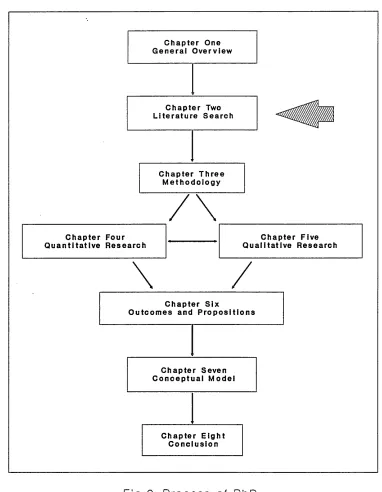
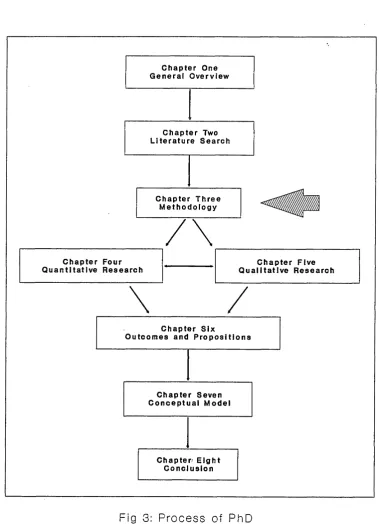
The structure of the PhD thesis is illustrated in Figure 1. The chapters are represented by rectangular boxes, where, the chapter under review is highlighted by the thick arrow pointing to the right or top of the boxes. For example in figure 1, "General Overview" is the topic under discussion.
C h a p t e r T h r e e M e t h o d o l o g y
C h a p t e r E i g h t C o n c l u s i o n C h a p t e r One G e n e r a l Ove rview
C h a p t e r Two L i t e r a t u r e S e a r c h
C h a p t e r Se ve n C o n c e p t u a l Mod el C h a p t e r Four
Q u a n t i t a t i v e R e s e a r c h Q u a l i t a t i v e R e s e a r c hC h a p t e r Five
C h a p t e r S ix O u t c o m e s an d P r o p o s i t i o n s
CONTENT
ABSTRACT I
PREFACE II
Process of PhD III
1 TOOL MANAGEMENT SYSTEM; GENERAL OVERVIEW
1.1 Manufacturing and Tooling 1
1.2 Evolution of Tool Management System 2
1.3 Tooling Problems 2
1.4 Computer Aided Tool Management And 4
Contro1 System (CATMACS)
1.5 Focus of the Research 5
2 LITERATURE REVIEW
2.1 Introduction 7
2.2 Tooling Problems 8
2.3 Tool Management Systems 12
2.4 Computer Aided Tool Management And 14
Control System (CATMACS)
2.5 Tool Management Software 16
2.6 Implementation of Computerised Tool 21
Management System
2.7 Tool Management Research 27
2.8 The scope of the research 2 9
3 METHODOLOGY
3.1 Introduction 34
3.2 Research Methodology 34
3.3 Case study 3 5
3.4 Questionnaire 3 6
3.5 The Research Process 3 8
3.6 Qualitative vs Quantitative 41
4 QUANTITATIVE RESEARCH
4.1 Introduction 47
4.2 Research Design 47
4.3 Questionnaire design 49
4.4 Pretesting the Questionnaire 50
4.5 Sample Classification and Profile 50
4.6 Survey Results 54
4.7 Types of Perceived Tooling problems 63
4.7.1 High Tool Variety 63
4.7.2 Tool Unavailability 64
4.7.3 Cost of Tooling 64
4.7.4 Tool Tracking and Control 65
4.7.5 High Tool Inventory 66
4.7.6 Lack of Tool Refurbishment Services 6 6
4.8 In-company Interviews 67 4.8.1 Lack of Understanding of Concept of
Tool Management 67
4.8.2 Lack of tooling Strategy 68
4.8.3 Lack of Prioritisation 68
4.8.4 The Degree of Awareness 68
4.9 Summary 69
QUALITATIVE RESEARCH
5.1 Introduction 74
5.2 Case Selection 74
5.3 Research Design 75
5.4 Case Analysis 76
5.5 Case Studies 78
5.6 Summary 125
5.6.1 Sample Classification and Profile 126
OUTCOMES and PROPOSITIONS
6.1 Introduction 131
6.2 Case Study Outcome 131
6.2.1 Company Position 131
6.2.2 Tool Audit 133
6.2.3 Investment Justification 133
6.2.4 Tool Management Software 134
6.2.5 The Change Process 136
6.2.6 Implementation Plan 137
6.2.7 Project Leader 139
6.2.8 Management Commitment 141
6.2.9 Education and Training 143
6.2.10 System Changeover 145
6.2.11 System Benefits 147
6.2.12 Evaluation 149
6.2.13 Critical Factors 153
6.3 Propositions 156
6.3.1 Company Position 156
6.3.2 Tool Audit 157
6.3.3 System Justification 158
6.3.4 Tool Management Software 159
6.3.5 The Change Process 160
6.3.6 Implementation Plan 161
6.3.7 Champion 163
6.3.8 Management commitment 164
6.3.9 Education and Training 165
6.3.10 System Changeover 167
6.3.11 System Benefits 168
6.3.12 Evaluation 168
6.3.13 Critical Factors 169
7 DEVELOPMENT OF FRAMEWORK
7.1 Introduction 171
7.2 Initial Framework 171
7.6 Phase 4:- Action 197
7.7 Phase 5:- Review 201
7.8 Validation 203
8 CONCLUSIONS
8.1 Quantitative Results 207
8.2 Qualitative Research 210
8.3 Qualitative Results 211
8.4 CATMACS Methodology 214
8.5 Further Research 221
REFERENCES 223
APPENDIX 1 Questionnaire and Covering Letter A-l
APPENDIX 2 Company Information A-8
APPENDIX 3 Questionnaire, Covering Letter, and A-13 relevant notes for the Validation of
the Model. APPENDIX 4
APPENDIX 5
List of Tables and Figures Paper Submitted
CHAPTER ONE
TOOL MANAGEMENT SYSTEMS; General Overview,
1.1- Manufacturing and Tooling
A manufacturing company can be viewed as a system which transforms raw materials
into finished products through the use of manufacturing resources. The manufacturing
resources are crucial aspects in this process and can be considered to be anything that
is required to produce the final product. As a manufacturing resource, tooling is a
fundamental aspect of this transformation process, and it is an inescapable fact of
manufacturing life that every manufactured product is built using a tool or by a machine
that was made using tools.
Broom (1967) defined tooling as all equipment and special fixtures that the system can
draw on and use during the setup and operation of a machine or assembly process.
Allen et al (1980) expanded this definition to cover a wide range of equipment such as
jigs, fixtures, pallets, cutting tools, rollers, brushes, tool holders, laps, chucks,
mandrels, collets, centres, arbors, set-blocks, angle plates, templates, molds, cams,
dies, tool magazines and patterns to name a few, and Melnyk (1988) categorised these
various items to "Transportation Tooling", equipment used for transferring parts from
one work station/area to another; "Set-up Tooling", equipment used primarily during
the set-up, and "Production Tooling", equipment used at work centres in the
production of given parts. Within the context of this study the term "tooling" is referred
1.2- Evolution of Tool Management Systems
Traditionally, dedicated machinery handled dedicated tooling. In such an environment
generally, a limited number of tools were associated with each machine on the
shopfloor and operators monitored, maintained, and replenished these in liaison with
stores personnel who managed the tooling resources with the aid of card/index system.
Advances in manufacturing technology such as Machining Cell and FMS also required
the direct supply of tools from a local tool storage area. However, increasing versatility
of NC and CNC machines, and a corresponding increase in work diversity, have
resulted in increasing number of tools being associated with individual machines. As
a result, the operators are no longer sufficiently in control to accept the responsibility
for the management of tooling. Further, the availability of correct tooling in the right
condition is vital to continuous flow of production in any manufacturing environment.
Given these factors, it is imperative that management and control of tooling resources
should receive far more attention. Computerised Tool Management systems are now
considered the way forward for managing tooling resources.
1.3- Tooling Problems
Mason (1986), was the first to highlight the mismanagement of tooling. Based on
company visits, he reported, although tooling may represent the third-most-costly
function in the typical US metal working company, typically;
• 30-60% of tooling inventory is lost on the shop floor.
• 40-80% of a foreman’s and 20% of operator’s time is spent expediting
tools.
The costs associated with the above problems are often combined with hidden costs
such as: machines down for tooling, missed delivery dates, dissatisfied customers,
excess tool inventory, and tool duplications.
Atkey (1986) reported that the UK manufacturing industries were spending £170 million
on tooling every year, Zuin (1990) reported that on average British manufacturers spend
£15,000 on tooling every month, Mason (1991) reported that the US metalworking
industry spends about $1.5 billion a year on cutting tools alone. Whilst these figures
could be higher in 1994, they are directed towards the purchase costs of tooling and do
not accommodate the costs associated with the poor management of tooling, therefore
it may be fair to assume that the real cost of tooling could be much higher. Such costs
have a significant impact on competitive nature of any manufacturing company.
Devaney (1988) argued that recent innovations in manufacturing have prevented from
yielding their maximum potential because managers consistently overlook the impact
of tooling. This lack of vision for tooling has led companies to neglect the importance
of this critical resource and have not changed the way they manage their tooling
resources, consequently it has become a major production bottleneck. However, very
little is known about the current state of tooling in the UK manufacturing companies.
It may be fair to assume that the situation in the UK concerning the management of
tooling resources is not much better than their American counterparts or other
1.4- Computer Aided Tool Management and Control System (CATMACS)
In recent years considerable attention has been diverted towards devising new strategies
to deal with the competitive nature of manufacturing environment. Such strategies are
often influenced by the costs and quality of the manufactured products.
An effective tool management and control system can assist companies to maintain their
competitive edge by reducing the manufacturing costs. Such a system can ensure the
availability of right tools at the right place, at the right time, and right quantity, hence,
manufacturing activities runs to the plant’s schedule. However, a key issue concerning
the effectiveness of such system is the availability of accurate and up to date tooling
information.
Information processing is a key issue in any organisation. However, in manufacturing,
due to the large number of different tools that must be monitored, managed, and
controlled, it becomes increasingly important. Due to unavailability of such information,
lack of cross references, poor control and poor communication between the
departments, provided by card/index tool management systems, Computer Aided Tool
Management And Control Systems (CATMACS) are now seen as a tool for improving
the management of tooling resources. But, despite the availability of such systems since
1.5- Focus of the Research
Since early JL980’s, a number of research programmes initiated in the UK have
addressed various issues concerning the management of tooling resources. But, as far
as the author is aware no formal attempt has been made to identify the company’s
situation with regard to the management of tooling resources in the discrete UK
manufacturing industries.
It is crucial to develop a better understanding of this critical manufacturing resource by
learning about tooling problems, their underlying causes, how they impact on the
efficiency of manufacturing facilities, and how to best control it and benefit from the
results of any improvements in the management of tooling. Such improvements which
often points to the utilisation of a Computerised Tool Management Systems are now
seen by many as the solution to tooling problems, and a means to improve the
efficiency of manufacturing facilities. However, very little is known about the
introductory process of such systems. As a result, the potential benefits of such systems
has not been fully detected by companies who presumed a technology led strategy
would enable them to improve the management of their tooling resources, and
consequently, enhance the efficiency of their manufacturing facilities.
The rationale for this study is driven by the lack of knowledge concerning the
management of tooling resources in the UK manufacturing industries, the scale and
nature of tooling problems, and the urgency to benefit from a systematic approach to
CHAPTER TWO
LITERATURE REVIEW
C h a p t e r T h r e e M e t h o d o l o g y
C h a p t e r E i g h t C o n c l u s i o n C h a p t e r One G e n e r a l Ove rview
C h a p t e r Two L i t e r a t u r e S e a r c h
C h a p t e r S eve n C o n c e p t u a l Model
C h a p t e r Five Q u a l i t a t i v e R e s e a r c h C h a p t e r Four
Q u a n t i t a t i v e R e s e a r c h
C h a p t e r Six O u t c o m e s an d P r o p o s i t i o n s
[image:16.612.93.475.157.649.2]CHAPTER TWO
LITERATURE REVIEW
2.1- Introduction
Chapter one provided the rationale for this study. This chapter reviews the literature,
but concentrates mainly on issues which are relevant to the study. In general, the
amount of literature on the management of tooling resources is very scarce and, the
discussions on tooling are mainly limited to technical issues when dealing with existing
literature. This lack of attention is important as it provides little visibility for tooling
problems and further, there is no real vehicle for assisting managers to benefit from the
introduction of Computerised Tool management Systems. The literature review consists
of seven sections; Tooling Problems, Tool Management System, Computer Aided
Tool Management and Control System (CATMACS), Tool Management Software,
Implementation of CATMACS, Research in Tool Management, and the Scope of
the Research. However, lack of literature in the area of implementation has forced the
author to look in parallel and similar technologies, in particular in the field of Advanced
Manufacturing Technologies (AMT), and CIM. This is also true when considering tool
management software. (The term AMT refers to a wide range of innovations in
manufacturing environments. It includes stand alone equipment such as CNC
machinery, shopfloor data collection system, to complete automated system such as
2.2- Tooling problems
The desire to acquire and maintain competitive advantages in the market place have
encouraged manufacturing companies to benefit from the introduction of advanced
technologies such as Just-in-Time Manufacturing (JIT), Flexible Manufacturing System
(FMS), and Computer Integrated Manufacture (CIM). Whilst these system offer the
promise of enhanced competitiveness through improvements in quality, flexibility, costs
and inventory reductions, their success is closely linked to tooling. This is mainly due
to the fact that tooling is the fundamental aspect of manufacturing life. Irrespective of
the type of operating systems, unavailability of right tooling can result in production
stoppages. Therefore, effective utilisation of manufacturing facilities and continuous
flow of production relies heavily on the availability of right tooling at the right place.
Little et al (1988) suggests, Tool management is a critical issue when meeting the
highly flexible requirements demanded, and Gray et al (1988) argues that, the way that
tools are managed largely effects the productivity of manufacturing facilities, and there
is evidence that lack of attention to structured tool management has resulted in poor
performance of numerous production systems.
Most companies however, do not manage and control their tooling effectively;
consequently it has become a major production bottleneck. Mason (1986), was the first
to provide an insight into typical tooling problems in traditional manufacturing
environments, he identified several key tooling problems and their magnitudes in some
American companies. In a report where tool management and control was linked to
• Typically 30-60% of a shop’s tooling inventory is somewhere on the
shopfloor, lost and expensed.
• Typically 16% of production schedule cannot be meet due to tool
unavailability.
• typically 40-80% of a foreman’s time is spent expediting materials and
tools.
• In some plants, operators spent up to 20% of their time searching for
cutting tools.
Melnyk (1988) suggests that tooling is such a familiar item to most of us that we no
longer understand it or appreciate its effect on the operation of manufacturing systems.
Tooling is often treated as a manufacturing residual, something that is considered only
after we have dealt with issues of capacity, design, manpower, and materials. As a
result we are faced with a situation on the shop floor in which: tooling is poorly
controlled, and schedules and delivery dates are compromised. Hence, the problems
with the management of tooling becomes more severe. For example:
• There is not enough tooling,
• There is enough tooling but it is not where it should be,
• There is enough tooling but the tooling is either not set up or not
adequate,
• Wrong tools are specified for a given jobs.
• Value of excess and obsolete tool inventory,
• Additional cost of hot purchases,
• Cost of expediting tools,
• Late deliveries and dissatisfied customers,
and hence, consequent market losses may indicate the importance of tooling in today’s
manufacturing environment and the need for effective utilisation of this critical
manufacturing resource. Mason (1991) characterised the management of tooling as
bordering on criminal neglect in many companies and suggests, if raw materials or
work-in-process were handled the way tools and tooling routinely are, the managers
would be considered incompetent. Melnyk (1991) suggests, Tooling as a manufacturing
task and problem, and as an area of research, lacks visibility and widespread
acceptance.
In the UK, early studies have focused on the tool management problems of Flexible
Manufacturing Systems (FMSs) including;[Kochan (1985 ) and (1987)], Kellock (1986),
Perera & Carrie (1987), Bell & De Suza (1987), and Hollingum (1989)]. Stephens
(1984) recognises the importance of tooling in FMS environment, and Rhodes (1986)
considers tool management as a critical factor in FMSs. He suggested improperly
developed tool management system can cripple such a system and greatly reduces
system efficiency and capacity. Like Perera (1987) he proposed that each FMS has its
own individual characteristics, therefore a single "standard" tool management system
can not apply to all FMSs. Gray et al (1988) suggests that lack of attention to tool
automated system to perform well, a high level of integration in necessary between
tooling capacity and the other production functions such as process planning,
scheduling, part design, and part programming. Whilst highlighting the importance of
effective tool management within FMSs and CIM, Little et al (1988) discusses the
requirements for a highly flexible integrated manufacturing environment, and identifies
the main parameters which influence the tool management requirements specification
for a particular FMS.
Although the above work has produced useful results in the management of tooling
resources within FMS environment, it has not been beneficial to the majority of
companies who utilise traditional manufacturing facilities. The absence of literature in
traditional manufacturing facilities is quite evident and no attempt has been made to
identify the full spectrum of tooling problems in the manufacturing industry and, it is
important to note that; Mason and Melnyk’s work are based on their experiences, not
scientific research. The lack of concern for the management of tooling resources, their
associated problems, and the impact of tooling on the efficiency of manufacturing
facilities has encouraged the author to identify the nature and causes of tooling problems
2.3- Tool Management Systems.
Mason [(1988),(1992)] defines the tool management system for a manufacturing
company as a system which ensures that right tools are delivered to the right places
throughout the plant at the correct times with the minimum investment in tools so that
operations may run to the plant schedule. He suggested this definition should be more
broad to include: tool design, tool purchasing, tool inventory, tool scheduling and
status, tool storage facilities, and tool history. According to Melnyk (1988) tool
management and control (TMC) describes all of the activities, direct and indirect which
are necessary to manage the availability, use, maintenance and enhancement of all
tooling resources needed by the shop floor to successfully direct the flow of work from
release to completion. In contrast to others, Mason and Melnyk have encapsulated the
essence of tool management. However, these definitions do not elaborate on their
validity for any type of tool management system.
Kuchinic et al (1988) defines tool management as: "tool management is broad in
concept, requiring a planning strategy to ensure that the appropriate tools are available
in the right quantities, a control strategy to coordinate tool transfer between machines
and cribs and to see that tools perform properly, and a monitoring strategy to identify
and react to unexpected events". Tyner (1988) defines tool management as a process
of getting the right tool to the right place on time. Kravitt (1988) suggested that, tool
management systems, controls all types of manufacturing tooling including perishable
tooling, consumed during use; durable tooling, such as jigs and fixture; and gauges and
other measuring devices. Eversheim et al (1991) considers tool management as a
the tool related information flow. Whilst such definitions can not be rejected, they do
not really cover all that tool management is.
According to Chapman (1990) tool management is defined differently by different
people. Tool management is not simply the control of tool inventory, it encompasses
many diverse activities including; tool identification, tool presetting, tool ordering
system, tool transportation, quick change tooling system, and post process gauging
systems. But with wide variety of definitions, there is common agreement on the
objectives of tool management systems first reported by Mason (1988). Long (1991)
characterises these objectives to "five rights of tool management".
• The right tool,
• In the right place,
• At the right time,
• In the right condition,
• At the right cost.
Computerised Tool Management Systems can assist companies to fulfil the objectives
2.4- Computer Aided Tool Management and Control System (CATMACS)
For many manufacturers tooling represent a significant investment. The urgency to
manage and control this manufacturing resource effectively, has encourage some
companies to benefit from the introduction of Computerised Tool Management. This
is mainly driven by the lack of accurate and up to data provided by the card/index
system. Information processing is a critical factor in the efficient management of tooling
resources. Little et al (1988) suggests "Traditional approach to tool scheduling and
kiting have made a significant contribution to improving the efficiency of tool
management, but, as flexibility demands increase and FMS become more dynamic,
information processing becomes the key issue". Although computers can not solve
tooling problems, they can provide better access to stored information through a
functioning tool database. Such a database can assist companies to improve the
management of their tooling resources.
Kupferberg (1986) suggests that the changing competitive nature of manufacturing has
made the traditional view of tooling obsolete. This is contrary to Mason’s report (1991).
In a update of his special report of May 1986 he argued that, although the management
of tooling resources has been improving somewhat in specific sectors (Aerospace,
Automotive), by enlarge, tool management is still in need of much greater attention
from company management. This study supports his view.
Brown (1991) in support of his discussion on computerised tool management systems
suggested, "while tool management system could be manual, they could seldom if ever
by an unwilling and unskilled workforce". Disregarding the comment concerning the
attitudes and status of workforce, new manufacturing developments, Just-In-Time
Manufacturing, Total Quality Management, and MRP (to name a few) are encouraging
awareness of tooling and further, present economic and technological trends favour the
growth of CATMACS.
Many authors have expressed the need for Computer Aided Tool Management And
Control Systems, including Kiran et al(1988) and Hershkovick (1991). According to
Mason (1991) experienced users of computerised tool management system cite the main
benefits they have gained to be: Improved operating efficiency and control; and
reduction of costs due to machine downtime, excess tool inventory, overtime, and the
costs of hot purchases. This view is shared by many authors including Pond (1986) who
suggested a Computer aided tool management and control system can make money for
the companies by increasing their productivity through better utilisation of tooling, and
Huber et al (1986) who argued that tools can make or break the major investment in
a new system. Atkey (1986), Zuin (1990), and Mason (1991) have reported on annual
purchase cost of tooling to British and American manufacturing companies (chapter
one). However, Zuin who reported, on average British manufacturers will spend
around £15,000 on cutting tools every month suggested this figure could be reduced by
20% if manufacturers adopted a Computer Aided Tool Management And Control
System. This view was supported in a recent report in Manufacturing Engineer 1991.
It suggested that, in pursuit of cost reductions and productivity improvement, the
efficient selection and management of manufacturing consumables is now recognised
Such benefits are only achieved through effective utilisation of Computerised Tool
Management Systems. Parallel with AMT implementation cube (Tranfield 1988), the
latter relies heavily on an implementation strategy which is based on Organisation,
Business, and Technological dimensions (Page 25).
2.5- Tool Management Software
In recent years the growing concern about cost reduction, quality improvement, shorter
product development lead-time, and market shares has increased interest in the
adaptation of computer aided advanced manufacturing technology. Hence, the
development and application of computer software in manufacturing has progressed at
a very fast rate and companies are investing heavily to improve their manufacturing
capabilities and with it, their competitive edge. Due to the importance of tooling in
manufacturing, computer applications are now seen as the solution to the efficient
management of tooling resources.
The software for tool management system can be developed in-house, purchased as an
integrated manufacturing system such as production planing and control system, or
purchased as a dedicated tool management software. Since the early 1980’s, the number
of manufacturing-oriented software packages available on micros, mini, and mainframes
has greatly increased. However, the number of software packages dealing specifically
with the management of tooling resources have been somewhat limited. Often these
packages have been taken the form of stand alone systems designed for very specific
functions (eg, tool tracking, management of tool crib, product costing/quotations), or
systems and often as a minor part of MRP/MRP II Packages.
Early tool management software generally provided information on tool inventory and
were capable of handling tooling transactions. However, due to poor design and
development they were not reliable, as a result the card/index system was operating as
an auxiliary or back-up system. Software dedicated to tooling was first introduced in
1980 by ITC integrated concepts and was followed by companies such as [ABR
Corporation, Applied Control Technologies Inc, Data Enterprises, GE Industrial
Automation Systems Dep, OIR, Stanley Vidmar, Wickman Corporation, and WCI
Control and Data Systems (American Machinist, May 1986)] who produced standalone
tool management programmes within the price range of £1,500 to £28,000 plus. Since
then there has been a growing interest from both software houses and manufacturing
companies who consider computer application in the area of tool management to be
essential to the efficient management and control of this critical manufacturing resource.
Perera (1991) who has followed the evolution of tool management software since 1985,
describes the range of software by leading suppliers and, lists them as in table 2.1.
Debut Software Company Operating Systems
1985 CTMS AMTECH (UK) Ltd XENIX, VAX/VMS
1986 TOOLWARE ISIS INFORMATICS
& ITC (USA) UNIX, AIX, VAX/VMSPC-MSDOS, XENIX, 1986 TOMAS
COROTAS(1990) SANDVIK COROMANT MSDOS, VAX/VMS 1989 STOREMAN
(MATRIX) AT&T ISTEL VAX/VMS
1990 CIMTOOL CIMTEL Ltd MSDOS, UNIX, IBM/AIX
According to him, tool management software is a rapidly growing market in the UK
manufacturing Industry.
In 1985, POLSTORE (UK), a specialist in tool storage and retrieval systems, claimed
that they introduced the world’s first tool management system, the system included all
the necessary modules such as tool transactions, tool assemblies, kit specifications, job
control and monitoring, and tool purchasing. The tool search by description feature
provided by this system was known to provide a user-friendly tool searching facility.
In 1987 AMAZON COMPUTERS acquired CTMS which is now marketed by
AMTECK UK Ltd.
In 1986 TOOLWARE was developed by ITC in USA. The system was then marketed
by System Limited (now ISIS information Ltd). It offered the very basic functions
required to manage a tool crib. However, other versions of this software "TOOLWARE
EXPERT”, and "TOOLWARE MASTER" are fully matured products. They support
all tool management functions and multiple databases, together with variety of powerful
facilities. SAND VICK, a leading supplier introduced its tool management software,
TOMAS in 1986. In 1990 they launched a new product COROTAS, developed in
Germany. The system is capable of supporting all tool management functions together
with interfaces to automated tool handling system. In 1989 Istel (now At&T) released
their product, STOREMAN. The system has been updated since, and is now a module
within their factory management and operational control system called "MATRIX”.
Whilst CIMTOOL developed by CIMTEL Ltd can be utilised as a stand alone product,
it can be integrated to other modules in their range of production management and
companies, are two other systems which have been reported in UK, Perera (1991)
Current software market for tool management is mainly dominated by a very limited
number of software houses who have gained considerable experience in this field and
offer a wide range of products such as standard tool inventory and control to interfaces
to MRP systems, purchasing, automated tool storage and retrieval systems. Udoka et
al (1990) suggests, there are more than half dozen providers of this type of software.
Software houses are usually involved in the production of variety of systems, and their
wide range of powerful application modules offers each user a complete computer
integrated manufacturing (CIM) solution. However, despite the availability of tool
management software packages, some companies have considered the in-house
development of such packages; [Mosley (1991), and Thomas et al (1991)]. Thomas
suggested; "tool management is a complex organisational problem in many industries
which much time and money being wasted due to both shortage and excess.
Commercial software dealing with these problems is difficult to adapt to individual
situations with the result that a more efficient and applicable methodology is being
sought". But, despite the benefits of a custom-tailored system, it is fair to assume that,
their development may not be suitable for most companies. This is mainly due to the
organisational, financial, and technical capabilities together with the length of time
required for the development of such software.
Tool management software selection is an important factor in the successful
implementation of CATMACS. With the availability of software technology in tool
package. However, lack of literature in this area has forced the author to look for
parallels concerning the purchase of software packages. Schwab et al (1992) suggests;
with increasing number of vendors, a multi vendor solution for purchasing software
should be adapted. Many authors including [Jeye (1988), Johnson (1988), Pecora
(1989), and Allen (1992), have discussed the criteria for vendor selection. But, with
the increasing vast array of commercial packages, the task of selecting the right
software becomes more important and requires a structured approach.
Thompson (1988) proposes a strategy for software selection, and many authors have
recommended selection criteria for choosing the right software package: [Fitzgerald
(1987), Heydt (1987), Blaum (1988), Nee (1988),Winsor (1988), Le Blanc et al (1989),
Kilmar (1990), Theophano (1991), Castellanos (1992)]. But, some authors have argued
that software evaluation improves the chances of selecting the right package, and have
recommended criteria for software evaluation; [Clark (1987), Helsell et al (1987),
Mullins (1987), Archer (1988), Effgen et al (1988), Krupp (1991)]]. However, the
existence of available software has moved the emphasis to implementation [Geisler et
al (1987), Schleich et al (1991), Bussert (1991), Launi (1991), and Chellis (1991)].
The views expressed by the above authors concerning the criteria for vendor, and
software selection is directed at commercial packages. At this stage there is no evidence
to whether or not such a procedures are adapted by the manufacturing companies
concerning the purchase of tool management packages. Therefore it is important to
develop a systematic approach to the selection of software for tool management system.
This is an integral part of the implementation process which, its success relies heavily
2.6- Implementation of Computerised Tool Management System.
The process of implementing manufacturing technology, in particular, CATMACS is
often viewed as the process of installing technology by many manufacturing companies.
This may be the case if the installed technology is compatible with the existing one.
But, CATMACS implementation contains elements such as new procedures, and rules
that changes the way in which tooling resources are managed. Hence, the
implementation of CATMACS requires more than just adaptation of technology. It
encompasses the actions from; development/purchase, and installation through to
successful utilisation of the system. But, many important determinants of successful
implementation are actions and conditions prior to purchase/development or installation.
Bessant et al (1985) argued that; "we need to shift our attention towards issues of
implementation and adaptation rather than simple adoption. Similarly, Barton (1988)
suggested; "implementation requires adaptation of technology and its environment, and
adaptation can infact be viewed as a part of the innovation process".
The pre-requisite for successful implementation of CATMACS are actions and
conditions that have to be meet prior to the development/purchase of such systems, for
example; existing system analysis, new system requirements, technical requirements,
and organisation context. Long (1991) considers the combination of good physical
organisation with a strong administrative foundation is a pre-requisite for successful
introduction of tool management system. Whilst his view of optimising the internal
customer/supplier relationship of the administrative process is directed at Total Quality
Management (TQM), it undermines the importance of the organisation’s commitment
should be considered when undertaking the actual process of implementing a tool
management and control system;
• Identify and solve basic problems first.
• Do not look for one big answer to all problems, chances are
there will be many little answers to many small problems.
• When bringing the system on-line, approach it from a phasing
standpoint. That is, introduce one major category of tooling at a time.
This allows the floor operators, as well as the crib attendants, time to
adjust to the new method of operations.
Such guidelines are useful when embarking on the process of implementation, but they
fail to provide any mechanism for the implementation of such system. This is also
partially true about Duggan (1991) who proposed a fourteen step methodology for
successful implementation of computerised tool management systems based on his own
experience. Although his methodology is more comprehensive to that of Melnyk’s, it
fails to appreciate the importance of; management commitment, employee’s
participation, education and training, information base, the process of change, and
system changeover, such factor are crucial to the successful implementation of
CATMACS. The Liverpool University Method for Tool Management (LUM-TM)
which is aimed at specifying the requirements of plant-wide tool management
information systems in FMS environment consists of two phases of; Requirements
Analysis, and Requirements Solution (Kehoe et al 1991). The LUM-TM provides a
simultaneously process volumes of a variety of parts and it differs from a conventional
manufacturing environment.
The success stories of CATMACS implementation has been reported in case studies;
[Zeleny (1981), Gayman (1986), Bottazzi (1987), Albert (1987), Witkow (1988),
Happersberger (1988), Anstiss (1988), and Hollingum (1989)]. The case studies are
important in providing real life data regarding the incurred costs and benefits by the
companies in improving the management of their tooling resources but, very little
attention has been paid to the actual implementation process of such systems and
technical details have always dominated. This is similar to implementation guide lines
provided by some software houses where installation and operational details receives
top priority with little in terms of training.
With significant amount of literature concerning various aspects of AMT
implementation; [(Beatty 1990),(Hashmietal 1990),(Steele etal 1990), (Baldwin 1990),
and (Corbitt et al 1991), and CIM; [Lucas et al (1988), Jain (1989), O’Hara (1990),
Seemann (1991), Howery et al (1991), Aletan (1991), and Von Ohsen (1992)] very little
is known about the implementation of CATMACS, hence, limited literature. This is
mainly due to newness of the concept and the time required for a large degree of
implementation.
This study supports Voss’s (1986) historical perspective of implementing manufacturing
technology which examines the history of the major manufacturing innovation of
1970’s. It suggests that there is little concern with implementation until about ten years
implementation of CATMACS, it has therefore been necessary to look for parallels in
similar technologies. In particular, the field of manufacturing and information
technologies. Although, it is important to minimise the possibilities of translating
experience from one technology field to another, some aspects of implementation are
technology independent, for example the project champion, process of change, and
employee’s participation.
Several studies indicate that many applications of Manufacturing Technologies have not
yielded their potential benefits. This view has been developed from the weight of
evidence accumulated concerning similar and sometimes related applications of AMT
and Information Technologies (IT) into manufacturing environments. Typically,
applications of new, and particularly of integrated technology, are seen as patchy in
terms of their success. The root cause of this has been attributed variously to
insufficient account being taken of the relationships between these technologies and the
business and organisational context in which they are located. These fundamental
problems are often experienced and have been reported as problem manifest in the
introduction and implementation of new technologies, [Voss (1985), Bessant and
Haywood (1985), Watrelow and Monniot (1986), Ingersoll Engineers (1986), ,Tranfield
and Smith (1988), Kirkwood et al (1989), and Maull et al (1990)].
Recent empirical work in the U.K. suggests an absence of "strategy” which is characte
rised by ad-hoc decision-making by management, and lack of understanding by senior
managers about the "strategic possibilities" of AMT (Currie 1990). Ferravanti (1990)
suggests that the process of choosing a system implementation strategy can be broken
and the data processing design methodology used, and Willis et al (1991) argues the
need for pre-implementation strategy and recommends four steps in his approach.
Tranfield et al (1988) in a study of thirteen different applications of various aspects of
AMT and Computer Aided Production Management (CAPM) in eight of the Britain’s
biggest manufacturers, concluded that the successful implementation of an integrated
technology depends heavily on the development of an overall strategy based on the
business, technology and organisational dimensions. Beatty (1990) recognises the
importance of implementation strategy and considers a capable champion, system
integration, and cross-functional implementation teams as the essential implementation
factors.
Hrebiniak & Joyce (1984) have proposed a model for the implementation strategy, and
Dean et al (1990) suggest that implementation of AMT consists of making and
implementing a series of decisions based on Technical, Economic, and political factors
(TEP). Kidd (1990) argues that the implementation strategy should be based on
organisation, people, and technological factors. However, it has been purported that
strategy is not an issue for consideration in small firms (Birley 1982), but, Dodgson et
al (1991) argues that, in the case of innovation, strategy is important, if not essential,
for the small and medium company’s development and growth.
The basis of an implementation strategy is one of planned change centred on the
framework of a policy and involving the tasks, individuals and structure of the
organisation. Brooks (1986), and Gupta & Yakimchuk (1989) have identified the
implementation. Kotter & Schlesinger (1979) have identified the sources of resistance
to change, and Blake et al (1964) and King et al (1989) express the need for strategic
approach when introducing organisational changes. Rochester (1990) identifies the first
step in change management is to gain an understanding of the nature of the change
itself, and Lawrie (1990), and Hendricks (1989) have recommended a step by step plan
for simple and effective change management programme.
Davids et al (1990) suggests that the implementation of AMT leads to conflict between
management and labour primarily over potential job losses. However, the emerging
problem is split between various sections of workforce, in particular, AMT users and
nonusers. Bulworth et al (1990) recommends a seven step plan for successful
implementation of employee involvement (El). Schroeder et al (1989) argues that the
adaptation of AMT is not a simple answer to the problems facing small manufacturers.
However, adaptation of AMT is a necessary and regular part of doing business if a
small manufacturer is to remain competitive. He then consider, planning and
implementation to be the most critical elements in successful adaptation of AMT.
Implementation is a vital issue that must be carefully considered prior to the
introduction of a CATMACS. Since industries and companies vary from one another
in manufacturing processes, organisational behaviour, and working practices. There
is no single strategy that can be exclusively adopted for the implementation of a
CATMACS. Hence implementation strategy must be carefully planned and specific
procedures must be tailored depending on the organisation characteristics and
environment. Udoka et al (1990) proposes that, because of the complex nature of the
projects have been unable to report on a consistent pattern of factors for successful
implementation efforts.
Most of the above studies have identified the problems of implementing new
technologies and suggested methodologies to utilise AMT more effectively. It is
important to study how well these could be applied to implementation of CATMACS.
Further, it is significant that the current literature on the implementation of CATMACS
is purely based on individual experiences, and it is apparent that the implementation of
such systems is in need of more attention. This has been the influencing factor in the
development of a framework for the implementation of CATMACS by this study. The
framework would provide guidelines for the best way of implementing such system.
2.7- Tool Management Research
There are only a limited number of publications that provide a detailed examination of
tooling: Melnyk & Carter (1987), Melnyk (1988), Blackstone (1989) and, a literature
survey provided litde support to the research. However, some concepts of tool
management have been addressed mainly in research programmes (table 1), conference
proceedings [(CIM 1986), (TMC 1988) & (TMC 1991)], and case studies; [ Zeleny
(1981), Gayman(1986), Albert (1987), Bottazzi (1987), Witkow (1988), Happersberger
(1988), Anstiss (1988), and Hollingum (1989)]. The current issues of tool management
are usually found in journals and magazines in particular American Machinist (AM),
and articles and books on Flexible Manufacturing Systems cover very basic tool
Perera (1990) who has followed the research programmes in UK since 1980 with
interest, partially holds the academia responsible for not addressing tooling problems
in conventional manufacturing systems. He categorises the past and current research
programmes in UK to three areas of: Tool Flow Control in Flexible Manufacturing
Systems, Tool Management & Control in Conventional Manufacturing Systems, and
Automatic Tool Selection Systems (Table 2.2).
Period Researcher Institution Topic 81-83 Kay Cranfield Tool flow simulation 83-87 Carrie &
Perera Strathclyde Planing and control problems ofFMS with high tool variety 85- Bell &
Newman Loughborough Tool management in highly automated batch manufacturing systems. The management of tool flow in multi cell batch manufacturing facilities.
The design of Flexible machining facilities.
87-90 Kehoe &
Little Liverpool Liverpool System specification fortool management system (FMS). 91- James Hull Intelligent tool condition
monitoring
86-89 Hannam UMIST Tool Database and Structure. 89- Perera Sheffield Tool planing in discrete batch
manufacturing.
Tool management and control in conventional manufacturing systems 86- Hinduj a UMIST Tool selection.
89- Maropoulos
& Simmons Durham Tool selection and control 89- Syan Nottingham Tool selection.
Table 2.2: Research programmes in UK. (Ref: Perera 1991)
Although the management of tooling resources has been receiving more attention since
companies leaves considerable room for improvements. This may be due to lack of
understanding of the concept of tooling as a manufacturing resource, and a systematic
approach in eliminating the production bottlenecks by identifying the underlying causes
of tooling problems.
2.8- The Scope of the Research
The literature survey provided some insight into management of tooling resources, but
raised many more questions:
• Why tooling remains an ignored issue?
• What are the tooling problems?
• What is responsible for tooling problems?
• What is the current state of tooling in the UK manufacturing
industries?
• Are UK manufacturing companies experiencing difficulties
concerning the management of their tooling resources?
• What are tooling costs?
On the implementation side of the Computer Aided Tool Management And Control
Systems (CATMACS), it is difficult to overlook the overwhelming volume of literature
which suggests; in the implementation of advanced technologies, people, and
organisational issues are as important as technological issues. Some of the questions
• What is a CATMACS?
• Why invest in such systems?
• Are companies benefiting from the implementation of CATMACS?
• What are the requirements for successful introduction of
CATMACS?
• What are the critical factors in implementation of CATMACS?
• Are companies successful in implementation of such systems?
The answers to the above questions together with many other relevant issues based on
CHAPTER THREE
METHODOLOGY
C h a p t e r T h r e e M e t h o d o l o g y
C h a p t e r E i g h t C o n c l u s i o n C h a p t e r One G e n e r a l Overview
C h a p t e r Two L i t e r a t u r e S e a r c h
C h a p t e r Seven C o n c e p t u a l Model C h a p t e r Four
Q u a n t i t a t i v e R e s e a r c h Q u a l i t a t i v e R e s e a r c hC h a p t e r Five
C h a p t e r Six O u t c o m e s an d P r o p o s i t i o n s
[image:41.615.91.471.131.656.2]CHAPTER THREE
METHODOLOGY
After reviewing the literature in chapter two, this chapter defines and defends the
methodology used in this study, in particular the principle of moving from a relatively
small base of case materials to theory. This chapter describes the research techniques
used to conduct this study, and aims to place the work in the context of research
methodologies developed by other writers.
Section 3.1- Introduction
Section 3.2- Research Methodology
This section describes the approach to the study and the motivation for the use of case
studies and mail survey.
Section 3.3- Case Study
After defining the case study this section describes the author’s approach to case study
method.
Section 3.4- Questionnaire
Whilst highlighting the importance of the questionnaire, this section highlights the
Section 3.5- The Research Process
This section looks at the research process in the context of induction and deduction as
seen by other authors.
Section 3.6- Qualitative vs Quantitative
defines the qualitative and quantitative techniques of data collection and their relation
3- Methodology
3.1- Introduction
With widely differing methods of data collection, data analysis, and a variety of styles
of reporting and presentation of the results available to researchers, the initial stage of
this study was devoted to the development of an effective research design and strategy.
This design forms the framework of the entire research programme and will detail the
most suitable methodology. The rational for the methodology is heavily motivated by
the lack of data concerning the management of tooling resources in the UK
manufacturing industry, and the need to develop a framework for the implementation
of CATMACS based on hard data.
3.2- Research Methodology
The methodology adopted three specific routes: a survey of the literature, a mail
survey, and a series of industrial case studies utilising quantitative and qualitative
techniques of data collection.
Whilst being aware of the distinction between the qualitative and quantitative
techniques, the author is concerned with the objectivity of the research programme
rather than the benefits or pitfalls of each technique. The advantages and disadvantages
of each method are widely documented including [Schofield (1969), Miller (1970), Rose
(1982), McNeil (1985), Chisnall (1986), and Baker (1988)]. However the multi
data collection for the purpose of theory building (Induction) and theory testing
(Deduction), which together make up a sound research strategy. Payne (1964), and
Chisnall (1986) favour the combination of survey techniques and Webb et al (1966)
considers questionnaire and interviews are probably the most flexible and generally
useful device we have for gathering information. Therefore it may be important to
provide the reader with descriptive data regarding the two main components of this
research methodology; case studies, and the questionnaire.
3.3- Case Study
The term "case study" usually refers to a detailed study of a single example. However,
Baker (1988) argues that field research need not be confined to single cases, but may
compare different social settings. With significant amounts of literature in field work,
the case study approach has been recognised as a useful field research technique by
many authors including; [Goode et al (1952), Bausell (1986), Eisenhardt (1989), and
Gilbert (1993)]. But no one has encapsulated the meaning of the term case study as well
as Eisenhardt (1989) in a series of statements below.
• The case study is a research strategy which focuses on understanding
the dynamics present in a single setting.
• Case studies involve either single or multiple cases.
• Case studies typically combine data collection methods, the evidence may
• Case studies can be used to accomplish various aims; to provide
description, test theory, or generate theory.
Baker (1988) considers the difficulties of establishing reliability in the field studies,
Since case studies tend to be individualized and non routinised, therefore it is difficult
for a second researcher to replicate the earlier work of another. In recent years, case
studies have provided valuable insight into the field of manufacturing since they convey
the success of new innovations and technologies. Such results have encouraged others
to follow the reported examples.
This study has considered several Mini Case Studies to establish similarities and
differences concerning the implementation of CATMACS. The development of case
studies has been based on an extended interviews with the participant companies
complemented with observation of the manufacturing operations and facilities (Chapter
5, section 5.3, page 75). A summary is then written up to draw attention to various
issues relevant to the research, and finally the obtained data is adapted to analysis.
3.4- Questionnaire
A questionnaire is a method of obtaining specific information about a defined problem
so that after data analysis and interpretation, the result will provide a better
understanding of the perceived problem. A questionnaire is generally referred to as the
backbone of most surveys and because of the impersonal nature of mail questionnaires,
the drafting of effective questions is more important than ever. Further, the
guide the respondents. With significant amount of literature relating to; definition, and
different aspects of questionnaires, mail survey, and advantages and disadvantages of
this technique of data collection over others [Parton (1950), Goode et al (1952),
Schofield (1969), Rose (1982), McNeill (1985), Chisnall (1986), Baker (1988), and
Gilbert (1993)], this study has only accommodated those aspects which were considered
relevant to the research. The questionnaire was designed to:
• Get the precise information required,
• Be clearly understood by all the respondents,
and, the rules for questionnaire design were followed according to Baker (1988);
• Include only questions pertinent to the research,
• Make questions appealing,
• keep the questionnaire short,
• Have brief, but clear instructions,
• Preconsider all issues that respondents receiving questionnaire might
have.
Baker’s (1988) recommends two strategies for soliciting cooperation in a survey:
stressing the importance of the research project as a contribution to science, and
stressing the need of the researcher. These were partially adapted in a covering letter.
However, it may be relevant to place the research methodology in the context of the
3.5- The Research Process
The process of research has been categorised to Induction; a process of building theory
from observation (Fig 3.1), and Deduction; a processes of testing the theory (Fig 3.2),
by many authors including; [Evered et al (1981), Baker (1988), Eisenhardt (1989), and
Gilbert (1993)].
Manufacturing Environment
w
TheoryFig 3.1: Theory building by Induction
Manufacturing Environment
Theory
I
Explanation
Fig 3.2: Theory testing by Deduction
as a technique for applying theories. He suggests that in terms of definition these two
methodologies are quite distinct, but in the course of research they often get
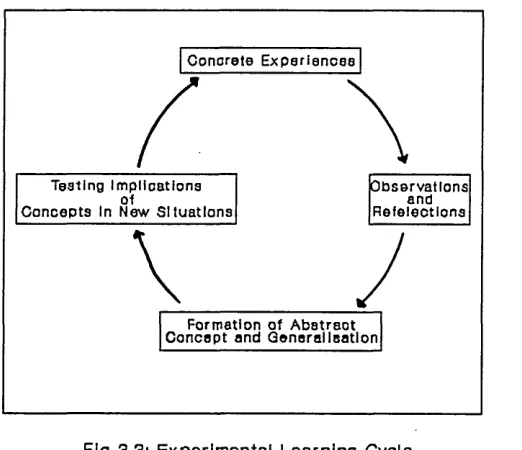
intertwined. Kolb et al (1979) goes further by tying the two methodologies together in
a model which they refer to as an Experiential learning Cycle (Fig 3.3). The two
methodologies are represented by right hand side of the circle corresponding to
inductive and left hand side corresponding to deductive research.
Concrete Experiences
Testing Implications ot
Concepts In New Situations
Observations and Refeiections
Formation of Abstract Concept and Generalisation
Fig 3.3: Experimental Learning Cycle
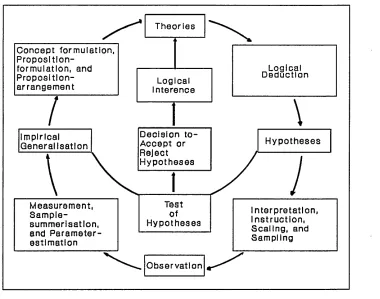
Baker (1988) argues that it is difficult to separate these two procedures in practice
(Induction and Deduction), and a scientific model must include both theories and
observations, conceptualising and data gathering, generalising and specifying. Such a
model, however, usually undergoes changes as the evidence is brought to bear on the
problem, resulting in reformulation of the hypotheses. Such a research process has often
been viewed as a cycle in which various phases are interdependent. Describing the
Wallace’s (1971) model of scientific process which has been widely used and adapted
to represent the research cycle (Fig 3.4), he attempts to provides a fuller conception of
[image:49.614.159.420.197.422.2]