DURABILITY OF SELF-COMPACTING CONCRETE WITH COAL BOTTOM
ASH AS SAND REPLACEMENT MATERIAL UNDER AGGRESSIVE
ENVIRONMENT
AHMAD FARHAN BIN HAMZAH
A thesis submitted in fulfilment of the
requirements for the award of the degree of
Doctor of Philosophy (Civil Engineering)
Faculty of Civil and Environmental Engineering
Universiti Tun Hussein Onn Malaysia
Special dedication to the memory of
Allahyarham Muhammad Faiz Hamzah.
May ALLAH bless his soul and forgiveness.
ACKNOWLEDGEMENT
In the name of Allah S.W.T., most gracious and most merciful, with His
permission, Alhamdulillah this dissertation has been completed. Praise to Prophet
Muhammad S.A.W of His companions and to those on the path as what He preached
upon, may Allah the Almighty keep us in His blessing and tenders.
First and foremost, I would like to convey my highest gratitude to my
supervisors, Assoc. Prof. Dr. Mohd Haziman Wan Ibrahim and Dr. Norwati
Jamaluddin who has helped, led and advised me in preparing a good proposal and for
all their contributions. They gave me so many useful advices from the first day until
the day of submitting this thesis. A special appreciation to my beloved co-supervisors,
Dr. Ramadhansyah Putra Jaya from Universiti Teknologi Malaysia (UTM) and Dr.
Mohd Fadzil Arshad from Universiti Teknologi MARA (UiTM) who has helped
tremendously in providing constructive comments and suggestions throughout the
experimental works and thesis writing.
Above and beyond, I would like to thank to my parent, my wife, sibling and
family-in-law for their prayers, understanding, and support during the preparation of
this dissertation.
My appreciation is also dedicated to Norul Ernida Zainal Abidin, Norzubaidah
Fadzil, Mohd Hanif Hasbullah, Mohd Arief Mohamed, Syahredza Salikin and all my
friends for their useful advices and instilled besides giving me their moral support.
Last but not least, there is too numerous persons to be mentioned here that have been
sharing their knowledge on how to complete this work effectively as a teaching and
learning tool. I would like to express my most sincere thoughts for those who helped.
Thank you.
ABSTRACT
Concrete is a major building material use for numerous purposes in construction
including the concrete structures that exposed to aggressive environment or seawater
such as coastal berthing facilities, breakwaters, retaining walls, tidal barriers, dry
docks, container terminals, off-shore floating docks and drilling platforms. As these
concrete structures that usually exposed to an aggressive environment, it is expected
to require a minimum level of repair or maintenance during their service life. The
ingress of aggressive agents, in particular chloride and sulphate ions, can lead to
corrosion of reinforcing steel bars and thus cause a reduction in strength and
subsequent decrease in the service life of concrete structures. In context to resist this
type of premature deterioration, concrete must be proportioned to achieve high
durability in aggressive environments. The incorporation of coal bottom ash as sand
replacement material was possible to help self-compacting concrete in designing mix
proportion which contains extra fine particles content and fewer amounts of coarse
aggregates. On the other hand, self-compacting concrete was developed to respond to
the need for a self-compacting concrete with improved durability. In this study, six
replacement levels were considered for self-compacting concrete: 0%, 10%, 15%,
20%, 25% and 30% by volume. The essential workability properties of the fresh
self-compacting concrete containing coal bottom ash were prepared and evaluated by the
test of slump flow, L-box and sieve segregation resistance. Later, the effect of coal
bottom ash subjected to sodium chloride (NaCl), sodium sulphate (Na
2SO
4) and
seawater through cyclic wetting and drying was also investigated. The durability
performance of the coal bottom ash self-compacting concrete exposed to aggressive
environment was evaluated through compressive strength, Rapid Chloride
Permeability Test (RCPT), chloride penetration by Rapid Migration Test (RMT) and
carbonation depth test. In addition, microstructural changes that occur in specimens
due to aggressive environmental effects were identified through X-ray diffraction
(XRD) techniques and Scanning Electron Microscopy (SEM). Test results show that
coal bottom ash can be acceptably used as a fine aggregate replacement material in
order to achieve good durability of concrete. The self-compacting concrete containing
10% coal bottom ash replacement showed excellent durability to chloride, sulphate
and seawater attack. The test results also indicate that the amount of calcium hydroxide
(Ca(OH)
2) in the 10% coal bottom ash concrete was slightly lower than that of control
ABSTRAK
Konkrit adalah bahan binaan utama yang digunakan untuk pelbagai tujuan dalam
pembinaan termasuk struktur konkrit yang terdedah kepada persekitaran yang agresif
atau air laut seperti kemudahan pantai (berthing), pemecah ombak, dinding penahan
(retaining wall), benteng pasang surut, dok kering, terminal kontena, dok terapung di
luar pantai dan penggerudian pelantar. Oleh kerana struktur konkrit tersebut terdedah
kepada persekitaran yang agresif, ia memerlukan tahap pembaikan yang minimum
atau penyelenggaraan semasa hayat perkhidmatan. Pendedahan dan kemasukan agen
agresif, terutamanya ion klorida dan sulfat boleh mengakibatkan kakisan bar tetulang
keluli dan menjejaskan kekuatan dan seterusnya menyebabkan penurunan hayat
perkhidmatan struktur konkrit. Justeru, bagi mengelakkan kemerosotan konkrit
pramatang ini, konkrit perlu dinisbahkan mengikut kesesuaian untuk mencapai
ketahanan yang tinggi dalam persekitaran yang agresif. Penggunaan abu enapan arang
batu
(coal bottom ash) sebagai bahan pengganti pasir adalah sesuai untuk
menghasilkan konkrit tanpa getar (self-compacting concrete) dalam merancang nisbah
campuran yang mengandungi kandungan zarah halus dan jumlah agregat kasar yang
sedikit. Sehubungan dengan itu, konkrit tanpa getar telah dibangunkan dengan
ketahanan yang lebih baik. Melalui kajian ini, enam tahap penggantian berdasarkan
volumetrik telah dipertimbangkan untuk konkrit tanpa getar iaitu 0%, 10%, 15%, 20%,
25% dan 30%. Sifat penting kebolehkerjaan dalam konkrit tanpa getar yang
mengandungi abu enapan arang batu dinilai oleh ujian aliran turunan (slump flow),
ujian L-box dan ujian rintangan pengasingan. Selain itu, kesan abu enapan arang batu
yang tertakluk kepada natrium klorida (NaCl), natrium sulfat (Na
2SO
4) dan air laut
melalui kitaran pembasahan dan pengeringan juga dikaji. Prestasi ketahanan konkrit
tanpa getar mengandungi abu enapan arang batu yang terdedah kepada persekitaran
yang agresif telah dinilai melalui ujian kekuatan mampatan, ujian kebolehtelapan
ion-klorida pantas (RCPT), penembusan ion-ion-klorida oleh ujian migrasi pantas (RMT) dan
ujian karbonasi. Di samping itu, perubahan mikrostruktur yang berlaku dalam
spesimen kerana kesan alam sekitar yang agresif telah dikenal pasti melalui teknik
X-ray pembelauan (XRD) dan Scanning Electron Microscopy (SEM). Keputusan ujian
menunjukkan bahawa abu enapan arang batu boleh digunakan sebagai bahan gantian
agregat halus untuk mencapai ketahanan konkrit yang baik. Penggantian sebanyak
10% abu enapan arang batu menunjukkan ketahanan yang sangat baik untuk
persekitaran klorida, sulfat dan air laut. Keputusan ujian juga menunjukkan bahawa
jumlah kalsium hidroksida (Ca(OH)
2) dalam spesimen konkrit penggantian 10% abu
TABLE OF CONTENTS
INTRODUCTION
1
1.1
Introduction
1
1.2
Problem Statement
4
1.3
Research Objectives
5
1.4
Research Significant
6
1.5 Scope of Works
7
1.6 Structure of Thesis
9
LITERATURE REVIEW
10
2.1
Introduction
10
2.2
Salt attack in concrete material
10
2.3
Factors affecting salt attack on concrete
10
2.3.1 Cement type and composition
11
2.3.2 Water binder ratio
11
2.3.3 Curing condition
12
2.3.4 Type of sulphate and concentration
12
2.3.5 Presence of chloride
13
2.3.6 Temperature of exposure
14
2.4
Mechanism of salt attack
15
2.4.2 Chloride attack
17
2.4.3 Sulphate attack
18
2.4.4 Seawater attack
19
2.5 Aggressive exposure condition
21
2.5.1 Wetting and drying
22
2.5.2 Freeze and thaw
23
2.5.3 Laboratory simulation of wetting and drying cycles
24
2.6
Coal bottom ash concrete
24
2.6.1 Durability of coal bottom ash concrete
28
2.6.1.1 Permeability
28
2.6.1.2 Wet and dry resistance
29
2.6.1.3 Salt attack resistance
29
2.7
Summary
30
MATERIALS PROPERTIES, RESEARCH DESIGN AND
EXPERIMENTAL DETAILS
32
3.1
Introduction
32
3.2
Research Design
33
3.3
Materials
37
3.3.1 Cement
37
3.3.2 Coal bottom ash
39
3.3.3 Aggregates
42
3.3.3.1 Coarse aggregates
42
3.3.3.2 Fine aggregates
43
3.3.3.3 Specific gravity and water absorption test
45
3.3.3.4 Flakiness Index and Elongation Index test
47
3.3.3.5 Aggregate Impact Value and Aggregate Crushing Value test 49
3.3.4 Water
50
3.3.5 Superplasticizer
51
3.4
Characterization of raw materials
52
3.4.1 Physical properties
52
3.4.1.2 Specific gravity
53
3.4.2 Chemical compositions
54
3.4.2.1 X-ray Fluorescence (XRF)
54
3.4.2.2 X-ray Diffraction (XRD)
55
3.4.2.3 Scanning Electron Microscopy (SEM)
55
3.5
Mix design mix proportioning
56
3.6
Cyclic wetting and drying
58
3.6.1 Samples preparation and curing condition
58
3.6.2 Sodium Chloride (NaCl)
59
3.6.3 Sodium Sulphate (Na
2SO
4)
60
3.6.4 Seawater sampling
61
3.6.5 Laboratory simulation-Temperature and Relative humidity data
63
3.7
Concreting procedure
63
3.7.1 Fresh properties of concrete
64
3.7.1.1 Slump flow and Slump spread time test
64
3.7.1.2 L-box test
65
3.7.1.3 Sieve stability test
66
3.7.2 Hardened properties
67
3.7.2.1 Compressive strength
67
3.7.2.2 Split tensile strength
68
3.7.2.3 Flexural strength
69
3.7.2.4 Water absorption test
71
3.8
Durability test
72
3.8.1 Rapid Chloride-ion Permeability Test (RCPT)
72
3.8.2 Rapid Migration Test
74
3.8.3 Carbonation test
75
SELF-COMPACTING CONCRETE WITH COAL BOTTOM ASH
78
4.1
Introduction
78
4.2
Properties of fresh self-compacting concrete
78
4.2.1 Flow ability
78
4.2.2 Passing ability
81
4.2.3 Segregation resistance
82
4.2.4 Concluding remarks on fresh properties
84
4.3
Properties of hardened self-compacting concrete
84
4.3.1 Unit weight
85
4.3.2 Compressive strength
87
4.3.3 Split tensile strength
91
4.3.4 Flexural strength
95
4.3.5 Permeable pore space and water absorption
98
4.3.6 Relationship of density and compressive strength
102
4.3.7 Relationship of compressive strength and split tensile strength
103
4.3.8 Relationship of compressive strength and flexural strength 104
4.3.9 Relationship of compressive strength and water absorption 106
4.3.10 Nomograph Development
107
4.4
X-ray diffraction (XRD)
109
.6
Scanning electron microscopy
116
4.7
Summary
119
EFFECT OF CHLORIDE AND SULPHATE EXPOSURE ON
SELF-COMPACTING CONCRETE WITH COAL BOTTOM ASH BY WETTING
AND DRYING CYCLES
120
5.1
Introduction
120
5.2
Compressive strength of self-compacting concrete with coal bottom
ash cured in tap water
120
5.2.1 Reduction in compressive strength due to chloride attack
124
5.2.2 Weight loss due to chloride attack
126
5.4 Compressive strength of self-compacting concrete with coal bottom
ash subjected to sodium sulphate solution
127
5.4.1 Reduction in compressive strength due to sulphate attack
129
5.4.2 Weight loss due to sulphate attack
130
5.5
Rapid Chloride-ion Permeability Test (RCPT)
131
5.5.1 Relationship between total charge passed and compressive
strength
135
5.5.2 Relationship between total charged passed, current and time
(chloride exposure)
138
5.5.3 Relationship between total charged passed, current and time
(sulphate exposure)
141
5.6
Chloride penetration by Rapid Migration Test
144
5.6.1 Relationship between total charge passed and depth of chloride
penetration
147
5.7
Carbonation depth test
150
5.7.1 Relationship between carbonation depth and compressive strength
153
5.8
X-ray diffraction (XRD)
150
5.9
Scanning Electron Microscopy (SEM)
163
5.10 Summary
174
EFFECT OF SEAWATER ON SELF-COMPACTING CONCRETE WITH
COAL BOTTOM ASH BY WETTING AND DRYING CYCLES
175
6.1
Introduction
175
6.2
Compressive strength of self-compacting concrete with coal bottom
ash subjected to seawater
176
6.3.2 Relationship between total charge passed, current and time 184
6.4
Chloride penetration by Rapid Migration Test
187
6.4.1 Relationship between total charge passed and depth of chloride
penetration
188
6.5
Carbonation depth test
190
6.5.1 Relationship between carbonation depth and compressive strength
191
6.6
X-ray diffraction (XRD)
193
6.7
Scanning Electron Microscopy (SEM)
197
6.8
Summary
201
CONCLUSIONS AND RECOMMENDATIONS
202
7.1
Conclusions
202
7.1.1 Properties of self-compacting concrete and optimum content of
coal bottom ash
202
7.1.2 Microstructure of self-compacting concrete incorporating coal
bottom ash with different percentage of sand replacement
203
7.1.3 Performance of coal bottom ash self-compacting concrete with
different percentages of sand replacement subjected to
aggressive environments by wetting and drying cycles
204
7.2
Recommendations for future research
205
References
207
List of publications
228
A. International Journal Papers
228
B. International / National Conference
229
C. International Competition
230
Appendix A
231
Appendix B
232
Appendix C
233
Appendix D
234
LIST OF TABLES
2.1
Parameters related due to salt attack
11
2.2
Effect of coal bottom ash on properties of concrete
27
3.1
Number of specimens by experiments
36
3.2
Overall number of specimens
36
3.3
Chemical composition of cement
38
3.4
Gradation for coal bottom ash
40
3.5
Compounds composition of coal bottom ash
41
3.6
Gradation of coarse aggregates
43
3.7
Gradation for fine aggregates
44
3.8
Specific gravity and water absorption for coarse and fine aggregates
47
3.9
Specific gravity and water absorption for coal bottom ash aggregate
47
3.10
Chemical analysis of tap water
51
3.11
Technical data of ADVA 181 superplasticizer
52
3.12
Mix proportions (kg/m
3)
57
3.13
Mix proportions by weight (kg)
57
3.14
Chemical analysis of sodium chloride
59
3.15
Chemical composition of sodium sulphate
60
3.16
Chemical analysis of seawater
62
3.17
Monthly analysis of seawater
62
3.18
Segregation resistance test (EFNARC, 2002)
67
3.19
Chloride ion penetrability (ASTM C1202, 2010)
74
4.2
Compressive strength result
88
4.3
Split tensile strength
92
4.4
Flexural strength
96
4.5
Coefficients of linear relationship between concrete density and
compressive strength
103
4.6
Coefficients of linear relationship between compressive strength and
split tensile strength
104
4.7
Coefficients of linear relationship between compressive strength and
flexural strength
105
4.8
Coefficients of linear relationship between compressive strength and
water absorption
107
5.1
Chloride ion penetrability of self-compacting concrete subjected to
sodium chloride solution with wetting-drying cycles
133
5.2
Chloride ion penetrability of self-compacting concrete subjected to
sodium sulphate solution with wetting-drying cycles
135
5.3
Coefficients of linear relationship between total charge passed and
compressive strength (exposed to chloride solution)
137
5.4
Coefficients of linear relationship between total charge passed and
compressive strength (exposed to sulphate solution)
138
5.5
Measurement of total charge passed, current and temperature
determined through RCPT (exposed to chloride solution)
139
5.6
Coefficients of linear relationship between total charge passed and time
(exposed to chloride solution)
140
5.7
Coefficients of linear relationship between total charge passed and
current (exposed to chloride solution)
141
5.8
Measurement of total charge passed, current and temperature
determined through RCPT (exposed to sulphate solution)
143
5.9
Coefficients of linear relationship between total charge passed and time
(exposed to sulphate solution)
144
5.10
Coefficients of linear relationship between total charge passed and
current (exposed to sulphate solution)
144
5.11
Coefficients of linear relationship between total charge passed and
chloride penetration (exposed to chloride solution)
148
5.12
Coefficients of linear relationship between total charge passed and
chloride penetration (exposed to sulphate solution)
6.1
Chloride ion penetrability of self-compacting concrete subjected to
seawater with wetting-drying cycles
183
6.2
Coefficients of linear relationship between total charge passed and
compressive strength (exposed to seawater)
184
6.3
Coefficients of linear relationship between total charge passed and time
(exposed to seawater)
185
6.4
Measurement of total charge passed, current and temperature
determined through RCPT (exposed to seawater)
186
6.5
Coefficients of linear relationship between total charge passed and
current (exposed to seawater)
187
6.6
Coefficients of linear relationship between total charge passed and
chloride penetration (seawater)
LIST OF FIGURES
2.1
Effect of physical condition of exposure (Hekal et al., 2002)
15
2.2
Chloride attack on reinforced concrete (Kung, 2014)
18
2.3
Schematic diagram for sulphate attack (China Microsilica
Union, 2011)
19
2.4
Concrete exposed to seawater (Malhorta, 2000)
21
3.1
Experimental stages in this research
33
3.2
Flow chart of experimental works
35
3.3
Holcim Top standard cement
38
3.4
Raw coal bottom ash
39
3.5
Sieved coal bottom ash
39
3.6
Grain size analysis for coal bottom ash
40
3.7
Coal bottom ash particle
41
3.8
Crushed blue stone aggregates
42
3.9
Grain size analysis for coarse aggregates
43
3.10
River sand used in this study
44
3.11
Grain size analysis for fine aggregates
45
3.12
Elongation gauge
48
3.13
Flakiness gauge
48
3.14
Flakiness and elongation index of aggregates
49
3.15
AIV and ACV test appratus
50
3.17
ADVA 181 polymer-based superplasticizer
52
3.18
Particle size analyser
53
3.19
Micromeritics AccuPyc 1330
53
3.20
XRF equipment
54
3.21
XRD instrument used in this study
55
3.22
NOVA NANOSEM 230 equipment
56
3.23
Sodium chloride
59
3.24
Sodium sulphate
60
3.25
Location of seawater sampling
61
3.26
Temperature and relative humidity data (laboratory
simulation)
63
3.27
Slump flow test
64
3.28
Measurement of slump flow
65
3.29
L-box test equipment
66
3.30
Sieve stability test
67
3.31
Compressive strength test
68
3.32
Cylindrical tensile test
69
3.33
Flexural test on concrete beam
70
3.34
Flexural breaking point failure
71
3.35
RCPT apparatus
73
3.36
RCPT sample in testing
73
3.37
Apparatus set up for RMT (NT Build 492, 1999)
75
3.38
Carbonation depth using a solution of phenolphthalein
76
3.39
Measurement of carbonation depth
76
4.1
Slump flow
79
4.2
Slump spread time (T
500)
79
4.4
Sieve stability test results
83
4.5
Density of concrete at 28 days
87
4.6
Compressive strength for specimens of 0.35 water cement
ratio
89
4.7
Compressive strength for specimens of 0.40 water cement
ratio
90
4.8
Compressive strength for specimens of 0.45 water cement
ratio
90
4.9
Split tensile strength for specimens of 0.35 water cement
ratio
93
4.10
Split tensile strength for specimens of 0.40 water cement
ratio
94
4.11
Split tensile strength for specimens of 0.45 water cement
ratio
94
4.12
Flexural strength for specimens of 0.35 water cement ratio
97
4.13
Flexural strength for specimens of 0.40 water cement ratio
97
4.14
Flexural strength for specimens of 0.45 water cement ratio
98
4.15
Permeable pore space for specimens of 0.35 water cement
ratio
99
4.16
Water absorption for specimens of 0.35 water cement ratio
100
4.17
Permeable pore space for specimens of 0.40 water cement
ratio
100
4.18
Water absorption for specimens of 0.40 water cement ratio
101
4.19
Permeable pore space for specimens of 0.45 water cement
ratio
101
4.20
Water absorption for specimens of 0.45 water cement ratio
102
4.21
Relationship between concrete density and compressive
strength
103
4.22
Relationship between compressive strength and split
tensile strength
104
4.23
Relationship between compressive strength and flexural
strength
105
4.24
Relationship between compressive strength and water
absorption
106
4.25
Compressive-tensile strength nomograph
108
4.26
Compressive-flexural strength nomograph
108
4.28
Diffractogram of 10% coal bottom ash replacement concrete
at 28 days
110
4.29
Diffractogram of 15% coal bottom ash replacement concrete
at 28 days
111
4.30
Diffractogram of 20% coal bottom ash replacement concrete
at 28 days
111
4.31
Diffractogram of 25% coal bottom ash replacement concrete
at 28 days
112
4.32
Diffractogram of 30% coal bottom ash replacement concrete
at 28 days
112
4.33
Diffractogram of control concrete at 180 days
113
4.34
Diffractogram of 10% coal bottom ash replacement concrete
at 180 days
113
4.35
Diffractogram of 15% coal bottom ash replacement concrete
at 180 days
114
4.36
Diffractogram of 20% coal bottom ash replacement concrete
at 180 days
114
4.37
Diffractogram of 25% coal bottom ash replacement concrete
at 180 days
115
4.38
Diffractogram of 30% coal bottom ash replacement concrete
at 180 days
115
4.39
Scanning electron micrograph of control concrete at 28 days
117
4.40
Scanning electron micrograph of 10% coal bottom
ash replacement concrete at 28 days
117
4.41
Scanning electron micrograph of 15% coal bottom ash
replacement concrete at 28 days
117
4.42
Scanning electron micrograph of 20% coal bottom
ash replacement concrete at 28 days
118
4.43
Scanning electron micrograph of 25% coal bottom
ash replacement concrete at 28 days
118
4.44
Scanning electron micrograph of 30% coal bottom
ash replacement concrete at 28 days
118
5.1
Compressive strength of specimens cured in tap water
121
5.2
Compressive strength of specimens subjected to sodium
chloride solution with wetting-drying cycles
123
5.3
Compressive strength reduction of coal bottom ash self-
compacting concrete due to chloride attack
126
5.4
Weight loss of coal bottom ash self-compacting concrete
due to chloride attack
127
5.5
Compressive strength of specimens subjected to sodium
sulphate solution with wetting-drying cycles
5.6
Compressive strength reduction of coal bottom ash
self- compacting concrete due to sulphate attack
130
5.7
Weight loss of coal bottom ash self-compacting concrete
due to sulphate attack
131
5.8
Total charge passed of self-compacting concrete
subjected to sodium chloride solution with wetting-drying
cycles
132
5.9
Total charge passed of self-compacting concrete
subjected to sodium sulphate solution with wetting-drying
cycles
134
5.10
Relationship between total charge passed and
compressive strength specimens subjected to chloride
solution
136
5.11
Relationship between total charge passed and
compressive strength specimens subjected to sulphate
solution
136
5.12
Relationship between total charge passed and time (exposed
to chloride solution)
140
5.13
Relationship between total charge passed and current
(exposed to chloride solution)
141
5.14
Relationship between total charge passed and time (exposed
to sulphate solution)
142
5.15
Relationship between total charge passed and current
(exposed to sulphate solution)
142
5.16
Chloride penetration rate of concrete subjected to
chloride solution
145
5.17
Chloride penetration rate of concrete subjected to
sulphate solution
146
5.18
Relationship between total charge passed and chloride
penetration (exposed to chloride solution)
148
5.19
Relationship between total charge passed and chloride
penetration (exposed to sulphate solution)
149
5.20
Carbonation for concrete subjected to chloride solution
151
5.21
Carbonation for concrete subjected to sulphate solution
152
5.22
Relationship between carbonation depth and
compressive strength (exposed to chloride solution)
154
5.23
Relationship between carbonation depth and
compressive strength (exposed to sulphate solution)
155
5.24
Diffractogram of control concrete after 180 days of
cyclic wetting-drying in chloride solution
5.25
Diffractogram of 10% coal bottom ash replacement
concrete after 180 days of cyclic wetting-drying in chloride
solution
157
5.26
Diffractogram of 15% coal bottom ash replacement
concrete after 180 days of cyclic wetting-drying in chloride
solution
157
5.27
Diffractogram of 20% coal bottom ash replacement
concrete after 180 days of cyclic wetting-drying in chloride
solution
158
5.28
Diffractogram of 25% coal bottom ash replacement
concrete after 180 days of cyclic wetting-drying in chloride
solution
158
5.29
Diffractogram of 30% coal bottom ash replacement
concrete after 180 days of cyclic wetting-drying in chloride
solution
159
5.30
Diffractogram of control concrete after 180 days of
cyclic wetting-drying in sulphate solution
160
5.31
Diffractogram of 10% coal bottom ash replacement
concrete after 180 days of cyclic wetting-drying in sulphate
solution
160
5.32
Diffractogram of 15% coal bottom ash replacement
concrete after 180 days of cyclic wetting-drying in sulphate
solution
161
5.33
Diffractogram of 20% coal bottom ash replacement
concrete after 180 days of cyclic wetting-drying in sulphate
solution
161
5.34
Diffractogram of 25% coal bottom ash replacement
concrete after 180 days of cyclic wetting-drying in sulphate
solution
162
5.35
Diffractogram of 30% coal bottom ash replacement
concrete after 180 days of cyclic wetting-drying in sulphate
solution
162
5.36
Microstructure of control concrete subjected to sodium
chloride solution with cyclic wetting-drying
164
5.37
Microstructure of 10% coal bottom ash replacement
concrete subjected to sodium chloride solution with cyclic
wetting-drying
164
5.38
Microstructure of 15% coal bottom ash replacement
concrete subjected to sodium chloride solution with cyclic
wetting-drying
165
5.39
Microstructure of 20% coal bottom ash replacement
concrete subjected to sodium chloride solution with cyclic
wetting-drying
5.40
Microstructure of 25% coal bottom ash replacement
concrete subjected to sodium chloride solution with cyclic
wetting-drying
166
5.41
Microstructure of 30% coal bottom ash replacement
concrete subjected to sodium chloride solution with cyclic
wetting-drying
167
5.42
Hexagonal-plate particle - Portlandite crystal
168
5.43
Fine layered particle – Calcium Silicate Hydrate (CSH)
168
5.44
Irregular-shaped particle – Friedel’s salt
169
5.45
Microstructure of control concrete subjected to sodium
sulphate solution with cyclic wetting-drying
169
5.46
Microstructure of 10% coal bottom ash replacement
concrete subjected to sodium sulphate solution with cyclic
wetting-drying
170
5.47
Microstructure of 15% coal bottom ash replacement
concrete subjected to sodium sulphate solution with cyclic
wetting-drying
170
5.48
Microstructure of 20% coal bottom ash replacement
concrete subjected to sodium sulphate solution with cyclic
wetting-drying
171
5.49
Microstructure of 25% coal bottom ash replacement
concrete subjected to sodium sulphate solution with cyclic
wetting-drying
171
5.50
Microstructure of 30% coal bottom ash replacement
concrete subjected to sodium sulphate solution with cyclic
wetting-drying
172
5.51
Ettringite and thaumasite
173
5.52
Hexagonal platy Portlandite crystal
173
5.53
Gypsum formation
174
6.1
Compressive strength of specimens subjected to sodium
sulphate solution with wetting-drying cycles
178
6.2
Compressive strength reduction of coal bottom ash
self- compacting concrete due to seawater attack
180
6.3
Weight loss of coal bottom ash self-compacting concrete
due to seawater attack
181
6.4
Total charge passed of self-compacting concrete
subjected to seawater with wetting-drying cycles
182
6.5
Relationship between total charge passed and
compressive strength specimens subjected to seawater
6.6
Relationship between total charge passed and time (exposed
to seawater)
185
6.7
Relationship between total charge passed and current
(exposed to seawater)
187
6.8
Chloride penetration rate of concrete subjected to seawater
188
6.9
Relationship between total charge passed and chloride
penetration (exposed to seawater)
190
6.10
Carbonation for concrete subjected to seawater
192
6.11
Relationship between carbonation depth and
compressive strength (exposed to seawater)
193
6.12
Diffractogram of control concrete after 180 days of
cyclic wetting-drying in seawater
194
6.13
Diffractogram of 10% coal bottom ash replacement
concrete after 180 days of cyclic wetting-drying in seawater
195
6.14
Diffractogram of 15% coal bottom ash replacement
concrete after 180 days of cyclic wetting-drying in seawater
195
6.15
Diffractogram of 20% coal bottom ash replacement
concrete after 180 days of cyclic wetting-drying in seawater
196
6.16
Diffractogram of 25% coal bottom ash replacement
concrete after 180 days of cyclic wetting-drying in seawater
196
6.17
Diffractogram of 30% coal bottom ash replacement
concrete after 180 days of cyclic wetting-drying in seawater
197
6.18
Microstructure of control concrete subjected to seawater
with cyclic wetting-drying
198
6.19
Ettringite and Portlandite
199
6.20
CSH and Gypsum
199
6.21
Microstructure of 10% coal bottom ash replacement
concrete subjected to seawater with cyclic wetting-drying
200
6.22
Microstructure of 15% coal bottom ash replacement
concrete subjected to seawater with cyclic wetting-drying
200
6.23
Microstructure of 20% coal bottom ash replacement
concrete subjected to seawater with cyclic wetting-drying
201
6.24
Microstructure of 25% coal bottom ash replacement
concrete subjected to seawater with cyclic wetting-drying
201
6.25
Microstructure of 30% coal bottom ash replacement
concrete subjected to seawater with cyclic wetting-drying
LIST OF ABBREVIATION
ACV
Aggregate Crushing Value
AIV
Aggregate Impact Value
ASTM
American Society for Testing and Materials
BS EN
British Standard
CBA
Coal Bottom Ash
CSH
Calcium silicate hydrate
EFNARC
European Federation of National Associations
Representing for Concrete
RCPT
Rapid Chloride-ion Permeability Test
RMT
Rapid Migration Test
SCC
Self-compacting concrete
SEM
Scanning Electron Microscopy
XRD
X-ray Diffraction
LIST OF SYMBOL
Ca(OH)
2Calcium hydroxide
CaCO
3Calcium carbonate
CaO
Calcium oxide
CO
2Carbon dioxide
C
PRChloride penetration rate (mm/v.hr)
f’
chAverage compressive strength subjected to
chloride solution with wetting-drying cycles
f’
dwAverage compressive strength cured in tap
water
f’
slAverage compressive strength subjected to
sulphate solution with wetting-drying cycles
f’
swAverage compressive strength subjected to
seawater with wetting-drying cycles
f
ctCompressive strength (N/mm
2or MPa)
f
fFlexural strength (N/mm
2or MPa)
f
tSplit tensile strength (N/mm
2or MPa)
H
2CO
3Carbonic acid
H
2O
Water
m
pWeight of pan
m
plWeight of sample
m
sWeight of laitance
NaCl
Sodium Chloride
W
dDry weight of specimen after 24 hours in oven
WL
chAverage initial weight of specimens subjected
to chloride solution with wetting-drying cycles
WL
dwAverage initial of weight of the specimens
cured in tap water
WL
slAverage initial weight of specimens subjected
to sulphate solution with wetting-drying cycles
WL
swAverage initial weight of specimens subjected
to seawater with wetting-drying cycles
W
ssdWeight of sample in saturated surface dry
condition in air
INTRODUCTION
1.1
Introduction
Concrete is one of major building materials use for numerous purposes in construction
such as buildings, dams, foundations, highways, and others (Matthias, 2010). Often,
the structures exposed to aggressive environment or seawater such as coastal berthing
facilities, breakwaters, retaining walls, tidal barriers, dry docks, container terminals,
off-shore floating docks and drilling platforms. Therefore, it is expected that the
concrete structures will require a minimum maintenance during their service life. The
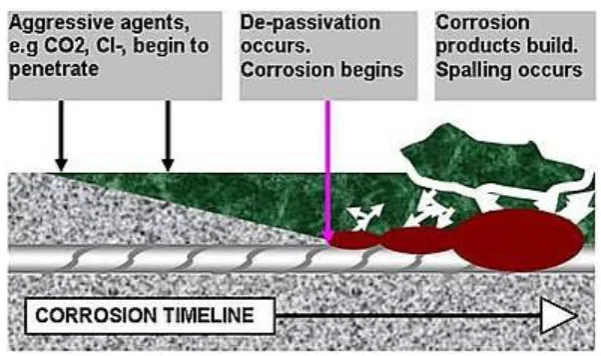
ingress of aggressive agents particularly chloride and sulphate ions can led to
corrosion of reinforcing steel bars, therefore will cause a reduction in strength and the
service life of concrete structures. In context to resist this type of premature
deterioration, concrete must be proportioned to achieve high durability in an
aggressive environment.
Interestingly,
the
current
construction
specifications
and
codes
includingnormal vibrated concrete exposed to marine or aggressive environments are
only emphasize on the quality of the concrete mixture itself. The construction
specifications are including recommendations regarding the water to cement (w/c)
ratio, minimum cement content, and concrete cover thickness, however the effect of
construction factors is not highlighted. For example, the American Concrete Institute
(ACI) Committee 357 on Design and Construction of Fixed Concrete Offshore
Structures (ACI Committee 357 1994) has recommended that concrete with a
maximum w/c ratio of 0.45, a minimum cement content of 400 kg/m
3and minimum
cover thickness of 50 mm, can be used for marine structures. Similar requirements are
also specified in other codes such as British Standards and European Codes (British
Standard, BS 8110, 1985 and European Pre-Standard, ENV-206 1992). It should be
noted that the in-situ quality of such concrete is not solely a function of its w/c ratio,
cement content, cover thickness, but also a function of the construction factors.
Essentially, the durability of concrete structure is proven by the production of a
workable concrete mixture, its effective consolidation, and the application of proper
curing techniques. The latter is sometimes very difficult to specify due to the lack of
skilled workers and variations in construction techniques among the construction
companies.
the ability to resist aggressive agents. Consequently, it will reduce the concerete’s
serviceability.
A large number of concrete structures has been built in accordance with recent
codes with exposed to aggressive environments have showed considerable
deterioration before the end of their service lives due to poor construction practices.
Because the specifications and codes for vibrated concrete do not account for possible
effects of construction practices, it has been postulated that without adequate
compaction and curing, even correctly proportioned concrete will often not be as
impermeable as expected on the basis of its mixture composition.
1.2
Problem Statement
The durability of concrete has become a major concern in the construction industry. It
is also known that aggressive environments are the major factor affecting the
durability of concrete (Zuquan et al., 2007). The deteriorative of concrete is the resuted
from an ineffectiveness durability that might cause by physical, mechanical and
chemical factors and of these can be induced by external and internal factors to the
concrete structure. Physical and chemical deterioration are external influenced from
climate such as weathering, variation of temperature, wetting and drying cycles and
exposure to aggressive environment (Hekal et al., 2002; Mohr et al., 2005). Chemical
deterioration is usually determined by the rate at which concrete is decomposed as a
result of chemical reaction. The aggressive chemicals are greatly affected the concrete
durability which include chlorides and sulphates with their related cations.
Degradation consists of dissolution of calcium and hydroxide ions out of the
matrix when chloride dissolved in water, which causes an increase in porosity and
transport properties; and subsequently, affecting the strength and permeability of
concrete (Rozière et al., 2009). According to Bertolini et al. (2004), the increment of
coal bottom ash content in concrete shows a decreasing trend in the porosity of
concrete. As the degradation of chloride-water dissolved caused an increase in
porosity, potentially the coal bottom ash will be employed in the concrete due to pore
refinement. This process is vital to produce good quality of durable concrete. Calcium,
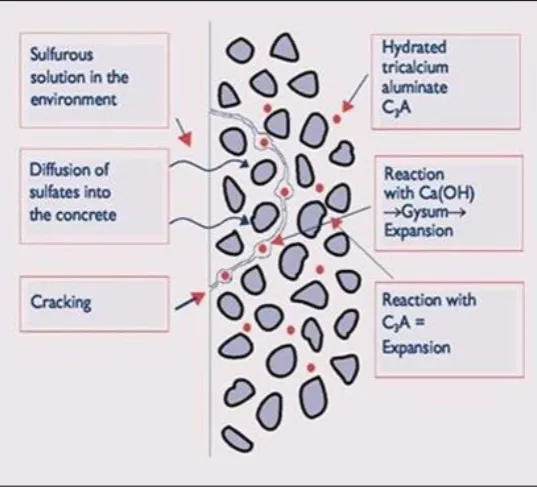
sodium, magnesium and ammonium sulphates may involve forming a progressive loss
of strength and loss of mass due to loss of cohesiveness in the cement hydration
products. Gypsum formation leads to reduction of stiffness and strength, then by
expansion and cracking. If concrete cracks, its permeability increases and the
aggressive chemical solution penetrate more easily into the interior, thus accelerating
the process of deterioration (Bassuoni & Nehdi, 2009; Monteiro & Kurtis, 2003).
proportion which contains extra fine particles content and fewer amounts of coarse
aggregates (Dubey & Kumar, 2012). On the other hand, self-compacting concrete was
developed to respond to the need for a self-compacting concrete with improved
durability. Therefore, the use of self-compacting concrete can minimize or even
eliminate the detrimental effects of poor construction practices. The combination of
the benefits of coal bottom ash and self-compacting concrete can provide possible
durability advantages to the concrete structures in aggressive environments. There are
many issues which are lack of knowledge in its characteristics relation to the behaviour
mainly in self-compacting concrete. Hence, further research about the self-compacting
concrete expose to aggressive environment, characterization of self-compacting
concrete using laboratory test methods, and construction issues related to
self-compacting concrete are practical.
1.3
Research Objectives
This research is involves experimental study on self-compacting concrete. The aims
of this research are:-
i.
To investigate the physical and mechanical properties of
self-compacting concrete incorporating coal bottom ash with different
percentage of sand replacement and optimum content of coal bottom as
sand replacement.
ii.
To investigate the microstructure of self-compacting concrete
incorporating coal bottom ash with different percentage of sand
replacement.
1.4
Research Significant
Self-compacting concrete signify the most important progress in concrete knowledge
for over decades. This type of concrete has been designed to make sure sufficient
compaction process and to ease the progress of concrete placement with complex
geometry areas and fully reinforced. The process is complicated or impracticable to
use mechanical compaction for fresh concrete. As the durability of concrete turns out
to be a crucial issue in exploring the potential cementitious materials, a good
compaction by expert workers was essential to get durable concrete structures
(Bouzoubaa & Lachemi, 2001; Zhu & Bartos, 2003).
Even there are advantages of utilization of self-compacting concrete; this type
of high performance concrete has not attracted local attention although it has been
introduced for the last 10 years especially in Malaysia. Mewah & Ehsan (2002)
acknowledged that the delivery of high strength concrete by the local ready mix
industry is not a current problem. There are many benefits from spectaculafdesin and
complex engineering whereby numerous high-rise structures have been constructed
such as Petronas Twin Tower and Menara Telekom Malaysia. The Menara Telekom
is a headquarters office that has been recognized as a noticeable project which
composed of excellence concrete technology and the use of high strength concrete.
self-compacting concrete is by using mineral admixtures or waste materials such as
limestone powder, natural pozzolans, ground granulated blast furnace slag and fly ash.
Malaysia is a country that hav hot and humid climate all the year, with an
average temperature of 27°C (80.6 °F) and small variability in the annual temperature.
The climate is characterized by high temperature and humidity with moderate
fluctuations in seasonal temperature and humidity. Conventional concrete admixtures
is greatly examined which subjected to aggressive environment such as sodium
chloride (NaCl), sodium sulphate (Na
2SO
4) solution and seawater. However, the
knowledge on exposure of fresh or harden self-compacting concrete to the harsh
condition are still limited Therefore, it is necessary to carry out a study on
self-compacting concrete using local admixture materials incorporating suitable
superplasticizer subjected to aggressive environment with wetting and drying cycles
that signify the region in Malaysja. Moreover, a preliminary standard mix design
nomograph of self-compacting concrete incorporating bottom ash will be produced
for future references.
1.5
Scope of Works
This study is focusing on the material performance of the self-compacting concrete.
The performance analysis were involved studying the characteristic of raw material of
coal bottom ash in terms of physical and mechanical properties to investigate the
durability and performance of self-compacting concrete containing coal bottom ash
with different proportion of fine aggregate replacement subjected to aggressive
sodium chloride, sodium sulphate solution and seawater with wetting and drying
cycles.
180 days to study the effects of sodium chloride (NaCl), sodium sulphate (Na
2SO
4)
and seawater on the durability of self-compacting concrete containing coal bottom ash
with repetitive wetting and drying cycles including concrete exposed with normal
water. The selection of chemical is based on dominant chemicals in marine
environment, as the most is chloride, sodium and sulphate.
1.6
Structure of Thesis
The thesis consists of eight chapters:
Chapter one discusses on the background of the study with a short overview
of the current situation, research and problem statement. Several research needs are
also identified. The objectives and scope of study are also presented.
Chapter two presents a background of the use of pozzolanic materials, its
characteristic and performance in concrete durability. The description on various
chemical solutions including chloride solution, sulphate solution and aggressive
seawater related to concrete were discussed.
Chapter three provides an overview of the research program and approach,
describes the preparation and testing of materials, discusses the selection and testing
of constituent materials, and highlights the procedures for experimental work,
apparatus and mixture design.
Details of finding and data about self-compacting concrete are presented in
chapter four. It has included various degrees of sand replacement on coal bottom ash
and different water-cement ratios on self-compacting concrete. Fresh and hardened
properties of concrete are analysed and presented in an appropriate forms. The chapter
discusses the significance of these results and determines the optimum percentage of
coal bottom ash incorporated in concrete. Additionally, mix design nomograph are
presented base on the results.
In chapter five, the influences of different replacement levels of coal bottom
ash to normal sand exposed to sodium chloride and sodium sulphate solution with
wetting and drying cycles are described. All results were presented in this chapter.
Chapter six discusses the performance of self-compacting concrete with coal
bottom ash subjected to seawater. Moreover, the chapter focuses on the exposure of
seawater from wetting and drying cycles and highlights the importance of these
results.
LITERATURE REVIEW
2.1
Introduction
Concrete is a man-made construction material and has been extensively used in the
world (Gambhir, 2006). According to Mehta & Monteiro (2006), concrete is made of
the basic ingredients of Portland cement, aggregates and water. Nowadays, the rapid
development in all areas of civil engineering has led to increase demand for concrete.
As a result many researchers have directed their attention towards developing concrete
that suits the contemporary requirements and proficient in the aggressive environment.
The concrete technology has been developing along with problem arises. This chapter
discusses the effect of aggressive environment and factors that influence the formation
of the crystallizing salt in the concrete structures. A general literature review of
research carried out on method for aggressive environment simulation and material of
coal bottom ash in self-compacting concrete are also presented.
2.2
Salt attack in concrete material
that may be carried in the various surrounds of the material. When the water is
evaporated through dryer area, the salt residuals are deposited in the pores of the
concrete material. This reoccurrence of wetting and drying of the pores will eventually
cause a slow rise of salt in the pores and capillaries of the material resulting in a more
concentrated salt remnant. At this time, the crystals have formed. As the crystals grow,
micro-particles from the mortar will expand, thus exerting internal forces and stresses.
The internal forces exerted by the salt crystals exert may lead to the eventual damage
to the concrete material.
2.3
Factors affecting salt attack on concrete
[image:37.595.115.516.431.517.2]The deterioration of concrete due to salt attack is considered as a complex problem
and it depends on many parameters related to materials and condition of exposure.
This can be found from Table 2.1 below.
Table 2.1: Parameters related due to salt attack
Dependence Parameters
Material properties Cement types and composition, mineral admixture type, water binder ratio, degree of hydration and curing conditions
Hydrated concrete properties Pore structure, permeability, diffusivity, mechanical properties
Exposure conditions Temperature, type of ions and concentration
2.3.1 Cement type and composition
The salt attack caused by sulphate is depends on availability of Ca(OH)
2and C
3A in
the hydrated concrete, hence chemical composition of binder have an important role
in the salt attack resistance. Cement that contains low C
3A has good sulphate
resistance. Sulphate Resisting Portland Cement (SRPC) has less content of C
3A,
therefore it is protected under sulphate attack. Too high cement content in the concrete
may cause increasein the sulphate resistance (Rodrıguez-Camacho & Uribe-Afif,
2002). Modern cement is made for rapid development of strength in which results to
an increase of tricalcium silicate (C
3S) contentsin the cement. The susceptibility to
the hardened cement which resulted from the increased of C
3S (Sancak, & Özkan,
2015).
Blending of mineral admixtures such as ground granulated blast furnace slag
(GGBFS), fly ash (FA), silica fume (SF) in cement increases resistance of concrete to
sulphate attack. The superior performance of blended cement over plain cement
concrete is attributedby the pozzolanic reactions that consumed the calcium hydroxide
and the reduction of the plain cement quantity in total binder will dilute the calcium
aluminate hydrates phase. Hekal et al. (2002) reported that the hardened cement paste
that contained 40% GGBFS shows a significant improvement in the sulphate
resistance.
2.3.2 Water binder ratio
Water to binder ratio is the key factor of the mechanism strength in the development
of concrete. The concrete with lower water/binder ratio is commonly denser and have
a higher strength. However, Prasad
et al. (2006) stated that the assumption is not
always true for the concrete with low water/binder ratio to have a better sulphate
resistance. Al-Amaudi et al. (1995) investigated this effect and found that the lower
water/binder ratio may enhance the strength reduction. The possible reasons for such
behaviour could be due to sulphate attack that is not physically in nature hence it is
independent from permeability of mix. Furthermore, the expensive product formed
from the reaction between the cement and sulphate salts are not well accommodated
in the finer pore structure of low water/binder ratio mix. Thus dense concrete mixtures
have aggravated the deterioration process which attributed from the sulphate attack.
2.3.3 Curing condition
concrete. Osborne (1999) reported that the beneficial effects of short initial air curing
are includingcontinuous moist curing, a long-term sulphate resistance of plain and
blended concrete. The possible reason for such behaviour may be due to the initial dry
curing that has reduces the calcium hydroxide concentration in the concrete surface
zone. In addition, the initial dry curing have caused minor carbonation and reduced
the availability of calcium hydroxide for the salt attack.
2.3.4 Type of sulphate and concentration
Deterioration rate of concrete under salt attack also depends on the type of sulphate.
Al-Amaudi
et al. (2002) presented the results of sodium, magnesium, and mixed
sulphate solution attack on mortar and concrete specimen. The strength reduction was
almost comparable in both environments up to about 100 days of exposure and
subsequently the reduction is spread in the magnesium sulphate for all types of
specimens. The expansion data indicates that the sodium sulphate environment has
caused more expansion on all mortar specimens. Results showed a superior
performance of blended cement in the sodium sulphate solution. In mixed sulphate
environment, the mode of sulphate attack is mainly controlled by magnesium sulphate
due to the generation of magnesium hydroxide (brucite). The solubility of magnesium
hydroxide (its solubility is 0.01 g/litre compared to 1.37 g/litre for calcium hydroxide)
and it’s saturated solution with the ph about 10.5 will cause destabilization of both
ettringite and calcium silicate hydrate. Therefore, the formation of ettringite is
significantly hindered in such environment and the deterioration of concrete is
attributed mainly to the formation of gypsum.
2.3.5 Presence of chloride
The chloride ions are inadvertently associated with the sulphate attack in the ground
water or marine environment on the concrete. It is commonly known that the chloride
ion reacts with the hydrates of cement and will form the Freidel’s salt that does not
have any harmful effects on the concrete. However, when chloride contents in the
concrete has reach more than the threshold value, the protective alkaline layer of steel
reinforcement in the concrete structure will be broken. Later, the presence of oxygen
and humidity will cause corrosion of of the steel reinforcement. The presence of
chloride in the sulphate solution will produce effects to the deterioration of concrete
under the sulphate attack. Al-Amoudi
et al. (2002) studied this effect on plain and
blended cement mortar specimens, through the specimens exposure to 2.1% SO
4solution and 2.1% SO
4+ 15.7% Cl solutions for 365 days. Deterioration was measured
on the basis of the strength reduction and expansion of specimens. Resultshows that
the deterioration was relatively more intense in the specimen that exposed to pure
sulphate solution compared to those that exposed to sulphate-chloride solution.
The increase of the sulphate resistance in the cement with the presence of
chlorides is attributed to (i) increased solubility of calcium aluminate hydrate phase
leading to calcium sulpho-aluminate crystallization i.e. ettringite formed in a
non-expensive form, (ii) a decrease in the lime concentration in the pure solution leading
conversion of the high insolubility of the basic aluminate hydrate phase to soluble low
basic compounds thus producing ettringite of liquid phase in the non-expensive forms,
(iii) a transformation of aluminate hydrate phase into chloro-aluminate phase, thereby
reducing the quantity of ettringite formed, (iv) the rate of diffusion of chloride ions is
much higher than the sulphate ions which allows the chloride to react with C
3A to
form calcium chloro-aluminate hydrate,this will result the quantity of C
3A to be
available for sulphate ions to react and the form ettringite will be reduced.
2.3.6 Temperature of exposure
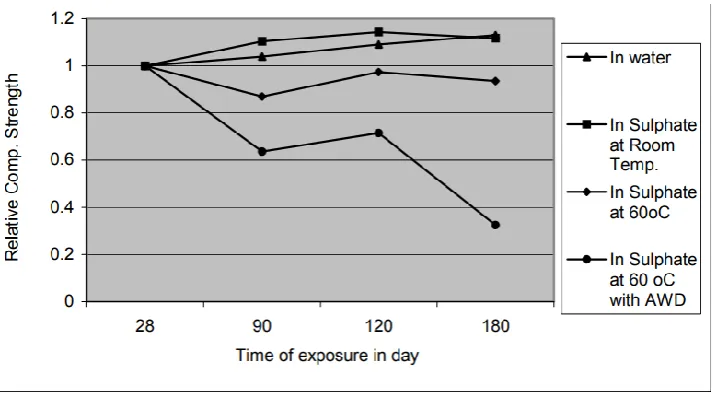
environment with drying-immersion cycle. The increase in temperature of sulphate
solution has accelerated the sulphate attack on all types of specimens of mortars. The
drying-immersion from the cyclic process at 60°C has accelerated the rate of sulphate
attack and this can be considered as an accelerated method to evaluate sulphate
resistance. Changes in compressive strength of ordinary Portland cement mortar cubes
over time at different exposure conditions is shown in Figure 2.1. The curve shows
more reduction in strength at higher temperature. Hence sulphate attack is more
aggressive in the summer or in a hot climatic area.
Figure 2.1: Effect of physical condition of exposure (Hekal et al., 2002)