International Journal of Emerging Technology and Advanced Engineering
Website: www.ijetae.com (ISSN 2250-2459,ISO 9001:2008 Certified Journal, Volume 3, Issue 7, July 2013)
285
Image Processing (IP) Through Erosion and Dilation Methods
Prof. sagar B Tambe
1, Prof. Deepak Kulhare
2, M. D. Nirmal
3, Prof. Gopal Prajapati
41MITCOE Pune
2H.O.D. Computer Dept., 3Student , CIIT, Indore 4
CIIT, Indore
Abstract –The regulated morphological transforms still have some redundancies, though it takes more memory space and time for processing and searching the multimedia data. In this paper, the redundancies that are present in the regulated morphological transform are removed. To store the image in the for m of reduced regulated morphological transforms requires less memory space, less processing and searching time. Morphological processing is constructed with operations on sets of pixels. Binary morphology uses only set membership and is indifferent to the value, such as gray level or color, of a pixel. We will examine some basic set operations and their usefulness in image processing.
A standard morphological operation is the reflection of all of the points in a set about the origin of the set. The origin of a set is not necessarily the origin of the base. Shown at the right is an image and its reflection about a point with the original image in green and the reflected image in white.
Dilation and erosion are basic morphological processing operations. They are defined in terms of more elementary set operations, but are employed as the basic elements of many algorithms. Both dilation and erosion are produced by the interaction of a set called a structuring element with a set of pixels of interest in the image.
Keywords- redundancies; dilation; erosion; opening; closeing;
I. MORPHOLOGICAL OPERATIONS
They can be obtained by techniques like Morphological Transform [MST], Hilbert Morphological Transform [HMST], Regulated Morphological Skeleton Transform [RMST] and others. Out of which MST and an improvement over it called as RMST is described in following paragraphs. In the RMST, we can restrict the morphological operations by using strictness parameter, s. In additional to this, we can remove the redundant points, which are present in the MST and RMST that is called as Reduced Regulated Morphological Transform [RRMST]. And the obtained reduced skeleton, which will be having fewer points as compared to MST and RMST. Most important part, which takes less time compared to other methods, is the matching. For matching of two images, we need more time, but by using of given images, that matching will be possible in less time. This gives the results as per our query for matching from the database.
By adding noise in the images, their MST, RMST and RRMST get affected.
II.MORPHOLOGICAL TRANSFORM [MT]
To obtain the shape of image the mathematical morphology plays an important role. It is also known as Mathematical Transform (MT). There are total four morphological operations i.e. erosion, dilation, opening and closing. Among these only dilation and erosion are most important to obtain the point. Erosion and dilation were defined for sets only, but they are now extended to
functions. Since, this paper deals with GrayScale images
only. Erosion Θ shrinks and dilation ⊕ expands the shape
of image.
A.DILATION:
The opening off set X by structuring element B Is
denoted an X ⊕ B ,is defined.
X ⊕ B = X + b ={ x + b : x ∈ X &b ∈ B}
If X is any gray scale shape and B is symmetric structuring element. The output of dilation is the set of translated points such that translate of the reflected
structuring element has a non-empty intersection with X.
This equation is based on obtaining the reflection of B about its origin and shifting this reflection by b. this dilation of X by B then is the set of all displacements, b, such that x and b overlap by at least one element.
One of the simplest applications of dilation is for bridging gaps. The structuring element has used for repairing the gaps. The gap shave been bridged.
B. EROSION:
The opening off set X by structuring element B is denoted a X Θ B, is defined.
X Θ B = X − b = { z : ( B + z ) ⊆X }
If X is any gray scale shape and B is symmetric structuring element. The output of erosion is the set of translation points such that the translated structuring
element is contained in the input set X. This equation
indicates that the erosion of X by B is the set of all points b
International Journal of Emerging Technology and Advanced Engineering
Website: www.ijetae.com (ISSN 2250-2459,ISO 9001:2008 Certified Journal, Volume 3, Issue 7, July 2013)
286
One of the simplest uses of erosion is for eliminating irrelevant detail sin terms of size from the grayscale image.
The opening off set X by structuring element B is denoted a XoB ,is defined.
Where X is any gray scale shape, B is symmetric structuring element. As the dilation expands an image and erosion shrinks it. The opening operation uses both operations. Opening generally smoothes the contour of an object, breaks narrow isthmuses, and eliminates thin protrusions. Thus the opening X by B is the erosion of X by B followed by a dilation of the result by B.
C. CLOSING:
The closing off set X by structuring element B is denoted a X
Where X is any gray scale shape, B is symmetric structuring element. Closing also tends to smooth sections of contours but as opposed to opening. It generally fuses narrow breaks and long thin gulfs, eliminates small holes and fills gaps in the contour. Thus the closing X by B is simply the dilation of X by B followed by erosion of the result by B.
III. BASIC ELEMENT OR OPERATION
In above equations, the set B is commonly referred to as the structuring element in all morphological operations. The structuring element is divided into two parts, flat and non-flat structuring element. The examples of flat structuring element are diamond, disk, line, octagon, square, etc. and the example of the non- flat structuring element is ball. It is also called as kernel.
IV. REGULATED TRANSFORM (RT)
Considering the fitting interpretation of the gray scale morphological erosion and dilation operations, it is possible to observe that are they are based on opposing strict approaches. The gray scale dilation collects shifts for which the kernel set intersection, whereas the gray scale erosion collects shifts for which the kernel set is completely contained within the object set without considering shifts for which some kernel elements are not contain within the object set.
Since the regulated morphological operations possess many of the properties of the ordinary morphological operations.
It is possible to use the regulated morphological operations in the existing algorithms that are based on morphological operations in order to improve their performance by using the strictness parameter. These
fundamental regulated morphological operations can be
used for obtaining and reconstruction of gray scale shapes are defined.
V. ELIMINATION MORPHOLOGICAL REDUNDANCY
The morphological is a compact error-free
representation of images. This property is useful for lossless image data compression.
However, the point is a redundant representation. That is, some of its points may be discarded without affecting its error-free characteristic. In some applications, such as coding, no importance is attributed to the shape or its connectivity, but an importance to its ability only to fully represent images in a compact way. It is interested in such applications to remove redundant points, so that there presentation contain as few possible points.
Maragos and Schafer defined in a minimal as being any set of points from the, which fully represents the original image. It does not represent original image, if any of its points is removed. A minimal always exists since in the worst case it is the itself. And there can be more than one minimal for an image.
Maragos and Schafer propose in an algorithm for finding a minimal from the point representation of a binary image. However, this algorithm is not fully morphological and therefore cannot be effectively implemented on a parallel machine, in contrast to the morphological itself, which is amenable to a parallel implementation. A fully morphological algorithm for finding minimal could take advantage of the parallel properties of the morphological operations and perform the computation more effective way.
The reduced has fewer representation points than the regulated and it is also error-free. It is not a minimal but it is obtained by morphological operations only.
Maragos and Schafer propose in an algorithm for
finding a minimal skeleton from the skeleton
International Journal of Emerging Technology and Advanced Engineering
Website: www.ijetae.com (ISSN 2250-2459,ISO 9001:2008 Certified Journal, Volume 3, Issue 7, July 2013)
287
Saprio and Malah defined in an essential point of the skeleton as any skeleton point that cannot be removed from the original skeleton without affecting its error-free property. The essential points are contained in any minimal skeleton, although usually are not sufficient for exact reconstruction. The set of essential points is unique and it is typically the major part of the minimal skeletons (90% and more). So that it is better to search first the essential points of skeleton and then the remaining minimal skeleton points. The essential points of the shape in Figure 1 (a) are shown in Figure (d). And they are present in the two minimal skeletons showing the figure.
The reduced skeleton has fewer representation points than the regulated skeleton and it is also error-free. It is not a minimal skeleton but it is obtained by morphological operations only.
VI. VARIOUS PART OF REDUNDANT
Let us consider a collection of subsets {Tn} which represents scale image X in the following way
Where ⊕ stands for morphological dilation, and B is a
pre-defined structuring element. The parameter n may assume all the non-negative continuous values (if X and B are continuous sets) or it may assume only discrete values n=0, 1, (for X and B which are both continuous or both discrete).
A point t belonging to the subset of order n represents an element translate.
VII. THE GENERIC APPROACH TO OBTAIN REDUCED
DATA
The approach used to remove redundant points from the skeleton was first to calculate the skeleton and then to apply a reduction algorithm move the redundant points a
sin andHowever, they itself is a partial reduction process,
and with following considerations, it is define as follows. If
the subsets Sn would have been defined as Sn = X Θ nb,∀
n, then the exact reconstruction property for Tn = Sn would be still satisfied, but this “skeleton” would contain too
many points. In fact, So itself would then be equal to X.
Instead, the sets [X Θ nb]° (∆ n)n) B of redundant points are removed from X Θ nb for all n in the definition of the skeleton so that the compact representation is obtained. However, we can remove only “Single–Element Redundancy in this way.
Now, we are going to remove as many redundant points as possible during the skeleton process, which is fully morphological. So that, a more efficient error-free decomposition than the regular skeleton can be obtain by morphological operations only.
If we choose X° (n + ∆n) B to be the “redundant region”,
then we obtain a Reduced Skeleton with no “Future-level
Redundancy
[image:3.612.312.540.205.257.2]
Fig .1 structural view 1
[image:3.612.345.551.307.625.2]International Journal of Emerging Technology and Advanced Engineering
Website: www.ijetae.com (ISSN 2250-2459,ISO 9001:2008 Certified Journal, Volume 3, Issue 7, July 2013)
[image:4.612.62.271.140.514.2]288
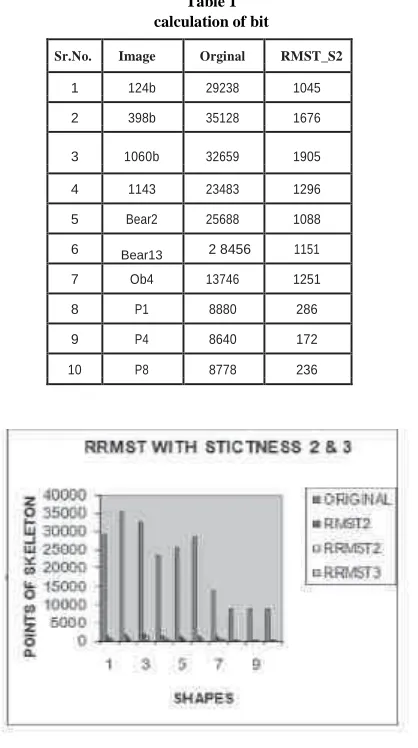
Table 1calculation of bit
VIII. CONCLUSION
We have discussed a number of shape similarity properties. More possibly useful properties are formulated in It is a challenging research task to construct similarity measure with a chosen set of properties. We can use a number of constructions to achieve some properties, such as remapping, normalization, going from semi-metric to metric, defining semi-metrics on orbits, extension of pattern space with the empty set, vantageing, and imbedding patterns in a function space.
In the present work the different approaches for obtaining morphological skeleton are observed. In the first approach ordinary morphological operations are sensitive to noise and small intrusions or protrusions on the boundary of shapes.
The skeletons have the scope to regulate by using strictness parameter.
In the second approach, by using regulated
morphological operations, the regulated morphological skeleton transform achieved. By using a strictness parameter greater than 1 the number of shape elements that are removed at each iteration is reduced, and so a finer progress of the process has been obtained Finally the regulated morphological skeleton transform still has scope to reduce the redundancies. These redundancies are removed from regulated skeleton transform and minimal skeleton achieved.
The results conforms that the reduced regulated transform has minimal points as compared to the regulated skeleton transform
REFERENCES
[1] R. Kresch and D. Malah, “Morphological Reduction of Skeleton Redundancy”signalprocessing38(1994)143-151.
[2] R. Kresch and D. Malah, “Morphological Multi-Structuring Element Skeleton and its Application”, Proc. Of the International Symposium on Signal Systems and Electronics, Paris, September 1992,pp.166-169.
[3] J. Goutsias and D. Schonfeld, “Morphological Representation of Discrete and Bianry Images”, IEEE Trans, Signal Processing, Vol.39,No.6,June194,pp.1369-1379.
[4] J. Serra, ed., Image Analysis and Mathematical Morphology, vol. 2,TheoreticalAdvances,AcademicPress,NewYork,1988.
[5] Gady Agam and Its'hak Dinstein, “Regulated Morphological Operations”,PatternRecognition32(1999),pp. 947-971.
[6] D. Sinha. E.R. Dougherty, Fuzzy mathematical morphology, J. Visual Commun. ImageRepresentation3(3)(1992)286-302. [7] J. Bloch, H. Maitre, Fuzzy mathematical morphology ,Ann. Math.
Artificial Intell. 10(1994)55-84.
[8] P. Kuosemanen, J. Astola, Soft morphological filtering, J. Math. ImagingVision5(1995)231-262.
[9] J. PitasandA. N. Venet sanopoulos, Order statistic sin digital image processing, Proc. IEEE80(12)(1992)1893-1921.
[10] G.Agam, i. Dinstein, Adaptive directional morphology with application to document analysis, in: P. Maragos, R.W. Schafer, M.A. Butt (Eds.), Mathematical Morphology and its Applications to Image and Signal Processing, Kluwer Academic Publishers, Dordrecht,1996,pp. 401-408.
[11] J. Serra, ed., Image Analysis and Mathematical Morphology, AcademicPress,NewYork,1982.
[12] P.E. Trahanias, “Binary Shape Recognition using the Morphological Skeleton Transform”, Pattern Recognition,Vol. 25, No. 11,pp. 1277-1288,1992.
[13] A. K. Jain, Fundamentals of Digital Image Processing, Prentice-Hall ,Engle wood Cliffs, New Jersey(1989).
[14] Petros A. Maragos, “Morphological Skeleton Representation and Coding of Binary Images”, IEEE Trans. ASSP, Vol. 34, No.5, pp. 1228-1244,October1986.
[15] L. Calabi, “A study of the skeleton of plane figures,” Parke Mathematical Labs, Carlisle, MA,Rep. SR2-60429,June1965.
Sr.No. Image Orginal RMST_S2
1 124b 29238 1045
2 398b 35128 1676
3 1060b 32659 1905
4 1143 23483 1296
5 Bear2 25688 1088
6 Bear13 2 8456 1151
7 Ob4 13746 1251
8 P1 8880 286
9 P4 8640 172
International Journal of Emerging Technology and Advanced Engineering
Website: www.ijetae.com (ISSN 2250-2459,ISO 9001:2008 Certified Journal, Volume 3, Issue 7, July 2013)
289
[16] P. A. Maragos and R. W. Schafer, “Aunification of linear, median, order-statistics and morphological filters under mathematical morphology,” in Proc. IEEE Int. Con5 Acoust., Speech, Signal Processing T ampa FL ,Mar. 1985,pp. 34.8.1-34.8.4.