International Journal of Emerging Technology and Advanced Engineering
Website: www.ijetae.com (ISSN 2250-2459, Volume 2, Issue 5, May 2012)21
Five Level Cryptography in Speech Processing using Multi
Hash and Repositioning of Speech Elements
Miss. Divya Sharma
Student, Department of Computer Science & Engineering, Rayat and Bahra Institute of Engineering &.Bio-Technology, Sahauran, Near Kharar, Distt. Mohali, Punjab, India
Abstract— This paper proposes a cryptography
technique for audio to increases the security of audio data meant to be transferred on an insecure medium. The audio is recorded in real time using microphone which is applied with five level of encryption which creates a cipher signal which is routed through an insecure line for the recipient who on receiving that signal decrypts the cipher signal in order to retrieve the signal back. The signal achieved in the proposed technique after decryption at the recipient end is a replica of the original signal which was meant for encryption. This cryptography process can take place for varied duration of audio data which can be recorded in real time system. The encrypted signal when played consists of hisses and clicking noise which holds no meaning to the third party who has intercepted that signal.
Here encryption and decryption is applied in a sequential manner on the audio file. This technique is reliable in regenerate the audio data, which was previously encrypted by the sender. The proposed technique hides the audio data such that even if one level of encryption is broken the rest of the levels will still be there to prevent the actual audio data getting discovered by a third party. In the proposed technique two processes take place -encryption and decryption. This proposed technique is capable to regenerate the audio which is encrypted. It guarantees a highly accurate communication between the sender and receiver.
Keywords— Cipher text, Cryptography, Decryption,
Encryption, Key tables, Plain text, Speech processing.
I. RELATED WORK
[8] Bismita suggested that encryption algorithms are used to provide security to multimedia data. In this paper, A.E.S. (Advance Encryption Standard) encryption is applied on the quantized audio data which is performed before the Huffman‟s entropy coding. [1] Brandau in this paper presents a voice encryption system which was programmed as a real-time software application. The application uses a frequency scrambling technique on an audio signal taken from the computer microphone input and plays it scrambled back to the speakers, or other way around to descramble the signal. [2] Aaron proposes a technique on matrix scrambling which is based on random function, shifting and reversing queue in circular queue. It gives statistical analysis, sequence random analysis and sensitivity analysis to plaintext and key on the proposed scheme.
[3] Yusuf adriansyah proposes that the audio data be broken down to its samples and they are distributed among shares. If an eavesdropper plays one share in the media player, he or she will only hear meaningless hiss sound, or probably annoying noise sound. [4] Daniel Socek proposed "audio cryptography scheme" (ACS) is perfectly secure and easy to implement. This technique relies on the human auditory system for decoding. "Audio sharing schemes" (ASS) proposed earlier were based on disguising secret binary message with a cover sound. [6] Peter Hyun-Jeen Lee, Udaya Parampalli proposed an efficient Certificateless Encryption scheme which is optimized for Optimized Link State Routing based Mobile Ad Hoc Network environment. [7] Fabian Monrose, Michael K. Reiter, Qi Li, Susanne Wetzel propose a technique to reliably generate a cryptographic key from a user‟s voice while speaking a password. In this technique the key resists cryptanalysis even against an attacker who captures all system information related to generating or verifying the cryptographic key.
II. INTRODUCTION
The Internet and its most popular application, the World Wide Web, are completely public systems. Unless one takes precautions, any information sent over the Internet is potentially audible and visible to all. Sending an e-mail, for example, is like posting a letter without an envelope: anybody can intercept the message and read its contents as it is routed towards its recipient. Similarly, when your web browser logs into a web server, anyone can listen in to the information that is exchanged between your computer and the remote server or any other computer.
International Journal of Emerging Technology and Advanced Engineering
Website: www.ijetae.com (ISSN 2250-2459, Volume 2, Issue 5, May 2012)22
Now a day‟s computers and mobile have become common medium for communication between people separated by long distances. The rapid advancements in method of communication across the world have motivated me to develop hash based five level cryptography for speech processing using multi repositioning of speech elements. To make sure that a secure communication takes place I have proposed this technique. If an eavesdropper plays the encrypted file, he or she will only hear meaningless hiss and clicks. Applying cryptography on audio file secures the audio file by converting it into a not understandable audio file which increases the security of the audio which can then transferred over the Internet. This file will hold meaning only to the person who has knowledge about the decryption process and access to the keys. The user can record the speech with the help of a microphone. Audio cryptography is best known for encrypting data which is to be sent to the receiver in the presence of the third party or on an insecure medium. This technique guarantees a lossless transfer of audio file from one computer to another. While in the decryption process, audio which is of equally good quality can be produced.
Audio cryptography is best known for encrypting data which is meant to be kept secure or has to be protected against tampering while being sent to the receiver in the presence of the third party.
Digitized voice — Analog sounds are recorded using a microphone. Microphone converts sound wave into electrical waves which still is analog. This analog electrical wave will be converted to digital audio inside an A/DC (analog to digital converter) chip inside your sound card.
There are two methods to change analog signal into digital signal, they are called Pulse code modulation (PCM) and Pulse density modulation (PDM). The one which is used to convert analog audio into digital audio is PCM. The PCM itself has three steps: sampling, quantizing, and coding as in [8].
Sampling — the time axis of an analog audio is sliced into many fixed intervals as in [8]. In my techniques, I took 16000 samples per second. The samples in the audio signal cannot be adjusted as they have been selected in the coding part.
Record 5 seconds of 16-bit audio sampled at 11025 Hz. The audio is sampled at rate of 8000 Hz generally a sampling rate of at least 2f Hz. So a sound having frequency of „f‟ Hz has „f‟ positive samples (above the time axis) and f negative samples (under the time axis) which here are 16000.
Quantizing — After sampling is done mostly quantization is done in the proposed system no quantization is done on the audio. I have conduct cryptography on the sample as a whole sample. There are various instantaneous values after sampling is done.
For these values, I have quantized them to a fixed number of allowed values. How many quantization levels are need? That is bit depth as in [8]. There are 2 kinds of bit depth commonly used, 8-bit and 16-bit. Using 16-bit means you have 256 quantization levels available, numbered from 0 to 255 where value 32768 is the central axis. Values above +32768 are positive samples and below −32768 are negative ones.
Coding — This is the last step. It takes place after all the planning has been done. Here the code for the proposed algorithm is written. The format used for recording the audio is 16-bit audio file. It is stored as signed words ranging from −32768 to +32767 which involve 16 samples per second. The audio will exist in the storage area using binary representation which is a default method and is applicable to all as in [8].
The block diagram of the proposed encryption system can be seen in figure 1. Here a speech signal is recorded with the help of a microphone this speech signal is put in a loop which will be run three times and during this time key table substitution process will take place where speech elements are substitute with the key table elements. In the next phase repositioning of the speech elements will take place. While in the fifth phase repositioning of elements will be done such that the end result is a cosine waveform and finally a new file is generated which will be meant to be transferred across the Intenet.
Figure1: Block Diagram of the proposed system.
International Journal of Emerging Technology and Advanced Engineering
Website: www.ijetae.com (ISSN 2250-2459, Volume 2, Issue 5, May 2012)23
A. Algorithm 1: ENCRYPTION
Encryption is done on each individual sample of audio file which is recorded. These values are sub divided further into individual units which are applied with encryption and then concatenated into one.
Record a speech signal for the specified time duration.
Challenge: It is important to make sure that the length of the audio file remains the same during the five steps of encryption. Any change in the length of audio file will indicate alternation to the audio file or the coding part for encryption process is not functioning right and a wrong audio file is generated which is not related to the original audio file in any manner or some discrepancy has taken place.
Phase 1: Substitution with the key table:
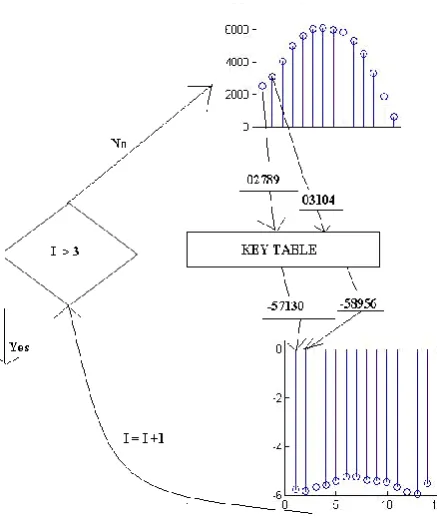
[image:3.595.346.501.251.539.2]During the substitution step the value of the audio file which is recorded is determined these values are interchanged with the values in the key tables. If the initial value is positive at certain position then it will become negative and vice- versa. Those values will be substituted with key table this process will be repeated three times which will indicate the first three phases of encryption on the whole audio file.
Figure 2: Diagrammatically represents the first three level of encryption
Phase 2: Interchange the values of the audio file:
[image:3.595.50.269.430.692.2]Here the interchange among the values in the audio takes place. In this phase, which is the fourth level of cryptography the value at the first position will remain the same while those on the second and second last get interchanged with each other while the value at the third position will remain the same. The same process will be followed for the rest of the audio file. This is explained clearly in a diagrammatic form below.
Figure 3: Diagrammatically view of fourth level of cryptography (Phase 2).
Phase 3: Splitting of the matrix so as to separate the addresses and values:
International Journal of Emerging Technology and Advanced Engineering
Website: www.ijetae.com (ISSN 2250-2459, Volume 2, Issue 5, May 2012)24
When there is no maximum left then the search for the minimum value begins. When minimum value is found it is placed in the value matrix while simultaneously the value is replaced with a zero in the original audio and same technique is followed for rest of the audio file. The addresses on which those values exist get stored in the address matrix.
After the encryption process the matrix‟s which consist of the duration of the audio file, the key table‟s, address and the value that existed on those location are concatenated into a single new matrix which is meant to be transferred from sender to receiver. When one listens to this audio file which is transferred amongst the user it sound like hisses or meaningless noise.
B. Algorithm 2: DECRYPTION
Challenge - It is to be made sure that the audio file which is received after encryption is of the same length as that of length which has been concatenated in the audio file which is being transferred. Make sure that the audio which is received contains all the elements (which in our case are the key table‟s, addresses and the values that exists on those addresses) in it and also the length of the audio. This can be seen with the help of the coding process. The different decryption phases are just the opposite of encryption.
III. EXPERIMENTAL RESULTS IN STEP BY STEP FORM
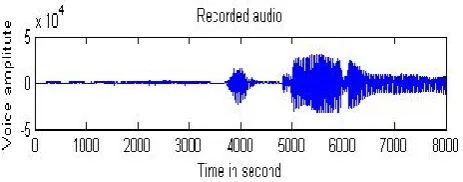
Step 1: Recording the voice on real time basis
[image:4.595.317.544.139.231.2]The user can record the audio with the help of a microphone which is shown in Figure 4. The duration of the audio recorded can vary according to the user requirement. In order to record an audio file of more duration user has to accomplish some hardware improvement in the project.
Figure 4: Recorded audio Step 2: Applying first level of encryption
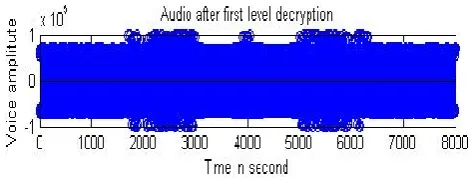
In the First level, the program will perform the first encryption on the recorded voice. In this step key table substitution method will be applied. Here I have substitute the value as that which is available in the key table. Example: replacing 4 with 8 in the audio file as exists in the key table correspondingly generating a new audio shown in Figure 5.
Figure 5: Audio after first level of encryption. Step 3: Applying second level of encryption
[image:4.595.315.548.351.439.2]I have repeated key table substitution in this second level which will further encrypt the voice. This will be applied on the audio file available after first level of encryption. This step a new file will be generated which will be nowhere near what the original audio was as shown in Figure 6.
Figure 6: Audio after Second level of Encryption Step 4: Applying third level of encryption
[image:4.595.315.548.545.640.2]The user can apply third level which will encrypt the audio which will be available after second level of encryption with the key substitution method once again. The output will be Figure 7.which will be a noise audio file.
Figure 7: Audio after Third level of Encryption Step 5: Applying fourth level of encryption
[image:4.595.48.280.550.641.2]International Journal of Emerging Technology and Advanced Engineering
Website: www.ijetae.com (ISSN 2250-2459, Volume 2, Issue 5, May 2012) [image:5.595.313.549.385.475.2]25
Figure 8: Audio after Fourth level of Encryption Step 6: Applyingfifth level of encryption
In the fifth level I have interchange the elements within the speech file such that a sinusoidal wave form will be generated when these interchanged elements will be concatenated into one. In this step of encryption I have combine the maximum and the minimum values in the speech file. Such that all value which is zero will be placed first in variable in Matlab, then those values will place next which hold the maximum values in the speech signal and simultaneously convert them into zero in the original speech file this will be performed until I have encountered a zero or negative value and concatenate them with the zero‟s. When negative values are encountered these will place the minimum value next in the new audio file which has been generated and simultaneously convert it into zero and apply the same until I have encountered a zero in the audio file which will be obtained after fourth level of encryption such that the end result in figure 9.
Figure 9: Audio after Fifth level of Encryption
Step 7: The final audio which is to be routed through the network or which is meant to be decrypted:
In this step a new audio file will be generated which is to be routed through the network will consist of. It will consist of length of recorded audio, keys, address, and values for the corresponding addresses which are to be routed through the network as they are combined into one and then routed through the network is shown in Figure 10.
Figure 10: Audio which is routed through the network
Step 8: Separate the audio file before decrypting the audio
Here I have separate the audio file which has been routed across the network to obtain the duration of the audio, the keys, the audio and their values which exist on those addresses.
Figure 11: Show the audio file which is to be decryption.
Step 9: Apply first level decryption on the encrypted audio
Decryption is the reverse of encryption. In the first level I have plot the corresponding values according to their addresses resulting in Figure 12.
Figure 12: Audio after First level of decryption
Step 10: Apply second level decryption on the audio available after first level decryption
In this level repositioning of speech elements will take place. This can be explained well by saying that audio value which exists at probably at the second position will be interchanged with that on the second last while the third and third last remain the same. While interchange takes place among the fourth and fourth last and so on. Figure 13 is achieved from figure 12.
Figure13: Audio after Second level of decryption. Step 11: Apply third level decryption
[image:5.595.49.280.460.536.2] [image:5.595.313.550.618.701.2]
International Journal of Emerging Technology and Advanced Engineering
Website: www.ijetae.com (ISSN 2250-2459, Volume 2, Issue 5, May 2012)26
Figure 14: Audio after Third level of decryption Step 12: Apply fourth level decryption
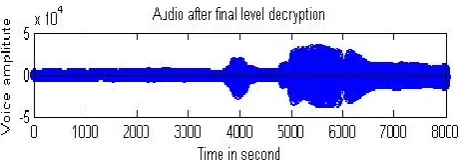
[image:6.595.49.280.486.566.2]In this level I will be substitute the values correspondingly to the key table.
Figure 15: Audio after Fourth level of decryption Step 13: Apply fifth level decryption
In this level I will be substitute the values correspondingly to the key table to obtain figure 15. This will be the final audio which sender will achieve after application of the whole decryption process and is meant to be heard.
Figure 15: Audio after Fifth level of decryption Step 14: Check the accuracy
Here I have check whether the audio which I have achieved after decryption is same as that which had been recorded. The accuracy is calculated with the help of P.S.N.R. the value of the P.S.N.R. is infinite as the audio achieved is the same as the audio which was recorded. This shows a lossless transfer between the receiver and sending party.
IV. CONCLUSION
The technique used in this paper guarantees a secure communication. In the proposed technique the audio file which is achieved after decryption is exact copy of the original file.
In case an eavesdropper changes the audio it can be detected with the length value which is sent along in the message. The audio which is sent through the network will be longer. In this paper, I have proposed a cryptography technique, which provides security to the audio data which is meant to be used for audio transfer within computers which are separated by long distances. Here, I have applied encryption on the whole audio data which will provide a very good security to our audio transmission. This paper suggests a technique which can be implemented in the online chatting and audio conferences, and can also be used in A.T.M. machines and for military purposes. With this technique I have achieved a loss less transfer between the sender and receiver on a single system.
V. ACKNOWLEDGEMENT
I would like to thank my sister and my mother, and father for their continuous support throughout this work. I would like to thank my sister for providing with her guidance and reviews on my work.
REFERENCES
[1] Chung J. Kuo and Maw S. Chen, “A New Signal Encryption
Technique and Its Attack Study”, International Carnahan Conference on Security Technology, 1991. Proceedings. 25th Annual 1991 IEEE.
[2] Fabian Monrose, Michael K. Reiter, Qi Li, Susanne Wetzel ,
“Cryptographic Key Generation from Voice”, Proceedings Of
The 2001 IEEE Symposium On Security And Privacy, May 2001.
[3] LV Jiuining, Luo Jingqing, Yuan Xuehua, “Digital Watermark
Technique of Speech Based on Wavelet Transform”, 7th International Conference on Signal Processing, 2004. Proceedings. ICSP '04. 2004.
[4] Daniel Socek, “General Access Structure of Audio
Cryptography” on2005.
[5] Peter Hyun-Jeen Lee, Udaya Parampalli, “ Secure
Communication in Mobile Ad Hoc Network using Efficient Certificate less Encryption”, IEEE Transactions On Dependable And Secure Computing, Vol. 3, No. 4, October-December 2006.
[6] SP.Venkatachalam, “Combining Cryptography With Biometrics
For Enhanced Security“, 18 Aug 2009 IEEE. International Conference on Control, Automation, Communication and Energy Conservation (INCACEC), 2009.
[7] Aaron Rosenfield , “Digital Cryptography Method” on June 6
,2010
[8] Yusuf adriansyah, “Simple Audio cryptography” on 2010.
[9] V.R.Vijaykumar, P.T. Vanathi, “Modified Adaptive Filtering
Algorithm for Noise Cancellation in Speech Processing”, International Conference on Multimedia Computing and Systems (ICMCS), 2011.
[10] Bismita Gadanayak. School of Computer Engineering. KIIT
University, “Encryption on MP3 Compression”, International Journal of Computer Applications ICIST (1):31-33, August 2011.
[11] Markus Albert Brandau, “Implementation of Real-Time Voice
Encryption System” on 2011.