
International Journal of Emerging Technology and Advanced Engineering
Website: www.ijetae.com (ISSN 2250-2459, Volume 2, Issue 3, March 2012)637
Survey on Distributed MAC Protocol for Power Saving in
Mobile Ad Hoc Network
Raghavendra Gowada
1, Prof. R.S. Havinal
21PG, Student M.B.E Society’s College of Engineering, Maharashtra 2Professor, CSE Dept., M.B.E Society’s College of Engineering, Maharashtra
2
Abstract—Wireless network adopts centralized transmission technique for transmission of power. But typical wireless ad hoc network do not have centralized coordinators for transmission of power, so it is difficult for a node in ad hoc network to predict the future transmissions of its neighbours. Thus instead of centralized transmission, distributed MAC protocols are widely adopted in wireless ad hoc network. We discuss various distributed MAC protocol for power saving.
Keywords— Power Control, Medium Access Control (MAC), IEEE 802.11, ad hoc networks, routing table (RT), Collision Avoidance Multiple Access (CSMA/CA).
I. INTRODUCTION
Wireless network is increasing popularly, many types of wireless services have become available, including cellular systems, satellite communication networks, and wireless local area networks (WLANs). Wireless LAN can operate in the infrastructure mode that lets to connect network devices within a fixed range or area of coverage. Wireless LAN that operate in infrastructure less mode lets to connect network devices without access points called wireless ad hoc network. In this type of network packets are directly sent and received by the intended transmitting and receiving stations, as long as the stations are within the range of one another [1].
Wireless ad hoc networks face challenges that are not present in wired networks. In wired networks, transmission errors typically occur at a low rate and interference among different communication flows is minimal. Collision detection is usually fast and easy in wired networks. Wireless communication, however, requires a shared transmission medium that is highly error-prone. Hence, in wireless communication, there is a much higher chance for collisions to occur. It is also more difficult to detect a collision in a wireless network [1].
Therefore, compared to a wired network, a wireless network requires a different and more complicated medium access control (MAC) layer. Wireless network adopts centralized transmission technique for transmission of power. But typical wireless ad hoc network do not have centralized coordinators for transmission of power, so it is difficult for a node in ad hoc network to predict the future transmissions of its neighbors. Thus instead of centralized transmission, distributed MAC protocols are widely adopted in wireless ad hoc network. The IEEE 802.11 standard consists of two components: point coordination function (PCF) and distributed coordination function (DCF). PCF is designed for centralized networks with an access point (AP), while DCF is a fully distributed scheme that is commonly used in ad-hoc wireless networks.
II. VARIOUS DISTRIBUTED MAC PROTOCOL
A. The Common Power Protocol [2]
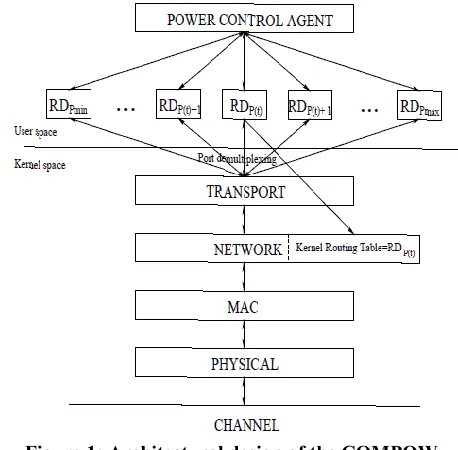
The essence of COMPOW protocol is to design an asynchronous distributed and adaptive algorithm which finds the smallest common power level at which the network is connected. The argument involves a joint solution for power control and routing. The next issue is how to seamlessly integrate the protocol in the network stack.
The solution employs parallel modularity at the network
International Journal of Emerging Technology and Advanced Engineering
Website: www.ijetae.com (ISSN 2250-2459, Volume 2, Issue 3, March 2012)638
If the optimum power level found, then RT is installed as the master routing table, which is used by the kernel.
This is done by the power control agent which takes
[image:2.612.54.283.215.440.2]input from the various routing tables and decides the optimum power level. This design of the COMPOW protocol is illustrated in the Figure. 1 [2]
Figure 1: Architectural design of the COMPOW protocol [2]
It is assumed that a manageable number of discrete transmit power levels in the design. This is true for the only commercially available wireless cards (at the time of our design) which support transmit power control, namely the CISCO Aironet 340 and the 350 series. The 340 series has four power levels (1, 5, 10 and 30 mW) and 350 has six power levels ( 1, 5, 20, 30, 50 and 100 mW).If there are cards with many discrete power levels then we can optimize the algorithm by maintaining routing tables at power levels close to the current optimum rather than at all power levels. Of course, we always have to maintain the routing table at the maximum power level. In the event of more vendors providing different cards having different transmit ranges and power levels, there needs to be a calibration equivalence of power levels between vendors, to enable the use of diverse hardware in a network. Such consensus is required for interoperability. The design of COMPOW involves employing parallel modularity that fits very nicely into the OSI networking stack.
We can use any routing protocol which pro-actively maintains routing tables. Since routing protocols operate in a distributed, asynchronous and adaptive fashion, COM- POW automatically inherits these features by virtue of its design. An alternative to maintaining multiple routing tables would be to use probes to flood the entire network to determine connectivity information. This would result in duplication of the work done by the routing protocol, would incur some additional overhead, would not be modular, and would result in a confusion of layers.
It might appear that running multiple routing daemons (six, in the case of Cisco Aironet 350 cards) simultaneously is a huge overhead. A simple calculation shows that it is not. Suppose each routing daemon broadcasts one hello packet of 1000 bytes every 5 seconds. This allows for about 10 entries (100 bytes per entry) in each incremental route update, which is enough for reasonable mobility rates and network size. Then, with six power levels, each node creates an overhead of 1200 bytes per second. With approximately six nodes within range which is reasonable from connectivity considerations, the net bandwidth consumed is 7.2K Bytes/sec or 60Kbits/sec. This is less than 1% of 11Mbps which is the available link bandwidth for 802.11b compliant cards (like Cisco Aironet 350). The overhead would be even less for 802.11a which supports 55Mbps. This over head is certainly acceptable and will be easily offset by the improvement in network capacity by using a lower power level. This power control protocol
guaranteesbi-directionality of links and connectivity of the
network, asymptotically maximizes the traffic carrying capacity, provides power aware routes, reduces MAC contention, and can be used with any proactive routing protocol.
B. Power controlled multiple access protocol for wireless packet network [3]
International Journal of Emerging Technology and Advanced Engineering
Website: www.ijetae.com (ISSN 2250-2459, Volume 2, Issue 3, March 2012)639
The simulations have shown that PCMA can improve throughput performance of IEEE 802.11 by a factor of 2. The major issue in wireless network is developing efficient medium access protocols that optimize the channel reuse and maximize channel utilization. The paper focuses the above issues by considering the dominant role of wireless multiple access protocol i.e IEEE 802.11 standards which follows the “CSMA/CA”.
The main goal of PCMA is to propose power- controlled multiple access protocols that follow the same collision avoidance principle. The second issue discussed in the paper is about the fundamental characteristics of the handshake and collision suppression mechanism in CSMA/CA. Multiple access based collision avoidance MAC protocols allows the sender-receiver pair should first “acquire the floor” before initiating a data packet transmission. Acquiring the floor allows the sender-receiver pair to avoid collisions due to hidden and exposed stations in shared channel wireless network. To achieve this protocol mechanism involves preceding a data packet transmission with exchange of RTS and CTS control packets between sender-receiver [3].
[image:3.612.52.287.425.593.2]This is a handshake that allows any station to hear a control packet or senses busy carrier to avoid collision during data transmission is in progress.
Figure. 2 General protocol operation for multiple access with collision avoidance [3].
A is the sender, B is the receiver, C is the exposed station within range of sender and D is the hidden station within range of receiver. For successful A-B transmission, D must not transmit. When A wants to send a data packet to B, it senses the channel to see if it is free, then A sends a RTS to B, if C hears the RTS, it should defer (off) until A can hear B’s CTS.
If B is free to receive, it sends back a CTS to A, when D hears the CTS, it should defer (off) transmission until A finishes sending data to B, when B receives the data packet correctly it sends back an ACK to A.
For the above operation to take place successfully the protocol needs to acquire the floor to enable collision avoidance from hidden and exposed stations problem. This is the fundamental requirement for the efficient operation wireless medium access.
The paper also discusses about the optimization of spatial channel reuse in shared wireless network. For successful completion of data transmission the communicating nodes must acquire the minimum area of the floor. The collision avoidance mechanisms considered above works correctly by considering a fixed power because when A is sending data to B, B’s CTS must reach every hidden station whose transmission can cause a collision at B, likewise A’s RTS must reach every exposed station whose transmission can collide, this means that a RTS/CTS exchange must acquire the channel over the maximum range which any hidden or exposed station can cause collisions. Thus even if A’s data transmission is sent with lower power to B then A-B pair must acquire the floor in their region. Therefore from the channel reuse point of view, adjusting the transmission for data has no impact in terms of increasing the channel reuse. The major goal of spatial channel reuse is to change fixed power transmission to flexible “bounded and variable power controlled” transmission model by changing fixed floor acquisition model for collision avoidance. Many researches carried out on transmission power and most recently by Deng and Hass used busy tones with added (on-off) collision avoidance mechanism.
Two key principles to achieve power controlled multiple access by :
a. The power conserving principle that dictates each
station must transmit at the minimum power level that is required to be successfully heard by intended receiver.
b. The co-operation principle that dictates no station
commences a new transmission must transmit loud enough to disrupt ongoing transmissions.
The PCMA protocol
The goal of PCMA is to achieve power controlled multiple access within the framework of CSMA/CA based multiple access protocols. There are two main components in these protocols.
a. Collision avoidance and
International Journal of Emerging Technology and Advanced Engineering
Website: www.ijetae.com (ISSN 2250-2459, Volume 2, Issue 3, March 2012)640
Collision avoidance takes place by means of a combination of carrier sensing by the transmitter and deferral of transmission by hidden and exposed stations when RTS/CTS packets hear.
Collision resolution takes place by means of a back off-based algorithm. In order to achieve bounded-power model, the power control component in PCMA has two main mechanisms [3]:
1. A request-power-to-send (RPTS) /
acceptable-power-to-send (APTS) handshake should be carried out between the data sender and receiver, which is used to determine the minimum transmission power that result in successful packet reception at the receiver.
The RPTS/APTS handshake occurs in the data channel and performs data transmission, after successful reception of the data, the receiver sends back an ACK packet confirming its reception
2. The busy tone or noise tolerance is advertised by
each active receiver about the minimum additional noise power it can tolerate. The busy tone is periodically pulsed by each receiver. The transmitter first “senses the carrier” by listening to the busy tone for a minimum time period and the packet handshake sequence on the data channel is RPTS-APTS-DATA-ACK.
3. The last major component in PCMA is collision
resolution, which is back off-based, similar to 802.11 and was implemented to facilitate one-to-one comparison to focus on power control.
At the sender monitoring the busy tone is equivalent to sensing the carrier and at the receiver periodical pulsing the busy tone is equivalent to sending CTS for collision avoidance. Thus PCMA can improve efficiency of channel access without changing the fundamental MAC paradigm.
PCMA protocol steps [3]
[image:4.612.323.533.125.293.2]The protocol steps correspond to source node i sending to a destination node j and a potential interfering transmitter l as shown below.
Figure. 3 PCMA protocol steps [3]
C. Single-Channel Power-Control Protocol for throughput Enhancement [4]
Transmission power control (TPC) has great potential to increase the throughput of a mobile ad hoc network (MANET). Existing TPC schemes achieve this goal by using additional hardware (e.g., multiple transceivers), by compromising the collision avoidance property of the channel access scheme, This paper present a novel power controlled MAC protocol called POWMAC, which enjoys the same single-channel, single-transceiver design of the IEEE 802.11 ad hoc MAC protocol but which achieves a significant throughput improvement over the 802.11 protocol. Instead of alternating between the transmission of control (RTS/CTS) and data packets, as done in the 802.11 scheme, POWMAC uses an access window (AW) to allow for a series of request-to-send/clear-to-send (RTS/CTS) exchanges to take place before several concurrent data packet transmissions can commence. The length of the AW is dynamically adjusted based on localized information to allow for multiple interference-limited concurrent transmissions to take place in the same vicinity of a receiving terminal. Collision avoidance information is inserted into the CTS packet and is used to bound the transmission power of potentially interfering terminals in the vicinity of the receiver, rather than silencing such terminals.
International Journal of Emerging Technology and Advanced Engineering
Website: www.ijetae.com (ISSN 2250-2459, Volume 2, Issue 3, March 2012)641
The main design issue here is how to determine the minimum TP for a given terminal such that some topological properties (e.g., connectivity, node degree, etc.) are guaranteed. One limitation of this class of protocols is its reliance solely on CSMA for accessing/reserving the shared wireless channel. It is known that using CSMA alone for accessing the channel can significantly degrade network performance (throughput, delay, and power consumption) because of the hidden terminal problem [2] . Unfortunately, this issue cannot be addressed by simply using a standard RTS/CTS-like channel reservation approach.
In the second class of TPC schemes, power control is applied on a per-packet basis, with the TP being dependent on both the transmitting and receiving terminals. The TP in this case is not directly tied to the routing layer or the topological properties of the network. This class of TPC schemes can be further divided into two subclasses: energy and throughput-oriented schemes. The former subclasses aims primarily at reducing energy consumption, with network throughput being a secondary factor. Terminals exchange their RTS and CTS packets at a maximum power (Pmax), but send their data and Ack packets at the minimum power needed for re liable communication (Pmin). The value of Pmin is determined based on the required QoS [i.e., the signal-to-interference-plus- noise ratio (SINR)], the interference level at the receiver, and the channel gain between the transmitter and the receiver. The performance of this approach is increased by periodically increasing the TP of the data packet to Pmax for enough time to protect the reception of the Ack at the source terminal. While this class of TPC protocols achieves good reduction in energy consumption (relative to the 802.11 MAC protocol), at best it gives comparable throughput to that of the 802.11 scheme. The main reason is that, as in the 802.11 approach, RTS and CTS messages are used to silence neighboring terminals, preventing concurrent transmissions from taking place over the maximum transmission range [4].
POWMAC Protocol
i. Assumptions
In designing POWMAC, we assume that the channel gain is stationary for the duration of a few control and one data packet transmission periods. We also assume that the gain between two terminals is the same in both directions. This is the underlying assumption in any RTS/CTS-based protocol, including the IEEE 802.11 scheme.
Finally, we also assume that the radio interface can provide the MAC layer with the average power of a received control signal, as well as the average interference power. Off-the-shelf wireless cards readily provide such measured values using SINR estimators. In POWMAC, each terminal is equipped with one transceiver that has standard carrier-sense hardware (i.e., a basic IEEE 802.11- compliant transceiver).
ii. Overview of POWMAC
POWMAC is distributed, asynchronous, and adaptive to channel changes. Its key features are as follows. First, unlike the IEEE 802.11 approach, POWMAC does not use the control packets (i.e., RTS/CTS) to silence neighboring terminals. Instead, CAI is inserted in the control packets and is used in conjunction with the received signal strength of these packets to dynamically bound the TP of potentially interfering terminals in the vicinity of a receiving terminal. The second main feature of POWMAC is that the required TP of a data packet is computed at the packet’s intended receiver, say terminal i, according to a predetermined maximum load factor. The rationale behind this approach is to allow for some interference tolerance at receiver, so that
multiple interference-limited transmissions can
simultaneously take place in the neighborhood of i. The third feature of POWMAC is that some control packets (CTS packets and newly defined decide-to-send (DTS) packets) are transmitted at an adjustable power level so that they reach all and only potentially interfering terminals. This improves the spatial reuse for the control packets themselves and reduces their collisions. Finally, in POWMAC, after terminals exchange their control packets, they refrain from transmitting their data packets for a certain duration, referred to as the access window (AW).
The AW allows several pairs of neighboring terminals to exchange their control packets such that (interfering) data transmissions can proceed simultaneously as long as collisions are prevented. The AW consists of an adjustable number of fixed-duration access slots, this number is adaptively varied, depending on network load. The AW is needed for two reasons.
International Journal of Emerging Technology and Advanced Engineering
Website: www.ijetae.com (ISSN 2250-2459, Volume 2, Issue 3, March 2012)642
The solution is by using an AW, whereby a receiving terminal allows its neighbors to exchange their RTS/CTS packets before i’s data reception starts, and when possible, to have these neighbors own data transmissions proceed simultaneously with i’s reception. Note that data packets are transmitted at a reduced power level to reach only the intended receiver, and so multiple data packets can be transmitted concurrently and still be received correctly.
The second purpose of the AW is to inform terminals that are currently transmitting or receiving of the ensuring data transmission. Because POWMAC uses a single-channel architecture, terminals can either transmit or receive at a given time, but not both. As a result, a terminal, say, is basically “deaf” while transmitting, so it cannot hear any transmitted control packets in its vicinity. Consequently, when i becomes idle, its information about the ongoing receptions in its vicinity can be outdated, which can lead to collisions. This can be alleviated by using a two-channel, two-transceiver architecture; terminals are able to transmit/receive their data packets and still hear the control signals.
[image:6.612.53.287.437.637.2]The basic operation of POWMAC illustrates by using a network topology shown in Figure. 4 the terminal A transmits an RTS to B at a maximum power Pmax.
Figure. 4 Basic operation of POWMAC [4]
Terminal B replies back with a CTS packet that is sent at an adjustable power level to reach all and only potentially interfering terminals. The RTS/CTS exchange allows terminals A and B to agree on the TP of the ensuing data packet.
It also provides a way to inform potentially interfering
terminals (e.g., terminal
E)
of the power that they can usewithout disturbing the scheduled reception of the data packet at B. Terminal A confirms that the transmission A→B can proceed using the newly defined DTS control packet, the DTS packet is used to inform A’s neighbors of the power level that A intends to use for its data transmission, this information is needed so that A’s neighbors can determine whether or not they can receive a data packet from some other terminal (e.g., terminal C) simultaneously, while A is transmitting to B. In addition, the DTS provides a way to inform potentially interfering terminals (e.g., terminal D) of the power that they can use without disturbing the reception of the Ack packet at A. After the RTS/CTS/DTS exchange, terminal A refrains from sending its data packet for the remaining of the AW duration. During this duration, E and F can exchange control packets and decide if they can start the transmission E→F depending on whether or not this transmission will disturb the scheduled transmission A→B.
D. Power Controlled Dual Channel (PCDC) Medium Access Protocol for Wireless Ad Hoc Networks [5] The paper emphasis the interplay between the MAC and network layers, whereby the MAC layer indirectly influences the selection of the next-hop by properly adjusting the power of route request packets. This is done while maintaining network connectivity. Directional and channel-gain information obtained mainly from overheard RTS and CTS packets used to dynamically construct the network topology. By properly estimating the required transmission power for data packets, our protocol allows for interference-limited simultaneous transmissions to take place in the neighborhood of a receiving node.
The Distributed Control Function (DCF) of the IEEE 802.11 standard is, by far, the most dominant MAC protocol for ad hoc networks . This protocol generally follows the CSMA/CA paradigm, with extensions to allow for the exchange of RTS-CTS (request-to-send/clear-to-send) handshake packets between the transmitter and the receiver [4].
PCDC Protocol i. Assumptions
International Journal of Emerging Technology and Advanced Engineering
Website: www.ijetae.com (ISSN 2250-2459, Volume 2, Issue 3, March 2012)643
ii. Channel Model
Radio channels are typically modeled using large- and small-scale propagation models. Large-scale models are used to predict the mean signal strength for an arbitrary transmitter-receiver separation. Such models have no impact on the validity of our channel assumptions. Small-scale models characterize the fluctuations of the received signal strength over very short time durations. These fluctuations result from multiple versions of the signal (i.e., multipath waves) arriving at the receiver at slightly different times and combining to give a resultant signal that can vary widely in amplitude and phase.
In addition to the above assumptions, we assume that the radio interface can provide the MAC layer with the average power of a received control signal as well as the average interference power. The radio interface is equipped with a carrier- sense hardware that senses the control channel for any carrier signal. No carrier-sense is needed for the data channel. The control channel is further divided into two
sub-channels: a RTS-CTS channel and an
acknowledgement (ACK) channel.
iii. Protocol Overview and Design considerations
The interaction between the network and MAC layers is fundamental for power control in MANETs. On one hand, the power level determines who can hear the transmission, and hence, it directly impacts the selection of the next hop. Obviously, this is a network-layer issue. On the other hand, the power level also determines the floor reserved for the node’s transmission. Obviously, this is a MAC-layer issue. Hence, we have to somehow introduce power control from the perspectives of both layers.
A power controlled MAC protocol reserves different floors for different uses of the channel, depending on the node’s transmission power. The selection of the “best” transmission range has that a higher network throughput can be achieved by transmitting packets to the nearest neighbor in the forward progress direction and have proved that using a smaller transmission range increases network throughput. This allows for simultaneous transmissions in the neighborhood. In addition to improving network throughput, reducing the transmission range plays a significant role in reducing the energy consumption. The power-efficient routes can be found by considering only the nodes in the “enclosure region” as potential next hops.
Significant power (more than 50% of the transmission power) is consumed in receiving a packet. Since reducing the transmission range results in a smaller number of nodes overhearing the transmission, less power will be consumed by those irrelevant receivers. The above discussion provides sufficient motivation to dynamically adjust the transmission range for data packets and select lowest possible power that ensures network connectivity and ensures proper MAC functionality.
By controlling the power used to transmit the route request (RREQ), the MAC layer affects the performance of the network layer effectively that controls the set of candidate next-hop nodes. From a power consumption standpoint, a smaller transmission power is preferable, which also means a smaller set of next-hop nodes. But reducing the size of this set may result in losing network connectivity. Hence, the goal is to provide a distributed mechanism by which a node can dynamically compute its connectivity set (CS), the minimum set of nodes that guarantees connectivity of the node to the network. From this CS, the node can then decide on the set of next-hop nodes.
A localized algorithm is used for constructing the CS for an arbitrary node i (CSi). This algorithm aims at producing power-efficient end-to-end routes while simultaneously maintaining network connectivity, assuring proper MAC functionality, and introducing as little overhead as possible[5].
Step 1 : Upon receiving an RTS/CTS packet from another node, say j, node i does the following.
Step 2 : If J Є CSi and the newly computed gain and AOA ( angle of arrival ) match the already stored ones, then the timer associated with J’s entry in CSi is reset and no further action is taken.
Step 3: On the other hand, if J Є CSi or if J Є CSi but the newly computed gain or AOA do not match the already stored ones, then node i compares Pij (the power required to communicate directly with node j) with Piu + Puj , where u Є CSi.
Step 4: If Pij < Piu + Puj for every node u Є CSi, then node j is added to CSi, otherwise it is not.
International Journal of Emerging Technology and Advanced Engineering
Website: www.ijetae.com (ISSN 2250-2459, Volume 2, Issue 3, March 2012)644
However, if Pij ≥ P(i)conn then Pij + Puj > Piu for any u Є CSi and hence there is no need to re-examine CSi.
iv. Interference Margin
In communicating with its connectivity set, a node has to know how much interference it can allow to account for potential transmissions in its neighborhood. A strategy is developed that dynamically adjusts the interference margin to maximize the network throughput. To implement the idea of distributed algorithm in MANET’s. First note the received signal-to-interference ratio (SIR) at a receiving node. Moreover, in ad hoc network, the channel consists of overlapping regions where nodes do not hear all transmitted signals, this means that the power received at two different nodes consist of the power signals received from two different sets of transmitters. PCDC dynamically adjusts the interference margin of the receiver depending on the nodes density and battery energy left and uses signal strength and the direction of arrival of the overhead control (RTS /CTS) signal to build a power efficient network topology.
III. CONCLUSION
In this paper, we review distributed MAC layer power control mechanisms for wireless ad hoc networks. To produce power-efficient routes in ad hoc networks we review four power control protocols like the common power control (COMPOW), which is done by the power control agent that takes input from the various routing tables and decides the optimum power level, the Power controlled multiple access protocol for wireless packet network ( PCMA ) that achieve power controlled multiple access within the framework of CSMA/CA based multiple access protocols, the Single-Channel Power-Control Protocol for throughput Enhancement shows transmission power control (TPC) has great potential to increase the throughput of a mobile ad hoc network (MANET) that uses the same single-channel, single-transceiver design of the IEEE 802.11 ad hoc MAC protocol and the Power Controlled Dual Channel (PCDC) Medium Access Protocol for Wireless Ad Hoc Networks that explains interplay between the MAC and network layers and PCDC protocol provides cooperation among neighboring nodes at the MAC layer.
References
[1] Wei Wang, Student Member, IEEE, Vikram Srinivasan, Member, IEEE, and Kee-Chaing Chua, Member, IEEE, “Power Control for Distributed MAC Protocols in Wireless Ad Hoc Networks,” IEEE TRANSACTIONS ON MOBILE COMPUTING, VOL. 7, NO. 8, AUGUST 2008
[2] Swetha Narayanaswamy, Vikas Kawadia, R. S. Sreenivas and P. R. Kumar “Power Control in Ad-Hoc Networks: Theory, Architecture, Algorithm and Implementation of the COMPOW Protocol” Proc. of European Wireless Conference, (2002), pp. 156-162.
[3] J. P. Monks, Vaduvur Bharghavan, and Wen-mei W. Hwu University of Illinois “A Power Controlled Multiple Access Protocol for Wireless Packet Networks”
[4] Alaa Muqattash, Student Member, IEEE, and Marwan Krunz, Senior Member, IEEE “POWMAC: A Single-Channel Power-Control Protocol for Throughput Enhancement in Wireless Ad Hoc Networks”, IEEE JOURNAL ON SELECTED AREAS IN COMMUNICATIONS, VOL. 23, NO. 5, MAY 2005
![Figure. 2 General protocol operation for multiple access with collision avoidance [3]](https://thumb-us.123doks.com/thumbv2/123dok_us/8736393.888693/3.612.52.287.425.593/figure-general-protocol-operation-multiple-access-collision-avoidance.webp)
![Figure. 3 PCMA protocol steps [3]](https://thumb-us.123doks.com/thumbv2/123dok_us/8736393.888693/4.612.323.533.125.293/figure-pcma-protocol-steps.webp)
![Figure. 4 Basic operation of POWMAC [4]](https://thumb-us.123doks.com/thumbv2/123dok_us/8736393.888693/6.612.53.287.437.637/figure-basic-operation-of-powmac.webp)
