Experimental Study on Infiltration in
Guwahati Using Double Ring Infiltrometer
Gayatri Das1, Mimi Das Saikia2
M.Tech Student, Department of Civil Engineering, Assam down town University, Panikhaiti, Guwahati, Assam, India1
Professor., Department of Civil Engineering, Assam down town University, Panikhaiti, Guwahati, Assam, India2
ABSTRACT: Infiltration rate of soil is a topic of continued interest. In this paper, an attempt has been made to find the constant infiltration rates of different soils under different soil conditions. Field experiments were carried out at six different sites located within Guwahati. They include DeeporBeel; Assam down town University, Panikhaiti; Eastern Retreat, Panikhaiti; Zoo Road; Bonda and Narengi Housing Colony. The highest infiltration rate obtained was 10.73cm/hr at Eastern Retreat and the lowest was 1.73cm/hr occurred at Bonda. Soil tests have also been done to know the soil type and how the infiltration curve varies for each soil type with respect to time.
KEYWORDS: infiltration, double ring infiltrometer, infiltration rate, cumulative time, infiltration curve.
I. INTRODUCTION
The process through which water enters the soil from the ground surface is known as infiltration. This process is caused by force of gravity and capillary action. Infiltration capacity may be defined as the maximum rate at which a given soil at a given time can absorb water and is expressed in cm/h or mm/h or inches/h. The infiltration capacity is dependent on a large number of factors; some of them are characteristics of the soil, vegetative cover, condition of the soil surface, soil temperature, water content of the soil, rainfall intensity, etc. If the intensity of rainfall exceeds the infiltration rate of a given soil it results in a runoff. Infiltration of water into the soil can be determined by a simple instrument called Double ring infiltrometer. The cylindrical ring made up of stainless steel are partially inserted into the soil and filled with water, after which the speed of infiltration is measured. Two types of cylinders are taken for this experiment of diameter 11cm and 22cm and height 40cm. The double ring limits the lateral spread of water after infiltration. Double ring infiltrometer is better than single ring infiltrometer because in single ring infiltrometer the water will spread both horizontally & vertically, but using double ring infiltrometer the water will penetrate in one direction that is towards the ground water without much wastage of water.
II. LITERATURE REVIEW
conditions and to compare validity of different infiltration equations viz. Kostiakov, modified Kostiakov, Horton and Philip.
III. MATERIALS
In this study a double ring infiltrometer has been used for measuring infiltration. The instrument essentially consists of:
Two rings having diameter 11cm and 22 cm.
Total height of the infiltrometer is 40 cm.
A steel rod having 4 cm x 4 cm and 70 cm in length.
A hammer of 2.5 kg weight.
A spade to collect the remove the sample from site.
A measuring scale having 30 cm in length.
Stopwatch and notebook for writing records.
A sufficient amount of water for reading.
IV. METHODOLOGY
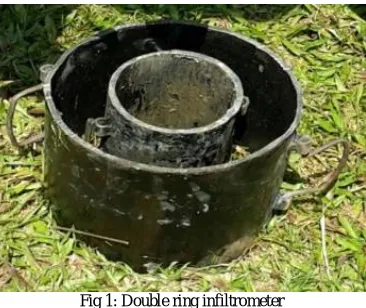
Certain places of Guwahati like DeeporBeel, ADTU Panikhati, Eastern Retreat Panikhaiti, Zoo Road, Bonda and Narengi Housing Colony was selected to conduct the test by using double ring infiltrometer. Area of 2m by 4m was taken in all the places. The two cylinders are digged inside the soil but the measurement is taken in the inner cylinder only; the outer cylinder helps the water from the inner cylinder to flow vertically downwards and not laterally. The cylinders are of height 40cm which are been digged up to a height of 20cm inside the soil with the help of steel rod and hammer. Figure 1 shows the infiltrometer that has been used in this experiment with inner diameter 11cm and outer diameter 22cm.
Fig 1: Double ring infiltrometer
Cylinders are kept back 20cm above the ground surface in which the water was poured and the measurement of the decreasing water level was taken. Water is supplied uniformly inside the ring without any disturbance of soil surface. A measuring scale of 30cm is placed in the inner cylinder and the initial water level of the inner cylinder is noted down. The measurement was continued until and unless a constant value of infiltration rate was achieved. A time interval of two minutes and later four minutes and a total of 90 minutes were taken and the decrease in the water level was measured. The water level in the outer cylinder is kept at the same level as the water level in the inner cylinder.
V. STUDY AREA
climate. The average annual temperature is 24.2 °C with extremes ranging from 40.6 °C recorded on 24 April 2014 to 30 °C recorded in January 1964. Guwahati is a city where the topography, climate, humidity, temperature, altitude, soil behaviour, etc varies from place to place. The six study areas have different location and altitude and as the experiments are conducted in different days so the temperature, humidity and pressure also varied. Table 1 shows the details of the climate profile of our study area.
Table 1: Table showing the location, altitude, temperature, humidity and pressure of the study areas.
Fig 2: Some photographs while carrying out the experiment on sites (a) Measuring the drop in water level (b) Measuring whether the infiltrometer is levelled (c) Noting down the readings (d) Filling the cylinders with water (e) Digging the cylinders into the soil
VI. RESULTS AND DISCUSSION
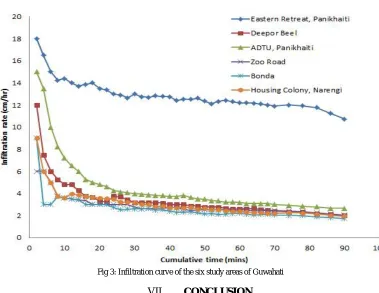
Figure 3 shows the infiltration curves for the different sites. We can see that Eastern Retreat, Panikhaiti has the highest rate of infiltration than the other five study areas and Bonda has the lowest infiltration rate. In Eastern Retreat, the infiltration rate at the beginning was high and decreased to reach the steady (constant) value of 10.73 cm/hr where else, Bonda has lowest infiltration rate of 1.73cm/hr.
Fig 3: Infiltration curve of the six study areas of Guwahati
VII. CONCLUSION
From research work it was found that soil conditions effects infiltration rate. From the graphs of infiltration rates against time it is found that initial infiltration rates were high and decreased with time up to constant infiltration rate. From the graph plotted, it is seen that Eastern Retreat, Panikhaiti has the highest infiltration capacity while Bonda has the lowest infiltration capacity. The application of infiltration method in the study area indicated that DeeporBeel, Bonda and Narengi Housing Colony are characterised by slow-moderate rate of infiltration. ADTU, Panikhaiti and Zoo Road is characterized by moderate rate of infiltration whereas, Eastern Retreat, Panikhaiti is characterized by moderate-rapid rate of infiltration. It is found that for loamy soil the type of infiltration is slow-moderate, for sandy loam soil the type of infiltration is moderate whereas, for sandy soil we got moderate-rapid rate of infiltration. The Atterberg limits (liquid limit and plastic limit) indicated that generally the sediments are with low to medium plasticity index. From the sieve size analysis test, we found that the soil the study area is generally covered by poorly graded sand.
REFERENCES
[1] ASTM, Standard test method for infiltration rate of soils in field using double-ring infiltrometer, Annual Book of ASTM Standards 04.08. Amer. Soc. Testing Materials, West Conshohocken, PA.,2003.
[2] Gregory, J.H., Dukes, M.D., Miller, G.L., and Jones P.H., “Analysis of double-ring infiltration techniques and development of a simple automatic water delivery system”, Applied Turfgrass Science, pp 2005.
[3] Dr.Kadam S. Avinash, “Determination of Infiltration Rate for Site Selection of Artificial Water Recharge: An Experimental Study”,
International Journal of Science and Research (IJSR), Volume 5 Issue 6, June 2016.
[4] Wu, L., Pan, L., Roberson, M.J. &Shouse, P.J, “Numerical evaluation of ring-Infiltrometers under various soil conditions” Soil Science, 162(11), pp771–777, 1997.
[5] TarekSelim, The effect of land use on soil infiltration rate in a heavy clay soil in Egypt, VATTEN 67: 161–166. Lund 2011.
[6] Maheshwari, B.L. “Development of an automated double-ring Infiltrometers”, Australian Journal of Soil Research, 34, pp 709–714, 1996.
[7] C. L. Jejurkar, Dr. M. P. Rajurkar, Infiltration studies for varying land cover conditions, International Journal Of Computational Engineering
Research, Vol. 2, Issue No.1, pp 072-076, 2012.
[9] Gray, D. M., and Norum, D. I., “The effect of soil moisture on infiltration as related to runoff and recharge”, In Proceedings of Hydrology Symposium. No. 6, National Research Council of Canada Associate Committee on Geodesy and Geophysics Subcommittee on Hydrology p. 133, 1968.
[10] GretAron,” Adaption of Horton and SCS Infiltration Equations to complex storms”, Journal of Irrigation and Drainage Engineering, Vol. 118,
No. 2, March/April ©ASCE, 1992.
[11] Robert Pitt, Janice Lantrip, Thomas P. O’Connor,” Infiltration Through Disturbed Urban Soils”, American Society of Civil Engineers ,
Building Partnerships, pp. 1-10, 2000.
[12] Adindu Ruth U., IgbokweKelechi K. and Dike Ijeoma I., Philip Model Capability to Estimate Infiltration for Solis of Aba, Abia State, Journal