DESIGN OF GRAPHICAL USER INTERFACE FOR
MULTIUSER SAC-OCDMA PERFORMANCE ANALYSIS
NAJLA. H ABDLKAREM
A project report submitted in partial
fulfilment of the requirements for the award of the Degree of Master of Electrical Engineering
Faculty of Electrical and Electronic Engineering University Tun Hussein Onn Malaysia
ABSTRACT
TABLE OF CONTENTS
ACKNOWLEDGEMENT iv
ABSTRACT v
TABLE OF CONTENTS vii
LIST OF TABLES x
LIST OF FIGURES xi
LIST OF ABBREVIATION xii
LIST OF SYMBOLS xiii
LIST OF APPENDICES xv
CHAPTER 1 INTRODUCTION 1
1.1 Introduction 1
1.2 Problem statement 2
1.3 Aims and Objectives 3
1.4 Scope and Limitation 3
1.5 Thesis outline 4
CHAPTER 2 LITERATURE REVIEW 5
2.1 Introduction 5
2.2 Theory of Code Division Multiple Access (CDMA). 5
2.3 Theory of Optical Code Division Multiple Access (OCDMA). 7
2.4 Code Selection 8
2.4.1 Optical Orthogonal Codes (OOC) 8
2.5 SAC-OCDMA System 10
2.6 Fiber Bragg Gratings 11
2.6.1 The Transmitter based on FBG 13
2.6.2 The Receiver based on FBG 14
2.7 Encoding Technique 15
2.8 Detection Technique 16
2.9 Previous work 18
CHAPTER 3 Methodology 21
3.2 System operational framework 21
3.3 Proposed System Design 23
3.4 Implementation of the Encoder using QC, EQC and MQC codes 24
3.4.1 Generation of CDMA code code for each user 25 3.4.2 Generation of binary data for each user 29
3.43 Generation of modulation signals for each user 30
3.5 Performance analysis 31
3.6 System Specification 33
3.7 Graphic User Interface (GUI) Design 34
CHAPTER 4 Reslte and Discussion 37
4.1 Introduction 37
4.2 Graphic User Interface (GUI) 38
4.2.1 Components functions in (GUI) 38
4.3 Simulation results 39
4.3.1 Coding scheme 39 4.3.1.2 Simulation result of (EQC codes) 42 4.3.2 Simulation result of Modified Quadratic Congruence (MQC) 44 4.3.3 Date rate analysis 45
4.4 Performance analysis 46
4.5 Bit Error Rate (BER) Vs Number of users 48
4.6 Summary of Result 49
CHAPTER 5 Conclusion and Future work 54
5.1 Conclusion 52
5.2 Future work 53
Reference 54
LIST OF TABLES
Table 2.1 Comparison of different properties of SAC_OCDMA code.. 11 Table 2.2 Summary of previous work………...18 Table 3.1 System parameter……….. 33
LIST OF FIGURES
Figure 1 Multiuser OCDMA System with n number of users ... 2
Figure 2 Principle of DS-CDMA ... 7
Figure 3 SAC-OCDMA receiver based on SPD technique [16]. ... 18
Figure 4 Block diagram of the SAC OCDMA system ... 13
Figure 5 Block diagram of SAC OCDMA system using MQC code ... 13
Figure 6 Structure of the transmitter ... 14
Figure 7 Representation of the FBG’s Function ... 15
Figure 9 Structure of the receiver... 16
Figure 10 Top down design of the GUI ... 34
Figure 11 Design of GUI layout using the GUIDE toolbox in Matlab ... 35
Figure 12 Graphical user interface designed and developed in Matlab ... 38
Figure 13 The length of QC codes versus number of users ... 40
Figure 14 The length of EQC codes versus number of users ... 42
Figure 15 User Vs Length for QC and EQC codes ... 42
Figure 16 Users vs Length of code for MQC code ... 43
Figure 17 Users vs data rate ... 44
Figure 18 SNR vs number of active users at 622Mbps data rate ... 45
Figure 19 SNR vs number of simultaneous at 1.25Gbps data rate ... 46
LIST OF ABBREVIATION
BER - Bit error rate
CDMA - Code Division Multiple Access DS-CDMA - Direct-sequence CDMA FBGs - Fiber Bragg gratings FH-CDMA - Frequency-hopping CDMA GUI - Graphical user interface MAI - Multiple access interference MUI - Multiple user interference OOC - Optical orthogonal code PIIN - Phase induced intensity noise PSD - Power spectral density
P.U - Power Unit
QC - Quadratic congruence
SAC-OCDMA- Spectral-amplitude-coding OCDMA SNR - Signal to noise ratio
LIST OF SYMBOLS
e - Electron’s charge
Cm - The code sequence for the m-th user
I - Average photocurrent,
B - Noise-equivalent electrical bandwidth of the receiver, - Coherence time of source,
- Boltzmann’s constant,
p - Prime number
- Receiver load resistor.
T - Period of data signal (seconds) Tc - Chip time (seconds)
LIST OF APPENDICES
CHAPTER 1
INTRODUCTION
1.1
Introduction
The transmission of data by multiple users simultaneously using various multiple access techniques over fibre optic communication has been studied in several literatures. This provides high data rates and leads to high total throughputs while taking advantage of high speed in optic fibre. This is particularly useful in meeting the bandwidth demand in future information networks by efficiently utilizing the available optical bandwidth.
The major multiple access schemes include Wavelength Division Multiple Access (WDMA), Time Division Multiple Access (TDMA), Code Division Multiple Access (CDMA). The use of CDMA in optical fibre offers interesting features for LAN compared to TDMA and WDMA. OCDMA is considered a better multiple access scheme because it does not require time management or frequency management of all transmitting nodes of users. Furthermore, it can operate asynchronously without centralized control which amounts to low latency. OCDMA can also benefit from high multiplexing gains since dedicated time or wavelength slots do not have to be allocated to users. In addition it allows flexible network design since bit error rate (BER) depends on the number of active users. [1].
codewords are combined together and sent over the channel as shown in Figure. 1.1. A decoder for each user is used at the receiver end to compare the incoming sequence with stored copies of the codewords in order to extract the information bits. Optical orthogonal codes (OOC) has been considered suitable for OCDMA and was first introduced by [2]. The use of OOC codes allows large number of asynchronous users to transmit information efficiently and reliably. Fundamentals of OOC are discussed in Chapter 2.
Code generator
Data in
Data in
Data in
+ Encoder 1
Encoder 2
Encoder n
Decoder 1
Decoder 2
Decoder n Optical
fiber User 1
User 2
[image:11.595.155.540.236.460.2]User n
Figure 1.1: Multiuser OCDMA System with n number of users [1].
In this research, fiber Bragg gratings (FBGs) is used for implementation of encoder-decoder for OCDMA. Spectral-amplitude-coding (SAC) OCDMA is used to cancel the effect of multiuser access interference using code sequence with in-phase cross correlation.
1.2
Problem statement
interference between users. This is called multiple user interference (MUI) or multiple access interference (MAI). In addition, different coding scheme have been designed with different length of codes which affects the data rate when many active users are transmitting simultaneously. As the number of active users increase the performance of the system in terms of BER and SNR also varies. It was observed that the different OCDMA codes proposed by different author offers different performance level. These codes have been developed using different platforms for example Matlab but there is need for a simple and user friendly simulator that can be used to observe and analyse the performance of the different codes used in the encoding and decoding scheme. A simple simulation platform needs to be develop to compare the performance OCDMA codes based on data rate, bit error rate, length of coding scheme and signal to noise ratio when the number of active users transmitting varies.
1.3
Aims and Objectives
The primary aim of this project is to develop a Matlab graphical user interface system that allows for comparison of existing OCDMA encoding and detection scheme.
The objectives of this project are as follows:
1) To understand different OCDMA codes and detection scheme for multiusers.
2) To develop a graphic user interface GUI, for OCDMA multiuser system 3) To analyse the performance of multiusers in OCDMA system.
1.4 Scope and Limitation
This research is limited to simulation using Matlab and the scope of this work is outlined as follows:
2. Simulate different OCDMA codes and detection scheme for multiple users 3. Compare simulated results in terms of BER, SNR, length of code and data
4. Design and develop a graphic user interface GUI with the following.
The system should satisfy the following requirments:-
1. To be able to select different number of users .
2. To be able to determine the data rate of different users.
3. To be able to compare to noise ratio (SNR) for different users.
1.4
Thesis outline
CHAPTER 2
LITERATURE REVIEW
2.1
Introduction
In this chapter we provide the background study on CDMA theory and optical CDMA codes. The different types of code selection and detection techniques are discussed.
2.2 Theory of Code Division Multiple Access (CDMA).
CDMA also known as radio-CDMA is a multiple channel access method in which several transmitters can send information simultaneously over a single communication channel. This has been employed in various radio communication technologies such as cdmaOne, CDMA2000 and WCDMA. Several users are able to share a band of frequency through spread-spectrum technology and a special coding scheme. The spread spectrum signal is generated using a fast pseudo-random code
transmission of signals, better device management compared to FDMA since it allows users to transmit using same carrier frequency hence same transmitters are deployed in the system. In addition, The CDMA transmitters are simple and less expensive compared to TDMA and FDMA transmitters.
[image:15.595.156.555.392.490.2]There are two basic types of CDMA, namely direct-sequence CDMA (DS-CDMA) and frequency-hopping CDMA (FH-(DS-CDMA) [1]. In DS-CDMA, users send a sequence of binary data when they want to transmit a ‘1’and they send a sequence of zeros when they want to transmit a ‘0’. The carrier frequency of the modulated signal is higher than that of the data signal and it depends on the CDMA code. In FH-CDMA, the spreading code contains different frequency components and the carrier frequency is always changing according to the code. This will increase the complexity of both transmitters and receivers. A transmitter should now consist of a broadband optical source and a multi-peak optical filter to create multi-wavelength optical output [3]. It has been seen that, the structure of transmitters should be as simple as possible.
Figure 2.1: Principle of DS-CDMA [12].
Figure 2.1, above shows an example of DS-CDMA: a user wants to send data ‘10110’ and is assigned a CDMA code of ‘1001100’ in the network. From the above analysis, we could easily get the modulated signals of the user: ‘1001100 0000000 1001100 1001100 0000000’. It is noted that the small time slots in the graph are called chip and Tc is the chip duration. Therefore, the length of CDMA code (U) can be written as equation (2.1) below.
/ c
U T T (2.1)
Where U is the length of CDMA code, T is period of data signal and Tc is the
2.3 Theory of Optical Code Division Multiple Access (OCDMA).
TDMA and WDMA are known traditional fibre optic communication schemes used to allocate bandwidth among several users. Unfortunately, when the numbers of users are large, these schemes pose significant drawbacks [4]. In TDMA, only one user can transmit at a time, hence the throughput of the system is limited by the product of number of users and their respective transmission rate. In addition, TDMA requires lot of coordination in allocating and granting request for time slots from users by the central node. This results to significant latency penalties. On the other hand, in WDMA system, each user transmits on a single wavelength of light using the peak speed of the network hardware. While WDMA can support high throughput, it is difficult to construct a WDMA system for a dynamic set of users because of significant amount of coordination among the nodes. Developing a WDMA network that supports dynamic user base, control channel and collision detection schemes would amount to waste of significant spectrum or bandwidth. Optical CDMA is seen as a good alternative to TDMA and WDMA because it does not require time or frequency (or wavelength) management system. In addition Optical CDMA offers significant gain in throughput by using multiplexing technique since time and frequency slots do not need to be allocated to each user. However, the limiting factor to CDMA is the bit error rate (BER) relationship to the number of users [5].
2.4 Code Selection
In selecting a code, some factors needs to be considered. The most important is the cross-correlation function of a code due to the number of transmitters in the systems. The second factor is auto-correlation of the code. The cross-correlation makes it easy to reduce the interference due to other users and channel noise and auto-correlation enables the effective detection of the desired signal. In-phase cross-correlation value between any two users should be the same in order to deploy balanced detection.
2.4.1 Optical Orthogonal Codes (OOC)
In fibre-optic CDMA each information bit from the m-th user is encoded into a signal that corresponds to a code sequence of N chips representing the address of that user. The receiver of the CDMA system must be able to correctly distinguish each of the possible addresses based on the conditions shown in [8] that:
1. The peak of the autocorrelation function of u(t) should be maximized as shown below:
ur u t u t dt
(2.2)2. The side lobes of the autocorrelation function , of u(t) should be minimized.
3. The cross-correlation function of any two signals t) and (t) in the system should be minimized as shown below:
u u
r u t u t dt
(2.3)i) Let the sequence of the m-th user be given by , then the number of ones, K, for the zero-shift, s = 0, in the corresponding discrete autocorrelation function shown below should be minimized
0
1 1
m
N
c m m
i
A s c i c i s N s N
(2.4)ii) The number of coincidences in the discrete autocorrelation functions of the sequence C, for every shift, s (except the zero-shift), s, should be minimized iii) the number of coincidences for every shift, s, in the cross-correlation function of two sequences and should be minimized
, 0 1 1 N c c iA s c i c i s N s N
(2.5)where an event which occurs when two ones from two shifted sequences occupy the same chip is called coincidence.
An optical orthogonal code C is a family of (0, 1) sequences characterized by a quadruple (n, w, λa, λc), where n is the sequence length, w its weight, λa and λc is the maximum value of the out-of-phase auto-correlation and maximum value of the cross-correlation, respectively [10, 11]. The (0, 1) sequences of an optical orthogonal code are called its codewords. A low correlation is an important property of the codewords in order to reduce crosstalk between users. A low autocorrelation indicates that each sequence in the code can easily be distinguished from a shifted version of itself. When the cross correlation is low, codeword can easily be distinguished from any combination of shifted versions of other sequences in C. Cm
is the code sequence for the m-th user.
The OOC should satisfy the two properties [11]: 1. Auto-correlation property:
0
λ N
m m a
i
c i c i s
(2.6)2. Cross-Correlation Property:
0λ N
c i
c i c i s
(2.7)The value of the cross-correlation function should be minimized all the time.
2.5 SAC-OCDMA System
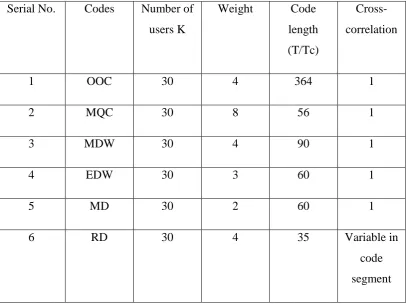
Table 2.1: Comparison of different properties of SAC_OCDMA codes
Serial No. Codes Number of users K
Weight Code
length (T/Tc)
Cross-correlation
1 OOC 30 4 364 1
2 MQC 30 8 56 1
3 MDW 30 4 90 1
4 EDW 30 3 60 1
5 MD 30 2 60 1
6 RD 30 4 35 Variable in
code segment
From the codes, MQC and RD codes show shorter code lengths. However, as shown in [20], the transmission performance of the MD code is significantly better than that of the MQC and RD codes. This shows that achieving a shorter code length does not necessary guaranty higher performance.
2.6 Fiber Bragg Gratings
optical encoder and decoder system is given in Figure 2.2 to illustrate the application when using MQC code.
LED Optical switch Spectral encoder Combiner Star Splitter Decoder PD LPF Coupler
Data in Data out
Transmitter Receiver
[image:21.595.148.557.193.355.2]Threshold Detector
Figure 2.2: Block diagram of the SAC _OCDMA system [14].
Broadband Source
Spectral encoder
Spectral
Coupler Coupler
A(v)
A(v)
Detection
PD2 PD1
1
k 1:k Unipolar
data
1 2 3 N
[image:22.595.120.516.74.263.2]Optical frequency
Figure 2.3: Block diagram of SAC OCDMA system using MQC code [14].
AT the receiver side, a 1: k splitter is used to divide the received signal into two parts which goes into two decoders with complementary decoding functions. When ( , , )N w code is used, the MUI coming from (k1) undesired users at the first photo detector (PD1) is equal to (k1) and that at PD2 is equal to
(w )(k 1)
. When / (w), the two MUI components are equal which cancels out after balanced photo detection [24].
2.6.1 The Transmitter based on FBG
FGBs FGBs
[image:23.595.150.549.70.265.2]Encoder
Figure 2.4: Structure of the transmitter [14].
Broadband Pulse
A
(w)A
(w)Figure 2.5: Representation of the FBG’s Function [14].
2.6.2 The Receiver based on FBG
FGBs FGBs
Decoder
Delay 1/p
PD1
[image:24.595.161.483.73.252.2]PD2
Figure 2.6: Structure of the receiver [14].
2.7 Encoding Technique
Data Generator
Spread Sequence Generator
Modulator
1 0
T
Data Signal
Spreading sequence
Modulated Signal
1 0 1 0 0 0 0 0 0 0
Laser
Architecture of Transmitter
Tc
1 0 1 0 0 1 0 1 0 0
[image:25.595.150.554.70.293.2]
Figure 2.7: Basic structure of encoder [18].
2.8 Detection Technique
The detection techniques can be classified into two, which are: direct detection and balanced detection. A simple detection scheme is the direct detection (also called peak detection). In most optical CDMA systems, detection is performed in the optical domain by using an optical correlator and a threshold detector such as in [3] and [6]. The balanced detection consist of two photodiodes connected electrically in opposition. The output signal is proportional to the power difference between the two optical inputs. The balanced detection technique enhances system performance compared to direct detection technique but with increased receiver complexity.
a) Modified-AND subtraction detection technique:-
Figure 2.8: SAC-OCDMA receiver based on modified-AND subtraction detection technique [27]
The AND and modified-AND utilise the balanced detection technique which requires two photodiodes. In recent work, single photodiode detection (SPD) technique has been proposed in [16].
b) SPD detection technique
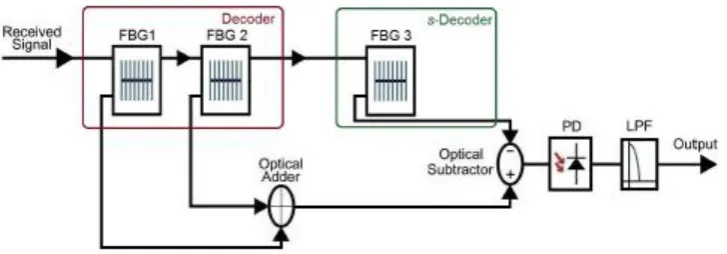
[image:26.595.168.501.99.254.2]The technique utilises single photodiode and has the potential to reduce the cost of receiver and shot noise. The block diagram of the SPD SAC-OCDMA technique is show in Figure 2.9.
Figure 2.9: SAC-OCDMA receiver based on SPD technique [16].
[image:26.595.162.526.529.656.2]modification in the spectral distribution of the s-decoder. The summary of SPD block diagram is described here and full details can be found in [16]. The decoder has an identical response to the intended encoder for the data received. The detected output from the decoder is either w power units (P.U.) for active user or c P.U. for interferers. The weight w represents the number of occupied frequency bins in the user’s encoder, and the in-phase cross-correlation c, which is the maximum number of common frequency bins occupied by any two codes of the family. The remainder of the signal from the decoder is then transmitted to the subtractive decoder (s-Decoder) to cancel out signals with mismatched signatures, i.e., interferers [16]. The s-Decoder contains only frequency bins from different interferers. The output from the s-decoder is either zero P.U for active user or c P.U for interferers. After optical subtraction, the output is either w P.U. for active user or zero P.U. for interferers which implies that the interference signals are cancelled in the optical domain. After the desired signal is detected by a photodiode, the data-carrying electrical signal is low pass-filtered by a Bessel-Thompson filter of order four to reject the out-of-band high-frequency noise. The three detection technique will be used in this project for performance analysis and modified MQC code.
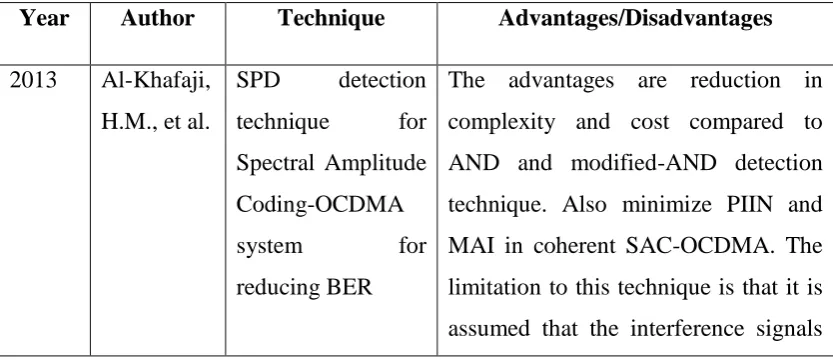
2.9 Summary of previous work
[image:27.595.109.526.591.771.2]The summary for the previous work cited in this chapter is provided in the Table 2.2.
Table 2.2: Summary of previous work
Year Author Technique Advantages/Disadvantages
2013 Al-Khafaji, H.M., et al.
SPD detection technique for Spectral Amplitude Coding-OCDMA
system for
reducing BER
at the optical subtractor of the SPD are assumed to be equal and cancel each other. In practice the interference signal differs slightly.
2012 Abd, T.H., et al
Use of multi-diagonal (MD) codes for SAC-OCDMA
Advantages are simplicity of design, support for large number of users with high data rates and zero cross-correlation that cancels MAI. The limitation are MQC and RD codes offer shorter code length compared to MD codes
2012 Al-Khafaji, et al
Use of modified-AND subtraction detection technique for incoherent SAC-OCDMA using MQC code
Advantages are the modified-AND detection technique offers better BER performance compared to AND detection and higher data rate using MQC code. Limitation is higher complexity and cost compared to the AND detection technique
2009 Fadhil, H.A
Use of Random diagonal (RD) code
The advantages are better performance compared to systems encoded with Hadamard, MQC and MFH codes. Simple encoder/decoder design. 2001 Wei, Z., H.
Ghafouri-Shiraz, and H. Shalaby
Modified Quadratic congruence (MQC) for fiber Bragg-grating based SAC-OCDMA
1993 Marić, S Quadratic
Congruence (QC) codes for use in spread-spectrum fiber-optic LAN
The advantages is the QC code offers auto-correlation and cross-correlation compared to the prime codes developed earlier with reduced complexity. The limitation is the length of code sequence is high which reduces the data rate for number of users
1983 Shaar, A. and P. Davies
Prime Sequence (PS) for channel code division multiplexing
CHAPTER 3
METHODOLOGY
3.1 Introduction
In this chapter, the steps taken to carry out this research is discussed. The operational framework for the research is explained in Figure 3.1. The implementation of the different coding scheme will be explained in section 3.3. The FBG system for the transmitter and receiver is described and the encoder and decoder are explained.
3.2 System operational framework
The operational framework for this research is shown in Figure 3.1. The literature review stage is discussed in Chapter 2. The basic theory of the OOC codes for CDMA was discussed. The understanding from the basic theory is used to develop Matlab codes used for simulation purpose.
Start
Literature review
Determine design parameter and algorithm for encoding and decoding
Implementation in matlab code
Simulation
Analyse results
Write up thesis
End
Design of Graphical User interface
Is result ok
[image:31.595.154.390.105.691.2]Yes No
Implementation of the codes in Matlab requires a good skill in programming. The coding algorithm were translated into Matlab codes for simulation. A top down approach was used to design the Matlab codes as shown in the follow in section 3.3. The simulation of codes where done using Matlab compiler, Errors were debugged using the Matlab editor and the results were displayed using the figure tool in Matlab. The simulated results are presented in Chapter 4.
3.3 Proposed System Design
The block diagram from the transmitter to the receiver using encoder and decoder is shown as follows:
user1
user2
.
[image:32.595.70.526.376.547.2]user 64
Figure 3.2: Proposed block diagram of Tx/Rx OCDMA Communication using 64 users.
Figure 3.3: Block diagram of Encoder and Decoding scheme. Fiber
OCDMA TX
Encoder
OCDMA TX
Encoder
OCDMA TX
Encoder
OCDMA RX
Decoder
OCDMA RX
Decoder
OCDMA RX
[image:32.595.174.521.609.738.2]All data generated by each user is encoded and sent to the spectral coupler. The pulses from all users are mixed up at the star coupler, and then this superimposed signal is sent to the receiver. At the receiver, the received optical signal is split and decoded using the selected detection scheme, in this case the SPD detection scheme is used. Then, after balanced detection, low-pass filter (LPF), and threshold decision, the original data can be recovered. The details of the implementation of the encoder is described in sub-section 3.4.
3.4 Implementation of the Encoder using QC, EQC and MQC codes
The description of the system implementation using Matlab codes is presented in this section.
The block diagram for the encoder is shown as follows :
Data Generator
QC, EQC, MQC Generator
Modulator
1 0
T
Data Signal
Spreading sequence
Modulated Signal 1 0 1 0 0 0 0 0 0 0
Laser
Encoder Architecture for QC, EQC and MQC codes
Tc
1 0 1 0 0 1 0 1 0 0
Figure 3.4: Block diagram of the encoder
The simulation of the encoder can be divided into the following four parts:
Step 1. Generation of CDMA codes for each user Step 2. Generation of binary data for each user
REFERENCE
1. Stok, A. and E.H. Sargent, Lighting the local area: Optical code-division multiple access and quality of service provisioning. Network, IEEE, 2000. 14(6): p. 42-46.
2. Salehi, J.A., Code division multiple-access techniques in optical fiber networks. I. Fundamental principles. Communications, IEEE Transactions on, 1989. 37(8): p. 824-833.
3. Agrawal, G.P., Fiber-optic communication systems. Vol. 1. 1997.
4. Han, S., Optical CDMA with Optical Orthogonal Code. Multiuser Wireless Communication (EE381K) Class Project, Fall, 2002.
5. Salehi, J.A. and C.A. Brackett, Code division multiple-access techniques in optical fiber networks. II. Systems performance analysis. Communications, IEEE Transactions on, 1989. 37(8): p. 834-842.
6. Shaar, A. and P. Davies, Prime sequences: quasi-optimal sequences for OR channel code division multiplexing. Electronics Letters, 1983. 19(21): p. 888-890.
7. Maric, S.V., Z.I. Kostic, and E.L. Titlebaum, A new family of optical code sequences for use in spread-spectrum fiber-optic local area networks.
Communications, IEEE Transactions on, 1993. 41(8): p. 1217-1221.
8. Marić, S., New family of algebraically designed optical orthogonal codes for use in CDMA fibre-optic networks. Electronics letters, 1993. 29(6): p. 538-539.
9. Wei, Z., H. Shalaby, and H. Ghafouri-Shiraz, Modified quadratic congruence codes for fiber Bragg-grating-based spectral-amplitude-coding optical CDMA systems. Lightwave Technology, Journal of, 2001. 19(9): p. 1274-1281.
10. Dinan, E.H. and B. Jabbari, Spreading codes for direct sequence CDMA and wideband CDMA cellular networks. Communications Magazine, IEEE, 1998. 36(9): p. 48-54.
12. Zouine, Y., et al., Analyses of constraints on high speed optical code division multiplexing access (OCDMA) link parameters due to fiber optic chromatic dispersion. Optics Communications, 2008. 281(5): p. 1030-1036.
13. Mandez, A., et al. Demonstration of Record BER and Number of Users for Optical CDMA (O-CDMA), with Implications to Secure Communications. 2005. VCRL-CONF-210103.
14. Wei, Z., H. Ghafouri-Shiraz, and H. Shalaby, New code families for fiber-Bragg-grating-based spectral-amplitude-coding optical CDMA systems.
IEEE Photonics Technology Letters, 2001. 13(8): p. 890-892.
15. Al-Khafaji, H.M., S. Aljunid, and H.A. Fadhil. Single photodiode detection for interference elimination in SAC-OCDMA systems. in Photonics (ICP), 2013 IEEE 4th International Conference on. 2013. IEEE.
16. Al-Khafaji, H.M., et al., Reducing BER of spectral-amplitude coding optical code-division multiple-access systems by single photodiode detection technique. Journal of the European Optical Society-Rapid publications, 2013. 8.
17. Noshad, M. and K. Jamshidi, Code family for modified spectral-amplitude-coding OCDMA systems and performance analysis. Optical Communications and Networking, IEEE/OSA Journal of, 2010. 2(6): p. 344-354.
18. Fadhil, H.A., S. Aljunid Bin syed Junid, and R. Ahmad, Effects of the Random Diagonal code link parameters on the performance of an OCDMA scheme for high-speed access networks. Optical Fiber Technology, 2009. 15(3): p. 237-241.
19. Aljunid, S., et al., A new family of optical code sequences for spectral-amplitude-coding optical CDMA systems. Photonics Technology Letters, IEEE, 2004. 16(10): p. 2383-2385.
20. Abd, T.H., et al., Modelling and simulation of a 1.6 Tb/s optical system based on multi-diagonal code and optical code-division multiple-access. Ukr. J. Phys. Opt, 2012. 13(2): p. 55.
21. Huang, J.-F. and D.-Z. Hsu, Fiber-grating-based optical CDMA spectral coding with nearly orthogonal M-sequence codes. Photonics Technology Letters, IEEE, 2000. 12(9): p. 1252-1254.
22. Chen, L.R., et al., Applications of ultrashort pulse propagation in Bragg gratings for wavelength-division multiplexing and code-division multiple access. IEEE J QUANTUM ELECTRON, 1998. 34(11): p. 2117-2129. 23. Grunnet-Jepsen, A., et al. Spectral phase encoding and decoding using fiber
24. Zhou, X., et al., Code for spectral amplitude coding optical CDMA systems.
Electronics Letters, 2000. 36(8): p. 728-729.
25. Hasoon, F.N., et al., Spectral amplitude coding OCDMA using AND subtraction technique. Applied optics, 2008. 47(9): p. 1263-1268.
26. Zaccarin, D. and M. Kavehrad, An optical CDMA system based on spectral encoding of LED. Photonics Technology Letters, IEEE, 1993. 5(4): p. 479-482.
27. Al-Khafaji, H.M., S.A. Aljunid, and H.A. Fadhil, Improved BER based on intensity noise alleviation using developed detection technique for incoherent SAC-OCDMA systems. Journal of Modern Optics, 2012. 59(10): p. 878-886. 28. Hanselman, D. and B. Littlefield, Matlab, the language of technical
computing. Matlab, the language of technical computing, 1997.
29. Smith, S.T., MATLAB: advanced GUI development. 2006: Ear Publishing. 30. T004:2013, S.M.T., SPECIFICATION FOR DIGITAL TERRESTRIAL
![Figure 1.1: Multiuser OCDMA System with n number of users [1].](https://thumb-us.123doks.com/thumbv2/123dok_us/8761981.894455/11.595.155.540.236.460/figure-multiuser-ocdma-n-number-users.webp)
![Figure 2.1: Principle of DS-CDMA [12].](https://thumb-us.123doks.com/thumbv2/123dok_us/8761981.894455/15.595.156.555.392.490/figure-principle-of-ds-cdma.webp)
![Figure 2.2: Block diagram of the SAC _OCDMA system [14].](https://thumb-us.123doks.com/thumbv2/123dok_us/8761981.894455/21.595.148.557.193.355/figure-block-diagram-sac-ocdma.webp)
![Figure 2.3: Block diagram of SAC OCDMA system using MQC code [14].](https://thumb-us.123doks.com/thumbv2/123dok_us/8761981.894455/22.595.120.516.74.263/figure-block-diagram-sac-ocdma-using-mqc-code.webp)
![Figure 2.4: Structure of the transmitter [14].](https://thumb-us.123doks.com/thumbv2/123dok_us/8761981.894455/23.595.150.549.70.265/figure-structure-of-the-transmitter.webp)
![Figure 2.6: Structure of the receiver [14].](https://thumb-us.123doks.com/thumbv2/123dok_us/8761981.894455/24.595.161.483.73.252/figure-structure-of-the-receiver.webp)
![Figure 2.7: Basic structure of encoder [18].](https://thumb-us.123doks.com/thumbv2/123dok_us/8761981.894455/25.595.150.554.70.293/figure-basic-structure-of-encoder.webp)