Journal of Chemical and Pharmaceutical Research, 2014, 6(6):1676-1680
Research Article
CODEN(USA) : JCPRC5
ISSN : 0975-7384
The study of different pH values on morphology of ZnO
nanoparticles via sol-gel technology
Jianfeng Jin
1, Ailian Hao
1, Gang Wang
2, Xiujun He
1, Wenyun Zhang
2*and Qinghua Chen
31
Kunming Municiple Stomatology Hospital, Kunming, China
2
Dept. of Stomatology, Kunming General Hospital of PLA, Kunming, China
3
Kunming University of Science and Technology, Kunming, China
____________________________________________________________________________________________
ABSTRACT
Antibacterial activity and uniform dispersion of zinc oxide(ZnO) had been studied and applied widely. But the property of ZnO was involved with particle size.The aim of this study was to further investigate morphology of ZnO prepared by sol-gel technology at different pondus hydrogenii(pH) value. By XRD analysis, ZnO particles were high purity under different pH value. In addition, the particles size of ZnO were minimum and uniform dispersion when the pH valeu was 8.5, and the mass ratio of polyethylene glycol(PEG) and zinc acetate was 1:2 by TEM analysis.
Keywords: pH value; Morphology; ZnO ; Sol-gel technology
____________________________________________________________________________________________
INTRODUCTION
Nano ZnO had been widely used in microelectronics, ceramics, catalytic chemistry and medicine and so on due to small size effect, surface effect, quantum size effect, the macroscopic quantum tunnel effect, coulomb blockade effect and dielectric confinement effect, etc[1]. Nowadys, the property of nano ZnO was studied widely all over the world[2], including four aspects of preparation, microstructure, macroscopical physical properties and applcation. But the main important key was preparation technology. Because it was important influence that the microscopic and macroscopic structute of particles were controlled through preparation process. Sol-gel method which compared with other methods was easy to control and the reaction temperature was low. It could prepare in high purity or ultrapurity oxide, doped oxide, film fiber and deposition of materiasl and so on.
Nano ZnO was susceptible to reunion when it was preparaed. Therefore, many scholars tried to solve this problem with kinds of methods. Khizar Hayat et al[3] found that Nano ZnO synthesized by sol gel and calcined at 500 ◦C was found to be more active for photocatalytic oxidation of phenol as compared to all other photocatalysts employed in this study. The main reason for high photonic efficiency and higher degradation rate of phenol for nano ZnO-500 was the smaller size, better dispersion and homogeneity of nanoparticles. Yidong Zhang et al [4] studied that The glucose additive could not only improve the surface RMS roughness and microstructure of ZnO thin films, but also enhance the transmittance and the energy band gap more easily. PAN Peng et al [5] found that nano ZnO was nuiform dispersion when the concentration of starch was 0.5%. The nano-diameter of ZnO was single digits or 50-60 when the different surface modifications were used[6].
EXPERIMENTAL SECTION
Materials Zinc acetate(China, AR); Polyethylene glycol(China, AR); Anhydrous ethanol(China, AR); 25% Ammonia(China, AR).
Methods Firstly, 2.86g zinc acetate and 1.43g PEG6000 dissolved in 130ml of anhydrous ethanol under the
magnetic stirrer. And the pH of solution was controlled by ammonia. Then the formation of nano-sized ZnO precursor was Zn5(0H)8(Ac)2•2H2O. After it was stirred at 70 for 2 hours, the mix solution was centrifuged and
dried. The white powder was abtained. At last, the white powder was sintered at 2 per minute to 800 [7], then it was been heat preservation for 30 min at 800 [3]. According to the experiment, the experiment was divided into five groups. Group A:pH=5.5,PEG:zinc acetate=1:2; Group B:pH=6.5,PEG:zinc acetate=1:2; Group C:pH=7.5,
PEG:zinc acetate=1:2; Group D:pH=8.5,PEG:zinc acetate=1:2; Group E:pH=8.5,PEG:zinc acetate=0:2,
respectively.
RESULTS AND DISCUSSION
XRD of ZnO
ZnO crystal(non-)standard XRD group A
group B group C
group D group E
Fig. 1. XRD pattern of nano ZnO prepared with sol-gel
A
B
C
D
Dental composite resins were widely usely restorative materials. Nanotechnology application of nanosize fillers had improved the performance of advanced dental materials[8]. Therefore, inorganic nanoparticles were widely used in polymer filling because of their nano properties and monodispersed spherical nanosilica fillers that were suitable for fabrication of dental nanocomposite and could be synthesized via sol-gel process[9]. In the powder preparation process, particles could be produced reunion due to nucleation, crystal growth, drying, calcination etc. The methods of dispersing nanoparticles were mainly mechanical, ultrasonic, high-energy treatment and chemical[10].
It could be seen from the fig. 1. The XRD main diffraction peak position of group A, B, C, D and E were basically consistent with the standard XRDspectra of group 3-1 and no impurity peak. It was demonstration that ZnO powder was high purity. In additon, diffraction peak was broaden. Because of small particle diameter of ZnO. ZnO nanometer powder with high purity could be prepared by sol-gel method.
TEM of ZnO
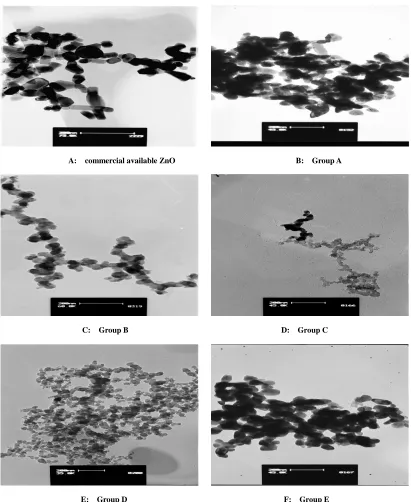
A: commercial available ZnO B: Group A
C: Group B D: Group C
[image:3.595.101.512.228.730.2]
E: Group D F: Group E
Figure 2 (A) showed that commercial available ZnO nanoparticles were uneven distribution. They had the shape of granular, short rod, and agglomerated obviously. Figure 2 (B) was the group A: pH=5.5, PEG: zinc acetate=1: 2. ZnO nanoparticles agglomerated obviously and were irregular shape. Figure 3-12 also was such. Figure 2(B) and (C) showed that ZnO was granular and agglomeration slightly. Group D (Fig. 2(E))showed ZnO nanoparticels were despersed and uniformity.
The results of Figure 2(B) to Figure 2(F) showed that the diameter of ZnO nanoparticles was 100 nm or so, 50 nm or so, 40 nm or so, 8-20 nm or so, and 70 nm or so respectively. The direct reason for this was relation to ultrasonic, pH value, surfactant dispersant, especially the pH duty and dispersing agents. Variables of solution in reaction process had pH value, temperature, organic impurities, concentration of reactant ratio, and veaction rate. As one of important factors pH value was ofter ignored. The pH value of sol influenced sol hydrolysis and condensation behavior when it changed which altered the structure of ZnO nanoparticles. In additon, pH value controlled H+ and OH- in the solution. Then it determined the metal oxygen bond formation. When the pH value was 5.5, H+ was more existence in the solution, which might be reacted with OH- in PEG6000. So that the activity of PEG6000 was decreased. With the
increasing of pH value, when the pH value was 8.5, ZnO nanoparticles were Spread evenly and diameter was smaller. The reason was that the number of OH- in the solution could improve the activity of PEG6000. The pH value
was considered to be an important parameter to control the sol-gel phase formation, particle size and the final molding[13, 14].
Surfactant PEG6000 was put in the experiment. It could selectively produce strong hydrogen bonding and electrostatic
effects on ZnO in the growth process of nanometer ZnO. Thus it could produce relaxation effect on crystal ionterface, and cause the change of interface atomic vibrational entropy, decrease the interfacial free energy, and show crystal interface easily. Finally, the formation of ZnO nanoparticles were dispersed. Xichang's research[11] showed that PEG400 could disperse intermediate precipitates. So ZnO nanoparticles had good dispersion, the particle
size distribution was narrow, and the mean particle diameter was 40-60 nm. However, the obtained ZnO was coarse particles and the particle size was distribution range without adding PEG400. In addition, PEG6000 was a kind of
non-ionic surface modifier. Its chain polymer extended to the solution as much as possible and the other end tightly adsorbed on the particle surface which had changed the nature of the ZnO precursor surface, had the steric hindrance effect, and prevented agglomeration of particles. At the same time, PEG6000 could also form template with inorganic
substances and control the morphology of powder[12]. In this study, OH- the end of PEG6000 extended as far as
possible, which combined with every Zn2+. The surface energy of Zn2+ was reduced. Thus the diameter of ZnO nanoparticle was decreaced. The results of Figure 3-12 showed that the diameter of ZnO nanoparticles was 70 nm or so, and particle size was not uniform because of the absence of PEG6000. However, its diameter was smaller than
figure 3-8. The possible reason was that the activity of Zn2+ was decreased in the alkaline environment.
When ammonia was alkali agent, Zn2+ existed with the form of Zn(OH)2 and [Zn(NH3)4]2+ in the solution. Their ratio
determined the morphology of ZnO crystals. When the solution pH>7, ionic crystal ZnO was anisotropic growth. The result was in agreement with He ying's research[15]. Moreover, Qin xiujuan showed that the pH value of the solution had some influence on the quality of ZnO nanoparticles[16].
Firstly, the particles were uniformity when pH value of the reaction process was maintained stablely. It was generally believed that the dispertion property of nanoparticles related to the surface potential. Because every surface potential corresponded to a pH value. By controlling the pH value of the solution, it could effectively reduce the particle size of precursor, improve the dispersion of nano ZnO, improve the quality of ZnO nanoparticles.
CONCLUSION
Within the limits of this study, ZnO nanoparticles were preparaed via sol-gel method, and dispersed uniformly. The results of XRD showed that ZnO powder was high purity. And the results of TEM showed that ZnO nanoparticles had different particle size in different pH values. ZnO nanoparticels were despersed and uniformity when pH value was 8.5 and the mass ratio of PEG and zinc acetate was 1:2. PEG6000 played an important role.
Acknowledgements
REFERENCES
[1] R.Rossetti, J.L.Ellison, J.M.Gibson,et al. J.Chem.Phys., 1984, 2(1), 4464-4469. [2] W.P.Halperin. Rev of Modern Phys., 1986, 3(2), 533-606.
[3] Khizar Hayat, M.A.Gondal, Mazen M.Khaled, et al. Applied Catalysis A: General, 2011, 5(393), 122-129. [4] Yidong Zhang, Huimin Jia, Pinjiang Li et al. Optics Communications, 2011, 4(284), 236-239.
[5] PAN Peng, MIAO Li-feng, WU Lei, et al. Journal of wuhan university of xcience and engineering, 2008, 21(12), 1-4.
[6] Guo L, Yang S H, Yang C L, et al. Chem Mater, 2002, 12(2), 2268-2274.
[7] The Versailles Project on Advanced Materials and Standards (VAMAS) and The European Structural Integrity Society (ESIS).Fracture toughness of ceramics using the SEVNB method; round robin. Swiss Federal Laboratories for Materials Testing and Research, 1999.
[8] M.Yin, Y.Gu, I.L.Kuskovsky, et al. J.Am.Chem.Soc, 2004, 4(3), 6206-6207. [9] Yeoh BW, Mohamad D, Rahman IA, et al. Dent Mater, 2009, 3(25), 156-164.
[10] Han Lihua, Jin Jianxin. Development and application of materials, 2005, 2(6), 30-33. [11] Xichang Shi, Shai Wang, Yi Qin, et al. New Chemical Materials, 2003, 6(3), 32-34. [12] Liu Xuening, Yang Zhizhong. The journal of physical chemistry, 2000, 3(8), 747. [13] Houng B, Huang C L, Tsai S Y. J Cryst Growth, 2007, 3(2), 328-333.
[14] Shmna P K, Vareda V K, Varadun V V. J Eur Ceram Soc, 2003, 2(5), 659-666.
[15] He Ying, Wang Junan, Zhang Wenfei, et al. Journal of shanghai univer(natural science edition), 2008, 4(5), 514-520.