© 2016, IRJET | Impact Factor value: 4.45 | ISO 9001:2008 Certified Journal | Page 1902
STUDY AND ANALYSIS OF DEEC PROTOCOLS IN HETERGENEOUS WSNs
USING MATLAB
Anamika Saini
1, Ashok Kumar
2, H.L.Mandoria
3, B.K.Pandey
41M.tech Student, Dept of Information Technology, G.B.P.U.A & T, Pantnagar, India 2,4Assistant Professor, Dept of Information Technology, G.B.P.U.A & T, Pantnagar, India
3Professor & Head, Dept of Information Technology, G.B.P.U.A & T, Pantnagar, India
---***---Abstract -
Wireless sensor networks are batteryconstrained. The main research in WSN is energy or power saving. Prolonging the network lifetime in WSN is research issue in field of sensor network. In cluster or hierarchical routing the cluster members send their sensed value to CH then CH relay the optimized and aggregated data to the base station. There are many ways to save the power of sensor nodes; one way is to reduce the unnecessary transmission of sensed data to the CH to BS. This paper focuses on using TEEN as an optimization algorithm for data transmission after cluster formation and then compares with DEEC variants and finally analyzes it in varying the nodes classification and initial energy of these groups of nodes. On comparing the proposed iP-DEEC protocol outperforms the traditional DEEC clustering protocols.
Key Words: CH, SN, HWSN, WSNs, DEEC, EDEEC, DDEEC
1. INTRODUCTION
Wireless sensor network represents the group of sensor network where the size of network can vary from a few to thousands [1-3]. Sensors relates the physical world to the virtual by sensing the surrounding environment then converting this information into a digital form then send it to the base station for the further processing [3,11]. Wireless sensor network consist of a large number of sensor nodes, which are connected wirelessly to collect the information from the sensing field.
Clustering of sensor nodes can balance the load among sensor nodes which increase the network lifetime of sensor nodes in Wireless Sensor Network [8]. The modern technology development in the field of sensor design, material used and other ideas make the size smaller and compact of sensors and sensor arrays with lower cost [10,12]. Wireless sensor technology has potential for sensing and monitoring in not only science and engineering but also in a wide range of applications in military, structure health, industrial, child care, medical monitoring, food processing, surveillance and in many more fields [13,15].
2. RELATED WORK
DEEC [4] protocol is developed for heterogeneous network which have three types of different initial energy of nodes with weighted different probability for electing CHs. DDEEC [7] is the advance version of DEEC and this protocol resolve the penalizing effect of DEEC protocol. EDEEC [5], this is an extended version of DEEC with normal, advance and super node classification on the basis of node’s energy. TDEEC [6] protocol is an improved version of DEEC and has three types of different energy nodes with modified probability function. EDDEEC [14] is the merged and improved version of E-DEEC and DDEEC protocol.
Teen [9] protocol is a reactive protocol for time critical applications for data transmission optimization developed by A. Manjeshwar and D.P. Agarwal in 2001.This protocol decides the wanted set of value of sensed data to be transmitted from cluster head to the base station. Thus the desired value (like a range of temperature) should be greater than the hard threshold and the difference between the current sensed value and previously sensed value. Thus the network lifetime is extended. We used TEEN algorithm for regulating the data transmission after cluster head selection done by the EDDEEC.
3.
MOTIVATION© 2016, IRJET | Impact Factor value: 4.45 | ISO 9001:2008 Certified Journal | Page 1903
4. iP-EDEEC Protocol
The iP-EDEEC (improved and prolonged-EDEEC) protocol is proposed in this paper which is a hybrid approach which composed of two protocols EDDEEC [14] and TEEN [9] protocol. The cluster formation and CH election from sensor nodes is accordingly EDDEEC protocol and afterwards TEEN concept is applied for the management of data transmission from the CH to BS. The TEEN concept of hard and soft threshold is used for regulating the data transmission.
4.1 System Model
4.1.1 Network Model
Heterogeneous Network Model is taken into consideration which means all sensor nodes have three different initial energy levels. N number of nodes is deployed in a M x M m2 region.
The sensor nodes are not equipped with the GPS or location aware system and they assumed to be fixed.
The location of the base station is at the centre of the network field and is assumed to be stationary.
The sensor nodes are energy constraint and left unattended after deployment.
All the sensor nodes have limited energy and deployed randomly in area.
4.1.2. Energy Model
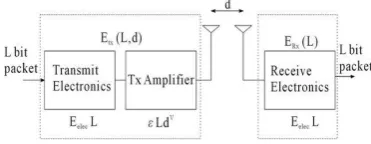
The radio energy model used in this protocol is same as used in DEEC protocol [4] is shown in figure 1. The energy expenditure model consists of radio hardware for transmitting and receiving the data packets wirelessly. The energy is needed to run the radio circuits for wireless communication.
Figure 1: Radio Energy Dissipation Model
This energy dissipation model explains that ‘L’ bit data packet is send over a distance d, and then energy dissipation can be calculated as given below:
4 2 . . . . . . ) , ( d E L E L d E L E L D L E amp elec fs elec TX if 0 0
d
d
d
d
(1)In this model
E
elec is the spent energy per bit to runthe receiver or transmitter of the radio circuit. The distance between the sender and receiver is defined as ‘d’. If the threshold distance d0is less than d then multi- path model is used otherwise free space model is used is taken in to consideration to calculate the energy expenditure. Value of threshold distance (do) in energy dissipation model is calculated by:
amp fs
E
E
d
0
(2)For receiving ‘L’ bit data packet energy consumption is given by:
E
Rx(
L
)
LE
elec. In TS-EDEEC, radio model used thesame parameters as was used in DEEC protocol:
bit nJ
Eelec50 ,
E
fs
10
pJ
bit
m
2,4
0013 .
0 pJ bit m
Eamp .
5. Simulation Results and Discussion
[image:2.595.91.277.627.699.2]This section discusses the results of simulation and analyzes them. Simulation has been done in Matlab. We simulate DEEC ,DDEEC ,iP-DEEC ,EDDEEC (Enhanced Developed DEEC purposed by N. Javed et al [14]) for three-level heterogeneous WSNs. Scenarios describe values for number of nodes dead in first and last rounds as well as values for the packets sent to BS by CH. Table 1 defines the Simulation Parameters used in this research work. In our simulations we are taking two cases where we changes values of some parameters such as fraction of super and advanced nodes (m, mo) and their energy excess (a, b). Table 1: Simulation parameters
Parameters Value Network field (100,100)
Number of nodes 100
E0 (Initial energy of
normal nodes) 0.5 J
Message size 4000 bits Eelec 50nJ/bit
Efs 10nJ/bit/
Eamp 0.0013pJ/bit/
EDA 5nJ/bit/signal
Popt 0.1
Hard Threshold 100
© 2016, IRJET | Impact Factor value: 4.45 | ISO 9001:2008 Certified Journal | Page 1904
Network Performance parameters taken for analyses are asfollows:
i. Network Lifetime
It is defined as the time (in terms of rounds) when the last sensor node dies. Maximization of the Network Lifetime is one of the most important areas of research for the researchers in the field of WSN.
ii. Stability Period
It is defined as the time (in terms of rounds) when the first node dies in the network. It depicts the time in network when the sensor nodes begin to lose their energy.
iii. Packets to CHs
It is defined as the total no. of packets send to the cluster heads by the sensor nodes.
In these cases the m, mo, a and b variables values are varied to create the different simulation. Here m and mo represents the fraction of advance and super nodes. And ‘a’ and ‘b’ are extra energy than initial energy of normal nodes.
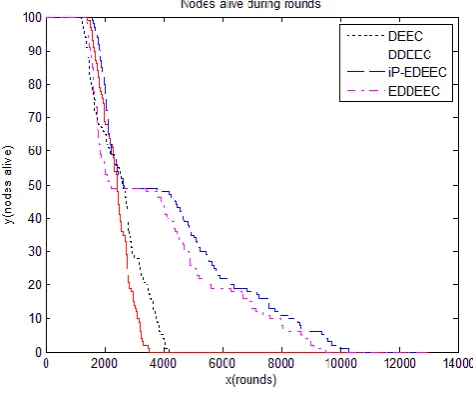
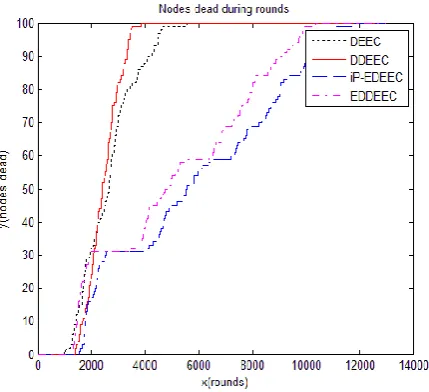
Case1. Table 2 shows performance comparison between proposed iP-EDEEC and existing protocols (DEEC, DDEEC, EDDEEC) with m=0.5, mo=0.4, a=1.5, b=3.0, figure 1, figure 2 and figure 3 are corresponding performance graphs of stability period(first node death), network lifetime (last node death) and packets send to the BS respectively. This simulation case has 50 normal nodes, 30 advance nodes and 20 super nodes.
Fig1. Nodes dead during rounds
Fig2. Nodes alive during rounds
Fig3. Packets sent to the Base station
Table2:
Protocols
compared Node First Dead
Tenth Node Dead
Last Node Dead
Packets sent to
BS DEEC 1154 1323 4696 109186 DDEEC 1320 1547 3248 79682 iP-DEEC 1448 1682 10295 372898 EDDEEC 1304 1431 9691 324123
[image:3.595.310.547.106.310.2]© 2016, IRJET | Impact Factor value: 4.45 | ISO 9001:2008 Certified Journal | Page 1905
protocols. Also the packet sent to the base station is372898 which is greater than the compared protocols.
Case2. In this case Table 3 shows performance comparison between proposed iP-EDEEC and existing protocols (DEEC, DDEEC, EDDEEC) with m=0.7, mo=0.6, a=1.7, b=3.4, fig 4, figure 5 and figure 6 are corresponding performance graphs. This simulation case has 30 normal nodes, 28 advance nodes and 42 super nodes.
Fig4. Nodes dead during rounds
In these graphs the figure 1and 4 graphs shows the stability period i.e. first node death in WSN. The figure 2 and 5 shows the graphs of network lifetime (last node death) of WSN. Then the figure 3 and 6 shows the graphs of packets send to the cluster head to base station (throughput).
Fig5. Nodes alive during rounds
[image:4.595.310.527.100.286.2]Fig6. Packets sent to the Base station
Table 3:
Protocols
Compared Node First Dead
Tenth Node Dead
Last Node Dead
Packets sent to
BS DEEC 993 1430 5562 134644 DDEEC 1390 1671 3875 89452 iP-DEEC 1572 1784 11735 535512 EDDEEC 1277 1474 10378 444213
Table 3 shows that the iP-EDEEC has more stability period and network lifetime than the other compared protocols. In iP-EDEEC first node, tenth node and last node dead at the 1572, 1784 and 11735 round respectively this is clearly higher than the other protocols. Also the packet sent to the base station is 535512 which is greater than the compared protocols.
6. CONCLUSION
[image:4.595.41.256.248.444.2]© 2016, IRJET | Impact Factor value: 4.45 | ISO 9001:2008 Certified Journal | Page 1906
REFERENCES
[1]Al-Karaki, J.N.; Kamal, AE., "Routing techniques in wireless sensor networks: a survey,"Wireless Communications, IEEE , vol.11, no.6, pp.6,28, Dec. 2004
[2] Heinzelman, W.R.; Chandrakasan, A; Balakrishnan, H., "Energy-efficient communication protocol for wireless microsensor networks," System Sciences, 2000. Proceedings of the 33rd Annual Hawaii International Conference on , vol., no., pp.10 pp. vol.2,, 4-7 Jan. 2000
[3] Anamika, Kumar, A. and Mandoria, H.L.” Study and Comparison of Distributed Energy Efficient Clustering Protocols in Wireless Sensor Network: A Review”. In i-manager’s Journal on Wireless Communication Networks, ISSN-2319-4839 Vol. 4 No. 4 Januray 2016.
[4] Li Qing, Qingxin Zhu, Mingwen Wang, Design of a distributed energy-efficient clustering algorithm for heterogeneous wireless sensor networks, Computer Communications, Volume 29, Issue 12, 4 August 2006, Pages 2230-2237, ISSN 0140-3664.
[5] P. Saini and A. K. Sharma, (2010). “E-DEEC- Enhanced Distributed Energy Efficient Clustering Scheme for heterogeneous WSN”. 1st International Conference on Parallel, Distributed and Grid Computing.
[6] ParulSaini and Ajay K Sharma. Article:Energy Efficient Scheme for Clustering Protocol Prolonging the Lifetime of Heterogeneous Wireless Sensor Networks. International Journal of Computer Applications 6(2):30–36, September 2010. [7] Elbhiri, B.; Saadane, R.; El Fkihi, S.; Aboutajdine, D.,
"Developed Distributed Energy-Efficient Clustering (DDEEC) forheterogeneous wireless sensor networks," I/V Communications and Mobile Network (ISVC), 2010 5th International Symposium on , vol., no., pp.1,4, Sept. 30 2010-Oct. 2 2010 [8] Lindsey, S.; Raghavendra, C.S., "PEGASIS:
Power-efficient gathering in sensor information systems," Aerospace Conference Proceedings, 2002. IEEE , vol.3, no., pp.3-1125,3-1130 vol.3, 2002
[9] Manjeshwar and D. P. Agarwal, "TEEN: a routing protocol for enhanced efficiency in wireless sensor networks," In 1st International Workshop on Parallel and Distributed Computing Issues in Wireless Networks and Mobile Computing, April 2001.
[10] Javaid, M. Waseem, Z. A. Khan, U. Qasim, K. Latif and A. Javaid, (2013). “ACH: Away Cluster Heads
Scheme nd for Energy Efficient Clustering Protocols in WSNs”. 2 IEEE Saudi International Electronics, Communications and Photonics Conference (SIECPC 13), Riyadh, Saudi Arabia.
[11] Thein, M.C.M.; Thein, T., "An Energy Efficient Cluster- Head Selection for Wireless Sensor Networks," Intelligent Systems, Modelling and Simulation (ISMS), 2010 International Conference on , vol., no., pp.287,291, 27-29 Jan. 2010
[12]Yingchi Mao; Zhen Liu; Lili Zhang; Xiaofang Li, "An Effective Data Gathering Scheme in Heterogeneous Energy Wireless Sensor Networks," Computational Science and Engineering, 2009. CSE '09. International Conference on , vol.1, no., pp.338,343, 29-31 Aug. 2009
[13] Manjeshwar and D. P. Agarwal, "APTEEN: A hybrid protocol for efficient routing and comprehensive information retrieval in wireless sensor networks," Parallel and Distributed Processing Symposium., Proceedings International, IPDPS 2002, pp. 195-202 [14] N. Javaid, T.N. Qureshi, A.H. Khan, A. Iqbal, E.
Akhtar, M. Ishfaq, EDDEEC: Enhanced Developed Distributed Energy-efficient Clustering for Wireless Sensor Networks, Procedia Computer Science, Volume 19, 2013, Pages 914-919, ISSN 1877-0509 [15] T. Heterogeneous N. Qureshi, N. Javaid, A. H. Khan, A. Iqbal, E. Akhtar, and M. Ishfaq, (2013). “Balanced Energy Efficient Network Integrated Super Heterogeneous Protocol for Wireless Sensor Networks”. Procedia Computer Science, Vol.19, pp.920-925.
AUTHORS
Ms Anamika is pursuing her M.Tech. From the Govind Ballabh Pant University Agriculture & technology Pantnagar, Uttarakhand, India in Information Technology, She received her B.Tech. Degree in Computer Science & engineering from College of Engineering Roorkee, Affiliated to Uttarakhand technical University Dehradun, India in 2012. Her interest includes Wireless Sensor Networks.
© 2016, IRJET | Impact Factor value: 4.45 | ISO 9001:2008 Certified Journal | Page 1907
Dr. Hardwari Lal Mandoria is currentlyworking as a Professor & Head In the Department of Information Technology, College of Technology GB Pant University of Agriculture & Technology, Pantnagar. His areas of Interest are Computer Networks, Network Security Wireless Communication, Mobile Computing, Information Security, information communication Technology