© 2015, IRJET ISO 9001:2008 Certified Journal Page 1047
Improved Fuzzy C-means Algorithm With Local Information And
Trade-Off Weighted Fuzzy Factor for Image Segmentation
Mr. Aditya P. Jadhav
1, Mr. Amar A. Dum
21
M.Tech-II (Electronics Technology) Department Of Technology, Shivaji University, Kolhapur, India.
2Assistant Professor, Department Of Technology, Shivaji University, Kolhapur, India.
---***---Abstract -
We present here an improved fuzzy c-means (IFCM) algorithm for image segmentation by introducing local information and tradeoff weighted fuzzy factor. An improved FCM algorithm is introduced to segment the image which is affected by noise, outlier or any other artifacts. The tradeoff weighted fuzzy factor depends simultaneously on the space distance of all neighboring pixels and their gray-level difference. By using this factor, the new algorithm can accurately estimate the damping extent of neighboring pixels. Also after iteration by iteration, membership values of the noisy as well as of the no-noisy pixels gradually tend to a similar value, ignoring the noisy pixels and which yields to improve segmentation accuracy. Furthermore, this algorithm is free of any parameter selection as well as prompting the image segmentation performance.Key Words: Image segmentation, fuzzy clustering,
tradeoff weighted fuzzy factor, spatial constraint.
1.
INTRODUCTION
Image processing is a method to convert an image into digital form and perform some operations on it, in order to get an enhanced image or to extract some useful information from it. Usually Image Processing system includes treating images as two dimensional signals while applying already set signal processing methods to them. It is among rapidly growing technologies today, with its applications in various aspects of a business. Image processing forms core research area within engineering and computer science disciplines too.
Image segmentation is process to partition an image into a set of different regions with uniform and homogeneous attributes such as intensity, color, tone or texture, etc. The division of an image into meaningful structures is often an essential step in image analysis, object representation, visualization, and many other image processing tasks. In this work, we focused on methods that find the particular pixels that make up an object. Many different segmentation techniques have been developed and detailed surveys can be found in references [1–3]. In this work, a clustering based method for image segmentation will be considered. Clustering does not
require any prior knowledge of the data objects and about the groups they belong to.
Data clustering is the process of dividing data elements into classes or clusters so that items in the same class are as similar as possible, and items in different classes are as dissimilar as possible. Depending on the nature of the data and the purpose for which clustering is being used, different measures of similarity may be used to place items into classes, where the similarity measure controls how the clusters are formed. In fuzzy clustering contradistinction to hard clustering, each point has a degree of belonging to cluster as in fuzzy logic, rather than belonging to just one cluster completely. The fuzzy set theory [4] was proposed, which produced the idea of partial membership of belonging described by a membership function. Thus points on the edge of a cluster may be a lesser degree of membership than points near to center of cluster [6]-[7].
Fuzzy C-Means (FCM) algorithm is one of the most widely used fuzzy clustering algorithms in image segmentation because it has robust characteristics for ambiguity and can retain much more information than hard segmentation methods [3]. This algorithm is widely preferred because of its additional flexibility which allows pixels to belong to multiple classes with varying degrees of membership. But the major operational complaint is that the FCM technique is time consuming. The drawback of the FCM is improved by the improved FCM algorithm.
© 2015, IRJET ISO 9001:2008 Certified Journal Page 1048 step, which is very time-consuming. Therefore for
reducing the computational time reference [9] proposed two variants, FCM_S1 and FCM_S2, which replace the neighborhood term of FCM_S by introducing the extra
mean-filtered image and median-filtered image
respectively. The mean-filtered image and median-filtered image can be computed in advance, so the computational complexity can be reduced. The enhanced FCM (EnFCM) proposed by [10] for further speed up FCM, which form a linearly-weighted sum image from both the local neighborhood average gray level of each pixel and original image, and then clustering is performed on the basis of the gray level histogram of summed image. Thus, the computational time of EnFCM is very small.
The fast generalized FCM (FGFCM) algorithm proposed by Cai et al. [11], which introduces a local similarity measure that combines both spatial and gray level information to form a non-linearly weighted sum image. Clustering is performed on the basis of the gray level histogram of the summed image. Thus, its computational time is also very small. However, these algorithms need some parameters a (or λ) to control the trade-off between robustness to noise and effectiveness of preserving the details.
To overcome the above mentioned problems, [12] presents a novel robust fuzzy local information c-means clustering algorithm (FLICM) to overcome the above mentioned problems, which is free of any parameter selection, as well as promoting the image segmentation performance. More recently, M. Gong, Z. Zhou, and J. Ma, [19] proposed a variant of FLICM algorithm (RFLICM), which adopts the local coefficient of variation to replace the spatial distance as a local similarity measure. It presents a more robust result. Although RFLICM algorithm can exploit more local context information to estimate the relationship of pixels in neighbors since the local coefficient of variation, it is still unreasonable to ignore the influence of spatial constraint on the relationship between central pixel and pixels in neighbors.
Although the conventional Fuzzy C-means (FCM) algorithm [5]-[8] works well on most noise-free images, it has a serious limitation, it does not incorporate any information about spatial context, which cause it to be sensitive to noise and imaging artifacts. To overcome this drawback of FCM, the obvious way is to smooth the image
before segmentation. However, the conventional
smoothing filters can result in loss of important image details, especially image boundaries or edges. More importantly, there is no way to rigorously control the trade-off between the smoothing and clustering.
In literature several other algorithms have also been proposed in order to improve the robustness of conventional FCM. We proposed here an improved fuzzy c-means (IFCM) algorithm for image segmentation by introducing a tradeoff weighted fuzzy factor and
controlling the local spatial relationship. Furthermore, this algorithm is free of any parameter selection as well as prompting the image segmentation performance.
2.
MOTIVATION
After going through the available literature, one thing came into focus is that the most of the clustering algorithms deals mainly with the Segmentation Accuracy. So for improving accuracy the iteration steps must be increased enormously. But it effects on algorithm so badly that, as the iteration steps increases the corresponding algorithm becomes sluggish and takes too much time to provide an output.
For certain applications it may not be essential that segmentation results be mostly accurate. Therefore for such applications we can minimize the iteration steps and reduce the computational time thus algorithm provides an output quickly. But this output is less accurate.
So the motivation of this work is to propose the appropriate algorithm which can balance the “Accuracy v/s Computational time” trade-off and is able to fill the gap between current demands and currently available algorithms. For the same purpose proposed algorithm introduces new Trade-off weighted fuzzy factor & uses a Non-Euclidean distance which is explained as below:
In FLICM [1], with application of the fuzzy factor, the corresponding membership values of the non-noisy pixels, as well as the noisy pixels that falling into the local window will converge to a similar, and thereby balance the membership values of the pixels that located in the window. Thus FLICM becomes more robust to outliers. Therefore fuzzy factor can reflect the damping extent of the neighbors with the spatial distance from the central pixel. In addition, the damping extent of the neighbors cannot be accurately calculated, as the same gray-level distribution and different spatial constraint [19].
Hence the motivation of this work is to design a trade-off weighted fuzzy factor for adaptively controlling the local spatial relationship. This factor depends on space distance of all neighboring pixels and their gray level difference simultaneously.
3.
PROBLEM FORMULATION
Although previous modifications in FCM can improve the weakness of FCM, such as special-type data, robust to outlier and special application area, there are still some problems. Especially, they are not enough robust to outlier and noise in the environment of unequal sized cluster data set, imaging artifacts and cannot work with non-linear data set.
© 2015, IRJET ISO 9001:2008 Certified Journal Page 1049 of dimensions and large number of data items can be
problematic because of time complexity and the effectiveness of the method depends on the definition of distance.
One prior thing that we can’t ignore is ‘Accuracy v/s Computational time’ trade-off. If the algorithm is the most accurate one (KWFLICM) then it performs large number of iteration steps which is very time consuming and if the algorithm is faster one (FCM) then it performs less number of iteration steps so it has less accurate.
No doubt that to overcome these problems and to provide optimum results, our proposed algorithms must be sandwiched in between these two algorithms. The improved Fuzzy C - Means algorithm is a solution to handle large scale data, which can select initial clustering center purposefully, reduce the sensitivity to isolated point, and avoid dissevering big cluster. By using this technique locating the initial seed point is easy and which will give more accurate and high-resolution result.
Furthermore, the improved algorithm introduced the trade-off weighted fuzzy factor as a local similarity measure to make a trade-off between image detail and noise. In addition, the trade-off weighted fuzzy factor is completely free from parameters determination & is able to incorporate the local information more exactly. Obviously the proposed algorithm improves the performance of image segmentation, as well as the robustness to the type of noises.
4.
METHODOLOGY
Although clustering is sometimes used as a synonym for segmentation techniques, we use it here to denote techniques that are primarily used in exploratory data analysis of high-dimensional measurement patterns. In this context, clustering methods attempt to group together patterns that are similar in some sense.
Motivated by the above descriptions we define certain algorithms:
1. Fuzzy C-Means (FCM) Algorithm
2. Improved Fuzzy C-Means (IFCM) Algorithm
4.1
Fuzzy C-means Algorithm
The fuzzy C-Means algorithm (FCM) generalizes the hard c-means algorithm to allow a point to partially belong to multiple clusters. Therefore, it produces a soft partition for a given dataset. In fact, it produces a constrained soft partition.
4.1.1 General Framework of FCM Algorithm Let us consider an image Ω be composed of N points, each point i belongs to Ω having a given value (gray-level)
xi.. In the FCM approach, the segmentation process of
gray-level image can be defined as the minimization of an energy function. Its objective function for partitioning a dataset {xi}Ni=1 into c clusters is defined in terms of
(1)
where║▪║denotes the Euclidean norm, cj stands for
centers of the clusters. The parameter m is a weighting
exponent on each fuzzy membership and determines the amount of fuzziness of the resulting classification. The
modified cluster centers cj and thereby updated
membership measures uij is given as
(2)
where is the distance from point i to current cluster center j and is the distance from point i to other cluster centers k.
(3)
This iteration will stop when
where k are theiteration steps and is a termination
criterion (threshold). This procedure converges to a local
minimum of Jm.
Thus, the proposed algorithm can be summarized as follows:
Step 1: Set the number c of the cluster prototypes, fuzzification parameter m, window size Niand the
stopping condition ε.
Step 2: Initialize randomly the fuzzy cluster prototypes. Step 3: Set the loop counter b = 0.
Step 4: Update the partition matrix U= (uij) using Eq. (2)
Step 5: Update the cluster prototypes using Eq. (3)
Step 6: If max |Vnew− Vold| < ε then stop, otherwise, set
b = b+ 1 and go to step 4.
Where V = [v1, v2, . . . , vc] are the vectors of the cluster
prototypes. When the algorithm has converged, a de-fuzzification process takes place to convert the fuzzy image to the crisp segmented image.
© 2015, IRJET ISO 9001:2008 Certified Journal Page 1050 4.1.2 Flowchart of FCM Algorithm
Fig -1: Flowchart of FCM Algorithm
4.2 Improved Fuzzy C-Means Algorithm
The improved FCM algorithm uses the same steps of conventional FCM except for the change in the cluster updation and membership value updation criterions. The details of the proposed algorithm, termed as IFCM for short described as below.
4.2.1 General Framework of IFCM Algorithm The objective function Jm of Improved fuzzy c-means
has been given in this way,
(4)
We introduce a tradeoff weighted fuzzy factor defined as,
(5)
The feature-weight learning is based on the similarity between samples. There are many ways to define the similarity measure, such as the related coefficient and Euclidean distance, etc. Motivated by simplicity and easy-manipulation, here for each pixel xi
with coordinate (pi , qi ), the spatial constraint reflects the damping extent of the neighbors with the spatial distance from the central pixel and defined as:
(6)
Thus, the IFCM algorithm can be summarized as follows: Step 1: Set the number c of the cluster prototypes, fuzzification parameter m, window size Ni and the stopping condition ε.
Step 2: Initialize randomly the fuzzy cluster prototypes. Step 3: Set the loop counter b = 0.
Step 4: Calculate the trade-off weighted fuzzy factor and the modified distance measurement
Step 5: Update the partition matrix using Eq. (2). Step 6: Update the cluster prototypes using Eq. (3). Step 7: If max |Vnew − Vold | < ε then stop, otherwise, set b
= b+ 1 and go to step 4.
where V = [v1, v2, . . . , vc] are the vectors of the cluster prototypes. When the algorithm has converged, a defuzzification process takes place to convert the fuzzy image to the crisp segmented image.
4.2.2 Trade-Off Weighted Fuzzy Factor
Generally speaking, a number in 0 to 1 can be assigned to a feature for indicating the importance of the feature. This factor shows that an appropriate assignment of feature-weight can improve the performance of fuzzy c-means clustering. The weight assignment is given by learning according to the gradient descent technique.
The noise resistance property of the proposed algorithm mainly relies on the fuzzy factor . The adaptive trade-off weighted fuzzy factor depends on the local spatial constraint and local gray-level constraint [3].
For each pixel xi with coordinate (pi, qi), the spatial constraint reflects the damping extent of the neighbors with the spatial distance from the central pixel. The definition of the spatial component makes the influence of the pixels within the local window change Start
Randomly select cluster centers ‘c’
Initialize fuzzy membership matrix ‘uij’
Calculate fuzzy centers ‘vij’
If
║u(k+1)-u(k)║ < Threshold
Stop Update membership
© 2015, IRJET ISO 9001:2008 Certified Journal Page 1051 flexibly according to their distance from the central pixel
and thus more local information can be used.
As in Fig. 2, it is clearly shown that the corresponding membership values of the noisy, as well as of the no-noisy pixels gradually tend to a similar value after iteration by iteration, ignoring the noisy pixels. And after five iterations the algorithm converges. In such case, the gray level values of the noisy pixels are different from the other pixels within the window, while the fuzzy factor balances their membership values. Thus, all pixels within the window belong to one cluster. Therefore, the combination of the spatial and the gray level constraints incorporated in the factor suppress the influence of
the noisy pixels. Moreover, the factor is automatically determined rather than artificially set, even in the absence of any prior noise knowledge. Hence, the algorithm becomes more robust to the outliers.
After that, we get the local coefficient of variation
Cjfor each pixel j as follow
(7)
Where, var (x) and are the intensity variance and mean in a local window of the image, respectively.
4.2.3 Significance of the Trade-Off Weighted Fuzzy Factor
The value of Cj reflects gray value homogeneity degree of the local window. It exhibits high values at edges or in the area corrupted by noise and produces low values in homogeneous regions. The damping extent of the neighbors with local coefficient of variation is measured by the areal type of the neighbor pixels located. If the neighbor pixels and the central pixel are located in the same region, such as homogeneous region or the area
corrupted by noise, the results of local coefficient of variation obtained by them will be very close, and vice versa. In addition, it helps to exploit more local context information since the local coefficient of variation of each pixel is computed in its local window. Furthermore, the weight of the neighboring pixel will be increased to suppress the influence of outlier and added the spatial constraint. Here, two cases are presented for examples.
Case 1: The central pixel is not a noise and some pixels within its local window may be corrupted by noise. A 3 × 3 window that extracted from Fig. 3(a) depicts this situation, as shown Fig. 3(b) A, marked by bold square. According to the results from the Fig. 3(b), situation A, we can see that the weighting of the pixel with the noisy pixels in its neighbors is smaller than the pixels without the noisy pixels. The more the noisy pixel is contained, the smaller the weight value is. In other words, as long as the pixel is around the noisy pixel, the damping extent of the neighbors will be increase. Then, the weighting added the spatial constraint is increased to suppress the influence of the outlier, as shown in Fig.3 (f).
© 2015, IRJET ISO 9001:2008 Certified Journal Page 1052 restriction and local gray-level relationship, we can
accurately estimate the discrepancy of neighboring pixels.
4.2.4 Flowchart of IFCM Algorithm
Fig -4: Flowchart of IFCM Algorithm
5.
MATLAB IMPLEMENTATION AND RESULTS
MATLAB stands for matrix laboratory. MATLAB is a high-performance language for technical computing. It integrates computation, visualization, and programming in an easy-to-use environment where problems and solutions are expressed in familiar mathematical notation.
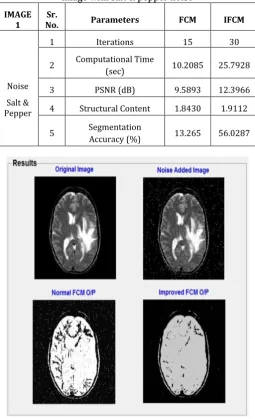
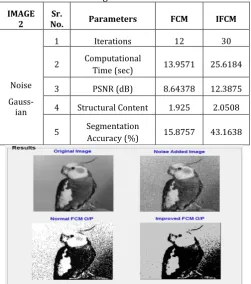
In this section, we describe the experimental results on different images with various types of noises. In addition, we test and compare the various parameters of the FCM and proposed IFCM. The significance of the
trade-off weighted fuzzy factor can be validated by comparisons between FCM and IFCM.
A. Results on Medical image
[image:6.595.37.256.146.559.2]Our first experiment applies on MR image with 256×256 pixels. The number of cluster is 2 and we test the algorithms on the image corrupted by Salt & pepper noise.
Table -1: Performance parameters calculations on the MR image with salt & pepper noise
IMAGE 1
Sr.
No. Parameters FCM IFCM
Noise
Salt & Pepper
1 Iterations 15 30
2 Computational Time
(sec) 10.2085 25.7928
3 PSNR (dB) 9.5893 12.3966
4 Structural Content 1.8430 1.9112
5 Segmentation
Accuracy (%) 13.265 56.0287
Fig -5 : Results for MR image with salt & pepper noise
B. Results on Natural image
In this experiment, algorithm applies on PARROT image with 256×256 pixels. The number of cluster is 2 and we test the algorithms on the image corrupted by Gaussian noise.
Input Image
Noisy Image
Noise
Calculate Trade-off weighted Fuzzy Factor Randomly Initialize Cluster Prototypes
Set Values of c, m,
Update Cluster Prototype
Segmented Output image Defuzzification Update Partition Matrix
Is ( - ) <
[image:6.595.306.562.221.641.2]© 2015, IRJET ISO 9001:2008 Certified Journal Page 1053 Table -2: Performance parameters calculations on the
PARROT image with Gaussian noise
IMAGE 2
Sr.
No. Parameters FCM IFCM
Noise
Gauss-ian
1 Iterations 12 30
2 Computational
Time (sec) 13.9571 25.6184
3 PSNR (dB) 8.64378 12.3875
4 Structural Content 1.925 2.0508
5 Segmentation
Accuracy (%) 15.8757 43.1638
Fig -6: Results for PARROT image with Gaussian noise
6. CONCLUSIONS
Improved fuzzy c-means algorithm introduced a reformulated spatial constraint, with the trade-off weighted fuzzy factor as a local similarity measure to make a trade-off between image detail and noise. Compared with its preexistences, it is able to incorporate the local information more exactly. In addition the trade-off weighted fuzzy factor is completely free of any parameter selection.
In our experiments, we test the proposed algorithm on different types of images. The experiment results show that the proposed algorithm improves the performance of image segmentation. Moreover it can balance accuracy v/s computation time trade-off.
REFERENCES
[1] S.Krinidis and V.Chatzis, “A robust fuzzy local information C-means clustering algorithm,” IEEE Trans. Image Process., vol. 19,no. 5,pp.1328-1337,May 2010.
[2] Tolias, Y.A.—Panas, S.M.: On Applying Spatial Constraints in Fuzzy Image Clustering Using a Fuzzy
Rule-Based System. IEEE Signal Processing Letters, Vol. 5, 1998, pp. 245–247.
[3] Maoguo Gong, Yan Liang, Jiao Shi, Wenping Ma, and Jingjing Ma, “Fuzzy C-Means Clustering With Local
Information and Kernel Metric for Image
Segmentation”, IEEE Transactions on Image
processing, vol. 22, no. 2, February 2013.
[4] S.Tan and N. A.M.Isa, “Color image segmentation using histogram thresholding fuzzy C-means hybrid approach,” pattern Recongnit.,vol.44,no 1,pp. 1-15,2011.
[5] Sayana Sivanand, “Adaptive Local Threshold
Algorithm and Kernel Fuzzy C-Means Clustering Method for Image Segmentation,” International Journal of Latest Trends in Engineering and Technology (IJLTET) volume-2-issue-3,pp.38,May-2013.
[6] J. Dunn, “A fuzzy relative of the ISODATA process and its use in detecting compact well-separated clusters,” J.Cybern., vol. 3,pp. 32-57,1974.
[7] J.Bezdek, Pattern Recongnition with Fuzzy Objective Function Algorithms, New York:Plenum, 1981.
[8] M. Ahmed, S. Yamany, N. Farag,Mohamed, A. Moriarty,”A modified fuzzy C-means algorithm for field estimation and segmemtation of MRI data,” IEEE Trans. Imag.,vol 21, no. 3,pp, 193-199, Mar. 2002.
[9] S.Chen and D. Zhang, “Robust image segmentation using and FCM with spatial constraints based on new kernel-induced distance measure,” IEEE Trans. Syst., Man, Cybern., vol.34,no 4,pp.1907-1916.
[10]L.Szilagyi, Z.Benyo,S.Szilagyii,and H. Adam, “MR brain image segmentation using an enhanced fuzzy C-means algorithm,” in proce.25th Annu.I nt. Conf. IEEE EMBS, Nov. 2003, pp. 17-21.
[11]W. Cai, S.Chen,and D. Zhang, “Fast and robust fuzzy C-means clustering algorithms incorporating local information for image segmentation,” Pattern Recognit, 40, no 3, pp. 825-838,Mar.2007.
[12]C.Fowlkes, S. Belongie, F.Chung, and J.Malik, “Spectral grouping using the Nystrom method ,” IEEE Trans .Neural Netw., vol.12,no, 2,pp. 1-12,Feb. 2004.
[13]N. Cristianini and J.S. Taylor, An Introduction to SVM’s and other kernel-Based Learning Methods. Cambridge, U.K:Cambridge,Univer.press,2000
[14]F.Masulli and a.Schenone, “A fuzzy clustering based segmentation system as support to diagnosis in medical imaging,”med,.vol. 16,no 2,pp. 129-147, 1999.
[15]K Wu and M. Yang, “Alternative C-means clustering algorithms,” pattern Recognit,vol35,pp, 2267-2278,2002.
© 2015, IRJET ISO 9001:2008 Certified Journal Page 1054
[17]F. Zhao, L.Jiao,H.Liu,and X.Gao,”A novel fuzzy clustering algorithm with non-local adaptive spatial
constraint for image segmentation,” Signal
Process,.vol 91. no. 4, pp. 988-999,2011.
[18]D. Zhang and S. Chen, “Kernel-based fuzzy clustering incorporating spatial constraints for image segmentation,” IEEE Trans,nol 12,Oct,2003.
[19]M. Gong, Z. Zhou, and J. Ma, “Change detection in synthetic aperture radar images based on image fusion and fuzzy clustering,” IEEE Trans,,Apr 2012.