R E S E A R C H
Open Access
Quantization-based image authentication
scheme using QR error correction
Wen-Chuan Wu
Abstract
Image authentication, which is provided with capabilities of tamper detection and data recovery, is an efficient way to protect the contents of digital images. Vector quantization (VQ) is a data compression method. A VQ-compressed code is not only a significant image authentication feature but also applicable in restoring possibly damaged pixels. However, if an image is tampered with, the necessary recovery information disappears. To solve this problem, this paper proposes a quantization-based image authentication scheme using two-dimensional (2D) barcodes to protect important features. Compared with older linear barcodes, 2D barcodes are a machine-readable representation of binary data that possess capabilities of location and tolerance. This paper presents a method for incorporating VQ-compressed code into 2D barcodes and embedding those barcodes into the image itself. Experimental results showed that VQ codes can be completely reserved during data recovery even though quick response codes sustain certain perceptible distortions. Moreover, the proposed scheme provided higher quality authenticated and recovered images compared with previous methods.
Keywords:Image authentication, Tamper detection, QR code, Error correction, Vector quantization coding
1 Introduction
Because of the extremely rapid advancements in com-puter technology and the Internet, an increasing number of people use digital devices, mobile phones, and tablets for data communication. As a result, more and more image and video data are emerged [1]. People cannot only deliver but access multimedia data anywhere on the Internet in a short time. These multimedia data, espe-cially the images and videos, are frequently used in com-puter vision application, for instance, feature detection, object recognition [2], visual surveillance [3], photo clus-tering, and virtual navigation in photos [4, 5]. However, some security issues exist because of open unsafe net-works. Data transmitted over networks are regularly sub-ject to active attacks [6], such as the erasing and tampering of documents or images. Destructive modifi-cations often cause the content of multimedia data to be inaccurate and further incur the difficulty or consider-able errors for subsequent computer vision application.
In general, cryptographic methods are applied to pro-tect the security of digital data by using encryption keys.
Without the correct key, illegal attackers cannot acquire the original data. However, encryption and decryption procedures are time-consuming processes, and they are thus not suitable for high-volume multimedia data [7], digital images, and videos. Image authentication [7, 8] is one of the techniques for protecting the content integ-rity of digital images from malicious and unauthorized modification. Image authentication technology can de-tect and indicate any changes or tampered regions in a tampered image. Image authentication schemes are clas-sified into two categories: active authentication [8–18] and passive authentication [19–21] schemes. The active authentication scheme involves extracting particular fea-tures of the image beforehand and then concealing them within the image itself, whereas the passive authentica-tion scheme entails authenticating images with no prior information requirement. The active image authentica-tion approach is also called fragile watermarking [12], which involves hiding a watermark in an image. The hid-den watermark is highly sensitive to any modifications in the image such that it becomes fragile and even unrecognizable when the image is modified. Hence, spe-cific locations that have been illegally modified can easily be indicated using these broken areas.
Correspondence:[email protected]
Department of Computer Science and Information Engineering, Aletheia University, 32 Zhenli St., Taipei 25103, Taiwan
Subsequently, Chen and Chen [10] employed the coeffi-cients in low-frequency wavelet subbands for preventing malicious tampering. The schemes that have been pro-posed in [14] and [15] involve applying block truncation coding and singular value decomposition, respectively, on image blocks to obtain authentication data. The aforementioned schemes are self-embedding methods of embedding the authentication data of an image into each spatial pixel bits. Moreover, all schemes provide tamper detection ability.
In addition to the described schemes, other methods with data recovery abilities are available, and such methods can restore possibly damaged regions to a state close to the original. Wang and Tsai [17] presented an automatic image authentication and recovery method applying a fractal encoding technique to the region of importance. This approach further uses the image inpainting technique to recover tampered areas for im-proving the quality of the recovered image. Yang and
Shen [18] drew an index table through vector
quantization (VQ) from the image content and used it as the important authentication and recovery data. In 2001, Wu and Hsieh [13] also used VQ coding to im-prove the embedded image quality. Chuang et al. [11] acquired the VQ indices for an image and then embed-ded multiple copies of them into other image blocks. When the image is to be authenticated, particular for-ward and backfor-ward detection mechanisms are designed to detect tampered regions more precisely.
In contrast to earlier studies, Chen and Chen [10] of-fered a distinct solution for image authentication in 2012. They employed a fashionable quick response (QR) code to protect the authentication data from being dam-aged or going missing. A QR code, an extension of the traditional linear barcode, is a type of two-dimensional (2D) matrix code. It introduces the vertical dimension, thus enabling the encoding of more data. Figures 1 and 2 depict images of a traditional barcode and novel QR code, respectively. Notably, a QR code consists of black and white dots arranged in a square; it also contains spe-cial position detection patterns placed in three corners [22] that enable it to be scanned from any direction and still be decoded correctly. QR codes are usually used to
represent concise text, product information, and web hy-perlinks. A QR code has not only a large capacity for data storage but also four levels (L, M, Q, and H) of error correction. The higher the level of error correction is, the larger the QR code size is and the greater the error correction becomes. This property enables QR codes to be read correctly even if slightly soiled or dam-aged. Thus, error correction renders QR codes more powerful and useful.
Through QR codes, Chen and Chen’s scheme can
ob-tain correct authentication data to verify image integrity. However, the scheme requires the original image to indi-cate the tampered regions. Moreover, the scheme does not have data recovery ability. Therefore, the scheme does not make good use of the error correction property of QR codes. In this study, we developed a QR code-based image authentication scheme that applies VQ
Fig. 1Traditional barcode
indices to address this problem and improve the embed-ded image quality. The rest of this paper is organized as follows. Section 2 provides a review of VQ coding and some previous relevant schemes [10, 18]. Section 3 presents the proposed image authentication scheme. Section 4 presents the experimental results showing the
improvement associated with using the proposed
scheme. The final section presents our conclusions.
2 Related methods
The proposed scheme integrates VQ coding and QR codes to achieve image tamper detection and data recov-ery. Therefore, this section first reviews the basic con-cepts of VQ in Section 2.1. Subsequently, two relevant schemes [10, 18] of image authentication are presented in Sections 2.2 and 2.3.
2.1 VQ coding
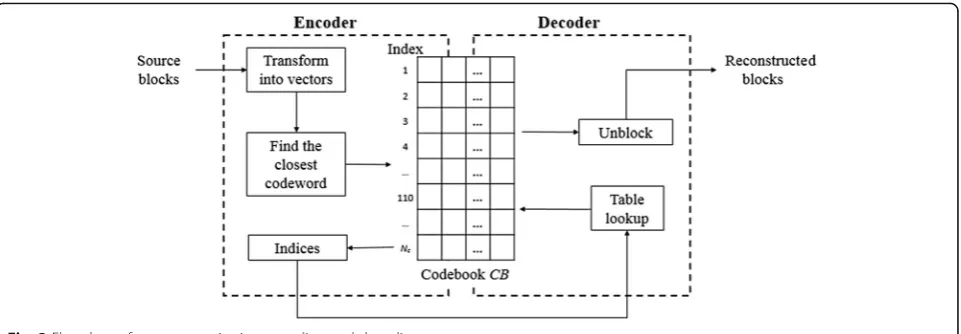
VQ [23] is a prominent lossy data compression tech-nique that guarantees the achievement of a satisfactory balance between image fidelity and compression ratio. Because of its easy implementation and simple decoding structure, the VQ technique has been widely used in a variety of research fields [24]. The concept of this tech-nique is to replace original image blocks with represen-tative patterns for the purpose of data compression. VQ comprises three procedures: (1) visual codebook gener-ation, (2) image block quantizgener-ation, and (3) index decod-ing. The codebook CB= {C1, C2, …, CNc} is a set of representative visual image vectors derived from the Linde-Buzo-Gray training algorithm [23], and each sig-nificant vector Ci is called a codeword. The generation of the codebook determines the performance of the VQ coding. VQ-based image quantization involves partition-ing an image into numerous fixed-sized blocks and then comparing them with codewords in the codebook to find the closest pattern for each input vector. On the side of the VQ encoder, each of the input blocks is compressed into an index of the codebook. That index is associated with the codebook during the index decoding procedure to rapidly reconstruct the corresponding block through a table lookup operation.
Figure 3 shows the flowchart of VQ image encoding and decoding. Consider, for example, a grayscale imageI of W×H pixels subjected to VQ coding. Initially, it is
necessary to prepare the codebook CB containing Nc
representative codewords, in which each element Ci
= (ci1,ci2,…,cik) is ak-dimensional vector. Next, imageI is divided into several non-overlapping blocks with size
n×n pixels, where k=n×n, and each image block is
then transformed into a vector X= (x1, x2, …, xk). For
block encoding, the vector X is matched with the
code-bookCBwith the lowest distortion, which can be simply
computed as follows:
d Cð btÞ ¼Min
∀i ðd Cð Þi d Cð Þ ¼i c i
j−xj
2
;
i¼ 1; 2; …;Ncandj¼ 1; 2; …;kÞ:
Notably,Cbt denotes the best-matched codeword with
the shortest distance for the vector X. Therefore, the
index value bt of the winner Cbt is recorded to replace the associated input block in order to achieve the aim of compression. The other image blocks are subsequently encoded through the same operation. The VQ encoder eventually produces a set of indices, also called an index table, to become the compressed codes of the original
image I. On the opposite side, the VQ decoder uses the
same codebook to translate the received index back for rebuilding the corresponding image block. That is, the decoder is required to perform only a simple table lookup operation to fetch the codewords in accordance with the indices. VQ has excellent performance with a low bit rate and a fast decoding process.
2.2 Yang and Shen’s scheme
In 2010, Yang and Shen [18] proposed an image authen-tication scheme for recovering the tampered image using VQ indexing. This scheme regards the VQ-compressed result, which is the index table, as important recovery information and then embeds it along with authentica-tion data into the original image. Figure 4 illustrates the
flowchart of Yang and Shen’s embedding procedure. At
the beginning, an image is processed to clear the least significant 3 bits of each pixel into zero. Subsequently,
that result is partitioned into non-overlapping n×n
image blocks. Each block is sequentially compressed using a VQ encoder to produce its corresponding VQ index. Because the codeword corresponding to that index is highly similar to the image block, it can be the recovery data of that block in the later recovery proced-ure. To protect the security of the authentication and re-covery data, Yang and Shen adopted pixel permutation to permute the embedding sequence randomly and then embedded these VQ indices into other pixel bits. Con-sider, for example, Fig. 4: supposed that the index value of the first block is 156, the value of which in binary is (10011100)2. The eight binary bits are hidden into the
permuted random pixels 12, 242, 159, and 90. Each pixel carries two binary bits of a VQ index into the second and third least significant bits (LSBs). In fact, Yang and Shen’s scheme can hide tcopies of a VQ index, wheret = (2 ×n×n)/(log2|Nc|). This scheme hides authentication data (a watermark) into the first LSB by using Wong
and Memon’s scheme [16] to create an authenticated
image.
the pixel sequence by using the same random key and then extract three LSBs from each pixel value. The first LSBs are grouped to form an output binary watermark, which is then compared with the original
watermark, just as in Wong and Memon’s scheme. If
the received image is modified in any way, either by changing pixel values or using an inappropriate secret key, then the extracted watermark bitmap becomes incorrect and consequently resembles random noise. The invalid block pixels can be recovered by fetching the hidden VQ indices from the preceding second and third LSBs and then decoding them. Because of lossy VQ compression, the restored image blocks are very close to the original contents. To avoid the loss
of the hidden VQ bits, this scheme uses t copies of
them to improve the image restoration result. How-ever, the original watermark may be required for checking image integrity and performing the image recovery process. Moreover, the process damages three LSBs of each image pixel such that the authen-ticated image quality is drastically reduced.
2.3 Chen and Chen’s scheme
In 2012, Chen and Chen [10] proposed a different solu-tion to image tamper detecsolu-tion. They efficiently utilized the properties of data storage and strong error correc-tion of QR codes to secure the authenticacorrec-tion data of an image. A QR code can hold up to 700 times more data than a typical barcode can, and it can be produced in four error correction levels. With the help of error cor-rection, the authentication data, even when tampered with, can still be completely restored without error.
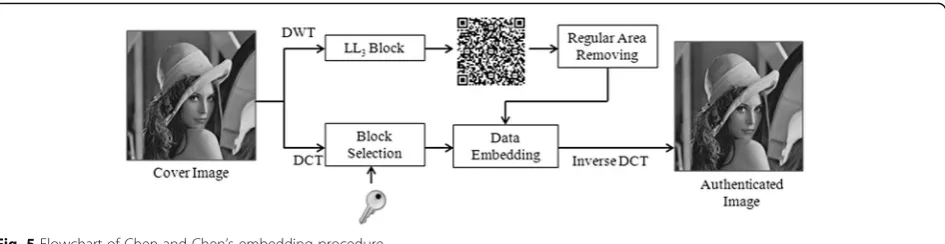
Figure 5 depicts the flowchart of Chen and Chen’s
em-bedding procedure. Initially, an original image is used to perform a discrete wavelet transform to extract a sub-band of the LL3block representing a coarse scale of that
image. The LL3block is then expressed in QR code
for-mat. The authors suggested using the M error correction level and removing a few regular areas, (e.g., position de-tection pattern, alignment pattern, and timing pattern) to generate a smaller QR code. The remaining areas serve as the authentication data. The original image is also partitioned into several small and non-overlapping Fig. 3Flowchart of vector quantization encoding and decoding
blocks, and a discrete cosine transform (DCT) is per-formed on each block. This scheme applied a secret key to randomly select block for data embedding. For each chosen block, only five high-frequency DCT coefficients are employed to conceal the aforementioned authentica-tion data. After the embedding process, these blocks are finally restored to a pixel-domain authenticated image by using an inverse DCT process.
During tamper detection, this scheme mainly adopts the readability of a QR code to verify that the re-ceived authenticated image is not a fake. First, that image is processed using a DCT and the same secret key is used to retrieve the block coefficients that were already carried with authentication data. Subsequently, the extracted bits and the regular areas that were re-moved earlier are filled into the look of a standard QR code. If the recovered QR code is not readable, the image may have been modified maliciously. By contrast, if it is readable, the data drawn out from
that code must be compared with the LL3 block of
the received authenticated image. If the two are iden-tical, the image has not been tampered with; other-wise, that image has been modified before. Because of the advantage of error correction in QR codes, Chen
and Chen’s scheme can be used to verify image
integ-rity. However, it cannot accurately locate the exact re-gions where the image has been tampered with, and it exhibits weak recovery capability.
3 Proposed scheme
To address the problems of the two aforementioned schemes, this section presents the proposed image au-thentication scheme for exploiting QR codes to protect the integrity of significant VQ authentication data. The proposed scheme involves of authentication data gener-ation procedure, image tamper detection procedure, and content reconstruction procedure. Before the authenti-cation data generation procedure is executed, it is
neces-sary to prepare a grayscale image I, called the cover
image, with W×Hpixels to be authenticated and a VQ
codebookCBwithNccodewords.
3.1 Authentication data generation procedure
The purpose of this procedure is to generate
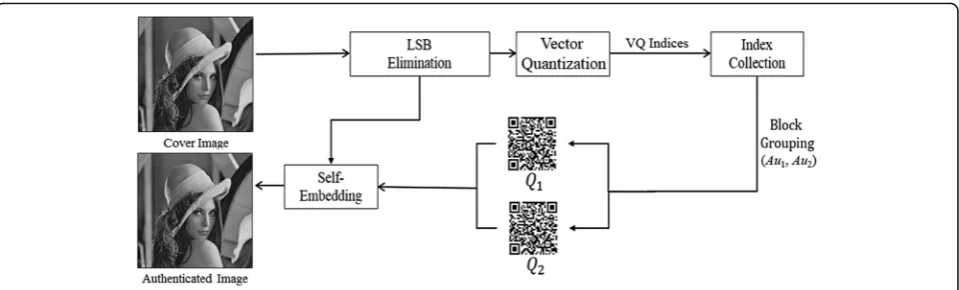
authentica-tion data from the cover image Iand then conceal them
underneath. For clarity, a flowchart of this procedure is presented in Fig. 6. An LSB elimination operation is first performed to clear the least significant 1 bit (1-LSB) of each pixel to zero for future data embedding. The resulting
image Iis then encoded using the VQ technique, where
each image block is the size ofn×npixels. The encoding result is an index table, consisting of VQ indices, and a VQ
index idxi corresponding to the ith image block. That
index table is regarded as the major authentication and re-covery data that must be embedded into imageI. Next, an operation of block grouping is introduced to reduce the volume of the VQ index table. A groupGiis defined by
Gi¼ fidxm;idxmþ1;idxmþc;idxmþcþ1g;
where
m¼ li−1 t
m
−1
2cþði−1Þ%t2þ1; c ¼W=n;t¼c=2:
Notably, each index valueidxibelongs to only one group. For example, for a 256 × 256 image and 4 × 4 blocks, there are four indices, namely idx3, idx4, idx67, and idx68 in
groupG2. That is, four adjacent blocks are included in the
same group. From each groupGi, the valueidxmis selected and collected in a set of authentication dataAu1, whereas
the value idxm+c+1 is collected in a set of authentication
data Au2. Subsequently, the two sets Au1 and Au2 are
encoded into the corresponding QR code formats Q1and
Q2, respectively, by using a dedicated code generator.
Be-cause the capacity of QR codes is limited, the block group-ing operation must be designed in the proposed scheme.
Before data embedding in imageI, image blocks must be rearranged arbitrarily according to a random sequenceRS
by using a secret key SK. This means that the seventh
modifications are widely distributed over QR codes. During the data embedding process, QR codesQ1andQ2are
hid-den into the 1-LSB of all pixels. If a module in QR codes is black, then an image pixel inIremains unchanged; other-wise, the 1-LSB of an image pixel is set to 1. The preceding data hiding processes are repeated until all the modules of the two QR codes are hidden into imageI. Finally, an au-thenticated imageĪcorresponding to the original image is generated. Only the 1-LSB of each pixel is modified; hence, the acquired imageĪis highly similar to the original image I. Conventionally, a QR code carrying more data capacity has a larger size. Because the size of QR modules is not proportional to the size of the cover image, we extend QR codes to enlarge part of the quiet zone so that the size of the QR codes is equal to that of the cover image.
3.2 Image tamper detection procedure
The main purpose of the tamper detection procedure is to accurately detect and mark the suspected modified re-gions of an authenticated image Ī*. Figure 7 shows the flowchart of the proposed tamper detection procedure. The first process entails dividing image Ī* into numerous
non-overlapping n×n blocks. These blocks are then
scrambled chaotically by using the same sequence RS
through key SK. The next process involves extracting the hidden data from the 1-LSB of each pixel and then
combining them to form two QR codes Q*1and Q*2. The
codesQ*1and Q*2carry authentication dataAu1and Au2,
respectively, and these data can be easily acquired by sub-jecting Q*1 and Q*2 to QR decoding. Simultaneously, our
scheme is also to execute the identical data generation procedure on imageĪ*in order to get its specific dataAu*1
and Au*2, where Au*1= {idx*m} and Au*2= {idx*m+c+1}. Note
that an index value appears only in none or one of two sets. By comparing values in the sets Au*1 and Au*2with
values in the setsAu1andAu2one by one, we could easily
discover where the suspected tampered blocks are. Ifidx*m inAu*1is not equal toidxminAu1, it means that them-th
block might have been tampered with already; otherwise, the m-th block is very likely correct and clear. Also, if idx*m+c+1inAu*2is not equal toidxm+c+1inAu2, it means
thatm+c+ 1-th block might be damaged; otherwise, that block is an undamaged and clear one.
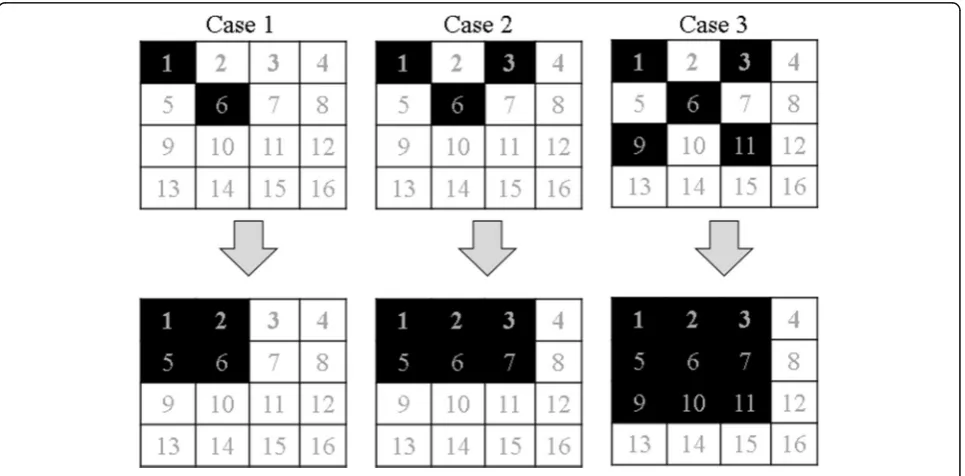
In a detected result, clear blocks are marked in white in-tensity whereas damaged ones are marked in black inten-sity. However, not all of blocks are able to be detected for content integrity. The main reason is that we introduced block grouping operation in the prior data generation pro-cedure. Half of VQ indices is recorded only in two QR codes. Hence, an additional stage is required to detect the other blocks inĪ*more accurately. The following six con-ditions are used to check an image block not including in Fig. 6Flowchart of the proposed authentication data generation procedure
the two sets Au1and Au2has been modified or not. As
long as one condition meets, this block will be regarded as a tampered one and marked in black intensity. Finally, we will derive a detected image of binary format. Figure 8 shows three detecting examples for different tampered blocks, in which the block drawn in black is damaged one. In case 1 of Fig. 8, they are detected as tampered ones be-cause the fifth block meets condition 3 and the second block meets condition 4. In addition to the second and fifth blocks, for case 2, the seventh one is also tampered block on account of condition 5.
Condition 1: Neighboring blocks on left and right are both tampered.
Condition 2: Neighboring blocks on top and bottom are both tampered.
Condition 3: Neighboring blocks on top and right are both tampered.
Condition 4: Neighboring blocks on left and bottom are both tampered.
Condition 5: Neighboring blocks on top and left are both tampered.
Condition 6: Neighboring blocks on right and bottom are both tampered.
3.3 Content reconstruction procedure
After tamper detection procedure, the next process of the proposed scheme is content reconstruction procedure so as to restore the image block, especially for the suspected tampered blocks. This procedure mainly aims at the blocks marked black in the prior detected image. Initially,
it is necessary to separate detected image into lots of non-overlappingn×nblocks. If an image block is black, it in-dicates that the block has been modified and it needs to be restored. Such modified blocks are classified into two categories: type 1 and type 2. Type For each block in type 1, its VQ index was taken down in QR codes. Owing to error correction capability of a QR code, the encoded data, VQ indices still can be restored completely and losslessly even though that code suffered from tolerable dirtied and damaged. Therefore, we can simply use the corresponding VQ indices to reconstruct the tampered blocks of type 1.
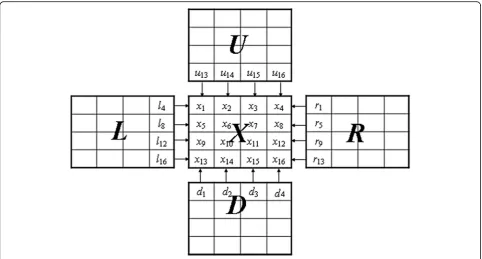
On the contrary, it is a bit hard to recover these dam-aged blocks in type 2 since their VQ indices are not re-corded beforehand. Here, we introduced a side-match prediction to reconstruct those blocks approximately. The concept of side-match prediction is shown in Fig. 9, where the middle blockXis what we want to restore and its four adjacent blocks on top, bottom, right, and left directions areU,D,R, andL, respectively. Among them, pixel values
in blocks U, D, R, and L are clear or have been
recon-structed already. The first step to restore blockXis to pre-dict its surrounding twelve pixels, that isx1,x2,x3,x4,x5,
x8, x9, x12, x13, x14, x15, and x16. The computational
for-mula about prediction are listed below:
x1¼avg lð4;u13Þ;x2¼u14;x3¼u15;x4 ¼avg r1ð ;u16Þ;x5¼l8;x8¼r5;
x13¼avg l16ð ;d1Þ;x9¼l12;x12¼r9;x16 ¼avg r13ð ;d4Þ;x14 ¼d2;x15¼d3:
Note that notation avg(S) is an average function to
return the average of the arguments in the set S.
Next step is for the middle four pixels, x6, x7, x10,
and x11, to calculate by using the surrounding known
or reconstructed pixels. Their corresponding formulas are shown below:
x6¼avg x2ð ;x5Þ;x7¼avg x3ð ;x8Þ;x10 ¼avg x9ð ;x14Þ;x11¼avg x12ð ;x15Þ:
Due to the image characteristic that neighboring pixels have extremely similar values, the prediction technique is considerably able to recover image content. It is
a
b
c
d
e
f
evident that the predicted pixels are inexact and injured, but they are very similar to the original values in general. This way is merely unsuitable to the situation of larger tampering regions. Our scheme is necessary to repeat the two steps as mentioned above until all the tampered blocks are reconstructed and a recovered image being obtained eventually.
4 Experimental results and discussion
In our experiments, six grayscale 256 × 256-pixel images were served as test images, which are “Baboon,” “ Cam-eraman,” “Chart,” “Lena,” “Pepper,”and“Sailboat”shown in Fig. 10. Each image was performed on LSB elimin-ation and vector quantizelimin-ation operelimin-ations in order to generate its index table of 4096 indices, where the size of image blocks is 4 × 4 and the codebook sizeNcis 256. Then, we took 2048 indices from those as the
authenti-cation code to create two QR codes (Q1 and Q2) of
175 × 175 pixels, where an error correction level is L. Afterward, our proposed scheme embeds two QR codes into the 1-LSB bits of that image. In order to evaluate the qualities of authenticated, tampered, and recovered images, here, the ruling metrics of peak-signal-to-noise ratio (PSNR) is adopted in the experiments. The PSNR
value indicates the fidelity between original image and modified image. In general, a higher PSNR value means that the modified image has better quality. In another word, that image is extremely similar to the original image.
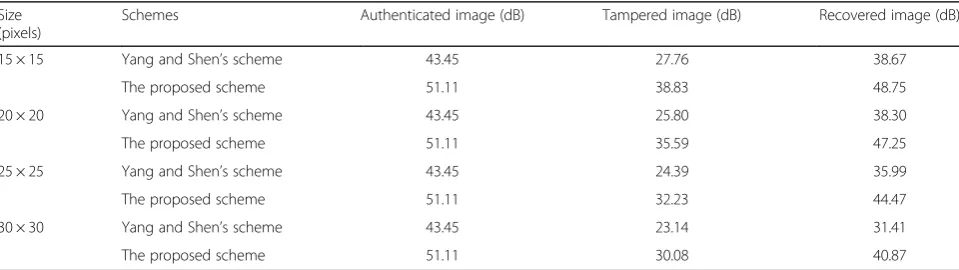
Tables 1 and 2 show the experimental results of two schemes for images“Pepper” and“Baboon,”respectively. The authenticated images generated by using Yang and
Shen’s scheme [18] and our proposed scheme are all
modified under distinct single tampering attacks. As
shown in the two tables, the size of m×mpixels is a
modifying area in a tampered image. No matter which one scheme is adopted, the larger the modifying area is, the worse the quality of tampered and recovered images will be, and vice versa. The results explicitly show that the qualities of the authenticated image in our proposed scheme reached as high as 51 dB, which is better than that of Yang and Shen’s scheme. The main reason is that
Yang and Shen’s scheme embeds authentication data
into three LSB bits of each pixel, but the proposed scheme only embeds them into one LSB bit of each pixel. On the average, in addition, our proposed scheme also produces better recovered image quality than that
of Yang and Shen’s scheme, especially for small
Table 2Results for the image“Baboon”under distinct tampering attacks
Size (pixels)
Schemes Authenticated image (dB) Tampered image (dB) Recovered image (dB)
15 × 15 Yang and Shen’s scheme 43.45 27.76 38.67
The proposed scheme 51.11 38.83 48.75
20 × 20 Yang and Shen’s scheme 43.45 25.80 38.30
The proposed scheme 51.11 35.59 47.25
25 × 25 Yang and Shen’s scheme 43.45 24.39 35.99
The proposed scheme 51.11 32.23 44.47
30 × 30 Yang and Shen’s scheme 43.45 23.14 31.41
The proposed scheme 51.11 30.08 40.87
Table 1Results for the image“Pepper”under distinct tampering attacks
Size (pixels)
Schemes Authenticated image (dB) Tampered image (dB) Recovered image (dB)
15 × 15 Yang and Shen’s scheme 43.13 24.92 43.00
The proposed scheme 51.09 35.19 43.99
20 × 20 Yang and Shen’s scheme 43.13 23.02 40.37
The proposed scheme 51.09 31.24 41.45
25 × 25 Yang and Shen’s scheme 43.13 21.69 39.55
The proposed scheme 51.09 26.99 39.63
30 × 30 Yang and Shen’s scheme 43.13 20.65 39.20
modifying areas. But, our proposed scheme will obtain a little degraded recovered results when the modifying area is getting bigger. For this reason, the proposed scheme is more suitable for small tampering areas. This is because our proposed scheme is performed based on block grouping and prediction recovery operations.
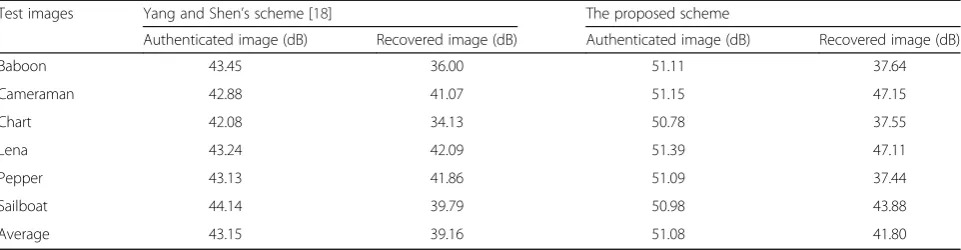
In addition to a single tampering attack, we also try to add more irregular region artifacts to the authenticated image in order to evaluate the tolerance of QR codes. Tables 3 and 4 show the comparative results of six test
im-ages using Yang and Shen’s scheme and the proposed
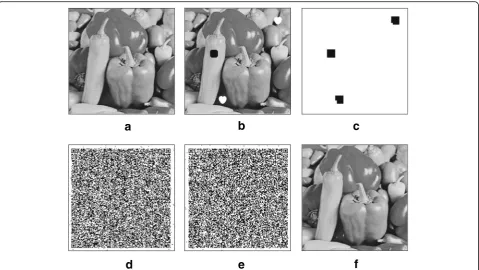
scheme, where there are two and three artifacts in each test image of Tables 3 and 4, respectively. It is obvious that the proposed scheme yields better image fidelity with higher PSNR value than the previous scheme [18] in terms of authenticated images and recovered images. Figures 11 and 12 present the subjective results based on visual qual-ity of test images“Pepper”and“Cameraman,”respectively, by using the proposed scheme. Figures 11b and 12b are the corresponding tampered image of Figs. 11a and 12a, in which we modified three irregular image areas. We ob-served from Figs. 11c to 12c that our scheme is able to de-tect and indicate tampered locations accurately without misjudgments occurred. Even though the two QR codes extracted from tampered image are a little damaged, VQ index values hidden in it still can be acquired completely
to restore suspected tampered regions as well shown in Figs. 11f and 12f.
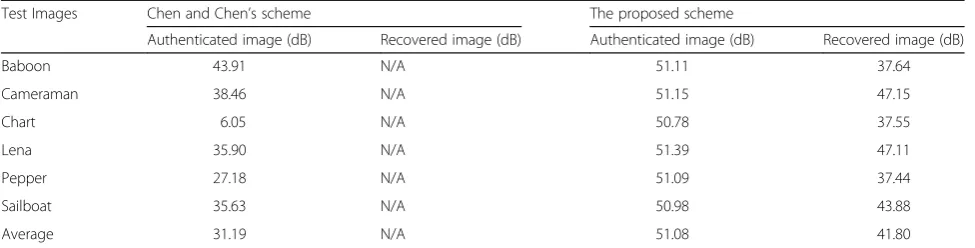
Table 5 compares the numerical results of the six
test images processed using Chen and Chen’s scheme
[10] and the proposed scheme. The results indicate that the quality of authenticated image generated from our scheme on average is superior to that
gen-erated from Chen and Chen’s scheme. Moreover, the
previous scheme yields rather degraded quality for the
image “chart” due to the usage of DCT frequency
op-eration. That means that Chen and Chen’s scheme is
inappropriate for binary images. In addition, we also attempted to modify the authenticated images in the same manner and then perform the two schemes in order to recover image content. From Table 5, it can be clearly seen that the recovered image quality of our scheme is 41.80 dB on average, whereas Chen
and Chen’s scheme failed in the recovery procedure.
The reason for this situation is that the previous
scheme [10] adopted LL3 subband, which represents
rough contours of an image, of DWT as the authenti-cation data. That scheme can neither locate tamper-ing regions nor recover them. In contrast, our scheme is not only capable of accurately detecting the suspected modified areas, but almost restoring to their original states.
Table 4Comparisons of the schemes under three modifying artifacts
Test images Yang and Shen’s scheme [18] The proposed scheme
Authenticated image (dB) Recovered image (dB) Authenticated image (dB) Recovered image (dB)
Baboon 43.45 34.30 51.11 35.37
Cameraman 42.88 40.54 51.15 47.05
Chart 42.08 32.63 50.78 35.98
Lena 43.24 42.04 51.39 46.99
Pepper 43.13 41.74 51.09 37.29
Sailboat 44.14 37.41 50.98 41.88
a
b
c
d
e
f
Fig. 12Visual results of the proposed scheme for the image“Cameraman”.a. Authenticated image (PSNR=51.15dB),b. Tampered image (PSNR=24.59dB),c. Detected result,d. Extracted QR code,e. Embedded QR code,f. Recovered image (PSNR=47.05dB)
a
b
c
d
e
f
Fig. 11Visual results of the proposed scheme for the image“Pepper”.a. Authenticated image (PSNR=51.09dB),b. Tampered image (PSNR=21.05dB),
5 Conclusions
In this paper, we proposed a simple and effective image authentication scheme based on vector quantization coding technique. It aims to extract VQ-compressed codes as the authentication and recovery data of an image and then convert them into two-dimensional QR code formats. With the capability of error correction and tolerance that QR codes have, the important confi-dential data can be protected completely and errorless. As shown in the simulation experiments, the perform-ance of proposed scheme in both image quality and de-tected result is quite satisfactory. Moreover, it is superior to the previous schemes especially for recovered images. Even though we attempt to modify authenticated images under multiple attacks, detected results of our proposed scheme are pretty exact, and recovered image quality is over 40 dB on average. The recovered images are condu-cive to later application in computer vision. In future, we will extend this current work to how to authenticate an image is real even while the photo size is changed. Furthermore, it is likely to verify the authenticity from not just one but multiple images because people often take repetitive photos from the same scene and transmit them to online repositories.
Funding
This work was supported by the Aletheia University, Taiwan, Republic of China, under the Grant AU-AR-104-004.
Competing interests
The authors declare that they have no competing interests.
Received: 29 July 2016 Accepted: 21 January 2017
References
1. I.C. Shen, W.H. Cheng, Gestalt rule feature points. IEEE Trans. Multimedia
17(4), 526–537 (2015).
2. K.E.A. van de Sande, T. Gevers, C.G.M. Snoek, Evaluation of color descriptors for object and scene recognition. IEEE Trans. Pattern Anal. Mach. Intell.
32(9), 1582–1596 (2010).
3. C.Y. Lin, W.W. Chang, Y.C. Chou, Bidirectional background modeling for video surveillance. J. Electron. Sci. Technol.10(3), 232–237 (2012). 4. H.Y. Chi, W.H. Cheng, C.W. You, M.S. Chen,What catches your eyes as you
move around? On the discovery of interesting regions in the street.,Proceedings of International Conference on Multimedia Modeling, (Miami, 2016), p. 4–6
5. T.H. Tsai, W.C. Jhou, W.H. Cheng, M.C. Hu, I.C. Shen, T. Lim, K.L. Hua, A. Ghoneim, M.A. Hossain, S.C. Hidayati, Photo sundial: estimating the time of capture in consumer photos. Neurocomputing 177, 529–542 (2016). 6. F. Ahmed, I.S. Moskowitz, Correlation-based watermarking method for
image authentication applications. Opt. Eng.43(8), 1833–1838 (2004). 7. S. Jothimani, P. Betty, A survey on image authentication techniques. Int. J.
Eng. Trends Technol.7(4), 184–186 (2014).
8. W.C. Wu and G.R. Ren, A new approach to image authentication using chaotic map and sudoku puzzle.Proceedings of the 5th International Conference on Intelligent Information Hiding and Multimedia Signal Processing, (Kyoto Japan), 628–631 (2009)
9. C.S. Chan, An image authentication method by applying hamming code. Pattern Recogn. Lett.32(14), 1679–1690 (2011)
10. J.H. Chen, C.H. Chen, Image tamper detection scheme using QR Code and DCT transform techniques. Int. J. Comput. Consum. Control1(2), 61–68 (2012)
11. J.C. Chuang, Y.C. Hu, C.C. Lo, W.L. Chen, Grayscale image tamper detection and recovery based on vector quantization. Int. J. Secur. Appl.7(6), 209–228 (2013)
12. W.C. Chen, M.S. Wang, A fuzzy c-means clustering-based fragile watermarking scheme for image authentication. Expert Syst. Appl.36(2), 1300–1307 (2009)
13. W.C. Wu and Y.P. Hsieh, Quantization- and prediction-based image authentication and recovery.Proceedings of the 5th International Conference on Genetic and Evolutionary Computing, (Kinmen Taiwan), 188–191 (2011) 14. C.M. Wu, Y.C. Hu, K.Y. Liu, J.C. Chuang, A novel active image authentication
scheme for block truncation coding. Int. J. Signal Process. Image Process. Pattern Recognit7(5), 13–26 (2014)
15. W.C. Wu and Z.W. Lin, An image content protection and tampering localization scheme using singular values.Proceedings of the 3rd International Scientific Conference on Engineering and Applied Sciences, (Okinawa Japan), 238–247 (2015)
16. P.W. Wong, N. Memon, Secret and public key image watermarking schemes for image authentication and ownership verification. IEEE Trans. Image Process.10(10), 1593–1601 (2001)
17. S.S. Wang, S.L. Tsai, Automatic image authentication and recovery using fractal code embedding and image inpainting. Pattern Recogn.41(2), 701– 712 (2008)
18. C.W. Yang, J.J. Shen, Recover the tampered image based on VQ indexing. Signal Process.90(1), 331–343 (2010)
19. S. Amtullah, A. Koul, Passive image forensic method to detect copy move forgery in digital images. J. Comput. Eng.16(2), 96–104 (2014)
20. Y.L. Chen, C.T. Hsu, Detecting recompression of JPEG images via periodicity analysis of compression artifacts for tampering detection. IEEE Trans. Inf. Forensics Secur.6(2), 396–406 (2011)
21. W. Luo, Z.H. Qu, F. Pan, J. Huang, A survey of passive technology for digital images forensics. Front. Comput. Sci. China1, 166–179 (2007)
22. K.H. Pandya, H.J. Galiyawala, A survey on QR codes: in context of research and application. Int. J. Emerg. Technol. Adv. Eng.4(3), 258–262 (2014) 23. Y. Linde, A. Buzo, R.M. Gray, An algorithm for vector quantizer design. IEEE
Trans. Commun.28(1), 84–95 (1980)
24. C. Karri, U. Jena, Fast vector quantization using a bat algorithm for image compression. J. Eng. Sci. Technol.19(2), 769–781 (2016)