
0095-1137/95/$04.0010
Copyrightq1995, American Society for Microbiology
Determination of MICs for Mycobacterium avium-M. intracellulare
Complex in Liquid Medium by a Colorimetric Method
R. GOMEZ-FLORES,
1,2S. GUPTA,
1R. TAMEZ-GUERRA,
2AND
R. T. MEHTA
1*
The University of Texas M. D. Anderson Cancer Center, Houston, Texas,
1and Facultad de Ciencias Biolo
´gicas,
Universidad Auto
´noma de Nuevo Leo
´n, San Nicola
´s de los Garza, Nuevo Leo
´n, Me´xico
2Received 13 October 1994/Returned for modification 13 January 1995/Accepted 22 April 1995
We investigated the potential of a rapid colorimetric microassay based on the reduction of
dimethylthiazol-diphenyltetrazolium bromide (MTT) for determining the growth of
Mycobacterium avium-M. intracellulare
complex (MAC) and MICs of clofazimine, resorcinomycin A, and the quinolone PD 127391 against MAC. The
reduction of MTT was directly proportional to the number of viable bacteria. A comparison of the MTT
reduction test with the [
3H]glycerol uptake assay showed the former to possess higher analytical sensitivity for
detecting MAC growth in microtiter plates. The MTT reduction test avoids the use of radioisotopes and costly
material and equipment; it is reliable, reproducible, and convenient for rapid routine susceptibility testing of
MAC.
Evaluation of bacteriostatic and bactericidal activities is
es-sential for the assessment of susceptibility to antimycobacterial
drugs before treatment and for screening and development of
new drugs. In this study, we selected Mycobacterium avium-M.
intracellulare complex (MAC) to evaluate a new method of
determining bacterial growth and the MICs of clofazimine,
resorcinomycin A, and the quinolone PD 127391 against MAC.
MAC is an intracellular pathogen that causes a high rate of
morbidity and mortality in AIDS patients (15).
When testing of MAC susceptibility to drugs is based on
growth on solid media, at least 12 days of incubation are
required (7). A rapid radiometric method (BACTEC) used
recently to determine the MIC of ansamycin for MAC
quan-tified
14CO
2
produced by mycobacteria growing in broth
con-taining
14C-labeled palmitic acid (7). MICs of drugs for MAC
also can be determined by visual inspection of bacterial growth
in microplates; however, MIC data are obtained after 2 weeks
of incubation (11).
A rapid, highly sensitive, quantitative, and less laborious
technique that does not involve the use of radioactive materials
or uncommon and expensive analytical equipment and
mate-rials is proposed in this study. The method is based on the
ability of metabolically active cells to reduce
dimethylthiazol-diphenyltetrazolium bromide (MTT) to formazan. Reduction
of tetrazolium salts by mycobacteria and other microorganisms
has been documented (12, 14).
In this study, we demonstrated that the MTT reduction assay
was very sensitive to detection of MAC growth, enabling us to
determine accurate MICs of clofazimine (a drug used for
mul-tiple-regimen therapy of MAC infections) (1, 9),
resorcinomy-cin A (10), and PD 127391 (13) against MAC.
MATERIALS AND METHODS
Antimycobacterial agents and reagents. Clofazimine was obtained from CIBA-GEIGY, Basel, Switzerland. A stock solution was prepared by dissolving 1 mg of clofazimine in 0.5 ml of dimethyl sulfoxide–0.5 ml of methanol–1.5ml of 6 N HCl. Resorcinomycin A (10) was a gift from Taichiro Komeno of Shinogi
Research Laboratories (Osaka, Japan). PD 127391, a new experimental quin-olone (13), was provided by Parke-Davis Pharmaceutical Research Division (Ann Arbor, Mich.). Stock solutions of 250mg of resorcinomycin A or PD 127391 per ml were prepared by dissolving 1 mg of the drugs in 100ml of ethanol or methanol, respectively, and volumes were adjusted to 4 ml with saline. MTT, sodium dodecyl sulfate (SDS), and N,N-dimethylformamide (DMF) were ob-tained from Sigma Chemical Co. (St. Louis, Mo.). MTT and extraction buffer were prepared as previously described (5). In brief, MTT was dissolved at a concentration of 5 mg/ml in phosphate-buffered saline at room temperature. The solution was then sterilized by filtration and stored at 48C in dark vials equipped with tight caps. It was prepared fresh every 15 days. Extraction buffer was prepared by dissolving 20% (wt/vol) SDS at 378C in a solution of 50% each DMF and demineralized water; the pH was adjusted to 4.7.
Culture and growth of mycobacteria.MAC 101, obtained from Children’s Hospital, Los Angeles, Calif., and isolates of M. avium (strain 35713) and M. intracellulare (strain 35761), obtained from the American Type Culture Collec-tion (ATCC), were maintained on slants of Lowenstein-Jensen medium (Remel, Lenexa, Kans.). Culture suspensions were prepared by growing an initial inocu-lum on Middlebrook and Cohn 7H11 agar plates (BBL, Becton Dickinson, Cockeysville, Md.) and subculturing in Middlebrook 7H9 broth (MBB) (Difco Laboratories, Detroit, Mich.) containing 0.5% glycerol (Boehringer Mannheim Biochemicals, Indianapolis, Ind.) and 10% OADC (oleic acid-albumin-dextrose-catalase) enrichment (Remel) for 72 h at 378C. The culture suspensions were shaken and sonicated in a bath type ultrasonicator (output power, 80 W; Labo-ratory Supplies Co., Hicksville, N.Y.) until visible clumps were disrupted (usually 15 to 30 s). Next, cultures were diluted in the same broth to yield a concentration of 3 Klett units/ml by using a Klett-Summerson colorimeter (Klett Manufactur-ing, Brooklyn, NY). Suspensions of 3 Klett units were frozen at2708C until used (cultures were stored no more than 1 month in a freezer, and fresh cultures were prepared monthly). The 3-Klett-unit culture suspensions were thawed, shaken, and sonicated for 90 s before use. This procedure yielded a suspension of actively growing culture containing 107viable bacilli per ml, as confirmed by plate counts
on 7H11 agar.
MTT reduction assay.Ten microliters of the 5-mg/ml stock solution of MTT was added to each well in 96-well microtiter plates containing bacteria (Becton Dickinson Co., Lincoln Park, N.J.). After incubation periods ranging from 1 to 6 h at 378C, 100ml of extraction buffer was added to each well. After overnight incubation at 378C, optical densities were measured at 570 nm by using a mi-croplate reader (Molecular Devices Corporation, Palo Alto, Calif.). MBB (in-cubated with MTT and extraction buffer) was used as a blank for resorcinomycin A and PD 127391. For clofazimine (4), the absorbances obtained with the drug alone were subtracted from those obtained with treated bacilli.
Effect of time on MTT reduction by MAC.To determine the optimal period of incubation of MAC with MTT, 20-ml volumes of MBB were inoculated with 105
bacilli per ml in 50-ml culture tubes (Becton Dickinson), which were then incubated at 378C and 160 rpm in an incubator-shaker (New Brunswick Scien-tific, Edison, N.J.) for 2 to 8 days. After each time point, 100-ml aliquots were distributed in six wells on microtiter plates. MTT was added to the wells and plates were incubated from 1 to 6 h, after which extraction buffer was added and plates were incubated overnight. Absorbances were then read.
Determination of MAC growth by MTT reduction test.The analytical sensi-tivity of the MTT test in assessing MAC growth was evaluated by incubating serially diluted MAC suspension in microtiter plates for 2, 6, and 10 days in a
* Corresponding author. Mailing address: Department of Clinical Investigations, Box 60, The University of Texas M. D. Anderson Can-cer Center, 1515 Holcombe Blvd., Houston, TX 77030. Phone: (713) 794-4851. Fax: (713) 796-1731.
1842
on May 15, 2020 by guest
http://jcm.asm.org/
humidified incubator at 378C and 5% CO2. At each time point, MTT was added
to all wells for 3 h. After extraction buffer was added and plates were incubated overnight, absorbances were determined.
Comparison of abilities of MTT test and [3H]glycerol uptake assay to deter-mine MAC growth.The analytical sensitivities of the MTT reduction test and the [3H]glycerol uptake assay to detect MAC growth in microtiter plates and in tubes
were compared. MAC growth in microtiter plates was determined by adding an inoculum of 106bacilli per ml from a 3-Klett-unit MAC suspension to wells
containing 100ml of MBB. The cultures were then grown for 2, 4, 6, 8, and 10 days in a humidified incubator at 378C and 5% CO2. After each time point, the
culture wells were incubated with MTT for 3 h. Next, extraction buffer was added and the plates were incubated overnight. Absorbances were measured as de-scribed above. For [3H]glycerol uptake assays, the same inoculum of bacteria was
added to 100ml of MBB without added glycerol. A 20-ml aliquot of [3
H]glycerol (ICN Biochemicals, Irvine, Calif.) was added to each well at a concentration of 50 mCi/ml (2). The plates were incubated for 2, 4, 6, 8, and 10 days in a humidified incubator at 378C and 5% CO2. At the end of the incubation periods,
50ml of 5.25% sodium hypochlorite was added to each well and bacteria were harvested onto fiberglass filters by using a semiautomatic cell harvester (Cam-bridge Technology, Watertown, Mass.). The filter paper discs were dried over-night in separate vials and analyzed for radioactivity incorporated into the bac-teria by using Scintiverse II (Fisher Scientific, Fair Lawn, N.J.) and a scintillation counter (Packard Instrument Company, Laguna Hills, Calif.).
MAC growth in tubes was examined by inoculating 10 ml of MBB with 105
bacilli per ml and incubating the suspension for 2, 4, 6, 8, and 10 days at 378C in an incubator-shaker at 160 rpm. After this, the tubes were sonicated in a bath type sonicator for 15 s (to disrupt visible clumps) and their contents were homogenized with a vortex mixer. One milliliter of this suspension was mixed with 100ml of MTT, and the mixture was incubated for 3 h. Next, 1 ml of extraction buffer was added and incubation was continued overnight. After this, 100-ml aliquots were distributed into each of six wells and absorbances were determined. For the [3H]glycerol uptake technique, 10 ml of MBB without added
glycerol was inoculated with 105bacilli per ml plus 1 ml of [3H]glycerol (50
mCi/ml). The tubes were then incubated at 378C for 2, 4, 6, 8, and 10 days in an incubator-shaker at 160 rpm. After each time point, 100-ml aliquots were dis-tributed into each of six wells and then 50ml of bleach per well was added and bacteria were harvested as explained above.
MIC determination.MICs were assessed by adding 20-ml aliquots of a 3-Klett-unit MAC suspension (107bacilli per ml) to each well in microtiter plates
containing the drugs diluted with 100ml of MBB (four replicate samples). The plates were prepared by adding 100ml of stock solutions (100 to 250mg/ml) of the drugs to the first well and making serial twofold dilutions up to 11 wells with MBB. Well 12 in all rows was left drug free so that these wells served as controls for bacterial growth (11). The plates were always prepared fresh immediately before inoculation. After inoculation of bacteria, the plates were incubated for 2, 4, 6, and 8 days at 378C and 5% CO2in a humidified atmosphere. The MTT
reduction test was performed after each time point, as explained above. The results obtained throughout this study were expressed as means6 stan-dard deviations for at least four replicate samples from one representative experiment; all experiments were performed three times.
RESULTS
Optimal incubation time of MAC with MTT.
To determine
an optimal incubation period of MAC with MTT dye, bacilli
were cultured for 2, 4, 6, and 8 days and then incubated with
MTT for 1 to 6 h. As shown in Fig. 1, absorbances resulting
from MTT reduction were observed to increase in a manner
proportional to days of culture. MTT reduction reached a
plateau, however, at 3 h of incubation with the dye (Fig. 1,
inset). Therefore, an incubation period of 3 h with MTT,
re-gardless of the number of days of culture, was considered
optimal for determining MAC growth by MTT uptake.
Analytical sensitivity of MTT dye for detection of MAC
growth.
The accuracy of the MTT dye in determining MAC
growth was assessed by using 10-fold serial dilutions of MAC
suspension (10 to 10
6bacilli per ml). As shown in Fig. 2, MTT
reduction correlated with the number of bacteria used to
ini-tiate cultures. As shown in the inset, detectable absorbances
were observed even with as few as 10 bacilli per ml.
Comparison of abilities of MTT test and [
3H]glycerol
up-take assay to determine MAC growth.
The analytical
sensitiv-ities of a radiometric ([
3H]glycerol uptake) assay and the MTT
colorimetric method to detect MAC growth were compared.
Microtiter plates and culture tubes under rotation were used to
culture the bacilli. When culturing MAC in microtiter plates,
we observed the MTT technique to be more sensitive than the
radiometric method in assessing the growth of bacilli. The
radiometric method was less sensitive to detecting MAC
growth during the first 8 days of culture, whereas the
colori-metric assay measured growth from day 2 of culture (Fig. 3).
FIG. 1. Effect of incubation time on MTT reduction by MAC. An inoculum of 105
bacilli per ml was grown in culture tubes under rotation. Aliquots were taken at days 2, 4, 6, and 8 and incubated with MTT for 1 to 6 h as explained in the text. Formazan was dissolved by adding extraction buffer. Absorbances were determined after overnight incubation. The inset shows the inverse plot empha-sizing the effect of incubation time of bacilli with the MTT dye on formazan production (a plateau was reached at 3 h of incubation with MTT). The data represent the means6standard deviations (error bars) for six replicate samples. Symbols for main diagram:E, incubation time of 1 h;F, 2 h;h, 3 h;■, 4 h;Ç, 5 h;å, 6 h.
FIG. 2. Effect of initial inoculum size on MTT reduction by MAC. Microtiter wells were seeded with 10-fold dilutions of MAC suspension (10 to 106
bacilli per ml) and incubated for 2, 6, and 10 days. MTT was added at each time point for 3 h, and formazan was dissolved by adding extraction buffer. Absorbances were determined after overnight incubation. The inset shows an expanded plot show-ing the absorbances obtained with low inocula of mycobacteria (10 to 103
bacilli per ml). The data represent the means6standard deviations (error bars) for four replicate samples. Symbols for main diagram:E, 106
bacilli per ml;F, 105
;
h, 104
;■, 103
;Ç, 102
;å, 10.
on May 15, 2020 by guest
http://jcm.asm.org/
When the bacilli were cultured in tubes, however, the two
methods showed comparable analytical sensitivities (Fig. 4).
MIC determination.
We preferred using microtiter plates to
determine MICs because in comparison with tubes they save
time and material. The MIC was determined as the lowest
concentration of drug that significantly inhibited bacterial
growth (as determined by a decrease in absorbances) over 4 to
8 days of treatment, did not allow resumption of growth, and
caused at least 99.6% MAC growth inhibition by day 8
(absor-bances from untreated bacilli were taken as a control for MAC
growth; percent reductions of absorbances for treated bacteria
compared with the control were expressed as MAC growth
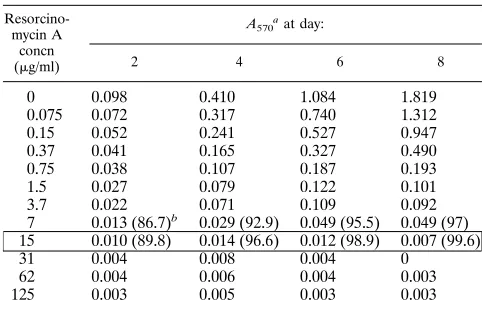
inhibition). As the data in Tables 1, 2, and 3 demonstrate, the
MICs of clofazimine, resorcinomycin A, and PD 127391
against MAC were 3, 15, and 31
m
g/ml, respectively. We found
the MICs of clofazimine against M. avium (strain 35713) and
M. intracellulare (strain 35761) to be 1.5 and 3
m
g/ml,
respec-tively (Tables 4 and 5). Solvents used to prepare the drugs had
no effect on mycobacterial growth (data not shown).
DISCUSSION
[image:3.612.60.295.72.238.2]Susceptibility of mycobacteria to drugs is usually tested by
determining the MIC (6). Susceptibility testing of MAC has
not been standarized, although a radiometric method
(BACTEC) has been used in some laboratories (7, 8). The
BACTEC method requires less time and labor than do
con-ventional methods (sampling and plating [7] or determining
the MIC in 7H10 agar medium [3]). However, it requires the
use of radioactive materials and costly analytical equipment.
Determining MICs by visual inspection gives a good estimation
of MAC susceptibility to drugs. It usually takes 2 weeks,
how-ever, to obtain confirmatory data (11).
FIG. 3. Determination of MAC growth by MTT test and [3
H]glycerol uptake in microtiter plates. The capacities of the MTT reduction test and [3
H]glycerol uptake assay to assess MAC growth in microtiter plates were compared. An inoculum of 106
bacilli per ml was grown in plates for 2 to 10 days. MTT was added at each time point for 3 h, and formazan was dissolved by adding extrac-tion buffer. Absorbances were determined after overnight incubaextrac-tion. For [3
H]g-lycerol uptake experiments, bacteria were harvested after each time point and radioactivity incorporated within bacilli was determined as explained in the text. The data represent the means6standard deviations (error bars) for four rep-licate samples.
FIG. 4. Determination of MAC growth by MTT test and [3
H]glycerol uptake in culture tubes. The capacities of the MTT reduction test and [3
H]glycerol uptake assay to assess MAC growth in culture tubes were compared. An inoc-ulum of 105
bacilli per ml was grown in tubes for 2 to 10 days with rotation, as explained in the text. Aliquots were then transferred to microtiter plates at each time point, and MTT was added for 3 h. Formazan was dissolved by adding extraction buffer, and absorbances were determined after overnight incubation. For [3
[image:3.612.315.555.82.229.2]H]glycerol uptake experiments, aliquots were similarly transferred to plates at each time point and bacteria were harvested. Radioactivity incorporated in bacilli was then determined as explained in the text. The data represent the means6standard deviations (error bars) for six replicate samples.
TABLE 1. Determination of MIC of clofazimine against MAC 101
Clofazimine concn (mg/ml)
A570aat day:
2 4 6 8
0 0.431 0.837 1.406 2.435
0.037 0.184 0.539 1.146 1.988
0.075 0.149 0.443 0.859 1.772
0.15 0.116 0.286 0.521 1.339
0.37 0.087 0.118 0.137 0.294
0.75 0.060 0.054 0.053 0.071
1.5 0.055 (87)b 0.039 (95) 0.027 (98) 0.066 (97)
3 0.039 (91) 0.016 (98) 0.006 (99.6) 0.004 (99.8)
6 0.019 0 0 0
12 0.007 0 0 0
25 0.005 0 0 0
50 0.003 0 0 0
a
Standard deviations from the absorbances shown are less than 5%. b
Values in parentheses correspond to MAC growth inhibition (percentage of control value at each time point).
TABLE 2. Determination of MIC of resorcinomycin A against MAC 101
Resorcino-mycin A
concn (mg/ml)
A570 a
at day:
2 4 6 8
0 0.098 0.410 1.084 1.819
0.075 0.072 0.317 0.740 1.312
0.15 0.052 0.241 0.527 0.947
0.37 0.041 0.165 0.327 0.490
0.75 0.038 0.107 0.187 0.193
1.5 0.027 0.079 0.122 0.101
3.7 0.022 0.071 0.109 0.092
7 0.013 (86.7)b 0.029 (92.9) 0.049 (95.5) 0.049 (97)
15 0.010 (89.8) 0.014 (96.6) 0.012 (98.9) 0.007 (99.6)
31 0.004 0.008 0.004 0
62 0.004 0.006 0.004 0.003
125 0.003 0.005 0.003 0.003
a
Standard deviations from the absorbances shown are less than 5%. b
Values in parentheses correspond to MAC growth inhibition (percentage of control value at each time point).
on May 15, 2020 by guest
http://jcm.asm.org/
[image:3.612.59.294.475.634.2] [image:3.612.314.555.546.701.2]Our study demonstrated that MICs can be determined by
measuring MAC growth for 8 days by the MTT reduction
assay. The MTT reduction test (the optimal incubation period
of MAC with MTT was 3 h; longer periods did not increase
formazan production significantly [Fig. 1]) could detect the
progression of growth of different sizes of inoculum (10 to 10
6bacilli per ml) with a high degree of analytical sensitivity, as
shown in Fig. 2. When we compared this technique with a
conventional method (measuring [
3H]glycerol uptake) (2) to
determine MAC growth, we observed that the MTT test was
able to monitor growth whether the bacteria were grown in
microtiter plates or culture tubes (Fig. 3 and 4). The
radiomet-ric technique was less sensitive to detection of MAC growth
during the first 8 days of culture in microtiter plates (Fig. 3);
this was probably because the method is limited to detecting
high numbers of growing bacteria. However, when MAC was
cultured in tubes under rotation (which facilitates MAC
growth), the analytical sensitivities of the radiometric and
colo-rimetric techniques were comparable (Fig. 4); reduced
absor-bances (formazan production) or counts per minute ([
3H]glyc-erol uptake), observed after 8 days of culture, may be caused
by a decline in the number of viable organisms cultured in
tubes, as reported by others (7), or they may occur because the
stationary phase has been reached (Fig. 4).
The ability of the MTT test to assess mycobacterial growth,
as demonstrated in this study, enabled us to determine the
MICs of drugs against MAC (Tables 1, 2, and 3). The reported
MICs of clofazimine and resorcinomycin A (1 and 8
m
g/ml,
respectively) were determined after 2 weeks of culture by
vi-sual inspection (11); the MICs of these drugs reported in the
present study (3 and 15
m
g/ml, respectively) were obtained at 8
days of culture by the MTT reduction test. The MTT test’s
analytical sensitivity, however, resulted in slightly higher MICs
of these drugs. We also determined the MICs of clofazimine
against M. avium (strain 35713) and M. intracellulare (strain
35761) by this technique (Tables 4 and 5). Thus, determination
of the MICs of drugs by the MTT method could be used for
other species of mycobacteria as well. The MTT method was
found to be faster and more accurate in determining the effect
of drugs on MAC growth than visual inspection was.
In conclusion, we support the MTT assay as a rapid, highly
sensitive, and quantitative colorimetric microassay for
suscep-tibility testing of MAC. It does not require the use of
radio-isotopes or costly materials and equipment. It is based on the
reduction of MTT to formazan by metabolically active cells,
and allows accurate and reproducible determination of MICs
of drugs against MAC. We believe that this is a promising
technique for rapid and convenient routine susceptibility
test-ing of MAC and other species of mycobacteria.
ACKNOWLEDGMENTS
This work was supported by grant ATP 00015030 from the Texas Higher Education Coordinating Board to R.T.M. S.G. was a college student trainee under the summer training program at The University of Texas M. D. Anderson Cancer Center, Houston.
We thank K. V. Rolston for providing the experimental quinolone PD 127391 and Lore Feldman for editorial assistance.
REFERENCES
1. Agins, B. D., D. S. Berman, D. Spicehandler, W. EL-Sadr, M. S. Simberkoff,
and J. J. Rahal.1989. Effect of combined therapy with ansamycin, clofazi-mine, ethambutol, and isoniazid for Mycobacterium avium infection in pa-tients with AIDS. J. Infect. Dis. 159:784–787.
2. Blanchard, D. K., M. B. Michelini-Norris, and J. Y. Djeu. 1990. A rapid [3
[image:4.612.58.297.83.231.2]H]glycerol radioassay for determination of monocyte-mediated growth in-hibition of disease due to Mycobacterium avium. J. Immunol. Methods 133: 285–290.
TABLE 4. Determination of MIC of clofazimine against M. aviuma
Clofazimine concn (mg/ml)
A570bat day:
2 4 6 8
0 0.460 1.317 2.700 3.232
0.037 0.393 0.887 1.606 2.049
0.075 0.207 0.665 1.208 2.122
0.15 0.140 0.403 0.347 1.301
0.37 0.088 0.261 0.140 0.353
0.75 0.087 (81)c 0.082 (93.7) 0.040 (98.5) 0.096 (97)
1.5 0.049 (89) 0.054 (95.9) 0.021 (99) 0.011 (99.7)
3 0.041 0.005 0 0
6 0.022 0 0 0
12 0.017 0 0 0
25 0 0 0 0
50 0 0 0 0
aATCC 35713.
[image:4.612.314.555.88.241.2]bStandard deviations from the absorbances shown are less than 5%. cValues in parentheses correspond to MAC growth inhibition (percentage of control value at each time point).
TABLE 5. Determination of MIC of clofazimine against M. intracellularea
Clofazimine concn (mg/ml)
A570bat day:
2 4 6 8
0 0.221 0.909 2.945 3.380
0.037 0.179 0.543 1.928 3.390
0.075 0.170 0.418 1.159 2.307
0.15 0.157 0.325 0.619 1.686
0.37 0.151 0.154 0.222 0.393
0.75 0.105 0.078 0.062 0.094
1.5 0.103 (53)c 0.037 (95.9) 0.020 (99.3) 0.030 (99.1)
3 0.060 (72.8) 0.012 (98.7) 0.007 (99.8) 0 (100)
6 0.040 0 0 0
12 0.016 0 0 0
25 0 0 0 0
50 0 0 0 0
aATCC 35761.
bStandard deviations from the absorbances shown are less than 5%. cValues in parentheses correspond to MAC growth inhibition (percentage of control value at each time point).
TABLE 3. Determination of MIC of PD 127391 against MAC 101
PD 127391 concn (mg/ml)
A570aat day:
2 4 6 8
0 0.102 0.416 1.076 1.709
0.075 0.047 0.106 0.152 0.154
0.15 0.035 0.065 0.096 0.070
0.37 0.031 0.046 0.067 0.040
0.75 0.024 0.038 0.048 0.032
1.5 0.020 0.035 0.042 0.027
3.7 0.019 0.027 0.034 0.024
7 0.014 0.024 0.034 0.017
15 0.013 (87)b 0.017 (95.9) 0.024 (97.8) 0.016 (99)
31 0.008 (92) 0.006 (98.6) 0.003 (99.7) 0 (100)
62 0.006 0.002 0.001 0
125 0 0.001 0 0
a
Standard deviations from the absorbances shown are less than 5%. b
Values in parentheses correspond to MAC growth inhibition (percentage of control value at each time point).
on May 15, 2020 by guest
http://jcm.asm.org/
[image:4.612.57.297.547.699.2]3. Cynamon, M. H. 1985. Comparative in vitro activities of MDL 473, rifampin, and ansamycin against Mycobacterium intracellulare. Antimicrob. Agents Chemother. 28:440–441.
4. Garrelts, J. C. 1991. Clofazimine: a review of its use in leprosy and Myco-bacterium avium complex infection. DICP Ann. Pharmacother. 25:525–531. 5. Hansen, M. B., S. E. Nielsen, and K. Berg. 1989. Re-examination and further development of a precise and rapid dye method for measuring cell growth/ cell kill. J. Immunol. Methods 119:203–210.
6. Heifets, L. 1988. Qualitative and quantitative drug-susceptibility tests in mycobacteriology. Am. Rev. Respir. Dis. 137:1217–1222.
7. Heifets, L. B., M. D. Iseman, P. J. Lindholm-Levy, and W. Kanes. 1985. Determination of ansamycin MICs for Mycobacterium avium complex in liquid medium by radiometric and conventional methods. Antimicrob. Agents Chemother. 28:570–575.
8. Heifets, L. B., M. D. Iseman, and P. J. Lindholm-Levy. 1986. Ethambutol MICs and MBCs for Mycobacterium avium complex and Mycobacterium tuberculosis. Antimicrob. Agents Chemother. 30:927–932.
9. Hoy, J., A. Mijch, M. Sandland, L. Grayson, R. Lucas, and B. Dwyer. 1990. Quadruple-drug therapy for Mycobacterium avium-intracellulare bacteremia in AIDS patients. J. Infect. Dis. 161:801–805.
10. Kundo, E., T. Katayama, Y. Kawamura, Y. Yasuda, K. Matsumoto, K. Ishii,
T. Tanimoto, H. Hinoo, T. Kato, H. Kyotani, and J. Shoji.1989. Isolation and characterization of new antibiotics resorcinomycins A and B. J. Antibiot.
42:1–6.
11. Mehta, R. T., A. Keyhani, T. J. McQueen, B. Rosenbaum, K. V. Rolston, and
J. J. Tarrand.1993. In vitro activities of free and liposomal drugs against Mycobacterium avium-M. intracellulare complex and M. tuberculosis. Antimi-crob. Agents Chemother. 37:2584–2587.
12. Peck, R. 1985. A one-plate assay for macrophage bacterial activity. J. Im-munol. Methods 82:121–140.
13. Rolston, K. V., D. H. Ho, B. Leblanc, and G. P. Bodey. 1990. In vitro activity of PD 127391, a new quinolone, against bacterial isolates from cancer pa-tients. Chemotherapy 90:365–372.
14. Thom, S. M., R. W. Horobin, E. Seidler, and M. R. Barer. 1993. Factors affecting the selection and use of tetrazolium salts as cytochemical indicators of microbial viability and activity. J. Appl. Bacteriol. 74:433–443. 15. Wallace, J. M., and J. B. Hannah. 1988. Mycobacterium avium complex
infection in patients with the acquired immunodeficiency syndrome. A clin-icopathologic study. Chest 93:926–932.

![[Barbee Davis] 97 Things Every net pdf](data:image/gif;base64,R0lGODlhAQABAIAAAP///wAAACH5BAEAAAAALAAAAAABAAEAAAICRAEAOw==)