© 2016, IRJET | Impact Factor value: 4.45 | ISO 9001:2008 Certified Journal
| Page 867
Design and Implementation of Modified CORDIC based FFT using Vedic
Multiplication Techniques
K Nagapramodh
1and Hemanth Kumar K.S
21
M.Tech Student, Dept. of E.C.E., UTL Technologies Ltd, Karnataka, India
2
Assistant Professor, Dept. of E.C.E., UTL Technologies Ltd, Karnataka, India
---***---Abstract –Time management is a very important issue in
today’s high speed day-to-day human life. Most essential thing in the time management is the uses of high speed devices which reduces the human effort and required time. The processor speed is the main requirements of any high speed devices. The speed is the main issue in any DSP processors due to the uses of large amounts of hardware resources. The main component cause this delay or frequency issue is the uses of conventional multipliers. In this paper, we proposed the implementation of FFT processor using modified CORDIC and Vedic multiplier to reduce the delay. The simulation and synthesis result shows that the proposed architecture can be able to process data faster than existing algorithms.
Key Words: Fast Fourier Transform, Vedic Multiplication, Modified CORDIC algorithm,Butterfly diagram, FPGA Implementation.
1.
INTRODUCTION
In today’s high speed era the trends is all day-to-day life gadgets must operate at high speed and the area of the device is less. Reducing area also indirectly effects battery life of the corresponding devices. To overcome from this problem the hardware and software of the device is designed in compact way that it does not require large amount of resources and operating frequency is high. Normally DSP systems uses large amount of resources and it’s operating frequency also lower. This is because all the DSP calculations involve complex mathematics which will requires large amounts of hardware resources. Also all those DSP calculations consists of a large amount of multipliers. This is a major component of most DSP systems. Normally hardware multiplier architectures require large amount of resources [1] in-terms of basic gates. As a result the number of multipliers increase will directly effects on the maximum operating frequency of the device and increase the area requirements. So, in most DSP system reducing multiplier with other elements is a main key feature to increase frequency and reduce area. But it is not suitable for all scenarios occurred in DSP systems. As a result a large number of multiplier remains after fine tuning of the algorithm.
To overcome that problem removing of multiplier with equivalent elements does not work along. With this
removing we must have to find some approach for implementing multiplier with reduced logic utilizations. The types of multipliers can be broadly divided into three parts [2] in electrical systems as Binary Multiplier, Analog Multiplier, Frequency Multiplier etc.
Since normally digital systems are used to implement all DSP processor so, we consider only digital multipliers. Digital multipliers are mainly divided into two categories [3] as Based on Sign and Based on Architecture.
Based on sign we can divide into two way as
I. Signed Multiplier: In this case both input and output can be either positive or negative binary numbers.
II. Unsigned Multiplier: In this case both input and output only positive binary numbers. It won’t support negative binary values.
Based on on the verity of architectures we can classify multipliers as
I. Baugh-Wooly Multiplier II. Wallace-Tree Multiplier III. Dadda Multiplier IV. Booth Multiplier
V. BKM Algorithm
VI. Modular Multiplication etc.
Also we can be able to change the performance of the multipliers by changing adder structures. Different types of adder structures are given below [3] as
I. RCA (Ripple Carry Adder) II. CLA (Carry Look-ahead Adder) III. CSA (Carry Save Adder) IV. CScipa(Carry Skip Adder) etc.
2.
LITERATURE SURVEYS
© 2016, IRJET | Impact Factor value: 4.45 | ISO 9001:2008 Certified Journal
| Page 868
multiplier is designed by using those predefined block.Parallel addition is used to increase the operating frequency of the design. To design efficient multiplier “Urdhva Tiryakbhyam” sutra is used. The proposed architecture is implemented on Spartan-3 FPGA board. Sreelekshmi et al., [2] uses Vedic multiplier to construct high speed MAC unit. To increase the speed of the MAC unit they replace normal multiplier by high speed Vedic multiplier. They design 32x32 bit multiplier using “Urdhva Tiryakbhyam” sutra. Also the normal adders structures are replaced by CSA (carry save adders). The proposed design is implemented using Xilinx ISE 10.1 and the coding is done by using HDL language. The structure produce 24.1 ns delay.Gaurav Sharma et al., [3] compare the delay introduced by different types of adders present in Vedic multiplier architecture. To implement 4x4 Vedic multiplier “Urdhva Tiryakbhyam” sutra is used. The conventional adder present in the architecture is replaced by CSA (carry save adder), CLS (carry lookahead adder) and RCA (ripple carry adder). Each architecture is implemented using VHDL language and the delay introduced by those architecture is measures on Xilinx Spartan-3 FPGA board. The result shows RCA present in Vedic multiplier shows minimum delay than others.Premananda B.S. et al., [4] proposed implementation of 8x8 Vedic multiplier. Here the Vedic mathematics is mainly used to generate partial products faster than conventional method. They propose carry skip addition techniques to increase the speed of multiplication. They implement 8-bit Vedic multiplier using 4x4 multiplier using both carry skip and ripple carry adder. The implementation is done in Xilinx Spartan-3 FPGA and the coding is done using HDL language. The proposed multiplier can be able to operate at higher frequency than existing.Pusphalata Verma [5] shows efficient way to implement Vedic multiplier (4x4) using Electronic Design Automation (EDA) tool. To implement 4x4 Vedic multiplier they used Xilinx 12.1i EDA tool and the coding is done by using VHDL language. They compared the proposed Vedic multiplier with conventional multiplier by synthesizing the proposed model in Spartan-3 FPGA board. Vedic multiplier can be able to operate much faster than conventional multiplier using less hardware resources.Poornima et al., [6] shows efficient hardware implementation of multiplier using Vedic mathematics. The proposed method used ripple carry adders (RCA) to generate partial products. They implement 8x8 multiplier using two 4x4 multipliers. The proposed design is implemented on Spartan-3 FPGA board and VHDL language is used to write coding part. The proposed multiplier produce 28.27 ns delay. Irine and Suchitra [7] propose Vedic multiplication based on floating point arithmetics. Due to this floating point calculations the accuracy of this multiplier increase in-terms of truncation errors. The proposed structure used ripple carry adders to generate intermediate products. The total multiplication procedure is divided into calculation unit and control unit. In calculation unit mantissa and exponent calculation is done. Along with this sign control also taken care by this unit. The architecture is implemented on Virtex-2 FPGA board.Keerthi and Manoj [8] proposed Vedic multiplier design using modified Gate Diffusion Input (GDI)
© 2016, IRJET | Impact Factor value: 4.45 | ISO 9001:2008 Certified Journal
| Page 869
compare the performance of both radix-2 and radix-4architecture. The proposed architecture is implemented on Spartan-3 board. The result shows reduction in hardware resources in the case of radix-4 structure.Aniket and Mayuresh [18] perform comparisons between various techniques used to implement FFT in hardware. For this comparisons they consider 256 and 1024 point FFT and to implement those in hardware they use radix-2, radix-4 and rader-brenner algorithm. VHDL language is used for coding and Xilinx tool is used for synthesis. The result shows small decrease in hardware requirements in the case of rader-brenner algorithm.Abhishek Gupta et al., [19] proposed FFT processor where normal multiplier is replaced with Vedic multiplier to increase the operating frequency and reduce area requirements. In the paper they modified the structure to achieve high frequency. The synthesis report prove that the operating frequency is more than existing.Subha Sri et al., [20] surveys different types of CORDIC implementation to understand advantages and disadvantages of each architectures. For this comparison they used folded structure, unfolded structure and parallel structure. The parallel structure shows high speed operation with the cost of area requirements.
3.
BASIC THEORIES
In this section we describe all basic theory used to implement the total architecture.
3.1.
Fast FourierTransforms
FFT is a form of Discrete Fourier Transform (DFT). The FFT reduce the time and computational complexity arises in DFT. This is a domain transform technique. It converts time domain information to frequency domain information and vice-versa. The equation of forward FFT is given below
( ) ∑
( )
(1)
Since we implement all stage parallel so it is parallel FFT.
Fig -1: Butterfly diagram of 4 point FFT
3.2.
Basic CORDIC Algorithm
The CORDIC (CO ordinate Rotation Digital Computer) [1] is based on the convention of 2D geometry. Jack E. Volder reported the first algorithm on the iterative reckoning functions of trigonometry, division and
multiplication in 1959. The popularity of CORDIC was intensify there after primarily due to economical implementation of applications which includes the trigonometric, logarithmic, multiplication of complex number, inverse of matrix ,computation of Eigen-value, linear systems solution and singular value decomposition (SVD) for signal processing, image processing, and general scientific computation. Some other prominent and forthcoming applications are: 1) Robot manipulation: Direct and Inverse Kinematics figuring 2) Synthesis and communication of speech/music : Digital Modulation and coding , Synthesis of Direct Frequency 3) Graphics and Animation: Planar and 3D vector rotation. Although CORDIC technique may not be the fastest in performing these operations, it is attractive because of hardware implementation simplicity, as the same iterative algorithm should be make used in all these applications using the basic add and shift operations.This method is based on trial and error method for calculating the sine and cos value of corresponding input angles. From the algorithm we can write the rotation matrix R as
[
] (2) ( ) [ ] (3)
We can rewrite the above equation as
[ ] (4)
( ) (5) So, now
( ) [ ] (6)
Where
√
By taking account all those equation we can write equation for CORDIC rotation mode
(7)
The basic block diagram of CORDIC rotation mode is shown in Fig. 2
[image:3.595.54.269.573.686.2] [image:3.595.316.554.597.747.2]© 2016, IRJET | Impact Factor value: 4.45 | ISO 9001:2008 Certified Journal
| Page 870
3.3.
Vedic Multiplications
In Vedic mathematics there are two sutras, which are applicable for multiplication. They are Urdhva-Tiryakbyham and Nikhilam Navatascaramam Dasatah.
3.3.1. Urdhva-Tiryakbyham Sutra
This sutra can be able to perform all kinds of multiplication. In this case all partial products are generated and then the concurrent addition of these partial products can be done. This sutra is used to obtain parallelism of partial products and their summation. The algorithm can be generalized for n × n bit number. The algorithm calculates partial products and their sums in parallel manner. The same amount of time to calculate the product is needed by the multiplier and hence it is possible to maintain high clock frequency. The multiplication procedure of two decimal numbers 14 ×15 is given below. The digits on the both sides of the lines are multiplied and added with the carry generated from the previous step.
Fig -3: Multiplication of Decimal Numbers Using Urdhva Sutra
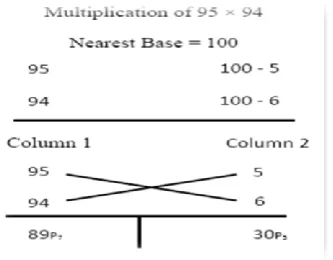
3.3.2. Nikhilam Navatascaramam Dasatah Sutra The sutra basically means start from the leftmost digit and begun subtracting’9’from each of the digits; but subtract ‘10’ from the last digit. To subtract 4679 from 10000, all the digits except the last digit are subtracted from 9 and the last digit is subtracted from 10, yielding 5321. This sutra is more efficient when the numbers involved are large.
One example of this sutra is given below
Fig -4: Multiplication of Decimal Numbers Using Nikhilam Sutra
4.
PROPOSED ARCHITECTURE
The proposed CORDIC based FFT architecture is shown in Fig. 5 where proposed CORDIC based FFT block consists of Controller, Modified CORDIC Block and 4 point DIT-FFT. The controller is used to control the operation of total block by activating and deactivating each block at correct clock sequence. Each block is explained in brief below
Fig -5: Proposed CORDIC based FFT 4.1. Modified CORDIC
The basic CORDIC equation consists of a large amount of constant multiplier. To increase the operating frequency and reduce area we replace the constant multiplication by corresponding shifts. So, the modified equation for CORDIC is given below
( )
( )
(8)
Where, (>>i) is left shift by ith position.
[image:4.595.315.548.197.459.2] [image:4.595.57.271.338.423.2] [image:4.595.82.249.583.713.2]© 2016, IRJET | Impact Factor value: 4.45 | ISO 9001:2008 Certified Journal
| Page 871
Fig -6: Internal Structure of Proposed CORDICAnother problem in basic CORDIC is it can able to produce output from angle -99.9° to +99.9°, to overcome from this problem we use one preprocessing unit before the CORDIC block which is shown in Fig 7. Through this the unit can be able to process angle present in any one of the four quadrants.
Fig -7: Modified CORDIC Architecture 4.2. Modified FFT
The radix-2 FFT algorithm is performed to generate N point DII-FFT. The twiddle factors are generated through CORDIC processor using N point samples as input. The Sinθ and Cosθ values of twiddle factors for variable angles are multiplied with an input to obtain N point FFT samples. The equation for FFT is given as
[ ] ∑ [ ]
∑ [ ]
(9)
Let us consider θ=2πnk/N then
(10)
Decomposing exponential term as
(11)
This Sinθ and Cosθ are generated by modified CORDIC algorithm. Now FFT equation is modified as
[ ] ∑ [ ]
∑ [ ] (12)
The FFT module implementation is done using equation where Sinθ and Cosθ are generated for predefined angles of N point FFT. The proposed FFT uses modified CORDIC to generate twiddle factors for predefined angles and observed that it avoids ROM based storage and Look Up Table method of storage. This results in high speed operation of FFT block with less hardware.
The multiplications present in FFT are replaced by Vedic multiplier to increase frequency.
5.
FPGA IMPLEMENTATION
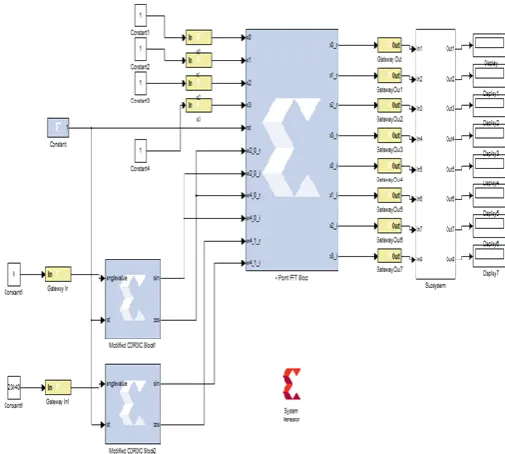
The proposed architecture is implemented on Xilinx ATLYS board (xc6slx45-2csg322) with the help of Simulink tools where the code is designed by VHDL language. The Simulink model of proposed technique is shown in Fig. 8
Fig -8: Simulink Model of CORDIC based FFT with Vedic Multiplier
The synthesis result of the proposed structure is given in Table 1
Table -1: Hardware Utilization of Proposed Architecture
Parameters Hardware Utilization
Number of Slice Registers 259
Number of Slice LUTs 1325
Number of fully used LUT-FF pairs 164
Maximum Operating Frequency (MHz) 104.828
6.
HARDWARE COMPARISONS
[image:5.595.39.264.91.283.2] [image:5.595.315.568.297.524.2] [image:5.595.109.215.374.506.2]© 2016, IRJET | Impact Factor value: 4.45 | ISO 9001:2008 Certified Journal
| Page 872
Table-2: Delay comparisons between existing andproposed method
Techniques Authors Delay
(nsec)
Normal Array based FFT ---- 32.01
Booth Multiplication based FFT ---- 29.549
Modified Vedic Multiplier based FFT Abhishek Gupta et al., [19] 19.467
Proposed Modified CORDIC based FFT with Vedic Multiplier
---- 9.539
7.
CONCLUSIONS
In this paper we propose parallel FFT architecture using modified CORDIC and Vedic multipliers. The proposed architecture is faster than existing architecture due to following reasons
i. The conventional multipliers are replaced by high speed MUX based Vedic multipliers.
ii. Parallel FFT architecture id used.
iii. Modified CORDIC architecture is used to generate twiddle factors instead of ROM based architecture.
REFERENCES
[1] Prashant D. Pawale, Venkat N Ghodke, “High speed Vedic multiplier design and implementation on FPGA”, International Journal of Applied Research, Vol. 1, No. 7, pp. 239-244, 2015.
[2] Sreelekshmi M. S., Farsana F. J., Jithin Krishnan, Rajaram S and Aneesh R, “Implementation of MAC by using Modified Vedic Multiplier”, International Journal of Advanced Computer Research, Vol. 3, No. 3, Issue. 12, pp. 11-15, 2013.
[3] Gaurav Sharma, Arjun Singh Chauhan, Himanshu Joshi
and Satish Kumar Alaria, “Delay Comparison of 4 by 4 Vedic Multiplier based on Different Adder Architectures using VHDL”, International Journal of IT, Engineering and Applied Sciences Research, Vol. 2, No. 6, pp. 28-32, 2013.
[4] Premananda B.S., Samarth S. Pai, Shashank B. and Shashank S. Bhat, “Design and Implementation of 8-Bit Vedic Multiplier”, International Journal of Advanced Research in Electrical, Electronics and Instrumentation Engineering, Vol. 2, Issue. 12, pp. 5877-5882, 2013. [5] Pushpalata Verma, “Design of 4x4 bit Vedic Multiplier
using EDA Tool”, International Journal of Computer Applications, Vol. 48, No.20, pp. 32-35, 2012.
[6] Poornima M, Shivaraj Kumar Patil, Shivukumar , Shridhar K P , Sanjay H, “Implementation of Multiplier using Vedic Algorithm”, International Journal of Innovative Technology and Exploring Engineering, Vol. 2, Issue. 6, pp. 219-223, 2013.
[7] Irine Padma B.T and Suchitra. K, “Pipelined Floating Point Multiplier Based On Vedic Multiplication Technique”, International Conference on Innovations
&Advances In Science, Engineering And Technology, pp. 130-137, 2014.
[8] B.Keerthi Priya and R.Manoj Kumar, “A Novel Low Power Vedic Multiplier using Modified GDI Technique in 45nm Technology”, International Journal of Innovative Research in Computer and Communication Engineering, Vol. 3, Issue 11, pp. 11721-11728, 2015. [9] Sumit Vaidya and Deepak Dandekar, “Delay-Power
Performance Comparison of Multipliers in VLSI Circuit Design”, International Journal of Computer Networks & Communications, Vol.2, No.4, pp. 47-56, 2010.
[10] Virendra Babanrao Magar, “Intelligent and Superior Vedic Multiplier for FPGA Based Arithmetic Circuits”, International Journal of Soft Computing and Engineering, Vol. 3, Issue. 3, pp. 31-36, 2013.
[11] P. Koti Lakshmi, B Santhosh Kumar and Rameshwar Rao, “Implementation of Vedic Multiplier using Reversible Gates”, International Journal of Applied Research, pp. 125–134, 2015.
[12] C.Sheshavali and K.Niranjan kumar, “Design and Implementation of Vedic Multiplier”, International Journal of Engineering Research and Development, Vol. 8, Issue. 6, pp. 23-28, 2013.
[13] Toni J.Billore and D.R.Rotake, “FPGA implementation of high speed 8 bit Vedic Multiplier using Fast adders”, IOSR Journal of VLSI and Signal Processing, Vol. 4, Issue. 3, pp. 54-59, 2014.
[14] N.G.Nirmal and D.T.Ingole, “Novel Delay Efficient Approach for Vedic Multiplier with Generic Adder Module”, International Journal of Engineering Research and Applications, Vol. 3, Issue 3, pp.1394-1396, 2013. [15] Pranali Thakre1, Sanjay Dorle and Vipin Bhure, “Low
Power 64-bit Multiplier Design by Vedic Mathematics”, International Journal of Application or Innovation in Engineering & Management, Vol. 3, Issue. 4, pp. 393-396, 2014.
[16] Elakkiya J and Mathan N, “Survey on Performance of Vedic Multiplier”, International Journal of Advanced Research in Computer and Communication Engineering, Vol. 4, Issue 2, pp. 416-419, 2015.
[17] Suresh Kumar Dunna, B Vijaya Bhaskar and R Suryaprakash, “Implementation of Higher Order FFT Processor Using FPGA”, International Journal of Engineering, Reserch and Technology, Vol. 1, Issue. 6, pp. 1-4, 2012.
[18] Aniket Shukla and Mayuresh Deshmukh, “Comparative Study Of Various FFT Algorithm Implementation On FPGA”, International Journal of Engineering, Technology and Science, Vol. 1, Issue. 1, pp. 19-22, 2012.
[19] Abhishek Gupta, Amit Jain, Anand Vardhan Bhalla and Utsav Malviya, “Design Of High Speed FFT Processor Using Vedic Multiplication Technique”, International Journal of Engineering, Reserch and Applications, Vol. 2, Issue 5, pp.1501-1504, 2012.