Feature Selection of Abnormal Speech using
Binary Tree
Snehal S Laghate 1, Prof.Sanjivani S Bhabad2
P.G. Student, Department of Electronics & Telecommunication Engineering, KK Wagh COE, Nashik, India1
Assistant Professor, Department of Electronics & Telecommunication Engineering, KK Wagh COE, Nashik, India2
ABSTRACT: Speech problems are faced by Articulatory handicapped people. To understand the problems it is necessary to create database and develop new and improved feature selection technique for reliable, robust and accurate recognition of spoken word. This paper describes novel method of automatic feature selection for abnormal speech which helps to improve performance and accuracy of system. The database created is eleven digits from zero to ten for ten persons each being recorded ten times. Twelve features considered with 183 parameter gives 4096 binary combination of features for eleven digits. The results obtained using MATLAB 12B gives 70% accuracy for digit two for sixteen combinations of feature.
KEYWORDS:MATLAB, Feature selection, Speech recognition
I. INTRODUCTION
Speech is most natural form of human verbal communication. It is therefore necessary to solve the difficulties and problems faced by abnormal speech people. Speech recognition is defined as process to automatically recognize spoken word of individual based on information of speech signal. However absence of standard database, diversity of articulator handicap is the major obstacles for reliable speech recognition system. This explains the poverty of market in speech recognition system for abnormal people. It is therefore necessary to study and develop automatic feature selection algorithm for speech recognition. The objectives of this proposed method is to understand the speech problems of Articulatory handicapped people by creating database, implementing method for verification of result in order to improve the performance and accuracy of system. This paper describes a novel method to automatically select features to recognize the spoken word. The design of this method requires careful attention to issues like creation of database, speech representation, feature extraction, feature selection and performance evaluation. This method is confined at improving the most important of these, being the need to increase reliability of present speech recognition before they can confidently be incorporated into lives of handicapped people.
The paper is organized as follows. Section II describes literature survey which presents past and recent advances in the methods of feature selection. The block diagram represents the steps of algorithm which is described in Section III. Section IV presents experimental results for calculation of accuracy for combination of features. Finally, Section V presents conclusion and future scope.
II. LITERATURESURVEY
Feature selection is a technique to select relevant features and eliminate redundant and irrelevant features based on evaluation criteria to improve performance and accuracy of system [1].Initial study focussed on dataset with small number of features with classification on labelled data which worked on supervised feature selection. As time progressed, features kept on increasing thereby set of techniques were divided into supervised and unsupervised learning.
Recognised Speech
III.PROPOSEDSYSTEM
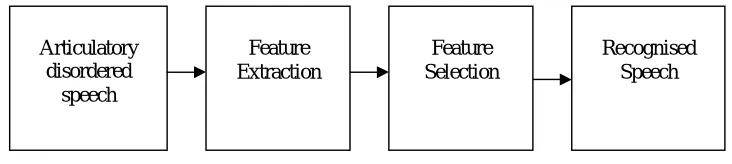
The block diagram of proposed system is shown in Figure 1 below. The function of each block is described as follows.
Figure: 1 Proposed System
1. Articulatory disordered speech
The database created consists of 1100 samples [11 digits x 10 persons x 10 samples]. The file format used to record speech is uncompressed file format and speech file is stored using .wav extension. Software Module used to record speech is RODE NT1 microphone using NUENDO 4 software module. The Figure 2 below shows RODE NT1microphone used for recording speech.
Figure 2: RODE NT1microphone for recording speech
2. Feature Extraction
Feature extraction is computation of feature vector which gives compact representation to speech signal. The extraction techniques are classified into temporal analysis and spectral analysis.
3. Feature selection
This is the most important step after features are extracted. Twelve features are selected for analysis which gives binary combination of 4096 (2 ) features with 183 parameters. The number of parameters selected for each feature is listed below in Table 1.
Articulatory disordered
speech
Feature Extraction
Table 1: Selection of features with number of parameters
Sr.No Selection of features Number of parameters
1 Audio 4
2 Loudness 4
3 Bark 32
4 Spectral Centroid (SC) 4
5 Spectral Roll off (SR) 4
6 Spectral Spread (SS) 4
7 Mel Frequency Cepstral Coefficient(MFCC)
96
8 Audio Spectral Flatness (ASF) 16
9 Autocorrelation 13
10 Log Attack Time (LAT) 1
11 Temporal Centroid (TC) 1
12 Zero Crossing Rate (ZCR) 4
4. Recognized speech
Testing of speech samples is carried to recognize digit. The detailed procedure is described in section IV below of Experimental results
IV.EXPERIMENTAL RESULTS
The analysis of speech to correctly recognize digit is carried in two steps namely training and testing which is explained below.
1. Training
In this step the first seven samples of eleven digits from zero to ten of ten users is selected. Thus 770 samples are used to obtain training matrix of dimension 770
x
183.2. Testing
The remaining three samples, each of eleven digits are selected for testing purpose which constitutes 330 samples. The test matrix obtained is 330
x
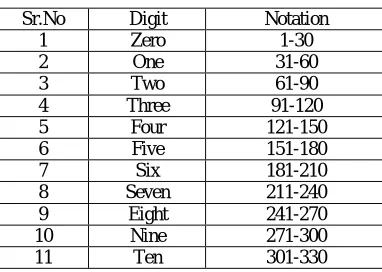
4096 which is used to calculate digit wise accuracy. The notation for 30 samples of digits from zero to ten is listed below in Table 2.Table 2: Notation of digits
Sr.No Digit Notation
1 Zero 1-30
2 One 31-60
3 Two 61-90
4 Three 91-120
5 Four 121-150
6 Five 151-180
7 Six 181-210
8 Seven 211-240
9 Eight 241-270
10 Nine 271-300
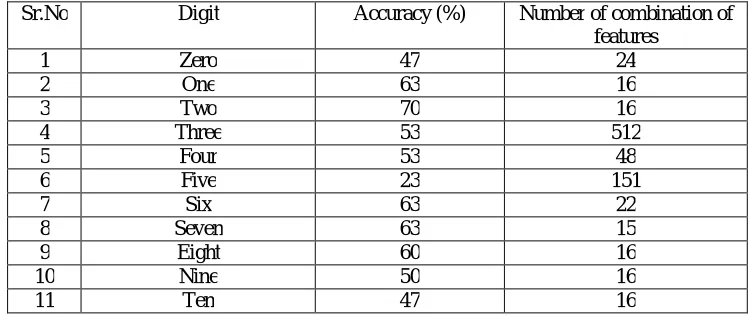
The table 3 below shows digit wise accuracy obtained for number of combinations of features for each digit. Maximum accuracy of 70 % is obtained for sixteen combinations for digit two while 63% accuracy is obtained for digits one, six and seven.
Table 3: Accuracy for different combination of features
Sr.No Digit Accuracy (%) Number of combination of
features
1 Zero 47 24
2 One 63 16
3 Two 70 16
4 Three 53 512
5 Four 53 48
6 Five 23 151
7 Six 63 22
8 Seven 63 15
9 Eight 60 16
10 Nine 50 16
11 Ten 47 16
The overall accuracy of 45% is obtained for sixteen combinations of features from zero to ten.
V. CONCLUSION
The binary combination of twelve features is selected for measuring performance of each digit by calculating accuracy. Maximum accuracy of 70 % is obtained for digit two while 63% accuracy is obtained for digits one, six and seven .Also maximum combined accuracy of 45 % is obtained for eleven digits for nineteen combinations of features.
VI. FUTURESCOPE
The method is implemented to automatically select features for database of eleven digits from zero to ten. In future this method can be implemented considering standard database with design of Feature Selection Toolbox (FST).Also C program can be implemented with design of hardware using this method for speaker independent analysis.
REFERENCES
[1] Antony G. Singh, S.Appavu Balamurgan,E.Jebamalar Leavline, “Literature review on Feature Selection Methods for High Dimensional Data”, IJCA (0975-8887),vol 136,no 1, 2016
[2] L. D. Fellow, J. Wu, J. Droppo and A. A. Fellow, “Analysis and comparison of two speech feature extraction/compensation algorithms", IEEE signal processing letters, vol 12, no 6, 2005
[3] M.A.Anusuya, S.K. Katti, “Speech recognition by machine: A Review” ,IJCSIS, vol 6, no 3, 2009.
[4] P.M and S.A., “Optical selection of bit steam features for compressed domain automatic speaker recognition”, Signal Processing Conference, 14 th European, pg 1-5,2006
[5] A. S and D. P, “Survey about speech recognition and its usage for impaired (disabled) persons", International Journal of Scientific Engineering Research ,vol 4, issue2, , 2013.
[6] F. Beritelli, S. Casale, A. Russo, and S. Serrano, “An Automatic Emergency Signal Recognition System for the Hearing Impaired", IEEE Conference, pg 179-182, 2006.
[7] Santosh K.Gaikwad, Bharti W.Gawali,, Pravin Yannavar , "A Review on Speech Recognition Technique", International Journal of Computer Applications, vol 10, no.3, 2010.
[8] Mathur A. and Saxena T and Krishnamurthy., “Generating Subtitles Automatically Using Audio Extraction and Speech Recognition” ,Computational Intelligence Communication Technology (CICT), IEEE International Conference , pg 621-626, 2015
[10] Metzger, Richard A. and Doherty, John F. and Jenkins, David M. “Analysis of compressed speech signals in an Automatic Speaker Recognition system”, Information Sciences and Systems (CISS), 49th Annual Conference ,pg 1-5, 2015.
[11] Zbancioc, M.D.and Feraru, M. “Integrated system for prosodic features detection from speech”, Electrical and Power Engineering (EPE), International Conference and Exposition, pg 114-117, 2014.