© 2016, IRJET | Impact Factor value: 4.45 | ISO 9001:2008 Certified Journal
| Page 1152
CLOSED LOOP ANALYSIS OF SPACE VECTOR MODULATED MATRIX CONVERTER USING PI AND FUZZY LOGICCONTROLLERS
Smitha M1, H.V.Govindaraju2
1M.Tech Scholar, Power Electronics, Dr. Ambedkar Institute of Technology, Bengaluru, Karnataka, India- 560056
2Associate Professor, Department of Electrical and Electronics Engineering, Dr. Ambedkar Institute of Technology, Bengaluru, Karnataka, India- 560056
---***---Abstract: A matrix converter performs direct transfer of electrical energy from input to output because of which the distortion and unbalance of the input voltage will greatly affect the output of the MC. In order to reduce the distortion in the matrix converter, a closed loop control of MC has been presented in this paper. A comparison in the operation of matrix converter with PI and fuzzy logic controller in the feedback individually has been performed. A fuzzy logic controller is an automatic controller that controls an object in accordance with the desired behaviour. The control action of fuzzy logic controllers is based on “if-then rules”. These set of rules describe the system behaviour. The closed loop analysis has been performed for both balanced as well as unbalanced grid conditions. Space vector modulation technique has been employed to control the matrix converter. Performance of the closed loop control of the matrix converter is analysed using MatLab / Simulink.
Key Words:
Matrix converter (MC), space vector
modulation, PI controller, Fuzzy Logic Controller (FLC) .
1.INTRODUCTION
The most interesting and promising member in the power electronic converter family is MC that provides direct AC-AC power conversion .The growth of power device technology and power ICs research work on exploring MC has increased. Matrix converter (MC) is a converter with three input and three output phases consisting of nine bidirectional switches distributed in a 3X3 matrix form. This topology provides direct AC-AC energy conversion. In contrast to conventional ac/ac converters, MC does not require an intermediate stage of DC conversion. It eliminates the need of DC link reactive component but requires small ac filters for the removal of switching ripples and also provides bidirectional power flow. One of the most important features of MC is that it is capable of converting magnitude and frequency of the input into a desired magnitude and frequency of the output using power semiconductor switches. The MC can be used to replace the
conventional AC-DC-AC system which employs two stage power conversions.
A 3ᵩ-3 ᵩ MC consists of a bidirectional switch arranged in a matrix form. Such an arrangement provides the
convenience in connecting any input phase to any output phase at any time. Fig- (1) shows the topology of matrix converter.
Fig-(1):Matrix converter topology.
A space vector modulation technique has been extensively used nowadays around the globe. This is because of the fact that it provides increased voltage gain & reduces the harmonic distortion. SVM applied to MC is of two types- Direct & indirect SVM. Even though application of SVM for an MC is a tedious method, it provides better output compared to other modulation techniques.
2. FUNDAMENTALS OF MATRIX CONVERTER
The switching of switch of MC can be defined as
Skj(t)=
© 2016, IRJET | Impact Factor value: 4.45 | ISO 9001:2008 Certified Journal
| Page 1153
Also SK1+SK2+SK3=1 and k={1,2,3} …………Eqn (1)The relation between the input voltages Va, Vb, Vc and the output voltages VA, VB,VC can be obtained as ,
Similarly, for a balanced load the relation between the input and output currents can be obtained as,
Where SAa through SCc are switching variables.
In a 3ϕ-3ϕ mc, we have bidirectional switches owning to 29=512 possible stage. Because of some constraints all of
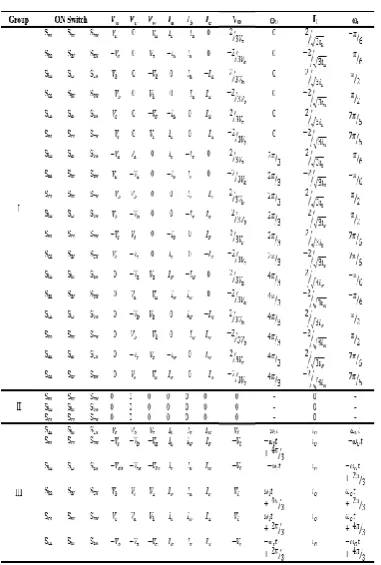
them cannot be used. Only 27 switch combinations as shown in table 1 can be employed. These 27 switching combinations can be divided into 3 groups.
3.SPACE VECTOR MODULATION
Space vector modulation is a type of PWM technique that treats the sinusoidal voltage as a phase or amplitude that rotates at frequency ω. This vector is represented in d-q reference frame. The vector summation of three modulating signals is known as reference voltage.
For a balanced three phase sinusoidal system,
In terms of complex space vector ,
2/3 is scaling factor.
The indirect transfer approach has been employed. In this approach the operation of MC is considered to be
[image:2.595.304.495.125.408.2]equivalent to that if (Voltage Source Rectifier) VSR and (Voltage Source Inverter) VSI. Hence VSR-SVM and VSI-SVM are reviewed in this section.
Table -1: Switching table
a) VSR-SVM
The reference current space vector is approximated using adjacent vectors. The input current vector and vector diagrams are shown in Fig-(2, 3). The duty cycles are given by,
0
*sin(
)
*sin
1
i i
i i
i
d
m
d
m
d
d
d
Where mi is the modulation index of VSR and 0≤mi<1.
Fig-(2): Input Current vector
..Eqn (2)
.Eqn (3)
….... Eqn (6)
…….Eqn (4)
[image:2.595.44.258.257.304.2]© 2016, IRJET | Impact Factor value: 4.45 | ISO 9001:2008 Certified Journal
| Page 1154
Fig-(3): Vector diagramsWithin first sector,
i
(
it
i)
it
i
The transfer matrix of VSR is,
2
2
cos(
)
cos(
)
cos(
)
a i i
b i i i dc
c i i
i
t
i
m
t
I
i
t
=TVSR. I dc
Substituting the value of modulation index yields the desired input current phase. The VSR input voltage is given by,
b) VSI-SVM
Here only 6 switching combinations are allowed that yields non-zero output voltages. Hence the resulting output line space vector can assume the values from V0-V6
as shown in Fig-(4).
Fig-(4): Output voltage vector
The space vector of output line is defined as,
( 30 )
3. .
;
{ , , }
j t o oi oi
v
v e
v i
u v w
The duty cycle of switching state vectors are as stated below
0
* sin( )
* sin
1
v v v
v v v
v v v
d m
d m
d d d
3
0
v(
oi) 1
dc
v
m
v
Where mv is the VSI modulation index.
The six vectors of the VSI corresponds to the 6 sextants of the three has output voltage as shown in Fig-(5).
Fig-(5): Output line voltages of six sextants.
The averaged output voltages are,
a v v
b v dc
c v
v
d
d
v
d
V
v
d
……….…Eqn(14)
…….Eqn (7)
..…Eqn (8)
…….Eqn (9)
...Eqn (10)
…....
Eqn
(11)
……..Eqn (12)
© 2016, IRJET | Impact Factor value: 4.45 | ISO 9001:2008 Certified Journal
| Page 1155
=cos(
)
*
sin(
)
sin( )
v
v v dc
v
m
V
…………Eqn(15)For the first sextant,
30
ot
o30
30
(
30 ) 30
v
t
o
………..Eqn(16)Substituting Eqn (16) in Eqn(14),
cos( )
* cos( 120 ) *
cos( 120 )
u
v dc
v
w
v t
m t V
v t v …Eqn(17)
Substituting for the modulation index we get,
cos(
)
3 * cos(
120 )
cos(
120 )
u
o v oi
w
v
t
V
v
V
t
t
v
……Eqn(18)The averaged input current of VSI is,
3
.
. .cos( )
tan
2
T
o om v L VSI
ip T i
I m
cons
t
…..Eqn(19)Since both VSI and VSR SVM contains six sectors each, there are a total of 36 combinations available. If the first voltage sector and the first current sector are active, the transfer matrix is,
cos(
)
cos(
)
sin(
)
sin(
)
sin( )
sin( )
T
v i
ph v i
v i
T
m
…Eqn(20) * * Tu v v a
o v v b
v c
w
V d d d d v
V V d d v
d d v
V ……...Eqn(21)
The output line voltages are,
*
*
T
u v v a
o v v b
v c
w
V
d
d
d
d
v
V
V
d
d
v
d
d
v
V
……..Eqn(22)This yields to,
T
u vi vi vi vi
v vi ab v ac
vi v
w
V
d
d
d
d
V
d
V
d
V
d
d
V
……..Eqn(23) Where,. .sin .sin( ) vi
vi v i v i
s
T
d d d m
T
.
.sin
.sin(
)
vivi v i v i
s
T
d
d d
m
T
.
.sin
/ 3
.sin( )
vi
vi i v v i
s
T
d
d d
m
T
.
.sin
/ 3
.sin( )
vi
vi i v v i
s
T
d
d d
m
T
4. PI AND FUZZY LOGIC CONTROLLER
The currents of RL load are measured using PI controller. The Kp and Ki parameters were obtained by trial and error method. Fuzzy Logic Controller is gaining popularity because of its simple methodology. It is based on ‘if-then rules’. The inputs to the fuzzy controller are error and change in error. In an FLC each input and output variables are defined a membership function individually. A
mamdani type fuzzy logic controller is used.For both the inputs triangular membership functions has been used. They have seven membership functions and they are shown in Fig-(6).The membership function of output signal of FLC is shown inFig-(7).
(a)
Fig-(6): Membership functions (M.F) of FLC. (a) M.F of error.
© 2016, IRJET | Impact Factor value: 4.45 | ISO 9001:2008 Certified Journal
| Page 1156
(b)Fig-(6): (b) M.F of change in error
[image:5.595.34.277.67.374.2]Fig-(7):M.F of output signal of FLC.
Table 2: The rules used in the FLC.
PB:PosititveBig;PM:PositiveMedium;PS:Positive Small;NS:NegativeSmall; NB:Negative Big; NM:Negative Medium;ZE:Zero;
5.SIMULATION RESULTS
The PI and FLC are applied to the matrix converter and the simulation results are carried out using Matlab/Simulink/SimPowersystems. The system parameters are listed in appendix.
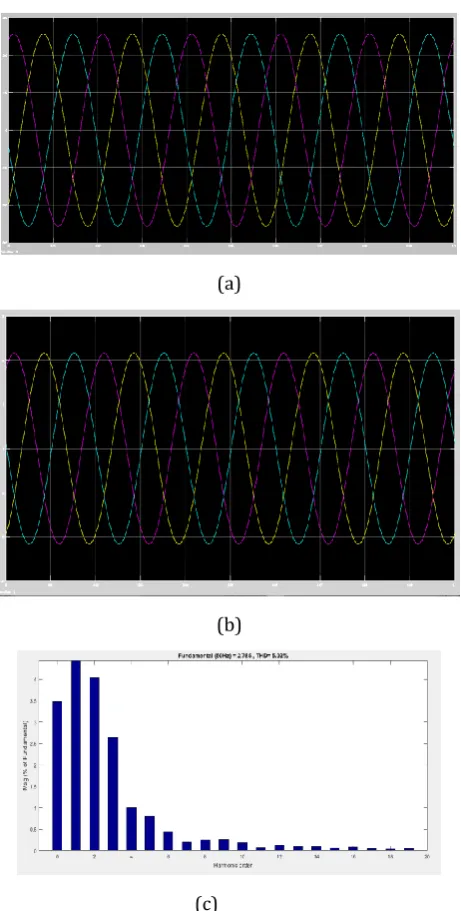
a) Balanced grid case
Here the supply input voltage in all the three phases is equal and there will be no distortions are shown in Fig-(8).
(a)
(b)
(c)
Fig- (8):(a) Output voltage.(b) Output current (c) Total Harmonic Distortion (THD) analysis of the MC with PI controller under balanced grid case
e/ce NB NM NS ZE PS PM PB
NB NB NB NB NB NM NS ZE
NM NB NB NB NM NS ZE PS
NS NB NB NM NS ZE PS PM
ZE NB NM NS ZE PS PM PB
PS NM NS ZE PS PM PB PB
PM NS ZE PS PM PB PS PB
[image:5.595.319.550.227.683.2]© 2016, IRJET | Impact Factor value: 4.45 | ISO 9001:2008 Certified Journal
| Page 1157
The output voltage and current waveform of the MC with FLCunder balanced grid case is shown in Fig-(9).
(a)
(b)
(c)
Fig-(9): (a) Output voltage (b) Current waveform(c) THD analysis of the MC with FLC under balanced grid case. B)Unbalanced grid case
The performance of matrix converter under unbalanced condition has been analysed by introducing the distortions at the input supply.
The output voltage and current waveform of the MC with PI controller under unbalanced grid case is shown in Fig-(10).
(a)
(b)
(c)
Fig-(10): (a) Output voltage (b) Current waveform (c) THD analysis of the MC with PI controller under unbalanced grid case.
The output voltage and current waveform of the MC with FLC under unbalanced grid case is shown in Fig-(11).
© 2016, IRJET | Impact Factor value: 4.45 | ISO 9001:2008 Certified Journal
| Page 1158
(b)(c)
Fig-(11): (a) Output voltage (b) Current waveform (c) THD analysis of the MC with FLC under unbalanced grid case Table-3: Comparison of THD
Sl No Controller THD
1 PI(Balanced grid case) 5.02%
2 FLC(balanced grid case) 2.46%
3 PI(unbalanced grid case) 5.81%
4 FLC(unbalanced grid case) 3.87%
From the table-3 , we can observe that the performance of the matrix converter has been improved with the use of Fuzzy controller as compared to the PI controller.
6.CONCLUSION
In this paper, both PI and FLC have been employed to control the matrix converter. FLC continuously adjusts the load current by reducing the error. From the comparison of the THD in all the four cases, it can be concluded that the performance of FLC is good in contrast to that of PI controller.
REFERENCES
[1] Saul Lopez Arevalo, “Matrix converter for frequency changing power supply applications”, 2008.
[2] Alesina and M.Venturini , “Analysis and design of optimum amplitude nine switched direct AC-AC converters”,IEEE Transactions on Power Electronics,vol.4,no.1,pp.101-112,Jan 1989.
[3] L.Huber and D.Borojevic, “Space vector modulated three phase to three phase matrix converter with input power factor correction”, IEEE Transactions on Power Electronics,vol.31,no.6,pp.1234-1246,Nov/Dec1995.
[4] Casadei, G.Serra and A.Tani, “Reduction of the input current harmonic content in matrix converters under input / output unbalance”, IEEE Transactions on Industrial Electronics,vol.5,no.3,pp.401-411,Jun 1998.
[5] Patrick W Wheeler , “Matrix converter: A technological Review”, IEEE Transactions on Industrial
Electronics,vol.49,no.2,pp.276-286,April 2002.
[6] L.Zhang, C.Watthanasarn, W.Shepherd, “Analysis and comparison of control technology for AC-AC matrix converter”, IEE proc-Electr.Power Appl,vol.145,no.4,July 1998.
[7] L.Zarri,M.Mengoni and O.Ojo, “Improvement in the control range of matrix converter”, in proc.IEEE ECCE’11, Phoenix,AZ,Sept.2011.
[8] Dr. Sarat Kumar Sahoo, K.V. Kandasamy, Sruty Shankar Singh, “Three-Phase Matrix Converter with Ripple Free Output” Third International Conference on Sustainable Energy and Intelligent System (seiscon 2012),VCTW, Tiruchengode, Tamilnadu, India on 27-29 December, 2012.
[9] A. Boukadoum, T. Bahi, S. Oudina, Y. souf , S. Lekhchine, “Fuzzy control adaptive of a matrix converter for
harmonic compensation caused by nonlinear loads”, Energy Procedia 18 ( 2012 ) 715 – 723.
[10] B.Hamane M. L. Doumbia A. Cheriti K. Belmokhtar, “Comparative Analysis of PI and Fuzzy Logic Controllers for Matrix Converter”, 2014 Ninth International