© 2016, IRJET | Impact Factor value: 4.45 | ISO 9001:2008 Certified Journal | Page 2384
Performance Analysis Of Double Inclination
Ribbed Solar Air Heater Rectangular Duct By
Liquid Crystal Thermography
Amit Kumar Gautam¹, Dr. J. L. Bhagoria²
¹M.Tech. Scholar, Mechanical Engineering, ²Professor, Mechanical Engineering
Department MANIT Bhopal (M.P.) India
Abstract :
The actual aim of this study is to enhancement of the transfer of heat from a double inclined artificially roughened ribbed rectangular duct, by using Liquid Crystal thermography technique. This artificially roughened rectangular duct has aspect ratio of 5.0. The investigation has relative roughness height (e/Dh) of 0.034, angle of attack of fluid flow (α) of 600 for a fixed relative pitch of 10 and Reynolds number (Re) rangeof 4000–12000. In this study Liquid Cristal Thermography (LCT) is used to determine the heat transfer distribution on the ribbed surface. Results has been compared with those of the smooth duct on similar flow conditions to determine the enhancement in heat transfer coefficient.
Keywords
Solar Air Heater, Heat Transfer, Artificial Roughness, Liquid Cristal Thermography
1. Introduction
The energy demand is rise incessantly and speedily, and it's not possible to satisfy the long run demand with the current on the market exhaustible energy sources. So, the technology is that specialize in harnessing new and renewable sources of energy. Further, the traditional energy sources area unit inflicting associate threat risk to the earth life. The utilization of alternative energy is intelligent possibility for the utilization of human beings that is available freed from value, in abundant and may be a clean supply for numerous applications.
© 2016, IRJET | Impact Factor value: 4.45 | ISO 9001:2008 Certified Journal | Page 2385
Thermo chromic liquid crystals (TLC) are materials that change their reflected colour as a function of temperature when illuminated by white light. More artificial roughened element geometries over the duct has been investigated by many authors in the last few years. Sandeep Jaiswal, K. R. Aharwal (2015) done his investigation on Transient Analysis of Transverse Ribbed Rectangular Duct by Liquid Crystal Thermography and it has been observed that the enhancement of heat transfer for proposed rib roughness arrangement. Momin, J.S. Saini, S.C. Solanki (2002) shows in his work, results of an experimental study of the effect of geometrical parameters of V-shaped rib elements on transfer of heat and fluid flow characteristics of an artificial roughned rectangular duct of solar air heater with absorber plate having V-shaped ribs on its underside has been reported. Sahu and Bhagoria (2005) was done performance analysis of solar air heater duct having straight discrete ribs P/e= 6.67-20, e/D= 0.0338, AR= 8, α= 900, Re=
3000-12000 with this value of parameters maximum value of Nusselt number was reported.
2. The Experiment
a. Apparatus
In this apparatus the main components are heater, rectangular test section, orifice meter, U tube manometer, illuminating light system, camera, data logger, computer, centrifugal blower and motor.
© 2016, IRJET | Impact Factor value: 4.45 | ISO 9001:2008 Certified Journal | Page 2386
The test section is a rectangular channel with AR= 5.0, width= 200mm, height= 40mm and a length= 1500mm, constructed with 12mm thick Cast Acrylic sheet. Heater is used to heat up the incoming air. Toshiba’s 3CCD camera is used to capture the thermal images. 20w LED light source is used as a illuminating system.
b. Roughness Geometry
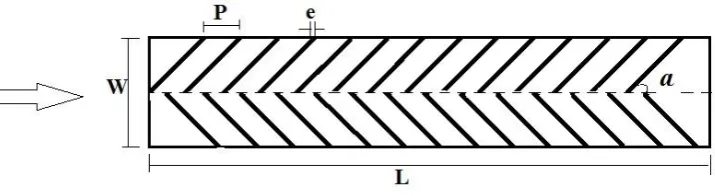
[image:3.595.47.524.300.432.2]Roughness geometry parameters are Range of Reynolds number (Re) is 4000 -12000, Relative roughness pitch (P/e) =10, Angle of attack (α) =60°, Diameter of rib (e) is 1mm, Width of plate (w) is 200mm, Length of plate (L) is 1500mm and Relative roughness height (e/D) has been chosen 0.034.
Fig. 2 Actual image of 60° double inclined ribs geometry
[image:3.595.51.409.546.644.2]© 2016, IRJET | Impact Factor value: 4.45 | ISO 9001:2008 Certified Journal | Page 2387
c. Experimental Procedure
Liquid Cristal Thermography technique is used to measure temp. distribution in the duration of heat transfer from hot air to the test surface. Apply the thermo chromic liquid crystal sheet on to the surface of the test section in the duct. Liquid crystal sheets used in this experiment is in the temperature range of 55˚C to 60˚C. The test section initially must be kept at constant temperature level and after that quickly exposed to a high temperature flow. Maintain the temperature with in the range of liquid crystal sheet. When air is maintain with in the range of LC sheet, then air is allow to pass through the main test section and during this bypass line is closed by operating three way valve. Measure and record the temperature response of LC sheet. Temperature response of LC sheet is captured by 3CCD Camera with suitable illuminating light source system and the temperature is recorded by data logger. After recording temperature and colour image of the LC sheet in different points of test section, we made a relationship between colour and temperature. Now the colour response of the LC sheet and their variation with temperature can be used to get exact temperature of any point of the test section.
d. Data Reduction
The convective heat transfer coefficient is determined by using following relationship.
Heat Transfer Coefficient : h = Qa / Ap (Tpav-Tfav)
Nusselt Number : Nu = h x Dh / k
Reynolds Number : Re = V Dh /υ
where, Qa is a heat gained by air, Ap is a surface area of the rectangular plate, υ is a
kinematic viscosity of air at Tfav, Dh is a hydraulic diameter of duct, k is a thermal
conductivity of air.
3. Results and Discussion
Calibration of liquid crystal sheet of specific band width of temperature range 550 C to
600 C is performed and after that calibration comparison of colour images hue value
© 2016, IRJET | Impact Factor value: 4.45 | ISO 9001:2008 Certified Journal | Page 2388
[image:5.595.70.528.104.312.2]m̊₁ m̊₂ m̊₃ m̊₄ m̊₅
Fig.4 Actual thermal images of ribs in different mass flow rate
S.
No.
m̊ (kg/s)
V (m/s)
Re
Nu
1.
0.00739
1.27
3490
5.91
2.
0.01044
1.80
4928
7.94
3.
0.01279
2.21
6032
9.74
4.
0.01476
2.55
6956
10.54
5.
0.01648
2.86
7749
12.31
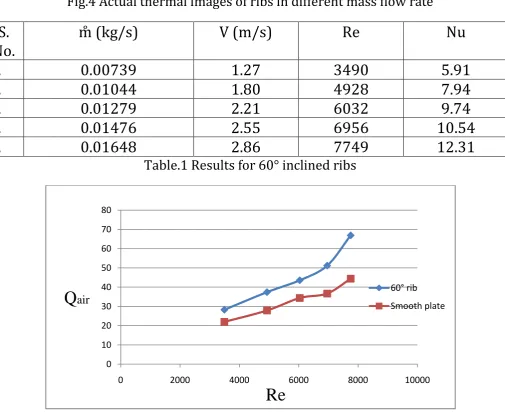
Table.1 Results for 60° inclined ribs
Fig. 5 comparison between Qair and Re for 60° ribs and smooth plate
0 10 20 30 40 50 60 70 80
0 2000 4000 6000 8000 10000
60° rib
Smooth plate
Q
air [image:5.595.47.553.302.716.2]© 2016, IRJET | Impact Factor value: 4.45 | ISO 9001:2008 Certified Journal | Page 2389
Fig. 6 comparison between h and Re for 60° ribs and smooth plate
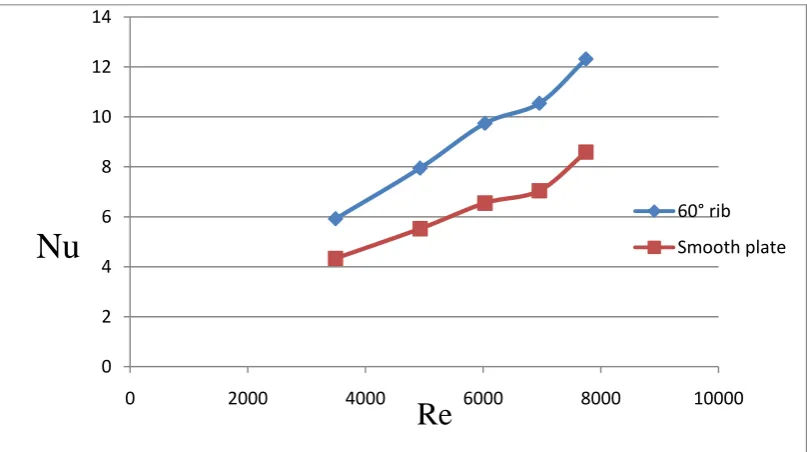
Fig. 7 comparison between Nu and Re for 60° ribs and smooth plate
0 1 2 3 4 5 6 7 8
0 2000 4000 6000 8000 10000
60° rib
Smooth plate
Re
h
0 2 4 6 8 10 12 14
0 2000 4000 6000 8000 10000
60° rib
Smooth plate
Nu
[image:6.595.97.501.403.629.2]© 2016, IRJET | Impact Factor value: 4.45 | ISO 9001:2008 Certified Journal | Page 2390
4. Conclusions
Experimental test is performed with the liquid crystal thermography technique for the selected design parameters of artificial rib geometry to find the local Nusselt number and this results of artificial roughened duct has been compared with the smooth duct on similar flow condition to determine heat transfer. It is observed that the enhancement of heat transfer for proposed rib geometry is better than the smooth duct.
References
[1] Aharwal K.R., B. K. Gandhi, J.S. Saini, (2008) Experimental investigation on heat-transfer enhancement due to a gap in an inclined continuous rib arrangement in a rectangular duct of solar air heater, Renewable Energy 33, 585–596.
[2] Sandeep Jaiswal, K. R. Aharwal (2015) An Experimental Investigation of Heat Transfer in A Discrete Rib Roughened Channel Volume 5, Issue 6, June 2015
[3] Sandeep Jaiswal, K. R. Aharwal (2015) Transient Analysis of Transverse Ribbed Rectangular Duct by Liquid Crystal Thermography Vol. 4 Issue 04, April-2015
[4] Yadav AS, Bhagoria JL. A CFD based heat transfer and fluid flow analysis of a conventional solar air heater. J Eng Sci Manag Educ 2013;6(2):137 – 46.
[5] ASHRAE Standard 93. Method of testing to determine the thermal performance of solar collectors. Atlanta: American Society of Heating, Refrigeration and Air Conditioning Engineers; 2003.
[6] Momin AME, Saini JS, Solanki SC. Heat transfer and friction in solar air heater duct with v-shaped rib roughness on absorber plate. Int J Heat Mass Transf 2002;45:3383– 96.
[7] Bhagoria JL, Saini JS, Solanki SC. Heat transfer coefficient and friction factor correlations for rectangular solar air heater duct having transverse wedge shaped rib roughness on the absorber plate. Renew Energy 2002;25:341 – 69.
[8] Saini RP, Verma J. Heat transfer and friction factor correlations for a duct having dimple-shaped artificial roughness for solar air heaters. Energy 2008;33:1277– 87.
© 2016, IRJET | Impact Factor value: 4.45 | ISO 9001:2008 Certified Journal | Page 2391 [10] Layek A, Saini JS, Solanki SC. Effect of chamfering on heat transfer and friction characteristics of solar air heater having absorber plate roughened with compound turbulators. Renew Energy 2009;34:1292– 8 .
[11] Karmare SV, Tikekar AN. Experimental investigation of optimum thermo-hydraulic performance of solar air heaters with metal rib grits roughness. Sol Energy 2009;82:6– 13.
[12] Aharwal KR, Gandhi BK, Saini JS. Heat transfer and friction characteristics of solar air heater ducts having integral inclined discrete ribs on absorber plate. Int J Heat Mass Transf 2009;52:5970 – 7 .
[13] Bopche SB, Tandale MS. Experimental investigations on heat transfer and frictional characteristics of a turbulator roughened solar air heater duct. Int J Heat Mass Transf 2009;52:2834– 48.
[14] Kumar A, Bhagoria JL, Sarviya RM. Heat transfer and friction correlations for artificially roughened solar air heater duct with discrete W-shaped ribs. Energy Convers Manag 2009;50:2106– 17.