ISSN: 1992-8645 www.jatit.org E-ISSN: 1817-3195
158
ADAPTIVE BACKSTEPPING CONTROL FOR WIND
TURBINES WITH DOUBLY-FED INDUCTION GENERATOR
UNDER UNKNOWN PARAMETERS
1
MOHAMMED RACHIDI, 2BADR BOUOULID IDRISSI
1,2
Department of Electromechanical Engineering, Moulay Ismaïl University, Ecole Nationale Supérieure d’Arts et Métiers, BP 4024, Marjane II, Beni Hamed, 50000, Meknès, Morocco
E-mail: [email protected], [email protected]
ABSTRACT
This paper deals with an adaptive, nonlinear controller for wind systems connected to a stable electrical grid and using a doubly-fed induction machine as a generator. The study focuses on the case wherein the aerodynamic torque model and winding resistances of the generator are unknown and will be updating in real time. Two objectives were fixed; the first one is speed control, which allows us to force the system to track the optimal torque-speed characteristic of the wind turbine to extract the maximum power, and the second deals with the control of the reactive power transmitted to the electrical grid. The mathematical development, both for the model of the global system and the control and update laws, is examined in detail. The control design is investigated using a backstepping technique, and the overall stability of the system is shown by employing the Lyapunov theory. The results of the simulation, which was built on Matlab-Simulink, confirm when compared with control without adaptation, the validity of this work and the robustness of our control in the presence of parametric fluctuations or uncertainty modeling.
Keywords: Wind power generation, doubly-fed induction generator, unknown winding resistances, unknown aerodynamic torque, adaptive control, backstepping control, Lyapunov theory.
1.
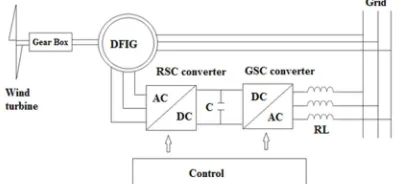
INTRODUCTIONFrom all sources of electricity generation, that which has the wind as origin has presented the highest growth rate for more than 20 years, and this should continue in the future [1]. Thus, wind generation should be the greatest contribution to reducing the greenhouse effect in the coming years. The causes for this increase lie in the high political will to promote this sector and also in production costs, which are becoming increasingly competitive. The most used structure in this area, especially in high power, which is also the subject of this work, is shown in Figure 1[2-3]. It uses a doubly fed induction machine as a generator. In general, the stator is directly connected to the electrical grid, but the rotor is connected through two back-to-back power converts and an RL filter. The capacitor C is considered as a DC regulated voltage source for the converts. The rotor side converter (RSC) is usually used to control the active and reactive power transmitted from the stator to grid. However, the grid side converter
(GSC) is used to regulate the DC voltage at a fixed value and, at the same time, control the reactive power transmitted the from the RL filter to the grid. The principal benefit of this configuration is the possibility of varying the rotor speed in a large range around the synchronous speed of about ±30% [2-4]. This allows us to design a speed control that forces the system to continuously track the optimal torque-speed characteristic of the wind turbine [11-12].
ISSN: 1992-8645 www.jatit.org E-ISSN: 1817-3195
159 unknown. To show the importance of this study, we compared the performances of our control with those of the control without adaptation.
[image:2.612.94.292.253.345.2]The paper is organized as follows. The second section presents a state-space modeling of the DFIG-based wind power conversion system. The third section details the proposed nonlinear adaptive controller. This design was established using backstepping technique and the Lyapunov approach. In the last section, we present the simulation results and discuss the importance of our study.
Figure. 1: DFIG-based wind power conversion system
2.
SYSTEM MODEL2.1. Modelling of the Wind Turbine
The aerodynamic turbine power Pt depends on the power coefficient Cp as follows [5]:
3 p 2 t
t R C ( , )v
2 1
P = ρπ λβ
(1a)
Where ρ, v, Rt, Cp, β, Ω et λ are the specific mass of the air, the wind speed, the radius of the turbine, the power coefficient, the blade pitch angle, the generator speed and the Tip Speed Ratio (TSR), respectively.
The TSR is given by:
v G RtΩ
=
λ (1b)
Where: G is the speed multiplier ratio.
The following equation is used to express Cp(λ,β) [5] as:
λ + λ − −
β − λ = β
λ 6
i 5 4
3 i 2 1
p ) c
c exp( ) c c c ( c ) , ( C
(1c)
Where
1 035 . 0 08 . 0
1 1
3
i β +
− β + λ =
λ and c1 to c6 are
constants coefficients given in "Appendix". The power coefficient reaches its maximum (cpmax) for β = 0° and a particular value λopt of λ. In this paper, we suppose that the wind turbine operates with β=0. To extract the maximum power and hence keep the TSR at λopt (MPPT strategy), a speed control must be done.
According to (1b), the optimal mechanical speed is:
opt t c
R v G
λ =
Ω (1d)
2.2. Induction Generator Model
To get the model of the induction machine, we have applied the Park transformation in the synchronously rotating frame, with the d-axis is oriented along the stator-voltage vector position (vsd=V, vsq=0). In this reference frame, the electromechanical equations are [6]:
[ ]
[ ][ ]dt ] [ d ] I ][ R [
V = + φ +ω φ
(2a) ]
I ][ M [ ] [φ =
(2b)
Ω − − = Ω
f T T dt d
J t em
(2c)
) i i i i ( pL
Tem= m sqrd− sdrq
(2d) Where
;
Rr 0 0 0
0 Rr 0 0
0 0 Rs 0
0 0 0 Rs
] R [
=
;
Lr 0 L 0
0 Lr 0 L
L 0 Ls 0
0 L 0 Ls
] M [
m m
m m
=
ω ω − ω
ω −
= ω
0 0
0
0 0 0
0 0 0
0 0 0
] [
r r s
s
[V], [I] and [Φ] are the voltage, the current and the flux vectors. The subscripts s, r, d and q stand for stator, rotor, direct and quadratic, respectively.
R, L, Lm, ω, J, f, p, Tt and Tem are resistance, inductance, mutual inductance, electrical speed, total inertia, damping coefficient, number of pole pairs, mechanical torque and electromagnetic torque, respectively.
By choosing currents and speed as state variables, the system (2) can be put into the following state-space form:
1 s r 1
1 g(x,R ,R ) u
x& = +β
(3a)
2 s r 2
2 g (x,R ,R ) u
x& = +β
(3b)
1 s r 3
3 g (x,R ,R ) u
x& = +α
(3c)
2 s
r 4
4 g (x,R ,R ) u
x& = +α
ISSN: 1992-8645 www.jatit.org E-ISSN: 1817-3195
160
em t
Fη+Γ +Γ
− = η& (3e) Where: Ω = η =
=(x,x ,x ,x ) (i ,i ,i ,i ), x 1 2 3 4 t sd sq rd rq t
J T ); x x x x ( a J t t 3 2 4 1 em
em = − Γ =
Τ − = Γ rq 2 rd 1 v ,u v
u = =
s r m
r LL
L , L 1 σ − = β σ = α
The functions gi(x,Rr,Rs) are:
η + η + − − = β + η − η − + − = η − η − + − − = α + η + η + + + − = 3 x 3 m 1 x 3 n 4 x r R 3 a 3 x 3 b 2 x s R 3 c 4 g u 4 x 3 m 2 x 3 n 4 x 3 b 3 x r R 3 a 1 x s R 3 c 3 g 3 x 1 n 1 x 1 m 4 x r R 1 c 2 x s R 1 a 1 x 1 b 2 g u 4 x 1 n 2 x 1 m 3 x r R 1 c 2 x 1 b 1 x s R 1 a 1 g J f F ; L L L 1 ; V , L L p n , p m , L L L c , f 2 b , L 1 a , V L 1 , L L p n , 1 p m , L L L c , f 2 b , L 1 a , J pL a r s 2 m u r m 3 3 r s m 3 r 3 r 3 s u s m 1 1 r s m 1 r s 1 s 1 m = − = σ β = β σ = σ = σ = π = σ = σ = α σ = σ σ − = σ = π = ω = σ = =
fr and V are respectively the constant frequency and magnitude of grid voltage.
Equations (3a) to (3.d) can be put into the following compact form: u A ) R , R , x ( g
x&= r s + (3f)
Where , ) g , g , g , g (
g= 1 2 3 4 t u=(u1,u2)t,
t 0 0 0 0 A α β α β =
3. CONTROL DESIGN
3.1.
Control objectives
By examining the equation system (3), we can identify two degrees of freedom u1 and u2 that can be used to control the RSC converter. Thus, two control objectives were set; the first one is speed control, which allows us to force the system to extract the maximum power, while the second deals with the control of reactive power transmitted by the stator to the electrical grid. To achieve this goal, we used the Backstepping technique [7-8].
Indeed, the following expression of the stator reactive power 2 sq sd sd sq
sg Im(VI ) v i v i Vx
Q = ∗ = − =−
(4) shows that the current variable x2 can be used to control the reactive power Qsg. According to equation (3b), it is clear that the control variable u2 can be designed so that the current variable x2 tracks its reference. On the other hand, from the system (3), we can reconstruct the following subsystem that adapts well to control speed:
β − α + α − β + ∇ = Γ Γ + Γ + η − = η 2 3 1 1 2 4 em em t u ) x x ( a u ) x x ( a g . h F & & (5) Where ) x x x x ( a ) x (
h =Γem= 1 4− 2 3
and )
x h , x h , x h , x h ( h 4 3 2 1 ∂ ∂ ∂ ∂ ∂ ∂ ∂ ∂ = ∇
So, in the first equation, the variable Γem can be considered as a virtual control for the speed η. The second equation shows that the control variable u1 can be designed so that Γem tracks its reference. 3.1.2. Control and update laws
For uncertain model to which the parameters are not known with sufficient accuracy, an appropriate choice of control and update laws must be done to still ensure the stability condition. In this study, it is assumed that the stator resistance, rotor resistance and mechanical torque Rs, Rr and Tt, respectively, are unknown and vary slowly with time. Their corresponding estimated terms are denotedRˆs,Rˆr and Γˆt, respectively. We define also the error variables as: t t t s s s r r r emc em 2 c 1 c 2 2 0 ˆ ~ Rˆ R R~ Rˆ R R~ z z x x z Γ − Γ = Γ − = − = Γ − Γ = η − η = − = (6)
Where x2c, ηc and Γemcare the references of variables x2, η and Γem, respectively.
ISSN: 1992-8645 www.jatit.org E-ISSN: 1817-3195 161 ) z ) x ( h z x ( a Rˆ ) z ) x ( h a z x c ( Rˆ ˆ v ) F ( ) x ( h 2 0 2 1 s s 2 3 0 4 1 r r t t t t t t t t t + γ − = − γ = η λ + ξ = Γ − η λ − λ + λ − ξ λ − = ξ & & & ) x x ( a u ) x x ( a gˆ . h ˆ u ; x z k ) Rˆ , Rˆ , x ( g u 2 4 2 3 1 1 c 2 0 0 s r 2 2 α − β β − α − ∇ − υ = β + − − = & With constants design positives are , , k , k , k )) Rˆ , Rˆ , x ( g x ) Rˆ , Rˆ , x ( g x ) Rˆ , Rˆ , x ( g x ) Rˆ , Rˆ , x ( g x ( a gˆ . h v ) z z k )( F k ( F z k z ˆ z ) F k ( z v ) x x x x ( a ) x ( h ˆ F z ) F k ( t r 2 1 0 s r 2 3 s r 3 2 s r 1 4 s r 4 1 t C 2 1 1 1 c 2 2 1 2 1 t 1 t 3 2 4 1 em C t c 1 1 emc λ γ − − + = ∇ + η + + − + η + − = υ − + λ − − = − = = Γ η + Γ − η + − − = Γ & & & &
achieve speed and current tracking objectives and ensure asymptotic stability despite the changes in parameters.
Proof:
a- Control law u2
Taking the derivative of z0 and using (3b), we can write: c 2 2 s r 2
0 g (x,R,R ) u x
z& = +β −& (7)
With the Lyapunov candidate function 0 z20
2 1 V =
and the choicez&0=−k0z0, where k0 is a positive
design constant, it’s possible to make negative the derivativeV&0=−k0z20 ≤0.
The control law u2 can be obtained from equation (7), using the previous choice and the estimated resistances, as:
β + − −
= 2 r s 0 0 2c
2 x z k ) Rˆ , Rˆ , x ( g u & (8)
So, the dynamic of the error z0 is governed by:
2 s 1 4 r 1 0 0
0 R x
~ a x R~ c z k
z& =− + −
(9) This can be obtained from (7) by using (8) and noting that 4 r 1 2 s 1 s r 2 s r
2 R x
~ c x R~ a ) Rˆ , Rˆ , x ( g ) R , R , x (
g = − + .
b- Control u1 and update laws
Step 1: Virtual control Γemc
Using equation (3e), the derivative of z1 is written as: C em t 1 F
z =− η+Γ +Γ −η& &
(10) Since Γtis unknown; it will be replaced with its
estimatedΓˆt. With the Lyapunov candidate function
2 1
1 z
2 1
V = and the choicez&1=−k1z1, where k1 is a positive design constant, it’s possible to make negative the derivativeV&1=−k1z12 ≤0.
Using this choice, equation (10) becomes:
C emc t 1
1z F ˆ
k =− η+Γ +Γ −η
− &
(11) Thus, the virtual controlΓemc is:
C t c 1 1
emc =−(k −F)z +Fη −Γˆ +η
Γ &
(12) Where η has been replaced by z1+ηc
Subtracting (11) from (10), we obtain:
t 2 1 1 1 ~ z z k
z& =− − +Γ
(13) Step 2: Control and update laws
We will now proceed in the same way for the derivativez&2 .
emc em 2
z = Γ& −Γ&
&
(14)
Firstly, we express Γ&em according to (5):
Using (6), the detailed development of the term g
. h
∇ gives:
) x ( h R~ a ) x ( h R~ a gˆ . h g .
h =∇ − 3 r − 1 s
∇ Where )) Rˆ , Rˆ , x ( g x ) Rˆ , Rˆ , x ( g x ) Rˆ , Rˆ , x ( g x ) Rˆ , Rˆ , x ( g x ( a gˆ . h s r 2 3 s r 3 2 s r 1 4 s r 4 1 − − + = ∇
To separate unknown terms from the rest, we write
em
Γ& as:
) x ( h R~ a ) x ( h R~ a
ˆ 3 r 1 s
em= υ− −
Γ& Where 2 3 1 1 2
4 x )u a( x x )u
x ( a gˆ . h
ˆ =∇ + β −α + α −β
υ (15)
ISSN: 1992-8645 www.jatit.org E-ISSN: 1817-3195 162 C t c t 2 1 1 1
emc ) F ˆ
~ z z k )( F k
( − − − +Γ + η −Γ +η
− =
Γ& & & &&
Thus the dynamic of error z is: 2
C t c t 2 1 1 1 s 1 r 3 2 ˆ F ) ~ z z k )( F k ( ) x ( h R~ a ) x ( h R~ a ˆ z η − Γ + η − Γ + − − − + − − υ = & & & & & (16)
To update the torque, one proposes the dynamic of error estimation t
~ Γ as [9]:
t t t
t v
~ ~ =−λΓ +
Γ& (17) Where λtis a positive design constant and v is a t
term to be determined after.
If we combine (17) and the equation of motion (3e), we can establish the update law of the torque as:
t t t t t t t t
t (ˆ ) h(x) (F ) v
ˆ −λη=−λ Γ −λη −λ +λ −λ η−
Γ& &
For this law, we have assumed that the torque varies slowly, which results in: t ˆt
~
Γ − = Γ& &
By using ξt =Γˆt−λtη as intermediate variable,
one can rewrite the update law of the torque as:
η λ + ξ = Γ − η λ − λ + λ − ξ λ − = ξ t t t t t t t t t ˆ v ) F ( ) x ( h & (18)
Equation (16) can be now put in the form:
t 1 t s 1 r 3 2 ~ ) F k ( ) x ( h R~ a ) x ( h R~ a A
z& = − − + λ + − Γ (19) Where t C 2 1 1 1
c (k F)( kz z ) v
F ˆ
A=υ− η& + − − − −η&& − (20)
To ensure the overall stability, one proposes the following Lyapunov candidate function:
2 ~ R~ 2 1 R~ 2 1 z 2 1 z 2 1 z 2 1 V 2 t 2 s s 2 r r 2 2 2 1 2 0 Γ + γ + γ + + +
= (21)
Using (9), (13) and (19), V&can be written as follows: s s s 2 1 0 2 1 t t 2 1 t 1 r r r 2 3 0 4 1 2 t t 2 1 2 1 1 2 0 0 R~ ) Rˆ 1 z ) x ( h a z x a ( ~ ) v z ) F k ( z ( R~ ) Rˆ 1 z ) x ( h a z x c ( ~ z ) z A ( z k z k V & & & γ − − − + Γ + − + λ + + γ − − + Γ λ − − + − − =
The update laws are obtained by cancelling the terms with Rr
~ and t ~ Γ : 2 1 t 1
t z ( k F)z
v =− − λ + −
) z ) x ( h a z x c (
Rˆ&r=γr 1 4 0− 3 2
) z ) x ( h z x ( a
Rˆ&s=−γs 1 2 0+ 2
By choosingA=z1−k2z2, equation (19) becomes:
t 1 t s 1 r 3 2 2 1 2 ~ ) F k ( ) x ( h R~ a ) x ( h R~ a z k z
z = − − − − λ + − Γ
& (22)
And the derivativeV& reduces to:
0 ~ z k z k z k
V& =− 0 20− 112− 2 22−λtΓt2≤
Which implies that the errorsz ,0 z ,1 z and2 t ~ Γ converge to zero.
Equations (9) and (22) show that if h(x) is different from zero then, errors Rr
~
and Rs ~
converge also to zero.
Finally, by using (15) one can establish the control law u1 as:
) x x ( a u ) x x ( a gˆ . h ˆ u 2 4 2 3 1
1 β −α
β − α − ∇ − υ =
For this expression, the term υˆ is determined, by replacing the term A in the equation (20) by
2 2 1 k z
z − , as:
t C 2 1 1 1 c 2 2
1 k z F (k F)(kz z ) v
z
ˆ = − + η + − + +η +
υ & &&
Remark: sq r r rq r r m sq r 2 4 L L a ) i L L L i L 1 ( a ) x x ( a φ σ − = σ − σ − = α − β
Since the effect of the stator resistance is negligible especially in high power, the flux and the voltage vectors are substantially orthogonal. Then, with the frame used for the induction machine, the term φsq is equal to the amplitude
of the stator flux. Consequently, the term )
x x (
a β 4−α 2 becomes different from zero as soon as the system is connected to the grid. 4. SIMULATION RESULTS
ISSN: 1992-8645 www.jatit.org E-ISSN: 1817-3195
163 (with unknown resistances and mechanical torque model) backstepping controllers.
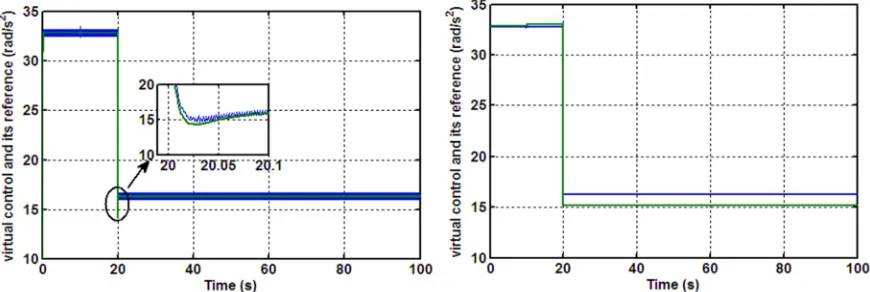
The tracking and identifying capability of our adaptive controller were verified in the case of time-varying wind speed (Figures 3). To demonstrate the robustness against winding resistances and mechanical torque changes, regulation performances for adaptive and conventional controllers were compared at constant wind speed (Figures 4). For both cases, one assumes that changes occur in the system model, first (at 10s, ∆Rr=50%) and next in the mechanical torque (at 20s, ∆Tt=-50%).
The constant values for DC-link voltage filter and quadratic currents references were considered. To have a unity power factor, the references of q-axis currents isq and ioq have been set to zero. The values of the design parameters used in simulation are:
k0 =1000, k1 =150, k2 =2000, λt=10 and
γs=γr =0.0001.
Figures 3a and 3b confirm the effectiveness of the MPPT strategy since the rotor speed varies in accordance with wind speed so that the turbine operates at its optimal TSR.
Figures 3d and 3e show the good tracking capability of the q-axis current controller. The same performances are achieved in the case of DC-link regulation (Figure 3f) and the virtual control variable (Figure 3c).
Figures 3g and 3h illustrate the two operating modes of the generator. Around time t=55s, we can see in Figure 3b that the induction machine switches from super-synchronous to sub-synchronous mode (Ns=1500 rpm). Figure 3g shows that grid voltage and stator current are in phase for both of the two operating modes; thus, the active power is transmitted from the stator to the grid. Figure 3h shows that grid voltage and filter current are in phase opposition for (t>55s); thus, the active power is transmitted from the grid to the rotor. This result is compatible with the sub-synchronous speed operation. Also, Figure (3h) shows that, for (t<55s), the grid voltage and filter current are in phase; thus, the active power is transmitted from the grid to the rotor. This result is compatible with the super-synchronous speed operation.
According to Figure 3i, one can notice that the unknown rotor resistance quickly converges to its true profile (unknown to the controller). Likewise, Figure 3j shows that the estimated mechanical torque recovers perfectly the applied unknown aerodynamic torque.
Figure 4 shows the regulation performances of the conventional and adaptive controllers when there are changes in the rotor resistance Rr and the mechanical torque Tt. The simulation assumes that changes occur in the system model first at 10s, ∆Rr=50% and next in the mechanical torque at 20s, ∆Tt=-50%. Unlike the conventional backstepping controller (Figures. 4b, 4d, and 4f), the adaptive controller tracks correctly the references of regulated variables despite the changes (Figures. 4a, 4c, and 4e). These results confirm the robustness of the proposed controller.
5. CONCLUSION
ISSN: 1992-8645 www.jatit.org E-ISSN: 1817-3195
164 Appendix: Characteristics and Parameters
Induction Generator Rated power
Rated stator voltage Nominal frequency Number of pole pairs Rotor resistance Stator resistance Stator inductance Rotor inductance Mutual inductance
3MW 690V 50Hz p =2 Rs=2.97e-3Ω Rr=3.82e-3Ω Ls=0.0122H Lr=0.0122H Lm=12.12e-3H Wind Turbine
Blade Radius Power coefficient Optimal TSR
Mechanical speed multiplier
Cp coefficients
Rt=45m Cpmax= 0.48 λopt=8.14 G=100
c1 = 0.5176,
c2 = 116, c3 = 0.4,
c4 = 5, c5 = 21
c6 = 0.0068 Generator and Turbine
Moment of inertia Damping coefficient
J=254Kg .m2 F=0.24
Bus DC C = 38 mF,
vdc = 1200 V
Filter RL R = 0,075 Ω,
L = 0,75 mH
Electrical grid U = 690 V,
f = 50 Hz
REFERENCES:
[1] B. Multon ; X. Roboam ; B Dakyo ; C. Nichita ; O Gergaud ; H. Ben Ahmed, “Aérogénérateurs électriques”, techniques de l’Ingénieur, Traités de génie électrique, D3960, Novembre 2004.
[2] R. Pena, J. C. Clare, G. M. Asher, “Doubly fed induction generator using back-to-back PWM converters and its application to variable -speed wind-energy generation,” IEE Proc. Electr. Power Appl., vol. 143, no. 3, pp. 231-241, May 996.
[3] Karthikeyan A., Kummara S.K, Nagamani C. and Saravana Ilango G, “ Power control of grid connected Doubly Fed Induction Generator using Adaptive Back Stepping approach“, in Proc 10th IEEE International Conference on Environment and Electrical Engineering EEEIC-2011, Rome, May 2011.
[4] H. Li, Z. Chen, “Overview of different wind generator systems and their comparisons” IET Renewable Power Generation, 2008, 2(2):123-138.
[5] Siegfried Heier, “Grid Integration of Wind Energy Conversion Systems” John Wiley & Sons Ltd, 1998, ISBN 0-471-97143-X.
[6] J.P.Caron, J.P.Hautier, 1995 “Modélisation et Commande de la Machine Asynchrone” Edition Technip, Paris.
[7] M. Krstic, I. Kanellakopoulos, P. Kokotovic, “Nonlinear and adaptive control design”, John Wiley & Sons, Inc, 1995.
[8] I. Kanellakopoulos, P.V. Kokotovic, and A.S. Morse, “Systematic design of adaptive controller for feedback linearizable systems”, IEEE Trans. Auto. Control. 1991. Vol. 36, (11), pp. 1241-1253.
[9] Marino, Riccardo, Tomei, Patrizio, Verrelli, Cristiano M. ‘’ Induction Motor Control Design” Springer-Verlag London, 2010.
ISSN: 1992-8645 www.jatit.org E-ISSN: 1817-3195
165
Fig. 3a: Time-varying wind speed Fig. 3b: Rotor speed and its reference
Fig. 3c: virtual control and its reference Fig. 3d: Stator q-axis current and its reference
ISSN: 1992-8645 www.jatit.org E-ISSN: 1817-3195
[image:9.612.94.529.64.258.2] [image:9.612.95.528.296.459.2]166
Fig. 3g: Phase a grid voltage and stator current Fig. 3h: Phase a grid voltage and filter current
[image:9.612.94.531.527.659.2]Fig. 3i: Rotor resistance and its estimated Fig. 3j: Mechanical torque and its estimated
Figure 3: Tracking capability under time-varying wind speed Changes occur at 10s (∆Rr=50%) and at 20s (∆Tt=-50%)
ISSN: 1992-8645 www.jatit.org E-ISSN: 1817-3195
[image:10.612.92.529.65.256.2]167
Fig. 4c: Stator current with adaptation Fig. 4d: Stator current without adaptation
Fig. 4e: Virtual control with adaptation Fig. 4f: Virtual control without adaptation
[image:10.612.94.529.290.436.2]