ORIGINAL RESEARCH ARTICLE
A SOCIOLOGICAL ASPECT ON INDUSTRIAL UNREST IN
THE WORKING ENVIRONMENT
1
Mandla Alfred Twala,
2Oliver Chimusoro,
3Itai Chimusoro and
4Jozi Joseph Thwala
1
PhD Sociology, Director: Monitoring and Evaluation, Gauteng Department of Infrastructure Development:
18 Rissik Street, Marshalltown, Johannesburg, Gauteng, South Africa
2
PhD Industrial Engineering Student, Chief Engineer: Green Technology, Gauteng Department of Infrastructure
Development: 18 Rissik Street, Marshalltown, Johannesburg, Gauteng, South Africa
3
PGDHE, People and Organisational Development Consultant, Roittchi Business Solutions:
Johannesburg, South Africa
4
Senior Lecturer, M.E.R Mathivha Centre for African Languages, Arts and Culture, School of Human and Social
Sciences, Department of Siswati, University of Venda, Private Bag X 5050, Thohoyandou, Limpopo Province,
South Africa
ARTICLE INFO ABSTRACT
Conflict occurs everywhere in South African industries and the mining sector is no exception. Mining, in particular, has experienced great conflict between management and workers, the main cause being salaries, as well as worker dissatisfaction over working conditions. The most common source of conflict between the tripartite (i.e. management, workers and/or unions) is found in arguments concerning the following: application of scarce resources, incompatibility of needs, goals and interests, different work attitudes, values and perceptions in general, ambiguity in responsibilities and roles, poor or inadequate organisational structures and poor communication. Management, for example, might decide one-sidedly to grant shareholders a higher dividend, to purchase new machinery or offer a large sum for an individual’s expertise. This, however, might not receive the workers and unions’ approval, who may believe instead that more of the available money should have been assigned to wage increases. It is commonly realised that the unilateral pursuit of goals causes continued conflict, hence an attempt should be made to manage or contain the conflict in a functional manner that takes the interest of both parties into consideration.
*Corresponding author
Copyright ©2017, Mandla Alfred Twala et al. This is an open access article distributed under the Creative Commons Attribution License, which permits unrestricted use, distribution, and reproduction in any medium, provided the original work is properly cited.
INTRODUCTION
Management and workers usually have different needs, goals, attitudes, interests, values and perceptions. While all parties pursue their own goals in line with their own interests and values, and perhaps at the cost of the other party or parties, conflict typically ensues. Where this is allowed to continue, such conflict can culminate in enormous disruption, which then causes both parties and the organisation at large to suffer negatively as a consequence. There are many circumstances in which any one of the parties to the employment relationship becomes an obstacle to the achievement of the purpose of one
of the others. Industrial relations are especially concerned with those circumstances in which different groups are set upon different courses in the pursuit of which one becomes an obstacle to the other. The procedures of industrial relations are, for the most part, concerned to protect the parties from inflicting an unacceptable degree of damage upon each other in a relationship which is often hostile (Anthony in Bendix, 1996). In the preceding quotation, the author attempted to elucidate the role of industrial relations when it comes to hostile relationships between workers and management in a workplace environment. The primary purpose of industrial relations is to minimise or eradicate conflict which may cause enmity between workers and management.
ISSN: 2230-9926
International Journal of Development Research
Vol. 07, Issue, 08, pp.14746-14752, August,2017
Article History:
Received 24th May, 2017
Received in revised form 15th June, 2017
Accepted 23rd July, 2017
Published online 30th August, 2017
Citation: Mandla Alfred Twala, Oliver Chimusoro, Itai Chimusoro and Jozi Joseph Thwala, 2017. “Site characterization through soil sample of
different Ghats of Allahabad for Forensic consideration”, International Journal of Development Research, 7, (08), 14746-14752.
ORIGINAL RESEARCH ARTICLE Open Access
Keywords:
The author hence acknowledged that in all working environments there are different views and opinions which might lead to conflict, especially if these are perceived as a hindrance to one party. Conflict is associated with the central processes of workers and their association and is hence an unavoidable part of organisational life (Jones & George, 2003).
Different Models of Strike Causality
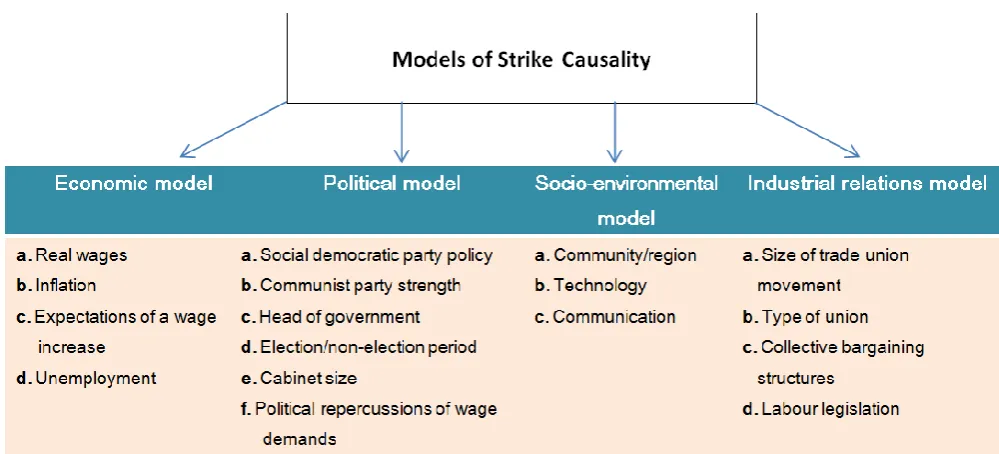
It is necessary to take into account two issues when analysing South African strikes: One has to look at what causes strikes and how this relates to internal dynamics. The different models of strike causality identify economic, political, socio-environmental and industrial relations variables as being of importance. See Figure 1. In light of the above, the following potential causal variables appear to have a relationship that is statistically significant to the occurrence of strikes in South Africa, namely: union size, expectations/deprivation of a wage increase, unemployment (only in the 1980s however and contrary to the belief that striking is discouraged by unemployment) and, finally, inflation. All these variables, it should be noted have experienced dramatic changes during the period under review; which is to say, the situation is one of both trends and discontinuities. Unemployment, expectations, union size and inflation are all variables that have been identified in established strike causality models, although it is hard to quantify expectations other than by assessing the (direct or lagged) relationship between higher real wages and an increase in strikes. As noted earlier, incidents of political ‘unrest’ in the South African context are a more appropriate means for measuring the possible effects of political developments on strikes compared to changes in coalition government composition, the heads of government and comparative strengths of communist and/or socialist parties. However, such a measure is only suitable where resistance of such nature was over a relatively long period of time, the 1980s for example, which then makes regression analysis possible. There appears to be no direct relationship between political ‘unrest’ and strike action occurrence, although an
indirect relationship could possibly exist. As for
unemployment, it is a rather vague and ambiguous measure,
seemingly not only constraining but also, in the 1980s at least, apparently encouraging strike action. Based on this, it is not the direct deterrent that the original model envisaged.
Theoretical Approach
In attempting to explain the nature of conflict, numerous scholars have come up with theories with which to guide an understanding thereof. Among these postulated theories is the traditional theory that views conflict in a negative light and thus bad for an organisation. Such a view is something to that needs to be avoided. Contemporary theory, on the other hand, recognises that human conflict are inevitable, but can nevertheless bring positive results to an organisation if they are well managed. Indeed, Tillett and French (2006) believe that conflict encourages communication between parties and assists with the growth individuals and organisations alike as it presents problem solving opportunities and helps an organization to advance. This, however, is contrary to Eunson (2007), who opines that conflict can assist in changing complacency through productive means. In his analysis of the relationship between workers and management, Fox (1981) identified the following three basic approaches to such a relationship: pluralist, unitary and radical. It is now accepted though that a third radical perspective also exists in the approach of fundamentalist unions and their respective members.
Pluralism Approach
[image:2.595.46.546.55.282.2]According to the pluralism perspective, different interests exist in industrial societies. For instance, workers obviously have an interest in increasing their wages, unlike management whose interest is to keep wages low in order for profits to remain high. Workers also wish to keep their jobs and it is hence not in their interest to push for wages that could potentially bankrupt their industry. Furthermore, as consumers, workers might also realise that excessive wage demands will result in inflation and thereby devalue their wages in the long run. In situations such as this, the possibility exists for various interest groups such as management and workers to resolve their differences by means of negotiations (Haralambos, 1991). This
clearly indicates that pluralists do in fact acknowledge the existence of wage conflicts in industries, and that they also offer possible solutions to the problems. They view trade unions as the major group representing the workers’ interest and maintain that through trade unionism, it is also possible to integrate the working class into capitalist society. Conflict between workers and management certainly does exist, but it has been institutionalised through an agreed set of rules and procedures.
Unitarism Approach
The underlying assumption of this approach is that natural inbuilt tension does not exist in the relationship between workers and management, since both work together for the mutual benefit of both parties. It therefore follows that conflict between management and workers is considered as just a temporary and irrational deviation from the parties’ normal and harmonious working relationship. Trade unions are hence viewed as outsiders who cause needless conflict between workers and management. According to Fox (1981), from a unitary standpoint, the enterprise’s organisational logic is perceived as pointing towards a loyal structure and unified authority, with management's prerogatives being supported and legitimised by every member of an organisation. The behaviour of employees is only seen as 'rational' based on the extent to which it follows the ‘racial’ goals and policies of management. Conflict is seen as an abnormality and trade unions are perceived to exist as a product of poor management, poor understanding of economics or ‘national interest’, sectional greed, or the result of subversive elements and ‘agitators’. Trade unions are not seen as necessary within this paradigm, but are regarded as intrusive as they compete with management for the loyalty of workers and create distraction and disharmony between the parties.
Radicalism Approach
Radicalism, to a large extent, can be perceived as criticism against the pluralist. Within society, two groups or classes exist namely the capitalists or owners’ class and the workers or non-owners’ class. The capitalists employ their power to obtain maximum profit from the labour of the workers’ class. Individual workers lack the necessary power to prevent this exploitation and thus acquire their fair share of the profits, hence trade unions are established accordingly to restore balance, their principal task being to serve as instruments whereby the workers’ class can overthrow the exploitative capitalist system. Furthermore, since there are no common grounds between employee and employer, the negotiation process is also viewed as simply an attempt by the capitalists to further protect their profits (Slabbert, 1998). The radical approach focuses on the political economy and the interrelationships that exists between political and economic variables. This approach is based on a critical analysis of the class division within capitalist society, as defined by the Neo-Marxist or radical school perspective. As a consequence, all policies with regard to unitarist human and industrial relations are seen as being oriented to the status quo. According to Herbst D, Slabbert JA & Terblanche SS (1987), for as long as people sell their labour and are engaged in economic activity, there will always be disputes between employee and employer. In the labour field, bargaining occurs between unions and management because each accepts that the other party has power.
Strikes in the South African Context
According to Baudrillard (1990:116), there has been a change in the nature of strike action in the West. Strikes are no longer representative of ‘life and death struggles’, but are instead based on the assumption of an intrinsic flexibility by both
parties. From a laissez-faire perspective, each party seeks to
maximise their own economic gain, without necessarily desiring to challenge the existing power relations within society. Most strike causality models are therefore based on the assumption of a rational, economically-orientated cost benefits analysis underlying the negotiations of both parties to the dispute.
However, it may also be argued that this assumption might not always apply in the developing world. Strikes are frequently viewed as a geographically specific and restricted struggle between management and workers over a certain set of issues that will be resolved without challenging the very existence and status of either. However, in the South African context, numerous strikes have led to the mass dismissal of workers, regularly with the help of authorities, or in protracted and bloody ‘trials of strength’ in more recent years. A good example of the former is the Amato textiles strikes in the late 1950s, while the 1987 miners’ strikes are a good example of the latter. A recent strike in the mining sector that was quite topical was the Marikana strike in 2012 in the North West between two rival unions: the Association of Mineworkers and Construction Union (AMCU) and the National Union of Mineworkers (NUM), at the centre of which were wage disputes. Quantitative models of strike action tend to also disregard the potential for wage disputes where one of the parties is in a suitably powerful position (due perhaps to the full coercive powers of the state) and totally uncompromising, to the enormous ultimate cost of a prolonged dispute (the 1980 Johannesburg Municipal Strike for example). Moreover, the conceptions held by the individual parties regarding their own respective strengths in an industrial dispute may prove to be illusory. Workers or management might well underestimate the strength of their opponents and overestimate their own. An example of the latter is the afore-mentioned Amato textile strikes of the late 1950s. After a series of easy victories, the workers completely underestimated the management’s relative strength and resolve including that of the firm’s financial backers. What’s more, in any conflict, there will always be a certain ‘fog and friction’ present (Clausewitz, 1968). Some degree of uncertainty always exists regarding the opposing side’s intentions as well as the different interpretations of the outcome of past disputes and the build-up and progression of an ongoing one. Even the demands of striking workers might not always be specific and fixed, but might instead be somewhat vague and ‘floating’. While this makes it significantly more difficult to understand strikes, as noted earlier, however, this need not necessitate rejecting the theory.
instead of emphasising the collective aspect of industrial relations. If, however, the latter occurs, management typically
adopts an ‘arms-length’ relationship with individual
employees and instead develops positive relationships with the trade union representatives who are tasked with bargaining for the collective. In the process, any individual workers’ conflicts that are not articulated or shared by the collective might be neglected. Woodworth and Meek (1995) suggest that labour management partnerships need to be created in which labour management relations exist on a continuum, moving through the following typical stages: open warfare, guerrilla tactics, bargaining compromise at the centre, creative problem solving, anticipatory problem solving and, finally, joint future creation.
The Causes of Industrial Unrest
Industrial unrest might be regarded as the main cause of strikes. Mostly, this commences as just a feeling of general dissatisfaction amongst workers with respect to present circumstances. When the unrest becomes more evident, the workers then commence to form groups and the matter deteriorates into an emotional affair that can eventually lead to a strike. There are several factors that cause industrial unrest in the workplace; the most important are discussed hereunder.
Political Environment
The 1990s provided many important challenges in the political arena that have directly affected the labour climate (Slabbert JA, Prinsloo JJ, Acker W, 1994). The African National Congress (ANC) was elected into power in South Africa’s inaugural democratic elections. While this resulted in much jubilation in most spheres, it also had a detrimental effect on the nation’s workforce, as with the ‘people’s’ party now in power, the workers placed unreasonable demands on management based on their elevated expectations. The run-up to the elections also had some interesting outcomes for the labour climate, particularly with regard to trade unions. While still playing a primary resistance role, trade unions also began to involve themselves in social forums and started to develop new roles in reconstruction and development. The year 1993 produced less political engagement by unions. The concentration on political issues during previous years by trade unions resulted in the workplace as well as organisational and economic issues being neglected. Also in 1993, the Congress of South African Trade Unions (COSATU) started to position
itself with an eye on the upcoming 1994 elections (Slabbert et
al., 1994). It was agreed by COSATU, the ANC and the South
African Communist Party (SACP) that the ANC-led election platform would be founded on the Reconstruction and Development Programme (RDP). COSATU also released several senior leaders to contest the elections, with the result that COSATU was left with a top structure that was largely inexperienced. As a consequence of this move, COSATU experienced a severe ‘brain drain’, with about 20 of its Members of Parliament taking up positions in the movement. This in turn had a negative effect on COSATU’s capacity to manage the militancy and expectations of its members on the shop floor. Interestingly, strike action in the first quarter of 1994 (before the elections) equated to a total loss of 295 000 man days, as compared to the 1.2 million man-days lost in the
second quarter of 1994 (after the elections) (Slabbert et al.,
1994). This could perhaps have been due to higher expectations by workers, as well as the inability of union officials to control militancy amongst their members. The
mining industry was especially affected in this regard, with many wildcat and illegal strikes occurring. The post-election phase, however, represented a new era for the nations’ trade unions, particularly those who had previously supported the liberation struggle. They found themselves assisting in the initiation and formulation of government policy and bargaining with the ANC.
Social Environment
Due to South Africa’s socio-cultural and historical
development, its current population is exceedingly
heterogeneous. There are numerous different languages and dialects used for communication in the mines, thus resulting in immense socio-cultural differences in the mining environment. In addition to these challenges, race-based legislation in the previous dispensation has resulted in the overutilisation of whites in managerial or supervisory positions. Compared to other developing countries, South Africa’s productivity figures are among the lowest and the mining industry has suffered an immense decrease in capital as well as labour productivity (MWU News, June 1994). There is a worry in South Africa that the use of capital is increasing at twice the speed as that of labour, which typically results in unemployment. The fact that Rand Mining deemed it necessary to retrench over 2 000 workers because of low production figures and the subsequent lack of income is supportive of these statements. The result of this is that it creates an adverse atmosphere in the workplace, as workers are therefore in perpetual fear of losing their jobs. Another issue that is aggravating the manpower problem is the rise in South Africa’s population, which is among the highest in Africa. The result is that job creation has fallen a long way behind the required numbers for providing employment for the
increasing population, hence causing even greater
unemployment along with an influx of desperate workers to the mines. Aggravating this even further is that many mining groups are now mechanising their production as far as possible and reducing the size of their workforce, as strikes and labour unrest are forcing them to seek and adopt more reliable production systems. In line with this, many millions are spent each year on testing mechanised mining systems and new mining methods. Another challenge is the shortage of skilled manpower. There is a massive gap when it comes to the skills level of skilled and unskilled mine workers. Mechanisation is also an increasingly attractive option in lieu of the vast wage increases over the past few years. This has resulted in increased unemployment, with around 70 000 workers having been retrenched in 1991 in the gold mining industry alone. The use of violence has also become a major problem in the mining environment. Violence is wholly detrimental to any organisation and hinders it from achieving its objectives. Management must therefore consider it as one of their primary tasks to combat and eradicate violence in any form in South Africa’s mines. The solution here lies not only with management but also in the political and economic areas i.e. the macro-level (Henderson, 1981). The majority of violent incidents in South African mine are political in nature and have very little to do with mining per se.
Communication Aspect
form of communication. This rejection by black workers is reflective of the fact that language has become an increasingly
politically sensitive issue. Fanakalo, however, was a necessary
move by management several years ago so as to overcome the
language problem, and it was usedprimarily to bridge the huge
communication gap between non-South Africans and South Africans. Aside from South Africa’s 11 official languages, there are also workers from Angola, Mozambique, Malawi and
Botswana, each with their own languages. Fanakalo was
developed simply as a way of bridging this communication gap and was not a political ploy by then government.
Cultural Environment
When referring to culture in daily discussion, the concept is frequently used in a narrow context to signify what sociologists term the “higher things of the mind”, for example art, music, literature and painting (Manning, 1987). On the other hand, social observers employ the concept to include how people dress, their family life and marriage customs, their work patterns, religious ceremonies and even their leisure pursuits. While most definitions of culture focus on the tangible, material products of society, the concept also includes an integral abstract element. For instance, the norms, ideas, values, beliefs, customs and attitudes that are at least partially shared by the various members of a particular society. Norms differ from society to society as well as between subcultures within a society. Likewise, values vary from society to society. A degree of shared norms and values is hence vital for the smooth operation of any society. If norms are not shared, members of society will be incapable of interacting with or even comprehending the behaviour of other people. In the same way, without shared values, members of society will not be able to work together. Culture is also inevitably influenced by any changes in the macro-environment (urbanisation) as well as through technological innovations (improved communication facilities). Cultural relativism relates to judgement of what constitutes desirable norms and values in particular cultures (Mullins, 1980). Cultural practices deemed appropriate and ‘good’ in certain cultures are regarded as undesirable or ‘bad’ in others. Cultures must therefore be understood in terms of their specific value systems, meaning that they cannot be perceived from any absolute or universal vantage point.
The true understanding of cultures hence involves acknowledgement of particular value systems. Simplistic comparisons of cultures cannot be made through an arbitrary or preconceived universal value system. Every culture must first be understood in terms of its own specific value system and idiosyncratic structure. The failure to acknowledge cultural relativism in South Africa is among the key contributing factors to social and organisational dissonance in the mining industry (Shane, 1985). These problems are among the many shortcomings in South Africa‘s educational system. Segregated, as opposed to multi-cultural education, has resulted in the country‘s ‘cultural illiteracy’ increasing to such an extent that people of one culture experience difficulty interacting with those from another culture. The problems of cultural illiteracy as caused by South Africa’s educational system are replicated in the society at large and have particular consequences in the workplace, which is where the cultural interface is experienced to the highest degree. Furthermore, over and above the many diverging cultures, a broader organisational culture founded on Western work ethics
imposes additional demands on the workplace participants. Shane (1985) asserts that traditionally, organisational culture is perceived as a unilateral structure, thereby necessitating adaptation and compliance by workers. Consistent with the above, workers are expected to be integrated into the norms and values of their management’s culture. No concessions are provided by organisations regarding the workers’ particular cultural frameworks. There is increasing awareness however that the nature of the mining industry is evolving and becoming more participative and less hierarchal, with less reliance on a ‘top-down’ authority and approach. The result of this is renewed interest in the notions of company cultures and workers’ commitments. The focus is gravitating from the economic aspects of the contractual relationship that exists between management and workers towards the sociological and psychological facets of the relationship between people and their work situation (Bruce & Carby-Hall, 1991).
Management Aspect
Management is the driving force in any system pertaining to industrial relations, the reason being that it has to balance certain expectations from both workers and shareholders alike. Essentially, management aims to protect the interests of shareholders through maximising profit. One of its primary roles in the coal mining industry, for instance, is the production of the coal-bearing ore that is required to keep the mines in operation. The means of acquiring this ore includes interaction between management and workers. There are various management policies in the mining industry that require special attention, one of which is that of workplace discrimination. Following the Wiehann Commission of Inquiry into Labour Law in 1979, a non-discriminatory working environment policy was enforced. In order for such a policy to work, it necessitates the full support from top management, who must then communicate these policies to the lowest levels so as to commit all workers to adhere to such policies. An
example indicating the consequences of lack of
communication or understanding of these policies is the system of lift conveyances that is used in mine shafts. All the various worker and supervisor levels have particular times for obtaining such conveyances at their respective underground levels, with senior officials being the first to be conveyed to the surface, followed at different time intervals by the other levels of workers.
The reason for this time difference is because of the amount of administrative work that is required from these senior officials. This issue, however has been politicised due to the fact that the majority of senior officials are whites, hence reinforcing the opinion of workers that this conveyance procedure is racially motivated. This single and seemingly minor issue has caused enormous setbacks in production and various sit-in strikes at mines, thus reinforcing the necessity for management to clearly communicate all policies and procedures right down to
the lowest levels. A prerequisite for co-operation,
communication and understanding between all parties involved entails the carrying of information up and down the lines of hierarchy. The conveyance and availability of
information also depend on the circumstances (Slabbert et al.,
decision-making and handling of conflict within the organisation. The leadership style of each manager affects the labour relations within his or her section, and this will ultimately affect those of the mine as a whole. There is a direct correlation between the workers’ acceptance of a manager and the quality of labour relations in that particular section. Management-related aspects play a definite role in determining the mine’s labour relations climate as a whole. It is thus important that the prerogatives of managers be carefully examined. There needs to be a move away from the ‘let us see how little we can give away’ style of negotiating to one that is more accommodating of workers’ needs. Furthermore, managers should consult continuously with workers and their various union representatives. Decision-making that is one-sided regarding what is best for the worker must be replaced by joint decision-making. This goes hand in glove with the fact that decision-making in the field of labour relations is not just for experts for all workers who should hence be drawn into these decision-making processes. Finally, management must also be cautious of constructing false company images through the introduction of ‘affirmative action’ policies, since this can cause an additional spiral of conflict in a labour force that is already highly-charged. The fact that black workers’ aspirations are continually growing has resulted in them becoming frustrated as management is generally reluctant to afford them a say in the matters that affect them.
Economic Aspect
Salaries and wages, along with the methods through which the various salary levels are determined remain the most significant source of conflict between labour and management, as workers normally seek to maximise the benefits they accrue from the organisation. There are numerous key factors that have resulted in dissatisfaction amongst workers when it comes to the issue of wages in particular, including:
Payment based on the quality of work done
The gap between lower-paid employees and the
minimum salary levels as determined by external organisations
The role of sex or race in the determining of salaries
It must be recalled, though, that salary increases can only improve motivation and effect better working standards if the workers perceive a clear correlation between their work performance and respective financial payment.
Working Hours
Working hours can be a factor when it comes to strikes but they are far less important than wages. Mines operate on a shift rotation basis, with only two shifts being worked for the most part: a morning shift and a night shift. The workers’ social lives can easily be disrupted when they are placed on the night shift, particularly if they are married and their spouses work during the day. This can cause discontent and eventually strikes.
Working Conditions and Safety
It is generally accepted that trade unions are morally obligated to ensure safe and healthy working conditions for workers (Knoesen, 1992). Safety and workers’ health hence play an
important role in the relationship that exists between management and unions. It is one of management’s basic duties as well as one of the workers’ basic human rights to expect and be provided with working conditions that are safe and healthy. The recommendations and introduction of the new Minerals Act 53 of 1993, along with the King Report, serve to tackle and improve the problems faced in the mining industry with regard to safe working conditions. The mining industry possesses a bad reputation with respect to the safety and protection of its workers in underground operations. These working conditions are for the most part undesirable, with
workers operating in hot, humid, unpleasant and
uncomfortable conditions which definitely impact negatively upon their overall performance, including their attitudes towards their positions. It is thus important that management should improve the working conditions for the workforce, along with the quality of their social life outside of the mine. The provision of suitable facilities for workers’ recreation purposes is a simple means for alleviating a great deal of their work pressure and stress. Being able to relax in a favourable environment plays a significant role in improving the work-related quality of life for workers, thereby helping to maintain a more positive attitude towards their jobs.
The Wages Issues
According to the Wage Settlement Survey carried out in 1994, wage settlements post elections were about 1% to 2% higher than they were before the elections. However, notwithstanding the fact that mining is among the worst working environments in any industry, the average minimum wage that is paid in the sector is not substantial. The strike figures recorded in South Africa’s mines are somewhat distorted (Department of Manpower). The mines are required to send all reasons and statistics for strike action to the Department of Manpower. During the annual period when negotiations over wages are in progress and strikes arise, additional petty reasons are generally given along with the wage issue as a reason for going on strike. As a result, a single clear reason can usually not be quoted as being the one and only issue causing the strike.
Foreign Workers in South Africa
Since the last century, foreign workers have flowed into South Africa in large numbers. Driven by their economies’ collapse and consequent pressures at home, they have instead worked to make South Africa the region’s most viable economy (SA Labour Bulletin, Vol. 18, No. 6, 1994). South African management have recruited foreign migrants systematically in order to supplement what they perceive to be an insufficient supply of cheap domestic labour for the mines. Recruitment from neighbouring and other African countries thus enables the Chamber of Mines to pay lower wages than would be the case if it employed South African workers only.
In recent times, there have been numberous debates regarding the issue of recruiting foreign workers. The main questions being asked are as follows: Are they taking jobs that should go to South African workers, and are they reducing wages by increasing the supply of labour? Another concern by unions is that they refuse to join these unions, thus reducing the bargaining power of unions by refusing to go on strike. This also has repercussions amongst the workers themselves and
and marginalisation of foreign workers should not occur (Cohen, 1988):
It will be grossly unfair if foreign workers are denied
jobs in South Africa. South Africa is far richer and more developed than any of its neighbours. Many foreign migrants in past years worked in South Africa, not because the pay was good, but because they were virtually forced to do so by their own governments, who wanted to tax them. These workers helped build and develop South Africa into the most developed country in Southern Africa
COSATU will only succeed in keeping foreign workers
out of South Africa at enormous cost to both our own and neighbourhood societies. Many foreign workers come as temporary migrants for months or years and send much of their money back home. If they are denied that opportunity, it is possible that they will bring their entire families to South Africa on a permanent basis
If COSATU does not extend its full solidarity with
foreign workers, management might use foreign migrants as a tool against South African workers’ interests
Conclusion and Recommendation
Naturally, the above-mentioned factors do not exhaust the many possibilities and reasons affecting the incidence of strikes. The incidence of strikes among workers may usually be ascribed to a combination of economic, political, industrial and even social relations. These factors must be regarded as an integrated whole when interpreting strikes. Nonetheless, it will not always be possible to take all the variables into consideration for an analysis of strikes and sometimes the real reasons for striking are actually overlooked, while secondary ones are regarded as causal. It is hence critical to establish formal systems and procedures for dispute resolution, grievances and disciplinary issues. In addition, it is important to link individuals’ performance targets to the overall organisational plans, so that everyone feels involved. Prior to decision-making, management should consult with workers and/or unions pertaining to rewards and working conditions.
REFERENCES
African National Congress, 1994. The Reconstruction and
Development Programme: A Policy Framework.
Johannesburg: Umanyano Publications.
Baudrillard, J. 1990. Revenge of Crystal. London: Pluto.
Bendix, S. 1996. Industrial Relationships in South Africa. 2nd
edition. South Africa: Juta and Company Ltd.
Management. Johannesburg.
Chapin, G. and Koshal, R.K. 1970. The Relationship Between the Rate of Change in the Money Wage Rate and
Unemployment Levels in South Africa, South African
Journal of Economics, 38:374-381.
Clausewitz, C. 1968. On War. Harmondsworth: Penguin.
Cohen, R. 1988. The New Helots: Migrants. England: Gower
Aldershot.
Eunson, B. 2007. Conflict Management. Milton, Australia:
John Wiley and Sons.
Fox, A. 1981. Industrial Relations: A Social Critique of Pluralist Ideology. In Barrett, B. Rhodes, E. and Beishon, J.
Industrial Relations and the wider society. London: Collier MacMilIan.
Haralambos, M. 1991. Sociology Themes and Perspectives. 3rd
edition. London: Collins Educational.
Herbst, D., Slabbert J.A. & Terblanche, S.S. 1987. Changes in
Black Workers’ Perception of the Role and Function of
Labour Unions. Pretoria: Human Science Research
Council.
Jones, G.R. & George, J.M. 2003. Contemporary
Management. 3rd edition. New York: McGraw-Hill.
Kemp, N. 1992. Labour Relations Strategies: An International
Approach. Kenwyn: Juta and Company Ltd.
Knoesen, E.O. 1992. Juridiese riglyne vir die bestuur van
stakings in vakbond georienteerde omgewings.
Johannesburg: RAU.
Manning, A.D. 1987. Communicating for Change.
Johannesburg: Juta Company.
Mullins, W.G. 1980. Strike Defense Manual. Birmingham.
Shane, S. 1985. Strikes in South Africa. Pretoria: Human
Sciences Research Council.
SIabbert, J.A., Prinsloo, J.J., Acker, W. 1994. Managing
Industrial Relations in South Africa. Pretoria: Digma.
Slabbert, J.A. 1984. Black Worker’s Perception of Problem
Solving. Pretoria: Human Science Research Council.
Slabbert, J.A. and Swanepoel, B.J. 1998. Introduction to
Employment Relations Management. Durban:
Butterworths.
South African Labour Bulletin, Vol. 18, No. 6, 1994.
South African Labour Bulletin. “Public Sector Strikes: An
Overview”, Vol. 14, No. 8, 1990.
South African Labour Bulletin, 1993. “The Law on Strikes”,
Vol. 14, No. 3, August 1993.
Tillett G, French B. 2006. Resolving Conflict. Melbourne,
Australia: Oxford University Press.
Twala MA 2002. Sociological Analysis of the Impact and
Management of Strike Action in South African Mining
Industry. Ph. D. Thesis, Published. Kwa-Dlangezwa:
University of Zululand.
Woodworth WP, Meek EB 1995. Creating Labour
Management Partnerships. United States of America:
Addison-Wesley Series.