Available online on www.ijpsr.com 44
IJPSR (2010), Vol. 1, Issue 3 (Research Article)
Received 20 January, 2010; received in revised form 15 February, 2010; accepted 24 February, 2010
U.V SPECTROPHOTOMETRIC METHOD FOR THE ESTIMATION OF MESALAZINE IN BULK AND ITS PHARMACEUTICAL DOSAGE FORMS
Rakesh Kumar Singh*1, Pankaj Singh Patel2 and Pragya Gupta3 College of Pharmaceutical Sciences *1, Mohuda, Berhampur, Orissa
Indira Gandhi Institute of Pharmaceutical science 2, Bhubaneswar, Orissa
Biotech Park, CIF Lab 3, Lucknow
ABSTRACT
Mesalazine is used, either orally or rectally, as an anti-inflammatory agent in treating ulcerative colitis and, to a lesser extent, Crohn's disease. Mesalazine is a white to pinkish crystalline powder. It is slightly soluble in cold water and alcohol; more soluble in hot water, soluble in hydrochloric acid. A simple UV spectrophotometric method was developed for the determination of Mesalazine (MEZ) in pure and its pharmaceutical formulations. Mesalazine exhibiting max absorbance at 210 nm in methanol and obeyed linearity in the concentration range of 0.2-50 g/ml. The proposed method was statistically validated.
*Correspondence for Author:
RAKESH KUMAR SINGH
College of Pharmaceutical Sciences , Mohuda, Berhampur, Orissa
Email:
[email protected] Keywords:
Mesalazine,
Anti-inflammatory,
UV Spectrophotometry,
Available online on www.ijpsr.com 45
INTRODUCTION: The scope of
developing and validating analytical methods is to ensure a suitable method for a particular analyte more specific, accurate and precise. The main objective for that is to improve the conditions and parameters, which should be followed in the development and validation. Chemically Mesalazine (MEZ) is 5-amino salicylic acid. It is an anti-inflammatory drug structurally related to salicylates and active in inflammatory bowel disease. Tablet formulations containing 250, 400 and 500 mg MEZ are available in the market. Literature survey revealed that Mesalazine is estimated by HPLC and micellar electrokinetic chromatography. No UV spectrophotometric methods have been reported for estimation of MEZ in single component formulation. Hence, an attempt has been made to develop new UV methods for its
estimation in pharmaceutical
formulations with good accuracy, simplicity, precision and economy.
5-Amino-2-hydroxybenzene-1 carboxylic acid [Mesalazine or 5-Amino salicylic acid (ASA)]
EXPERIMENTAL:
Instrumentation: Spectral and
absorbance measurements were made
on an ELICO SL-159 UV-Vis
spectrophotometer by using 1 cm quartz cells. Dhona balance was used for weighing the samples. Commercially
available tablets of Mesalazine were procured from the local market and estimated.
Reagent used:
1. Disodium hydrogen phosphate anhydrous (Merck)
2. Citric acid
3. Double distilled water
4. Mesalazine, Sun pharma ltd., (India)
Optimization: Scanning and
determination of maximum
wavelength (max):
In order to ascertain the wavelength of maximum absorption (λmax) of the drug, different solutions of the drugs (10 μg/ml and 20 μg/ml) in
methanol were scanned using
spectrophotometer within the
wavelength region of 200 – 380 nm against Phosphate buffer (pH- 3.6) as blank. The resulting spectra were shown in fig 1 and the absorption curve showed characteristic absorption maxima at 298 nm for Mesalazine.
Fig 1: UV Spectrum of Mesalazine in Phosphate buffer (pH- 3.6)
Available online on www.ijpsr.com 46
Reference: Phosphate Buffer (pH-3.6) Instrument: Elico SL 159 UV –Visible Spectrophotometer.
METHOD
Preparation of Phosphate buffer
solution (pH-3.6): 0.9g of anhydrous disodium hydrogen phosphate and 1.298g of citric acid monohydrate were weighed accurately, mixed and volume made with double distilled water (1000ml).
Preparation of Stock Solutions:
Standard stock solution was prepared by dissolving 25 mg of each drug in 25 ml of Phosphate Buffer (pH-3.6) to get concentration of 1mg/ml (1000 μg/ml) solutions.
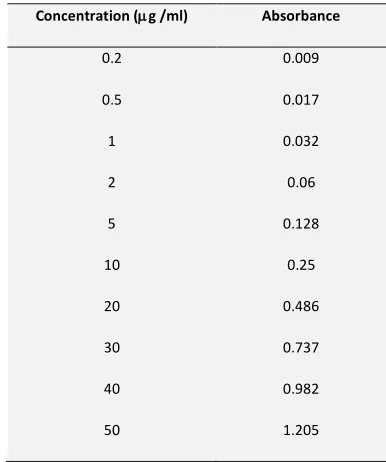
Preparation of Working Standard Solutions and construction of standard graph: The prepared stock solution was further diluted with Phosphate Buffer (pH-3.6) to get working standard solutions of 10 g/ml and 100 g/ml of mesalamine to construct Beer’s law plot for pure drug, different aliquots of Mesalazine were taken and diluted to 10 ml with Phosphate Buffer (pH-3.6).
The absorbance was measured
maximum at 245 nm, against Phosphate Buffer (pH-3.6) as blank. The results were shown in table (1). The standard
graph was plotted by taking
concentration of drug on x-axis and absorbance on y-axis and was shown in Fig. (b) The drug has obeyed Beer’s law in the concentration range of 0.2-50µg/ml.
[image:3.612.344.537.121.352.2]Table 1: Linearity table of Mesalazine in Working Standard
Table 2: Optical characteristics
Beer’s Law limit (µg/mL) 0.2-50 Sandell’s sensitivity
(µg/cm2/0.001absorbance unit) 0.0390 Molar extinction coefficient
(1 mole-1 c.m-1) 4.90 10 3
% Relative standard deviation 1.1083
Confidence limits
95% Confidence limits 0.189209 99% Confidence limits 0.249058 Correlation coefficient 0.999
Regression equation (Y*)
Slope (a) 0.024
Intercept (b) 0.0077
* Y= a + bC where C is the concentration of mesalamine and Y is the peak area
Concentration (g /ml) Absorbance
0.2 0.009
0.5 0.017
1 0.032
2 0.06
5 0.128
10 0.25
20 0.486
30 0.737
40 0.982
[image:3.612.343.536.390.629.2]Available online on www.ijpsr.com 47 Fig 2: Standard graph of Mesalazine
Table 3: Recovery from the formulation:
* Each value is average of three determinations ± standard deviation.
Validation:
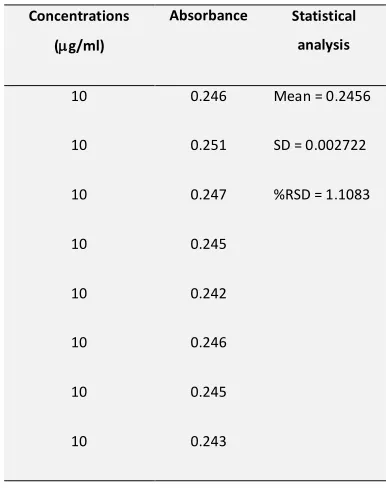
Precision: The precision of the proposed method was ascertained by actual determination of eight replicates of fixed concentration of the drug within the Beer’s range and finding out the absorbance by the proposed method. From this
absorbance, Mean, Standard
deviation, % RSD was calculated. The readings were shown in Table 4.
Table 4: Precision readings:
Concentrations
(g/ml)
Absorbance Statistical
analysis
10 0.246 Mean = 0.2456
SD = 0.002722
%RSD = 1.1083
10 0.251
10 0.247
10 0.245
10 0.242
10 0.246
10 0.245
10 0.243
Accuracy: To determine the accuracy of the proposed method, recovery studies were carried out by adding different amounts (80%, 100%, and 120%) of bulk samples of mesalamine within the linearity range were taken and added to the pre-analyzed formulation of concentration 20g/ml. From that percentage recovery values were calculated. The results were shown in Table 5.
RESULTS AND DISCUSSION: From the optical characteristics of the proposed method, it was found that mesalazine obeys linearity within the concentration range of 0.2-50 g/ml. From the results shown in Table (4) it was found that the % RSD is less than 2, which indicates
that the method has good
reproducibility. From the results shown in accuracy Table 5, it was found that
Formulation Labeled amount
(mg)
UV- method*
Mean ± s. d (amount mg recovered)
%Drug
recovered % RSD
Mesacol (tablets)
[image:4.612.83.313.307.454.2]Available online on www.ijpsr.com 48
the percentage recovery values of pure drug from the preanalyzed solution of formulation were in between 98.676 – 101.397, which indicates that the proposed method is accurate and also reveals that the commonly used excipients and additives in the pharmaceutical formulations were not interfering in the proposed method. Table 5: Accuracy table
Sample ID
Concentration (g/ml)
%Recovery of Pure
drug
Statistical Analysis Pure
drug Formulation
S1 : 80 % 8 10 101.29 Mean 101.397
S2 : 80 % 8 10 101.52 SD 0.1159
S3 : 80 % 8 10 101.38 % RSD 0.1143
S4 : 100 % 10 10 99.046 Mean 99.3253
S5 : 100 % 10 10 99.57 SD 0.2637
S6 : 100 % 10 10 99.36 % RSD 0.2655
S7 : 120 % 12 10 98.819 Mean 98.6757
S8 : 120 % 12 10 98.328 SD 0.3026
S9 : 120 % 12 10 98.880 % RSD 0.3067
CONCLUSION: The proposed method
was simple, sensitive and reliable with good precision and accuracy. The proposed method is specific while estimating the commercial formulations without interference of excipients and other additives. Hence, this method can be used for the routine determination of Mesalazine in pure samples and pharmaceutical formulations.
ACKNOWLEDGEMENTS
The authors thank Sun Pharma Ltd. for providing the gift sample of Mesalazine. Authors are thankful to CIF Lab Biotech Park, Lucknow for providing necessary facilities for the work. Authors are also thankful to Dr. Pragya Gupta under whom this work was completed.
REFERENCES:
1.Budavari S: The Merck Index. Merck Research Lab Division of Merck and Co., Inc., Whitehouse Station NJ, 1996, 12th ed. Pp-1163.
2.Tripathi KD: Essential of Medical Pharmacology, Jaypee Brothers Medical Publishers (p) Ltd., New Delhi, 2004; 620-621.
3.Gotti R, Pomponio R, Bertucci C, Cavrini VJ and Chromatogr A., 2001; 916(1-2) 175-183.
4.Palumbo G, Carlucci G, Mazzeo P, Frieri G, Pimpo MT and Fanini D : Simultaneous determination of 5-aminosalicylic acid, acetyl-5-aminosalicylic acid and 2,5-dihydroxybenzoic acid in endoscopic intestinal biopsy samples in humans by high-performance liquid chromatography with electrochemical detection. J Pharm Biomed Anal 1995; 14 (2):175-80.
5.Brendel E, Meineke I, Witsch D, Zschunke M. Simultaneous determination of 5-aminosalicylic acid and 5-acetylaminosalicylic acid by high-performance liquid chromatography. J Chromatogr 1987;385:299-304
6.De Vos M, Verdievel H, Schoonjans R, Beke R, De Weerdt GA and Barbier F. High-performance liquid chromatographic assay for the determination of 5-aminosalicylic acid and acetyl-5-5-aminosalicylic acid concentrations in endoscopic intestinal biopsy in humans. J Chromatograph 1991; 564 (1):296-302.
Available online on www.ijpsr.com 49 8.Kersten BS, Catalano T and Rozenman Y:
Ion-pairing high-performance liquid chromatographic method for the determination of 5-aminosalicylic acid and related impurities in bulk chemical. J Chromatogr 1991; 588(2):187-93.
9.Palumbo G, Bacchi S, Primavera L, Palumbo P and Carlucci G. A validated HPLC method with electrochemical detection for simultaneous assay of 5-aminosalicylic acid and its metabolite in human plasma. Biomed Chromatogr. 2005; 19 (5):350-4.
10.Nobilis M, Vybíralová Z, Sládková K, Lísa M, Holcapek M, Kvetina J: High-performance liquid-chromatographic determination of 5-aminosalicylic acid and its metabolites in blood plasma. J Chromatograph 2006;1136(2):248.
11.Bystrowska B, Nowak J, Brandys J: Validation of a LC method for the determination of 5-aminosalicylic acid and its metabolite in plasma and urine. J Pharm Biomed Analysis 2000;22(2):341-7
12.Hirsch RE, Lin MJ and Das KM. Estimation of 5-aminosalicylic acid and its metabolite in human serum by front-face fluorometry: a simple and sensitive method. J Lab Clin Med 1990; 116(1):45-50.