ISSN: 1992-8645 www.jatit.org E-ISSN: 1817-3195
4623
A QUANTITATIVE MODEL OF DETERMINANTS OF USE
BEBAVIOR FOR THE CRYPTOCURRENCY SYSTEM IN
TERMS OF SECURITY CONCERNS AND RISKS
1YOUNG-HO HWANG, 2YOO-JIN MOON
1First Author: Kunsan National University, Gunsan, Republic of Korea
2Corresponding Author: Hankuk University of Foreign Studies, Seoul, Republic of Korea E-mail: 1[email protected], 2[email protected]
ABSTRACT
The paper performs quantitative analysis of moderating effects of security concerns and risks for management of cryptocurrency systems and proposes solutions for security concerns and risks. The results show some important implications for the management of cryptocurrency systems. Particularly, performance expectancy can be headed for management and system design strategies of cryptocurrency service providers, and the cryptocurrency systems should be elaborated in the pleasant and beneficial way. This paper also illustrates that perceived security concerns and perceived risks might negatively affect cryptocurrency use and trading. Based on the research results, security concerns and risks prove that they are very important interaction variables as a great interest for cryptocurrency users. For the safe transmission of cryptocurrency in the financial industries, the paper suggests that Korean Article 49 of the Enforcement Decree of Information and Communication Network Act should require higher standards to the cryptocurrency exchange markets. For the safe transactions of cryptocurrency, the paper suggests three solutions for security concerns and risks relevant to the cryptocurrency exchange markets.
Keywords: Cryptocurrency, Use Behavior, Performance Expectancy, Social Influence, Hedonic
Motivation, Security Concerns, Risks
1. INTRODUCTION
A cryptocurrency is a digital asset designed to work as a medium of exchange that uses strong cryptography to secure financial transactions, to control the creation of additional units, and to verify the transfer of assets [1, 2, 3]. A cryptocurrency aspires to be a new form of currency and promises to maintain trust in the stability of its value through use of technology. It consists of three elements. First, a set of rules (the ‘’protocol’’), computer code specifying how participants can transact. Second, a ledger storing the history of transactions. Third, a decentralized network of participants that update, store and read the ledger of transactions following the protocol [4]. With these elements, advocates claim, a cryptocurrency is not subject to the potentially misguided incentives of banks and sovereigns. A cryptocurrency is a kind of digital currency, virtual currency and alternative currency. Cryptocurrencies
utilize decentralized control as opposed to centralized E-money and central banking systems [5, 6]. While all cryptocurrencies rely on a distributed ledger, they differ in terms of how the ledger is updated [7, 8, 9].
Decentralized cryptocurrency is produced by the entire cryptocurrency system collectively, at a rate which is defined, when the system is created, and which is publicly known. More important use cases are likely to combine crypto-payments with sophisticated self-executing codes and data
permission systems. Some decentralized
4624 which hold asset value measured in it. The underlying technical system on which decentralized cryptocurrencies are based, was created by the group or individual known as Satoshi Nakamoto [10].
As of May 2018, over 1,800 cryptocurrency specifications existed [11]. With the growing popularity of the crypto market, the large number of unregulated cryptocurrencies (several hundreds), greater attention is now being paid by governments and other stakeholders around the world. Illustrative is that the total market capitalization of the 100 largest cryptocurrencies is reported to exceed the equivalent of EUR 330 billion globally by early 2018 [12]. Regulators are looking at whether — and how — to regulate cryptocurrencies. Until now there is no univocal view on how to do that. In any event, there are compelling reasons why cryptocurrencies should be under more scrutiny by regulators and supervisors. The threat of price volatility, speculative trading, hack attacks, money laundering and terrorist financing all call for stricter regulation [13]. Within the cryptocurrency system the safety, integrity and balance of ledgers is maintained by a community of mutually distrustful parties referred to as miners: who use their computers to help validate and timestamp transactions, adding them to the ledger in accordance with a certain timestamping scheme [14].
A good many of cryptocurrencies are designed to gradually reduce production of that currency, placing a cap on the total amount of that currency that will ever be in circulation [15]. Compared with ordinary currencies held by financial institutions or kept as cash on hand, cryptocurrencies can be more difficult for seizure by law enforcement [1]. This difficulty derived from leveraging cryptographic technologies.
The purpose of this research is to address empirical analysis of effects of revised UTAUT factors on use behavior of cryptocurrency and moderating effects between the factors. For the safe transactions of cryptocurrency, the paper suggests three solutions for security concerns and risks in the aspect of law relevant to the cryptocurrency exchange markets. Based on the research it could be found how cryptocurrency’s users (including potential users) behave, regarding use and trading of cryptocurrency.
2. THEORETICAL BACKGROUND:
CRYTOCURRENCY
Due to the anonymity in the night market, the exchange of goods necessitates a means of payment which we assume is a cryptocurrency. A cryptocurrency is a digital record-keeping device that uses balances to keep track of the obligations from trading and that is publicly known to all traders. A cryptocurrency system is defined by two parameters: money growth rate μ≥0 and transaction fee charge at a rate τ≥0. As discussed, the digital nature of these balances results in the double-spending problem. In what follows, we describe the features of a ledger that records the transfers of these balances [16].
2.1 Aggregate State
Each trader is entitled to a balance. Let mt D(i)≥0
denote the balance associated with agent i in the period t day market. We then use StD= {mtD (i)}to
denote the entire public record of these balances, called the (aggregate) state. Similarly, mN
t,n(i)≥0
and SN
t,n denote the balances and the state at the
beginning of the nth trading session of the period t night market. The economy starts with a given initial state S D
0.
2.2 Payments
We use ΔD
t(i,j) and ΔNt,n(i,j) to denote
respectively day and night transfers of balances from agent i to agent j and call these transfers payments. A day payment is feasible if
ΔD
t (i, j)≥0, (1)
mt D(i)≥∑ ΔDt (i, j). (2)
Similarly, a night payment is feasible if
ΔN
t,n(i,j)≥0, (3)
mN
t,n(i)≥∑ ΔNt,n(i,j). (4)
A trader can pay positive amounts to others and the total payments are bounded by the balances one has accumulated.8 Given any payments the state is then updated in the two markets according to
mN
t,0(i) = mt D(i) + ∑ ΔDt (j, i)- ΔDt (i, j) + Tt(i), (5)
ISSN: 1992-8645 www.jatit.org E-ISSN: 1817-3195
4625 mN
t,n(i) = mt,n-1 D(i) + ∑ ΔNt ,n-1(j, i)- ΔNt,n-1(i, j),
j
for n = 1, ….. N (6)
mt+1 D(i) = mNt,N(i) + ∑ ΔNt ,N (j, i)- ΔNt,N(i,j) (7)
j
where T(i) is the transfer of new balances to agent i.
3. RESEARCH METHODOLOGY 3.1 Research Model
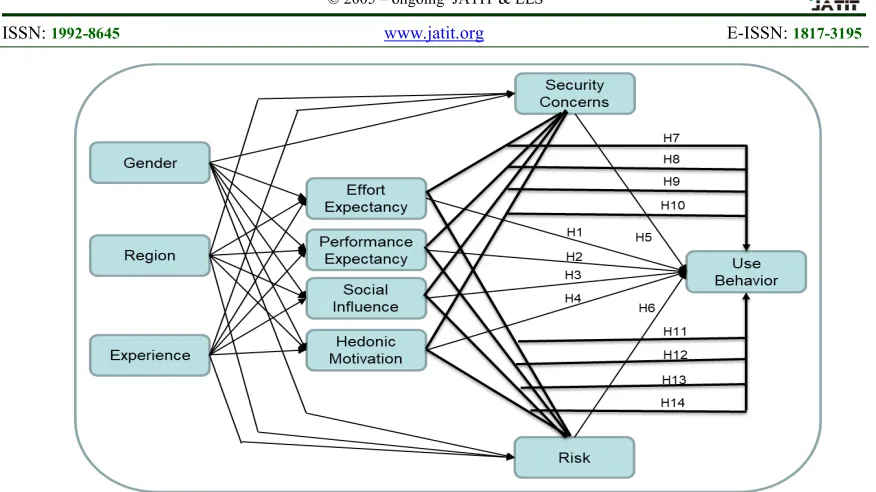
The objective of this research is to study, understand and identify the factors that affect the acceptance and use of cryptocurrency services by utilizing the power of revised UTAUT model. It also aims to investigate and analyze the fundamental relationships among the proposed research model constructs and moderating effects of security concerns and risks on cryptocurrency system.
The research utilizes the Venkatesh et al.’s UTAUT model as a theoretical driver for this study [17]. However, a revised version of the UTAUT will be utilized to suit the context of the study and to achieve its aim. The original UTAUT model contains four direct independents (effort expectation, performance expectation, social influence, facilitating conditions) of behavioral intention and use behavior [18]. In this research, independent variable, ‘facilitating conditions’, was omitted, hedonic motivation was chosen as a substitute for facilitating conditions. And additionally, two new constructs, security concerns and risks, have been added, so there are six independent variables (effort expectancy, performance expectancy, social influence, hedonic motivation, security concerns, risks) and one dependent variable (use behavior) as follows.
The independent variables in the proposed research model are presented below:
1. Effort expectancy (E-E) - the degree of ease associated with the use of the system. Effort expectancy will be measured by the perceptions of the ease of use of cryptocurrency services, as well
as the ease of learning how to use these services [16].
2. Performance expectancy (P-E) – the degree to which individuals believe that using a system will help them improve their job performance. Performance expectancy will be measured by the perceptions of using cryptocurrency services in terms of benefits, such as saving time, money and effort and improving the quality of cryptocurrency services [17].
3. Social influence (S-I) – the degree of which peers and important people influence the use of the system, whether positive or negative. Social influence is a main factor in many aspects of the lives of young people and is likely to be powerful. This variable will be measured by the perception of how peers and important people affect my use of cryptocurrency services [19].
4. Hedonic motivation (H-M) – the degree of pleasure or enjoyment derived from using cryptocurrency services. Hedonic motivation will be measured by perception of how user enjoys using the cryptocurrency services [20].
5. Security concerns (S-C) – the degree to which users feel that using the cryptocurrency system will cause security concerns. Security concerns will be measured by the perception of potential loss due to fraud or hacking compromising insecurity of the cryptocurrency services [21].
6. Risks (R-S) - the degree of uncertainty using the cryptocurrency systems. Risks will be measured by the perception of the uncertainty in the cryptocurrency transaction situation [22].
4626
Figure 1: The Proposed Research Model
3.2 Research Hypotheses
Taking into account relationships and constructs of the revised UTAUT, we put forward the following hypotheses in respect of cryptocurrency.
3.2.1 Key Constructs Hypotheses
The key constructs hypotheses are the direct relationships between the seven constructs in the proposed research model as presented in Figure 1. This set of hypotheses addresses the relationship between six independent variables and one dependent variable.
H-1: A user’s effort expectancy (E-E) would have a positive influence on use behavior of cryptocurrency.
H-2: A user’s performance expectancy (P-E) would have a positive influence on use behavior of cryptocurrency.
H-3: A user’s social influence (S-I) would have a positive influence on use behavior of cryptocurrency.
H-4: A user’s hedonic motivation (H-M) would have a positive influence on use behavior of cryptocurrency.
H-5: A user’s perceived security concerns (S-C) would have a negative influence on use behavior of cryptocurrency.
H-6: A user’s perceived risks (R-S) would have a negative influence on use behavior of cryptocurrency.
3.2.2 Moderating Hypotheses
The moderating hypotheses are the set of hypotheses that will be tested for moderators. The revised research model considers the influence of two moderators which are: security concerns and risks. Therefore, this study is investigating the impact of these moderators on use behavior of cryptocurrency services.
H-7: A user’s perceived security concerns (S-C) mediates the relation between his/her effort expectancy and use behavior of cryptocurrency.
H-8: A user’s perceived security concerns (S-C) mediates the relation between his/her performance expectancy and use behavior of cryptocurrency.
H-9: A user’s perceived security concerns (S-C) mediates the relation between his/her social influence and use behavior of cryptocurrency.
H-10: A user’s perceived security concerns (S-C) mediates the relation between his/her hedonic motivation and use behavior of cryptocurrency.
H-11: A user’s perceived risks (R-S) mediates the relation between his/her effort expectancy and use behavior of cryptocurrency.
H-12: A user’s perceived risks (R-S) mediates the relation between his/her performance expectancy and use behavior of cryptocurrency.
ISSN: 1992-8645 www.jatit.org E-ISSN: 1817-3195
4627 H-14: A user’s perceived risks (R-S) mediates the relation between his/her hedonic motivation and use behavior of cryptocurrency.
3.3 Data Collection Strategies
3.3.1 Questionnaires
Questionnaire are self-reported data collection instruments which are answered at a distance from the researcher. A high quality of a question and questionnaire design gives the researcher high valid and reliable measures that also will help the participants to understand the questions and answer them with the appropriate response [23]. The survey was designed to include a two-part questionnaire. The first part includes seven-point Likert scales. A Likert scale is appropriate when the research needs to measure the respondent’s attitude towards constructs [24]. The survey consists of 21 items to measure the constructs. And the second part includes nominal scales using the demographic data.
Items selected of the questionnaire for measuring the constructs in our research model were adapted from prior studies. With regard with implementing the questionnaire in this study, the researcher followed Leedy’s four practical guidelines to develop the questionnaire draft as follows: using clear language; meeting research aims; planning the development, sample, distribution, and collection of the questionnaire; and creating a solid cover letter [25].
3.3.2 Data Collection and Analytical Methods
Gray defines a population as the entire number of possible groups or elements that the researcher wishes
to include in this study [26]. With regard with the population of this study, this researcher is targeting the undergraduate students, which are participated in this research from a public Korean university in the southwestern region and a private Korean university in the metropolitan area. To identify demographics of the respondents, frequency analysis and ANOVA were performed based on a total of 226 samples. Then, this research performed the exploratory factor analysis to ensure the content validity of the scales. This research also tested reliability. Lastly, ‘multiple regression’ analysis and ‘Smart Partial Least Squares’ analysis was conducted.
4. QUANTITATIVE ANALYSIS AND
HYPOTHESIS VERIFICATION
4.1 Frequency Analysis
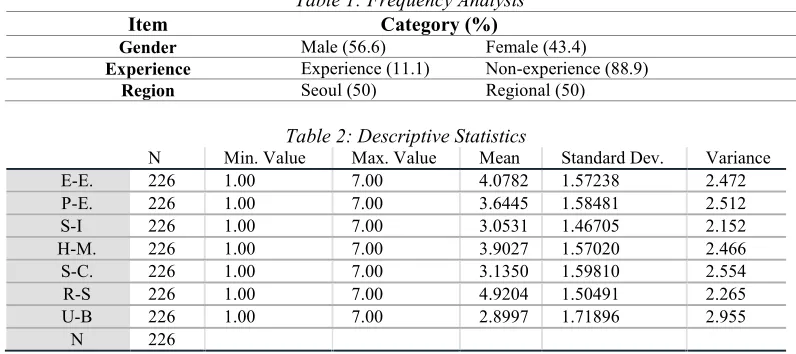
[image:5.612.101.499.540.717.2]This study used purposive and non-probability sampling. Those who were questioned in this study were voluntary participants. A total of 230 questionnaires were distributed, of which 226 questionnaires were collected with the respondent rate 98.3%. Table 1 showed that 56.6 % of the respondents were male, and 43.4 % were female. In terms of experience, 11.1 % were cryptocurrency users. And 50 % of respondents lived in Seoul and 50 % lived in regional area. Table 2 illustrated descriptive statistics. While effort expectancy and hedonic motivation showed moderate level and risks showed fairly high level, performance expectancy, social influence and security concerns showed a little low level and use behavior showed fairly low level.
Table 1: Frequency Analysis
Item Category (%)
Gender Male (56.6) Female (43.4)
Experience Experience (11.1) Non-experience (88.9)
Region Seoul (50) Regional (50)
Table 2: Descriptive Statistics
N Min. Value Max. Value Mean Standard Dev. Variance
E-E. 226 1.00 7.00 4.0782 1.57238 2.472
P-E. 226 1.00 7.00 3.6445 1.58481 2.512
S-I 226 1.00 7.00 3.0531 1.46705 2.152
H-M. 226 1.00 7.00 3.9027 1.57020 2.466
S-C. 226 1.00 7.00 3.1350 1.59810 2.554
R-S 226 1.00 7.00 4.9204 1.50491 2.265
U-B 226 1.00 7.00 2.8997 1.71896 2.955
4628
4.2 ANOVA
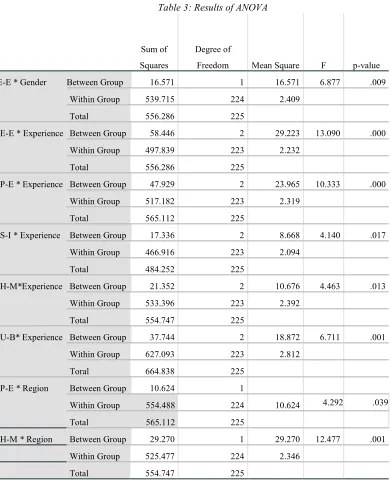
As illustrated in Table 3, results of ANOVA demonstrated that significant differences did exist at the level of α=.05 between effort expectancy and gender, between effort expectancy and experience,
[image:6.612.93.484.167.648.2]between performance expectancy and experience, between social influence and experience, between hedonic motivation and experience, between use behavior and experience, and between hedonic motivation and residency.
Table 3: Results of ANOVA
Sum of Squares
Degree of
Freedom Mean Square F p-value E-E * Gender Between Group 16.571 1 16.571 6.877 .009
Within Group 539.715 224 2.409
Total 556.286 225
E-E * Experience Between Group 58.446 2 29.223 13.090 .000 Within Group 497.839 223 2.232
Total 556.286 225
P-E * Experience Between Group 47.929 2 23.965 10.333 .000 Within Group 517.182 223 2.319
Total 565.112 225
S-I * Experience Between Group 17.336 2 8.668 4.140 .017 Within Group 466.916 223 2.094
Total 484.252 225
H-M*Experience Between Group 21.352 2 10.676 4.463 .013 Within Group 533.396 223 2.392
Total 554.747 225
U-B* Experience Between Group 37.744 2 18.872 6.711 .001 Within Group 627.093 223 2.812
Toral 664.838 225
P-E * Region Between Group 10.624 1
Within Group 554.488 224 10.624 4.292 .039
Total 565.112 225
H-M * Region Between Group 29.270 1 29.270 12.477 .001 Within Group 525.477 224 2.346
Total 554.747 225
4.3 Test of Reliability and Validity
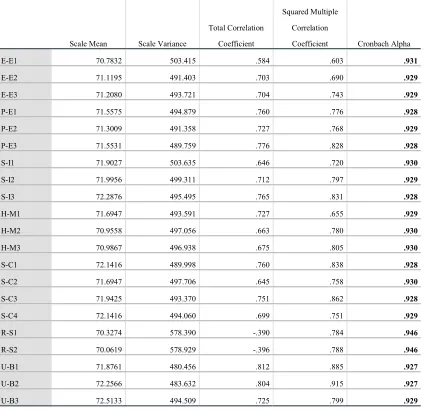
The reliability of a measure refers to the degree to which the instrument is free of random error. It is concerned with the consistency and stability of the measurement. Hair et al. mentioned that construct
ISSN: 1992-8645 www.jatit.org E-ISSN: 1817-3195
4629 Cronbach’s α values for each construct ranged from .927 to .946, and all values were above the recommended value of .7 [28].
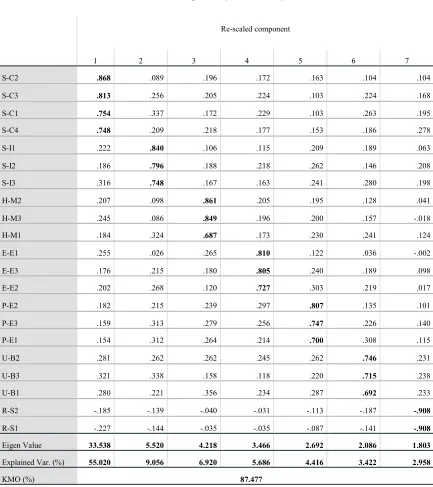
Construct validity is defined as the degree to which an operational measure correlates with the theoretical concept being investigated. According to Turocy, factor analysis is most often associated with construct validity and considered one of the analytic tools to assess construct validity [29]. In this study, the validity and the unidimensional measurement scale was assessed by using exploratory factor analysis and an examination of the correlation coefficients for all of instrument scales. Generally, factor loadings below .4 are considered low, and low-loading items should be suppressed [27]. In this study, the recommended
[image:7.612.92.516.312.722.2]cut-off factor loading of .50 was used to ensure that all variables had practical significance [27]. Moreover, the researcher assessed sampling adequacy by examining the Kaiser-Meyer-Olkin (KMO) output provided in the factor analysis. A KMO correlation above .60 to .70 is considered adequate for analyzing the exploratory factor analysis output [29]. As Table 5 shows, the KMO statistic is .87477, which is above the minimal acceptable level. As shown in Table 5, this research verified validity of the structural model (n=226), by conducting the exploratory factor analysis based on principal components analysis and Varimax Rotation [20]. All seven factors were extracted. Each factor showed that an Eigen value was above 1.
Table 4: Results of Reliability Analysis
Scale Mean Scale Variance
Total Correlation
Coefficient
Squared Multiple
Correlation
Coefficient Cronbach Alpha
E-E1 70.7832 503.415 .584 .603 .931
E-E2 71.1195 491.403 .703 .690 .929
E-E3 71.2080 493.721 .704 .743 .929
P-E1 71.5575 494.879 .760 .776 .928
P-E2 71.3009 491.358 .727 .768 .929
P-E3 71.5531 489.759 .776 .828 .928
S-I1 71.9027 503.635 .646 .720 .930
S-I2 71.9956 499.311 .712 .797 .929
S-I3 72.2876 495.495 .765 .831 .928
H-M1 71.6947 493.591 .727 .655 .929
H-M2 70.9558 497.056 .663 .780 .930
H-M3 70.9867 496.938 .675 .805 .930
S-C1 72.1416 489.998 .760 .838 .928
S-C2 71.6947 497.706 .645 .758 .930
S-C3 71.9425 493.370 .751 .862 .928
S-C4 72.1416 494.060 .699 .751 .929
R-S1 70.3274 578.390 -.390 .784 .946
R-S2 70.0619 578.929 -.396 .788 .946
U-B1 71.8761 480.456 .812 .885 .927
U-B2 72.2566 483.632 .804 .915 .927
4630
Table 5: Exploratory Factor Analysis
Re-scaled component
1 2 3 4 5 6 7
S-C2 .868 .089 .196 .172 .163 .104 .104
S-C3 .813 .256 .205 .224 .103 .224 .168
S-C1 .754 .337 .172 .229 .103 .263 .195
S-C4 .748 .209 .218 .177 .153 .186 .278
S-I1 .222 .840 .106 .115 .209 .189 .063
S-I2 .186 .796 .188 .218 .262 .146 .208
S-I3 .316 .748 .167 .163 .241 .280 .198
H-M2 .207 .098 .861 .205 .195 .128 .041
H-M3 .245 .086 .849 .196 .200 .157 -.018
H-M1 .184 .324 .687 .173 .230 .241 .124
E-E1 .255 .026 .265 .810 .122 .036 -.002
E-E3 .176 .215 .180 .805 .240 .189 .098
E-E2 .202 .268 .120 .727 .303 .219 .017
P-E2 .182 .215 .239 .297 .807 .135 .101
P-E3 .159 .313 .279 .256 .747 .226 .140
P-E1 .154 .312 .264 .214 .700 .308 .115
U-B2 .281 .262 .262 .245 .262 .746 .231
U-B3 .321 .338 .158 .118 .220 .715 .238
U-B1 .280 .221 .356 .234 .287 .692 .233
R-S2 -.185 -.139 -.040 -.031 -.113 -.187 -.908
R-S1 -.227 -.144 -.035 -.035 -.087 -.141 -.908
Eigen Value 33.538 5.520 4.218 3.466 2.692 2.086 1.803
Explained Var. (%) 55.020 9.056 6.920 5.686 4.416 3.422 2.958
KMO (%) 87.477
Extraction: Principal Component Analysis. Rotation: Varimax with Kaiser normalization
4.4 Multiple Regression Analysis
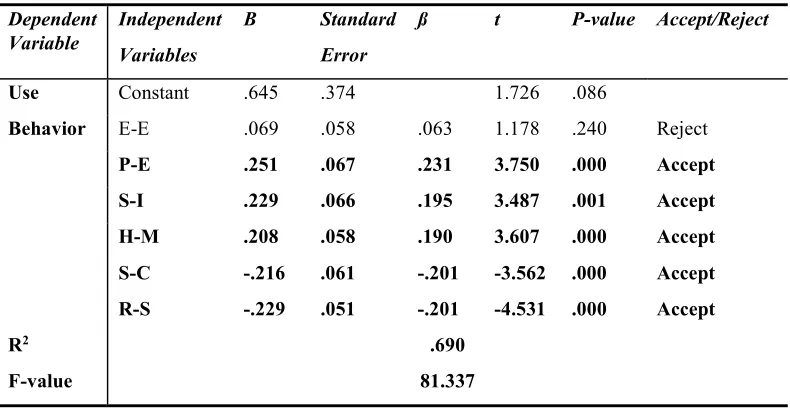
The results of multiple regression analysis illustrated that five of the six suggested hypotheses turned out to be significant, as shown in Table 6. This research used multiple regression analysis by setting use behavior (U-B) as a dependent variable
and six variables (E-E, P-E, S-I, H-M, S-C, R-S) as independent variables.
ISSN: 1992-8645 www.jatit.org E-ISSN: 1817-3195
4631 H-1 was rejected because E-E did not influence on U-B significantly at the level of α= .05 (ß= .063, p≤ .240). Effort expectancy means perceived ease of use for predicting adoption of new technologies.
H-2 was accepted because U-B was significantly influenced by P-E at the level of α= .05 (ß= .231, p≤ .000). Performance expectancy means the degree of perceived usefulness. This research indicated that the higher the performance expectancy was, the higher use behavior of cryptocurrency services was.
H-3 was accepted because S-I had a positive influence on U-B significantly at the level of α= .05 (ß= .195, p≤ .001). Social influence may occur when an individual’s opinions, feelings or actions are affected by other people.
H-4 was accepted because H-M had a positive influence on U-B significantly at the level of α= .05
(ß= .190, p≤ .000). The higher perceived enjoyment was, the higher use behavior of cryptocurrency services was.
H-5 was accepted because S-C had a negative impact on U-B significantly at the level of α= .05 (ß= -.201, p≤ .000). Security concerns will be measured by the perception of potential loss due to fraud or hacking compromising insecurity of the cryptocurrency services. The lower security concerns was, the higher use behavior of cryptocurrency services was.
[image:9.612.86.481.367.571.2]H-6 were accepted because R-S had a negative impact on at the level of α= .05 (ß= -.201, p≤ .000). Risks means the degree of the perception of the uncertainty in the cryptocurrency transaction situation. The lower was risks, the higher was use behavior of cryptocurrency services.
Table 6: Results of Multiple Regression Analysis
Dependent Variable
Independent Variables
B Standard
Error
ß t P-value Accept/Reject
Use Behavior
Constant .645 .374 1.726 .086
E-E .069 .058 .063 1.178 .240 Reject
P-E .251 .067 .231 3.750 .000 Accept
S-I .229 .066 .195 3.487 .001 Accept
H-M .208 .058 .190 3.607 .000 Accept
S-C -.216 .061 -.201 -3.562 .000 Accept
R-S -.229 .051 -.201 -4.531 .000 Accept
R2 .690
F-value 81.337
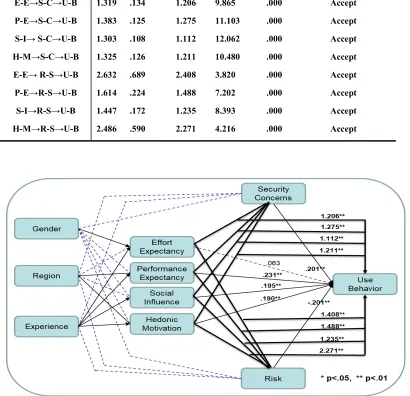
4.5 Smart Partial Least Squares (PLS) Analysis To test moderating effects of security concerns proposed by H-7, H-8, H-9, and H-10, this research followed Chin et al.’s Partial Least Squares Product-Indicator approach [30]. And to test mediating effects of risks proposed by H-11, H-12, H-13, and H-14, this study also followed Chin et al.’s method. Table 7 illustrated the results of testing security concerns and risks factors as mediators. We created the interaction variables by cross-multiplying the items of E-E and S-C, P-E and S-C, S-I and S-C, H-M and S-C, E-E and R-S,
4632 between H-M and R-S (ß= 2.271, p≤ .000). Based on these results, hypotheses of H-7, H-8, H-9, H-10, H-11, H-12, H-13, and H-14 were supported. Therefore, we could conclude that a user’s security concerns mediated the impacts of E-E, P-E, S-I, and H-M on use behavior of cryptocurrency services, which implies that the higher impacts of E-E, P-E, S-I, and H-M on U-B of cryptocurrency services were, the higher a user’s S-C was. We also concluded that a user’s risks mediated the impacts of E-E, P-E, S-I, and H-M on use behavior of cryptocurrency services, which implies that the higher impacts of E-E, P-E, S-I, and H-M on U-B
of cryptocurrency services were, the higher a user’s R-S was.
[image:10.612.90.480.279.445.2]The proposed model was analyzed using Smart PLS. We evaluate the properties of measurement model and estimate the parameters of the structured model taking into account the mediating latent constructs [21]. In this study, path of the structured model was evaluated. Each path in Figure 2 corresponded to a hypothesis [31]. As shown on Figure 2, the bottom line is that Smart PLS analysis results provided support for the hypotheses of H-7, H-8, H-9, H-10, H-11, H-12, H-13, and H-14.
Table 7: Results of Smart PLS Analysis
Variables B SEr ß t P-value Acc./Rej.
E-E→S-C→U-B 1.319 .134 1.206 9.865 .000 Accept
P-E→S-C→U-B 1.383 .125 1.275 11.103 .000 Accept
S-I→ S-C→U-B 1.303 .108 1.112 12.062 .000 Accept
H-M→S-C→U-B 1.325 .126 1.211 10.480 .000 Accept
E-E→ R-S→U-B 2.632 .689 2.408 3.820 .000 Accept
P-E→R-S→U-B 1.614 .224 1.488 7.202 .000 Accept
S-I→R-S→U-B 1.447 .172 1.235 8.393 .000 Accept
[image:10.612.84.494.303.699.2]H-M→R-S→U-B 2.486 .590 2.271 4.216 .000 Accept
ISSN: 1992-8645 www.jatit.org E-ISSN: 1817-3195
4633
4.6 Policy Implications for Security Concerns and Risks
Based on the research results, security concerns and risk have been proved to be important moderating effects as a great interest for cryptocurrency users. Recently, hacking problems of the cryptocurrency exchange markets have occurred in Japan and Korea, which may cause a sudden market contraction [32]. To prevent the
hacking of the markets, relevant and
complementary measures should be taken for security concerns and risk with regards to the law of the cryptocurrency exchange markets.
Cryptocurrency transmission itself ensures safe exchange processing since it is encrypted for transmission through blockchain network. But there have been many hackings of cryptocurrency through the exchange markets in Japan and Korea.
For the safe transmission in the financial industries, Korean Article 49 of the Enforcement Decree of Information and Communication Network Act requires the Information Security Management System (ISMS) authentication to a company that has a sales figure equal to or higher than 10 billion won for the previous year or that has an average user equal to or higher than 1 million users for 3 months. Even though the ISMS authentication is the minimal security measure for the company, none of Korean cryptocurrency exchange markets satisfied it [33]. Thus, most of the exchange markets for the cryptocurrency are not required to have the ISMS authentication due to their small size and the others neither meet the ISMS standards.
In addition, although the current ordinance can penalize companies that failed to meet the ISMS authentication requirements, Korean government cannot continuously monitor their security activities after companies get the ISMS authentication because of lack of regulations [34]. The government also lacks the interest to regulate these exchange markets because regulating these exchange markets may signify a formal recognition of cryptocurrency as a legal currency, which it is trying to avoid.
For the safe transactions of cryptocurrency, the paper suggests three solutions for security concerns and risk in the aspect of law relevant to the cryptocurrency exchange markets.
First, security breaches and monetary damages experienced by the exchange markets require government regulations. These exchange markets should be regulated similarly to other financial industries which are regulated by the Electronic Financial Supervision and Regulation. The government should specifically focus on Article 8 (Labor Force, Structure and Budget), Article 15 (Hacking Prevention Measures), Article 18 (IP
Address Management Plans), Article 22
(Constructing Processing System), Article 34 (Electronic Financial Transactions Compliance), and Article 37 (Authentication Method Standards) of the Electronic Financial Supervision and Regulation.
Second, the standards of Article 49 of the
Enforcement Decree of Information and
Communication Network Act should lower a sales figure equal to or higher than 10 billion won for the previous year, to encompass the smaller exchange markets.
Third, the standards of Article 49 should lower an average user equal to or higher than 1 million users for 3 months, to encompass the smaller exchange markets. And so, most of the cryptocurrency exchange markets should be regulated by the ISMS. In spite of hackings and accidents related to the cryptocurrency, there are limitations of law for the cryptocurrency in that the cryptocurrency’s lack of legal status makes dispute resolutions difficult, and that the personal privacy protection within the distributed ledger system of the cryptocurrency cannot be mandated by law.
5. DISCUSSIONS AND CONCLUSIONS
4634 management and system design strategies of cryptocurrency service providers, and the cryptocurrency systems should be elaborated in the pleasant and beneficial way. (One of the system design strategies for cryptocurrency should be reputation-building, by gaining a favorable opinion from referents.) This research also illustrates that perceived security concerns and perceived risks might negatively affect cryptocurrency use and trading.
Based on the research results, security concerns and risks have been proved important moderating effects as a great interest for cryptocurrency users. Recently, hacking problems of the cryptocurrency exchange markets have occurred in Japan and Korea, which may cause a sudden market contraction. To prevent the hacking of the markets, relevant and complementary measures should be taken for security concerns and risk. For the safe transactions of cryptocurrency, the paper suggests three solutions for security concerns and risk relevant to the cryptocurrency exchange markets. For the safe transmission of cryptocurrency in the financial industries, the research suggests that Korean Article 49 of the Enforcement Decree of Information and Communication Network Act should require higher standards to the cryptocurrency exchange markets.
The rise of cryptocurrencies and related technology brings to the fore a number of policy questions. Authorities are looking for ways to ensure the integrity of markets and payment systems for financial stability. An important challenge is to combat illicit usage of funds. And a related question is whether central banks should issue their own central bank digital currency [35].
Security violations and monetary damages experienced by the cryptocurrency exchange markets require government regulations. These exchange markets should be regulated similarly to other financial industries which are regulated by the Electronic Financial Supervision and Regulation.
Even though there are hackings and accidents related to the cryptocurrency, there are limitations of law for the cryptocurrency in that the cryptocurrency’s lack of legal status makes dispute resolutions difficult, and that the personal privacy protection within the distributed ledger system of the cryptocurrency cannot be mandated by law. As a result, they can be regulated indirectly only.
ACKNOWLEDGEMENTS
This work was supported by Hankuk University of Foreign Studies Research Fund of 2019
REFRENCES:
[1] Andy Greenberg (20 April 2011).
"CryptoCurrency". Forbes.com. Archived from the Original on 31 August 2014. Retrieved 8 August 2014.
[2] Cryptocurrencies: A Brief Thematic Review Archived 2017-12-25 at the Wayback Machine… Economics of Networks Journal. Social Science Research Network (SSRN). Date accessed 28 August 2017.
[3] Patrick Schuettel (2017). The Concise Fintech Compendium. Fribourg: School of Management Fribourg/Switzerland. Archived from the original on 2017-10-24.
[4] Bank for International Settlements, BIS Annual Economic Report 2018, 17 June 2018, pp. 95-96. [5] Patrick McDonnell "PK" (9 September 2015).
"What Is the Difference Between Bitcoin, Forex, and Gold". NewsBTC. Archived from the Original on 16 September 2015. Retrieved 15 September 2015.
[6] Ian Allison (8 September 2015). "If Banks Want Benefits of Blockchains, They Must Go Permissionless." NewsBTC. Archived from the original on 12 September 2015. Retrieved 15 September 2015.
[7] H. Natarajan, S. Krause and H. Gradstein, “Distributed Ledger Technology (DLT) and Blockchain”, World Bank Group, FinTech Note, No 1, 2017; BIS.
[8] "Cryptocurrency FAQ - What is Distributed Ledger Technology?", CryptoCurrency Works. Retrieved 21 May 2018.
[9] Matteo D’Agnolo. "All You Need to Know about Bitcoin". timesofindia-economictimes. Archived from the Original on 2015-10-26. [10] Economist Staff (31 October 2015).
"Blockchains: The Great Chain of Being Sure about Things". The Economist. Archived from the Original on 3 July 2016. Retrieved 18 June 2016.
[11] Mamta Badkar (May 14, 2018). "Fed's Bullard: Cryptocurrencies Creating 'Non-uniform' Currency in US". Financial Times. Retrieved May 14, 2018.
ISSN: 1992-8645 www.jatit.org E-ISSN: 1817-3195
4635 [13] R. Houben and A. Snyers, “Cryptocurrencies
and Blockchain”, In-depth Analysis Requested by the European Parliament’s Special Committee on Financial Crimes, Tax Evasion and Tax Avoidance, Policy Department for Economic, Scientific and Quality of Life Policies, July 2018, pp. 12-13. (electronically available via https://www.europarl.europa.eu/swupporting-analyses)
[14] Jerry Brito and Andrea Castillo (2013). "Bitcoin: A Primer for Policymakers" (PDF). Mercatus Center. George Mason University. Archived (PDF) from the original on 21 September 2013. Retrieved 22 October 2013. [15] "How Cryptocurrencies Could Upend Banks'
Monetary Role". Archived 2013-09-27 at the Wayback Machine., American Banker. 26 May 2013.
[16] J. Chiu and T. Koeppl, “The Economics of cryptocurrencies – Bitcoin and Beyond”, Bank of Canada working Paper”, September 2017. https://ssrn.com/abstract=3048124 or
https://dx.doi.org/10.2139/ssrn.3048124
[17] V. Venkatesh, M. Morris, G. Davis, and F. Davis, “User Acceptance of Information
Technology: toward a Unified View”,
Management Information Science Quarterly, Vol. 27, No. 3, 2003, pp. 425-478.
[18] Michael D. Williams, Nripendra P. Rana, Yogesh K. Dwivedi, “The unified Theory of Acceptance and Use of Technology (UTAUT): A Literature Review”, Journal of Enterprise Information Management, Vol. 28, Issue 3, 2015, pp. 443-488. http://doi.org/10.1108/JEIM-09-2914-0088.
[19] Mohammed A. Alshehri, “Using the UTAUT Model to Determine Factors Affecting Acceptance and Use of E-government Services in the Kingdom of Saudi Arabia”, Doctoral Dissertation, Griffith University, 2012.
[20] Young-Ho Hwang and Yoo-Jin Moon, “Statistical Analysis of Impact Factors Affecting Strategies of the Virtual Reality Service Systems and Intervening Effects of Performance Expectancy”, Journal of Theoretical and Applied Information Technology, Vol. 49, No. 1, 2018, pp. 7435-7445.
[21] Hyun Shik Yoon and Linsey M. Barker Steege, “Development of a Quantitative Model of the Impact of Customers’ Personality and Perceptions on Internet Banking Use”, Computers in Human Behavior, Vol. 29, 2013, pp. 1133-1141.
[22] C. Kim, M. Mirusmonov, and I. Lee, “An Empirical Examination of Factors Influencing
the Intention to Use Mobile Payment”, Computers in Human Behavior, Vol. 26, No. 3, 2010, pp. 310-312.
[23] W. Newman, Social Research Methods: Qualitative and Quantitative Approaches (6th ed.), Boston, MA: Allyn & Bacon, 2006. [24] C. J. McDaniel & R. Gates, Marketing
Research Essentials (5th ed.), Hoboken: John Wiley & Sons, Inc., 2006.
[25] P. D. Leedy, Practical Research: Planning and Design, New York: Maxwell Macmillan, 1993.
[26] D. E. Gray, Doing Research in the Real World, Los Angeles: Sage Publication, 2009.
[27] J. Hair, W. Black, B. Babin, R. Anderson, and R. Tatham, Multivariate Data Analysis (6th ed.), Upper Saddle River, NJ: Pearson Education, Inc., 2006.
[28] Young-Ho Hwang and Yoo-Jin Moon, “Analysis of Factors Influencing Intention to Use the Online-only Bank and Interaction Effects among the Factors”, Advanced Science Letters, Vol. 22, No. 9, 2016, pp. 2588-2591.
[29] P. s. Turocy, “Survey Research in Athletic Training: The Scientific Method of Development and Implementation”, Journal of Athletic Training, Vol. 37, 4S, 2002, pp. 174-179. [30] W. W. Chin, R. A. Peterson, and S. P. Brown,
“Structural Equation Modeling in Marketing: Some Practical Reminders”, The Journal of Marketing Theory and Practice, Vol. 16, No. 4, 2008, pp. 287-298.
[31] Joseph F. Hair Jr., G. Tomas, M. Hult, Christian M. Ringle, and Marko Sarstedt, A Primer on Partial Least Squares Structural Equation Modeling (PLS-SEM), Los Angeles: Sage, 2017.
[32] Hacking of the Cryptocurrency Exchange Market, “Bithumb”,
https://m.post.naver.com/viewer/postView.nhn? volumeNo=16094921&memberNo=3939441&v Type=VERTICAL, E-Daily News, June 20, 2018.
[33]
http://cointalk.co.kr/bbs/board.php?bo_table=coi nnews&wr_id=12537
[34]
http://www.boannews.com/media/view.asp?idx= 70 576
[35] A. Carstens, “Central Banks and