
5245
ABNORMAL BEHAVIOR DETECTION IN AUTOMATED
SURVEILLANCE VIDEOS: A REVIEW
*1AHLAM AL-DHAMARI, 2RUBITA SUDIRMAN, 2NASRUL HUMAIMI MAHMOOD
Faculty of Electrical Engineering, Universiti Teknologi Malaysia, Department of Electronic and Computer Engineering, 81310 UTM Johor Bahru, Malaysia
E-mail: 1[email protected], 2{rubita, nasrul}@fke.utm.my
ABSTRACT
Abnormal detection refers to infrequent data instances that come from a diverse cluster or distribution than the majority normal instances. Owing to the increasing demand for safety and security, discovery abnormalities from video streams has attracted significant research interest during recent years. By automatically finding abnormal actions, it significantly decreases the cost to label and annotate the videos of a huge number of hours. The current advancements in computer vision and machine learning have a remarkable role in enabling such intelligent frameworks. Different algorithms that are specially designed for building smart vision frameworks seek to scene understanding and building correct semantic inference from observed dynamic motions caused by moving targets. Unfortunately, although there are many algorithms have been proposed in this interesting topic, the research in this area still lacks strongly to two important things: comparative general assessment and public-accessible datasets. This study addresses these inadequacies by presenting an overview of most recent research algorithms that concentrate significantly on abnormal behavior detection in surveillance applications. This study extensively presents state-of-the-art algorithms in a way that enables those interested to know all the key issues and challenges relevant to the abnormal behavior detection topic and their applications as well as their specific features. Additionally, there are five important evaluation benchmarks from 2007 to 2017. The performance and limitations of those benchmarks are discussed, which will help largely research in this area.
Keywords: Video Surveillance, Abnormal Detection, Feature Extraction, Learning Methods, Clustering,
Spatio-temporal Compositions, Sparsity.
1. INTRODUCTION
Nowadays, because of the pervasiveness of CCTV, there is a considerable research effort to improve analysis methods for surveillance videos together with machine learning techniques for the sake of autonomous analysis of such data sources. Although video capturing devices are extremely common in today’s world, available human resources to observe and analyze the video clips are very limited and mostly not cheap [1-3]. In many cases where surveillance cameras are used, there are some human factors such as fatigue and tiredness, which lead to bad monitoring. In addition, the people who work on CCTV monitoring suffer monotony because in most cases, unusual or strange events occur rarely [4-8]. Automated anomaly detection is very beneficial in decreasing the amount of data to be handled manually by drawing attention to a particular portion of the data and to ignore the massive amounts of not pertinent data [9]. Figure 1
represents the flow cycle for the main parts of the abnormal detection processes in automated surveillance. However, we explain each process separately in the upcoming sections.
5246
such as network intrusion, medical diagnoses [19], marketing [20], automated surveillance [21] and many other fields. To the best of our knowledge, there are few review studies that have focused particularly on abnormalities of human behavior. The previous studies have sought to discuss the abnormal detection in a general way. In this review paper, we look forward to creating a more concentrated review which includes recent publications relevant to abnormal human behavior detection in surveillance systems. Therefore, we discuss comprehensively the problems and challenges in this interesting topic.
This paper is organized across ten sections. Some significant related work to abnormal behavior detection review papers is presented in section 2. Section 3 addresses different surveillance goals that are commonly known in abnormal detection studies. Significant definitions and suppositions about abnormal concepts that are applied in different research are discussed in section 4. Sections 5 to 8 address the main processes for abnormal behavior detection framework in details with an emphasis on algorithms reported in the last few years. A set of public-accessible evaluation benchmarks with their characteristics and limitations is given in section 9. Finally, the prime challenges in this area and our conclusion are given in section 10.
[image:2.612.85.297.423.624.2]2. RELATED WORK
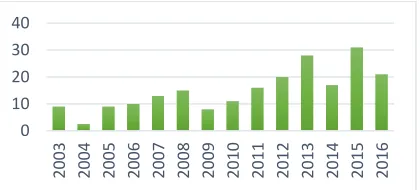
Figure 2 presents the frequency of publications in "abnormal human behavior detection" topic published during the last 14 years. It is noted that the number of publications in this topic from 2012 till now is more than all the publications during the
whole period from 2003 to 2011. Interestingly, this indicates that this topic is still a hot area for researchers. Video-based surveillance, which requires acquisition and processing visual data from a scene to detect object(s) a long time and space for purpose of recognizing interesting cases and possibly generate alarms, has been a subject undergoing intense study by scientific researchers. It normally starts with detecting changes and capturing motion information for moving object(s) by utilizing tracking and non-tracking approaches, to employ successive high-level event analysis.
In [22-25], comprehensive reviews of research on human motion analysis is presented. The focus on three key issues concerned with human motion analysis applications, namely human detection, tracking and activity understanding. Various approaches for each issue were presented. In [26], the main methods in human activity recognition from 3D data are condensed with an attention on methods that utilize depth data. Extensive categories of algorithms are discovered based upon the use of various features. The upsides and downsides of each algorithm in each category are addressed and analyzed. Most of the existing review papers relevant to abnormal detection either concentrate on a single research area or on a specific application domain. Papers in [1,9, 27-29]are related works that organize abnormal detection into multiple categories and discuss algorithms under each category. This review builds upon these works by essentially expanding the search in several directions. Different problems and challenges relevant to the abnormal behavior detection algorithms as well as their specific features are discussed comprehensively in the next sections. In addition, this study addresses five important evaluation benchmarks of abnormal behavior detection from 2007 to 2017 with their distinct characteristics and limitations to evaluate the performance of abnormal detection algorithms. Details about them are in section 9.
0 10 20 30 40
2003 2004 2005 2006 2007 2008 2009 2010 2011 2012 2013 2014 2015 2016
Figure 1: The Flow Cycle for All Anomaly Detection Processes.
Feature Extraction
Raw data Normal/
Abnormal
[image:2.612.314.524.576.671.2]5247
3. ABNORMAL SURVEILLANCE GOAL
The surveillance goal is the entity or entities upon which the surveillance works. Instances of popular goals comprise individuals, crowds, and vehicle traffic. Most of the works on abnormal detection for individuals have been utilized to guaranteeing the health and safety of elderly or impaired people in an infirmary, hospital, or nursing home [30-32]. In addition, a large body of studies concentrates on distinguishing anomalies in behavior indicating breaking the law or breach of security or events referring to a safety problem [33-35]. A few other studies are applied to unspecified applications and focus on detection of events that are infrequent.
The second goal of abnormal detection in surveillance is the crowds. Using social force model, authors in [36] introduce an approach to detect abnormalities in crowd scenes. They address the ability of the approach to capture the crowd behavior dynamics depend on the interaction forces of individuals Without needing to do segmentation or track objects individually. Authors in [37] make use of both optical flow and mixture of gaussian model for detecting abnormalities in crowd scenes. Further studies [38-41] present other significant works related to abnormal crowd behavior detection.
The researches involved with vehicle traffic intend to detect either violations of the traffic law or safety considerations like congestion and accidents [42-44].
4. DEFINITIONS AND SUPPOSITIONS OF
ABNORMALITY
Designing a method to detect abnormalities for a specific application demands some significant definitions as well as suppositions about abnormal behavior [9,45]. The definitions and suppositions might differ depending on the goal from the surveillance and the main aims considered by the researchers. However, the definitions and suppositions influence the approaches later applied to accomplish the abnormal detection and the selection process for the suitable sensors. The mission of defining the abnormality may be intrinsically a challenging and critical to the robustness and success of the abnormal detection algorithm. In general, there are three popular definitions and suppositions of abnormal behavior found in studies:
Abnormal events do not occur frequently
compared with normal events [46-48]. Authors in [49] state that the abnormalities of this type should be differentiated from noise, which may
cause a similar impact resulting in a false positive.
Abnormal events have crucially different
characteristics from normal events [50-51]. An important limitation of this supposition is the incapability to detect abnormalities, which are not significantly distinguished from normal events. This is a specific matter when an object is specifically attempting to hide an abnormal action like a behavior accompanying a concerted crime or terrorist activity [9]. Abnormal events have essentially a distinctly
different meaning [52-53]. Although this supposition achieved success in detecting abnormalities which are difficult to identify from normal events, this supposition has the disadvantage of being very narrow in the range of events which are detectable. This kind of abnormal detection can detect only the single event that it is designed for. In addition, it is unable to detect unexpected or diverse types of abnormalities.
5. TYPES OF SENSORS USED FOR
CAPTURING FEATURES
Generally, sensors are chosen in accordance with the steps involved in the anomaly detection process such as feature extraction and modeling approach. For instance, given the task of detecting screams and cries for humans in an urban environment [54], it may be easier to detect those events using audio sensors than using visual sensors. Without a doubt, some anomalies cannot be detected by using some sensors; for instance, facial expression may not be detected using low-resolution sensors [9]. Besides that, reliability, cost and availability affect the decision of choosing the suitable sensor. This section describes in detail the range of sensors that have been utilized for anomaly detection in surveillance applications.
5.1Visible-Light Camera (VLC)
5248
abnormalities. It is worth mentioning that anomaly detection methods using a visible spectrum camera are influenced by two factors: the field of view (FOV) and the resolution of the camera. The FOV refers to the horizontal (or vertical or diagonal) length that the lens will cover a specific distance [55]. However, one significant but often ignored consideration in video surveillance applications is the trade-off between field of view and resolution. The vaster the resolution is spread, the lower the pixel density, the lower the resolution [9, 56].
5.2Thermal Camera (TC)
Thermographic cameras are inactive sensors that capture the infrared radiation released by all objects with a temperature above zero. This sort of camera was primarily invented as a night vision instrument for the military purposes, but lately the price has declined, outstandingly opening up a wider field of applications. Since the gray-level value of the objects in thermal imaging describes the temperature and radiated heat, which is independent from illumination conditions. Employing this sort of sensors in vision systems eradicate the illumination problems which exist in visible-spectrum cameras. Therefore, thermal camera is preferred in many applications. Bear in mind that the radiation is released by the objects themselves in the medium and long wavelength infrared spectrum (3–14 μm) contingent upon the temperature [57-58]. On the other hand, the sensitivity and resolution of thermal videos are very low compared to visible spectrum videos. Therefore, thermal videos are noisy with low video quality [59].
5.3Forward Looking Infrared (FLIR) Camera
Several recent studies of FLIR in the landmine detection domain have broadly concentrated on developing abnormal detection approaches [60]. FLIR based detection frameworks utilize from larger standoff distances and quicker rates of advance than other detecting modalities, but they also cause many significant challenges in designing the detection algorithms [61]. Authors in [62] proposed an approach using FLIR imaging to generate cues of potential abnormal objects represented in the field of view of an Infrared Camera settled on a moving object. Studies in [63-65] are other noteworthy studies that have benefited from FLIR Camera.
5.4Others
Other approaches to detect anomaly utilize sensors other than visible-light and thermal cameras. Some of these approaches employ many simple
sensors scattered throughout the environment to collect information. The main advantage of using many sensors in these approaches is the ability to cover a broader region than is conceivable by the limited field of view of a camera [9, 66-67].
6. FEATURE EXTRACTION METHODS
Feature extraction is a task which includes extracting both spatial and motion information from a video that is distinctive in relation to specific activities within a scene [68-69]. Feature extraction methods in researches, which use a visible-spectrum camera as the essential sensor, can be divided into two major categories:
1. Methods that extract low-level features at the pixel-level directly from the image. For instance, a system that obtains the frequency and change rate for each pixel in consecutive frames to construct a map of motion levels in a scene.
2. Methods which extract high-level features for a detected object after applying object tracking or detection. For instance, a system that detects and tracks individual's vehicles from a motion video.
More recently, there is an integrated pipeline, which combines the low-level features and high-level features for abnormal behavior inference. This enables to identify abnormal behaviors for object trajectories relevant to speed and direction, and additionally complex behaviors relevant to the finer movement of each object [70]. Generally, kind of method employ for feature extraction depends on the type of surveillance target. All state-of-the-art papers which deal with crowd anomaly detection use some form of low-level pixel-based feature extraction, whilst object extraction and tracking is the most popular method to be implemented to anomaly detection in individuals [9].
6.1Low-Level Feature Extraction (LLFE)
5249
non-crowd. Whereas, low-level features can be utilized directly as inputs to abnormal detection algorithms [68, 71].
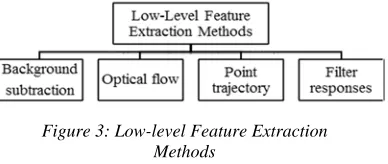
As shown in Figure 3, there are four main categories for low-level feature extraction methods to be utilized in different applications: Background Subtraction Blobs, Optical flow, Point trajectories, and filter responses [72-73]. Background subtraction is the most common technique to recognize the moving parts of the view. The resulted silhouette shape for an object is mostly utilized to characterize object(s) and their activities [68, 74-77]. Optical flow gives a succinct description about the regions of the video frame undergoing motion and their velocity. We refer to the reference in [78] for a comprehensive study and comparison of optical flow computation approaches. [79-81] are interested studies utilizing optical flow technique.
Point trajectories for moving objects have been employed as features to deduce the activity of an object. In fact, the picture-plane trajectory itself is not extremely valuable since it is sensitive to some image processing operations such as rotations, translations, and scale changes. Extracting unequivocal trajectories from video streams is intricate by different factors like noise, background clutter, and occlusions as well. To obtain motion trajectories well, accurate tracking algorithms should be used. Filter responses methods depend on filtering a video volume employing a large filter bank. The reactions of the filter bank are further processed to infer activity features [82].
6.2High-Level Feature Extraction (HLFE)
Considering that some event detection strategies use only low-level feature extraction methods and classify events according to their distribution across temporal and spatial dimensions. Other methods use higher level representations, which necessitate more accurate information about the event than the low-level representation [68, 83]. To extract more particular data about an object than could be done with low-level feature extraction methods, features extraction strategy from object(s) is utilized. The decision to choose the features that will be extracted from an object relies on the goal from the surveillance, the kind of expected anomalies and the
environment itself. The decision to choose the features that will be extracted from an object relies on the goal from the surveillance, the kind of expected anomalies and the environment itself. In addition, resolution and field of view are other fundamental factors to choose the further required features. The position and the trajectory of the object’s centroid are the most well-known features to be extracted from objects. The two mentioned features are adequate in many researches, which their goal is only individuals to discover the violation in a specific area [84-85], certain unusual behaviors like falling and running [86-87], uncommon paths elucidating loitering or distraction [88].
7. TRAINING AND LEARNING METHODS
This section discusses briefly the training and learning approaches utilized to behavior modeling and anomaly detecting. Based on the amount of prior knowledge and human intervention, the training and learning approaches can be widely classified into three main categories [1, 89, 90]:
7.1 Supervised Learning (SL)
This approach constructs normal/abnormal behavior models depending on the labeled/ training data and then use them to foresee abnormalities. This approach for anomaly detection is useful in the case that there are enough training data and the anomaly events are well-known in advance [68]. The disadvantages of this approach lie on how to integrate a long-term scene adaptation. On the other hand, the existence of a comprehensive set of all potential scenarios is unpractical in reality [1, 91]. Owing to these reasons, this approach is not commonly used to detect anomalies [68]. C4.5,
k-Nearest Neighbor, Multi-Layer Perceptron,
Regularized discriminant analysis, Fisher Linear Discriminant and Linear Programming Machine and Support Vector Machine are the most popular algorithms in supervised Learning [92].
7.2 Unsupervised Learning (USL)
[image:5.612.94.288.474.556.2]This approach is the most widely applicable [93]. It employs the co-occurrence statistic concepts on extracted features from unlabeled frames data. It learns normal/abnormal patterns based on statistical properties of the extracted data. On other words, repeatedly occurred patterns consider normal and the pattern that does not look like the majority of normal patterns consider as abnormal [94-95]. ʎ-algorithm, K-Means Clustering, Single Linkage Clustering,
5250
Quarter-sphere Support Vector Machine are the common unsupervised algorithms [92].
7.3 Semi-Supervised Learning (SSL)
This approach falls in the middle of the former two. Semi-supervised anomaly detection supposes that the training data has labeled instances for only the normal patterns. Because they do not need labels for the anomaly patterns, they are more broadly applicable than supervised algorithms [93].
8. MODELING AND CLASSIFICATION
ALGORITHMS USED FOR ANOMALY DETECTION
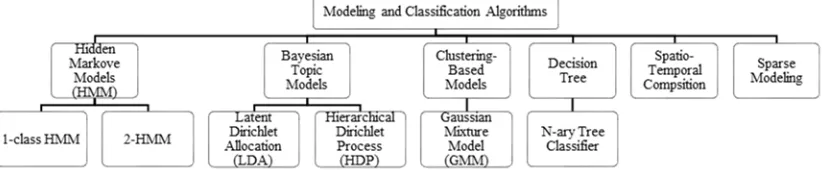
The majority of the models for activity recognition may be used also for the purpose of abnormality detection [96]. Figure 4 presents the most common modeling and classification algorithms that utilize in abnormal behavior detection. Details about each model will be addressed in the following subsections.
8.1 Hidden Markov Models
The Hidden Markov Model (HMM) can be described as a simplest dynamic Bayesian network (DBN) [97]. HMM is a statistical model that can be utilized to analyze complex behaviors. HMM describes a time series of states, which are supposed to follow a distribution with uncertain parameters by using observations. Since HMM has a powerful mathematical theory, it has been successfully implemented in different research areas. It is used in automatic speech recognition, computational molecular biology applications, data compression, artificial intelligence and pattern recognition [21]. Moreover, because HMM can take into consideration the inherently dynamic nature of the observed features, it is applicable in video event detection and anomaly detection applications as well [9, 98].
The HMM represents a structure of nodes joined by transition links illustrating time series of states. Where each node represents a state that is not directly observable. The observation identifies a set
of probabilities of states. The HMM is determined by matrices encoding the possible states (known as the state transition matrix) and the probabilities of observations (known as the emission matrix). The related research papers to anomaly detection using HMM modeling approaches vary mainly in the states allotted to HMM nodes, observations meanings and the type of the model. Nodes may pose objects’ positions [99], accelerations, velocities [100], crowd behavior [101], postures [102], or local behaviors such as standing, leaning, walking, etc. [103]. Authors in [104] had mentioned two drawbacks of traditional anomaly detection approaches. Firstly, the inability of predicting future trends (future anomalies) leads to failure of detecting disease’s sudden attack. Secondly, the incorporating of single context for decision making had led to high false alarm rate. Thus, they have developed an “integrated system” using both HMM and Fuzzy Logic to detect “multiple contextual activities” and to predict the outcome by gathering all the information. Depending on the availability of anomaly data instance as a sample for training, the authors used two techniques for anomalies detection. The first one is 1-class HMM, which used when anomaly data instance is not available and the entire data set is used as normal data (Profile). A specific threshold value is determined to decide normal/abnormal boundary. The second one uses both normal and anomaly data instances to model two hidden states HMM (2-HMM).
8.2 Bayesian topic Models
Methods employing Bayesian topic models [105-106] can evaluate the normality of each local event (word) while considering interactions (topic) between them. Nevertheless, these approaches do not require explicit spatial temporal dependencies between local events and only run in a batch mode [107]. Latent Dirichlet Allocation (LDA) and
Hierarchical Dirichlet Process (HDP) are
[image:6.612.102.513.628.713.2]hierarchical Bayesian models for language processing [105]. Authors in [105] proposed a hierarchical Bayesian model based to improve existing models such as LDA and HDP by modeling
5251
interactions without supervision. Under this model, surveillance missions such as clustering video clips and anomaly detection have a nice probabilistic explanation. Since the data is hierarchical, a hierarchical model can have sufficient parameters to suit the data well while avoiding overfitting issues. However, because only plain local motion features are taken into account for behavior representation, their approach has limited capability to model behavior correlations between fixed and moving objects and neglected any global context to be used in modeling complex behaviors in a vast scene [106].
8.3 Clustering-Based Models
Clustering is the process of gathering data that have identical features into groups (clusters). Abnormal detection using clusters is made by employing a clustering algorithm to the data and then the classification is made by one of the following principles [91, 108]
Normal data instances should belong to a cluster
and anomaly instances do not: in this situation, the clustering algorithm should not compel every instance to belong to a cluster. Since if it does it will not appear any abnormal case, which results in no anomaly instances.
Normal data instances are nearer to clusters centroid and anomaly instances are far away. Normal data instances should belong to denser
clusters and anomaly instances are in less dense clusters: In this situation, the density of each cluster of data should be measured. A threshold value is defined to obtain the density value where a cluster belongs to each one of the classes. Since these methods do not require the data to be labeled, clustering is mostly an unsupervised technique. Semi-supervised clustering has also been researched lately [109-110]. Though the abnormal detection is plain and swift after the cluster have been applied, the clustering procedure is very slow and computationally costly. The performance of the abnormal detection algorithm relies primarily on the clustering process; thus, bad clusters lead to bad detection [111].
The k-means is a broadly used algorithm to cluster features. Further improvements are achieved to overcome the limitations of k-means when implemented for behavior clustering like k-medoids [88], radius-based clustering [112], and ant-based clustering [113].
Generally, model-based clustering algorithms don't require determining the number of clusters beforehand. These algorithms might be hard to implement without previous knowledge of the
distribution of the data [114-115]. An outstanding method is the Gaussian mixture model (GMM) [116]. The number of clusters in the GMM is supposed to be obtained from a Gaussian distribution [9]. However, [47,117-121] are some researches that used GMM to detect abnormalities in automated surveillance.
8.4 Decision Tree
Decision tree is a common technique for representing classifiers [122]. A decision tree considers a classification or regression tree based on the target variables. It is called a classification tree if the target variables are discrete and a regression tree if the target variables are continuous [123]. A decision tree comprises of successive nodes. One of the nodes considers as a parent node and all the other nodes are its children. Each node constitutes a decision and branch (connection) constitutes a state and a probability of entering that state [9, 124-126]. Duarte et al. [127] proposed a novel method to predict abnormal behaviors using an N-ary tree classifier. In which, the classifier's tree is organized by layers and each layer characterizes a period of time. Thus, every track should be presented by a sequence of nodes. The probabilities of the tree links are learned in a supervised way from both normal and anomaly training instances. After the process of training, a formerly unseen behavior is located on the tree and its probability of entering each connecting state is computed. Afterwards, if there is a high probability of entering an abnormal state, then the behavior is flagged as abnormal.
8.5 Spatio-Temporal Composition (STC)
5252
8.6 Sparsity-Based Abnormality Detection
Models
Lately, sparse-based models have been widely and successfully utilized in a lot of multi-disciplinary research [130-131]. Present research related to sparse modeling can be divided into two main sets: Sparse coding and Dictionary Learning. On one hand, Sparse coding focus on finding coefficients for a given dictionary, which requires that each input signal is represented sparsely. On the other hand, Dictionary learning concerns with finding suitable basis vectors that build the dictionary [132]. In spite of the progress of existing dictionary algorithms, it is hard to apply them directly on anomaly event detection. This is because of the unavailability of labels, where only normal videos are utilized in a training data process. Authors in [133-134] introduce their sparsity-based dictionaries, which are intended especially and efficiently for anomaly detection purpose. In these two methods, an over-complete dictionary or frame (a concatenation of dictionaries) and sparse coefficient matrix are generated during the learning according to visual features. A new testing feature is recognized as an abnormal if its reconstruction error from the dictionary/frame is larger than a certain threshold. However, the relationship between atoms does not take part in the final detection, that means an abnormal event is recognized on whether it can be represented by a few atoms or not, regardless of how far away representing atoms are. Therefore, in this case, it is difficult to distinguish between infrequent features and real abnormalities, consequently, has a high false alarm rate.
9. VIDEO EVALUATION BENCHMARKS
To evaluate the performance of abnormal detection algorithms, the algorithms should be tested on several public-accessible datasets. However, these datasets have distinct characteristics and limitations in terms of saliency of the anomalies, size, evaluation criteria, etc. In this section, we will list five widely used datasets from 2007 to 2017: University of Minnesota (UMN), Live Videos (LV), Subway, University of California San Diego (UCSD), and Avenue Datasets.
UMN Dataset: The UMN dataset [36] is a
commonly used benchmark. It comprises from eleven video footages for three different escape views, one indoor view, and two outdoor views. The total length for this dataset is 7,739 frames. In addition, the resolution of the frames is 320*240 pixels. The main limitations of this dataset are that a) It is comparatively simple and small. b) has no
pixel-level ground truth. c) presents quite salient changes in the average motion intensity of the scene.
LV Dataset: This is the newest anomaly detection
dataset proposed by Leyva et al. [135]. The LV dataset contains 30 video footages. It is characterized by the following: a) Its events are realistic where no actors performing predefined
scripts. b) Extremely has unpredictable
abnormalities in different views, c) has challenging and difficult environmental conditions.
Subway Dataset: The subway dataset [136]
includes two video clips for entrance and exit gates. Whereas entrance gate has 144,249 frames and exit gate has 64,900 frames. In comparison with UMN dataset, Subway dataset considers much more natural. Authors in [137] demonstrate two major limitations for this dataset: a) Most of the frames in the video clips are redundant as no motion appears in them. (b) The assessment metric is excessively coarse due to the absence of exact ground truth annotation.
UCSD Dataset: The UCSD [38] consists of two
sub-sections, Ped1 and Ped2. Each sub-section contains a number of training and testing video clips, in which training sets have only normal events and testing sets have both normal and abnormal events. It is worth mentioning that Ped1 is greater challenging than Ped2 because the angle of camera produces larger perspective distortion. Moreover, anomalous events in Ped1 involves not only abnormalities resulted by small carts, bikers and skateboarders etc., but also contextual abnormalities such as a person walking over the grass.
Avenue Dataset: This dataset [133] has 16 and 21
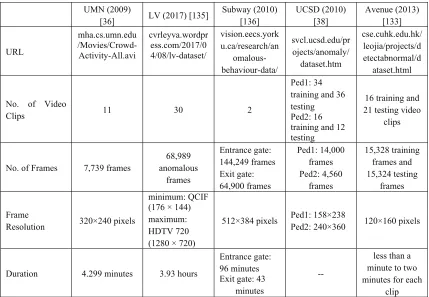
video clips for both training and testing, respectively. The total frames are 30,652 frames. There are fourteen irregular events comprising loitering, running, throwing objects, and walking in opposite direction. The main difficulties of this dataset comprise camera shakes as well as a few abnormalities in the training data. Additionally, some normal pattern rarely appears in the training data [130]. More Details of each dataset are provided in Table 1. Figures [5-6] show sample frames for both normal and abnormal events in UMN and LV datasets. Also, figures [7-9] demonstrate some frames for only abnormal events such as jumping from the entrance gate, running, walking in the wrong direction, throwing objects…etc.
10. CONCLUSION AND CHALLENGES
5253
UMN (2009)
[36] LV (2017) [135]
Subway (2010) [136]
UCSD (2010) [38]
Avenue (2013) [133]
URL
mha.cs.umn.edu /Movies/Crowd-Activity-All.avi
cvrleyva.wordpr ess.com/2017/0 4/08/lv-dataset/
vision.eecs.york u.ca/research/an
omalous-behaviour-data/
svcl.ucsd.edu/pr ojects/anomaly/ dataset.htm
cse.cuhk.edu.hk/ leojia/projects/d etectabnormal/d ataset.html
No. of Video
Clips 11 30 2
Ped1: 34 training and 36 testing Ped2: 16 training and 12 testing
16 training and 21 testing video
clips
No. of Frames 7,739 frames
68,989 anomalous
frames
Entrance gate: 144,249 frames Exit gate: 64,900 frames
Ped1: 14,000 frames Ped2: 4,560
frames
15,328 training frames and 15,324 testing
frames
Frame
Resolution 320×240 pixels
minimum: QCIF (176 × 144) maximum: HDTV 720 (1280 × 720)
512×384 pixels Ped1: 158×238
Ped2: 240×360 120×160 pixels
Duration 4.299 minutes 3.93 hours
Entrance gate: 96 minutes Exit gate: 43
minutes
--
less than a minute to two minutes for each
[image:9.612.92.521.119.416.2]clip
Table 1: Benchmarks for Evaluating Anomaly-Detection Algorithms
(a) (b) (c)
[image:9.612.104.508.127.645.2](d) (e) (f)
5254
(a) (b) (c)
[image:10.612.88.524.56.255.2](d) (e) (f)
Figure 7: Shows Some Frames from Subway Dataset. Frames in The First and Second Rows Are Abnormal Frames from The Entrance And Exit Subway Video Clips, Respectively. (a) (b) (c) (d)
(e) (f) (g) (h)
Figure 6: Presents Sample Frames from LV Dataset. [(a), (e)], [(b), (f)], [(c), (g)], [(d), (h)] Are Eight Sample Frames from Fell_down, Kidnap, Fighting, and Robbery0 Video Clips, Respectively. Where the Top Row Represents Normal Frames and The Bottom Row Corresponds Abnormal Frames in The Lv Dataset.
[image:10.612.133.484.312.507.2](a) (b) (c) (d) Figure 8: Four Different Abnormal Events from Ped1 UCSD Dataset.
[image:10.612.89.528.539.712.2]5255
One of the prime challenges for abnormal
detection techniques is that defining a normal area, which comprises every potential normal behavior is very complicated.
The other difficulty is that availability of labeled data for training/validation of models, which employed by abnormal detection techniques is typically a considerable issue.
The conception of abnormality differs based on
different applications. For instance, in the medical field, a slight deviation from normal may be an abnormality, whilst the same deviation in the stock market field may be considered as normal. Consequently, applying a technique developed in a certain field to another is not easy.
Even though noise is handled as "abnormal", it is not an interesting abnormality. In addition, its existence makes the task of finding the interesting ones more complicated.
Nowadays, since many applications deal with
high volume of input and output data as well as a variety of activities and services that are being provided. High computational complexity has become a big challenge to many abnormal detection algorithms.
The more challenging task is to build up real-time intelligent surveillance frameworks. Video clips which have complex scenes, take more time to process it at the time of features extraction and detecting abnormal events.
Additionally, quality of the video, illumination condition, camera motion, the complexity of backgrounds, blurring and shadows are other significant challenges, particularly with a single-camera view.
Owing to these difficulties, the abnormality detection issue is not straightforward to solve. As a matter of fact, most of the present abnormality
detection approaches resolve a particular
formulation of the matter. The formulation is inferred by several factors like nature of the data, labeled data availability, kind of abnormalities to be identified.
Besides all the mentioned challenges above, the presence of only a few datasets forms a challenge to the researchers in this area. This is due to the scarcity and roughly infinite variety of anomalous behaviors in reality. However, the large quantity of clips that are captured by the CCTV cameras spread everywhere can offer an excellent resource for standard datasets. Those real datasets should let researchers to evaluate how well an abnormal detection method fulfills in two critical responsibilities: abnormal detection (i.e., does this
video sequence consist of an abnormal event or not?) as well as abnormal localization (where does an abnormal event occur?).
It is of note that, many abnormal detection methods address distinctly highly complex structured scenes. In fact, there is need to examine the performance of such methods in unstructured cases. More work should be devoted to evolution of frameworks that can cope with the scalability of video analysis in an effective way particularly in the real videos of cluttered environments, which contains a lot of moving objects and activities.
ACKNOWLEDGMENT
The authors would like to express our gratitude to the Universiti Teknologi Malaysia for supporting and funding this study under Research Universiti Grant - Tier 2 (Vote: P4/2016/07608). We thank also the anonymous reviewers for their helpful comments and suggestions.
REFERENCES
[1] Oluwatoyin P and Kejun Wang,
“Video-based abnormal human behavior
recognition—a review”, IEEE Transactions
on Systems, Man, and Cybernetics, Part C
(Applications and Reviews), Vol. 42, No. 6,
2012, pp. 865-878.
[2] Fatih Porikli, François Brémond, Shiloh
Dockstader, James Ferryman, Anthony Hoogs, Brian Lovell, Sharath Pankanti, Bernhard Rinner, Peter Tu, and Péter Venetianer, “Video surveillance: past, present, and now the future [DSP Forum]”,
IEEE Signal Processing Magazine, Vol. 30,
No. 3, 2013, pp. 190-198.
[3] Sutrisno Ibrahim, “A comprehensive review
on intelligent surveillance systems”,
Communications in Science and Technology,
Vol. 1, No. 1, 2016.
[4] Javier Albusac, Jos´e J. Castro-Schez, David
Vallejo, Luis Jim´enez-Linares and Carlos Glez-Morcillo, “A scalable approach based on normality components for intelligent
surveillance”, In Innovations in Defence
Support Systems–3. Springer Berlin
Heidelberg, 2011, pp. 105-145.
[5] Roberto Arroyo, J. Javier Yebes, Luis M. Bergasa, Iv´an G. Daza and Javier Almaz´an, “Expert video-surveillance system for real-time detection of suspicious behaviors in
shopping malls”, Expert Systems with
7991-5256
8005.
[6] Ioannis Tziakos, Andrea Cavallaro and Li-Qun Xu, “Local abnormality detection in video using subspace learning”, Proceedings
of 7th International Conference on Advanced
Video and Signal Based Surveillance (AVSS), USA, 2010, pp. 519-525.
[7] John See and Suyin Tan, “Lost world:
Looking for anomalous tracks in long-term surveillance videos”, Proceedings of the 29th International Conference on Image and
Vision Computing, New Zealand, ACM, 2014,
pp. 224-229.
[8] K. C. Scott-Brown and P. D. J. Cronin,
“Detect the unexpected: a science for
surveillance”, Policing: An International
Journal of Police Strategies & Management,
Vol. 31, No. 3, 2008, pp. 395-414.
[9] Angela Sodemann, Matthew Ross, and Brett
J. Borghetti, “A review of anomaly detection
in automated surveillance”, IEEE
Transactions on Systems, Man, and Cybernetics, Part C (Applications and
Reviews), Vol. 42, No. 6, 2012, pp.
1257-1272.
[10] D. Gowsikhaa, S. Abirami, and R. Baskaran,
“Automated human behavior analysis from surveillance videos: a survey”, Artificial
Intelligence Review, Vol. 42, No. 4, 2014, pp.
747-765.
[11] Weixin Li, Vijay Mahadevan, and Nuno
Vasconcelos, “Anomaly detection and
localization in crowded scenes”, IEEE
transactions on pattern analysis and machine
intelligence, Vol. 36, No. 1, 2014, pp. 18-32.
[12] Kun Wang, Stanley Langevin, Corey O’Hern,
Mark Shattuck, Serenity Ogle, Adriana Forero, Juliet Morrison, Richard Slayden, Michael Katze, Michael Kirby, “Anomaly detection in host signaling pathways for the early prognosis of acute infection”, PloS one, Vol. 11, No. 8, 2016.
[13] Yudong Zhang, Genlin Ji, Jiquan Yang,
Shuihua Wang, Zhengchao Dong, Preetha Phillips and Ping Sune, “Preliminary research on abnormal brain detection by
wavelet-energy and quantum-behaved
PSO”, Technology and Health Care, 2016,
pp. 1-9.
[14] Yoshiyuki Kobayashi, Takafumi
Yanagisawa, Hidenori Sakanashi, Hirokazu Nosato, Eiichi Takahashi, and Masaaki Mochimaru, "Assessment of abnormal
detection technology aimed for the clarification of the causes of falls in public area", Japanese journal of fall prevention, Vol. 1, No. 1, 2014, pp. 55-63.
[15] Arthur Zimek, Ricardo J. G. B., and J¨org Sander, “Ensembles for unsupervised outlier detection: challenges and research questions a
position paper”, Acm Sigkdd Explorations
Newsletter, Vol. 15, No. 1, 2014, pp. 11-22.
[16] Soumi Ray and Adam Wright, “Detecting
Anomalies in Alert Firing within Clinical
Decision Support Systems using
Anomaly/Outlier Detection Techniques”,
Proceedings of the 7th ACM International
Conference on Bioinformatics, Computational Biology, and Health
Informatics, USA, 2016, pp. 185-190.
[17] José M. Valiente-González, Gabriela
Andreu-García, Paulus Potter, and Ángel Rodas-Jordá, “Automatic corn (Zea mays) kernel inspection system using novelty detection
based on principal component
analysis”, Biosystems engineering, 117, 2014, pp. 94-103.
[18] Hugo Kuijf, Pim Moeskops, Bob de Vos,
Willem Bouvy, Jeroen de Bresser, Geert Jan Biessels, Max A. Viergever, and Koen L. Vincken, “Supervised novelty detection in brain tissue classification with an application
to white matter hyperintensities”,
Proceedings of SPIE Medical Imaging, International Society for Optics and
Photonics, United States, 2016, pp.
978421-978421.
[19] Li-Fei Chen, “An improved negative
selection approach for anomaly detection: with applications in medical diagnosis and
quality inspection”, Neural Computing and
Applications, Vol. 22, No. 5, 2013, pp.
901-910.
[20] Naohiko Suzuki, Kosuke Hirasawa, Kenichi
Tanaka, Yoshinori Kobayashi, Yoichi Sato and Yozo Fujino, “Learning motion patterns and anomaly detection by human trajectory analysis”, Proceedings of IEEE International Conference on Systems, Man and
Cybernetics, Canada, 2007, pp. 498-503.
[21] Zoubin Ghahramani, “An introduction to
hidden Markov models and Bayesian networks”, International Journal of Pattern
Recognition and Artificial Intelligence, Vol.
15, No. 01, 2001, pp. 9-42.
5257
“Recent developments in human motion analysis”, Pattern recognition, Vol. 36, No. 3, 2003, pp. 585-601.
[23] Ronald Poppe, “Vision-based human motion
analysis: An overview”. Computer vision and
image understanding, Vol.108, No. 1, 2007,
pp. 4-18.
[24] Xiaofei Ji and Honghai Liu, “Advances in view-invariant human motion analysis: A
review”. IEEE Transactions on Systems,
Man, and Cybernetics, Part C (Applications
and Reviews), Vol. 40, No. 1, 2010, pp.
13-24.
[25] Lulu Chen, Hong Wei and James Ferryman,
“A survey of human motion analysis using depth imagery”, Pattern Recognition Letters, Vol. 34, No. 15, 2013, pp. 1995-2006.
[26] J.K. Aggarwal and Lu Xia, “Human activity
recognition from 3d data: A review”, Pattern
Recognition Letters, Vol. 48, 2014, pp. 70-80.
[27] Malik Agyemang, Ken Barker and Rada
Alhajj, “A comprehensive survey of numeric
and symbolic outlier mining
techniques”, Intelligent Data Analysis, Vol. 10, No. 6, 2006, pp. 521-538.
[28] Victoria Hodge and Jim Austin, “A survey of
outlier detection methodologies”, Artificial
intelligence review, Vol. 22, No. 2, 2004, pp.
85-126.
[29] Zhixian NiuShuping, ShiJingyu Sun and Xiu
He, “A survey of outlier detection methodologies and their applications”, Proceedings of International Conference on Artificial Intelligence and Computational Intelligence, Springer Berlin Heidelberg,
China, 2011, pp. 380-387.
[30] Joseph Rafferty, Jonathan Synnott, Chris
Nugent, Gareth Morrison, and Elena Tamburini, “Fall Detection Through Thermal
Vision Sensing”. Proceedings of 10th
International Conference on Ubiquitous Computing and Ambient Intelligence, Part II,
Springer International Publishing, Spain,
2016, pp. 84-90.
[31] Muhammad Mubashir, Ling Shao, and Luke
Seed, “A survey on fall detection: Principles and approaches”, Neurocomputing, Vol. 100, 2013, pp. 144-152.
[32] Erik Stone and Marjorie Skubic, “Fall
detection in homes of older adults using the
Microsoft Kinect”, IEEE journal of
biomedical and health informatics, Vol. 19,
No. 1, 2015, pp. 290-301.
[33] Husheng Li and Zhu Han, “Catching attacker
(s) for collaborative spectrum sensing in cognitive radio systems: an abnormality
detection approach”, Proceedings of IEEE
Symposium on New Frontiers in Dynamic
Spectrum, Singapore, 2010, pp. 1-12.
[34] Alexandros Fragkiadakis, Elias Tragos, and Ioannis Askoxylakis, “A survey on security threats and detection techniques in cognitive
radio networks”, IEEE Communications
Surveys & Tutorials, Vol. 15, No. 1, 2013, pp.
428-445.
[35] Wei Wang, Lin Chen, Kang Shin, and Lingjie
Duan, “Thwarting intelligent malicious
behaviors in cooperative spectrum
sensing”, IEEE Transactions on Mobile
Computing, Vol. 14, No. 11, 2015, pp.
2392-2405.
[36] Ramin Mehran, Alexis Oyama, and Mubarak
Shah, “Abnormal crowd behavior detection using social force model”, Proceedings of IEEE Conference on Computer Vision and
Pattern Recognition, USA, 2009, pp.
935-942.
[37] Oscar Rojas and Clesio Tozzi, “Abnormal
Crowd Behavior Detection Based on
Gaussian Mixture Model”, Proceedings of
European Conference on Computer Vision,
Springer International Publishing, Cham,
2016, pp. 668-675.
[38] Vijay Mahadevan, Weixin Li, Viral Bhalodia,
and Nuno Vasconcelos, “Anomaly detection
in crowded scenes”, Proceedings of IEEE
Conference on Computer Vision and Pattern
Recognition (CVPR), USA, 2010, pp.
1975-1981.
[39] Bo Wang, Mao Ye, Xue Li, Fengjuan Zhao,
and Jian Ding, “Abnormal crowd behavior detection using high-frequency and
spatio-temporal features”, Machine Vision and
Applications, Vol. 23, No. 3, 2012, pp.
501-511.
[40] Xuxin Gu, Jinrong Cui, and Qi Zhu,
“Abnormal crowd behavior detection by
using the particle entropy”,
Optik-International Journal for Light and Electron
Optics, Vol. 125, No. 14, 2014, pp.
3428-3433.
[41] Andrea Pennisi, Domenico Bloisi, and Luca Iocchi, “Online real-time crowd behavior
detection in video sequences”, Computer
Vision and Image Understanding, Vol. 144,
5258
[42] Javier Barria and Suttipong Thajchayapong, “Detection and classification of traffic
anomalies using microscopic traffic
variables”, IEEE Transactions on Intelligent
Transportation Systems, Vol. 12, No. 3, 2011,
pp. 695-704.
[43] Jaraspat La-inchua, Sorawat Chivapreecha,
and Suttipong Thajchayapong, “A new system for traffic incident detection using fuzzy logic and majority voting”, Proceedings of 10th International Conference on Electrical Engineering/Electronics, Computer, Telecommunications and Information
Technology (ECTI-CON), Thailand, 2013, pp.
1-5.
[44] Debdutta Roy and Rituparna Chaki, “State of
the art analysis of network traffic anomaly
detection”, Proceedings of IEEE conference
on Applications and Innovations in Mobile
Computing (AIMoC), India, 2014, pp.
186-192.
[45] Nahum Kiryati, Tammy Raviv, Yan
Ivanchenko, and Shay Rochel, “Real-time abnormal motion detection in surveillance
video”, Proceedings of 19th IEEE
International Conference on Pattern
Recognition, USA, 2008, pp. 1-4.
[46] Jie Yin, Qiang Yang, and Jeffrey Pan,
“Sensor-based abnormal human-activity
detection”, IEEE Transactions on Knowledge
and Data Engineering, Vol. 20, No. 8, 2008,
pp. 1082-1090.
[47] Ioannis Tziakos, Andrea Cavallaro, and Li-Qun Xu, “Event monitoring via local motion
abnormality detection in non-linear
subspace”, Neurocomputing, Vol. 73, No. 10, 2010, pp. 1881-1891.
[48] Erhan Ermis, Venkatesh Saligrama, Pierre-Marc Jodoin, and Janusz Konrad, “Abnormal behavior detection and behavior matching for
networked cameras”, Proceedings of the
Second ACM/IEEE International Conference
on Distributed Smart Cameras, USA, 2008,
pp. 1-10.
[49] Tao Xiang and Shaogang Gong, “Video
behaviour profiling and abnormality detection
without manual labelling”, Proceedings of
10th IEEE International Conference on
Computer Vision, China, 2005, pp.
1238-1245.
[50] C. Stauffer and W Grimson, “Learning
patterns of activity using real-time
tracking”, IEEE Transactions on pattern
analysis and machine intelligence, Vol. 22,
No. 8, 2000, pp. 747-757.
[51] Chen Loy, Xiang., and Shaogang Gong,
“Detecting and discriminating behavioural anomalies”, Pattern Recognition, Vol. 44, No. 1, 2011, pp. 117-132.
[52] S Velastin, B Boghossian, B Lo, Jie Sun, and
M Vicencio-Silva, “PRISMATICA: toward ambient intelligence in public transport
environments”, IEEE Transactions on
Systems, Man, and Cybernetics-Part A:
Systems and Humans, Vol. 35, No. 1, 2005,
pp. 164-182.
[53] Ediz Şaykol, Muhammet Baştan, Uğur
Güdükbay, and Özgür Ulusoy, “Keyframe labeling technique for surveillance event classification”, Optical Engineering, Vol. 49, No. 11, 2010, pp. 117203-117203.
[54] Anil Sharma and Anil Sharma, “Two-stage
supervised learning-based method to detect
screams and cries in urban
environments”, IEEE/ACM Transactions on
Audio, Speech, and Language Processing,
Vol. 24, No. 2, 2016, pp. 290-299.
[55] Ravi Swamy, Jonathan Sykes, and Sam Most,
“Principles of photography in rhinoplasty for the digital photographer”, Clinics in plastic
surgery, Vol. 37, No. 2, 2010, pp. 213-221.
[56] Krishna Reddy and Nicola Conci, “Camera
positioning for global and local coverage
optimization”, Proceedings of 6th IEEE
International Conference on Distributed
Smart Cameras (ICDSC), China,2012, pp.
1-6.
[57] Rikke Gade and Thomas Moeslund, “Thermal
cameras and applications: a survey. Machine
vision and applications, Vol. 25, No. 1, 2014,
pp. 245-262.
[58] Wai Wong, Poi Tan, Chu Loo, and Way Lim,
“An effective surveillance system using
thermal camera”, Proceedings of IEEE
International Conference on Signal
Acquisition and Processing, Malaysia, 2009,
pp. 13-17.
[59] Supriya Mangale and Madhuri Khambete, " Camouflaged Target Detection and tracking using thermal infrared and visible spectrum
imaging”, Proceedings of International
Symposium on Intelligent Systems Technologies and Applications, Springer
International Publishing, Cham, 2016, pp.
5259
[60] Jordan Malof, Kenneth Morton, Leslie
Collins, and Peter Torrione, “Processing forward-looking data for anomaly detection:
single-look, multi-look, and spatial
classification”, Proceedings of International Society for Optics and Photonics on SPIE
Defense, Security, and Sensing, USA, 2012,
83571O-83571O.
[61] Jordan Malof, “Exploiting Multi-Look
Information for Landmine Detection in
Forward Looking”, Doctoral dissertation,
Duke University, 2013.
[62] Mihail Popescu, Kevin Stone, Timothy
Havens, Dominic Ho, and James Keller, “Anomaly detection in forward looking infrared imaging using one-class classifiers”, Proceedings of International Society for Optics and Photonics on SPIE Defense,
Security, and Sensing, United States, 2010,
76642B-76642B.
[63] Mihail Popescu, Kevin Stone, and James
Keller, “Detection of targets in forward-looking infrared imaging using a multiple instance learning framework”, Proceedings of International Society for Optics and Photonics on SPIE Defense, Security, and
Sensing, United States, 2011,
80171Z-80171Z.
[64] K. Stone, J. M. Keller, M. Popescu, T. C. Havens, and K. C. Ho, “Forward looking anomaly detection via fusion of infrared and color imagery”, Proceedings of International Society for Optics and Photonics on SPIE Defense, Security, and Sensing, United States, 2010, pp. 766425-766425.
[65] Derek Anderson, Kevin Stone, James Keller,
and Christopher Spain, “Combination of anomaly algorithms and image features for explosive hazard detection in forward looking infrared imagery”, IEEE Journal of Selected Topics in Applied Earth Observations and
Remote Sensing, Vol. 5, No. 1, 2012, pp.
313-323.
[66] Emad Felemban, “Advanced border intrusion
detection and surveillance using wireless sensor network technology”, International Journal of Communications, Network and
System Sciences, Vol. 6, No. 5, 2013, pp. 251.
[67] Mohammad Abdel‐Rahman, Dima
Abu-Aysheh, Ahmad Abu-El-Haija, and Ahmad Abu-El-Haija, “Detecting Intruders by
Wireless Sensor Networks”, Ad Hoc &
Sensor Wireless Networks, Vol. 31, No. 1-4,
2016, pp. 303-337.
[68] Jogile Kuklyte, “Unusual event detection in
real-world surveillance applications”,
Doctoral dissertation, Dublin City
University, 2014.
[69] Yang Xian, Xuejian Rong, Xiaodong Yang,
and Yingli Tian, “Evaluation of Low-Level Features for Real-World Surveillance Event
Detection”, IEEE Transactions on Circuits
and Systems for Video Technology, Vol. 27,
No. 3, 2016, pp. 624-634.
[70] Serhan Coşar, Giuseppe Donatiello, Vania
Bogorny, Carolina Garate, Luis Otavio Alvares, and François Brémond, “Toward Abnormal Trajectory and Event Detection in
Video Surveillance”, IEEE Transactions on
Circuits and Systems for Video Technology,
Vol. 27, No. 3, 2017, pp. 683-695.
[71] Siqi Wang, En Zhu, and Jianping Yin, “Video
anomaly detection based on ULGP-OF
descriptor and one-class ELM”, Proceedings
of IEEE International Joint Conference on
Neural Networks (IJCNN), Canada, 2016, pp.
2630-2637.
[72] Ashok Ramadass, Myunghoon Suk, and B.
Prabhakaran, “Feature extraction method for video based human action recognitions:
extended optical flow algorithm”,
Proceedings of IEEE International Conference on Acoustics Speech and Signal
Processing (ICASSP), USA, 2010,
pp.1106-1109.
[73] Pavan Turaga, Rama Chellappa, V. S.
Subrahmanian, and Octavian Udrea,
“Machine recognition of human activities: A
survey”, IEEE Transactions on Circuits and
Systems for Video Technology, Vol. 18, No.
11, 2008, pp. 1473-1488.
[74] Deepjoy Das, Sarat Saharia, “Implementation
and performance evaluation of background subtraction algorithms”, arXiv preprint, 2014, pp. 1405.1815.
[75] Gruffydd Morris and Plamen Angelov,
“Real-time novelty detection in video using background subtraction techniques: State of the art a practical review”, Proceedings of IEEE International Conference on Systems,
Man, and Cybernetics (SMC), USA, 2014, pp.
537-543.
[76] Massimo Piccardi, “Background subtraction
techniques: a review”, Proceedings of IEEE international conference on Systems, man
5260
pp. 3099-3104.
[77] Sebastian Brutzer, Benjamin Höferlin, and
Gunther Heidemann, “Evaluation of
background subtraction techniques for video
surveillance”, Proceedings of IEEE
Conference on Computer Vision and Pattern
Recognition (CVPR), USA, 2011, pp.
1937-1944.
[78] S. S. Beauchemin and J. L. Barron, “The
computation of optical flow”, ACM
computing surveys (CSUR), Vol. 27, No. 3,
1995, pp. 433-466.
[79] Tian Wang and Hichem Snoussi, “Detection
of abnormal visual events via global optical
flow orientation histogram”, IEEE
Transactions on Information Forensics and
Security, Vol. 9, No. 6, 2014, pp. 988-998.
[80] Myo Thida, How-Lung Eng, and Paolo
Remagnino, “Laplacian eigenmap with temporal constraints for local abnormality
detection in crowded scenes”, IEEE
transactions on cybernetics, Vol. 43, No. 6,
2013, pp. 2147-2156.
[81] Rensso Colque, Carlos Júnior, and William Schwartz, “Histograms of Optical Flow Orientation and Magnitude to Detect Anomalous Events in Videos”, Proceedings
of 28th SIBGRAPI Conference on Graphics,
Patterns and Images, Brazil, 2015, pp.
126-133.
[82] Pavan Turaga, Rama Chellappa, and Ashok
Veeraraghavan, “Advances in video-based human activity analysis: challenges and
approaches”, Advances in Computers, 80,
2010, pp. 237-290.
[83] Ali Wali and Adel Alimi, “Event detection from video surveillance data based on optical flow histogram and high-level feature
extraction”, Proceedings of 20th IEEE
International Workshop on Database and
Expert Systems Application, 2009, pp.
221-225.
[84] Duarte Duque, Henrique Santos, and Paulo Cortez, “Prediction of abnormal behaviors for intelligent video surveillance systems”, Proceedings of IEEE Symposium on Computational Intelligence and Data
Mining, USA, 2007, pp. 362-367.
[85] M. Elarbi- Boudihir and Khalid Al-Shalfan, “Intelligent video surveillance system architecture for abnormal activity detection”, Proceedings of international conference on informatics and applications (ICIA2012), The
Society of Digital Information and Wireless
Communication, Malaysia, 2012, pp. 102-11.
[86] Minoo Rashidpour, Fardin Abdali
Mohammadi, and Abdolhossein Fathi, “Fall
detection using adaptive neuro-fuzzy
inference system”, International journal of
multimedia and ubiquitous engineering, Vol.
11, No. 4, 2016, pp. 91-106.
[87] Du Tran, Junsong Yuan, and David Forsyth,
“Video event detection: From subvolume
localization to spatiotemporal path
search”, IEEE transactions on pattern
analysis and machine intelligence, Vol. 36,
No. 2, 2014, pp. 404-416.
[88] Simone Calderara, Rita Cucchiara, and
Andrea Prati, “Detection of abnormal behaviors using a mixture of von mises
distributions”, Proceedings of IEEE
Conference on Advanced Video and Signal
Based Surveillance, UK, 2007, pp. 141-146.
[89] Divya D and Suvanam Babu, “Methods to
detect different types of outliers”,
Proceedings of IEEE International Conference on Data Mining and Advanced
Computing (SAPIENCE), India, 2016,
pp.23-28.
[90] O. Chapelle, B. Scholkopf, and A. Zien,
“Semi-supervised learning”, IEEE
Transactions on Neural Networks, Vol. 20,
No. 3, 2009, pp. 542-542.
[91] Xiaoshu Hang and Honghua Dai, “Applying
both positive and negative selection to supervised learning for anomaly detection”,
Proceedings of the 7th ACM annual
conference on Genetic and evolutionary
computation, USA, 2005, pp. 345-352.
[92] Pavel Laskov, Patrick Düssel, Christin
Schäfer, and Konrad Rieck, “Learning
intrusion detection: supervised or
unsupervised?”, Proceedings of International Conference on Image Analysis and
Processing, Springer Berlin Heidelberg,
2005, pp. 50-57.
[93] Varun Chandola, Arindam Banerjee, and
Vipin Kumar, “Anomaly detection: A
survey”, ACM computing surveys (CSUR),
Vol. 41, No. 3, 2009, p. 15.
[94] Yue Zhou, Shuicheng Yan, and Thomas
Huang, “Detecting anomaly in videos from trajectory similarity analysis”, Proceedings of IEEE International Conference on
Multimedia and Expo, China, 2007, pp.
5261
[95] Yang Song, L. Goncalves, and P. Perona,
“Unsupervised learning of human
motion”, IEEE Transactions on Pattern
Analysis and Machine Intelligence, Vol. 25,
No. 7, 2003, pp. 814-827.
[96] Cristina Manfredotti, “Modeling and
inference with relational dynamic Bayesian
networks”, Proceedings of Canadian
Conference on Artificial Intelligence,
Springer Berlin Heidelberg, 2009, pp.
287-290.
[97] Fred Felori and Florentine Margez, “Motif Mining by Combined Hidden Markov Model
and Clustering Method”, Journal of
Bioinformatics and Intelligent Control, Vol.
4, No. 1, 2015, pp. 35-43.
[98] Teng Li, Huan Chang, Meng Wang, Bingbing
Ni, Richang Hong, and Shuicheng Yan, “Crowded scene analysis: A survey”, IEEE Transactions on Circuits and Systems for
Video Technology, Vol. 25, No. 3, 2015, pp.
367-386.
[99] Benjamin Yao, Liang Wang, and Song-chun
Zhu, “Learning a scene contextual model for
tracking and abnormality detection”,
Proceedings of IEEE Computer Society Conference on Computer Vision and Pattern
Recognition Workshops, CVPRW'08, USA,
2008, pp. 1-8.
[100] Toshinori Hayashi and Keiichi Yamada,
“Predicting unusual right-turn driving
behavior at intersection”, Proceedings of
IEEE Intelligent Vehicles Symposium, China, 2009, pp. 869-874.
[101] Maria Andersson, Joakim Rydell, and Jorgen
Ahlberg, “Estimation of crowd behavior using sensor networks and sensor fusion”,
Proceedings of 12th IEEE International
Conference on Information Fusion,
FUSION'09, USA, 2009, pp. 396-403.
[102] Weilun Lao, Jungong Han, and Peter H.n. De
With, “Automatic video-based human motion
analyzer for consumer surveillance
system”, IEEE Transactions on Consumer
Electronics, Vol. 55, No. 2, 2009, pp.
591-598.
[103] Ping Guo and Zhenjiang Miao, “A home
environment posture and behavior recognition
system”, Proceedings of IEEE International
Conference on Convergence Information
Technology, South Korea, 2007, pp. 175-180.
[104] Abdur Rahim Forkan, Ibrahim Khalil, Zahir Tari, Sebti Foufou, and Abdelaziz Bouras, “A
context-aware approach for long-term behavioural change detection and abnormality prediction in ambient assisted living”, Pattern
Recognition, Vol. 48, No. 3, 2015, pp.
628-641.
[105] Xiaogang Wang, Xiaoxu Ma, and Eric
Grimson, “Unsupervised activity perception
by hierarchical bayesian models”,
Proceedings of IEEE Conference on Computer Vision and Pattern Recognition, USA, 2007, pp. 1-8.
[106] Jian Li, Shaogang Gong, and Tao Xiang,
“Global Behaviour Inference using
Probabilistic Latent Semantic Analysis”, Proceedings of British Machine Vision
Conference (BMVC), 2008, 8, 10.
[107] Jaechul Kim and Kristen Grauman, “Observe
locally, infer globally: a space-time MRF for
detecting abnormal activities with
incremental updates”, Proceedings of IEEE
Conference on Computer Vision and Pattern
Recognition, USA, 2009, pp. 2921-2928.
[108] João Vitor Cepêda de Sousa,
“Telecommunication Fraud Detection Using
Data Mining techniques”, M. Sc. Thesis,
Faculty of Engineering, University of Porto,
2014.
[109] Sugato Basu, Mikhail Bilenko, and Raymond
Mooney, “A probabilistic framework for semi-supervised clustering”, Proceedings of
the 10th ACM SIGKDD international
conference on Knowledge discovery and data
mining, USA, 2004, pp. 59-68.
[110] B. Chandra and Manish Gupta, “A novel
approach for distance-based semi-supervised clustering using functional link neural network”, Soft Computing, Vol. 17, No. 3, 2013, pp. 369-379.
[111] Roberto Perdisci, Giorgio Giacinto, and Fabio Roli, “Alarm clustering for intrusion detection
systems in computer networks”, Engineering
Applications of Artificial Intelligence, Vol.
19, No. 4, 2006, pp. 429-438.
[112] Lamberto Ballan, Marco Bertini, Alberto Del
Bimbo, Lorenzo Seidenari, and Giuseppe Serra, “Effective codebooks for human action
categorization”, Proceedings of IEEE 12th
International Conference on Computer Vision
Workshops (ICCV Workshops), Japan, 2009,
pp. 506-513.
[113] Wang Kejun and P. Popoola Oluwatoyin,
![Figure 6: Presents Sample Frames from LV Dataset. [(a), (e)], [(b), (f)], [(c), (g)], [(d), (h)] Are Eight Sample Frames from Fell_down, Kidnap, Fighting, and Robbery0 Video Clips, Respectively](https://thumb-us.123doks.com/thumbv2/123dok_us/8906073.956887/10.612.88.524.56.255/presents-dataset-sample-frames-kidnap-fighting-robbery-respectively.webp)
