204
EECLA: CLUSTERING AND LOCALIZATION TECHNIQUES
TO IMPROVE ENERGY EFFICIENT ROUTING IN WIRELESS
SENSOR NETWORKS
ANNAPURNA GUMMADI, DR. K RAGHAVA RAO
CSE Department, K L University, Andhra Pradesh, India.
ABSTRACT
Wireless sensor network is an efficient technology in coming future. The main problem
of the WSN is consuming energy hence poor energy efficient routing. As per our survey
we found that to perform poor routing is localization problems with respective to the
clustering of the cells in the network. Hence we proposed a clustering and localization
techniques for improving an efficient energy routing methods. We hope proposed
methods given better solutions than the existed techniques for more energy consumption
and inefficient localization problems. This research aims to optimize the energy
consumption of wide scale wireless sensor networks. This paper performs the survey on
results, comparison and analysis of the different existed works from, we feel confident to
prove our work is better by work on load balancing of each cell in the network,
measurement of node, cells overall availability and it is related to energy with respective
to the distance and data transfer, deal with the nodes in between two clusters and finally
make all nodes die almost at the same time by using an adaptive system for solving these
problems. We got confidant that this work improves the energy conservation with 94%
regards to the original LEACH Algorithm, clustering and localization techniques. Finally
the results are shown and compared to the existed LEACH, clustering and localization
approaches.
Keywords:
Wireless sensor networks, clustering, localization, LEACH, EECLA,
CLAEER.
1.
INTRODUCTION
As the technology spreads widely in
terms of computers and communication
era;
the
communication
through
networks for exchange of data, data
transfer, maintenance and management
of data played good role. The wired
networks performed well in this regard
still few issues are there from the user
suffered a lot like compatibility, rate of
speed, efficiency, mobility, routing, Data
base centric, deployment, coverage, base
stations and finally quality of services.
Hence the solution for these problems
can be fixed most by using wireless
sensor networks.
WSN service better than wired nets still
WSN suffers from energy efficient
routing and localization problems which
causes poor
205
we got abundant knowledge which may
be useful to proceed further our work. In
this survey we have under gone many
algorithms and other researcher works
which helped us to give better solution
through our research work.
2.
WSN
A wireless sensor network (
WSN
) is a
wireless network consisting of spatially
distributed autonomous devices using
sensors
to
monitor
physical
or
environmental
conditions.
A
WSN
system incorporates a gateway
that provides wireless connectivity back
to the wired world and distributed nodes
(see Figure 1).
Source: From Google images
The WSN contains nodes which are used
for hopping data from one to each other is
called “NODE” with a set of protocols.
The connection and cooperation of large
number of nodes makes a rigid network
with high capabilities and specifications
[1]. This networks type is currently
deployed to be used in wide range of
applications with a suitable cost with
respect to its prospective [2]. The wireless
sensor networks major rule is to measure
specific
field
and
logging
its
measurements to a host, and this is the
most application that known and directly
used.
From the other hand, cancellation of large
hardware installations and cabling,
reduces
significantly
the
cost
of
maintenance,
neither
emergency
maintenance nor proactive maintenance.
Over that, the outdoor installations,
especially cables, almost are subjected to
be stableman. This topology of wireless
sensors reduces the probability of stalling
the equipment and hardware, because of
no use of cables [3]. The wireless sensor
nodes also, don’t require communicating
directly with the nearest control tower
which is high power or even don’t require
directly communicating to the base
station. But it communicates with the
nodes local peers only. Thus, this
connection will be a pear-to-pear
connection making a mesh network. The
mesh architecture implies a flexible
networking of hopping branches. And the
system is very adaptive for node failure
substitution and compensation [4].
WSN
establishes “Routing Topology” or
“Network Topology”. The mount of
sensors can be extended from tenth or
hundreds to thousands in some cases [5].
The main objective of this paper is to
perform and compare to get the best
solution for the mentioned problems in
the paper by conducting an intensive
survey.
3.
LITERATURE SURVEY
206
Table.1 Different deploment techniques
Technique
Algorithm
Deployment Method
Sensor node
Deployment
Howard
et al.
[16]
Deployment of a mobile nodes in
an unknown environment.
Heo
et al.
[17]
Deployment
of mobile sensor
nodes in the region of interest.
Dhillon
et al. 1[
28]
Probabilistic
optimization
of
number of sensors.
Zou
et al.
[19]
Virtual force algorithm as a sensor deployment
strategy.
Wang
et al.
[10]
Deployment problem using the Voronoi diagram
approach .
Lin
et al.
[11]
Near-optimal
deployment
to achieve
complete coverage.
Liu
et al.
[12]
Power-aware sensor node deployment.
Poe
et al.
[13]
Considering coverage, energy consumption, and
delay.
Park
et al.
[14]
Nodes deployment using Fuzzy C-means algorithm.
Base Station
Deployment
Pan
et al.
[3, 4]
Minimum Enclosing Circle with lower and upper
bound.
Bogdanov
et al.
[18]
Minimizing power consumption of sensor nodes.
Efrat et al. [9]
Approximation schemes for locating a base station.
Wong
et al.
[10]
Binary integer programming for base station
placement.
Akkaya
et al.
[5]
Dynamic positioning of base station to increase
network lifetime.
Basheer
et al.
[11]
Receiver placement using reducing localization
error.
207
Table.2. Different localization Techniques
Technique
Algorithm
Localization Method
Anchor Based
Localization
Priyantha
et al.
[4]
Localization using time diff
of arrival (TDoA).
Doherty
et al.
[5]
Semi program based localization.
Savvides
et al.
[6]
Localization
using collaborative
Multilateration.
APS [7]
Localization using angle of arrival.
APIT[8]
Approximate PIT Test using neighbor
information.
Meertens
et al.
[9]
Localization using inter node distance.
Peng
et al.
[10] Localization using angle of arrival.
Cheng
et al.
[11] Localization using MDS and proximity distance
mapping.
Huang
et al.
[12] Localization using Monte Carlo method.
Basheer
et al.
[13]
Localization using stochastic tunneling.
Anchor Free
Localization
Bulusu
et al.
[7]
GPS-less low cost outdoor localization.
ABC [9]
Assumption
Based
Coordinates
(Solved geometrically).
SPA [8]
Localization using distances be-
tween the nodes.
AFL [10]
Anchor Free Localization using hop count.
Moses
et al.
[11] Localization using time-of-arrival and
direction-of-arrival.
Moore
et al.
[14] Localization using robust quadrilaterals.
KPS [15]
Knowledge-based Positioning System.
Basheer
et al.
[16]
Localization using receive error factor and
diversity.
MSPA [7]
Matrix transform-based Self Positioning
Algorithm.
Wang
et al.
[8]
Cluster based localization using residual
energy and node degree.
208
The evaluation metrics includes a key
variables that should be monitored and
recode its validity. Those variables
describe the capabilities of the wireless
sensor
networks and include Cost, Power
,dissipation, Coverage, The ease to use
and deploy, Life time, Security,
Accuracy, Effective sampling rate,
Response time.
Table.3. Different clustering algorithms
Algorithm
Clustering Rule
LEACH [1]
Random probabilistic clustering.
LEACH-C [2]
Centralized clustering algorithm to produce better clusters.
LEACH-F [2]
Clustering with fi ed number of clusters.
TEEN [12]
Total number of transmissions are reduced by allowing the
nodes to transmit only when the sensed value less than a
threshold value.
APTEEN [13]
New TDMA schedule is introduced to avoid collisions of close-
by nodes which fall in the same cluster. As these nodes sense
similar data and try to send their data simultaneously.
PEGASIS
[14, 17]
Each node communicates only with a close neighbor and takes
turns in transmitting to the base station, thus reducing the
amount of energy spent per round.
HEED [15, 16]
Cluster heads are selected periodically according to a hybrid of
the node residual energy and node proximity to its neighbors or
node degree.
EECS [16]
Clustering based on residual energy through local radio com-
munication while achieving better cluster head distribution.
Hansen
et al.
[13]
Clustering for large sensor networks using a minimum sepa-
ration distance.
TB-LEACH[10]
Nodes which have the shortest time intervals from randomly
selected time interval by nodes will win the competition and
become cluster heads to ensure that the partition of cluster is
balanced and uniform.
EEHC [11]
Cluster head selection based on weighted election probabilities
according to the residual energy in each node. Heterogeneous
topology is assumed.
EECED [12]
Nodes with more residual energy have more chances to be
selected as cluster head.
IB-LEACH [11]
Clustering using characteristic parameters of heterogeneity.
MMCR [12]
Multi-interface multi-channel routing for enhancing capacity
of wireless sensor network.
4.
RELATED WORK
Many researches were submitted in the
past few years concerning the wireless
sensor networks issues, and specially,
communication
209
consumption,
optimal
clustering,
communications structure and topology,
etc. Here down, major researches, those
with core related to this proposed thesis.
Many researches were submitted in the
past few years concerning the wireless
sensor networks issues, and specially,
communication and control protocols.
Those researches include
energy
management
and
power
consumption,
optimal
clustering,
communications structure and topology,
etc. Here down, major researches, those
with core related to this proposed thesis.
Many researches were submitted in the
past few years concerning the wireless
sensor networks issues, and specially,
communication and control protocols.
Those
researches
include
energy
management and power consumption,
optimal
clustering,
communications
structure and topology, etc. Here down,
major researches, those with core related
to this proposed thesis.
As new fabrication and integration
technologies reduce the cost and size of
micro-sensors and wireless interfaces, it
becomes feasible to deploy densely
distributed wireless networks of sensors
and actuators. These systems promise to
revolutionize biological, earth, and
environmental monitoring applications,
providing
data
at
granularities
unrealizable by other means. In addition
to the challenges of miniaturization, new
system architectures and new network
algorithms must be developed to
transform the vast quantity of raw sensor
data into a manageable stream of
high-level data. To address this, we propose a
tiered system architecture in which data
collected at numerous, inexpensive
sensor nodes is filtered by local
processing on its way through to larger,
more capable and more expensive nodes.
We briefly describe Habitat monitoring
as our motivating application and
introduce initial system building blocks
designed to support this application. The
remainder of the paper presents details
of our experimental platform.
PROBLEM DEFINITION AND
MOTIVATION
The wireless sensor depends on its battery
to run along its life time, thus, the life time
depends on the consumption of the power.
This is related to many variables,
including the distance between the sensor
and the head of cluster, the transfer packet
size, the energy slope of that sensor which
is related to its physical measuring
structure, and other effects. From that, the
problem of energy optimization in
wireless sensor networks is important case
for the modern researchers, and taken into
place for all manufacturers and developers
of such systems. Whereas, the main issue
of this problem - from computer systems
and information technology side is the
clustering of the wireless sensors network.
By developing a good new adaptive
clustering algorithm EECLA (Energy
Efficient Clustering and Localization
Algorithms) of the network, it can be save
energy by 93% or more in large scale
wireless sensors network related to the
original LEACH Protocol.
210
approximately equals. This is done by
balancing the transfer and introducing new
clustering technique.
When clustering and dividing the sensors
of the wireless network into clusters, some
sensors can be added to more than one
cluster without damage the cells and with
correct clustering processer. Thus, this
research developed a new methodology
and technique of wireless sensor networks
clustering. This clustering is
fuzzy-clustering based. And comprise variable
clusters every transfer process. Where, the
clusters and also, the head of cluster, are
being changed every transfer process. And
this thesis also, introduces a new concept
in distributing sensor (nodes) on the cells
(clusters), depending on the potential of
the cluster. The potential of the cluster is
an introduced and adapted variable that
included implicitly all physical variables
those affect the energy dispatch and
transfer of the network. Finally, this
research
in
determined
concept,
concentrate on deploying wireless sensor
networks clustering procedure that ensures
all nodes to be dead in a time limit
approached to zero. The result of the
introduce protocol will be compared to
LEACH, LEACH-M, and LEACH-L
methodologies.
5.
s
LEACH is acronym regards “Low Energy
Adaptive Clustering Hierarchy”. The
hierarchal clustering was introduced by
Heinzelman. It clusters all nodes of the
network into clusters (cells) where each
cell has center called “head of cluster”. In
such protocol, each node transmit its
information to the head of cluster, and it
collects the data from all cluster’s nodes,
then, it compress and format the data
before sending it to the base mobile station
[2]. The cluster’s head consumes more
power than other sensors, because of the
load on it. The load is subjected to
collecting data from all nodes, formatting
data, sending and receiving data from base
station. This needs to make the CH to have
max power or energy than other sensor
nodes. The LEACH, uses random
selection of the head of cluster, so, it may
not be the maximum energy node. The
LEACH protocol rotates the node that is
selected as head of cluster when its energy
becomes low after a threshold value [16].
Proposed System
We proposed an algorithm called EECLA (Energy Efficient Clustering and Localization Algorithm).Starting by network data collection, it includes the calculation, determining the energy of each sensor and the initial nodes clustering (distributing on the cells) over the measurement space and initialization. The initialization is plotting the location of each sensor in measurement space and applying (FCM) traditional clustering algorithm to get the starting location of the head of each cluster. That done after receiving the number of clusters that is needed to be used for cells from the base station.
The next is to start the EECLA clustering procedure, which is continue overall running period of the network. During this mode, the network is re-clustered every transfer time and re-localizes a new head of cluster and new distribution of nodes (sensors) in the cells (clusters). When the nodes start to die, the base station should stop collecting data from the network and generates the decision and command to replace the sensors.
Clustering
211 one of the cluster’s nodes. The number of nodes in one cluster is almost differs from it in the other clusters. Where the head of cluster can form in some systems a second tier of the network and thus, another hieratical level can be formed, or it may be just the data to another point [8].
The clustering in theory has many advantages in addition to the network scalability support. Also, it minimized the routing table’s size that stored at individual nodes, and allows to safe the bandwidth of the communication because it limits the cluster interactions scope to the head of clusters, the redundancy avoiding would result and change among nodes is being enabled.
The Proposed Clustering Algorithm
The EECLA is an adaptive developed structural algorithm that locates the head of cluster by cluster centroid localization of data set that consists of geometric distribution of sensor-nodes in x-y plan or even capable to be used in 3-D space of sensing. EECLA is based on the original Fuzzy C-mean algorithm of clustering data in 2-D plan, and improving it that by the use of “Potential” concept of the networks nodes and clusters. When calculating the overall sensor-nodes potential to the centroid that is being obtained from FCM, the nodes will be distributed into clusters easily
Fig.1. EECLA Algorithm Model
by the mean of its potential not Euclidean
212 cluster (CH) will be localized via the traditional FCM algorithm. The clustering process will follow the last centroid (head of cluster) determination phase. This will be determined and localized using the current suggested modification (addition) to the fuzzy approach of clustering. The developed procedure in this thesis will generate clusters that are equivalent in potential. Equation 3.2 expresses the contributed potential mathematical form.
Where: P is the Potential.
Eq: is the Euclidian distance.
Er: is the total remaining energy in the sensors battery.
D is the transmission data cost function. Tq is the energy slop of transmission data. K is the battery self-leakage.
This above equation calculates the potential of the node, and it represents a non-linear relation between the Euclidean distance, and the sensor’s current working energy (which is the maximum initial energy minus the running cost energy), in addition to the energy cost (assumption) of each data bit; the energy consumption is known as (energy slope). When the potential is taken into consideration, the specification of internal battery surely has leakage. Its leakage is represented by the Equation below equation.
The above equation illustrates how to calculate the Eq.Dist between target point “q” and destination pint “p”. Here the distance is “d”. The destination point may be the head of cluster or normal node [9] The proposed methodology of the thesis consists of three phases. The bulk network of sensors should be divided into clusters and that process is so called “Clustering”. The thesis assumed to use the fuzzy logic approach of clustering by what is called C-mean. The phase one distribute the sensor points into separate clusters, each cluster has its own head. That clustering is potential-based as illustrated in this chapter above. The
below equation is being used to calculate the contributed potential.
This research is a novel clustering algorithm for improving the conservation of energy in WSN’s. Hence, the asymmetry of clusters (cells), the nodes will consume asymmetrical power, due to the asymmetrical structure, design, and pocket data transfer. While, it can be managed to balance the cluster’s load by introducing a specific variable or concept that can express the overall load of the cluster and also node. Whereas this variable or concept should be mathematically and physically meaningful for all conditions and variables that affect the sensors battery and cluster communication transfer. This variable or concept is so called in this thesis “POTENTIAL”.
This thesis, introduces the “POTENTIAL” concept of the wireless sensors network. The potential of the node represents the availability of that node (sensor) to transfer data and for how long a time. The POTENTIAL of the cell is the availability of the cluster of sensors to measure and send data for a how long time. In thesis, the symmetry of all clusters (Cells) enables all clusters to work in the same time long. Thus, all clusters will start to die at the same time. This ensures that, no cluster work and other die.
Also, the symmetry inside the cluster, make to whole network nodes work in the progress together for a time long, and the all nodes will start in death in the same moment. This ensures a time interval for nodes death to be approaches zero. The symmetry of the clusters and nodes can be achieved in different methodologies. This paper use three methodologies and techniques to perform this approach. The first one is to re-cluster all networks continuously after each transfer process. Although, this will increase up the computational power, but this rise is always negligible with comparison of optimization. The second technique is to make the head of clusters to be variable, and all heads of clusters are being changed continuously over the time after each data transfer process seemingly.
213 one of the clusters those the nodes located near to it without any big change in cell load. The “in between” nodes is a good concept to handle. The calibration of cluster balance can be done by controlling those nodes in order to fine tune the POTENTIAL of the clusters. The small change of cluster’s potential can be tuned using those nodes interestingly. Fuzzy logic clustering is an intelligent method to distribute the nodes over the cells or clusters, but its result is always generated Equal sizes clusters and also, Not-Equal Potentials.
This thesis introduced and implemented a new modification on the fuzzy C-mean clustering algorithm. This modification uses the POTENTIAL to distribute the nodes over the cells (clusters). The fuzzy C-mean clustering is used to determine the initial nodes those can be represented as “head of clusters” and the modification of the algorithm is to retest each node and add it to the appropriate cluster by POTENTIAL.
The fact that, if we got symmetrical clusters by POTENTIAL over the time of data transfer, then all nodes and clusters will start to die and die in the same time, leads to implement the variable clustering algorithm. This clustering includes re-locating the head of cluster after each transfer of data process, and then re-clustering all data.
6. RESULTS
Performance Evaluation
This Thesis developed MATLAB program to experiment and simulate EECLA algorithm and getting the results. In such, two assumed areas are used for testing the protocol. The wireless sensor networks are distributed in the two scope areas individually and both are tested, and the parameters measured individually. The “round” concept represents a complete transmission process over running of the wireless sensors network.
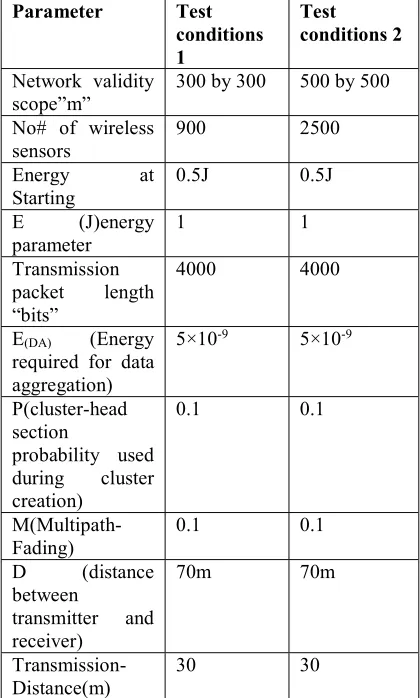
The first scope is 300 by 300 m, where the second is 500 by 500 m. Initial conditions and test conditions are illustrated in the below tables.
[image:10.612.318.528.175.524.2]The test will consider almost on the energy optimization measurements with respect to a LEACH, LEACH-M, and LEACH-L protocols. The result will be compared and given in the table 3.
Table 4. Simulation Parameters
Parameter Test
conditions 1
Test conditions 2
Network validity
scope”m” 300 by 300 500 by 500
No# of wireless
sensors 900 2500
Energy at
Starting 0.5J 0.5J
E (J)energy parameter
1 1
Transmission packet length “bits”
4000 4000
E(DA) (Energy
required for data aggregation)
5×10⁻⁹ 5×10⁻⁹
P(cluster-head section
probability used during cluster creation)
0.1 0.1
M(Multipath-Fading)
0.1 0.1
D (distance between
transmitter and receiver)
70m 70m
Transmission-Distance(m) 30 30
214 The trends and Figures illustrated the energy scope and performance. The energy consumption will be shown in Figures to show how the energy is being consumed. The dead node trends show the node activity until it died. The overall nodes death displays the performance of the network optimization.
The testing of EECLA is done in two topological scenes; the first is over 500 by 500 meters, while the other comprises 300 by 300 meters.
Experimental Result
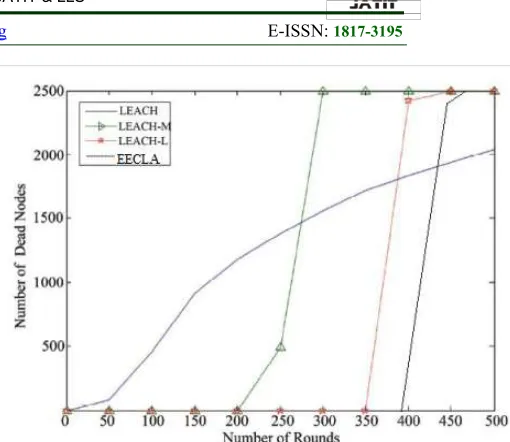
[image:11.612.320.575.63.284.2]From the Figures bellow, it’s easily and clearly to see that, the contributed Energy Efficient Clustering Algorithm “EECLA” comprises the minimized power consumption via time unit. So, the backup power of the sensors will be saved for longer time.
Figure 2. Nodes Death over 300 x 300 round in different protocols.
The cycle across the total running time of the network of 300X300 m results are displayed in Figure 4. From the Figure, it’s clear that, the nodes using the EECLA algorithm are running for more number of cycles than the others and the death of the nodes is very balanced in the contributed EECLA algorithm. While in comparison to other LEACH schemes, there is a larger interval. Again, that cause to save more
[image:11.612.92.298.316.487.2]power and energy by prolong the nodes running time.
Figure 3. Dead Nodes over a round of 500 x 500 in different protocols
Whereas Figure 3 displays the nodes death scheme for an area of 500 by 500m. It can be shown that EECLA algorithm has two benefits: The system is running for more number of rounds than using other LEACH protocols and the time death interval between the first and last node is the shorter than others. So EECLA system can minimize the death nodes interval, reduce the power consumption, save more energy and prolong the lifetime of the nodes.
7. ENEGRY CONSUMPTION MODEL
Before discussing the energy consumption model, understanding of cluster is important. Clustering (see Fig.1) is a process of grouping nodes using an algorithm to perform certain tasks efficiently as per the requirements. Clustering can also be used to divide the topology into sub-regions based on certain criteria e.g. whole area should be covered, minimum energy consumption, maximum lifetime.
Table.5.Energy optimization of different clustering algorithms
Algorithm Energy Optimization Percent
EECLA 96%
EECA 93%
LEACH-M 80%
215
Fig.4 PDF of mean energy lost in one epoch
8. CONCLUSION
This paper was given new methodology to implement EECLA algorithm for wireless sensors adaptive clustering and localization techniques to provide energy efficient routing. Any many past works were given the same about the problem. The optimization of wireless network energy researches either concerns on hardware modification and optimization or either software management. The past researches on clustering of wireless sensor networks
got a result of saving an interesting amount of energy and sensor’s life. This research added a value of saving more energy and power, and building adaptive algorithm.
This algorithm as shown in chapter four, was been tested on different scopes of wireless sensors networks in different conditions. From that point the following conclusions have been got The energy of wireless sensor networks is important issue and needs more hardware and software solutions to get good optimization methods. Energy optimization can significantly be done by a suitable clustering algorithm.
REFERENCES
[1].Base Station Positioning, Nodes’
localization and clustering
algorithms for wireless sensor
networks by Rajiv Kumar
Tripathi.
[2].Seema Bandyopadhyay and Edward J., Coyle, “An Energy Efficient Hierarchical Clustering Algorithm for Wireless Sensor Networks”. IEEE Conference INFOCOM 2003, pp. 189-200.
[3]. Heinzelman W., Chandrakasan A., and Balakrishnan H., “Energy-Efficient Communication Protocol for Wireless Micro sensor Networks”, In Proceedings of the Hawaii Conference on System Sciences, Vol. 2, No. 8, 2000, pp. 584-598. [4].Cerpa A., “Habitat Monitoring Application Driver for Wireless Communications Technology”, In proceeding of ACM SIGCOMM, 2001, pp. 20-41.
[5]. Philipp S., and Roger W., “Gradient Clock Synchronization in Wireless Sensor Networks”. In 8th ACM/IEEE International Conference on Information Processing in Sensor Networks (IPSN), San Francisco, USA, April 2009, pp. 421-442.
216 [6]. Mainwaring A., “Wireless Sensor Networks
for Habitat Monitoring”, In proceeding of (WSNA'02), 2002, pp. 88-97.
[7]. Shah R., Roy S., Jain S., and Brunette W., “Modeling three tier architecture for sparse sensor networks”, In Proceedings of the First IEEE Workshop on Sensor Network Protocols and Applications (SNPA), 2003, pp. 30-41.
[8]. Yarvis D., “Real-World Experiences with an Interactive Ad Hoc Sensor Network”, In International Conference on Parallel Processing Workshops, 2002, pp.143-151. [9]. Dr. K Raghava Rao at.Development of RLS
algorithm for Localization in Wireless Sensor
Networks.https://www.sciencedirect.com/s cience/article/pii/S1877050915029063. [10]. Ye W., Heidemenn J., and Estrin D., “An
Energy-Efficient MAC Protocol for
Wireless Sensor Networks”,
http://www.isi.edu/ilense/macss/, 2001, Technical Report.
[11]. Fan N. and Song L., “Improvement on LEACH Protocol of Wireless Sensor Networks” Proceedings of 2007 International Conference on Sensor Technologies and Applications, Valencia, 2007, pp. 260-264.
[12]. Pottie G. and Kaiser W., “Wireless Integrated Network Sensors (WINS): Principles and Approach” In proceeding of Communications of the ACM, Vol.43, No. 5, 2000, pp.51-58.
[13]. Mclurkin J., “Algorithms for distributed sensor networks” Master’s Thesis for Electrical Engineering at the University of
California, Berkeley, 1999,
http://www.rice.edu/~jm23/publications/M cLurkin-MS-UCB-1999.pdf, Technical report.
[14]. Geng Y., Hong-bing C. and Su-jun H., “A novel hierarchical routing protocol algorithm for wireless sensor networks” Science Direct, Vol. 15, 2008, pp. 75-81. [15]. Dr. K Raghava Rao at.Selection of Anchor
Nodes in Time of Arrival for Localization in Wireless Sensor Networks. https://link.springer.com/chapter/10.1007/9 78-81-322-2671-0_5/fulltext.html.
[16]. Dargie, W. and C. Poellabauer,
Fundamentals of wireless sensor networks: theory and practice2010: John Wiley & Sons Inc.
[17] Sohraby, K., D. Minoli, and T.F. Znati, Wireless sensor networks: technology, protocols, and applications2007: Wiley-Blackwell.
[18]. David J. Stein, E., Wi . reless Sensor Network Simulator. 2006(1.1).
[19]. Chong, C.-Y. and S.P. Kumar, Sensor networks: evolution, opportunities, and challenges. Proceedings of the IEEE, 2003.
91(8): p. 1247-1256.
[20]. Dr. K Raghava Rao at. Establishing path quality management in wireless sensor networks through cluster head determination.