ORIGINAL RESEARCH ARTICLE
EFFECT OF USING CONSTRUCTIONAL WASTE ON STRENGTH PROPERTIES OF
NORMAL CONCRETE
*1
Mohammed M. Salman and
2Mohammad Z. Al-Rawas
1
Prof., Civil Engineering Department, College of Engineering, Mustansiriayah University, Baghdad, Iraq
2
Lecture, Civil Engineering Department, College of Engineering, Mustansiriayah University, Baghdad, Iraq
ARTICLE INFO ABSTRACT
The main solid waste production in the world is the.construction.and.demolition waste constituents. Thispaper discuss the effect of replacement of waste Red.Clay.Brick.Powder (RCBP) on the mechanical properties of concrete (C25) at both conditions; fresh and hardened concrete through using of different partial replacement of powdered brick with cement until 50 percent by weight (0% , 5% , 10% , 15% , 20% , 25% and 50% ) andreplacing10% of microsilica fume (MSF) by weight replacement of cement to produce concrete and to reduce theimpact.on.environment.by.consuming the material generally considered as waste product. Crushed red clay brick and sieved through 75µm sieve size to achieve fineness as in cement. Cubes of size 150mm, Cylinders of size 300mm x 150mm and prisms of size 100mm x 100mm x 500mm were casted and tested.Workability (slump flow), compressive strength and splitting tensile strength for 7, 14 and 28 days; and the modulus of rupture and the modulus of elasticity for 28 days, were investigation. The results were compared with the referencespecimen that casted with normal concrete only.The addition was the use of waste as an alternative to cement and up to 20% with a slight decrease in the properties of concrete compared with ordinary concrete.
Copyright © 2019,Mohammed M. Salman and Mohammad Z. Al-Rawas. This is an open access article distributed under the Creative Commons Attribution License, which permits unrestricted use, distribution, and reproduction in any medium, provided the original work is properly cited.
INTRODUCTION
The new development in construction material industry passed through depending on availing from the waste material and industrial waste such as pozzolanic materials. According
to.some.authors the best way for the construction. Industry to
become a more sustainable one is by using wastes from other industries as building.materials (Kae, 2010; Mehta, 2001 and
Meyer, 2009). About 850kg of CO2 are emitted per ton of
clinker production (Gartner, 2004). Environment protection from the pollution is the main benefit of using the construction and industrial waste. Different resources are usually used as brick waste; some of them are from mistake the industry process and other are from demolition or reconstruction of structures. Millions tons of waste are the amount of waste material were disposed from the environment. In literature, there are several researches interested in studying the production of concrete by using clay brick waste. The
durability of concrete was studied by Swaroop. et al. (2015); in
*Corresponding author: Mohammed M. Salman,
Prof., Civil Engineering Department, College of Engineering, Mustansiriayah University, Baghdad, Iraq
this investigation, brick powder (BP) and quarry. dust (QD) was developed in the concrete instead of cement powder. Secondary cementing materials like Brick Powder can be used to partially replace cement because of pozzolanic nature. Materials like quarry dust best suites to sand due to its physical and chemical properties, fineness etc. Also these materials are known to increase durability, resistance to sulphate. attack and Alkali-Silica. reaction (ASR). In their investigation, different mixes of concrete were adopted; normal aggregate. concrete, replacing 10% of cement by brick powder, replacing 10% of
brick powder and 10% of quarry.dust by cement and sand
respectively, replacing 10% of brick powder and 15% of
quarry.dust by 10% cement and 15% sand respectively,
replacing 10% of brick powder and 20% of quarry.dust by
10% cement and 20% sand respectively, replacing 15% of cement with 15% of brick powder, replacing 15% of cement and 10% of sand by 15% of brick powder and 10% of
quarry.dust, replacing 15% of cement and 20% of sand by 15%
of brick powder and 20% of quarry.dust, and replacing 15% of
cement and 30% of sand by 15% of brick powder and 30% of
quarry.dust. The results indicated that all above mixes
achieved increase in the strength of concrete after 7days, 28
ISSN: 2230-9926
International Journal of Development Research
Vol. 09, Issue, 06, pp.28113-28120, June 2019
Article History:
Received 27th March, 2019 Received in revised form 05th April, 2019 Accepted 17th May, 2019 Published online 30th June, 2019
Available online at http://www.journalijdr.com
Key Words:
Brick Dust, Waste clay bricks,
Replacement, Construction and Demolition, Workability, Mechanical Strength.
Citation: Mohammed M. Salman and Mohammad Z. Al-Rawas. 2019. “Effect of using constructional waste on strength properties of normal concrete”,
International Journal of Development Research, 09, (06), 28113-28120.
days and 120days of curing. Heidari and Hasanpour
investigated the feasibility of using waste bricks powder in concrete. Cement is replaced by waste bricks powder in different proportions until 40 percent by weight. pozzolanic properties of bricks powder and compressive
concrete were investigated. Results show that concrete with partial cement replacement by waste bricks powder has minor strength loss. The results of the investigation confirmed the potential use of this bricks powder material to produce pozzolanic concrete. Pradhan and Dutta (Debabrata Pradhan 2013), determined the compressive strength of concrete in which cement was partially replaced with silica fume (0%, 5%, 10%, 15%, and 20%). The compressive strength test was conducted on age of 24 hours, 7 days and 28 days for 100mm and 150mm cubes. The results indicated that the compressive strength of concrete increased with additional of silica fume Up to 10% replaced by weight of cement. This paper presents, the experimental work consists replacingcem
bricks powder in addition to variation in mechanicalproperties of the concrete at different ages, it ensured the reduction of hazard on environment.
EXPERIMENTAL PROGRAM
Materials Used
Cement: Ordinary Portland Cement (OPC) type (I)
manufactured at northern cement factory Bazian, Al Sulaimaniya / Iraq with the trademark of (Al
used in this investigation. Tables (1) and (2) show the chemical. composition and main. compounds, and.
[image:2.595.311.555.210.322.2]properties of the cement used throughout this work respectively.
Table 1. Chemical Composition and main compounds of Al ordinary Portland cement used throughout this work
Oxide Composition % by
weight Silica Dioxide (SiO2) 21.61
Lime (CaO) 64.23
Magnesia Oxide (MgO) 2.28 Iron Oxide (Fe2O3) 3.30 Alumina Trioxide (Al2O3) 4.97
Sulphate (SO3) 2.65
Loss on ignition (L.O.I) 1.90 Insoluble residue (I.R) 0.85 Time saturation factor (L.S.F) 0.909
Main Compounds (Bogue΄s equation) %by weight of cement Tricalcium Silicate (C3S) 51.510
Dicalcium Silicate (C2S) 23.182 Tricalcium Aluminate (C3A) 7.593 Tetracalcium Alumino-Ferrite (C4AF) 10.032
Table 2. Physical Properties of Al-mass Ordinary Portland Cement used throughout this work
Physical Properties Test result
Limits of Iraqi No.5:1984 Fineness (m2/kg) by Blaine method 335 ≥ 230 Setting time (Vicat΄s method)
Initial setting (min) Final setting (hrs.)
150 4:40
≥ 45 min ≤ 10 hrs Compressive strength for cement
mortar cube (70.7)mm at, MN/m2 3 days 7 days 30.0 39.5 > 15 > 23 Soundness using Auto clave% 0.03 < 0.8
Heidari and Hasanpour (2013), investigated the feasibility of using waste bricks powder in concrete. Cement is replaced by waste bricks powder in different proportions until 40 percent by weight. pozzolanic properties of bricks powder and compressive strength of Results show that concrete with partial cement replacement by waste bricks powder has minor strength loss. The results of the investigation confirmed the potential use of this bricks powder material to produce Debabrata Pradhan, , determined the compressive strength of concrete in which cement was partially replaced with silica fume (0%, 5%, 10%, 15%, and 20%). The compressive strength test was 7 days and 28 days for 100mm and 150mm cubes. The results indicated that the compressive strength of concrete increased with additional of silica fume This paper presents, the experimental work consists replacingcementby (5-50)% bricks powder in addition to variation in mechanicalproperties of the concrete at different ages, it ensured the reduction of
Ordinary Portland Cement (OPC) type (I) manufactured at northern cement factory Bazian, Al-Sulaimaniya / Iraq with the trademark of (Al-mass) has been used in this investigation. Tables (1) and (2) show the compounds, and. physical. properties of the cement used throughout this work
Chemical Composition and main compounds of Al-mass ordinary Portland cement used throughout this work
Limits of Iraqi specification No.5: 1984[8] - - <5.0 - - <2.8 <4.0 <1.5 0.66 – 1.02 Main Compounds (Bogue΄s equation) %by weight of cement
- - - -
mass Ordinary Portland Cement used throughout this work
Limits of Iraqi specification No.5:1984[8]
≥ 45 min ≤ 10 hrs
Clay brick powder: The waste.
investigation were taken from the building. The WCBs were converted into the same size of aggregates, then, the products were placed inside the impact crusher, after that, ground and softening the products to different average particle
converted into fine powder. After grinding, which has
been.sieved and grains.passing through 75micron was the
primary material used, plates (1 & 2). The waste clay bricks types used derived from a variety of sources in Iraq, and are referred to as Red Clay Brick (RCB). The chemical compositions of RCBP was analyzed and results obtained are reported in Table (3).
Plate 1. Sep’s of crushing grounding the WCBs
[image:2.595.41.285.466.648.2]Plate 2. Step’s of sieving and grains passing through 75µm
Table 3. The chemical composition of CBP (wt.%)
Composition SiO2 Al2O3 Fe2O3 CaO Na2O K2O MgO TiO2 P2O5 SO3 L.O.I
Micro.Silica.Fume (MSF): Micro
been used as an artificial.pozzolanic
in improving the mechanical
Silicafumeor microsilica (very fine amorphoussilicap 1µm) used throughout this research is comme partial replacement of cement
the composition and properties of microsilica fume according to manufacture reditions and the chemical composition test.
Fine Aggregate: From Al-Ukhaider region, Karbalaa
natural sand is used in this study which
modulus.of.(3.18) and specific gravity (2.63). The grading of
the fine aggregate was checked according to
Specification.(No.45: 1984) (Iraqi Specification, 1984
(6) shows the sieve analysis of fine aggregate. Table (7) shows the physical properties of the fine aggregate.
Coarse Aggregate: Natural
maximum size 10 mm was used in this research.
.clay.bricks (WCBs) used in the
investigation were taken from the building. The WCBs were converted into the same size of aggregates, then, the products were placed inside the impact crusher, after that, ground and softening the products to different average particle size were converted into fine powder. After grinding, which has passing through 75micron was the primary material used, plates (1 & 2). The waste clay bricks types used derived from a variety of sources in Iraq, and are s Red Clay Brick (RCB). The chemical compositions of RCBP was analyzed and results obtained are
Plate 1. Sep’s of crushing grounding the WCBs
Plate 2. Step’s of sieving and grains passing through 75µm
The chemical composition of CBP (wt.%)
RCBP 50.70 % 16.92 % 6.18 % 14.12 % 0.95 % 2.17 % 4.20 % 0.72 % 0.16 % 1.11 % 3.0 %
Micro Silica Fume (MSF) has
pozzolanic.admixture that is effective
properties significantly (2000). microsilica (very fine amorphoussilicap articles < 1µm) used throughout this research is commercially known as weight. Tables (4&5) illustrate the composition and properties of microsilica fume according
and the chemical composition test.
Ukhaider region, Karbalaa-Iraq, and is used in this study which has fineness
(3.18) and specific gravity (2.63). The grading of the fine aggregate was checked according to Iraqi Standard Iraqi Specification, 1984). Table sieve analysis of fine aggregate. Table (7) shows the physical properties of the fine aggregate.
Natural.crushed.coarse.aggregate of
[image:2.595.33.291.686.791.2]It was brought from AL–Badrah region. The gradation,
specific gravity, density and sulphate.content.were.tested. The
properties of.natural.coarse.aggregate used are show in Tables
(8,9).
Water: The water used in the. mix. Preparation and curing the specimens of concrete for 7,14 and 28 days was potable water
from the water-supply.network.system.(tap water).
Concrete Mix Design: A reference mix was made with
ordinary portland cement (a concrete without waste brick powder material), and proportioned according to the ACI
211.1-91[12]. The specified minimum compressive strength at
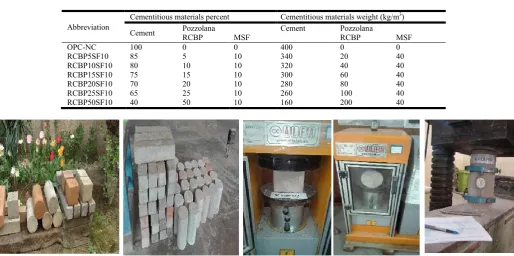
28 days for this mix was 25 MPa. Many trial mixes were adopted to check the required properties and accurate amount of W/B ratio. In order to achieve the scope of this study, six types of sustainable concretemixes were used in the present research as listed in Table (10). At the beginning of the
mixture design, binder content 400 kg/m3, fine aggregate
content was 600 kg/m3, coarseaggregatecontentwas1200 kg/m3
and w/c ratio is (0.5) were chosen as constant. Concretemixes were made with waste bricks powder replacing 5, 10, 15, 20, 25 and 50 percent with replacing 10% MSF by weight of the
cement and with the same amount of aggregates and water as in the reference. The concrete mixtures were mixed in accordance with ASTM C192/C192M (ASTM, 2002).
The.work ability of the concrete was measured by slump cone
test according to ASTM C143/C143M (ASTM, 2012). The interior of the drum was initially washed with water to prevent absorption. The coarse and fine aggregate were mixed first, followed by addition of the cement and RCBP with 10% MSF and water containing required amount. With each mix, control specimens are prepared to determine the mechanical properties of the hardened concrete at 7,14 and 28 days. Control specimens involve 9 cubes (150)mm for compressive strength measurement, 21 cylinders (150×300)mm for compressive strength measurement, splitting tensile strength and modulus of elasticity and 1 prism (100×100×500)mm for flexural strength (modulus of rupture). Plate (3) and table (11) shows specimens, number of specimens and types of test used for these specimens in order to determine the properties of the hardened concrete.
Fresh and hardened properties tests of RCBPSF concrete:
It consists of mixing of concrete by partialreplacing cement
[image:3.595.42.536.79.142.2]withproportions (by weight) of waste red clay brick powder
Table 4. Physical properties and requirements of microsilica fume
Physical properties Results Limit of Specification Requirement (ASTM C1240)[10]
Colour Grey to medium grey
Specific surface area (m2/kg) 22000 ≥ 15000
Strength active Index with Portland cement at 7 days, min. percent of control
122 ≥ 105
[image:3.595.71.518.177.293.2]Percent retained on 45μm (No.325), max,% 8 ≤ 10
Table 5. Chemical properties of microsilica fume
Oxides composition Abbreviation Oxide Content (%) Limit of Specification Requirement (ASTM C1240)[10]
Silica SiO2 93.03 85.0 (min)
Alumina Al2O3 < 0.04 -
Iron oxide Fe2O3 0.05 -
Lime CaO 1.38 -
Sodium oxide Na2O 0.21
Magnesia MgO 0.35 -
Titanium dioxide TiO2 < 0.01
Sulfate SO3 0.55 -
Phosphorus pentoxide P2O5 0.19
Potassium oxide K2O 1.09 -
Loss on ignition L.O.I. 3.37 6.0(max)
Table 6. Sieve analysis of fine aggregate (Zone 2)
Limits of Iraqi standard specification No. 45:1984[11] (Zone 2) % passing by weight
Sieve size mm
100 100
10
90-100 92
4.75
75-100 75
2.36
55-90 56
1.18
35-59 38
0.6
8-30 16
0.3
0-10 5
0.15
- 0
Pan
Table 7. Physical properties of fine aggregate
Physical properties Test result Limit of Iraqi specification No.45:1984[11]
Specific gravity 2.63 -
Sulphate content as SO3 0.194% 0.5% (max)
Fineness modulus 3.18
Fine materials passing from sieve (75µm) 2.2% 5% (max) Dry rodded density kg/m3 1715 -
Absorption 2%
Moisture content 1.4
[image:3.595.84.499.321.408.2] [image:3.595.116.469.441.519.2]Table 8. Sieve analysis of natural coarse aggregate
Limits of Iraqi standard specification No. 45:1984[11]
% passing by weight Sieve size mm
100
100 20
90-100
99 14
50-85
86 10
0-10
4.1 5
-
[image:4.595.114.480.177.238.2]- 2.36
Table 9. Physical properties of natural coarse aggregate
Physical properties Test result Limit of Iraqi specification No.45:1984[11]
Specific gravity 2.65 -
Sulphate content as SO3 0.034% ≤ 0.1% Fine materials passing from sieve (75µm) 0.4 - Compacted bulk density kg/m3 1575 -
Absorption 0.7% -
Table 10. Samples name and composition
Abbreviation
Cementitious materials percent Cementitious materials weight (kg/m3)
Cement Pozzolana Cement Pozzolana
RCBP MSF RCBP MSF
OPC-NC 100 0 0 400 0 0
RCBP5SF10 85 5 10 340 20 40
RCBP10SF10 80 10 10 320 40 40
RCBP15SF10 75 15 10 300 60 40
RCBP20SF10 70 20 10 280 80 40
RCBP25SF10 65 25 10 260 100 40
RCBP50SF10 40 50 10 160 200 40
Plate 3. Control Specimens
Table 11. Specimen and Type of Testing
Specimen Total Number of
specimen for each test
Test Standards of Test
Cube:(150)mm
63 Cube Compression Strength B.S: 1881: part 116[15]
Cylinder:(150 300)mm
63 21
Splitting Tensile Strength Modulus of Elasticity
ASTM C496/C496M[16]ASTM C469[17]
Prism:(100 100 500)mm
[image:4.595.45.560.259.515.2] [image:4.595.62.537.566.783.2]
(RCBP) added to concrete mixtures were as follows: 0% (for the control mix), 5%, 10%, 15%, 20%, 25% and 50% with replacing 10% MSF concrete samples are tested, to evaluate the concrete fresh and harden properties like Workability, Compressive strength, Split tensile strength, Modulus of elasticity and Flexural strength requirements.
Workability of Concrete (Slump Test): The workability of
all concrete.mixes.was.measured.immediately.after mixing in
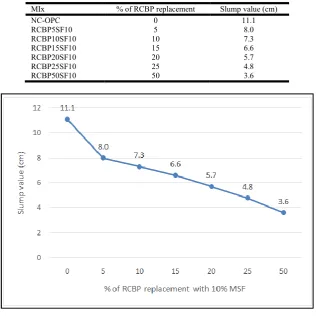
accordance with test method of ASTM C143/ C143M (ASTM, 2012). Figure 1, shows the relationship between the waste redclay brick powder and the slump test value of the sustainable concrete mix with replacing 10% MSF. According to the results obtained, when replacing 10% of MSF from the cement weight in the sustainable concrete mix with RCBP replacement, the results show, from table (12), the workability of sustainable concrete at fresh state are decrease about (27.92%, 34.23%, 40.54%, 48.64%, 56.75% and67.56%) respectively when replacing (5%, 10%, 15%, 20%, 25% and 50%) of RCBP from the cement weight.
Compressive Strength Test: Standard cubes (150mm) are used according to (B.S 1881: part116, are casting and testing to determine the compressive strength at 7, 14 and 28 days. The machine used in the test is hydraulic compression machine of 2000 kN capacity. The average of three specimens at age of 7, 14 and 28 days is used to determine the compressive strength for the NC as well as the partial replacement mixes, as shown in Figure (2).
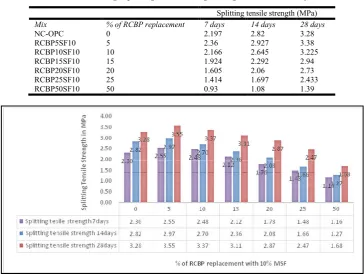
Splitting Tensile Strength Test: The concrete splitting tensile strength was measured experimentally using standard cylinder with the dimensions of d=150mm, h=300mm according to
ASTM C496/C496M[16]. The tests results are shown in figure
3.Three cylinders were tested for each batch at the age of 7days, 14days and 28days, and an average value of the splitting tensile strength was obtained, as shown in Table (14). From table 14 and Figure 3, the reduction of splitting tensile strength with presence of RCBP due to the effect of bond strength between the cement and RCBP in the concrete mix and the weakness of red clay brick which entirely made up of concrete.
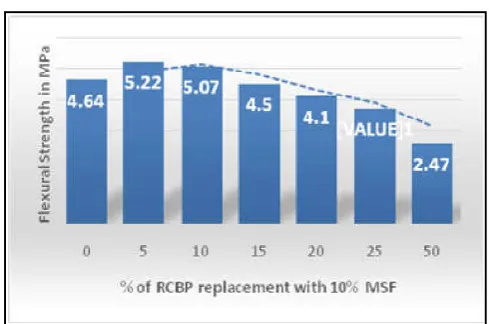
Modulus of Rupture Test: The concrete modulus of rupture was measured experimentally using standard prismatic with the dimensions of b=100mm, d=100mm, h=500mm according to ASTM C78/C78 (ASTM, 2015), the results as shown in table 15 and Figure 4. Table 15 and figure 4, shows a comparison of the flexural tensile strength for normal concrete mix and the type of concrete included RCBP with 10% MSF mixes. The comparison between flexural strength values for sustainable concrete with RCBP with a combination of normal concrete, shows that the flexural strength of the RCBP concrete specimen is more decreased when replacement 50%
RCBP from the cement weight. This is attributed to the lower tensile strength of RCBP and the weaker bond between RCBP and cement matrix.
[image:5.595.139.456.311.627.2]Static Modulus of Elasticity Test: It is one of the most important elastic properties of concrete. The concrete static modulus of elasticity was measured experimentally using standard cylinder with the dimensions of d=150mm, h=300mm according to ASTM C469/C469M. The tests results are shown in Figure 4.Three cylinders were tested for each batch at the age of 28days, and an average value of the static modulus of elasticity was obtained, as shown in Table (16).
Table 12. Measured values of Concrete Workability
MIx % of RCBP replacement Slump value (cm)
NC-OPC 0 11.1
RCBP5SF10 5 8.0
RCBP10SF10 10 7.3
RCBP15SF10 15 6.6
RCBP20SF10 20 5.7
RCBP25SF10 25 4.8
RCBP50SF10 50 3.6
Figure 1. Slump value with % RCBP with 10% MCF replacement
Table 13. Average compressive strength in ages 7, 14 and 28 days
Compressive strength (MPa)
Mix % of RCBP replacement 7 days 14 days 28 days
NC-OPC 0 20.5 24.26 30.11
RCBP5SF10 5 23.92 26.80 35.67
RCBP10SF10 10 22.86 26.05 32.65
RCBP15SF10 15 20.80 24.30 28.05
RCBP20SF10 20 18.30 21.87 26.69
RCBP25SF10 25 16.84 19.65 23.41
RCBP50SF10 50 12.93 15.86 17.28
[image:6.595.119.484.401.675.2]Figure2. Average compressive strength with % of RCBP replacement
Table 14. Average splitting tensile strength in ages 7, 14 and 28 days
Splitting tensile strength (MPa)
Mix % of RCBP replacement 7 days 14 days 28 days
NC-OPC 0 2.197 2.82 3.28
RCBP5SF10 5 2.36 2.927 3.38
RCBP10SF10 10 2.166 2.645 3.225
RCBP15SF10 15 1.924 2.292 2.94
RCBP20SF10 20 1.605 2.06 2.73
RCBP25SF10 25 1.414 1.697 2.433
RCBP50SF10 50 0.93 1.08 1.39
[image:6.595.187.416.724.804.2]Figure 3. Average splitting tensile strength with % of RCBP replacement
Table 15. Modulus of Rupture value in MPa
% of RCBP replacement Modulus of Rupture MPa
0 4.64
5 5.22
10 5.07
15 4.50
20 4.10
25 3.71
Figure 4. Modulus of rupture with % of RCBP replacement
Table 16. Static Modulus of Elasticity value in GPa
MIx % of RCBP
replacement
Static Modulus of Elasticity (GPa)
NC-OPC 0 27.58
RCBP5SF10 5 32.17
RCBP10SF10 10 29.53
RCBP15SF10 15 26.88
RCBP20SF10 20 22.45
RCBP25SF10 25 18.87
RCBP50SF10 50 13.83
Figure 5. Static modulus of elasticity of %RCBP replacement
The modulus of elasticity can be defined as the stress change with respect to strain in elastic range for hardened concrete. Table 16 and figure 5, shows a comparison of the static modulus of elasticity for normal concrete mix and the type of concrete included RCBP with 10% MSF mixes.
Conclusion
Based on the.results.obtained.from.experimental.work for
normal and sustainable concrete with RCBP and 10% MSF, in this study that waste bricks can be used until 50 percent as a replacement of cement in concrete, besides to their corresponding cubes, cylinders and prisms specimens, the conclusions can be illustrated below:
1. When addition 10% of MSF from the cement weight in
the sustainable concrete mix with RCBP replacement, the results show, the workability of concrete at fresh state are decrease about (27.92%, 34.23%, 40.54%, 48.64%, 56.75% and 67.56%) respectively when replacing (5%, 10%, 15%, 20%, 25% and 50%) of RCBP from the cement weight as compared with reference mix.
2. When replacing 10% of MSF from the cement weight
in the sustainable concrete mix with RCBP
replacement, the results show, the compressive strength development of sustainable concrete increase in 7 days curing about (16.68, 11.51 and 1.46) percent respectively when replacing (5%, 10% and 15%) of red powder of the clay brick waste RCBP from the cement weight and that strength decreasing about (10.73, 17.85 and 36.92) percent respectively when replacing (20%, 25% and 50%) of RCBP from the cement weight, but the compressive strength increase to (18.46 and 8.43) percent respectively when replacing (5% and 10%) of RCBP and decrease about (6.84, 11.36, 22.25 and 42.61) percent in 28 days curing respectively for replacing (10%, 15%, 20%, 25% and 50%) from the cement weight in the concrete mix by red powder of the clay brick waste RCBP with MSF.
3. The percentages of increase in splitting tensile strength
in 7 days age for RCBP-10SF are (10.72 and 7.47) percent when replacing (5% and 10%) of RCBP respectively and that strength decreasing about (7.81, 22.92, 35.73 and 49.63) percent respectively when replacing (15%, 20%, 25% and 50%) of RCBP from the cement weight, but the splitting strength increase to (8.26 and 2.65) percent when replacing (5% and 10%) of RCBP respectively and that strength decreasing about (5.12, 12.44, 24.81 and 48.78) percent in 28 days curing respectively for replacing (15%, 20%, 25% and 50%) from the cement weight in the concrete mix by RCBP with MSF relative to the plain concrete specimen.
4. The maximum flexural strength of RCBP with 10%
MSF is recorded. The percentages of increase in flexural strength are (12.62% and 9.38%) when replacing (5% and 10%) of RCBP respectively and that strength decreasing about (2.91, 11.45, 19.96 and 46.71) percent respectively for replacing (15%, 20%, 25% and 50%) from the cement weight in the concrete mix by RCBP with MSF relative to the reference concrete.
5. the maximum static modulus of elasticity of RCBP with
10% MSF is recorded. The percentages of increase in static modulus of elasticity are (16.62% and 7.07%) when replacing (5% and 10%) of RCBP respectively and that strength decreasing about (2.54, 18.60, 31.58 and 49.85) percent respectively for replacing (15%, 20%, 25% and 50%) from the cement weight in the concrete mix by RCBP with MSF relative to the reference concrete.
6. The concrete can be produce by using the 20%
replacement of cement, which is giving the same
mechanical properties of reference.concrete.
7. Generally, the reduction in the mechanical properties of
the concrete containing red clay brick waste could be due to the following:
The lower strength of clay brick waste
(RCBP) compared with that of natural OPC.
The poor adhesive strength between clay
brick powder and the cement paste.
The amount of weak bond areas in RCBP is
significantly more than that in OPC-NC.
The objective of the research
This research aims to investigate the mechanical
properties of concrete containing type of waste (RCBP) and compared the obtained results with that of reference
concrete as well as this study will be helped to get rid of the waste.
The importance of the study in the use of waste from
the bricks in the production of ordinary concrete, which contributes to securing the environment of these wastes as well as reducing the amounts of cement used in the concrete industry, which also reduces the emissions of
CO2 gas from the manufacture of cement.
That is consider as one of the opinion of sustainability.
REFERENCES
A. Heidari and B. Hasanpour, "Effects Of Waste Bricks Powder Of Gachsaran Company As A Pozzolanic Material In Concrete", Asian journal of civil engineering, Vol.14, no.5, pp. 755–763, 2013.
A.H.L.Swaroop, K.Venkateswara Rao and DrP.Kodanada Rama Rao, "Experimental Investigations On Durability Characteristics Of Concrete Developed By Using Brick Powder (BP) And Quarry Dust (QD) ", International Journal of Civil Engineering and Technology (IJCIET), ISSN 0976 – 6308 (Print), ISSN 0976 – 6316(Online), Volume 6, Issue 1, pp. 86-96 , January 2015.
ACI Committee 211.1-91. "Use of Raw or Processed Natural Pozzolans in Concrete", American Concrete Institute, pp.1-38, 2000.
ACI Committee 234R-96,"Guide For The Use of Silica Fume in Concrete", American Concrete Institute, Reapproved 2000.
ASTM C1240 "Standard Specification for Use of Silica Fume as a Mineral Admixture in Cement Concrete, Mortar, and Grout ", Annual Book of ASTM Standards, Vol.04.02, pp. 1-6, 2003.
ASTM C143/C143M, "Standard Test Method for Slump of Hydraulic CementConcrete", American Society for Testing and Materials International, Vol. 04.02, 2012.
ASTM C192/C192M, "Standard Practice for Making and Curing Concrete Test Specimens in the Laboratory", American Society for Testing and Materials International, Vol. 04.01, 2002.
ASTM C469, "Standard Test Method for Static Modulus of
Elasticity and Poisson’s Ratio of Concrete in
Compression", pp.1-5, 2002.
ASTM C496/C496M,"Standard Test Method for Splitting TensileStrength of Cylindrical Concrete Specimens", Vol.04.02, 2011.
ASTM C78/C78M,"Standard Test Method for Flexural Strength of Concrete (Using Simple Beam with Two Points Loading", Annual Book of ASTM Standard, vol. 04, no.02, 2015.
B.S.1881, part 116,"Method of determination of compressive strength of concrete cubes", British Standards Institution, p.3,1989.
Debabrata Pradhan and D. Dutta, "Influence of Silica Fume on Normal Concrete ", Int. J. of Engineering Res. and Application, Vol.3(5), pp. 79-82, 2013.
Gartner E. “Industrially interesting approaches to low-CO2
cements”, Cement and Concrete Research, 34(2004) 1489–
98.
Iraqi Standard No. 5, "Portland cement" the Central Organization for Standardization and Quality Control, Ministry of Planning, 1984, (in Arabic).
IraqiSpecification,No.45,"Aggregate from Natural Sources for Concrete and Construction",1984.(Arabic Translator) Kae LL, Hsiu HW, Je LS, Chao LH, An C. “ Recycling waste
brick from construction and demolition of buildings as
pozzolanic materials”, Waste Management and
Research,7(2010) 653-9.
Mehta PK. “Reducing the environment impact of concrete”, Concrete Can be Durable and Environmentally Friendly,
Concrete International, 10(2001) 61–6.
Meyer C. “The greening of the concrete industry”, Cement and
Concrete Composites, 31(2009) 601–5.