http://dx.doi.org/10.4236/am.2014.521322
How to cite this paper: Wang, L., Hu, J.F. and Chen, C.Z. (2014) On Accelerated Singular Value Thresholding Algorithm for Matrix Completion. Applied Mathematics, 5, 3445-3451. http://dx.doi.org/10.4236/am.2014.521322
On Accelerated Singular Value Thresholding
Algorithm for Matrix Completion
Li Wang, Jianfeng Hu*, Chuanzhong Chen
School of Mathematics and Statistics, Hainan Normal University, Haikou, China Email: [email protected], *[email protected], [email protected]
Received 16October 2014; revised 8November 2014; accepted 16November 2014
Copyright © 2014 by authors and Scientific Research Publishing Inc.
This work is licensed under the Creative Commons Attribution International License (CC BY).
http://creativecommons.org/licenses/by/4.0/
Abstract
An accelerated singular value thresholding (SVT) algorithm was introduced for matrix completion in a recent paper [1], which applies an adaptive line search scheme and improves the convergence rate from O(1/N) for SVT to O(1/N2), where N is the number of iterations. In this paper, we show that it is the same as the Nemirovski’s approach, and then modify it to obtain an accelerate Nemi-rovski’s technique and prove the convergence. Our preliminary computational results are very favorable.
Keywords
Matrix Completion, Singular Value Thresholding, Nemirovski’s Line Search Scheme, Adaptive Line Search
1. Introduction
In many practical problems of interest, such as recommender system [2]-[4], one would like to recover a matrix from a small sampling of its entries. These problems can be formulated as the following matrix completion problem:
( )
( )
min rank
. . , ,
X
ij ij
X
s t X M i j
= ∈Ω
(1)
where M∈m n× is the given incomplete data matrix, Ω is the set of locations corresponding to the observed
entries. The problem (1) is NP-hard because the rank function is non-convex and discontinuous. However, it is known that the rank of a matrix is equal to the number of nonvanishing singular values, and the nuclear norm
∗
⋅ stand for the sum of the singular values. Thus, the rank minimization problem (1) can be relaxed as fol-lowing convex program problem:
( )
min . . , , X ij ij Xs t X M i j
∗
= ∈Ω
(2) and Candès and Recht [5] proved that under suitable conditions, the program (1) and (2) are formally equivalent in the sense that they have exactly the same unique solution.
Now, there are many algorithms for solving the model (2), such as singular value thresholding (SVT) algo-rithm [6], accelerated proximal gradient (APG) algorithm [7] and so on. The singular value thresholding (SVT) algorithm solves the following problem:
( )
( )
2 1 min 2 . . FX X X
s t P X P M
τ ∗ Ω Ω + = (3)
where PΩ denotes the orthogonal projector onto the span of matrices vanishing outside of Ω so that the
( )
i j, th component of PΩ( )
X is equal to Xij if( )
i j, ∈ Ω and zero otherwise. In [6], Cai et al. showed that the op-timal solution to the problem (3) converges to that of (2) as τ → ∞.However, SVT has only a global convergence rate of O
(
1 N)
, where N is the number of iterations. Then Liu Jun et al.[1] proposed an accelerated SVT algorithm by considering the Lagrange dual problem of (1.3) as fol-lows:( )
min m n Y h Y ×∈ (4)
where
( )
(
( )
)
1(
( )
)
2 ,(
(
( )
)
)
2 F
h Y τ Dτ P YΩ Dτ P YΩ Y PΩ M Dτ P YΩ
∗
= − − − − , Dτ is the soft-thresholding op-
erator [1], and h Y
( )
is convex and continuously differentiable with Lipschitz continuous gradient.In the accelerated SVT algorithm, an adaptive line search scheme was adopted based on Nemirovski’s tech-nique [8]. For reference purpose, in the following we list the related key steps of the algorithm in [1]:
Step 7: compute 1
( )
1k k k
k
Y S h S
L
+ = − ′ ;
Step 8: if
( ) ( )
1( )
2 12
k k k F
k
h Y h S h S
L
+ ≤ − ′ then;
Step 9: go to step 14; Step 10: else; Step 11: Lk =2Lk; Step 12: end if; Step 13: end while;
Step 14: set
( ) (
)
( )
1 2
2 k k k
k F
h S h Y
L
h S
ω= − +
′ , Lk+1=h
( )
ω Lk,( )
1, 1 5, 0.8, 5.
h ω ω
ω
≤ ≤
= >
Comparing with Nemirovski’s scheme for updating Lk, i.e. Lk+1=Lk in step 14, Liu Jun et al. [1] [9] used a more flexible scheme, in which Lk is not required to monotonically increase. As Lk is decreased, the step size 1Lk is increased, it is expected that the number of iterations may be reduced. The idea is really attractive. However, it is found that the approach is just the same as the Nemirovski’s algorithm in the following section.
2. Main Procedure
First, we declare that the value of ω (in step 14) is always not bigger than 2, this means that it is just the same as Nemirovski’s line search scheme.
Since h Y
( )
is convex and continuously differentiable with Lipschitz continuous gradient, we have( )
k 1( )
( )
k , k 1 k(
)
( )
( )
21 , 1 1
2
k k k k k k k F
L
h Y+ ≤h S + h S′ Y+ −S + Y+ −S (6)
where L is the Lipschitz gradient constant [10].
Define function
( )
( )
( )
, 22
k k k k k F
L
Y h S h S Y S Y S
φ = + ′ − + − , then we have
( ) ( )
( )
21 , 1 1
2 k
k k k k k k k k F
L
Y h S h S Y S Y S
φ + = + ′ + − + + − (7)
which along with 1
( )
1k k k
k
Y S h S
L
+ = − ′ gives
( ) ( )
( )
21
1 2
k k k k F
k
Y h S h S
L
φ + = − ′ (8)
From (5), (6) and (7), we have
(
)
2( )
( )
(
)
1 1 , 1 1
2
k k k F k k k k k
L
h Y+ − Y+ −S ≤h S + h S′ Y+ −S ≤h Y+
and
( )
( )
( )
21 1 1
,
2 k
k k k k k k k k F
L
h S + h S′ Y+ −S =φ Y+ − Y+ −S
It follows that
( )
2( )
( )
21 1 1 1 1
2 2
k k
k k k k F k k k k k F
L L L
Y Y S h Y Y Y S
φ + + + φ + +
−
− − ≤ ≤ + −
that is
( ) ( )
1 12 1
2 2
k k k
k k
k k F
Y h Y
L L L
Y S
φ + +
+
−
− ≤ ≤
− (9)
Combining (8), (9),
( ) (
)
( )
1 2
2 k k k
k F
h S h Y
L
h S
ω= − +
′ and 1
( )
1
k k k
k
Y S h S
L
+ = − ′ , we obtain
2
max 1, k 2
k
L L
L ω
− ≤ ≤
(10) Then, we make a few improvement based on the original algorithm to obtain a revised algorithm. The overall steps can be organized as follows:
Algorithm 1 The Modified ASVT Algorithm
Step 1: Input: L1, 0, 1, t−1= t0= Y1=Y0=0, 0,1η∈
( )
;Step 2: Output: YN+1, XN+1=Dτ
(
P YΩ(
N+1)
)
; Step 3: for k=1, 2,,N do;Step 4: compute 2 1 1 k k k t t β − − − = ;
Step 5: compute Sk =Yk+βk
(
Yk−Yk−1)
;Step 6: while 1 do;
Step 7: compute 1
( )
1k k k
k
Y S h S
L
+ = − ′ ;
Step 8: if
( ) ( )
1( )
2 12
k k k F
k
h Y h S h S
L
+ ≤ − ′ then;
Step 10: else; Step 11: Lk+1=2Lk; Step 12: end if; Step 13: end while;
Step 14: set
2 1
1 1 4
2
k k
t t = + + − ;
Step 15: end for.
The convergence of algorithm 1 is given by the following theorem. And in this algorithm, the upper bounds of the order of convergence have nothing to do with the initial value L1, which means that the modified scheme improved and accelerated the Nemirovski’s technique.
Theorem 1 For large enough k, the approximate solution Yk obtained by the modified algorithm satisfies
(
)
(
)
2 1 2 4 1 h k LRh Y h
k
∗ + − ≤
+
where Rh is the distance from the starting point to the optimal solution set.
Proof. According to the convergence of Nemirovski’s algorithm ([8] Theorem 10.2.2), it has
( )
(
)
2 1 1 2 2 1 k h k L Rh Y h
k
∗ +
+ − ≤
+
where Lk+1≤ =Lˆ max 2 ,
{
L L1}
. In the following we declare that Lk+1≤2L for large enough k in our modified algorithm.Suppose that there exists a positive integer k such that Lk+1>2L. Obviously, Lk+1=ηLk or 1 2
l
k k
L+ = ×η L , where l denotes the number of implementing step 11 in kth iteration. Since the test condition in step 8 is satisfied when Lk ≥L, it easily follows that 2 2
l k
L < L. Therefore, we have
1 2
k k
L+ =ηL > L
and then 2 2 k L L L η > >
So we have a recurrence relation of the form 1 1
k k
L L
η +
= , then by recurrence, we obtain
1 2 1
1 1 1
2
k k
k
L L L L
η η + η
= = = > ×
Obviously, as k→ ∞, we can obtain L1→ ∞, which is impossible by finiteness of the initial value L1. Thus, when k is large enough, we have Lk+1≤2L. This completes the proof.
3. Computational Results
In this section, numerical experiments with MATLAB were performed to compare the performance of the Ne-mirovski’s technique algorithm and further to gain an insight into the behavior of our approach on synthetic dataset.
relative reconstruction error defined by following:
error F
F
X M
M
−
= (11)
where X is the computed solution of an algorithm, then there is using the “error” to evaluate the quality of the algorithm. In addition, we set L1=1, η=0.8 for all test problems. Compiled using MATLAB2010, both Ne-SVT and M-ASVT were run under a Windows XP system on a AMD Fusion APU E-450 1.65 Ghz personal computer with 1.98 GB of memory and about 16 digits of precision.
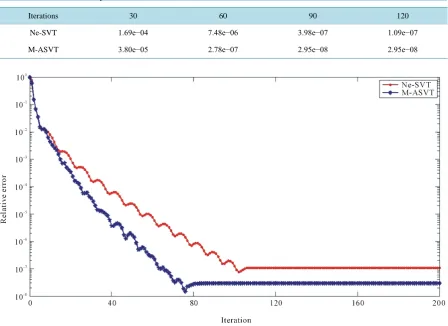
Firstly, we compare the relative error between Ne-SVT and M-ASVT for solving the randomly generated low rank matrix problem. The initial parameters as follows: m = 100, n = 50, r = 5, p = 0.9, so meaning that 90% en-tries are observed. We will recover the other 10% enen-tries by running Ne-SVT and M-ASVT separately.Table 1 reports the relative reconstruction error of different methods after 30, 60, 90 and 120 iterations. We can observe that the convergence rate of M-ASVT is really faster than that of the other, which is consistent with our analysis, and the further shows we can seeFigure 1.
Then we can still test these algorithms with different settings on the following different low rank matrix com-pletion problems: 1) Fix the matrix size
(
m n,)
, the rank r and the ratio of the observed entries p. Then test the performance with respect to different choices of the parameter τ. We fix m = 100, n = 50, r = 3, p = 0.9, and let τ change from 2 mn to 5 mn; 2) Fix some number remains the same, and only let p change from 0.5 to 0.9; 3) Fix some number remains the same, let rank r change from 3 to 15; 4) Fix some number remains the same, only change the size of M. [image:5.595.90.539.375.701.2]Finally,Table 2 shows the comparative results of randomly generated matrix completion problems, in which we choose error < 10−6 as the stop condition. Clearly, we can know that the more smaller τ, the more bigger p,
Table 1. Relative error comparison between Ne-SVT and M-ASVT.
Iterations 30 60 90 120
Ne-SVT 1.69e−04 7.48e−06 3.98e−07 1.09e−07
M-ASVT 3.80e−05 2.78e−07 2.95e−08 2.95e−08
Table 2. Comparisons between Ne-SVT and M-ASVT on the synthetic dataset with different settings.
Settings Iterations CPU time (s)
m n r p τ Ne-SVT M-ASVT Ne-SVT M-ASVT
τ
100 50 3 0.9 5 mn 158 114 3.02 2.65
100 50 3 0.9 4 mn 119 87 2.31 2.00
100 50 3 0.9 3 mn 89 74 1.78 1.67
100 50 3 0.9 2 mn 66 46 1.32 1.02
p
100 50 3 0.5 2 mn 200 122 4.02 2.87
100 50 3 0.6 2 mn 200 112 3.88 2.60
100 50 3 0.7 2 mn 147 96 2.89 2.24
100 50 3 0.8 2 mn 94 61 1.85 1.38
r
100 50 5 0.9 2 mn 86 56 1.70 1.22
100 50 8 0.9 2 mn 97 75 1.91 1.73
100 50 10 0.9 2 mn 130 97 2.58 2.26
100 50 15 0.9 2 mn 197 145 3.98 3.41
m, n
80 40 3 0.9 2 mn 69 51 0.81 0.70
160 80 3 0.9 2 mn 65 45 3.61 2.85
200 100 3 0.9 2 mn 56 39 5.45 4.32
300 150 3 0.9 2 mn 52 38 13.37 10.84
1000 500 3 0.9 2 mn 44 33 57.15 49.76
the more smaller rank r and the more bigger the size, then the more smaller the error and the more better effi-ciently. And we can observe that the M-ASVT performance surpasses Ne-SVT in all cases.
4. Conclusion
In this paper, we point out that the ASVT algorithm [1] is essentially the same as the Nemirovski’s approach, then modify it to obtain the accelerate Nemirovski’s approach and prove the convergence. We also give the comparative results of the convergence rate of Ne-SVT and M-ASVT. The preliminary computational results show that our approach is really more efficient. We empirically choose η =0.8
(
0< <η 1)
in our test, and then we plan to study the better choice of η and develop the adaptive line search scheme to further improve the algorithm.Acknowledgements
The research is supported by Natural Science Foundation of Hainan Province of China (No. 114006).
References
[1] Hu, Y., Zhang, D. and Liu, J. (2012) Accelerated Singular Value Thresholding for Matrix Completion. Proceedings of the 18th ACM SIGKDD International Conference on Knowledge Discovery and Data Mining, Beijing, 12-16 August 2012, 298-306. http://dx.doi.org/10.1145/2339530.2339581
August 2008, 426-434. http://dx.doi.org/10.1145/1401890.1401944
[3] Koren, Y. (2010) Collaborative Filtering with Temporal Dynamics. Communications of the ACM, 53, 89-97. http://dx.doi.org/10.1145/1721654.1721677
[4] Steck, H. (2010) Training and Testing of Recommender Systems on Data Missing Not at Random. Proceedings of the 16th ACM SIGKDD International Conference on Knowledge Discovery and Data Mining, Washington DC, 25-28 July 2010, 713-722.
[5] Candès, E.J. and Recht, B. (2009) Exact Matrix Completion via Convex Optimization. Foundations of Computational Mathematics, 9, 717-772. http://dx.doi.org/10.1007/s10208-009-9045-5
[6] Cai, J.F., Candès, E.J. and Shen, Z. (2010) A Singular Value Thresholding Algorithm for Matrix Completion. SIAM Journal on Optimization, 20, 1956-1982. http://dx.doi.org/10.1137/080738970
[7] Toh, K.C. and Yun, S. (2010) An Accelerated Proximal Gradient Algorithm for Nuclear Norm Regularized Least Squares Problems. Pacific Journal of Optimization, 6, 615-640.
[8] Nemirovski, A. (1994) Lecture Notes on Efficient Methods in Convex Programming. http://www2.isye.gatech.edu/~nemirovs/Lect_EMCO.pdf
[9] Liu, J., Chen, J. and Ye, J. (2009) Large-Scale Sparse Logistic Regression. Proceedings of the 15th ACM SIGKDD In-ternational Conference on Knowledge Discovery and Data Mining, Paris, 28 June-1 July 2009, 547-556.
http://dx.doi.org/10.1145/1557019.1557082