ISSN(Online): 2319-8753 ISSN (Print): 2347-6710
I
nternational
J
ournal of
I
nnovative
R
esearch in
S
cience,
E
ngineering and
T
echnology
(An ISO 3297: 2007 Certified Organization)
Website: www.ijirset.com
Vol. 6, Issue 4, April 2017
Smart Crawler: A Two-Stage Crawler for
Efficiently Harvesting Deep-Web Interfaces
Rahul Shinde1, Snehal Virkar1, Shradha Kaphare1, Prof. D. N. Wavhal2
B. E Student, Department of Computer Engineering, Jai Hind College of Engineering Kuran Pune, Savitribai Phule
Pune University, Pune, India1
Professor, Department of Computer Engineering, Jai Hind College of Engineering Kuran Pune, Savitribai Phule Pune
University, Pune, India.2
ABSTRACT: On web we see web pages are not indexed by crawler that increase at a very fast , there has been
developed many crawler efficiently locate deep-web interfaces, Due to large volume of web resources and the dynamic nature of deep web, For that to achieve better result is a challenging issue. To solve this problem we propose a two-stage framework, namely Smart Crawler, for effectively finding deep web. Smart-crawler get seed from seed database. First stage, Smart Crawler performs “Reverse searching” that match user query with URL. In the second stage “Incremental-site prioritizing” performed here match the query content within form. Then according to match frequency classify relevant and irrelevant pages and rank this page. High rank pages are displayed on result page. Our proposed crawler efficiently retrieves deep-web interfaces from large sites and achieves greater result than other crawlers. We develop searching thorough personalized searching to improve performance considering time we maintain log file. Bookmarked are saved for each user.
KEYWORDS: Two-stage crawler, Crawler, Deep web, Feature selection URL, IP, Site frequency, Ranking
I. INTRODUCTION
A Web Crawler also known as a robot or a spider is a system for the bulk downloading of web pages. Web crawlers are used for a variety of purposes. Most prominently, they are one of the main components of web search engines, systems that assemble large of web pages, index them, and allow users to issue queries against the index and find the web pages that match the queries Also use in web data mining, where web pages are analyzed for statistical properties, or where data analytics is performed on them. On web deep web is increasing there has been increased interest in techniques that help efficiently locate deep-web interfaces. However, due to the large volume of web resources and the dynamic nature of deep web, achieving wide coverage and high efficiency is a challenging issue. Quality and coverage on relevant deep web sources are also challenging. We propose a two-stage framework, namely Smart Crawler, for efficient harvesting deep web interfaces. In the first stage, Smart Crawlerperforms Link based searching for center pages with the help of search engines, avoiding visiting a large number of pages. In second phase we are going to match form content, then we classifying relevant and irrelevant sites. Here we developer personalized search for efficient results and we are maintaining log for efficient time management.
II. REVIEW OF LITERATURE
1) Comparative Study of Hidden Web Crawlers - give Review on working of the various Hidden Webcrawlers. They mentioned the strengths and weaknesses of the techniques implemented in each crawlers. Crawlers are differentiated on the basis of their underlying techniques and behavior towards different kind of search forms and domains. This study will useful in research perspective [3].
ISSN(Online): 2319-8753 ISSN (Print): 2347-6710
I
nternational
J
ournal of
I
nnovative
R
esearch in
S
cience,
E
ngineering and
T
echnology
(An ISO 3297: 2007 Certified Organization)
Website: www.ijirset.com
Vol. 6, Issue 4, April 2017
-Selection of relevant sources.
-Extracting the underlying content of deep web pages. Here is the problem of retrieving unwanted pages which needs more time to crawl relevant results [6].
3) An active crawler for discovering geospatial Web services and their Distribution pattern - A case study of OGC Web Map Service: The increased popularity of standards for geospatial interoperability has led to anincreasing number of geospatial Web services (GWSs), such as Web Map Services(WMSs), becoming publicly available on the Internet. However, finding the services in a quick and precise fashion is still a challenge. This paper addresses the above challenges by developing an effective crawler to discover and update the services in 1. Proposing an accumulated term frequency (ATF)–based conditional probability model for prioritized crawling,
(2) Utilizing concurrent multi-threading technique, and
(3) Adopting an automatic mechanism to update the metadata of identified services [2].
4) Search Engines going beyond Keyword Search: A Surveying order to solve the problem of information overkill on the web or large domains, current information retrieval tools especially search engines need to be improved. Much more intelligence should be embedded to search tools to manage the search and filtering processes effectively and present relevant information. As the web swells with more and more data, the predominant way of sifting through all of that data —keyword search —will one day break down in its ability to deliver the exact information people want at our fingertips [1].
5)Personalization on E-Content RetrievalBased on Semantic Web Services:
In the current educational context there has been a significant increase in learning object repositories (LOR), which are found in large databases available on the hidden web. All these information is described in any metadata labeling standard (LOM, Dublin Core, etc). It is necessary to work and develop solutions that provide efficiency in searching for heterogeneous content and finding distributed context. Distributed information retrieval, or federated search, attempts to respond to the problem of information retrieval in the hidden Web[5].
III. EXISTING SYSTEM
Existing strategies were dealing with creation of a single profile per user, but conflict occurs when user’s interest varies for the same query E.g. When a user is interested in banking exams in query “bank” may be slightly interested in accounts of money bank where not at all interested in blood bank. At such time conflict occurs so we are dealing with negative preferences to obtain the fine grain between the interested results and not interested. Consider following two aspects:
1) Document-Based method:
These methods aim at capturing users’ clicking and browsing behaviors. It deals with click through data from the user i.e. the documents user has clicked on. Click through data in search engines can be thought of as triplets (q, r, c)
Where,
q = query r = ranking
c = set of links clicked by user.
2) Concept-based methods:
ISSN(Online): 2319-8753 ISSN (Print): 2347-6710
I
nternational
J
ournal of
I
nnovative
R
esearch in
S
cience,
E
ngineering and
T
echnology
(An ISO 3297: 2007 Certified Organization)
Website: www.ijirset.com
Vol. 6, Issue 4, April 2017
DISADVANTAGES - 1) Deep-web interfaces.
2) Achieving wide coverage and high efficiency is a challenging issue
IV. PROPOSED SYSTEM ARCHITECTURE
Fig.No.01) System architecture of smart crawler Reverse searching
Classification
Relevant and irrelevant
Incremental-site prioritizing Extract form
Ranking Classification Query
processing
Database Database
Database Seed collection
Seed collection log filelog file Enter query
Display result Personalized query
ISSN(Online): 2319-8753 ISSN (Print): 2347-6710
I
nternational
J
ournal of
I
nnovative
R
esearch in
S
cience,
E
ngineering and
T
echnology
(An ISO 3297: 2007 Certified Organization)
Website: www.ijirset.com
Vol. 6, Issue 4, April 2017
To get user expected deep web data sources, Smart Crawler is developed in URL Matching and Content matching .The first site locating stage finds the most relevant site for a given topic, and then the second in-site exploring stage uncovers searchable forms from the site. Specifically, the site locating stage starts with a seed set of sites in a site database. Seeds sites are candidate sites given for Smart Crawler to start crawling, which begins by following URLs from chosen seed sites to explore other pages and other domains. Seed fetcher get seeds and then perform Reverse searching it match user query content in url, then we going to classify the relevant and irrelevant links. Then in Incremental-site prioritizing we are matching content of query on form, depends on matching frequency we are going to classify relevant and irrelevant. Page ranking is performed by graph based technique and display high ranked results on result page. We personalize the searching according to user profile by using user profession, so it is easy to get accurate result to user. Domain classification is performed for each domain.User has allowed bookmarking the links.
ADVANTAGES-
1.Gives User relevant result
2. Two crawling strategies, Reverse searching and Incremental-site prioritizing
3. Avoid Deep-web interfaces issues.
4. Achieving wide coverage and high efficiency result
5. Personalize searching is allowed to user.
6. Log file is maintained.
7.Bookmarked is stored for each user.
8.According to domain links will display to user
V. MATHEMATICAL MODEL
FSS = U, A, T; [1]
FSL = P, A, T; [2]
. = 1 + log t , ; [3]
Site ranking:
ST(l) = Sim(U, U )+ sim(A,A ) + sim(T,T) [4]
SF(s) =∑ [5]
Link Ranking:
ISSN(Online): 2319-8753 ISSN (Print): 2347-6710
I
nternational
J
ournal of
I
nnovative
R
esearch in
S
cience,
E
ngineering and
T
echnology
(An ISO 3297: 2007 Certified Organization)
Website: www.ijirset.com
Vol. 6, Issue 4, April 2017
VI. EXPERIMENTAL RESULTS
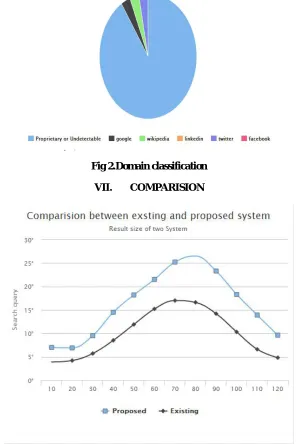
Fig 2.Domain classification
VII. COMPARISION
Fig.3 Comparision between existing and proposed Smartcrawler
VIII. CONCLUSION
ISSN(Online): 2319-8753 ISSN (Print): 2347-6710
I
nternational
J
ournal of
I
nnovative
R
esearch in
S
cience,
E
ngineering and
T
echnology
(An ISO 3297: 2007 Certified Organization)
Website: www.ijirset.com
Vol. 6, Issue 4, April 2017
result than other crawler. Smart Crawlerworks in two phases: Reverse searching and Incremental-site prioritizing. The ranking helps to get relevant results. We personalize searching through profession. Maintaining log file will reduce time to search results. Bookmark is stored for each user.
REFERENCES [1] Search Engines going beyond Keyword Search: A Survey, Mahmudur Rahman, 2013.
[2] An active crawler for discovering geospatial Web services and theirDistribution pattern - A case study of OGC Web Map Service .WenwenLia; ChaoweiYanga; ChongjunYangb. 16 June 2010
[3] A Comparative Study of Hidden Web Crawlers, International Journal of Computer Trends and Technology (IJCTT) Vol. 12,Sonali Gupta, Komal Kumar Bhatia Jun 2014.
4) Optimal Algorithms for Crawling a Hidden Database in the WebCheng Sheng Nan Zhang Yufei Tao XinJin.Proceedingsof the VLDB Endowment, 5(11):1112–1123, 2012.
[5]Personalization on E-Content Retrieval Based on Semantic Web ServicesA.B. Gil1, S. Rodríguez1, F. de la Prieta1 and De Paz J.F.1al.2013. [6] Web Crawling, Foundations and Trends in Information Retrieval, vol. 4, No. 3, pp. 175–246, 2010. Olston and M. Najork,
[7] Supporting Privacy Protection in Personalized Web Search,LidanShou, He Bai, Ke Chen, and Gang Chen, 2012
[8]Focused crawler:a new approach to topic-specific web resource discovery.SoumenChakrabarti, Martin Van den Berg, and Byron Dom. 1999. [9]Scalability challenges in web search engines, in Synthesis Lectures on Information Concepts,Retrieval, and Services. San Mateo, CA, USA: Morgan, 2015, B. B. Cambazoglu and R. A. Baeza-Yates,