© 2017, IRJET | Impact Factor value: 5.181 | ISO 9001:2008 Certified Journal | Page 1182
EXPERIMENTAL STUDY ON GREEN CONCRETE
Prof. Ashok Admute
1, Mr. Vardhan Nagarkar
2, Mr. Sanket Padalkar
2, Ms. Samruddhi Bhamre
3,
Mr. Akshay Tupe
4Prof. A.M.Adamuthe
1Professor, affiliated to deparment of civil engineering, Anantrao Pawar College of
Engineering & Research, Mr. Vardhan Nagarkar
2, Mr. Sanket Padalkar
2, Ms. Samruddhi Bhamre
3, Mr. Akshay
Tupe
4UG students affiliated to deparment of civil engineering, Anantrao Pawar College of Engineering & Research.
---***---Abstract: Conventional concrete is responsible for amount of carbon-dioxide emission to some Extent. So to reduce the emission, various types of concrete are developed using waste products from industries and agricultural use like blast furnace slag, silica fume, fly ash which requires low Amount of energy and also cause least harm to the environment. Green concrete is a new technology developed now days to reduce the effect on environment by production of cement. Cement contains high amount of carbon-di-oxide which harms the environment drastically, so by replacing the cement by various materials which causes harm to the environment we not only reduce the problem of disposal of these materials but we reduce the emission of carbon-di-oxide from cement and as a result of which we reduces the negative effect on environment.
Keywords - Green Concrete, Silica fume, Demolished Brick Aggregate, CO2 Emission, Eco-Friendly concrete.
I. INTRODUCTION
Color has nothing to do with green concrete. It is a concept of thinking and environment into an every aspect of the raw materials manufacture over construction, mixture design to structural design, and durability. Green concrete is very often considered to be cheap to produce due to the use of recycled material whereby avoiding the charges for the disposal of waste, less energy consumption and greater durability.
While a normal construction practices are guided by short term economic considerations, sustainable construction is focused on best practices which emphasize on long term affordability, durability and effectiveness. At each stage of the life cycle of the construction, it increases ease and quality of life, while minimizing the negative environmental impacts and increasing economic sustainability of the construction. Any infrastructure designed and constructed in a sustainable way minimizes the use of resources through the whole life cycle of the construction process in which the green concrete play a vital role in achieving the sustainable construction. Having so much of advantageous has led to popularity in construction world and one of the emerging technology in sustainable construction. Green concrete is miracle of present and tool for future when the natural resources are on the verge of extinction.
Due to growing interest in sustainable development, engineers and architects are motivated more than ever before to choose materials that are more sustainable. Selection of material for concrete is more sustainable and minimizes environmental impact. Cement production accounts for more than 6% of all CO2 emission which is a major factor in the world’s global warming (Greenhouse gas). India is the third largest cement producer in the World and one of the largest consumers of cement per capita in the world. Rough figures are that India consumes about 1.2 Ton/year/capita, while as World average is 0.6 Ton/year/capita. CO2 emissions from 1 ton of concrete produced vary between 0.05 to 0.13 tons. 95% of all CO2 emissions from a cubic meter of concrete are from cement manufacturing.
Cement is the one of the major component of the concrete. The production of one ton of cement releases one ton of a CO2 into the atmosphere. CO2 is known to be greenhouse gas that contributes to the global warming. The reduction in CO2 emission from a concrete can be achieved with a partial replacement of cement by the various supplementary cementitious materials. The use of these cementitious materials has resulted in an improvement of the properties of concrete.
So to reduce this environmental impact green concrete plays a vital role. By using recycled materials or waste materials which are harmful to the environment as a replacement of cement such as fly ash, silica flume, etc. we can reduce the CO2 emission from concrete as well as it reduces the environmental impact on earth. As a result of which green concrete is one of the major tool in the future when the natural resources are on verge of extinction.
II. OBJECTIVES
1) To study the effect of silica fume on the environment.
2) To study the effectiveness of concrete by partial replacement of cement by silica fume.
3) To determine the strength of new mix design concrete of grade M40.
4) To determine the various test results like compression test, flexural test & split tensile test. 5) To find the optimum percentage of silica fume in
© 2017, IRJET | Impact Factor value: 5.181 | ISO 9001:2008 Certified Journal | Page 1183 III. METHODOLOGY
• To find out number of literature on green concrete.
• To study about the ingredients of green concrete.
• Collection of various ingredients required for project from different outsources.
• To design a concrete mix for M40 grade as per the Indian Standard Recommended method.
• To cast cubes, beams & cylinders by using a various ingredients as per mix design.
• To test the casted cubes, beams & cylinders for strength after 7, 14, 28 days of curing respectively by performing various test like compressive test, flexural test & split tensile test.
• To calculate the economy for green concrete.
• To compare between conventional concrete and green concrete based on various parameters.
EXPERIMENTAL WORK:- 3.1 CEMENT
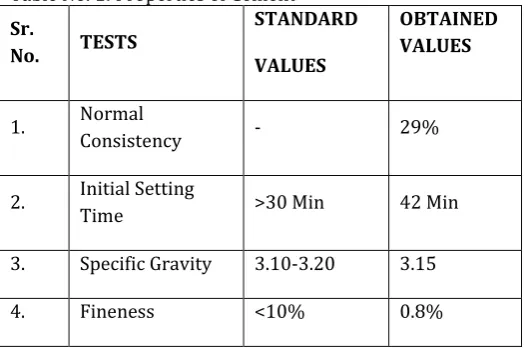
[image:2.595.303.565.180.316.2]Ordinary Portland cement grade 53, manufactured by Birla .super confirming to IS 12269 – 2013.
Table No. 1: Properties of Cement Sr.
No. TESTS
STANDARD
VALUES
OBTAINED VALUES
1. Normal
Consistency - 29%
2. Initial Setting
Time >30 Min 42 Min
3. Specific Gravity 3.10-3.20 3.15
4. Fineness <10% 0.8%
3.2 FINE AGGREGATE
Artificial sand passing through 4.75 mm IS sieve & retained on 150 micron confirming to IS 383 – 1970.
Table No. 2: Properties of Fine Aggregate Sr.
No. TESTS
STANDARD
VALUES
OBTAINED VALUES
1. Specific Gravity 2.50-2.80 2.53
2.
Water Absorption
1%-2% 1.2%
3. Grading Zone I-IV II
3.3 COARSE AGGRGATE
20mm size coarse aggregates confirming to IS 383 – 1970.
Table No. 3: Properties of Course Aggregate Sr.
No. TESTS
STANDARD
VALUES
OBTAINED VALUES
1. Specific Gravity 2.50-3.00 2.90
2. Water Absorption
0.5%-1.0% 1%
3. Grading Zone I-IV II
3.4 DEMOLISHED BRICKS
Demolished bricks were collected from the demolished building of age 50 years. The collected sample were broken manually into pieces of size passing through 4.75mm IS sieve and retained on 150 micron IS sieve.
Table No. 4: Properties of Demolished Brick Wastes Sr.
No.
TESTS STANDARD
VALUES
OBTAINED VALUES
1. Specific Gravity 1.80-2.0 1.96
2. Water Absorption
28%-30% 30%
3.5 MICRO SILICA
Silica fume used was confirming to ASTM – C (1240 – 2000) and was supply by “ELKEM INDUSTRIES” was name Elkem – Micro Silica 920 D. The silica fume is used as a partial replacement of cement.
Table No. 5: Properties of Micro Silica
Sr. No. PROPERTIES STANDARD
VALUES
1 Specific Gravity 2.2
2 Bulk Density 576 (Kg/m3)
[image:2.595.31.297.391.565.2]© 2017, IRJET | Impact Factor value: 5.181 | ISO 9001:2008 Certified Journal | Page 1184 3.6 MIX DESIGN
Mix design was done based on IS 10262 – 1982 & IS 456 – 2000 for M40 grade of concrete.
Following shows the mix proportion of concrete per m3
Cement Content : 430.00 Kg
Fine Aggregate : 717.50 Kg
Coarse Aggregate : 1233.66 Kg
Admixtures (BSF) : 5.16 Kg
W/C Ratio : 0.35
Cement : Fine Aggregate : Coarse Aggregate 1 : 1.66 : 2.93
3.7 EXPERIMENTAL PROCEDURE
The specimen of standard cube of 150mm*150mm*150mm and standard cylinder of 300mm*150mm and prism of size 100mm*100mm*500mm were used to determine the compressive strength, split tensile strength and flexural strength of concrete.
IV. TEST RESULTS & DISCUSSION
4.1 Compression Test
The test was carried out confirming to IS 516 – 1959 to obtain compressive strength of concrete at the age of 7, 14, 28 days. The cubes were tested using Compression Testing Machine (CTM) of capacity 2000 KN.
Table no. 5: Results of compression test % SILICA % BRICK
AGGREGATE
COMPRESSION STRENGTH (MPa)
7 DAYS 14 DAYS
28 DAYS
0% 0% 32.45 42.38 50.11
5% 50% 33.03 42.73 51.18
10% 50% 35.40 43.03 52.07
15% 50% 30.29 36.00 40.50
20% 50% 24.29 31.11 38.88
0 10 20 30 40 50 60
7 Days 14 Days
28 Days
Co
m
p
re
ss
iv
e
S
tren
g
th
(M
p
a)
COMPARISON BETWEEN
COMPRESSIVE STRENGTH
Conventional
5%
Replacement
10% Replacement
15% Replacement
4.2 Flexural Test
The test was carried out confirming to IS 516 – 1959 to obtain flexural strength of concrete at the age of 14 & 28 days. The cubes were tested using Universal Testing Machine (UTM) of capacity 600 KN.
Table no.6: Results of flexural test % SILICA % BRICK
AGGREGATE
FLEXURAL STRENGTH (MPa)
14 DAYS 28 DAYS
0% 0% 4.68 5.96
5% 50% 4.93 6.21
10% 50% 4.98 6.40
15% 50% 4.59 5.70
© 2017, IRJET | Impact Factor value: 5.181 | ISO 9001:2008 Certified Journal | Page 1185
0 1 2 3 4 5 6 7
14 Days 28 Days
F
lex
u
ra
l
S
tren
g
th
(M
p
a)
COMPARISON BETWEEN
FLEXURAL STRENGTH
Conventional
5%
Replacement
10% Replacement
15% Replacement
4.3 Split Tensile Test
The test was carried out confirming to IS 516 – 1959 to obtain flexural strength of concrete at the age of 14 & 28 days. The cubes were tested using Universal Testing Machine (UTM) of capacity 600 KN.
Table no.7: Results of split tensile test % SILICA % BRICK
AGGREGATE
SPLIT TENSILE STRENGTH (MPa)
14 DAYS 28 DAYS
0% 0% 1.63 2.78
5% 50% 2.00 3.51
10% 50% 2.38 3.90
15% 50% 1.60 2.71
20% 50% 1.40 2.25
0 1 2 3 4 5
14 Days 28 Days
Sp
lit ten
sile
Stre
n
g
th
(
Mp
a)
COMPARISON BETWEEN
SPLIT TENSILE STRENGTH
Conventional
5%
Replacement
10%
Replacement
15%
Replacement
V. COST ANALYSIS
Cemet 320/50kg Coarse aggregate 625/MT Fine aggregate 750/MT
Table no.8: Cost of production of 1m3 of concrete.
% SILICA %BRICK
AGGREGATE
TOTAL COST (Rs.)
0% 0% 4061.15/-
5% 50% 3654.50/-
10% 50% 3517.10/-
15% 50% 3380.10/-
20% 50% 3242.10/-
VI. CONCLUSION
Silica fume is a material which may cause air pollution; this is the byproduct of some industries. Addition of micro silica in cement reduces the air pollution and makes concrete more sustainable; as well as the optimum replacement of cement with silica 5% to 15% leads to increase in strength whereas the 20% replacement leads to decrease in strength of concrete. Silica fume is finer than cement and more reactive to concrete ingredients so it increases the normal consistency of cement and achieves more strength in less time as compare to conventional concrete.
By replacing the fine aggregate with demolished brick waste, there is no significant effect on any strength of concrete, but the overall cost of concrete reduces up to 20% so economically the concrete is more economical than conventional concrete.
VII. REFERANCES
BOOKS
1. Concrete Technology : M.S. Shetty ( S. Chand Publications
)
2. Concrete Technology: A.M. Neville, J.J. Brooks ( Pearson
Publications )
JOURNAL PAPERS
1. Anita Bhatia, Rashmy Nair & Neeru Gakkhar, 2016 “Green
Concrete A Stepping Stone For Future,” International Journal of Engineering Research & Management Technology 3(1).
2. Praveer Singh, Mohd. Afaque Khan & Abhishek Kumar
2016 “The Effect on Concrete by Partial Replacement of Cement by Silica Fume,” International Research Journal of Engineering and Technology 3(3).
3. Tae Hyoung Kim , Chang U Chae , Gil Hwan Kim &
© 2017, IRJET | Impact Factor value: 5.181 | ISO 9001:2008 Certified Journal | Page 1186
4. Kasi Rekha, Dr. M. Potharaju 2015 “Residual Compressive
Strength of Recycled Brick Aggregate Concrete at High Temperatures,” International Journal of Emerging Technology and Advanced Engineering 5(1)
5. Dhiraj Kumar Tiwari, Ankur Rai, Jagrit Dewan & Rohit
Mathew, 2015 “Comparative Study on Green Concrete,” International Journal Of Advanced Research In Engineering Technology & Sciences 2(4).
6. Xian LI, Fujin WANG, Fei LI 2015 “Effect of Recycled
Waste Brick Fine Aggregate on Compressive Strength and Flexural Strength of Mortar,” 5th International Conference on Civil Engineering and Transportation.
7. Kakamare M.S. & Nair V.V., 2015 “Sustainable
Construction Materials And Technology: Green Concrete,” International Journal of Advanced Technology in Engineering and Science 3(2).
8. Mohammed Tarek Uddin1, Ali Zafar Khan, Aziz Hasan
Mahmood. 2015 “Recycling of Demolished Brick Aggregate Concrete as Coarse and Fine Aggregates.”
9. Dewanshu Ahlawat, L.G.Kalurkar 2014 “Coconut Shell as
Partial Replacement of Coarse Aggregate in Concrete,” International Conference on Advances in Engineering & Technology.
10.Abhijeet Baikerikar, 2014 “A review on green concrete,”
Journal of Emerging Technologies and Innovative Research 1(6).
11.Chirag Garg & Aakash Jain, 2014 “Green Concrete:
Efficient & Eco-friendly Construction Materials,” International Journal of Research in Engineering & Technology 2(2 ).
12.Umesh Sharmaa, Ankita Khatrib & Abhishek Kanoungoc
2014 “Use of Micro-silica as Additive to Concrete-state of Art,” International Journal of Civil Engineering Research 5(1).
13.N. K. Amudhavalli & Jeena Mathew, 2012 “Effect Of Silica
Fume On A Strength & Durability Parameters Of Concrete,” International Journal of Engineering Sciences & Emerging Technologies 3(1).
14.Verma Ajay, Chandak Rajeev & Yadav R.K. 2012 “Effect of Micro Silica on The Strength of Concrete with Ordinary Portland Cement,” Research Journal of Engineering Sciences 1(3).
IS CODES
1. IS 383 – 1970, “Specification for coarse and fine
aggregates from natural sources for concrete.”
2. IS 516 – 1959, “Methods of tests for strength of concrete.” 3. IS 2386 (part3) – 1963, “Method of tests for aggregates
for concrete.”
4. IS 4031 (part1) – 1996, “Methods of physical tests for
hydraulic cement.”
5. IS 4031 (part4) – 1988, “Methods of physical tests for
hydraulic cement.”
6. IS 4031 (part5) – 1988, “Methods of physical tests for
hydraulic cement.”
7. IS 4031 (part11) – 1988, “Methods of physical tests for
hydraulic cement.”
8. IS 12269 – 2013, “Ordinary Portland cement 53 grade
specification.”
9. IS 15388 – 2003, “Silica fume specification.”
10.IS 456 – 2000, “Plain and reinforced concrete - code of
practice.”
11.IS 10262 – 2009, “Guidelines for concrete mix design.” 12.IS 10086 – 1982, “Specification for moulds for use in test
of cement and concrete.”
13.IS 8112 – 1989, “Ordinary Portland cement 43 grade