© 2017, IRJET | Impact Factor value: 5.181 | ISO 9001:2008 Certified Journal | Page 1564
Experimental Study on Collection Efficiency of
Solar Cooking System
Pushkaraj D. Karande
1, Siddharaj V. Kumbhar
2, Basgonda K. Sonage
31,2,3
N.K. Orchid College of Engineering & Technology, Solapur, M.S., INDIA – 413002
---***---Abstract -
The experiment is conducted for cooking of the
rice by using square parabolic solar collector. The heat transfer to the food is via heating of oil. The main objective is to study the energy collection efficiency of solar cooker. From the experimentation it is found that the time required for cooking of half kg of rice with 1 liter water is only 3 hrs. The heat utilized for the cooking is only 1.45% out of incident heat.
Key Words: Solar Cooking, Energy-Exergy Analysis, Collector Efficiency
1. INTRODUCTION
Cooking is one of the daily activities for people. In most of the countries, rural people use wood, kerosene and other petroleum bi-products for cooking. It leads to deforestation and air pollution. Electric cookers and LPG are also used for cooking. The cost of electricity is high, and the supply of LPG is also burdened due to increasing population. Therefore alternative non-conventional energy resources are required to overcome pollution, deforestation and increasing demand of fossil fuels. Solar energy can be used as alternate source of energy for cooking.
Several experiments were done for evaluating the thermal performance of different types of solar cookers by different researchers. The work of various authors is discussed below.
The efficiency of box type solar cooker using the standard procedure of cooking power is 26.7% [1]. Performance of box type of solar cooker with two different cooking identical pots (with and without fins) is evaluated. The result shows that finned pot reduces time required for heating the water by 11%. And also rice is cooked in less time in finned pot [2].
Different types of solar cookers like box-type, panel-type and parabolic solar cooker are designed, constructed and investigated for evaluating the thermal performance. The result shows that the efficiency of box type solar cooker is greater than parabolic type solar cooker but less than the efficiency of panel-type solar cooker. But panel type of solar cooker attained the minimum temperature and parabolic type of solar cooker attained the maximum temperature [3].
The efficiency factor of parabolic solar cooker under the no load and full load condition (i.e. cooker filled with different volume of water along with rice) is experimentally
investigated. Experimental results show that the optical efficiency factor was very little affected by solar insolation [4].
Performance and testing of hot box solar cooker with heat storage materials is worked upon, so that cooking can be done at evening. The efficiency of the hot box storage solar cooker was found to be 27.5% [5]. Work is carried out on parabolic solar cooker with convective heat exchanger system for off-place cooking. Experimental result shows that the energy used for cooking, out of incident energy, is only 3.36% [6].Hybrid solar cooker with sensible heat storing material (oil), cooking can be carried out during the day time and even during evening period [7].
The desired sensorial properties of food like flavour, color, texture depends upon the heat transfer to food. Therefore in most of food processing industry, heat transfer media (oil) is used for heat transfer from source to the food [8]. Therefore present experimental investigation is carried on the performance of solar cooker with heat transfer media (oil), which is rarely seen in literature.
2. METHODOLOGY
2.1 Experimental Setup
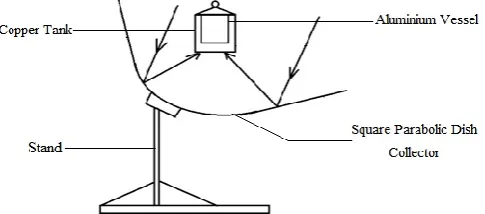
[image:1.595.313.556.579.686.2]The experimental set up is as shown in the Fig-1. It consists of parabolic dish collector, copper tank, aluminium vessel, manual tracking mechanism, thermocouples and temperature indicating device etc.
Fig -1: Experimental setup of solar cooker
Aluminium anodized parabolic dish collector having aperture area of 1.6m2 with focal length of 400mm is used as solar
© 2017, IRJET | Impact Factor value: 5.181 | ISO 9001:2008 Certified Journal | Page 1565 is main cooking vessel in which cooking is carried out. This
vessel is inserted into the copper tank in such a way that it remains continuously in contact with heating fluid. Aluminium vessel has 0.20m diameter and 0.10m height. The simple nut and bolt arrangement is used as tracking mechanism. When the shadow of upper nut is exactly falling on the bottom nut, then rays are perpendicular to face and all rays are concentrated at the bottom of the copper tank. Hence after every 10 or 15 minutes, the position of the collector is adjusted to bring it in correct position.
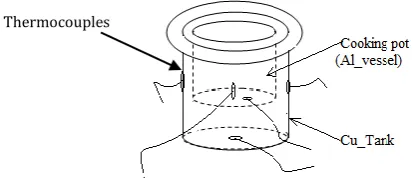
The temperature measurement is very important because it is necessary to examine heating condition of various surfaces (sides and bottom), food and heat transfer from oil for the analysis purpose. For this, K type thermocouples are used. Total eight thermocouples are installed in this setup for measuring the variation of temperature across the system. Out of these thermocouples, five thermocouples are mounted on outer surface of Cu tank and one is at bottom surface of Al vessel as shown in Fig-2. Remaining two thermocouples are used for measuring the temperature of oil and food during the experimentation.
[image:2.595.43.250.373.462.2]
Fig -2: Details of cooking pan and position of thermocouples
1.2 Testing Methodology
The experimental testing of the solar cooker was conducted at the host institute. The experiment was conducted in the month of January 2016 to evaluate the thermal efficiency of solar cooker. 4.5 kg heating fluid (soyabean oil) was filled into the thermal storage tank. Cooking vessel was placed into thermal storage tank in such a way that the surface of the cooking vessel comes in contact with heating oil. All the elements of present system are assembled as shown in Fig-1 and provided with solar insolation. Half kg rice with 1 litre of water is filled into the cooking vessel. The experiment was started at 11:10 hrs. During testing, K-type thermocouples were used to measure the temperature at different points, such as the heating fluid temperature, surface temperature of thermal tank, cooking fluid temperature and ambient temperature. The mass of the food material was measured after food gets cooked.
3. PERFORMANCE OF SOLAR COOKER
Initial temperature of oil, food and ambient temperature were recorded as 310C, 290C and 320C respectively. The
variation of solar insolation, ambient temperature, food
temperature, oil temperature, surface temperature of copper tank and top surface temperature of aluminum vessel were noted at 15 minutes time interval.
Thermal performance of system depends upon the input total incident energy, heat utilized for cooking and heat absorbed by the oil. Following methodology is used for data reduction. Total input incident energy to absorber can be determined by[9]
………..……… (1)
And energy output i.e. energy utilized for the cooking is given by [7],
………..……… (2)
Similarly un-utilized energy i.e. heat stored into the heating oil is calculated by following equation
... (3) The energy efficiency of the solar cooker can be defined as the ratio of the energy gained by the solar cooker (energy utilized for the cooking) to incident energy[7]
………..……… (4)
Expression for the available energy flux, which is widely used, can be followed to calculate the exergy of solar radiation as the exergy input to the solar cooker [10, 11]
……….……. (5)
Where, Ta is the ambient temperature (K). Although the surface temperature of the sun (Ts) can be varied on the earth surface due to the spectral distribution, the value of 5800 K has been considered for Ts. The exergy gained by the solar cooker (exergy output) is given by [10,11]
……….………. (6)
The exergy efficiency of the solar cooker can be defined as the ratio of the exergy gained by the solar cooker (exergy output) to the exergy of the solar radiation (exergy input).
………. (7)
3.1 Calculation of heat losses
© 2017, IRJET | Impact Factor value: 5.181 | ISO 9001:2008 Certified Journal | Page 1566 heat losses from the sides of thermal tank and top of the
vessel. Heat loss by convection and radiation is given by [12]
………. (8)
Qrad. = Qrad,side + Qrad,top
………..……… (9) Therefore, total heat loss from absorber is
……… (10) The overall thermal efficiency is determined by following equation [1]
……….. (11)
4. RESULTS AND DISCUSSION
1. The square parabolic concentrator solar cooker was tested and the results are thus presented. Chart-1 shows the variation in temperature of oil, food, average surface temperature of copper tank and aluminum plate with respect to time. From the chart-1 it is found that maximum temperature of oil, bottom surface temperature of cooking pot and food temperature are 1400C, 1360C and 940C
respectively at 14:10 hrs.
Chart -1: Variation of temperature and heat incident with
time
2. Chart-2 shows the variation of heat with respect to time. Heat losses found from the system are the convective and radiative heat losses, which are calculated by using equations (8), (9) and (10). The heat loss by convection depends upon coefficient of convection of air. The coefficient of convection is the function of velocity of air. During the experimentation average velocity of air was found to be 1.6 m/s. Hence the heat loss by the convection is more as compared to radiation, as of high temperature difference in surface of copper tank and ambient air. The chart-2 shows
that the rate of heat stored in the oil is initially more but it decreases with time because the rate of heat stored in the oil depends upon the temperature difference i.e. change in temperature of oil. It is found that initially the heat stored in the oil is at a faster rate due to large temperature difference of the oil and bottom surface of copper tank but it decreases with increase in temperature of oil.
Chart -2: Variation of heat with respect to time
3. The heat transfer to the food from the solar concentrator is through the bottom surface of copper tank, oil and aluminum vessel. It means that there are convective and conductive thermal resistances of oil, Al and Cu metal respectively. Hence the change in temperature of food is very slow. From equation (2) and equation (6), it is clear that the efficiency of energy and exergy depends upon the change in temperature of the food. Hence chart-3 shows that the energy efficiency is high and it decreases with respect to time, but exergy is initially low and it increases with respective time.
Chart -3: Variation of efficiency with time
4. The thermal conductivity of thermic fluid seems to decrease with increase in temperature of the fluid and heat transfer coefficient increases with respect to temperature. 5. We have, thermal diffusivity α= k/ρ.Cp = 4.399 m2/sec.
The thermal diffusivity of thermic fluid decreases with increase in temperature difference of oil and hence the cooking time increases.
© 2017, IRJET | Impact Factor value: 5.181 | ISO 9001:2008 Certified Journal | Page 1567 solar radiation the rate of cooking is stable due to the
storage of heat into the oil during the higher intensity period. Thus uniform cooking is obtained.
7.
About 505 KJ of heat remains un-utilized by the use of thermic fluid which cannot be furthermore used to cook the food at 940C or more. So the use of thermic fluid for indirect
heating of food is disadvantageous for just to get uniform cooking. Uniform cooking may be attained by agitating the food or in other words over heating may be avoided by agitation.
5. CONCLUSION
From the experimentation it is found that the time required for cooking half kg of rice with 1 liter water is 3 hrs. The heat is transferred to the cooking rice by natural convection through the oil. The overall thermal efficiency of system is determined by using equation (11); it is found to be only 1.459%. Heat stored in the oil i.e. unutilized heat for the cooking, heat loss by convection and radiation are determined and they were found to be 43.254%, 37.921% and 15 % respectively.
NOMENCLATURE
Qincident Total input incident
energy to absorber W Qunutilised Un-utilized energy or
heat stored in to the oil W Qcooking Heat utilized for
cooking W
Qconv. Heat losses from the
absorber by convection
W
Qrad Heat losses from the
absorber by radiation W Qloss Total heat losses from
the absorber W
Energy efficiency % Exergy efficiency %
Exergy input W
Exergy output W
T Time required for
cooking min.
Ib Solar insolation W/m2
Insolation falling on
cooker aperture W/m
2
Ts Solar temperature K
Ratio of food
temperature -
Surface temperature of thermal tank
0C
Surface temperature top Al plate
0C
Ambient temperature 0C
Asc Aperture area of
collector 1.6 m
2
Side surface area of
thermal tank 0.16 m
2
At Top surface area of Al
plate 0.038m
2
Emissivity of collector
dish material 0.55
Emissivity of material
of thermal tank 0.570 Emissivity of material
of top surface 0.090
Change in food temperature
0C
Total time required to
cooking food sec
Change in oil temperature
0C
Time interval sec
Difference in
temperature between hot tank and ambient
0C
Difference in
temperature between top surface and ambient
0C
Cpoil Specific heat capacity
of oil 1.97 KJ/Kg.K
Cpf Specific heat capacity
of food 1.3925 KJ/Kg.K
Mf Mass of cooked food 0.5 Kg
Moil Mass of oil 4.5 Kg
V Average Velocity of air 1.6 m/s2
Constant 5.67 10-8
W/m2 K4
REFERENCES
[1] El-Sebaii, A.A. and Ibrahim, A., 2005, Experimental
testing of a box solar cooker using the standard procedure of cooking power, Renewable energy. 30: 1861-1871.
[2] Dasin, D.Y, Habou D and Rikoto, I.I., 2011, Performance
evaluation of parabolic solar concentrator against international standard procedure in the tropical Environment. Nigerian Journal of Renewable Energy, 15, 20-28.
[3] Elamin,O. M., Akoy, Abdalla, I. A. and Ahmed 2015,
© 2017, IRJET | Impact Factor value: 5.181 | ISO 9001:2008 Certified Journal | Page 1568
[4] Gavisiddesha , Revankar , P. P. and Gorawar M. B.,
Evaluation of Thermal Performance of Paraboloid Concentrator Solar Cooker, International Journal Of Innovative Research In Technology & Science .Volume 1, Number 3.
[5] Nahar N., 2003, Performance and testing of hot box
storage solar cooker. Energy Conservation and Management, 44, 1323-1331.
[6] Murty, V.V., Gupta, A. et. al, September 2007, Evaluation
of thermal performance of heat exchanger unit for parabolic solar cooker for off place cooking, Indian journal of pure and applied physics. Vol. 45, pp. 745-748.
[7] Sonage, B. K., Gavali S., et. Al, 2015, Analysis of parabolic
concentrator type solar cooker by using heat storing materials, Dissertation report.
[8] Fryer, P. J., Robbins, P. T., 2004, Heat transfer in food
processing: ensuring product quality and safety, Applied Thermal Engineering. 25 (2005) 2499–2510.
[9] Ashok k., Sudhir, C.V.2009, Proposal for new world
standard for testing solar cookers, Journal of engineering science and technology. vol. 4, no. 3, 272 – 281.
[10] Petela, R., 2003, Exergy of undiluted thermal radiation,
Solar Energy, 74, 469-488.
[11] Petela, R., 2010, Engineering Thermodynamics of
Thermal Radiation for Solar Power Utilization, McGraw-Hill, New York.
[12] Yahya, D. D., 2013, Experimental investigations of heat
losses from a parabolic concentrator solar cooker, African Journal of Engineering Research Vol. 1(3), pp. 90-96.
BIOGRAPHIES
Mr. Karande P.D.
M.E. (Thermal Engg.) MISHMT
Research Interests – Solar Energy, Radiation, Convection, Renewable Energy Sources, Engineering Agricultural Applications, PCM, CFD, Fluid Mechanics, Nano Technology.
Siddharaj V. Kumbhar,
M.E. (Thermal Engg.), B.E. (Mechanical Engg.) AMIE, MISHMT, MSESI
Research Interests – Heat Transfer, Nanotechnology, CFD, Industrial Furnaces, Industrial Insulations, Cold Storage – Design, Development and Installation, Air Conditioning Systems, Design of Thermal Systems, Solar Energy, Refrigeration, Fluid Mechanics.
Basgonda K. Sonage,
PhD., M.E. (Heat Power Engg.) MIE, MISTE