© 2017, IRJET | Impact Factor value: 5.181 | ISO 9001:2008 Certified Journal | Page 1811
Image Quilting in Steganography using Reversible
Texture Formation
Prasad Tanaji Satpute
1, Prof. Deipali Gore
21
Student, Dept. of Computer Engineering, PES Modern College of Engineering Pune, Maharashtra, India
2Professor, Dept. of Computer Engineering, PES Modern College of Engineering Pune, Maharashtra, India
---***---Abstract -
It is an exclusive method or approach for asteganography, which is used for communication or sharing the private data with the help of multimedia carriers. There are many stenographic approaches available. The main goal of using stenography is to hide the data or secret data from the striker. This paper explains steganography in texture image. Texture formation or syntheses is a process in which we are first taking large texture image from a smaller texture image, we then merge texture synthesis image with steganography data to embed secret message and generate arbitrary size image and by using Image Quilting we can enhance the quality of the image and a simple image-based method of generating novel visual appearance in which a new image is synthesized by stitching together small patches of existing images. We call this process image quilting. First, we use quilting as a fast and very simple texture synthesis algorithm which produces surprisingly good results for a wide range of textures. Second, we extend the algorithm to perform texture transfer rendering an object with a texture taken from a different object. More generally, we demonstrate how an image can be re-rendered in the style of a different image. The method works directly on the images and does not require 3D information.
Key Words
: Steganography, Texture image, Data
embedding, Texture synthesis, Image Quilting.
1.
INTRODUCTION
Steganography is a method which is use for hiding a message, video, image, and file within another file, image, video or message. This word steganography is a combination of two Greek words steganos means protection and grapheins means writing. Benefit of steganography on cryptography is that the secret message does not attack the attention of the attackers by simple observation.
The cryptography protects only the content of the message, while steganography protects the both messages and communication environment. In most of the image stenographic methods, uses the existing image as their cover medium. This leads to two drawbacks. Since the size of the cover image is fixed, embedding a large secret message will results in the distortion of the image. Thus a compromise should be made between the size of the image and the embedding capacity to improve the quality of the cover image. The distortion of the image results in second drawback, because it is feasible that a steganalytic algorithm
can defeat the image steganography and thus reveal that a hidden message is conveyed in a stego image.
This paper propose a good approach for steganography using reversible texture synthesis based on edge adaptive and tree based parity check to improve the embedding capacity. A texture synthesis process is of creating a big digital image with a similar local appearance of the original image and has an arbitrary size. And the paper is also using another two methods named edge adaptive and tree based parity check to improve the embedding capacity. In this paper steganography fabricates the texture synthesis procedure into secret message as well as the source texture. In particular, this procedure can be used on existing cove image to hide message. This algorithm uses process called as texture synthesis, in which secret message is embedded into the input source texture image. With the help of this process we can separate input source texture and secret message. The proposed approach offers three advantages. First, since the texture synthesis can synthesize an arbitrary size of texture images.
Until the Human Visual System (HVS) is less effictive to changes in sharp regions compared to smooth regions, edge adaptive methods has been proposed to find the edge regions and hence improve the quality of the stego image as well as improve the embedding capacity and TBPC to hide the secret data into the cover image. Secondly, a steganalytic algorithm is not to defeat the steganographic approach since the texture image is composed of a source texture rather than by changing the existing image contents. Third, the reversible capability used in the project results in the recovery of the source texture so that the same texture can be used for the second round of message redirect.
2. REVIEW OF LITERATURE
2.1 Line-Based Cubism-like Approach
Currently, most popular theme is dynamic generation of art images which is creating images automatically. This type of methods produces an interest in computer operator[2]. Line based cubism, explains the algorithm known as stroke based rendering. This method is involuntary use to make the non-photo realistic type of imagery, and also uses the paintstroke and strippers methods to generate art images.
© 2017, IRJET | Impact Factor value: 5.181 | ISO 9001:2008 Certified Journal | Page 1812
art images, but mosaic image is one of the automaticgenerating art images, now the ting to arrange the tiles which belongs to the mosaic image, there is various type of arrangement available to create dynamic mosaic images. One of the methods is the stationary pattern method, but in this paper writer explains the arrangement of tittle by placing or by ordering the edges of input images.
This method generate the asphyxiate type of image. By using this method we can generate smooth image. When we try to paint the source images by using cubism method then that method is called cubism like line based method, and after this step there are other functions also ie. a) Extraction with help of prominent line. b) Extraction and recoloring of the tiles.
Fig -1:Diagram for Line-Based and Cubism-based approach
2.2
Markov Random Field (MRF) Method
This paper explains different type of duckbill algorithm with various texture formations. While implementing this algorithm, first the input will be any noise images and size can be change as per the user requirement. To make the sight duckbill image, this method or algorithm requires changes in dynamic nose image. This method requires sample of texture formation patches then it suit obsequious and sample to use. This method requires large time to create new texture and shape of a sample image. In this algorithm there are two main and large pillars, first is search algorithm and other is the multi-resolution pyramid. Benefit of using this method or algorithm is to increases the speed of image processing with help of image quality:
This type of method gives many benefits like better quality of the synthesized texture image with respect to the existing techniques, it also increases the image processing speed twice and generate better order of magnitude as
compare to existing results of the system. This method permits us to implement this system in application where synthesis texture is a very exclusive method. This procedure also inherits image editing and motion texture synthesis.
This procedure implements MRF method for generating texture models, since its verified that Markov Random Field is beneficial to remove the extensive type of texture forms. It does also improve the texture synthesis method to shun sampling. The Markov Random Field method uses every pixel categorized by its sets of surrounding pixels, and this method is same for every pixel in the image. While implementing MRF there are some terms and condition:
We have to check that the input image is local or stationary if the input image is local or stationary. If the input image fix between the given window size then that pattern will looks similar, then that of image is considered as stationary image and if the every pixel is simple to analyze from set of neighbouring pixels and totally different from the other image ten that image is called as local image. As based on the above condition, this method synthesis new image having same appearance and texture patch. To show the same or similar image new texture is created pixel by pixel. In the probability distribution synthesis method is not explicit and also not completely deterministic. This procedure is capable of giving high efficiency with more accelerating features.
3. SYSTEM ARCHITECTURE / SYSTEM OVERVIEW
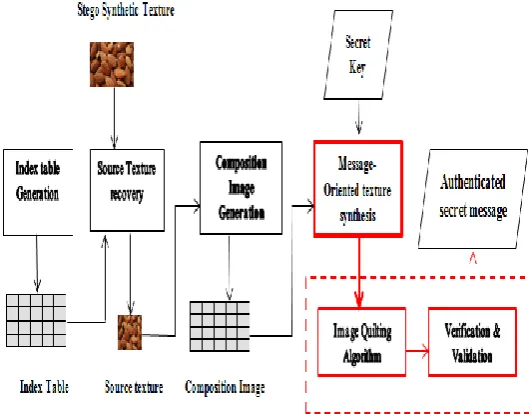
Fig -2:Architecture Diagram of the Texture Synthesis with Reversible procedure
[image:2.595.73.273.274.489.2] [image:2.595.318.583.446.653.2]© 2017, IRJET | Impact Factor value: 5.181 | ISO 9001:2008 Certified Journal | Page 1813
both steganography and texture synthesis process. Thewhole process comprises of two methods
Embedding message method
Message extraction method
This first method is use to separate input source image into dissimilar image block. Those chunks of images are called as patches. For recording thee location of those consistent source patches or original input patches we are taking help of index table generation method. There is also one unconditional image called as workbench, whose size is equal to the synthetic texture. And while recording the location of patches we are also allocating a patch ID. With the help of source patch ID which is been recorded into index table, we are again pasting those equivalent source patches on workbench; this procedure is called as composite image generation.
After doing the above procedure we have to find Mean square error (MSE) of those regions where the images are overlapped. Mostly overlapped areas are found between patch which we have insert into the workbench. And after that all the patches are rearranged as per the order of Mean square error (MSE). Finally the patch image is selected with respect to the given list in such a way that the patch rank is equal to the decimal value. This decimal value is also called as n- bit value of conceal or secret message.
At client location there is a creation of index table by using secrete key, that key client already have for every size of the input source texture we can also called as patch region and its equivalent order is directly mentioned in index table. After taking the block size manage a s per the equivalent order.
Authentication is the next step, where we are assuming the current location of workbench and equally the located of stego synthetic texture to analyses the block region of stego. This block region of stego is use to predict or to search the candidate list and to verify that is there any patch from candidate list having equal kernel region as the corresponding block region of stego. If such alike region of patches is originated, then the matched patch is given a rank. We can show the secrete bit value in a decimal value format. This above mentioned procedure is also called as extraction of message.
3.1 PROCESSING STEPS FOR THE SYSTEM
This reversible texture synthesis scheme has following steps:
1) Data collection (Consists any type of host medium), 2) Pre-processing (Index table generation, composition, message orientation)
3) Similar stego synthetic texture,
4) High-image quality (Image quilting, verification and validation)
1) Input Data Collection
All type of multimedia used for Reversible Texture Synthesis Systems are: Images (JPEG,GIF,PNG), Videos (MP4,MKV, FLV). Our main input which is given by user is a single Image as a query.
2) Index Table Generation
The first process is the index table generation where we produce an index table to record the location of the source patch set SP in the synthetic texture. The index table allows us to access the synthetic texture and retrieve the source texture completely.
3) Patch Composition Process
The second process of the algorithm is to paste the source patches into a workbench to produce a composition image. First, we establish a blank image as our workbench where the size of the workbench is equal to the synthetic texture. By referring to the source patches ID stored in the index table, we then paste the source patches into the workbench.
4) Message-oriented texture synthesis process
We will embed our secret message via the message oriented texture synthesis to produce the final stego synthetic texture.
5) Image Quilting
All these steps are applied on single query image. A simple image-based method of generating novel visual appearance in which a new image is synthesized by stitching together small patches of existing images. We call this process image quilting.
6) Output: Stego synthetic texture
After applying all the algorithms which are listed above, the output will be a Query image with same texture and embedd data into host medium
3.2 MATHEMATICAL MODEL
Let S be a system having Input (I), Functions(F) and Output(O).
S= { I; F;O }
Where, I is a set of all types of multimedia files. I = {Images; Videos / Kw * Kh } -–(1) O is the set of Steganography Texture Synthesis
O = { MKw *MKh } --–(2)
F is the set of functions used for steganography using Reversible Texture Synthesis.
© 2017, IRJET | Impact Factor value: 5.181 | ISO 9001:2008 Certified Journal | Page 1814
F1 is a function for Index Table Generation Input: Patch Image / Kw * Kh
Output: No. of patchs with Index values (TPn)
Functions: Where,
Tpw is the width dimensions of Index Table. Tph is the height dimensions of Index Table. F2 is a function for Patch Composition Process.
Input:Tpw _ Tph
Output:TPn � SPn
Function:
– EPn = TPn - SPn —–(4) Where,
EPn is the Embeddable patches in the setgo synthesis texture.
TPn is the No. of patches in the synthetic texture.
SPn is the No. of source patches sub divided in the source texture.
F3 is a function for Message-Oriented texture synthesis.
Input: TPn - SPn
Output: TC
Function:
– TC = BPP * EPn * Eij —–(5) Where,
TC is the Total Message embedding capacity Image Quilting Algorithm.
BPP is the Bit per Patch.
EPn is the No if embeddable patches in the stego synthetic texture.
Eij is the Minimum Error Boundary Cut.
3.3 THE IMAGE QUILTING ALGORITHM
The complete quilting algorithm is as follows:
Go through the image to be synthesized in raster scan order in steps of one block (minus the overlap).
For every location, search the input texture for a set of blocks that satisfy the overlap constraints (above and left) within some error tolerance. Randomly pick one such block.
Compute the error surface between the newly chosen block and the old blocks at the overlap region. Find the minimum cost path along this surface and make that the boundary of the new block. Paste the block onto the texture. Repeat. The size of the block is the only parameter controlled by the user and it depends on the properties of a given texture; the block must be big enough to capture the relevant structures in the texture, but small enough so that the interaction between these structures is left up to the algorithm. In all of our experiments the width of the overlap edge (on one side) was 1/6 of the size of the block. The error was computed using the L2 norm on pixel values. The error tolerance was
set to be within 0.1 times the error of the best matching block.
4. SYSTEM ANALYSIS
4.1 DataSet
First stored the admin face image into the database. Then create a training set of face images. The Capture images are the training set. It contains no. of images (M) for each person.
Data is in the form of .jpg format
Size of image : 0-10 KB
4.2 Hardware
1) Memory: 8GB
2) Processor: Intel (R) Pentium (R) CPU B950 @2.10 GHz
3) Hard disk: 64 GB
4.3 Software
1) Operating System: CentOs 2) Eclipse 4.2.2 and above
D. Performance Parameters
There are several mechanisms to determine or to analyze the image quality of the stego texture synthetic. In this paper we are using the following type of algorithm to define the performance parameters-
1) Mean squared error of the overlapped (MSEO) 2) Pearson Product Moment Correlation(PPMC) 3) Structural SIMilarity (SSIM)
4. RESULT
© 2017, IRJET | Impact Factor value: 5.181 | ISO 9001:2008 Certified Journal | Page 1815
The maximal capacity provided by our algorithm is 34398bits.
Capacity PURE 4 BPP 5 BPP 8 BPP 10 BPP 192*193 1562 1680 1557 1680 1541
96*96 141 141 141 141 136
128*128 385 402 385 402 385
TABLE : COMPUTING TIME (SECOND).
Chart -1:Stegnography Performance and Error Correction
The computing times of are shown in Table I. The range of the computing time is 6.8 percentage to 8.7 percentage more than that needed for pure texture synthesis. Nevertheless, our algorithm is flexible enough to provide a different embedding capacity by simply altering the patch size, satisfying the desirable capacity or texture quality demanded by users. Also, our algorithm can retrieve the source texture, making possible the second round of message embedding using the recovered source texture.
Algorithms Rope Net Metal Peanuts Ganache MSEO 1565.3 1391.1 1236.9 556.2 PPMC 0.9991 0.9984 0.9974 0.9955
SSIM 0.28 0.26 0.07 0.15
TABLE : Algorithm Parameters For Image Quality Dataset
Chart -2:Parameters Measurement for image quality dataset
We use several mechanisms to determine the image quality of the stego synthetic texture. We define the first measurement, which is called the mean squared error of the overlapped area (MSEO) to determine the image quality of the synthetic results. MSEO reflects the similarity between the candidate patch and the synthesized area where we will specifically operate image quilting technique during the message-oriented texture synthesis process. Consequently, the MSEO has a nonzero value even in the case of the pure patch-based texture synthesis. If the MSEO produces a small value, it implies that the synthetic texture shows a high image quality of the overlapped area.
The second scheme we adopt for measuring the image quality is the Pearson Product Moment Correlation (PPMC). It is employed as a measure of how well two variables are related. The Pearson coefficient values that this scheme produces are between 1 and -1. A result of 1 means that there is a perfect positive correlation between the two variables, while a result between 0.5 and 1.0 represents a high correlation.
Next, we employ the SSIM (Structural SIMilarity) index to quantify the similarity between the pure and stego synthetic textures. The SSIM is an image quality assessment method for measuring the change in luminance, contrast, and structure in an image. The SSIM index is in the range of [-1, 1] and when it equals to 1, the two images are identical.
5. CONCLUSIONS
© 2017, IRJET | Impact Factor value: 5.181 | ISO 9001:2008 Certified Journal | Page 1816
same data multiple time then this will be a drawback.Therefore this approach proposed have additional and more advantages capabilities like reversibility to extract the original image from given stenographic texture. We can also use this whole procedure on a single source image many time. The original image recovery is possible by using the above approach.
ACKNOWLEDGEMENT
Reversible Texture Formation and Image Quilting Using Steganography has been a wonderful subject to research upon, which leads one’s mind to explore new heights in the field of Computer Engineering. I dedicate all my dissertation works to my esteemed guide, Prof. Deipali Gore, whose interest and guidance helped me to complete the work successfully. I express my immense pleasure and thankfulness to all the teachers and staff of the department of Computer Engineering, P.E.S Modern College of Engineering, Shivajinagar, Pune -05 for their co-operation and support. Last but not the least, I thank all others, and especially my friends who in one way or another helped me in the successful completion of this dissertation.
REFERENCES
1) Kuo-Chen Wu and Chung-Ming Wang, Steganography Using Reversible Texture Synthesis, IEEE Transactions on image processing vol: 24 NO: 1 YEAR 2015
2) N. Provos and P. Honeyman, Hide and seek : an introduction to steganography, Security Privacy, IEEE, vol. 1, no. 3, pp. 32-44, 2003.
3) F. A. P. Petitcolas, R. J. Anderson, and M. G. Kuhn, Information hiding-a survey, Proceedings of the IEEE, vol. 87, no. 7, pp. 1062-1078, 1999.
4) S.-C. Liu and W.-H. Tsai, Line-based cubism-like image - A new type of art image and its application to lossless data hiding, IEEE Trans. Inf. Forensics Security, vol. 7, no. 5, pp. 1448-1458, 2012. 5) C. Dragoi and D. Coltuc, Local-prediction-based
difference expansion reversible watermarking, IEEE Trans. Image Process., vol. 23, no. 4, pp. 1779-1790, 2014.
6) J. Fridrich, M. Goljan, and R. Du, Detecting LSB steganography in color, and gray-scale images, MultiMedia, IEEE, vol. 8, no. 4, pp. 22-28, 2001. 7) N. F. Johnson and S. Jajodia, Exploring
steganography: Seeing the unseen, Computer, vol. 31, no. 2, pp. 26-34, 1998.
8) Y.-M. Cheng and C.-M. Wang, A high-capacity steganographic approach for 3D polygonal meshes, The Visual Computer, vol. 22, no. 9, pp. 845-855, 2006. [5]
9) Y. Guo, G. Zhao, Z. Zhou, and M. Pietikinen, Video texture synthesis with multi-frame LBP-TOP and
diffeomorphic growth model, IEEE Trans. Image Process., vol. 22, no. 10, pp. 3879-3891, 2013. 10)L.-Y. Wei and M. Levoy, Fast texture synthesis using
tree-structured vector quantization, in Proc. of the 27th Annual Conference on Computer Graphics and Interactive Techniques, 2000, pp. 479-488. A. A. Efros and T. K. Leung, Texture synthesis by non-parametric sampling, in Proc. of the Seventh IEEE International Conference on