Research on Interference Coordination and Resource
Allocation Algorithm in D2D Communication Systems
Yanhua Song
1,
Jinjing Wan
2(1.Chongqing Key Lab of Mobile Communications Technology,Chongqing University of Post and Communications(CQUPT)
Chongqing 400065;)
Abstract:D2D in the cellular network (Device-to-Device,
Terminal pass through) technology can improve spectrum
efficiency of resource utilization, but due to D2D reuse
resources of cellular subscribers will cause co-channel
interference with D2D user. Reducing interference and
improving system performance, a better allocation of resources
become the focus of recent studies. In order to suppress this
interference, presents a resource allocation scheme based on
fairness, using weights value to represent the user's priorities
and resource allocation, improve the fairness of the system, aim
to improve system throughput. Finally, simulation analysis
shows that, the programme can effectively improve the fairness
of the system, it also well enhance the throughput of the
system.
Key words:D2D, allocation of resources, fairness,throughput;
1
Introduction
With the advent of the Internet age, people began to seek
higher rates of mobile data services, the limited spectrum
resource has been unable to meet the growing needs of the
business, mobile spectrum shortages facing serious challenge,
the spectrum of scientific and rational resource allocation
scheme has been the focus of the next generation of mobile
communication studies. D2D communication technology is a
new technology that allows the end user to communicate
directly with the shared cell spectrum resources under the
control of the cellular system, It can improve the frequency
spectrum utilization rate, increase the capacity of
communication, reduce the load of the base station, etc.. In
addition, D2D communication technology can also reduce the
transmit power of the terminal user through power control ,
thereby ,improving the service life of the battery terminal.
When D2D communication in multiplexed mode, The
co-channel frequency interference will be generated between
the D2D communication link and the cellular communication
link in a cellular cell, how to supress the co-channel frequency
interference and improve the system throughput, reasonable
resource allocation scheme proposed in D2D communication is
particularly important. Literature [1] proposed a power control
based on dynamic mechanism to reduce interference and
improve the overall performance of cellular systems. Literature
[3] have come up with a probability based on interrupt and
model selection of combined control algorithm with improve
the overall performance of communication systems. Based on
the method of Literature [6], the paper proposes a method to
select the reuse of cellular users, and proposes a power control
scheme based on the distance between the D2D and the base
station. Literature [7] set the D2D communication of the SIR
threshold, set around the base station to prohibit D2D users
communication area. D2D users will not multiplexing
communication ban cellular users within the region, otherwise
the D2D receiving end of the received signal SIR (signal
interference ratio) does not meet the threshold requirements
and will not be able to normal communication, so as to improve
the performance of the communication system.. Literature [8]
allocate the resource to the D2D users at first, and then
according the allocation of D2D users in each RB to allocate
the resource to the cellular user. First allocate the resource to
cellular user, assigning resources to D2D, and then cellular
subscribers in proportional fair scheduling timeshare weight
value will change, so that the fairness of the system is reduced.
Two resource allocation strategies are proposed in the literature
[9] ,D2D users fairness policy and cellular user fairness policy
to improve the fairness of the system. Although the literature
[8-9] improves the system fairness, the throughput of the
system is not very high. Considered in the literature are single
cell users, this paper will consider multi-cell user scenarios, and
combined with the status of current research D2D cellular users,
on the basis of literature [8] proposed scheduling fairness based
resource allocation scheme. Finally, simulation analysis shows
that compared with [8], the proposed algorithm has a great
improvement in fairness and throughput.
ISSN 2348 – 7968
1
D2D communication model in LTE
system model
1.1 System Model
As shown in figure 1 is a seven-cell cellular model, each
district is divided into the area of the edge and center regions,
and assign different frequency band resources.The central area
of allocation bands F1, three edge of the adjacent area
allocation band orthogonal F2, F3, F4, thus avoiding the same
frequency interference between adjacent neighborhood.
F1
F1 F1
F2 F4F3 eNB
A
B
C
F1
F2
F3
F4
Central region
A cell edge
B cell edge C cell
edge
Available frequency band
Figure 1 Seven cell model of D2D communication
As shown in figure 2 is a multi-cell environment, Assume
cell A as the target user area, In cell A randomly distributed m
cellular users and n D2D users, in which the cellular user is set
as C={1,2…m},d2d user is set as D={1,2…n}, for the base
station, all cellular users of the location coordinates are known. In the figure 1, A circular area with radius
1
r
is the basestation communication Prohibited Area, A circular area with
radius
2
r
is the reuse prohibited area for D2D users, A circular area with radius r3 is the base station traffic prohibited areaWhen d2d other regions when a user is in the base station
communication prohibited area where cellular users can reuse
the region.
Assume that all fading channel gain exponential
distribution and the path loss model:
r s
P
=
cP d
−αWhere
s
p
andr
p
respectively means that the transmitterpower and transmitter signals received from the transmitter
power,
c
andα
respectively on behalf of the path loss constant and the path loss exponent.BS r1
r2
r3
A
D2D interfere
Figure 2 multiple - cell system model
1.2 Problem description
As shown in Figure 2, when a pair of D2D users reuse the
cellular user’s spectrum resources will inevitably make the
same frequency interference with cellular users. At this point,
the weight of the cellular system is bound to be affected, so the
fairness of the original cellular system will be destroyed by the
D2D of the cellular user resources.
In the literature [10], the formula for the weight value of
the cellular system scheduling is
c c
i i
i
r R
ω
=(1.1)
Where c i
ω
is the user i in resource block thecorresponding weighted value, the higher the weight value,
then the user I the larger the priority assigned to the resource.
In (1.1), c i
r represents the cellular subscribers in an
instantaneous data rate in the resource block, The average data
rate of Ri to indicate that the user i, The computation of c i
r
the is obtained by the SINR of the user I reference signal on the
resource block The programme first assign the resource to
cellular users, and then select candidates that meet the criteria
for D2D users’ cellular users and reuse its resources to weight
values it at the same time less impact on the user as a priority in
order to ensure the fairness of the system.
1.3 Resource allocation scheme based on Fairness
The proposed scheme is based on the literature [8], which
is based on the minimum damage to the cellular user's weight
ISSN 2348 – 7968
programs are shown in figure 3:
为D2D对选择满足阈值条件的可
复用资源作为候选蜂窝用户
以对蜂窝用户调度权重值破坏最小为优先
的原则将合适的资源分配给D2D用户
D2D通信的区域限制
Fig. 3 flow chart of D2D communication resource
allocation
Step 1: Choose the celluar users that can meet the conditions of
D2D as potential candidate the cellular users
If the cellular user i can be reuse by D2D users j , it must
also meet the QoS of cellular user i and D2D users j , that is,
meet the following conditions:
0 i ie
i cth
j je
p g
p g
N
g
= ≥g
+
(1.2)
0
j j
j dth
j ij
p g
p g
N
g
= ≥g
+
(1.3)
max
i c
p
≤p
(1.4)max
j d
p
≤p
(1.5)(1.2) and (1.3) requires a cellular user i and D2D users j
meet the minimum SINR threshold that can make communicate
properly, (1.4) and (1.5) provides for maximum transmitting
power threshold of their communications,In the above
equation,
i
p
andj
p
are
respectively represent the transmissionpower of the celluar user i and the D2D users j,
g
ieandje
g
represent the channel gain between the subscribers of cellular
user i and D2D users j to the eNB channel gain,respectively.
g
ijis channel gain between the subscribers of celluar user i and
D2D users j channel gain,
j
g
is the channel gain of D2D usersj,
r
cth Andr
dthrepresent the lowest SINR threshold ofcellular users and D2D User Communication.Set
s
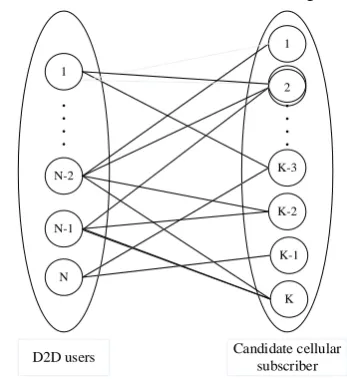
i as thecollection of candidate cellular usersAs shown in figure 4,For
the D2D and candidate cellular users matching example.
1
N-2
N-1
N
1
2
K-2
K-1
K K-3
D2D users Candidate cellular subscriber
Figure 4 D2D users and candidate cellular users
matching examples
Step 2 : D2D limited traffic area
(1) Restrictions on the area of communication for the base
station
When the distance between D2D and base station is too
close, it will cause greater interference to the base station, in
order to ensure the quality of cellular communication links, it
should be limited interference of eNB and D2D communication
within a certain range. Assume that the noise threshold values
for eNB is
c
η
,there is, 0
d e
N
cI
≤η
(1.6)Where
I
d e, is the interference of D2D-Tx to eNB.1 , max
( )
1d e
p g
d jep
d cI
= × = × ×r
−α (1.7)Take the formula (1.7) into (1.6) will get
1 1 [(
p
dmax c) ( cN
0)]r
= ×η
× −α (1.8)Known by (1.8) that the communications prohibited area
of eNB cares that the the largest transmission power of D2D-Tx
max
d
p and pass loss index α1.
This communication forbidden area is also called the eNB
interference limited area., that is, That is, when the D2D is
located in the interference limited area, ENB interference will
be greater than the threshold value
c
η
.If D2D is outside of theinterference -limited areas, The interference of D2D to eNB
ISSN 2348 – 7968
the cellular communication. Based on the actual situation,
eNB's position is fixed, which means that the transmitter should
be located in that take the eNB as the center, outside the circle
with a radius of
r
1.(2) Restriction of the D2D multiplexing prohibited area
D2D users will be subject to very serious interference if
they are reused by D2D users in a relatively close range,in In
order to guarantee the communication quality of D2D users, the SIR of D2D-Rx should be limited
d
η
.Assuming that D2D-Rx is in the worst case of interference,
at this point, all cellular users who use m cellular users of the
same uplink resources are located on the circumference of the
radius
r
2,there ismax 0
c
N
dI
≤η
(1.9)Among them,
max
c
I
refers to Maximum interference ofcellular networks to D2D-Rx, Assume that cellular users use
maximum transmit power
p
cmax ,and there is2 max max ( 2)
c M
p
c cI
= × × ×r
−α (1.10)Where
2
α
is the path loss exponent of cellular subscribers and D2D-Rx. By the formula (1.9) and (1.10) theD2D multiplexing forbidden region range is obtained.
2 0 2
max
( d )
c
M c
N
r
P
α
η
× −=
× ×
(1.11)
We can get the D2D multiplexing prohibited area which is
a circular area that take D2D-Tx as the center and the radius is
2
r
,That is, D2D users can only reuse the uplink resources ofcellular users located outside the circle, at this time, the
D2D-Rx’s SIR is lower than the interference threshold value,
so as to ensure the quality of D2D communication.
Step 3 : Allocation of resources in order to minimize the
priority of scheduling weight values for cellular users
In order to ensure the fairness of the cellular system,
resource priority is assigned to the D2D communication which
is the minimum of damage to the weight value.
According to the cellular user scheduling weights
mentioned above , there are,
For cellular users I, when no d2d users reuse its resources,
When there are no D2D users reuse their resources, the
scheduling weights is
i i
i
R
R
ω
=Where
i
R
is the instantaneous rate at a certain time, iR
is average rate.
If the D2D users j reuse the resource of cellular user i ,the
scheduling weight value will be changed to
ij ij
i
R
R
ω
=,
Of these,
2 0
(1 )
log
i iei
p g
R
= +N
2
0
(1 )
log
i ieij
j ie
p g
R
p g
N
= +
+
The change of the weight value of the D2D user is
ij i ij
ω ω ω
∗= −
arg
min
i i
j ij
s
ω
∈
′ = ∗
If the cell contains a number of D2D users, there may be
a cellular user exists at the same time in a number of D2D users
of the candidate cell collection, at this time based on the
fairness of the selection of cellular users algorithm is as
follows:
,
min
i
ij ij i∈
s
j D∈x
ω
∗
∑
1,
ij ij
D
x
≤ ∀ ∈
∑
1,
ij i
j
i
x
≤ ∀ ∈s
∑
{
0,1 ,
}
,
ij
j
D
i
ix
=
∀ ∈ ∀ ∈
s
Among them,
s
iis a candidate cellular user for D2D users,D is a collection of all D2D pairs, Where
x
ij is atwo-dimensional distribution matrix
ij M N
H
x
×
= , when the
D2D users j multiplexing cellular users i ,B is 1, otherwise 0.
Resource allocation of specific steps are as follows :
1. First, according to the formula to calculate the change
of each pair of candidate cell weight value, and according to
ISSN 2348 – 7968
them into the collection S.
2. Check whether the set s is the empty set, in the case of
the empty set, the ending, if not for the empty set, then
allocated in the order of elements in the set s.
3. If cellular D2D user i and j have been assigned, then
removes it from the collection s cellular subscribers value. If
not assigned, the collection s cellular user i in the order
assigned to the D2D j, and removes it from the s, until the end
of the set s is the empty set.
4. When the D2D users j is assigned to cellular user i,
separately testing whether the cellular users and D2D users
meet their QoS performance , if not satisfied, it won’t allow the
D2D user j multiplexing the resource of cellular user i,if
meet ,you can reuse.
1.4 Based on D2D user location select reuse area
In the preamble, it calculate the region of the eNB
communication prohibit and protection respectively, D2D
reuse prohibited area, and according to D2D user’s location
information to discuss the resource allocation scheme for D2D
communication.The radius of the central region of this paper is
1
r
, which is the central region and the region of eNB prohibitand protection communication overlap.
Determination of the Edge users:
Difference based on RSRP: Assuming the D2D user i is
located in the edge of a cell A, and adjacent to cell B,according
to the feedback of RSRP measurement report from user i ,
The main service area judge whether the difference between the
received signal power from the A and B is less than a certain
threshold, if the user I receive power to meet
( )
A B dB
RSRP
−RSRP
<dThen determine the user i as the edge users, if not meet
the above conditions, then determine the D2D user is not a
marginal user.
(1) when D2D the user is located at the edge area, D2D
users can reuse within the community except D2D reuse
prohibited areas of the region.
(2) When the D2D users in the center zone, adjacent to the
cell is as cell cooperation in Regional Center for D2D users
provide reusable resources. At the same time, D2D users can
reuse region is to base station as the center, the adjacent cells
within a circle of radius (except for the district) cellular
subscribers to
r
3 .According to the resource allocation scheme in this paper,
the mathematical model of the cellular system throughput can
be got by the Shannon formula:
2 2
1 1 1 1
0 0
max
log
(1 )log
(1 )M N M N
j j i ie
ij
i j i j
j ie i ij
ij
p g
p g
x
p g
x
p g
N
N
= = = =
+ + +
+ +
∑∑
∑∑
1,
ij ij
D
x
≤ ∀ ∈
∑
1,
ij i
j
i
x
≤ ∀ ∈
s
∑
{
0,1 ,
}
,
ij
j
D
i
ix
=
∀ ∈ ∀ ∈
s
2
.The simulation results
2.1
Simulation parameters
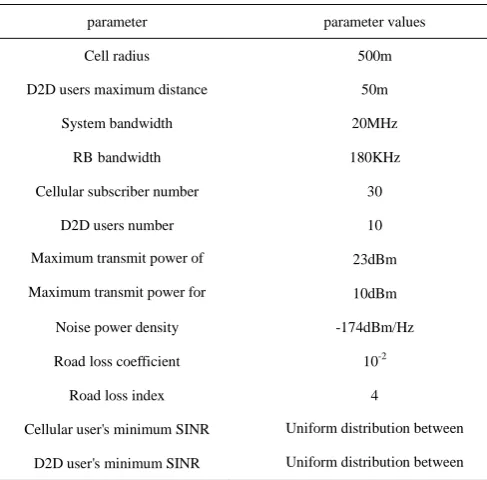
In order to verify the performance of the proposed
resource allocation scheme, taking into account in LTE cellular
system with multi-cell scenario, the system simulation using
Matlab. Main simulation parameters are set as follows:
Table 1. Main parameters of the simulation
parameter parameter values
Cell radius 500m
D2D users maximum distance 50m
System bandwidth 20MHz
RBbandwidth 180KHz
Cellular subscriber number 30
D2D users number 10
Maximum transmit power of 23dBm
Maximum transmit power for 10dBm
Noise power density -174dBm/Hz
Road loss coefficient 10-2
Road loss index 4
Cellular user's minimum SINR Uniform distribution between
D2D user's minimum SINR Uniform distribution between
2.2 The simulation results
ISSN 2348 – 7968
0 50 100 150 200 250 300 350 400 7
7.5 8 8.5
D2D communication reuse forbidden zone radius (m )
A
v
er
age s
pec
tr
al
ef
fi
c
ienc
y
(bi
t/
s
/H
z
)
no fair scheduling in document [8] Proposed fairness scheduling algorithm fairness scheduling in document [8] Proposed no fairness scheduling algorithm
Figure 5 Relationship between D2D forbidden region
radius and spectrum efficiency
As is shown in Fig 5 when D2D communication multiplex
prohibited zone radius is less than 150 meters, there is no
obvious change in the average spectral efficiency of the system,
more than this distance, with D2D communication restriction
zone radius increases the average spectral efficiency of the
system is also increasing. It can be seen that the throughput of
the whole communication system is affected by the radius limit
of communication multiplexing forbidden region. Therefore, it
is beneficial to the D2D communication reuse area restriction
in the cellular community. At the same time by Figure 5 can be
seen that the proposed algorithm is far superior to the system
spectral efficiency of the proposed algorithm in the literature
[8].
0 1 2 3 4 5 6 7 8 9 10 5.5
6 6.5 7 7.5 8 8.5
the number of D2D
A
v
er
age s
pec
tr
al
ef
fi
c
ienc
y
(bi
t/
s
/H
z
)
no fair scheduling in document [8] Proposed fairness scheduling algorithm fairness scheduling in document [8] Proposed no fairness scheduling algorithm
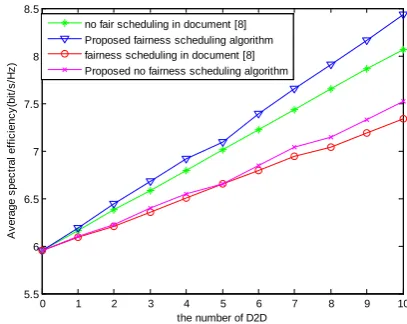
figure 6 the relationship between D2D users and spectral
efficiency
From Figure 6 shows, the average spectrum efficiency of
the cellular system with D2D users increase almost increasing
linearly, similarly, with the increase of D2D users that the
proposed scheme is superior to that of the literature [8] scheme,
especially in after joining the fair scheduling scheme
superiority becomes more significant. As compared to the
resource allocation algorithm in the literature [7] that the
proposed resource allocation algorithm in block based on fair
scheduling based on the multiplexing performance of D2D
users better resources for communication, so as to achieve the
purpose of improving the performance of the communication
Systems.
0 1 2 3 4 5 6 7 8 9 10 0.78
0.8 0.82 0.84 0.86 0.88 0.9 0.92 0.94 0.96
the number of D2D users
F
ai
rnes
s
f
ac
tor
no fair scheduling in document [8]. Proposed fairness scheduling algorithm fairness scheduling in document [8] Proposed no fairness scheduling algorithm
figure 7 The relationship between D2D users and fairness
factor
As can be seen from Figure 7, with the increase of D2D,
the fairness of the whole cellular system is gradually reduced.
This is because the increase in the number of D2D users, D2D
users are also increasing the number of celluar users of the
reuse, the entire cellular system will be a great change in the
weight value, the fair will be reduced. At this time, compared
with the proposed scheme, the system fairness of the proposed
scheme is significantly improved compared with the literature
[8]. This is because the resource allocation algorithm,
according to the value of fair scheduling in weight changes in
the size for D2D users chose to reuse meet the conditions of
cellular subscriber resource block and minimize multiplexing
cellular users before and after weight value variation, so as to
improve the fairness of the cellular system.
3.
Concluding remarks
D2D communication technology introduces LTE cell,
which can improve the system throughput and spectrum
efficiency, and save spectrum resources. But at the same time,
it will bring interference to the cellular system and reduce the
ISSN 2348 – 7968
algorithm is proposed to improve the fairness and spectrum
efficiency of the system, which can maximize the system
throughput. Simulation results show that the proposed scheme
can effectively improve the fairness and efficiency of the
system while guaranteeing the D2D of cellular users and QoS
users.
reference
[1] Gu J, Bae S J, Choi B G, et al. Dynamic power control
mechanism for interference coordination of device-to-device
communication in cellular networks[C]// Ubiquitous and Future
Networks (ICUFN), 2011 Third International Conference on.
IEEE, 2011:71-75.
[2] Lee N, Lin X, Andrews J G, et al. Power Control for
D2D Underlaid Cellular Networks: Modeling, Algorithms and
Analysis[J]. IEEE Journal on Selected Areas in
Communications, 2013, 33(1):1-13.
[3] Min H, Seo W, Lee J, et al. Reliability Improvement
Using Receive Mode Selection in the Device-to-Device Uplink
Period Underlaying Cellular Networks[J]. IEEE Transactions
on Wireless Communications, 2011, 10(2):413-418.
[4] Jung M, Hwang K, Choi S. Joint Mode Selection and
Power Allocation Scheme for Power-Efficient
Device-to-Device (D2D) Communication[C]// Vehicular
Technology Conference (VTC Spring), 2012 IEEE 75th. IEEE,
2012:1-5.
[5] Min H, Lee J, Park S, et al. Capacity Enhancement
Using an Interference Limited Area for Device-to-Device
Uplink Underlaying Cellular Networks[J]. Wireless
Communications IEEE Transactions on, 2011,
10(12):3995-4000.
[6]Ali S, Rajatheva N, Latva-aho M. Full Duplex
Devi-ce-to-Device Communication in Cellular Networks[C]//
Networks and Communications (EuCNC), 2014 European
Conference on, Bologna, Italy, 2014: 1-5.
[7]Hyunkee Min, Jemin Lee, Sungsoo Park, et al.
Capacity Enhancement Using an Interference Limited Area for
Device-to-Device Uplink Underlaying Cellular Networks[J].
Wireless Communications, IEEE Transactions on, 2011, 10(12):
3995-4000.
[8] Sun X M, Wang B, Wang W N, et al. A Scheme to
Improve Fairness in LTE Network with D2D
Communication[J]. Journal of Nanjing University of Posts &
Telecommunications, 2013.
[9] Nguyen P, Rao B. Throughput improvements for
cellular systems with device-to-device communications[C]//
Signals, Systems and Computers, 2013 Asilomar Conference
on. IEEE, 2013:1973-1977.
[10] Lee S B, Pefkianakis I, Meyerson A, et al.
Proportional Fair Frequency-Domain Packet Scheduling for
3GPP LTE Uplink[C]// INFOCOM 2009,IEEE. IEEE,
2009:2611-2615.