Enhanced diffusion and bound exciton
interactions of high density implanted
bismuth donors in silicon
Peach, T, Stockbridge, K, Li, J, Lourenco, MA, Homewood, KP, Hughes, MA,
Murdin, BN, Chick, S and Clowes, SK
http://dx.doi.org/10.1063/1.5115835
Title
Enhanced diffusion and bound exciton interactions of high density
implanted bismuth donors in silicon
Authors
Peach, T, Stockbridge, K, Li, J, Lourenco, MA, Homewood, KP, Hughes,
MA, Murdin, BN, Chick, S and Clowes, SK
Type
Article
URL
This version is available at: http://usir.salford.ac.uk/id/eprint/52021/
Published Date
2019
USIR is a digital collection of the research output of the University of Salford. Where copyright
permits, full text material held in the repository is made freely available online and can be read,
downloaded and copied for noncommercial private study or research purposes. Please check the
manuscript for any further copyright restrictions.
implanted bismuth donors in silicon
T. Peach,1K. Stockbridge,1 Juerong. Li,1K. P. Homewood,2, 3 M. A. Lourenco,2, 3 S. Chick,1 M. A. Hughes,1, 4 B. N. Murdin,1and S. K. Clowes1
1)Department of Physics, University of Surrey, Guildford, Surrey, GU2 7XH UK
2)Department of Electrical and Electronic Engineering, University of Surrey, Guildford, Surrey,
GU2 7XH UK
3)School of Materials Science & Engineering, Hubei University, Wuhan 430062 PR China
4)Joule Physics Laboratory, School of Computing Science and Engineering, University of Salford,
Salford M5 4WT UK
(Dated: 17 July 2019)
This study reports the effect of an increasing ion dose on both the electrical activation yield and characteristic properties of implanted bismuth donors in silicon. A strong dependence of implant fluence is observed on both the yield of bismuth donors and the measured impurity diffusion. This is such that higher ion concentrations result in both a decrease in activation and an enhancement in donor migration through interactions with mobile silicon lattice vacancies and interstitials. Furthermore, the effect of implant fluence on the properties of the Si:Bi donor bound exciton,D0X, is also explored using photoluminescence, PL, measurements. In the highest density sample, centers corresponding to the PL of bismuthD0Xs within both the high density region and the lower concentration diffused tail of the implanted donor profile are identifiable.
Bismuth donors in silicon are promising candidates for im-plementation as spin qubits due to their extremely long elec-tron and nuclear spin coherence times1and strong hyperfine interaction2,3. This promise has lead to a great deal of
re-search into the implementation of bismuth donors as qubit states in recent years. Such interest has included studies into their incredibly robust so called clock transitions4 and util-ising the large donor ground state hyperfine splitting for the optical hyperpolarisation of bismuth donors in the absence of a magnetic field5. Fabrication of bismuth donors in silicon on a device scale is now required and the leading mechanism of incorporation is ion implantation. Previous work on im-planted bismuth donors in silicon has demonstrated that the incorporation of ions using this technique is sufficient to fab-ricate high quality impurity qubit states. Such studies have produced bismuth spin qubits with an electron spin coherence time of 0.2 ms6 and a resolvable zero-field groundstate hy-perfine doublet7. However, work still needs to be done in order to understand the fabrication techniques needed to pro-duce a wide range of quantum devices. One example of this is the selection of the appropriate implantation dose parameters and understanding how this will translate to an active bismuth donor density. Implementing the appropriate donor density is of great importance when fabricating Si:Bi samples that are to be used in the measurement of quantum phenomena. This is because it has been observed that the effects of concentra-tion broadening plays a significant role in both the degradaconcentra-tion of coherence times4and reduction of available excited orbital transitions8.
This letter reports the effect that increasing the Bi+ dose has on both the diffusion, and electrical activation yield of implanted bismuth donors in silicon. The characteristic prop-erties of the Si:Bi donor bound exciton,D0X, complex is ex-plored for each dose sample using PL measurements. These
techniques are used in tandem to illustrate how the effects of bismuth diffusion can be observed inD0X luminescence and how the measured spectra can provide an indication of the quality of bismuth ion incorporation into the silicon lattice.
AD0X is formed when an electron and hole bind together through the Coulomb interaction to produce an exciton (X, the semiconductor equivalent of positronium) this exciton can then bind together with a neutral donor (D0) through the exchange interaction (analogous with positronium hydride)9. These systems can be considered as a single hole bound to a positively charged donor through a electron pair bond and have resonant formation energies of 1.149 eV or 1.146 eV, in the case of phosphorus and bismuth donors respectively10.
Once an exciton undergoes a recombination event, energy can be emitted optically leaving the donor in a neutral state11. Silicon is an indirect band gap medium which means that, duringD0X recombination, the crystal momentum (k) must be conserved. This leads to two possible mechanisms of PL which are often referred to as no-phonon (NP) and phonon assisted (PA) transitions. In a PA transition,kis conserved by the generation of an accompanying lattice phonon. In this case, the energy of emitted radiation will be red-shifted from the NP transition by an amount equalling the phonon energy. NP recombination arises when the wave-function of theD0X
has a very small spatial extent, i.e. the binding energy is large, so that its momentum uncertainty is large allowingk -conservation to be broken. The luminescence of both NP and PAD0Xs are used in the analysis of samples in this study.
2 from 400 keV to 2000 keV. Samples have been labeled from
A to D in order of increasing ion dose. A beam tilt angle of 7◦ was use to inhibit ion channeling. These implant condi-tions were chosen to ensure that bismuth impurities would be deep enough to restrict undesirableD0X surface recombina-tion channels and generate a PL signal that is large enough to be measurable. To repair crystal damage and incorporate bismuth atoms into lattice sites, substrates were annealed in a nitrogen atmosphere at a temperature of 900◦C for 300 s after implantation. This annealing treatment has previously been demonstrated to achieve bismuth ion incorporation in a crystal environment free from the effects of lattice strain7. Spreading resistance profiling, SRP,12 was used to evaluate the fraction of active bismuth donor sites. Samples were beveled at an angle of 0.005◦and the two-probe room temperature resistiv-ity was measured down the angled face using a 5 mV voltage source and an iterative step of 4 µm. InD0X PL measure-ments, above bandgap illumination was provided by a 532 nm laser which was incident on each of the implanted samples, mounted within a liquid helium cooled cryostat at a tempera-ture of 10 K. The photoexcitation laser was modulated using an optical beam chopper which, in conjunction with a lock-in amplifier, was used to filter out any signal from background noise. Emitted PL was analysed using a 1 m spectrometer us-ing a slit width of 1 mm and a nitrogen cooled germanium detector with a diameter of 5 mm.
SRP measurements (figures 1(a – d)) indicate that within every sample a population of n-type extrinsic doping has been introduced in the region predicted by Monte Carlo calcula-tions (using the SRIM package13). For each sample it is clear that, in the depth region of 0.1 to 0.7 µm, the
mea-sured charge profiles are dominated by the implanted bis-muth donors. However, as the depth from the surface of the substrate increases, the apparent bismuth donor popula-tion decreases and the charge concentrapopula-tion asymptotically approaches the known phosphorus density. Assuming an ex-ponential decrease in bismuth donor population within the ‘tail’ region of the profile, and knowing the constant bulk den-sity of phosphorus, a least squares model to fit to the measured charge profiles has been used to separate the contribution of each donor species. We define the integrated electrical acti-vation yield (EAY–I) to be the total sheet concentration found from integrating the SRP over the depth, divided by the total implanted Bi fluence. Extracted EAY–I values (figure 1(e)) indicate that there is an inverse correlation between bismuth implantation dose and fractional activation. Substrates C and D both achieve a EAY–I of approximately 60% of the implant dose which is consistent with other reports for similar den-sity implants6. By comparison, in sample A, a donor yield of (74±3)% is achieved. While this is an encouragingly high EAY–I, it should be compared to the peak electrical activa-tion yield (EAY–P) which is defined as the percentage of bis-muth concentration at a given depth from SRP to that pre-dicted by the SRIM calculation. In sample A the EAY–P is only (57±3)%, and the fact that the EAY–P is lower than the EAY–I indicates that diffusion of bismuth ions has occurred. This effect is observable in each of samples in this study where the EAY–P is consistently∼15 % less than the EAY–I would
10 15 10 16 10 17 10 18 10 12 10 13 10 14 40 50 60 70 80 10 12 10 13 10 14 4 5 6 7 8 9 c) b) a) C B C h a r g e c a r r i e r c o n c e n t r a t i o n ( c m -3 ) A e) f)
0.0 0.5 1.0 1.5
D
Depth (µm)
0.0 0.5 1.0 1.5 10 15 10 16 10 17 10 18 d) Depth (µm)
EAY - P
C D B A Y i e l d %
EAY - I
Total Bi + Fluence (cm -2 ) D i f f u s i o n C o e f f i c i e n t ( 1 0 -1 3 c m 2 s -1 ) Total Bi + Fluence (cm -2 )
FIG. 1. (a – d) Measured spreading resistance profile donor depth distributions for each of the samples A to D shown by coloured dots. For each sample, the solid black line shows a Monte Carlo simula-tion for the implant depth profile before annealing/activasimula-tion. Dashed grey lines indicate the bulk concentration of phosphorus donors pre-existing in the substrate before the implant whereas coloured dashed lines are diffused bismuth donors which are extracted by fitting to the SRP data (solid coloured lines). (e) Measured percentage integrated yield (EAY–I) and peak yield (EAY–P) for each of the four density samples (as indicated). (f) Extracted diffusion coefficients for each donor profile.
suggest.
[image:3.612.330.548.52.332.2]temperature of 900◦C, the equilibrium bismuth diffusivity is is estimated to be 3.6×10⁻¹⁵cm2s−1from extrapolating the Arrhenius relation as described by Ishikawa et al14. By
com-parison the extracted diffusion coefficients from this study are of a magnitude that would be expected for annealing temper-atures above 120◦C.
During the Bi+implant, traveling ions create an abundance of silicon crystal vacancies and interstitials through collisions with lattice sites. These point defects are known to be tremely mobile and, during annealing, coalesce to create ex-tended defects15. It is well established that the presence of lattice damage can significantly enhance the migration of im-planted impurity states. One key example of this is known as transient enhanced diffusion, TED, which is most often in associated with the diffusion of phosphorus and boron atoms which pair with Si interstitials16,17. Bismuth on the other hand is known to favour pairing with silicon lattice vacancies to accommodate diffusion due to its large covalent radius and much lower activation energy14. It is therefore reasonable to suggest that the abundance of lattice vacancies created by the increasing dose of implanted Bi ions directly contributes to the enhanced diffusion observed in this study.
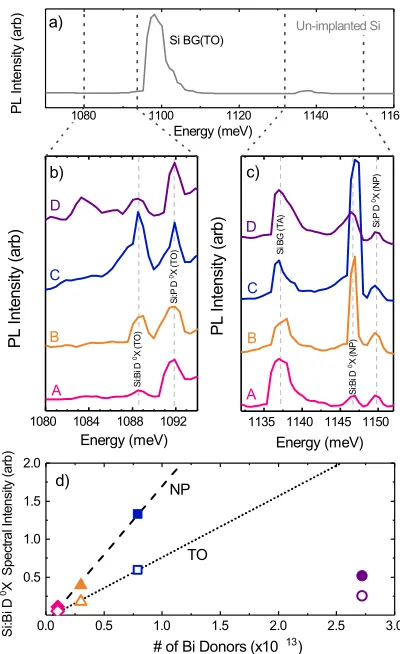
To evaluate the characteristic properties of active bismuth donors,D0X PL measurements were taken using each of the samples in this study. Figure 2(a) displays a reference PL measurement of un-implanted silicon. Included is an iden-tification of the spectral regions within which theD0X trans-verse optical phonon, TO, and NP transitions are expected (b & c respectively). These are situated either side of the sig-nificantly stronger transverse optical phonon mediated silicon bandgap PL, Si BG(TO). Figures 2(b & c) display measured spectra of the implanted samples in this study, peaks centred at 1147 meV and 1150 meV correspond to the NPD0X PL
for bismuth and phosphorus donors respectively. Transitions at 1137 meV correspond to the recombination of free excitons assisted by the creation of a transverse acoustic phonon, Si BG(TA). Figure 2(d) displays the integrated spectral density of both Si:BiD0X PL centres as a function of active bismuth donor population. For samples A to C, the NP and TO spectral intensities scale lineally with donor population and it is found that the TO:NP transition intensity ratio match the known Si:BiD0XPL branching ratio (1:2.2)10. This serves as an indi-cation that the crystal environment, within which the bismuth donors are populated, is of relatively high quality. However in sample D the PL strength is found to be greatly reduced from what would be extrapolated from the lower density substrates. Accompanying this reduction in the expected D0X PL cen-tre from sample D is the emergence of a lower energy feature present in the D0X (TO) spectrum at (1083.57±0.09) meV.
It is not clear if this feature is also present in the equivalent NP measurement due to the overlapping position of the Si BG(TA) transition. It is also of note that, at the expected lu-minescence energy, the TO:NP intensity ratio from sample D does match the known 1:2.2 branching ratio.
An identification for the shifted low energy peak can be pro-vided by considering the formation of theD0Xcomplex in an environment with a dense population of bismuth donors. The interaction between excitons and multiple donors has been
re-A B C D S i B G ( T A ) S i: P D 0 X ( N P ) S i :B i D 0 X ( N P )
1135 1140 1145 1150
S i :B i D 0 X ( T O ) S i: P D 0 X ( T O ) A B C D
1080 1084 1088 1092
Energy (meV)
1080 1100 1120 1140 1160
0.0 0.5 1.0 1.5 2.0 2.5 3.0
0.5 1.0 1.5 2.0 P L I n t e n s i t y ( a r b ) P L I n t e n s i t y ( a r b ) Energy (meV) Energy (meV) a) c) b) P L I n t e n s i t y ( a r b ) Si BG(TO) Un-implanted Si d) TO S i : B i D 0 X S p e c t r a l I n t e n s i t y ( a r b )
# of Bi Donors (x10
13
) NP
FIG. 2. (a) Reference PL spectra of un-implanted silicon. (b – c) PL
spectra of samples A to D. NP and TO phonon assistedD0X
transi-tion energies for both bismuth and phosphorus donors are indicated
as dashed grey lines. (d) Integrated Si:BiD0Xspectral density as a
function of total number of active Bi donors for each of the four sam-ples. Linear fits to the PL of samples A to C are included as dashed and dotted lines for NP and TO centres respectively.
ported previously in the cases of both bulk and ion implanted Si:P substrates. The energy ofD0X PL has been observed to shift down in energy by as much as 20 meV with increas-ing concentrations18,19. Much like a pair of hydrogen atoms, neighbouring pairs of group V donors in silicon are known to form bonding states with reduced overall energy through the exchange interaction20. Similarly, if a bound exciton is shared between twoD0(analogous to positronium di-hydride), there can be an overall reduction in the correspondingD02Xbinding energy. By approximating the wavefunction of theD0X com-plex as a sphere with a radius ofr0, the binding energy of an
exciton bound to a pair of neutral donors with separationR
(>r0) is21
E2=E1[1+2 exp(−R/r0)] (1)
whereE1is the energy required to dissociate a bound exciton
from a single donor, 8.8 meV in the case of Si:Bi10. TheD0X
radius,r0, may be approximated by the sum of the free exciton
[image:4.612.338.538.50.377.2]4
200 400 600 800 1000 1200 1400 0
10 20 30 40 50
Depth (nm)
10 -9
10 -8
10 -7
10 -6
10 -5
10 -4
Probability Density (nm
-2
)
10 1 0.1 0.01
C
a
l
c
u
l
a
t
e
d
E
n
e
r
g
y
S
h
i
f
t
(
m
e
V
)
B
i
s
m
u
t
h
D
o
n
o
r
S
e
p
a
r
a
t
i
o
n
(
n
m
[image:5.612.59.294.54.216.2])
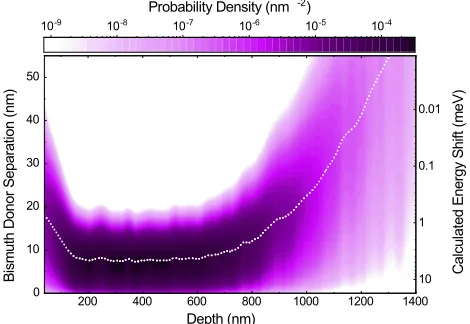
FIG. 3. Probability density distribution of bismuth donor separations
(and predicted energy shift|E2−E1|, Eqn 1, for the bi-donor bound
mono-excitonD02Xrelative to theD0X ) as a function of depth for
implant D. The dotted line contours the expectation value of separa-tions at each depth.
shift caused by this clustering effect increases as expeced. Figure 3 displays, for sample D, the probability of finding a bismuth donor that is within a depth rangez→z+dz be-low the surface, and that has its nearest neighbour within the radial distance rangeR→R+dR. This probability density assumes complete spatial randomness within the plane per-pendicular to the ion beam, and a non-homogeneous Poisson point process with its density variation in depth found from the measured SRP density data (figure 1(a–d))24. The expec-tation nearest neighbour radius was then calculated from this probability density function and is plotted as the white dot-ted line in figure 3. As to be expecdot-ted, the nearest neighbour donor separation reaches a minimum within the high density ‘flat top’ region of the sample at depths ranging from 0.1 to 0.7 nm below the surface of the sample. Within this popula-tion the donor separapopula-tion expectapopula-tion value is (7.6±0.2) nm which corresponds to a calculated energy shift of −(4.6±
0.4)meV. This predicted value is in good agreement with the
−(4.8±0.1)meV shift measured experimentally in the Si:Bi
D0X(TO) PL spectra.
There is also significance in the fact that, within the PL measured from sample D, there remains a spectral feature present at the expected Si:BiD0X energy that exhibits the ex-pected 1:2.2 TO:NP branching ratio. This can be identified as a population of bismuth donors which are not subjected to any concentration effects. Using the linear spectral intensity relations displayed for the lower density samples (figure 2(d)), this PL strength can be correlated to a donor population of ap-proximately (3.3±0.2)×1013. This number matches well the population of bismuth donors which are measured to be at depths greater than 900 nm below the surface. As donors diffuse to greater depths, the population density drops signifi-cantly and the resultant nearest neighbour separation increases correspondingly. Thus,D0XPL will not undergo any measur-able density effects.
The effect of increasing the ion implantation dose on the
characteristic properties of implanted bismuth donors in sili-con has been studied. We found that implants with a lower ion fluence produced higher EAY–I, the total (integrated) electri-cal activation density when measured as a fraction of the total fluence. The peak in the activation density as a fraction of the simulated peak implant density EAY–P, was observed to be significantly less than the total yield in every sample, and correspondingly the thickness of the annealed layer was larger than the implant profile. A clear correlation was observed be-tween an increasing Bi+ dose and faster bismuth diffusion. This is consistent with diffusion of bismuth ions through the silicon crystal during the anneal via interactions with silicon vacancies and interstitials. PL measurements showed, for ev-ery sample, features corresponding to both the implanted bis-muth and bulk doped phosphorus donors. For the highest den-sity sample, we observed a suppression in theD0X transition from isolated Si:Bi donors, and an additional low energy peak was also measured. We have identified the latter as due to ex-citons interacting more loosely with a pair of bismuth donors. The spectral feature associated with isolated Si:Bi donors is not suppressed completely, thanks to significant numbers of donors situated within the diffused tail where densities are correspondingly lower. These results demonstrate the signif-icance in careful selection of appropriate implantation doses when considering the fabrication of quantum devices centered around active bismuth impurity states in silicon.
We gratefully acknowledge the financial support from the UK Engineering and Physical Sciences Research Council [ADDRFSS, Grant No.EP/M009564/1].
1J. P. Gordon and K. D. Bowers, Phys. Rev. Lett.1, 368 (1958). 2G. Feher, Phys. Rev.114, 1219 (1959).
3K. Saeedi, M. Szech, P. Dluhy, J. Z. Salvail, K. J. Morse, H. Riemann, N. V.
Abrosimov, N. Nötzel, K. L. Litvinenko, B. N. Murdin,et al., Scientific Reports5, 10493 (2015).
4G. Wolfowicz, A. M. Tyryshkin, R. E. George, H. Riemann, N. V.
Abrosi-mov, P. Becker, H.-J. Pohl, M. L. W. Thewalt, S. A. Lyon, and J. J. L. Morton, Nature Nanotechnology8, 881 (2013), 1301.6567.
5T. Sekiguchi, M. Steger, K. Saeedi, M. L. W. Thewalt, H. Riemann, N. V.
Abrosimov, and N. Nötzel, Physical Review Letters104(2010).
6C. D. Weis, C. C. Lo, V. Lang, A. M. Tyryshkin, R. E. George, K. M. Yu,
J. Bokor, S. A. Lyon, J. J. L. Morton, and T. Schenkel, APL100, 172104 (2012).
7T. Peach, K. Homewood, M. Lourenco, M. Hughes, K. Saeedi, N. Stavrias,
J. Li, S. Chick, B. Murdin, and S. Clowes, Advanced Quantum Technolo-gies1, 1800038 (2018).
8G. a. Thomas, M. Capizzi, F. DeRosa, R. N. Bhatt, and T. M. Rice, Phys.
Rev. B28, 5472 (1981).
9P. J. Dean, J. R. Haynes, and W. F. Flood, Phys Rev161, 711 (1967). 10J. R. Haynes, Physical Review Letters4, 361 (1960).
11G. Davies, Physics reports176, 83 (1989).
12R. Brennan and D. Dickey, Solecon Labs Technical Note.
13J. Ziegler, M. Ziegler, and J. Biersack, Nuclear Inst. and Methods in
Physics Research, B268, 1818 (2010).
14Y. Ishikawa, K. Yazaki, and I. Nakamichi, Jpn. J. Appl. Phys.28, 1272
(1989).
15A. Claverie, B. Colombeau, B. de Mauduit, C. Bonafos, X. Hebras,
G. Ben Assayag, and F. Cristiano, Appl Phys A76, 10251– (2003).
16K. Cho, M. Numan, T. Finstad, and W. K. Chu, APL47, 1321 (1985). 17K. Jones, H. Banisaukas, and J. Glassberg, APL75, 3659 (1999). 18Y. Shiraki and H. Nakashima, Solid State Comms29, 295 (1979). 19H. Sumikura, K. Nishiguchi, Y. Ono, A. Fujiwara, and M. Notomi, Optics
Express19, 25255 (2011).
22P. Yu and M. Cardona,Fundamentals of Semiconductors: Physics and
Ma-terials Properties(Springer-Verlag Berlin Heidelberg, 2010).
23J. Li, N. H. Le, K. L. Litvinenko, S. K. Clowes, H. Engelkamp, S. G. Pavlov,
H.-W. Hübers, V. B. Shuman, L. Portsel, A. N. Lodygin,et al., Phys. Rev. B98, 085423 (2018).
24K. Stockbridge, S. Chick, E. Crane, A. Fisher, and B. Murdin, (2019),