M a c hi n e l e a r ni n g a i d e d a n d r oi d
m a l w a r e cl a s sific a tio n
N i k ol a , M , D e h g h a n t a n h a , A a n d Ki m-Kw a n g R a y m o n d , C
h t t p :// dx. d oi.o r g / 1 0 . 1 0 1 6 /j.c o m p e l e c e n g . 2 0 1 7 . 0 2 . 0 1 3
T i t l e
M a c hi n e le a r ni n g a i d e d a n d r oi d m a l w a r e cl a s sific a tio n
A u t h o r s
N i k ol a, M , D e h g h a n t a n h a , A a n d Ki m-Kw a n g R a y m o n d , C
Typ e
Ar ticl e
U RL
T hi s v e r si o n is a v ail a bl e a t :
h t t p :// u sir. s alfo r d . a c . u k /i d/ e p ri n t/ 4 1 5 5 4 /
P u b l i s h e d D a t e
2 0 1 7
U S IR is a d i gi t al c oll e c ti o n of t h e r e s e a r c h o u t p u t of t h e U n iv e r si ty of S alfo r d .
W h e r e c o p y ri g h t p e r m i t s , f ull t e x t m a t e r i al h el d i n t h e r e p o si t o r y is m a d e
f r e ely a v ail a bl e o nli n e a n d c a n b e r e a d , d o w nl o a d e d a n d c o pi e d fo r n o
n-c o m m e r n-ci al p r iv a t e s t u d y o r r e s e a r n-c h p u r p o s e s . Pl e a s e n-c h e n-c k t h e m a n u s n-c ri p t
fo r a n y f u r t h e r c o p y ri g h t r e s t r i c ti o n s .
Machine learning aided Android malware classification
Nikola Milosevic
School of Computer Science, University of Manchester, UK [email protected]
Ali Dehghantanha
School of Computing, Science and Engineering University of Salford, UK
Kim-Kwang Raymond Choo
Department of Information Systems and Cyber Security
The University of Texas at San Antonio, San Antonio, TX 78249-0631, USA [email protected]
Abstract
The widespread adoption of Android devices and their capability to store
ac-cess significant private and confidential information have resulted in these
de-vices being targeted by malware developers. Existing Android malware analysis
techniques can be broadly categorized into static and dynamic analysis. In
this paper, we present two machine learning aided approaches for static
anal-ysis of Android malware. The first approach is based on permissions and the
other is based on source code analysis utilizing a bag-of-words representation
model. Our permission-based model is computationally inexpensive, and is
im-plemented as the OWASP Seraphimdroid Android app that can be obtained
from Google Play Store. Our evaluations of both approaches indicate an
F-score of 95.1% and F-measure of 89% for the source code-based classification
and permission-based classification models, respectively.
Keywords: Static malware analysis, OWASP, Seraphimdroid Android app,
Machine learning
1. Introduction
In our increasingly connected society, the number and range of mobile devices
continue to increase. It is estimated to have approximately 6.1 billion mobile
device users by 2020 [1]. The wealth of private information that is stored on
or can be accessed via these devices made them an attractive target for cyber
5
criminals [2]. Studies have also revealed that users generally do not install
anti-virus or anti-malware app installed on their mobile devices, although the
effectiveness of such apps is also unclear or debatable [3]. Hence, mobile devices
are perceived by security professionals among the ”weakest links” in enterprise
security.
10
While all mobile operating systems/platforms have been targeted by
mal-ware developers, the trend is generally to focus on mobile operating systems
with a larger market share. A bigger market share [4] along with Google’s
flexible publishing policy on Android’s official application (also referred to as
app) market – Google Play – resulted in Android users being a popular target
15
for malware developers. It is also known that Android permission-based
secu-rity model provides little protection as most users generally grant apps requests
permissions [5]. There have also been instances where malicious apps were
suc-cessfully uploaded to Google Play [6]. This suggests a need for more efficient
Android malware analysis tools.
20
Existing approaches for malware analysis can be broadly categorized into
dynamic malware analysis and static malware analysis. In static analysis, one
reviews and inspects the source code and binaries in order to find suspicious
patterns. Dynamic analysis (behavioral-based analysis) involves the execution
of the analyzed software in an isolated environment while monitoring and tracing
25
its behavior [7].
Early approaches to mobile malware detection were based on the detection
of anomalies in battery consumption [8]. Operating system events, such as API
calls, Input/Output requests, and resource locks, have also been used in
dy-namic malware detection approaches. For example, TaintDroid is a malware
detection system based on anomalies in the app’s data usage behavior [9]. In
[10], the authors created a system that monitored anomalies in Android Dalvik
op-codes frequencies to detect malicious apps. Several approaches utilized
ma-chine learning to classify malware based on their behaviors. For example, the
authors in [11] focused on run-time behavior and classified Android malware
35
into the malware families using inter-process communications in combination
with SVM. A random forest-based approach with set of 42 vectors including
battery, CPU and memory usage as well as network behavior was also used for
Android mawlare detection in [12]. In [13], the authors used system calls and
regular expressions to detect data leakage, exploit execution and destructive
40
apps.
In order to avoid degrading of mobile devices’ performance, solutions based
on distributed computing and collaborative analysis for both static and dynamic
malware analysis have also been proposed [7]. For example, M0Droid is an
Android anti-malware solution that analyzes system calls of Android apps on
45
the server and creates signatures which are pushed to the user devices for threat
detection [14].
Static malware analysis techniques mainly rely on manual human analysis,
which limits the speed and scalability of investigation. Different approaches to
automate the static analysis process have also been proposed. [15] suggested
50
transforming malware source code into Calculus for Communicating Systems
(CCS) statements and utilized formal methods for checking the software’s
be-havior. However, their approach requires human analysts to formally describe
the unwanted behavior, which could still be time-consuming. The authors in
[16] proposed a methodology to generate fingerprints of apps that captures
bi-55
nary and structural characteristics of the app. Machine learning techniques can
be used to automate static malware analysis process. In [17], pattern
recogni-tion techniques are used to detect malware, while other works used standard
machine learning algorithms such as perception, SVM, locality sensitive hashing
and decision trees to assist in malware analysis (see [18]). In [19], the authors
60
file manipulation and information reading, prior to applying different machine
learning algorithms to classify malicious programs. In [20], the authors
ex-tracted 100 features based on API calls, permissions, intents and related strings
of different Android apps and applied Eigen space analysis to detect malicious
65
programs. Sahs and Khan used Androguard to obtain permissions and control
flow graphs of Android apps and created a SVM-based machine learning model
to classify Android malware [21].
In this paper, we demonstrate the utility of employing machine learning
techniques in static analysis of Android malware. Specifically, techniques such
70
as manifest analysis and code analysis are utilized to detect malicious Android
apps. The contributions of this paper are two-folded:
1. We present a machine learning model for Android malware detection based
on app permissions. This approach is lightweight and computationally
inexpensive, and can be deployed on a wide range of mobile devices.
75
2. We then present a new approach to perform code analysis using machine
learning, which provides higher accuracy and is capable of revealing more
granular app behaviors. Static code analysis of malware is a task generally
undertaken by forensics and malware analysts. However, our research
results indicate the potential to automate several aspects of the static
80
code analysis, such as detecting malicious behavior within the code.
The structure of this paper is as follows. In the next section, we present the
research methodology used in this paper. Research results are then presented,
followed by a discussion of the findings. Finally, the paper is concluded and
several future directions are suggested.
85
2. Methodology
Combination of permissions may give a clear indication about the
capabili-ties of the analyzed app(s). From combining the permissions, it can be induced
weather the app may cause harm or behave maliciously. We hypothesize that
malicious apps will have certain patterns and common permission combinations,
which can be learned by a machine learning algorithm. On the other hand, the
app code reflects the app’s behavior and, therefore, is a common choice for static
malware analysis. We utilize two machine learning techniques, namely:
classi-fication and clustering. As apps can be classified into malware and goodware,
the task of malware detection can be modeled as a classification problem.
95
Classification is a supervised machine learning technique, which can be used
to identify category or sub-population of a new observation based on labeled
data. Clustering is an unsupervised machine learning technique that is capable
of forming clusters of similar entities. Clustering algorithms are useful when
only a small portion of dataset is labeled. The labeled examples can be utilized
100
to infer the class of unlabeled data. Labels obtained through clustering can be
subsequently used to retrain a classification model with more data.
Also, in this research, we conducted four experiments, namely:
permission-based clustering, permission-permission-based classification, source code-permission-based clustering,
and source code-based classification. For the training and testing of our machine
105
learning models, we utilize M0Droid dataset, which contains 200 malicious and
200 benign Android apps [14].
2.1. Permission-based analysis
In this approach, we use Android’s permission names as features to build a
machine learning model since Android security model is based on app
permis-110
sions. Every app has to acquire the required privileges to access the different
phone features. During an app installation, a user is asked whether to grant the
app access to the permissions requested. Malicious apps usually require certain
permissions. For example, in order to access and exfiltrate sensitive information
from the SD card, a malicious app would require access to both the SD card
115
and Internet. Our approach is to model combinations of the Android
permis-sions requested by such malicious apps. We propose an approach that uses the
appearance of specific permissions as features for a machine learning algorithm.
In this approach, we first extract the permissions from our dataset and
cre-ate a model. For training, we use Weka toolkit and evalucre-ate several machine
learning algorithms, including SVM, Naive Bayes, C4.5 Decision trees, JRIP
and AdaBoost. Classification algorithms we chose differ in their underlying
concept. Support Vector Machines is a non-probabilistic supervised machine
learning binary classification algorithm. SVM is capable of nonlinear
classifica-tion that maps inputs into high dimensional feature space. C4.5 decision treeis
125
a statistical classifier that builds a decision tree based on information entropy.
Each node of the tree algorithm selects a feature and splits its sets of samples
into subsets until classes can be inferred. Random forest is an ensemble
classifi-cation algorithm that combines a number of decision trees and returns the mode
of individual decisions by decision trees. Naive Bayes is a simple probabilistic
130
classifier that is based on applying Bayes theorem with strong independence
assumption between features. Bayesian network is a probabilistic graphical
model that represents a set of random variables and their inter-dependencies
in directed acyclic graph. JRIP is a propositional rule learner that tries every
attribute with every possible value and adds a rule which results to the greatest
135
information gain. Logistic regressionis a statistical regression model where
de-pendent variable is used to estimate the probability of binary response based on
multiple features. AdaBoost is a meta algorithm that can be used with many
other algorithms to improve their performance by combining their outputs into
a weighted sum which represents the final output.
140
We then used the modified Weka 3.6.6 library1 for Android to develop the OWASP Seraphimdroid Android app, which is using support vector machines
with sequential minimal optimization2.
We also apply several clustering techniques in order to evaluate the
per-formance of our unsupervised and supervised learning algorithms. Training,
145
testing and evaluation of our model are performed using Weka Toolkit by
ap-plying the Farthest First, Simple K-means and Expectation maximization (EM)
1http://www.pervasive.jku.at/Teaching/lvaInfo.php?key=346&do=uebungen 2https://www.owasp.org/index.php/OWASP_SeraphimDroid_Project
algorithms. Simple K-means is a clustering algorithm where samples are
clus-tered into n clusters, in which each sample belongs to a cluster with the nearest
mean. Farthest First algorithm uses farthest-first traversal to find k clusters
150
that minimize the maximum diameter of a cluster, andExpectation
maximiza-tion (EM) assigns a probability distribution to each instance which indicates
the probability of it belonging to each of the clusters.
2.2. Source code-based analysis
The second approach is a static analysis of the app’s source code. Malicious
155
codes generally use a combination of services, methods, and API calls in a way
that is not usual for non-malicious app [11]. Machine learning algorithms are
capable of learning common combinations of malware services, API and system
calls to distinguish them from non-malicious apps.
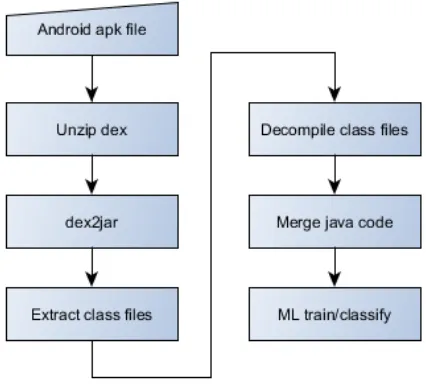
In this approach, Android apps are first decompiled and then a text mining
160
classification based on bag-of-words technique is used to train the model.
Bag-of-words technique has already showed promising results for classification of
harmful apps on personal computers [22]. Decompiling Android apps to conduct
static code analysis involves several steps. First, it is necessary to extract the
Dalvik Executable file (dex file) from the Android application package (APK
165
file). The second step is to transform the Dalvik Executable file into a Java
archive using the dex2jar tool3. Afterwards, we extract all .class files from the
Java archive and utilize Procyon Java decompiler (version 0.5.29) to decompile
.class files and create .java files. Then, we merge all Java source code files of
the same app into one large source file for further processing.
170
Since Java and natural language text have some degree of similarity, we apply
the technique used in natural language processing, known as ”a bag-of-words”.
In this technique, the text, or Java source code in our case, is represented as a
bag or set of words which disregards the grammar or word order. The model
takes into account all words that appear in the code. Our approach considers the
175
whole code including import statements, method calls, function arguments, and
instructions. The source code obtained in the previous step is then tokenized
into unigrams that are used as a bag-of-words. We use several machine
learn-ing algorithms for classifications, namely: C4.5 decision trees (in Weka toolkit,
it is known as J48), Naive Bayes, Support Vector Machines with Sequential
180
Minimal Optimization, Random Forests, JRIP, Logistic Regression and
Ad-aBoostM1 with SVM base. We performed our training, testing and evaluation
using Weka Toolkit. For source code analysis, we also utilized ensemble
learn-ing with combinations of three and five algorithms and majority votlearn-ing decision
system. Ensemble learning combines multiple machine learning algorithms over
185
the same input, in hope to improve the classification performance. The number
of algorithms is chosen in a way that system is able to unambiguously choose
the output class based on majority of votes.
We also experiment with clustering on the source code. Clustering
algo-rithms we use include the Farthest First, Simple K-means and Expectation
190
[image:9.612.199.412.427.620.2]maximization (EM). A flow diagram of the process is presented in Figure 1.
2.3. Ensemble learning
To improve the performance of our learning algorithms, our tests were
per-formed using ensemble learning with voting for both permission-based and
source code-based analysis. Ensemble methods use multiple classification
al-195
gorithms to obtain better performance than could be obtained from any of the
constituent algorithms individually. The final prediction is chosen as the label
that was predicted by the majority of classifiers. We also experiment with
en-sembles that contained combinations of three and five algorithms. Odd number
of algorithms allow us to unambiguously choose the class with majority voting.
200
For classification algorithms, we use SVM, C4.5, Decision Trees, Random Tree,
Random Forests, JRIP, and Linear Regression.
3. Evaluation and Discussion
We evaluated the performance of our approaches using 10-fold cross
valida-tion. In 10-fold cross validation, the original sample was randomly partitioned
205
into ten equal sized sub-samples. A single sub-sample was retained for the
test-ing, while the remaining nine were used for training. The process was repeated
ten times, and each time using a different sub-sample for testing. The results
were then averaged to produce a single estimation. The main advantage of this
method is that all samples were used once only for validation. The metrics we
210
used for the evaluation of the algorithms are precision, recall and F-measure,
which are widely used in the text mining and machine learning communities.
Classified items can be true positive (TP – items correctly labeled as belonging
to the class), false positive (FP - items incorrectly labeled as belonging to a
cer-tain class), false negative (FN - items incorrectly labeled as not belonging to a
215
certain class), and true negative (TN - items correctly labelled as not belonging
to a certain class).
Given the number of true positives and false negatives, recall is calculated
using the following formula:
The recall is sometimes referred to as ”sensitivity” or the ”true positive rate”.
Given the number of true positive and false positive classified items, precision
(also known as ”positive predictive rate”) is calculated as follows:
P recision= T P (T P +F P)
The measure that combines precision and recall is known as F-measure, given
as:
F =(1 +β
2)∗Recall∗P recision β2∗P recision+Recall) ,
where β indicates the relative value of precision. A value of β = 1 (which is
usually used) indicates the equal value of recall and precision. A lower value
220
indicates a larger emphasis on precision and a higher value indicates a larger
emphasis on recall [23].
3.1. Evaluation of permission-based classification
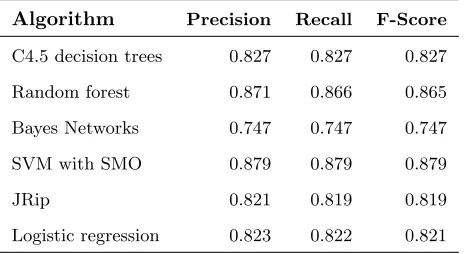
The evaluation of machine learning algorithms performing permission-based
classification is presented in Table 1.
225
Algorithm Precision Recall F-Score
C4.5 decision trees 0.827 0.827 0.827
Random forest 0.871 0.866 0.865
Bayes Networks 0.747 0.747 0.747
SVM with SMO 0.879 0.879 0.879
JRip 0.821 0.819 0.819
[image:11.612.191.423.423.550.2]Logistic regression 0.823 0.822 0.821
Table 1: Evaluation results of permission-based classification using single machine learning algorithms
As observed from Table 1, support vector machines with sequential minimal
optimization has the best performance with a F-measure value of 0.879. In other
words, this algorithm correctly classified 87.9% of test instances in 10-fold cross
seconds to train the model. Instances were also classified faster; thus, making
230
this approach suitable for real-time classification of (malicious) apps. We then
integrated this model for classification based on permissions with SVM in the
OWASP Seraphimdroid Android app 4, which can be obtained from Google
Play Store5.
On the other hand, Bayesian algorithms such as Naive Bayes and Bayesian
235
networks have the worst performance. This could be due to the small dataset
(comprising only 387 instances) used in this study. Bayesian algorithms
usu-ally require much larger datasets than SVM to train the model with a higher
accuracy. A larger dataset may also the improve SVM model performance.
SVM algorithm outperforms Naive Bayes, Bayesian Network, JRip and
Lo-240
gistic regression on statistical t-test with a confidence interval of 0.05. However,
it is not significantly statistically better than decision trees and random forests.
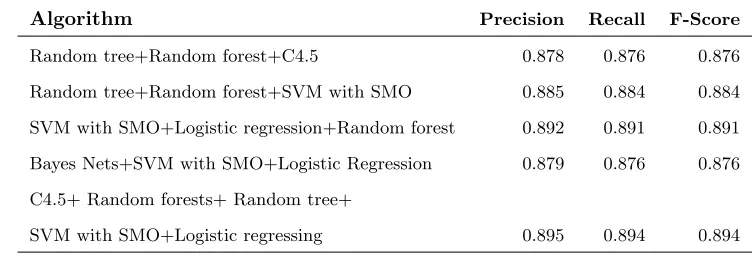
In Table 2, we present the results of ensemble learning using majority voting.
We experimented with ensembles of three algorithms in order to determine
which algorithm(s) contribute to the best results in ensembles. The best three
245
performing algorithms are SVM with SMO, Logistic Regression and Random
Forest with an F-measure of 0.891. This is only a slight improvement compared
to using the SVM algorithm in isolation. The t-test suggested that ensemble
learning is not significantly better with a confidence interval of 0.05.
On the other hand, ensemble algorithms were much slower as more time is
250
needed to apply multiple machine learning algorithms (in our case, three or five)
and post-process results. Since the significance test showed that the performance
of the ensemble learning algorithm is not significantly better than the single
machine learning algorithm, there is no benefit in using these algorithms in
production.
255
Both results from the single classifier and ensemble method present a
promis-ing performance that can be used in anti-malware systems. This method would
4https://github.com/nikolamilosevic86/owasp-seraphimdroid
be able to detect unknown and new malware samples since it does not rely on
signatures, but rather on learned dangerous permission combination. Our
find-ings echoed the findfind-ings of previous studies such as [24], which demonstrated
260
the potential of machine learning algorithms in achieving a high detection rate,
even on new malware samples.
Algorithm Precision Recall F-Score
Random tree+Random forest+C4.5 0.878 0.876 0.876
Random tree+Random forest+SVM with SMO 0.885 0.884 0.884
SVM with SMO+Logistic regression+Random forest 0.892 0.891 0.891
Bayes Nets+SVM with SMO+Logistic Regression 0.879 0.876 0.876
C4.5+ Random forests+ Random tree+
[image:13.612.125.502.220.349.2]SVM with SMO+Logistic regressing 0.895 0.894 0.894
Table 2: Evaluation results of permission-based classification using ensemble learning
There are, however, limitations with this approach. For the
permission-based approach, we reported an F-measure of 87.9% for single machine learning
algorithms. In other words, some malware samples would be undetected and
265
some non-malicious apps classified as malicious. In our case, 340 apps were
cor-rectly classified, while 47 were incorcor-rectly classified. Using ensemble learning,
the number of misclassified instances was reduced to 42. Our reported
perfor-mance is higher than those reported in [25]. Also, our permission-based analysis
model is not computationally expensive and when implemented in the OWASP
270
Seraphimdroid app, we were able to scan and classify all 83 installed apps on
the test device (i.e., a Nexus 5 device with Quad-core 2.3 GHz, 2 GB RAM) in
under 8 seconds.
3.2. Evaluation of permission-based clustering
Clustering refers to the grouping of similar items together, without any
275
knowledge of how the grouping should be performed. Clustering is different
from supervised learning, where the training set is defined in a way that shows
The set of elements is clustered into a certain number of groups, which are
usually formed based on the elements’ similarity.
280
Table 3 presents the results of our permission-based clustering approach. In
our case, apps will be grouped according to whether they use a similar set of
permissions. However, if an app uses a similar set of permissions as some
mal-ware, it does not mean that the app is malicious. As it can be seen from Table 3,
the results are not as good as classification. The best algorithm incorrectly
clus-285
tered more than 35% of the instances while permission-based classification only
incorrectly classified around 10.5% of the instances. In our permission-based
analysis, clustering had a higher error rate than classification.
Algorithm Correctly clustered instances Incorrectly clustered instances
SimpleKMeans 229 (59.17%) 158.0 (40.83%)
FarthestFirst 199 (51.42%) 188.0 (48.58%)
[image:14.612.128.511.313.384.2]EM 250 (64.6%) 137.0 (35.4%)
Table 3: Evaluation results of permission-based clustering
3.3. Evaluation of source code-based classification
Of the 400 apps in our data set, we were unable to decompile 32 of them
290
(10 non-malicious and 22 malicious), perhaps due to code encryption and
ob-fuscation or instability of our Java decompiler. Nevertheless, the remaining 368
source files were sufficient to train a good model.
The evaluation of the classification for the analysis of the app’s source code
is presented in Table 4.
295
As Table 4 shows, over 95% of instances were correctly classified using SVM.
The high accuracy of source code-based classification reveals that the machine
can infer app behavior from its source code. Even though the bag-of-words
model disregards grammar and word order in text (in our context, the source
code), it is possible to train a successful machine learning model that is able
300
to distinguish malicious app from non-malicious app. Other machine learning
Algorithm Precision Recall F-Score
C4.5 decision trees 0.886 0.886 0.886
Random forest 0.937 0.935 0.935
Naive Bayes 0.825 0.821 0.820
Bayesian networks 0.825 0.821 0.819
SVM with SMO 0.952 0.951 0.951
JRip 0.916 0.916 0.916
[image:15.612.190.424.125.270.2]Logistic regression 0.935 0.935 0.935
Table 4: Evaluation results of source code-based classification using single machine learning algorithm
evaluated and had an F-score of over 90%. Therefore, source code appears to be
a viable source of information for a machine learning classification algorithm.
Also, with the machine learning-based source code analysis, it is possible to
305
analyze whether an Android package (apk) is malicious in less than 10 seconds,
which is significantly faster than a human analyst.
Algorithm Precision Recall F-Score
C4.5 decision tree+random tree+random forests 0.950 0.948 0.948
Logistic regression+C4.5+SVM with SMO 0.947 0.946 0.946
Random tree+Random Forest+SVM with SMO 0.825 0.821 0.820
SVM with SMO+Logistic regression+Random forest 0.942 0.940 0.940
SVM with SMO+Logistic regression+
AdaBoostM1 with SVM base 0.952 0.951 0.951
Logistic regression+JRip+Random Forests+
C4.5+SVM with SMO 0.950 0.948 0.948
SVM with SMO+Logistic regression+
[image:15.612.126.518.414.617.2]Simple Logistic regression+AdaBoostM1 with SVM base 0.958 0.957 0.956
Table 5: Evaluation results of source code-based classification using ensemble learning
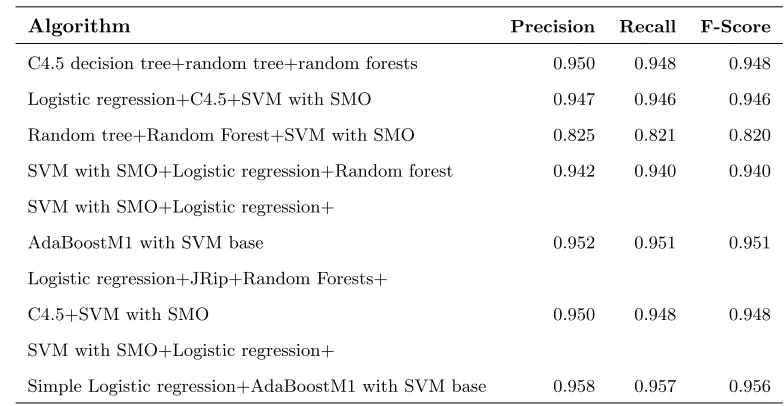
learning with voting had a slight improvement compared to the best results
from using single machine learning algorithms (the best F-measure of
ensem-310
ble learning was 0.956; the F-measure of SVM was 0.951) by combining SVM
with SMO, logistic regression, LogitBoost with simple regression functions as
base learners (simple logistic regression) and AdaBoostM1 with SVM as a base.
Some of the ensembles (e.g. C4.5 decision tree+random tree+random forests
or SVM with SMO+Logistic regression+Random Forest) performed worse than
315
SVM with SMO. Since the F-measure of C4.5 decision trees was 0.886, it had
a negative impact on the ensembles. Ensembles that contained SVM may have
misclassified some instances if the majority of algorithms voted for the wrong
class. The combination of algorithms in one case (SVM with SMO+Logistic
re-gression+Simple Logistic regression+AdaBoostM1 with SVM base) had slightly
320
improved classification performance (by 0.5% in F-measure), but it was not
statistically significant. Our source code analysis approach allows successful
classification of new malware in 95.1% cases with a single machine learning
algorithm.
3.4. Evaluation of source-based clustering 325
Table 6 presents the results of source code clustering. These results were
more promising than the those obtained from permission-based clustering since
the best performance of correctly clustered instances increased from 64.6% to
82.3%. The increase in performance is due to the fact that source code provides
a greater amount of data based on which clustering can be done. However,
330
there were still 17.6% incorrectly clustered instances. Since clustering is a type
of unsupervised machine learning algorithm, it creates clusters that are based on
code similarity. This is not necessarily a good indication of the code’s malicious
behavior. The way clustering maps instances in the absence of any
supervi-sion is the main reason that its performance is worse than the classification
335
algorithms. The results for non-supervised learning can be used for creating
larger labeled data sets. Classification (SVM) performed 14% better than the
detecting malware but only for expanding small datasets if necessary.
Algorithm Correctly clustered instances Incorrectly clustered instances
SimpleKMeans 303 (82.3%) 65 (17.66%))
FarthestFirst 296 (80.44%) 72 (19.56%)
[image:17.612.131.509.152.223.2]EM 300 (81.53%) 68 (18.47%)
Table 6: Evaluation results of permission-based clustering
4. Conclusion and Future Research Directions 340
In this paper, we presented two machine learning aided (classification and
clustering) approaches based on app permissions and source code analysis to
de-tect and analyze malicious Android apps. The use of machine learning allows our
algorithms to detect new malware families with high precision and recall rates.
Our approach complements existing signature-based anti-malware solutions, as
345
the latter is not capable of detecting malicious software until the appropriate
signatures are released. Specifically, we demonstrated that the permission-based
method was able to classify malware from goodware in 89% of cases while source
code analysis classification performance was over 95%. Accuracy rates of 95.1%
using SVM, and 95.6% using the ensemble learning method are comparable with
350
existing state-of-the art solutions.
The majority of existing approaches need to perform analysis on the
re-mote server or they require the Android device to be rooted. However, our
permission-based approach can run on Android devices without root access and
offers a relatively good accuracy in malware detection. Source code-base
analy-355
sis approach, to the best of our knowledge, is the only automated Android static
malware analysis method that uses machine learning to scan the entire source
code of an app. Other static malware detection approaches are usually limited
to monitoring a set of API or system calls, ignoring import code snippets such
as operator statements and other code features. Our source code-based
classi-360
files prior to analysis. However, detailed analysis of decompiled code does not
take more than 10 seconds per app. Practically, this method can be used to
scan and classify any apps including those on Google Play and other app stores.
Future research includes the evaluation of the proposed models using a
signif-365
icantly bigger labeled balanced data sets and utilizing online learning. Another
research focus is combining static and dynamic software analysis in which
mul-tiple machine learning classifiers are applied to analyze both source code and
dynamic features of apps in run-time.
References 370
[1] A. Boxall, The number of smartphone users in the world is expected to
reach a giant 6.1 billion by 2020 (2015).
URL http://www.digitaltrends.com/mobile/
smartphone-users-number-6-1-billion-by-2020/
[2] A. Dehghantanha, K. Franke, Privacy-respecting digital investigation, in:
375
Privacy, Security and Trust (PST), 2014 Twelfth Annual International
Con-ference on, IEEE, 2014, pp. 129–138.
[3] J. Walls, K.-K. R. Choo, A review of free cloud-based anti-malware
apps for android, in: 14th IEEE International Conference on Trust,
Security and Privacy in Computing and Communications
(Trust-380
Com/BigDataSE/ISPA), IEEE, 2015, pp. 1053–1058.
[4] M. Kitagawa, A. Gupta, R. Cozza, I. Durand, D. Glenn, K. Maita, L. Tay,
T. Tsai, R. Atwal, M. Escherich, E. He, A. Jump, B. Lakehal, C. Lu, T. H.
Nguyen, A. Sato, V. Tripathi, A. Zimmermann, W. Lutman, Market share:
Final pcs, ultramobiles and mobile phones, all countries, 2q15 update, Tech.
385
rep. (2015).
[5] C. Chia, K.-K. R. Choo, D. Fehrenbacher, How cyber-savvy are older
mo-bile device users?, in: M. H. Au, K.-K. R. Choo (Eds.), Momo-bile Security
[6] N. Viennot, E. Garcia, J. Nieh, A measurement study of google play, in:
390
ACM SIGMETRICS Performance Evaluation Review, Vol. 42, ACM, 2014,
pp. 221–233.
[7] A.-D. Schmidt, J. H. Clausen, A. Camtepe, S. Albayrak, Detecting
sym-bian os malware through static function call analysis, in: Malicious and
Unwanted Software (MALWARE), 2009 4th International Conference on,
395
IEEE, 2009, pp. 15–22.
[8] T. K. Buennemeyer, T. M. Nelson, L. M. Clagett, J. P. Dunning, R. C.
Marchany, J. G. Tront, Mobile device profiling and intrusion detection using
smart batteries, in: Hawaii International Conference on System Sciences,
Proceedings of the 41st Annual, IEEE, 2008, pp. 296–296.
400
[9] W. Enck, P. Gilbert, S. Han, V. Tendulkar, B.-G. Chun, L. P. Cox, J. Jung,
P. McDaniel, A. N. Sheth, Taintdroid: an information-flow tracking system
for realtime privacy monitoring on smartphones, ACM Transactions on
Computer Systems (TOCS) 32 (2) (2014) 5.
[10] G. Canfora, F. Mercaldo, C. A. Visaggio, Mobile malware detection using
405
op-code frequency histograms, in: Proceedings of International Conference
on Security and Cryptography (SECRYPT), 2015.
[11] S. K. Dash, G. Suarez-Tangil, S. Khan, K. Tam, M. Ahmadi, J. Kinder,
L. Cavallaro, Droidscribe: Classifying android malware based on runtime
behavior, Mobile Security Technologies (MoST 2016) 7148 (2016) 1–12.
410
[12] M. S. Alam, S. T. Vuong, Random forest classification for detecting
an-droid malware, in: Green Computing and Communications (GreenCom),
2013 IEEE and Internet of Things (iThings/CPSCom), IEEE International
Conference on and IEEE Cyber, Physical and Social Computing, IEEE,
2013, pp. 663–669.
415
[13] T. Isohara, K. Takemori, A. Kubota, Kernel-based behavior analysis for
(CIS), 2011 Seventh International Conference on, IEEE, 2011, pp. 1011–
1015.
[14] M. Damshenas, A. Dehghantanha, K.-K. R. Choo, R. Mahmud, M0droid:
420
An android behavioral-based malware detection model, Journal of
Infor-mation Privacy and Security 11 (3) (2015) 141–157.
[15] F. Mercaldo, V. Nardone, A. Santone, C. A. Visaggio, Download malware?
no, thanks: how formal methods can block update attacks, in: Proceedings
of the 4th FME Workshop on Formal Methods in Software Engineering,
425
ACM, 2016, pp. 22–28.
[16] E. B. Karbab, M. Debbabi, D. Mouheb, Fingerprinting android packaging:
Generating dnas for malware detection, Digital Investigation 18 (2016) S33–
S45.
[17] L. Nataraj, S. Karthikeyan, G. Jacob, B. Manjunath, Malware images:
430
visualization and automatic classification, in: Proceedings of the 8th
inter-national symposium on visualization for cyber security, ACM, 2011, p. 4.
[18] H. V. Nath, B. M. Mehtre, Static malware analysis using machine learning
methods, Recent Trends in Computer Networks and Distributed Systems
Security (2014) 440–450.
435
[19] V. M. Afonso, M. F. de Amorim, A. R. A. Gr´egio, G. B. Junquera, P. L.
de Geus, Identifying android malware using dynamically obtained features,
Journal of Computer Virology and Hacking Techniques 11 (1) (2015) 9–17.
[20] S. Y. Yerima, S. Sezer, I. Muttik, Android malware detection: An
eigenspace analysis approach, in: Science and Information Conference
440
(SAI), 2015, IEEE, 2015, pp. 1236–1242.
[21] J. Sahs, L. Khan, A machine learning approach to android malware
de-tection, in: Intelligence and Security Informatics Conference (EISIC), 2012
[22] V. A. Benjamin, H. Chen, Machine learning for attack vector identification
445
in malicious source code, in: Intelligence and Security Informatics (ISI),
2013 IEEE International Conference on, IEEE, 2013, pp. 21–23.
[23] W. Hersh, Evaluation of biomedical text-mining systems: lessons learned
from information retrieval, Briefings in bioinformatics 6 (4) (2005) 344–356.
[24] J. Z. Kolter, M. A. Maloof, Learning to detect and classify malicious
exe-450
cutables in the wild, The Journal of Machine Learning Research 7 (2006)
2721–2744.
[25] Cyveillance, Cyveillance testing finds av vendors detect on average less than
19% of malware attacks (2010).
URL http://www.businesswire.com/news/home/20100804005348/en/ 455
Cyveillance-Testing-Finds-AV-Vendors-Detect-Average
5. Biography of authors
5.1. Nikola Milosevic
Nikola Milosevic is a PhD student at the University of Manchester, School
of Computer Science, where his research topics focus around machine
learn-460
ing and natural language processing. Also he is involved with OWASP (Open
Web Application Security Project) as a founder of OWASP Serbia local
chap-ter, OWASP Manchester local chapter leader and a project leader of OWASP
Seraphimdroid mobile security project.
5.2. Ali Dehghantanha 465
Dr. Ali Dehghan Tanha is a Marie-Curie International Incoming Fellow in
Cyber Forensics, a fellow of the UK Higher Education Academy (HEA) and
an IEEE Sr. member. He has served for many years in a variety of research
and industrial positions. Other than Ph.D in Cyber Security he holds several
professional certificates such as GXPN, GREM, CISM, CISSP, and CCFP.
470