International Journal of Emerging Technology and Advanced Engineering
Website: www.ijetae.com (ISSN 2250-2459, ISO 9001:2008 Certified Journal, Volume 3, Issue 4, April 2013)
672
An Efficient Survey on Multi Colony- Particle Swarm
Optimization (MC-PSO) Algorithm
T. Geetha
1, B. Sowmiya
2, L. JayaKumar
3, A. Sarang Sukumar
3 1Assistant Professor, 2Associate Professor, Dept of CSE, Chendu College of Engineering & Technology, Tamilnadu,India 3Assistant Professor, Christ College of Engineering & Technology,Puducherry,India.
3Adhoc Lecturer, NIT Calicut. Abstract- The Swarm Intelligence plays a major role in
solving complex real world optimization problems. This paper proposes an algorithm namely Multi Colony- Particle Swarm Optimization (MC - PSO) algorithm. MC - PSO algorithm mainly focusing the animal collective behavior, and its movement, as well as the intelligence of the swarm. MC - PSO coordinately and cooperatively work together and they share their information with each other. The convergence speed is also high when compared to PSO algorithm. The performance of MC- PSO algorithm is compared with PSO algorithm.
Keywords- optimization; swarm intelligence; particle swarm optimization.
I. INTRODUCTION
In the recent years, nature inspired computation plays a very major role and it got a great attention in solving complex problems. The most successful one is Swarm Intelligence. Swarm Intelligence (SI) comes under the computational intelligence. Swarm Intelligence focusing the animal collective behavior.SI is particularly applied to insects, but it can also be applied to any other animals that exhibits swarm behavior. SI is a population of boids interacting locally with one another and also with their environment.SI are Meta-Heuristic algorithm because they uses natural metaphor to solve the complex, combinatorial as well as numerical optimization problem to get optimal or near optimal solutions. It is either a local search or global search algorithm. SI includes two algorithms they are Ant Colony Optimization (ACO) and Particle Swarm Optimization algorithm (PSO).SI algorithms are suitable to solve “NP-Hard” problems. The common NP-Hard problems are optimization problem, decision making problems and so on. In the few years ,to solve the optimization problems many researchers are using SI algorithm especially PSO[1][2][3][4][5][6].In this paper we proposed a optimization algorithm known as Multi Colony- Particle Swarm Optimization ( MC - PSO )
algorithm. MC-PSO algorithm follows SI principles and its concepts.
The remainder of this paper organized as follows. Section 2 describes the PSO concept.
In Section 3, describes the MC-PSO concept. Section 4 describes the comparison between PSO and the MC-PSO algorithm. Section 5 describes the experimental result analysis of both PSO and MC-PSO algorithms. In section 6, conclusion is discussed.
II. PARTICLE SWARM OPTIMIZATION ALGORITHM
PSO was introduced by James Kennedy and Rusell Eberhart in the year 1995. PSO is a robust, stochastic optimization technique based on the movement and the intelligence of the swarms. PSO is inspired with social behavior. PSO does not belongs to the survival of the fittest.PSO is initialized with a group of random particles and then it searches for optima by updating generations. In every iteration, each particle is updated by two best values. The first one is the personal best (pbest) that is achieved during the local search and the another best value is the global best (gbest) that is achieved during the global search. After finding the two best values the particle updates its velocity and position. PSO uses its particles for local search and global search. It satisfies the local optimization but it is very complicated to express the robustness because of its iteration ability. In order to reduce the iteration, the operator such as crossover and mutation of Genetic algorithm are combined with PSO to achieve a better solution. PSO converge very fast when compared to other evolutionary algorithms. PSO algorithm having its own memory. The main drawbacks of PSO algorithm are premature convergence problem and it falls under the local search [2][6].
III.
M
ULTIC
OLONY-
P
ARTICLES
WARMO
PTIMIZATION(MC – PSO) Algorithm
International Journal of Emerging Technology and Advanced Engineering
Website: www.ijetae.com (ISSN 2250-2459, ISO 9001:2008 Certified Journal, Volume 3, Issue 4, April 2013)
673
MC-PSO algorithm follows the five basic principles of the swarm intelligence and it utilizes the concept of PSO algorithm. The five basic principles are Proximity principle (population should be able to carry out simple space and time computation), Quality principle (population should respond to the quality factors pbest and gbest), Diverse Response principle (allocation of responses between pbest and gbest should ensure the diversity of responses),Stability principle (the population should not change its behavioral mode every time when the environment changes) and Adaptability principle ( the population should adapt the changes when gbest changes).
MC - PSO is initialized by a group of random particles. Consider each particle as a bird. After initialization the particles are sorted in a descending order. Then the sorted particles are placed into the different colonies (i.e. the entire swarm or community is divided into several colonies).
Intra-Swarm-Communication is described as follows: The community consists of set of colonies. Each colony performs a local search and it finally gives one best solution. Within each colony, the individual birds having their own ideas they share their ideas with each other.
Inter-Swarm-Communication is described as follows:
This can be evolved through a process of iterations. After a defined number of iterations, the information obtained is passed among the colonies and the knowledge among each colony is shared. These colonies coordinately and cooperatively work together and it provides the optimal solution.
With these intra and inter-birds communication mechanisms, the birds can jump out from local optima and it quickly fly through the neighborhood of the possible global optimum. Therefore a balance between local search and global search is attained. Through this, MC - PSO overcome the problem of Premature Convergence in the PSO algorithm.
In [2] James Kennedy and Rusell Eberhart did not include any inertia weight and constriction factor they proposed PSO algorithm without any performance improvement factors. In order to improve the performance of the PSO algorithm, some authors include inertia weight factor [16, 17, 18, 19, 20 and 21] and few of them include constriction factor [20, 22 and 23]. The proposed methodology includes constriction factor concept. By including the constriction factor the performance of the algorithm is improved.
The process is initialized with a group of random particles P. For S-dimensional problems (S variables), a bird i is represented as
Xi= (xi1, xi2, xis).
Then the birds are sorted in a descending order according to their fitness. Then the entire community is divided into m colonies, each containing n birds (i.e. P = m × n). In this process, the first bird goes to the first colony, the second bird goes to the second colony, bird m goes to the mth colony, and the bird m+1 goes back to the first colony. Within each colony, the birds with the best and the worst fitness are represented as and , and the bird with the global fitness is represented as Xg. Then, a process
similar to PSO is applied to improve only the bird with the worst fitness not for all birds in each iteration. In each iteration, the communication is formulated as
---(1)
Where
is the velocity,
is the performance improvement factor,
is the best position found so far by the particle in the colony,
is the best position found so far by the multi-colony community.
is the social learning rate between the particles within each colony,
is the social learning rate between different colonies,
is a random number between 0 and 1.
The term
describes the
cooperation between individuals of the same colony and the term describes the cooperation between different colonies in the
community.
Then the position of the bird with the worst fitness is represented as follows
---(3)
,where is the
International Journal of Emerging Technology and Advanced Engineering
Website: www.ijetae.com (ISSN 2250-2459, ISO 9001:2008 Certified Journal, Volume 3, Issue 4, April 2013)
674
If this process produces a better solution, it replaces the worst bird, else the calculations in this equation are repeated but with respect to the global best bird ( replaces ). If no updation is possible then a new solution is randomly generated to replace that bird.A. Pseudocode of Multi Colony - Particle Swarm Optimization (MC - PSO) Algorithm
Begin;
Initialization:
Generate random population of P solutions(i particles);
For each individual i ϵ P;
Fitness Evaluation:
Calculate fitness (i);
Sorting:
Sort the population P in descending order of their fitness;
Divide the entire community P into m Colonies (Community);
Intra Colony Communication:
For each colony;
Determine the best and worst particles;
Improve the worst particle by using equations 3 and 4;
Repeat for a specific number of iterations;
Self- attraction within the colony is achieved by equation 1 in the 2nd term;
End;
Inter Colony Communication:
Combine the evolved colonies;
Sorting: Sort the population P in descending order of their fitness;
Cooperation between different colonies is achieved by equation 1 in the 3rd term;
Termination:
Check if termination = true;
End;
B. Advantages of MC - PSO Algorithm over PSO Algorithm
It solves premature convergence and local search problem in PSO.
It is a two way information sharing mechanism. i.e. both pbest and gbest gives the information to others.
IV. COMPARISON BETWEEN PSO AND MC - PSO ALGORITHM
This section describes the common features and the advantages and the disadvantages of both PSO and the MC - PSO algorithm. Table 1 shows the common features and the advantages and the disadvantages of PSO and the MC - PSO algorithms.
TABLEI
COMPARISON BETWEEN PSOAND MC-PSOALGORITHMS
S.No
COMPARISON BETWEEN PSOAND MC-PSO ALGORITHMS
PSO MC-PSO
1
Based on the social behavior of “ Flocking of migrating birds”
Based on the social behavior of “ Flocking of migrating birds”
2
Used to solve continues non-linear optimization
Used to solve continues non-linear optimization
3
It use only it particles for local and global search
It use only it particles for local and global search
4
It uses one way information sharing mechanism.
It uses two way information sharing mechanism.
5
Disadvantages:
-premature convergence -falls under local search
Advantages:
-solves premature convergence problem
-does not fall under local search
V. EXPERIMENTAL RESULTS
International Journal of Emerging Technology and Advanced Engineering
Website: www.ijetae.com (ISSN 2250-2459, ISO 9001:2008 Certified Journal, Volume 3, Issue 4, April 2013)
675
TABLEIII
PARAMETER SETTINGS
Parameter settings
Parameter Settings
PSO Algorith
m
MC - PSO Algorithm
Particles 100 100
Dimension 30 30
C1 , C2 2 2
Inertia weight 0.4 0.4 Maximum
iterations
30000 30000
Runs 30 30
Colonies 10
No of individuals in the colonies
10
Experimental Result analysis: The experimental results of both PSO and the MC - PSO algorithms are given in table 3.Table 3 shows the 10 benchmark functions and the results of both PSO and MC - PSO algorithm with their mean and standard deviation values. From the results we can easily analysis that the MC - PSO algorithm performs very well when compared to PSO algorithm.
TABLEIIIII
EXPERIMENTAL RESULTS OF BOTH PSO AND MC-PSO ALGORITHMS
EXPERIMENTAL RESULTS OF PSO AND MC-PSO ALGORITHMS
PSO MC - PSO
FUNCTION MEAN SD MEAN SD
SPHERE 0.0024 0.7114 -7.5829e -004
0.041 5
RASTRIGIN 0.0027 0.8153 0.0013 0.070 3
SINUSOIDA L 1
-5.4903e -006
0.0016 6.3779e -004
0.034 9
SINUSOIDA L 2
1.9345e -005 +2.991 8e+014 i
5.8033e -003 +8.975 4e+016i
-8.0330e -004
0.044 0
SINUSOIDA L 3
2.8040e +003 -1.1143e +004i
8.4119e +005 -3.3429e +006i
0.0016 0.085 1
BOHACHE VSKY 1
0.0107 3.2125 4.8812e -004
0.026 7
BOHACHE VSKY 2
0.0059 1.7753 5.6352e -004
0.030 9
BOHACHE VSKY 3
0.0103 3.0893 7.7009e -004
0.042 2
PARSOPOL OUS
1.9882e -004
0.0596 -3.2156e -004
0.017 6
MCCORMI CK
0.0140 4.2125 -0.0011 0.057 9
From the below graph we can easily analyze the results of PSO and MC - PSO algorithms. The graph is plotted for each benchmark function with their mean values for both the algorithms. Lower the mean value indicates the high performance. From the graph we can understand that MC - PSO algorithm performs well in 7 benchmark functions except 3 benchmark functions (Sinusoidal 1, Sinusoidal 2, Sinusoidal 3).
VI. CONCLUSION
In this paper, Multi Colony - Particle Swarm Optimization algorithm was proposed and the concept of MC - PSO was discussed and we proved that the MC - PSO performs very well when compared to PSO algorithm. This MC - PSO algorithm is suitable to solve complex real world optimization problem.
Appendix
International Journal of Emerging Technology and Advanced Engineering
Website: www.ijetae.com (ISSN 2250-2459, ISO 9001:2008 Certified Journal, Volume 3, Issue 4, April 2013)
676
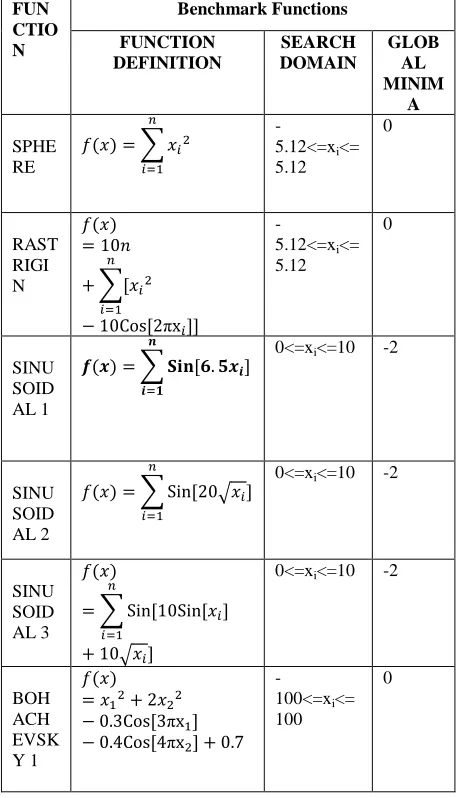
Table 4 shows the function definition and their search domain and their global minimum values for 10 benchmark functions. Bohachevsky1, Bohachevsky2, Bohachevsky3, Sinusoidal 1, Sinusoidal 2, Sinusoidal 3, and parsopolous these seven functions are comes under Constrained Multimodal Trignometric family.
Sphere/Dejong 1 comes under unconstrained unimodal polynomial family.
[image:5.612.54.284.300.701.2] Rastrigin and McCormick come under unconstrained multimodal trigonometric family.
TABLE IVV
Benchmark functions with their function definition, search domain and global minima.
FUN CTIO N
Benchmark Functions FUNCTION
DEFINITION
SEARCH DOMAIN
GLOB AL MINIM
A
SPHE RE
∑
-5.12<=xi<=
5.12
0
RAST RIGI N
∑
-5.12<=xi<=
5.12
0
SINU SOID AL 1
∑
0<=xi<=10 -2
SINU SOID AL 2
∑ √
0<=xi<=10 -2
SINU SOID AL 3
∑
√
0<=xi<=10 -2
BOH ACH EVSK Y 1
-100<=xi<=
100
0
BOH ACH EVSK Y 2
-100<=xi<=
100
0
BOH ACH EVSK Y 3
-100<=xi<=
100
0
PARS OPOL OUS
-5<=xi<=5 0
MCC ORMI CK
-1.5<=xi<=4
-1.9133
REFERENCES
[1] Dario Bruneo, Marco Scarpa, Andrea Bobbio, Davide Cerotti, Marco Gribaudo, Markovian agent modeling swarm intelligence algorithms in wireless sensor networks.
[2] Hongbo Liu, Ajith Abraham, Maurice Clerc, Chaotic dynamic characteristics in swarm intelligence
[3] Dušan Teodorovic, Swarm intelligence systems for transportation engineering:Principles and applications
[4] Ganesh K.Venayagamoorthy _, LisaL.Grant,SheetalDoctor, Collective robotic search using hybrid techniques: Fuzzy logic and swarm intelligence inspired by nature
[5] J. Izquierdo _, I. Montalvo, R. Pérez, V.S. Fuertes, Forecasting pedestrian evacuation times by using swarm intelligence
[6] S. He, Member, IEEE, Q. H. Wu, IEEE, Senior Member, and J. R. Saunders, Group Search Optimizer: An Optimization Algorithm Inspired by Animal Searching Behavior
[7] M. J. D. Powell, “A Survey of Numerical Methods for Unconstrained Optimization”, Society for Industrial and Applied Mathematics,Jan-1970.
Website:http://www.jstor.org/stable/2029042
[8] Marcin Molga, Czesław Smutnicki, “Test functions for optimization needs”, 2005. Website:http://www.scribd.com/doc/46766287/Test-functions-for-optimization-needs
[9] Jani Ronkkonen , Xiaodong Li, Ville Kyrki, Jouni Lampinen, “A framework for generating tunable test functions for multimodal optimization”, soft computing, springer, 2010.
[image:5.612.54.284.305.704.2]International Journal of Emerging Technology and Advanced Engineering
Website: www.ijetae.com (ISSN 2250-2459, ISO 9001:2008 Certified Journal, Volume 3, Issue 4, April 2013)
677
[11] Teng nga sing, Jason Teo and Mohd. Hanafi Ahmad Hijazi,“Empirical testing on 3-parents differential evolution (3PDE) for unconstrained function optimization”, IEEE Congress on Evolutionary Computation, 2007.
[12] Neculai Andrei, “An Unconstrained Optimization Test Functions Collection”, Advanced Modeling and Optimization, Volume 10, Number 1, 2008.
[13] Multivariate test functions. Website: http://extreme.adorio-research.org/download/mvf/html/node8.html .
[14] General test functions. Website: http://www.it.lut.fi/ip/evo/functions/functions.html
[15] Optimization test functions. Website: http://www.math.ntu.edu.tw/~wwang/cola_lab/test_problems/multipl e_opt/multiopt_prob/
[16] James Kennedy' and Russell Eberhart2, “Particle Swarm
Optimization”.
[17] XiaohuiHu1,2, Russell Eberhart 2,”Solving Constrained Non-linear
Optimization Problems with Particle Swarm Optimization”.
[18] Xiaohui Hu 1, 2 and Russell C. Eberhart2 , “Adaptive Particle Swarm
Optimization: Detection and Response to Dynamic Systems”. [19] YuhuiShiand Russell Eberhart, “A Modified Particle Swarm
Optimizer”.
[20] Russell C. Eberhart, Yuhui Shi,” Particle Swarm Optimization: Development, Applications and Resources”.
[21] Xiang Xiao, Ernst R. Dow, Russell Eberhart, Zina Ben Miled, Robert J. Oppelt, “Gene Clustering Using Self-Organizing Maps and Particle Swarm Optimization”.
[22] Daniel Bratton, James Kennedy,“Defining a Standard for Particle Swarm Optimization”, Proceedings of the 2007 IEEE Swarm Intelligence Symposium (SIS 2007).