International Journal of Emerging Technology and Advanced Engineering
Website: www.ijetae.com (ISSN 2250-2459,ISO 9001:2008 Certified Journal, Volume 4, Issue 8, August 2014)
636
Investigational Study of Image Forensic Applications,
Techniques and Research Directions
Meenakshi Sundaram.A
1, C. Nandini
21
Research Scholar, Visvesvaraya Technological University, Belgaum, India
2Dept of Computer Science, Dayananda Sagar Academy of Technology & Management, Bangalore, India
Abstract— In the age of information and internet
technology, images and videos having superior usage in various applications either for information sharing or authentication. The task of image manipulation has been simplified by the advances in digital imaging techniques. Nowadays many image editing tools can alter the features of an image, which is impossible to notice by naked eyes. Therefore the Reliability of digital images is undermined. The credibility of the digital images is an important issue because digital images are used in various applications like in military, law enforcement, intelligence, surveillance, etc. Three most common forgery types are splicing, copy/move and retouching. There is an area called image forensic which is having a similar notion as cryptanalyst, which is aimed to find the tampering in an image; it's nature, and its location. Many techniques and algorithms have been proposed such as cryptography, digital watermarking, and digital signatures. The aim of the paper is to present a survey and comparisons of the various image authentication methods.
Keywordst-- Digital watermarking, Digital Image
Processing Image forensic, Image Retouching ,Image splicing,
I. INTRODUCTION
Due to advancement in the field of computer graphics, digital images are vulnerable to manipulation. With the modernization of the information technology (IT) and communication system, the availability of the tools are increasing that has both positive and negative aspects in terms of digital content security. These are highly difficult or impossible to differentiate from original ones. Thus, the credibility of the images are reduced. The information transmitted over the internet is not secure. It can be easily reproduced which may result in serious consequences, in fields like military, medical diagnosis or it may be a fake event. In many areas like military target images, in courts, pharmaceutical research, and digital notaries, etc. Image authentication plays an important role. One can make an unauthorized copy of images and manipulate images such that that could lead to financial issue or even loss of human lives. At the same time, in some applications image processing techniques such as enhancement or restoration needed while still be able to detect any significant changes in the image content.
Digital Image Forensics is a relatively new research field aiming at gathering information on the history of an image in such a way that its authenticity can be evaluated. Image Forensics is based on the observation that any processing carried out while any stage of the image’s life cycle leaves specific subtle traces, whose presence can be exploited to expose the corresponding manipulation. The history of an image can be verified without the original image, prior to the manipulation. Cryptographic solutions and fragile watermarking provides near appropriate results for strict authentication, but still there is a need to carry out research to enhance localization and reconstruction performances of the regions that have been tampered. On the other hand Selective authentication, uses techniques based on semi-fragile watermarking or image content signatures, to provide some concrete method against specific and desired tampering.
International Journal of Emerging Technology and Advanced Engineering
Website: www.ijetae.com (ISSN 2250-2459,ISO 9001:2008 Certified Journal, Volume 4, Issue 8, August 2014)
These characteristic lead the applications to a controlled environment that include military systems or surveillance cameras. Hence such methods are not always feasible. In the other hand, passive techniques for classifying the images are more popular and desired because they work on the principle of image statistics. Currently, there are no methods to verify the authenticity and integrity of digital images in an automatic manner. It is an emerging study field with important implications to ensure the integrity of images and videos. Therefore, robust and sophisticated techniques that can classify the image into genuine and forged ones are required. In this paper, section II presents the classification of different types of tampering and different algorithms and section III describes the techniques that provide solutions for image authentication. Comparisons are mainly based on different criteria such as detection, restoration, localization, and tolerance. Section IV is about the related work in the field on image forensic and finally in section V we draw the conclusion remark and research gap in the field of image forensic.
II. TYPES OF IMAGE FORGERY
Image forging is mainly classified into three types, namely Image retouching, Image splicing and Copy-Move attack.
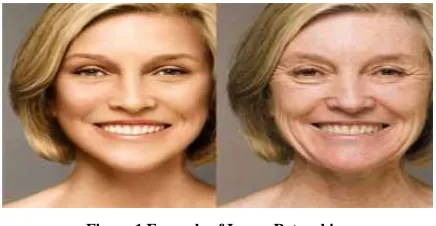
[image:2.612.334.553.204.324.2] Image Retouching: Image Retouching can be considered as a less harmful kind of digital image forgery [3]. Retouching is nothing but applying some image processing algorithms to enhance or to reduce certain features of an image. But it doesn’t significantly change the image. It can be considered as soft forging. This type of forging is mainly used by magazine photo editors to make the picture more attractive, still knowing that this kind of image modification is morally wrong.
Figure 1 Example of Image Retouching
In IEEE Digital library, the keyword “Image Retouching” gives only 5 conferences and 1 journal/magazine as a search result, which shows that the image retouching has been less studied by many academician and researchers. The research
[image:2.612.59.277.548.661.2] Image Splicing: This technique is more violent than soft image retouching. Image Splicing is an image-forging technique that involves a composite/ merging of two or more images, the images are combined to create a fake image [4].
Figure 2 Example of Splicing
Splicing is also called as Copy-Paste forgery. It is carried out by taking a region of the source image and pasting it onto another (target) image, thus producing a fake one. It is very likely that this method introduces inconsistencies between the characteristics of the original and created ones. There are multiple methods to identify cut & paste forgery, some of the techniques will be discussed in the next sections. In IEEE Digital library, the keyword “Image Splicing” gives 41 conferences and 5 journal/magazine as a search result, which shows that the image spicing is studied more as compare to image retouching by many academician and researchers. The research timeline was 2004 till 2014, which makes it as open research problem.
International Journal of Emerging Technology and Advanced Engineering
Website: www.ijetae.com (ISSN 2250-2459,ISO 9001:2008 Certified Journal, Volume 4, Issue 8, August 2014)
[image:3.612.339.557.139.231.2]638 In IEEE Digital library, the keyword “Copy-move Attack” gives only 10 conferences and 1 journal/magazine as a search result, which shows that the Copy-move Attack is very-very less studied by many academician and researchers as its research timeline was 2008 till 2013. Currently this is the most recent and open research issue.
Figure 3 Example of Copy-Move forgery
III. FORGERY DETECTION TECHNIQUES
Digital image forgery detection techniques (DIFDT) are classified into active and passive approaches [7]. In the active approach, the digital image requires some preprocessing such as watermark embedding or signature generation at the time of image acquisition; it is mainly based on the watermark computation by the camera. Cryptographic digital signatures and Digital watermarking are being used as a means of image authentication in many applications. The downside of this methodology is that a watermark must be interleaved at the time of capturing; it limits this approach to specially equipped digital cameras. Moreover, there are millions of digital images already on the internet without watermark or digital signature. Hence, in such scenario active approach are not feasible to find the authenticity of the image. In contrast to active approaches, passive techniques operate without any requirement of watermarks or signature embedded in advance. These techniques work on the notion that although digital forgeries may leave no visual clues that indicate tampering, they may alter the underlying statistics of the image.
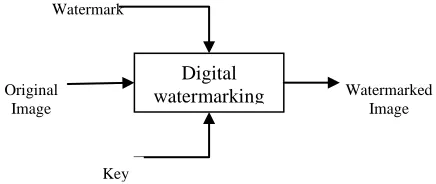
Watermarking [8] method includes calculating a watermark at the source side and hiding it into the original image. At the other side, extract the watermark and give the measure of the tampered image, and then extracting it when it is necessary. The method should be such that any modification made in the image should also affect the inserted watermark. Figure 4 shows the generic framework at the source side.
Figure 4: Generic watermark insertion process
[image:3.612.66.285.208.317.2]At the receiver end the watermark extraction is shown in the figure 5. First we authentic the test image and then we locate the tampered region.
Figure 5: watermark extraction process
Passive techniques assume that original image patterns and statistics are distinguishable even after some image processing. Since the original patterns are constrained by the statistical data. There are two ways in passive forensic techniques [9].
A. Identification of image source
An image may come from various imaging sources like digital camera, computer graphics, scanners etc. however, the different imaging sources have their own different characteristics due to different types apparatus used, different parameters applied and image processing methods applied inside imaging devices. So these inherent patterns can be used as fingerprints to identify the source of the image [9].
Source Digital Camera Forensic Methods: In digital camera image forensic method, the main interest is to determine the source of the image and tampering detection. In existing methods, source identification is accomplished by exploring the various stages of processing inside the camera for obtaining information that distinguishes source cameras. Similarly inconsistencies in image quality are considered as an indication of forgery [10].
Watermark and/or original image
Watermark or Confidence
measure Watermarked
Image
Watermark recovery
Key Watermark
Watermarked Image Original
Image
Digital watermarking
[image:3.612.353.572.301.395.2]International Journal of Emerging Technology and Advanced Engineering
Website: www.ijetae.com (ISSN 2250-2459,ISO 9001:2008 Certified Journal, Volume 4, Issue 8, August 2014) Using JPEG Quantization Tables: Generally JPEG
compression is used to encode images from the digital cameras and different manufacturers typically configure their devices with different compression levels and parameters. Farid [11] exploits this difference by extracting the JPEG quantization table from an image and comparing it against a database of known digital cameras for source identification. Likewise, it can be compared against a database of photo-editing software for signs of tampering. Out of 204 digital cameras used for the experiments, 62 cameras had a unique quantization table while the remaining tables fall into equivalence classes ranging from 2 to 28 in size. Using 5 different versions of Adobe Photoshop, an image (presumably uncompressed) is saved in each of the 13 compression levels and it was found that the JPEG quantization tables used were different from those of the 204 cameras. Thus, by detecting the presence of JPEG quantization tables unique to any particular photo-editing software, it can be determined if the image is authentic or was previously tampered with and saved using a photo-editing software. Using Chromatic Aberration: There are some techniques
in literatures that are introduced for evaluating the variance of the chromatic aberration [12] for identifying the image tampering. The technique uses color channels as an alignment parameters and the metric based on mutual information is considered. The quantification for minimizing error is done between global and local attributes by evaluating the mean angular error. A threshold based technique is used, where if the mean error is more than threshold will signify the image variance across the image. Thereby the image is termed as forged image.
Using Lighting: This technique uses identifying the variances in the orientation of the light source originating from each object in two dimensional models. Evidence of such techniques can be seen in [13][14]. The technique is highly dependent on light source and illumination point.
Using Camera Response Function (CRF): Use of image splicing was also seen in the technique proposed by Hsu et al. [15]. The technique uses geometry invariants as well as some specific operation of image capturing device. Equivalent notion was shared in literature [16]. The splicing border is preliminarily detected and extractions of geometry invariants were carried out from pixels on each portion of the border using specific camera response function. Computation is done for evaluating the consistency using cross-fitting techniques.
The outcome of the technique can show better enhancement for detection of spliced image.
B. Detection of Image alteration
As free image editing softwares like Adobe Photoshop, GIMP, Paint Shop etc are available, tampering is no longer difficult. Certain manipulations not only change the contents, they also alter the meaning of the image.
Methods based on conventional cryptography: In Image hashing methods based on cryptography, first compute a message authentication code (MAC) from image features using a hash function [14][21].The generated hash will be further encrypted by a secret key and either embedded into the image or transmitted along with the image. The receiver similarly computes the hash from the received image and decrypts from the same key and then compares one with the other. If any changes in the hashes is observed then the image is declared as manipulated otherwise declared as authentic.
Copy-paste and Splicing detection: One of the common made image tampering is splicing, where the regions of undesirable things in an image are replaced by other chunks of the same image. The literatures described in References [19−23] are based on block matching. In these methods, images are divided into small blocks and the features of each block are extracted, then the duplicated regions are identified by comparing the extracted features. The difference in these methods is the consideration of different features. In [19], Fridrich, et al., considered the DCT cefficients for each block. Popescu, et al., [20] adapted the principal component analysis (PCA to achieve a more solid representation of each block which minimizes the number of image blocks and hence the PCA feature vector). In [21], Luo and Huang exploited the seven features for each block and thereby the experimental results demonstrated by them showed better performance for post image processing operations. Later, few researchers presented Fourier-Mellin transform (FMT) as signature, since FMT does not vary to rotation and scaling. Wu et al recommended the use of Log-Polar Fourier transform (LPFT) as block signature to produce invariance to rotation and scaling.
International Journal of Emerging Technology and Advanced Engineering
Website: www.ijetae.com (ISSN 2250-2459,ISO 9001:2008 Certified Journal, Volume 4, Issue 8, August 2014)
640 Similarly the statistical feature moments are calculated for each nine high-frequency sub-bands as features. The same processes are executed for the prediction of wavelet coefficients to acquire other 36-D features. So, seventy two discrete feature vectors are generated for each test image. At the end, an SVM classifier is applied.
Ng et al. extended this work by predicting the bi-coherence features of authentic images and embedding the image features that featured the variance of the performance. Finally SVM is employed. The accuracy of detection is increased about 70%.
IV. RELATED WORK
Manudhane et al. [25] focused only on copy- move forgery detection methods that are categorized generally into two broad approaches- block-based and key-point. Methodology (generalized as well as approach specific) of copy move forgery detection is presented in detail. Copied region is not directly pasted but manipulated (scale, rotation, adding Gaussian noise or combining these transformations) before pasting.
Al-Qershi et al. [26] described the current state-of-the-art of passive copy-move forgery detection methods. The current key issues in developing a robust copy-move forgery detector are identified, and the trends of tackling those issues are addressed. This paper also surveyed the algorithms that were dedicated to copy-move forgery because it is the most common forgery type. For comparison purposes, one algorithm in each category was considered to represent its category.
Chang et al. [27] acknowledged that most accepted and permissible operations on images are global manipulations for image enhancement and image compression like low-pass filtering and JPEG compression etc, whereas illegal data manipulations are usually localized distortions. To exploit these forgeries, they proposed an image authentication scheme where the signature generated during image recording is used. The method is robust against extremely low-bit-rate content-based compression.
Ahmed et al. [28] proposed a robust image pattern authentication method which uses correlation-based digital watermarking technique. In the embedding stage, to the image’s Fourier magnitude spectrum they hide a phase-based signature of the image. As usual at the detector side reverse operation takes place, the detector calculates the Fourier transform from the watermarked image and hence the embedded signature. Finally, Authentication performance is evaluated by a correlation test i.e. by comparing the extracted signature from the original image and the signature computed from the watermarked image.
Lu et al. [29] presented a digital signature scheme which constructs the structural digital signature (SDS) by using the image’s contents in the wavelet transform domain for image authentication. The main characteristic of the structural digital signature algorithm is that it can tolerate content-preserving modifications in the mean while it detects content-changing modifications. Many incidental manipulations, which were found out as malicious in the earlier digital signature verification schemes or fragile watermarking schemes, were correctly detected by SDS. Lee et al. [1] illustrated another reversible image authentication technique, it is based on watermarking where if the image is authentic, the distortion due to embedding can be completely removed from the watermarked image after the hidden data has been extracted. This technique utilizes histogram characteristics of the difference image and modifies pixel values slightly to embed more data than other lossless data hiding algorithm.
Singh et al. [30] discussed feature extraction of fingerprint image using canny edge detection and Prewitt edge detection. Feature Similarity Indexing of image is used to generate the matching score between the input test image and the original image in the database. The experiments were conducted on available database of Hong Kong Polytechnic University which is available publicly, results achieve recognition accuracy of 96.77% and 97.16%using canny and Prewitt FSIM respectively. Tiwari et al. [31] studied a comprehensive overview of semi fragile based image authentication techniques. In addition to a comparison based on image quality matrix, some observation is also suggested to efficiently develop an effective watermarking technique.
Swathi et al. [32] introduced a new modified digital signature scheme for image authentication. Structural Content-dependent image features as well as the wavelet filter parameterization are integrated into the conventional crypto signature scheme to improve the system robustness and protection. It is specially suited for wireless authentication systems and also to real time applications since the proposed scheme does not require any computational overhead.
International Journal of Emerging Technology and Advanced Engineering
Website: www.ijetae.com (ISSN 2250-2459,ISO 9001:2008 Certified Journal, Volume 4, Issue 8, August 2014)
Also, an unnoticeable watermark is difficult to embed in white regions of the document binary image, making such regions vulnerable to hostile attacks.
Bhattacharya et al. [34] proposed an efficient image authentication technique by using an artificial neural network, by interleaving the handwritten signature image in selected Discrete Wavelet Transform sub-band of the image. At the receiver side, signature image is extracted from it and verified with a model signature using ANN and hence image authentication is accomplished.
Hassan et al. [35] demonstrated a new vector quantization (VQ) attack that can be applied to self-recovery image authentication. In this attack, the codebook contains authenticated blocks with their encrypted codes and displacement vector(s).
Consequently, the proposed replacement procedure is used to generate a counterfeit image that can pass the verification process without triggering.
Sathik et al. [36] proposed a semi-fragile watermarking method which embeds watermark signal into the image to be secured. The watermark is designed in such a way that integrity is proven if any contents of the image are not been altered and against few image processing algorithms. The watermark will be generated from the features of the image as a binary pattern and embedded in to the image in the frequency domain in the wavelet sub band. Similarity Ratio (SR) and Peak Signal to Noise Ratio (PSNR) are evaluated to check the image quality.
Additional Studies exclusively addressing the image forensics are discussed in Table 1.
Table 1
# Author Technique Outcome Inference
1 Fan et al. (2013)-IEEE [37]
JPEG Anti-forensic process Database: UCID corpus
Forensic undetectability and visual quality of processed images.
Inconsistency in convergence noticed in outcome
2 Conotter et al. (2013-IEEE [38]
Designed a mathematical model for blockwise JPEG compression and full frame linear filtering
Database: UCID – corpus
improved accuracy is achieved with
the separation of the filters.
The method works by knowledge of the quantization step.
3
Valenzise et al.
(2013)-IEEE
[39]
anti-forensic method revealing the traces of JPEG compression
Database: UCID corpus
less prone to produce false positives when the image has been corrupted by other non-malicious kinds of
noise.
Problem of compression anti-forensics in the field of video coding is not considered
4
Wo
et
al.
(2014)-JCIS
[40]
Hashing Scheme
Database: Not Mentioned
Robust against Content-preserving Manipulations
-hash functions resiliency not discussed
5
Wang
et
al.
(2005)-IEEE[41]
Maximum detector and the thresholding detector for colluder identification
Database: Lena & Baboon image
Resilient against collusion attack
-Vulnerability Analysis is not resilient against other types of attacks
6
Lin
et
al.
(2009)-IEEE
[42]
Designed an image source coding forensic detector
Database: Lena, Baboon, Barbara, Couple, Man, Boat, and Tank
Highly extensible in selection of encoded with variable PSNR range
multiple image
source coding forensics are not discussed
7 Stamm et al. (2010)-IEEE [43]
Statistical Intrinsic image Database: Not Mentioned
detects the global addition of noise to a previously JPEG-compressed image
Very useful tools for identifying image manipulations
8 Cao et al. (2008)-IEEE [44]
Introduced a demosaicing detection framework
Database: Not Mentioned
Effective detection of demosaicing regularities
-Effectiveness of model not benchmarked with existing image forensics techniques
9 Zheng & Chang (2014)-JCIS [45]
Haris Corner Point
Database: Columbia University image data sets
Effective against detection of copy-move forgery
International Journal of Emerging Technology and Advanced Engineering
Website: www.ijetae.com (ISSN 2250-2459,ISO 9001:2008 Certified Journal, Volume 4, Issue 8, August 2014)
642 10 Patil et al.
(2014)-IJSTR [46]
Used SVD & Cellular Automata To Detect Image Manipulation In Facebook
Database: Real Images On Facebook
No discussion of extensive outcome
Outcome, algorithm efficiency, benchmarking is missing
11 Bharthi (2014)- ICGICT [47]
Dempster-Shafer’s Theory of Evidence, Fuzzy Theory and Bayesian approach Database: Not Mentioned
No discussion of extensive outcome
Outcome, algorithm efficiency, benchmarking is missing
12 Chierchia (2014)-IEEE [48]
Photo response non-uniformity (PRNY) based method
Database: Real-time images
With medium-size forgeries, 96x96 pixels, the performance gain is much more limited
Algorithm efficiency, benchmarking is missing
V. OPEN ISSUES / RESEARCH GAP
There is an increasing requirement for advanced image forensics methods, and numerous strategies have been proposed to address different parts of computerized picture criminology issue. Albeit a significant number of these procedures are exceptionally guaranteeing and imaginative [42][45], e.g. they all have constraints and none of them without anyone else's input offers a decisive result. At last, these methods must be consolidated together to acquire solid choices. In any case, there are still two significant difficulties to be met by picture legal sciences research. • Performance Evaluation and Benchmarking. Basically
the main worry that emerges concerning scientific utilization of proposed procedures is the achievable execution regarding false-caution and genuine recognition/distinguishing proof rates and clear understanding of the variables that influence the execution. Starting here of perspective, large portions of the proposed strategies could be all the more faultlessly characterized as verification of idea analyses. To further refine these strategies, execution benefits must be characterized all the more plainly and fitting test and assessment datasets must be planned and imparted. Studies e.g. [44]-[48] are not efficiently analyzed and benchmarked; hence, their effectiveness is still yet to be measured. However, few studies address such issues. • Robustness Issues. The most difficult issue that image
forensic examination confronts is the strength to different normal and pernicious picture handling operations. Proposed routines are not planned and tried thoroughly to perform under the most troublesome conditions, and, in addition, most procedures could be effectively evaded by a new technique. Since the data used by the image forensic methods is basically in subtle point of interest, it might be effectively uprooted. It is a matter of time for such apparatuses to be accessible for open utilization.
Strategies must be composed and assessed considering this admonition. Beating these difficulties requires the advancement of a few novel systems and careful assessment of their confinements under more general and down to earth settings. This might be attained as a team with image forensics specialists and through their persistent sentiment on the created systems.
International Journal of Emerging Technology and Advanced Engineering
Website: www.ijetae.com (ISSN 2250-2459,ISO 9001:2008 Certified Journal, Volume 4, Issue 8, August 2014)
Hence, as a research gap, the area of image forensic will require to be investigated more for exploring a computationally efficient technique that has higher supportability of large number of image. No significant studies were explored that uses efficient mathematical modelling using feature based technique for detecting the forged part of the image.
VI. CONCLUSION
This paper has discussed the essentials of image forensics and has discussed the various techniques used for detection of forged part of the image. The study has discussed image retouching, image splicing as well as copy move attack as majority of the literatures considers such types of image attacks. From the study it was evident that all such categories of image forgery technique have their potential adversarial feature depending upon the scale of vulnerability of the victim. The paper has also discussed about the forgery detection techniques, where multiple standard techniques were discussed. Finally the some of the recently published research literatures were reviewed and open issues along with research gap is discussed. Our work towards future direction will be to design a model that can effectively overcome such research gap for the purpose of cost effective design of image forensics applications.
REFERENCES
[1] S-K.Lee, Y-H. Suh, Y-S. Ho. "Reversible Image Authentication Based on Watermarking." IEEE International Conference In Multimedia and Expo, pp. 1321-1324, 2006
[2] A.Tiwari, M.Sharma, “Semifragile Watermarking Schemes for Image Authentication- A Survey”, International Journal of Computer Network and Information Security, Vol.2, pp. 43-49, 2012
[3] P.S. Burvin, J.M. Esther, “Analysis of Digital Image Splicing Detection.” IOSR Journal of Computer Engineer, Vol.16, Iss.2, pp.10-13., 2014
[4] T.T. Ng, S.F.Chang, “A model for image splicing”. In: Proceedings ofICIP, vol. 2, pp.1169–1172, 2004
[5] A. Popescu, H. Farid, “Exposing digital forgeries by detecting duplicated image regions”, Tech. Rep. TR2004-515, Department of ComputerScience, Dartmouth College, 2004
[6] W.Q. Luo, J.W. Huang, G.P. Qiu, “Robust detection of region-duplication forgery in digital image”. In Proceedings of ICPR, vol.4: pp.746–749, 2006
[7] P.Deshpande, “Pixel Based Digital Image Forgery Detection Techniques” IJERA, Vol 2, pp.539-543, 2012
[8] A.Tiwari, M.Sharma, “Semifragile Watermarking Schemes for Image Authentication- A Survey”, International Journal of Computer Network and Information Security, Vol.2, pp. 43-49, 2012
[9] L. Weiqi, QU Zhenhua, P. Feng, H. Jiwu, “A survey of passive technology for digital image forensics.” Frontiers of Computer Science in China-Springer, vol.1, Iss.2, pp.166-179,2007
[10] T. V. Lanh, “A survey on digital cameras image forensic techniques.” IEEE International Conference on Multimedia and
[11] H. Farid, “Digital Image Ballistics from JPEG
Quantization”,Technical Report, TR2006-583, Dartmouth College, ComputerScience, 2006.
[12] M. K. Johnson and H. Farid, “Exposing Digital ForgeriesThrough Chromatic Aberration”, In ACM Multimedia and securityWorkshop, Geneva, Switzerland, 2006.
[13] M. K. Johnson and H. Farid, “Exposing Digital Forgeries byDetecting Inconsistencies in Lighting”, In ACM Multimedia andSecurity Workshop, New York, NY, 2005
[14] P. Nillius and J.O. Eklundh, “Automatic estimation of theprojected light source direction”, Proc. of IEEE Computer SocietyConference on Computer Vision and Pattern Recognition, Vol.2, ISSN: 1063-6919, 2001
[15] Y.-F. Hsu and S.-F. Chang, “Detecting Image Splicing UsingGeometry Invariants and Camera Characteristics Consistency”, ICME, Toronto, Canada, July 2006
[16] Z. Lin, R. Wang, X. Tang, and H.-Y. Shum, “Detectingdoctored images using camera response normality andconsistency,” CVPR, pp. 1087–1092, 2005
[17] M.MohamedSathik, S.S.Sujatha, “Authentication of Digital Images by using a semi-Fragile Watermarking Technique”, International Journal of Advanced Research in Computer Science and Software Engineering, Vol.2, Issue.11, 2012
[18] H. Farid, “Digital Image Ballistics from JPEG
Quantization”,Technical Report, TR2006-583, Dartmouth College, ComputerScience, 2006
[19] J. Fridrich, D. Soukal, J. Lukas, “Detection of copy-move forgery indigital images”. Processings of DFRWS, Cleveland, OH, USA, pp.5-8 Aug. 2003
[20] A. Popescu, Farid H. “Statistical Tools for digital Forensics”, Proceedings of 6th international conference on Information Hiding, Springer-verilag, pp.127-147, 2004
[21] WQ. Luo, JW Huang, G.P. Qiu, “Robust detection of region-duplicationforgery in digital image”, Proceedings of ICPR, vol. 4, pp.746-749, 2006
[22] T.-T. Ng, S.-F. Chang, and Q. Sun, “Blind Detection of Photomontage Using Higher Order Statistics”, IEEE International Symposium on Circuits and Systems (ISCAS),Vancouver, Canada, May 2004
[23] J. Dittmann, A. Steinmetz, “Content-based digital signature for motion pictures authentication and content-fragile watermarking”. Proceedings of the IEEE international conference on multimediacomputing and systems, vol.2, pp 209–213, 1999 [24] H. Farid, “Detecting Digital Forgeries Using ispectralAnalysis”,
Technical Report, AIM-1657, MIT AI Memo, 1999.
[25] K. Manudhane, M.M. Bartere, “Methodology for Evidence Reconstruction in Digital Image Forensics”, Computer Engineering and Intelligent Systems, Vol.4, No. 13, 2013
[26] A.Qershi, M.Osamah, B.E. Khoo. "Passive detection of copy-move forgery in digital images: State-of-the-art." Forensic science International, Vol. 23, No. 1, pp. 284-295, 2013.
[27] E-C.Chang, M.S. Kankanhalli, X.Guan, Z. Huang, Y. Wu. "Robust image authentication using content based compression." Multimedia Systems, Vol. 9, No. 2, pp. 121-130, 2003
[28] F.Ahmed, I.S. Moskowitz. "Correlation-based watermarking method for image authentication applications."Optical Engineering, Vol.43, No. 8, pp.1833-1838, 2004
International Journal of Emerging Technology and Advanced Engineering
Website: www.ijetae.com (ISSN 2250-2459,ISO 9001:2008 Certified Journal, Volume 4, Issue 8, August 2014)
644 [30] H.A Singh, R.Gayathri, “Image Authentication Technique Using
Fsim Algorithm”, International Journal of Engineering Research and Applications, Vol.2, Iss.2. pp.1129-1133, 2012
[31] A. Tiwari, M. Sharma, “Semifragile Watermarking Schemes for Image Authentication- A Survey”, International Journal of Computer Network and Information Security, vol.2, pp.43-49, 2012
[32] K S. Swathi, S.G. Krishna, “Secure Digital signature scheme for Image authentication over wireless channels”, International Journal of computer Technology and Applications, Vol 2, Iss.5, pp.1472-1479, 2011
[33] N.B. Puhan, A.T.S. Ho, F. Sattar, “Erasable Authentication Watermarking in Binary Document Images”, Proceedings of the Second International Conference on Innovative Computing, Informatio and Control, ISBN:0-7695-2882-1, pp.288, 2007 [34] T. Bhattacharya, S. Hore, B.S.R Chaudhuri. “An Image
Authentication Technique by Handwritten Signature Verification using DWT and ANN”. International Journal of Computer Applications, vol.47, Iss.21, pp.:35-40, June 2012
[35] A.M. Hassan, YMY. Hassan, M.A.A, Wahab, “A New Vector Quantization Attack on Self-Recovery Image Authentication”, International Conference on Communication and Information Technology (ICCIT-IEEE), 2012
[36] M.M. Sathik, S.S. Sujhata, “Authentication of Digital Images by using a semi-Fragile Watermarking Technique”, International Journal of Advanced Research in Computer Science and Software Engineering, Vol.2, Iss.11,Nov.2012
[37] W. Fan, K. Wang, F. Cayre, and Z. Xiong, “A variational approach to jpeg anti-forensics”, IEEE International Conference on Accoustic, Speech, and Signal Processing, pp. 3052-3062, 2013
[38] V. Conotter, P. Comesana, F. Perez-Gonzalez , “Forensic analysis of full-frame linearly filtered JPEG images”, IEEE International Conference on Image Processing, pp.4517-4521, 2013
[39] G. Valenzise, M. Tagliasacchi, S. Tubaro, “Revealing the Traces of JPEG Compression Anti-Forensics”, IEEE Transactions On Information Forensics And Security, Vol. 8, No. 2, February 2013
[40] Y. Wo, G. Han, B. Zhang, J. Han, “Geometrically Robust Image Hash with Tamper Detection and Location”, Journal of Computational Information Systems, vol.10, Iss. 2, pp.643–654, 2014
[41] Z. J. Wang, M. Wu, H. V. Zhao, “Anti-Collusion Forensics of Multimedia Fingerprinting Using Orthogonal Modulation”, IEEE Transactions on Image Processing, Vol. 14, No. 6, June 2005 [42] W. S. Lin, S.K. Tjoa, H. V. Zhao, K. J. R. Liu, “Digital Image
Source Coder Forensics Via Intrinsic Fingerprints”, IEEE Transactions On Information Forensics And Security, Vol. 4, No. 3, September 2009
[43] M. C. Stamm, K. J. R. Liu, “Forensic Detection of Image Manipulation Using Statistical Intrinsic Fingerprints”, IEEE Transactions On Information Forensics And Security, Vol. 5, No. 3, September 2010
[44] H. Cao, A. C. Kot, “Accurate Detection of Demosaicing Regularity for Digital Image Forensics”, IEEE Transactions on Information Forensics & Security, pp.899-910, 2008
[45] J.Zheng, L. Chang, “Detection Technology of Tampering Image Based on Harris Corner Points”, Journal of Computational Information Systems, vol.10, Iss. 4, pp.1481–1488, 2014
[46] S S.Patil, A N.Patil, N P.Patil, J D.Dhongde, B S.Khade, “Digital Image Forgery Detection Using Basic Manipulations In Facebook”, International Journal Of Scientific & Technology Research, Vol.3, Iss.3, March 2014-
[47] D.G.Bharathi, G.Selvavinayagam, “A Image Forensics Analysis by Using DST, Fuzzy and Bayesian Approaches”, International Journal of Innovative Research in Computer and Communication Engineering, Vol.2, Special Issue 1, March 2014