International Journal of Emerging Technology and Advanced Engineering
Website: www.ijetae.com (ISSN 2250-2459, UGC Approved List of Recommended Journal, Volume 8, Issue 5, May 2018)
206
Data hiding through Image Steganography using Modified LSB
Method
Ankita Khare
1, Prof. Bhavana Gupta
2 1M-tech Scholar, 2Associate Professor, Department of Computer Science Engineering, Oriental College of Technology, Bhopal Abstract-- Information security, Steganography is a vast
research area of computer science that develops numerous intelligent systems for secret communication. Image steganography is the most prevailing dimension due to its frequency on the internet in this field. The objective of this research work is to provide high level of security, maximum embedding capacity, efficiency and reliability for secret communication using steganographic techniques. In this proposed work we present an image based steganography technique that integrates Least Significant Bits (LSB) techniques and pseudo random coding technique to boost the protection of the communication. This combination provides better security for hiding confidential message and formerly reduces time complexity. Finally, effectiveness of the proposed algorithm is tested using encryption time, Avalanche impact, PSNR value.
Keywords: - Steganography, Encryption, Decryption, Advance encryption standard (AES) technique, least significant bit (LSB).
I. INTRODUCTION
Information security in today’s world is a sense of declaration against threats, means that important information must be secured and there risks of attacks as well as controls must be balanced. Information security actually starts with the emergence of first main frame computer. But with the introduction of information security many viruses and code breakers were also developed that breaks the security channel and damage the important information.
Information security is further divided into three dimensions that are:
Watermarking: Watermarking could be a familiar image prototype that tone will be of darker or lighter, specifies the copy rights of specific documents.
Cryptography: Cryptography arrives from a Greek which sense concealed or covert writing for communication that is secure within the existence of person who is not authorized. Cryptography really hides the data from amerceable sources.
Steganography: Steganography is a combination of two words “stegano” means covered and “graphy” means writing. Steganography[2] is an art of hiding the existence of the message so it dose attract the attention toward the secret message, hence third party or illegal person cannot be able to detect the message.
1.1Types of Cryptography
There are main two types of cryptographic algorithm.
Symmetric key cryptography
Asymmetric key cryptography
1.2 Types of Steganography
Text Steganography: It hides the text behind some other text file. In this type of steganography the quantity of redundant text to hide the confidential message is limited in text files. Examples of text steganography techniques are selstive hiding, web pages etc.
Image steganography: this is the very difficult and famous techniques of steganography because of the limitation of HVS (Human visual System). The color vast range cannot be detected by eyes of human and any irrelevant modification in the image quality than results from steganography is easily detected.
Audio Steganography: It is also one more hard form of steganography as humans are effortlessly capable of detecting even a minute modification in audio quality.
International Journal of Emerging Technology and Advanced Engineering
Website: www.ijetae.com (ISSN 2250-2459, UGC Approved List of Recommended Journal, Volume 8, Issue 5, May 2018)
207
II. LITEREATURE REVIEW
Many active researchers have proposed various methods to embed the information message after encryption. Some researchers hide message contained by any document or text file or even sound file whereas others use image files.
Now-a-days everyone works on steganography systems to cover their objects using images. I have examined numerous such algorithms and lots of techniques that have been projected to conceal the secret data at the back of cover image without leaving any sort of mark.
Ibrahim et.al(2011) In this paper, A new set of algorithm is designed by the author for hiding data in images by means of Steganography. Here, in this algorithm binary codes and image pixels are used to hide data. In this method, for Maximising the data storage capacity, It is firstly converted into Zip file and then to the binary codes. The application of this algorithm system is called Steganography Imaging System (SIS). Then the viability of the proposed algorithm is tested to observe, whether it is viable or not. Algorithm, when applied and tested with the naked eyes, it remains unchanged and cannot be noticed. When the stego images are tested using PSNR value. The PSNR value of those images observed higher and hence, this method of data hiding is very viable and liable for hiding our data from getting leaked[1].
Khaled Loukhaoukha et.al.(2012) A new design has been created using Rubik's cube principle. In the proposed algorithm, the author has shuffled and mixed the data with its identical but different data using the Rubik's cube method.XOR operation is applied to intermix the image data in rows and columns by applying two secret keys. In this method of data encryption, the time taken for hiding data is comparatively less and the method is also very liable as well as viable as per the data security, data encryption and its capability to defend its data from the various attacks of data hacking. The experiment shows tremendous results and is used in the real time application for communication applications [2].
Seetaiah Kilaru et.al.(2013) This paper put a light how to propose novel algorithm planted on the toy principle Rubik cube. Here, XOR operator along with two secret keys is used to design algorithm. The results also showed that the proposed algorithm is efficient in cases of eye sensitivity and key sensitivity. The main reason behind this algorithm is to produce confusion between the original and encrypted images in most possible manner. XOR operator is applied to rows and columns of an image in such a way that using the same key. After that key is flipped and applied again to the same number of rows and columns to reconstruct the image [3].
Devi, Kshetrimayum Jenita et.al. (2013) In this set, The image based steganography that combines Least Significant Bits techniques and pseudo random encoding technique on images for improving the security of the communication, is proposed. In this method, the Least Significant Bits (LSB) of the cover image is replaced with the Most Significant Bits (MSB) for hiding out the communication data without actual distortion or destruction of image data property. This LSB-based technique is the most efficient and challenging method for getting hacked as it is difficult to differentiate between the cover-object and stego-object, if few LSB bits of the cover object are changed or replaced with another bits. In the Pseudo-Random technique, keys in random are used. In the embedding process, Pseudo-Random Number Generator is needed, as seen in the study [4].
Navneet Kaur et.al. (2014) Many observations and reviews been given on digital steganography methods in this paper. The comparison of Least Significant Bit based Steganography, Discrete Cosine Transform based Steganography and Discrete Wavelet Transform based steganography have been made and their advantages and disadvantages are discussed[5].
A.K. Gulve et.al. (2014) this paper put a light on all the important aspects of Steganography and data encryption. The LSB steganography technique in images can be made more complicated by further using combination of Cryptography and Pseudo-random number generator. The given method provides security of both data hiding and data encryption. The use of Pseudo-Random Number sequence helps the message bit to spread across 3 (4th, 5th and 6th) LSB’s randomly, without the proper key. It is most difficult and almost impossible to detect the exact address of the LSB which holds the message bits. By using only a single RBG component from the pixel, the distortion created by Steganography is negligible, But at the cost of capacity to hold the data is high [7].
International Journal of Emerging Technology and Advanced Engineering
Website: www.ijetae.com (ISSN 2250-2459, UGC Approved List of Recommended Journal, Volume 8, Issue 5, May 2018)
208
B. Srinivasan et.al. (2015) a new method has been made by adding up the three security channel in digital data image by wrapping up the message in digital image. For many different cover images and secret images this approach was executed and tested. Through their PSNR values the final stego-image and original image are compared. In this set of paper a new algorithm named, Non-uniform segmentation algorithm have been introduced named Non-Uniform Block Adaptive Segmentation on Image (NUBASI). The key function of the given algorithm is to create various numbers of segmented images with different dimensions, for embedding the secret messages. The Author used LSB replacement method. An arbitrary pattern is preferred by an algorithm Random Pattern Number Generator (RPNG). A great result is observed by using this method on Original image and stego-image PSNR values [9].
[image:3.612.67.546.363.672.2]Ashwini B. Akkawar et.al. (2016) In this paper, the important aspects of a new steganography technique for embedding both text or image in cover images by using LSB & Link List method is used and implemented. This steganography technique is completely based on pixels. The secret messages are embedded directly into 24- bit colour image. In this method, two ways are provided for embedding the secret data inside cover image such as sequential encoding and random encoding for both text & image. For the purpose of data security, encryption technique is used with a user-defined key. RGB image format is used to enhance the quality of the stego image. Both of this encoding technique works successfully using this hybrid method and hides the text data & image in cover images efficiently. By using same method, Audio or Video can also be used as cover object but it increases the payload capacity of secret data [10].
Table 1:
Analysis of the available recent algorithms
International Journal of Emerging Technology and Advanced Engineering
Website: www.ijetae.com (ISSN 2250-2459, UGC Approved List of Recommended Journal, Volume 8, Issue 5, May 2018)
209
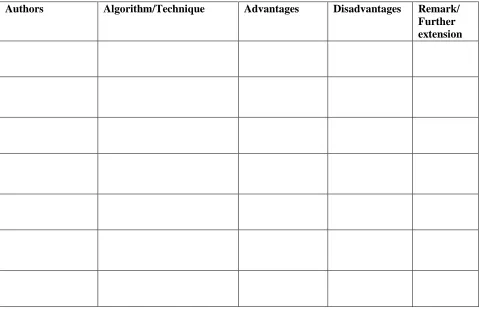
In the comparison table 1 above, some existing recent algorithms are discussed, their advantages, disadvantages, limitation and further extension is discussed in the given table.
III. PROPOSED WORK
This work presents data hiding techniques by joining encryption and steganography to achieve high quality hidden secret image.
Proposed algorithm is a combination of proposed Encryption / decryption Algorithm and proposed Steganography Algorithm.
Proposed encryption algorithm is designed in a way that it can encrypt both text file as well as image file.
Proposed algorithm works on bit manipulation. It is block cipher symmetric key algorithm .
3.1Encryption algorithm
1. Input a key of arbitrary length
2. Generate a pseudo – random no. (RN) by using following rules.
a) Add all the ASCII Value of characters of key.
b) Divide the result by 32 and the remainder comes out is Pseudo Random No (RN)
3. Convert the key into binary format & if it’s lengthy after conversion is less than 128, then perform padding operation using following rules
a) Perform XOR operation on each bit of a key moving left to right with its RN position bit
b) Result of step 3 (a) concatenate with the key
c) Repeat above steps 3 a & 3b until becomes greater or equal to 128 bit
4. Extract Most Significant 128 bits from key, Hence the final key become of 128 key.
5. Now generate 8 different keys k[0] to k[7] by using following rules.
a).K[0]=XOR all bits by its RN position bit in key b).K[1]= Circular left rotate K[0] by RN position c).K[2]=XOR all bits by its RN position bit in K[1]. d) K [3] =Circular left rotate K [2] by RN position. e) K [4] = XOR all bits by its RN position bit in K[3]. f) K [5] =Circular left rotate K [4] by RN position. g) K [6] = XOR all bits by its RN position bit in K[5]. f) K [7] =Circular left rotate K [6] by RN position.
6. Now, Divide the plain text in bit format into 128 bits chunks, if the last chunk does not have 128 bits then pad it by 0’S
7. Now for each chunk do the following:
a) Divide the chunk into 4 equal parts ( i.e of 32 bits)[pt1,Pt2,Pt3,Pt4].
b) Repeat the following for ( i=0 to i=7) (i) Pt1=Left rotate (Pt1) by RN (ii) Pt2=XOR all bits of Pt2 by RN bit (iii) Pt3= Left rotate (Pt3) by RN (iv) Pt4= XOR all bits of Pt4 by RN bits (v) Divide key K[i] into 4 equal parts [K1, K2, K3, K4] from M.S.B.
(vi)XOR (Pt1,K1),XOR (Pt2,K2),XOR(Pt3,K3), XOR(Pt4,K4).
(vii)Pt1=XOR all bits by Pt1 by RN. (viii) Pt2=Left rotate (Pt2) by RN. (ix) Pt3= XOR all bits by Pt3 by RN. (x) Pt2=Left rotate (Pt4) by RN. 8. Result of Step 7 is cipher text of given Chunk.
3.2 Decryption algorithm: it’s just a reverse process of encryption algorithm
3.3 Steganography algorithm:
Proposed Stegnography algorithm is Modification of Standard LSB Method.
Steps of Steganography Algorithm
1. Select a cover image having no. Of pixels equals to 8/3 bits in cipher text
2. Hide all the bits of the Cipher text behind R, G, and B Component using LSB method.
3. Now perform the analysis Using the mentioned Example:
Let consider the bits to be hide is 1011 & Pixels of cover image are 10011110, 00010111, 11111110 & 01010111.
International Journal of Emerging Technology and Advanced Engineering
Website: www.ijetae.com (ISSN 2250-2459, UGC Approved List of Recommended Journal, Volume 8, Issue 5, May 2018)
210
It is shown from above out of 4 pixels 3 has been changed so distortion % is 75%.
Now divide all the pixels into 4 groups on the basis of 6th & 7th bits are 00 then belongs to group 00, similarity created group 01 group 10, group 11.
Now if in each group changing % is more than 50% then insert all the L.S.B pixels of that group
Although in above example all pixels are belong to group11 & changing % is more than 50% therefore insert all L.S.B of pixels hence we have
10011110,00010111,11111110,01010110 & marked the gropu as inserted group so that it can be detected at reciver end . Now compare this pixels , the distortion % is 25%.
IV. EXPERIMENTAL RESULTS
Here, I experimentally evaluated proposed algorithm and compare it with DISEWRCP Algorithm[8]
4.1 Evaluation method and experimental result of proposed algorithm
Encryption plays an important part in information security. Therefore, it is necessary to evaluate the performance of encryption and decryption algorithms. The evaluation is done on three parameters: execution time and avalanche effect and PSNR . I analyzed and compare the
proposed algorithm with DISEWRCP [8] on above three parameters. In this section, I showed the experimental results of Proposed algorithm.
4.1.1Execution time of proposed Encryption and decryption Algorithm
Execution time of encryption algorithm is the time required to encrypt the file and that of the decryption algorithm is the time required to decrypt the file. Execution time increases with the increase in file size.
Table 4.1:
Execution time of proposed encryption Algorithm and DISEWRCP encryption Algorithm
File Size in KB
Encryption Algorithm
( Execution Time in Second)
DISEWRCP [8] Proposed Algorithm
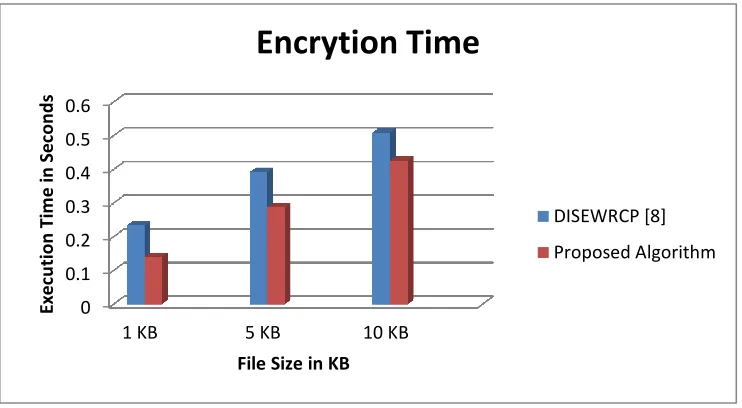
1 KB 0.234 0.140
5 KB 0.392 0.287
International Journal of Emerging Technology and Advanced Engineering
Website: www.ijetae.com (ISSN 2250-2459, UGC Approved List of Recommended Journal, Volume 8, Issue 5, May 2018)
[image:6.612.117.488.140.344.2]211
Figure 4.1: Results of Execution time of proposed encryption algorithm and DISEWRCP algorithm (2016)
It is clear from the table 4.1 & figure 4.1 that the execution time of proposed algorithm is very less as compare to DISEWRCP algorithm. Example 1KB file require0.234 second to encrypt where as Proposed algorithm require 0.140 seconds.
4.1.2 Avalanche effect
It is an enviable property in which if you change a one bit in input then its lead to a major bit change in output of cipher text. Some cipher systems have the property in which a small change in the input results in a very large change in the output.
Table 4.2:
Avalanche effect of DISEWRCP algorithm & Proposed algorithm
File Size in KB
Avalanche Effect
DISEWRCP [8] Proposed Algorithm
Single bit change in
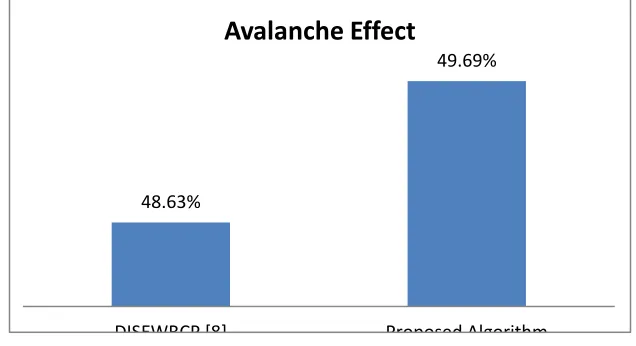
key 48.63 % 49.69% 0
0.1 0.2 0.3 0.4 0.5 0.6
1 KB 5 KB 10 KB
Exec
u
tion
Ti
m
e
in
Sec
o
n
d
s
File Size in KB
Encrytion Time
DISEWRCP [8]
[image:6.612.95.512.469.632.2]International Journal of Emerging Technology and Advanced Engineering
Website: www.ijetae.com (ISSN 2250-2459, UGC Approved List of Recommended Journal, Volume 8, Issue 5, May 2018)
212
Figure 4.2: Avalanche Effect of DISEWRCP algorithm and proposed algorithm
It is clear from the table 4.2 and figure 4.2 that the avalanche effect of Proposed algorithm is greater than the
DISEWRCP algorithm [2016].
4.1.3 Peak Signal to Noise Ratio
[image:7.612.146.464.132.305.2]Peak signal to noise ratio is a term used to find ratio between the highest possible value of a input signal and the rate of distorting noise that change the quality of its representation. PSNR is generally articulated in concerned of decibel.
Table 4.3:
PSNR value Comparison between proposed algorithm and DISEWRCP algorithm (2016).
File Size in KB
PSNR Value
DISEWRCP
[8]
Proposed Algorithm
Single bit change in key
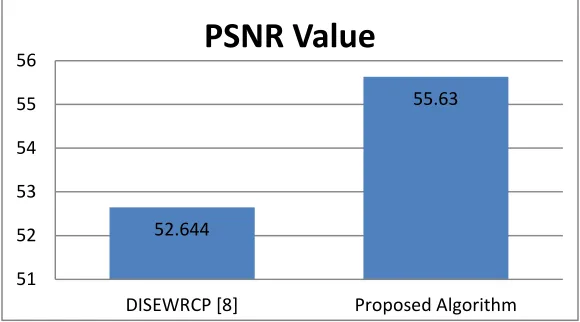
52.644
55.63
48.63%
49.69%
DISEWRCP [8] Proposed Algorithm
International Journal of Emerging Technology and Advanced Engineering
Website: www.ijetae.com (ISSN 2250-2459, UGC Approved List of Recommended Journal, Volume 8, Issue 5, May 2018)
[image:8.612.161.451.132.293.2]213
Figure 4.3 PSNR Comparison between DISEWRCP Algorithm (2016) and proposed algorithm.
Table 4.3 shows the experimental results and figure 4.3 shows that Peak to Signal ratio of proposed algorithm is for 1 KB file is higher as compared to that of DISEWCRP algorithm
V. CONCLUSION
With the projectile like growth of technologies in the field of computers and internet, security of data is an important concern in today’s life. In this thesis, I have studied lots of cryptographic algorithms and proposed an improved algorithm and analyzed it with DISEWRCP[8]. Steganography has been known and practiced for centuries. Previously, people would use manual methods for data hiding in which data is placed inside some host file or an object. But after the arrival of digital steganography, the entire method of data hiding has been modified. Digital steganography has totally overtaken the old traditional methods in recent world of computers and internet. Also with the arrival of new methods, the attackers have invented newer techniques to break the code. This in turn gives rise to invention of more secure methods which are even more complex. This paper aims to develop an algorithm which provides more security to the confidential data by first encrypt it by applying a new secure encryption algorithm and then hiding it in some text or document files abundant on the internet .
VI. FUTURE ENHANCEMENT
Improvisations on this work would be possible in the future in a number of ways:
Firstly, this security system encrypts and embeds a confidential message into which is essentially a text document. Now if this cipher message might be further encrypted and sent as a secret message, the attacker would not be able to retrieve the original message.
Secondly, this method could also be improved to compress the original secret message file and then encrypt more than one small compressed secret message files and embed them randomly.
REFERNCES
[1] M. Matsumoto, T. Nishimura, “ Marsenne Twister: A 623-dimensionally equidistributed uniform pseudo-random number generator,” in ACM Transactions on Modeling and Computer Simulation, 1998.
[2] A. Westfeld, A. Pfitzmann, “Attacks on steganographic systems,” in Information Hiding, LNCS, vol.1768, 1999.
[3] J. Fridrich, M. Goljan and R. Dui, “Reliable Detection of LSB steganography in Color and Grayscale Images”, in Proc. ACM Workshop on Multimedia and Security, Ottawa, CA, 5th Oct. 2001, pp. 27-30
[4] R Chandramouli , M Kharrazi and N Memon, “Image Steganography and Steganalysis: Concepts and Practices”, in Proc. 2nd Int. Workshop on Digital Watermarking, Seoul, Korea, 20-22 Oct. 2003, pp.35-49..
[5] Piyush Goel “Data Hiding in Digital Images: A Steganographic paradigm” Indian Institute of Technology Kharagpur, May, 2008 http://cse. iitkgp. ac.in/~abhij/facad/03UG/Report/03CS3003_Piyush_Goel.pdf [6] M. Juneja, P.S. Sandhu, "Designing of robust image steganography
technique based on LSB insertion and encryption," in International Conference on Advances in Recent Technologies in Communication and Computing, pp.302-305, 27-28 Oct. 2009.
[7] Ibrahim, Rosziati, and Teoh Suk Kuan. "Steganography algorithm to hide secret message inside an image." arXiv preprint arXiv: 1112.2809 (2011).
52.644
55.63
51 52 53 54 55 56
DISEWRCP [8] Proposed Algorithm
International Journal of Emerging Technology and Advanced Engineering
Website: www.ijetae.com (ISSN 2250-2459, UGC Approved List of Recommended Journal, Volume 8, Issue 5, May 2018)
214
[8] Hung-Min Sun, Chi-Yao Weng, Chin-Feng Lee, Cheng-Hsing Yang, "Anti-forensics with steganographic data embedding in digital images," in IEEE Journal on Selected Areas in Communications, vol.29, no.7, pp.1392-1403, August 2011.
[9] G. Zhang and Q. Liu, “A novel image encryption method based on total shuffling scheme,” Optics Communications,vol.284, no. 12, pp. 2775–2780, 2011.
[10] Loukhaoukha, Khaled, Jean-Yves Chouinard, and Abdellah Berdai. "A secure image encryption algorithm based on Rubik's cube principle." Journal of Electrical and Computer Engineering 2012 (2012).
[11] Kilaru, Seetaiah, et al. "effective and key sensitive security algorithm for an image processing using robust Rubik encryption and decryption process."University of Birmingham, ISSN (Print) 2 (2013): 2278-8948.
[12] Devi, Kshetrimayum Jenita. “A secure image steganography using LSB technique and pseudo random encoding technique”, National Institute of Technology-Rourkela, 2013.
[13] Kaur, Navneet, and Sunny Behal "A Surveyonvarious types of Steganography and Analysis of Hiding Techniques", International Journal of Engineering Trends and Technology 11.8 (2014): 387-91. [14] Thakre, Ketki, and Nehal Chitaliya "Dual Image Steganography for
Communicating High Security Information" ,International Journal of Soft Computing and Engineering (IJSCE) 4.3 (2014).
[15] Gulve, Avinash K., and Madhuri S. Joshi. "An image steganography algorithm with five pixel pair differencing and gray code conversion.” International Journal of Image, Graphics and Signal Processing 6.3 (2014)
[16] Yang Ren-er, Zheng Zhiwei, Tao Shun, Ding Shilei, "Image steganography combined with DES encryption pre-processing," in Sixth International Conference on Measuring Technology and Mechatronics Automation (ICMTMA), pp.323-326, 10-11 Jan. 2014.
[17] Sirisha, M., and S. V. V. S. Lakshmi. "Pixel Transformation based on Rubik’s Cube Principle.", International Journal of Science and Technology 8.S7 (2015): 228-235.
[18] Srinivasan, B., S. Arunkumar, and K. Rajesh. "A novel approach for color image, steganography using nubasi and randomized, secret sharing algorithm." Indian Journal of Science & Technology 8.S7 (2015): 228-235.
[19] G.S. Charan, Nithin Kumar, B. Karthikeyan, V. Vaithiyanathan, K. Divya Lakshmi, “A novel LSB based image steganography with multi-level encryption,” in International Conference on Innovations in Information, Embedded and Communication Systems (ICIIECS), pp.1-5, 19-20 March 2015.