multi-messenger era
Thesis by
Sarah E. Gossan
In Partial Fulfillment of the Requirements for the Degree of
Doctor of Philosophy
CALIFORNIA INSTITUTE OF TECHNOLOGY Pasadena, California
2019
© 2019
Sarah E. Gossan
ORCID: 0000–0002–8138–9198
Acknowledgements
Where better to begin with acknowledging those who have shaped my life than with my parents. To Mum and Dad, this thesis is a testament to your boundless support throughout my life. It’s because of you that I never hesi-tated I could do anything I set my mind to. You always encouraged any in-terest or curiosity, and allowed me to make my own mistakes along the way. Thank you for your unconditional love and support. Thanks are also due to my sister, Rachel Gossan, for (among many other things) first introduc-ing me to Criminal Minds back in 2006 (more below), and for consistently introducing me and Mum to bingeworthy TV shows (my stalwart!) during the 00s. Thanks to my brother, Tom Gossan, for (again, among many other things!) indulging in various shared obsessions with me (Pokémon, Super Mario, and physics, to name a few) over the years as we grew up together.
Francesca D’Abramo, India Farrell, Matthew, Clare Moscowicz, Sarah Evans, Nathan Barrett, Liam Fitzgerald, and Knuthai Edwards, for the fun times and friendship; you were rays of hope in a very dark place, and I miss you lots.
Thank you to the St Brendan’s sixth form college folks; to Rachael Crowe, my tattoo sister, to Anna Wardell, Lauren Falloon, Lucas Fedyniak-Hopes, Kerry Parker, Austin Ball, thank you for introducing me to the world and, to name but a few, Keri Hudson, James Nelson, and Oliver Denton-Turner. Thank you Jammy, one of my oldest and dearest friends, for always believing in me. Oliver, you are magical and a true kindred spirit; thank you for keeping me grounded, I hope our worldlines intersect soon. Thank you Richard, my A-level maths++ teacher; for encouraging me at every turn, for indulging my competitive side, and for challenging me to follow my dreams.
My time as an undergrad at Cardiff University was formative for my aca-demic development, and I had the fortune to interact with many wonder-ful people who helped shape the person I am today. To Carole Tucker, my personal tutor; thank you for your mentorship and support over the years, and for indulging my competitive streak. Thank you for pushing me to go beyond my comfort zone and explore new things. You encouraged me to ap-ply for the LIGO summer research position, something I’d never considered before. For the first time, I learned how tolearn, and the experience opened doors that I previously didn’t even know existed. Thank you for changing my life, and being an endless inspiration. To Bangalore Sathyaprakash, my academic advisor. Thank you, Sathya, for introducing me to black hole ring-downs and the prospect of getting a PhD in astrophysics - something I’d never seriously considered before meeting you. You are an endless inspira-tion and I would not be where I am today without your continued support, guidance, mentorship, teaching, and collaboration. Thank you for bearing with me over the years, and for always believing in me.
supernovae to name just a couple, thank you for being such a genuine per-son who supports your students, and for continuing to have my back over the years. To John Veitch and Chris Messenger, thank you for being my base-line for advising students. John, thank you for teaching me how to write a paper and navigate applying for PhD positions. LALNest was truly a bap-tism of fire (particularly given that I’d never coded in C before), but working with you was the first time I really developed a passion for coding, and I use computing skills you taught me back in 2011 to this day. Thanks for not laughing at me as I stumbled (random walked?) through many baby researcher follies. Chris, thank you for teaching me about matter! Neutron stars have always been my jam1, so studying gravitational waves from the hypermassive magnetars formed when two neutron stars merge was an ab-solute dream. Thank you for always being a kind and helpful advisor, and for (repeatedly) having my back. I hope we can work together again soon!
I also want to thank several other outstanding teachers I had during my time at Cardiff; Haley Gomez, Phil Mauskopf, Steve Fairhurst, Ed Gomez, Chris van der Broeck, Bernard Richardson, Mark Hannam, and Mike Edmunds. To the rest of the Cardiff gravy waves group, thank you for welcoming me so warmly into your world. To Valeriu Predoi, thank you for your endur-ing friendship. Sharendur-ing an office with you was unmatchable, and our week-end pub adventures got me through countless tough times. Collaboration meetings were highlighted (or, indeed, made bearable) by meeting up with you for a brewski or three. To more of my office mates (at one time or an-other) in Cardiff; Gareth Jones, Craig Robinson, James Clark, Thomas Dent, Jereon Meidam, Mark Edwards, and Ian McKechan. Thank you for the ca-maraderie; I have learned so much about research, academia, and life from you. To Laura Nuttall, Duncan Macleod, Patricia Schmidt, Geraint Pratten, and Ian Harry; I met you as grad students and today you’re at the top of your fields and running the LIGO world! Thank you for being so friendly and inviting to the overachieving undergrad in your midst. Your excellence and scientific badassery continue to be incredibly motivating and inspiring.
To the Cardiff Astrophysics class of 2012, thank you for the four unforget-table years of camaraderie and kinship. From Mondays at Fun Factory and
1Citing here the magnetar poster I made when I was seventeen for my A-level Physics
Wednesday at Metros, thank you for making 9am lectures on Tuesdays and Thursdays less painful. Chaos forever! To Gregg Evans, Danielle Gardiner, and Aaron Bryant; thank you for the fun roomie times and dear friendship - I cherish the time we lived together. To David Sullivan, Tom Wilson,
Lly-welyn Gale, Harriet Parfitt, Rebecca Pinhorne; our exam study sessions were the highlights of my year. Chaos forever! To the postgrad TAs: Tom Hughes, Adam Rykala, Sara Carver, Sarah Harry, thank you for making lab after-noons a fun experience and for being such warm, friendly, patient (!), and kind-hearted people. To Julie Gould, Vicky Evans, Jackie Webb, Alrun Guen-ther, Lianne Coulbeck, and Helen Johnson; your academic excellence was a constant source of motivation. Thank you for (inadvertently!) pushing me to work harder and learn more.
Moving to Pasadena for grad school was like nothing I could have imagined. Though my time at Caltech has been, ahem, turbulent2, I will cherish it for-ever. This place has been my Hogwarts (complete with its own chamber of secrets), and I understand the universe (and the physics governing it) inde-scribably much better having completed this PhD. I have also learned a lot about people, not to mention having taken a veritable crash course on many-body interactions in a high pressure environment3. To Felicia Hunt; thank you for having faith in me when I had lost faith in myself. Caltech is a safer place for your work there. To Kristina Larson, thank you for your help and advice (both legal and otherwise!) over the past three years. You are an in-credible person who does such important work. Thank you for amplifying my voice.
Thank you to Samaya Nissanke, Chiara Mingarelli, Patricia Schmidt, and Jess McIver, for reminding me of what it looks like to have self-respect and for supporting my fight to get it back. Samaya, your strength, grace, and boundless enthusiasm for high energy astrophysics are a constant inspira-tion. Thank you for repeatedly hosting me at GRAPPA both before and after my defense; you helped me back from the depths of despair, and are also a big part of the reason I have been able to write this thesis. I’m forever grateful for both your existence and to be your friend. You are a superstar!
To Alan Weinstein, my advisor; thank you for welcoming me into the fold,
2Sorry, not sorry.
supporting my decisions, and giving me the freedom to research what inter-ested me. You offered me a route out of TAPIR that kept me at Caltech, and have always wanted the best for me; I will forever be thankful for that. To Jim Fuller, my thesis committee chair; thank you for your endless patience over the past three and a half years, and for introducing me to the many applications of wave physics. Your ongoing support is a significant part of why I’m able to sit here (officially doctored!) and have a completed thesis for which to be writing an acknowledgements section. To Rana Adhikari, Yanbei Chen, and Phil Hopkins, who comprised the rest of my thesis com-mittee; thank you for your guidance and patience with me on my journey from candidacy (way back in November 2015) to defense and thesis submis-sion. Rana, so many of my favourite Caltech moments have either involved or been organised by you; thank you for seeing my sparkle from the start, and for always having faith in me.
To my fellow Physics grad students incoming fall 2012, special mentions to the Friday pub crew; Tony Bartolotta, Dustin Anderson, Daniel Brooks, Jason Pollack, Jon Blackman, Kevin Barkett, Evan Hall, and Nick Hunter-Jones. Kevin, thank you for being you. Having you as an office mate and fellow TAPIR was a blessing I’ll never forget, and I’ll always fondly remem-ber the awesome summer with Natalie and Thibault - go team dinos! Evan, you are a true kindred soul, and there is no-one I’d rather have grown up with (academically and otherwise) as LIGO grad siblings. Thank you for the sugar-free adventures and Starbucks, for Silverlake, for winter 2017, and last (but definitely not least) for being you. I’m excited for what’s next to come. To Yoni BenTov, thank you for the sparkle bae times at Copa. Looking forward squirrel adventures with smoked salmon and berries in the frozen place soon. To JoAnn Boyd, you are the soul and backbone of TAPIR. Be-tween our hallway chats, impromptu fashion shows, and whine and wine, you anchored me in a brutal storm. Thank you for pushing me to stand up for myself and move on with my life. To Dan Hemberger, Ernazar Ab-dikamalov, Philipp Mösta, Chris Mach, Matt Giesler, David Tsang, Vicky Scowcroft, Tony Piro, Jeandrew Brink, Leo Stein, Aaron Zimmerman, Fan Zhang, John Wendell, and Abhilash Mishra; thank you for making a hope-less place hope-less hopehope-less. To Casey Handmer, thank you for using your voice.
support and positive influence has helped push me through to the finish line4. Julie, your cross-stitch will forever have a place on my fridge for morn-ing (and any time) motivation. To Alex Urban, thank you for bemorn-ing you. Over the eight years since I first met you, you’ve always unconditionally offered your support and friendship. Thank you for holding me down in Pasadena, for Baton Rouge, for loving little sweets like your own, for everything. May we chronicle meow meow kitty adventures (starring Indica, in the role of a lifetime) forever and always. To Brittany Kamai, thank you for being a breath of fresh air in an often suffocatingly toxic work environment. Our check-ins on signal kept me on pace while writing up, and brought light to often other-wise dull days. I deeply appreciate you and your sparkle, and am constantly inspired by you. You are a wonderful and powerful human fighting for long-overdue change, and the field (not to mention my life) is so much better for you in it. To my fellow LIGO grad siblings in 364 W. Bridge, Craig Cahillane, Max Isi, Surabhi Sachdev, and Aaron Markowitz; thank you for the fun ad-ventures and office mate kinship. To my postdoc office mates Rory Smith and Michael Coughlin, thank you for your friendship. I’ve known you since the start of my (our?) LIGO days, and it has been a joy to watch you grow up academically and move to faculty (!!!) positions. You are two of the kindest hearted and talented researchers I know, and I can’t wait to see the amazing things you’ll continue to do. To Eric Gustafson and Syd Meshkov, talking with you about core-collapse supernovae after some of my LIGO seminars is a really happy and positive experience from Caltech that I’ll always cherish. Thank you for the advice, chats, and friendship. To Mary Massinger, Jamie Rollins, TJ Massinger, Eric Quintero, Zach Korth, Andrew Wade, and Aidan Brooks; thank you for the (reliably very interesting) chats at Wednesday beer hour and Friday coffee, which were always high points of my week. To Cody Messick, thank you for the truly magical three months in early 2016 when you visited Pasadena - you are awesome.
To Fiona Harrison, your leadership and compassion have changed PMA, and with Sofie Leon, Mika Walton, and the PMA grad program office, the Cal-tech experience for the typical Physics grad student has been transformed for the better. Thank you for your all for your support, and for helping me get to where I needed to be. To Cora Went, Ivanna Escala, Gina Duggan, Ali-cia Lanz, Jacob Jencson, Sean Carroll, Mansi Kasliwal, Lynne Hillenbrand,
Gregg Hallinan, Melany Hunt, and Maria Spiropulu; thank you for pushing for much needed change. To France Cordova, thank you for (among many things) setting up the Garmire Scholar prize. Being awarded this by you in 2017 was the highlight of my career, and the prize fund allowed me to purchase the laptop I wrote this thesis with.
To Jasmine Gill, Laksh Bhasin, Alex DeMaio, Tony Rojko, and Yun-Ting Cheng, all of whom I had the pleasure of meeting and briefly mentoring through student programs at Caltech; thank you for reminding me of why I got into science. Your brilliance and passion for learning never ceased to be infectious, and I’m so proud of everything you’ve accomplished and con-tinue to accomplish.
Thank you to Deirdre Shoemaker and Pablo Laguna for hosting me at Geor-gia Tech in October 2015, giving me some (space)time ring down after the Title IX investigation came to a local minimum and the poop really started to hit the fan. To Norna Robertson, Fred Raab, Jocelyn Read, Bruno Gia-comazzo, Tyson Littenberg, Chris Pankow, Josh Smith, Geoffrey Lovelace, Anna Watts, Sera Markoff, Jean-Michel Désert, Chanda Prescod-Weinstein, Alessondra Springmann, Sarah Tuttle, Jorge Moreno, Laura Lopez, Jessica Kirkpatrick, Karan Jani, Satya Mohapatra, Lionel London, Shane Larson, and others, thank you for reaching out and offering truly buoyant support during early 2016 and beyond. Thank you to the Ladies Science Collective for the wonderful care package you sent me that year, which moved me to tears and I have kept to this day. To Nicole Yamzon, thank you for ex-isting. Thank you to the wonderful people I’ve met at COFI, UvA, KCL, and FOE2019 over the past few months; Katie Breivik (see you soon, CITA friend!), Jillian Bellovary, Laura Blecha, Tanja Hinderer, David Nichols, Athira Menon, Amruta Jaodand, Geert Raaijmakers, Tom Edwards, Ralph Wijers, Malcolm Fairbairn, Eugene Lim, and Helvi Witek for welcoming me so warmly into your world, and propelling me to the finish line.
war-ranted to Penelope Garcia (Kirsten Vangsness) and Spencer Reid (Matthew Gray Gubler), for playing such compelling, wholly relatable characters that I have so closely identified with while growing up, moving through uni and grad school, and now onto the next f rontier - with the final season approach-ing, it’s really the end of an era. Thank you for first introducing me to Cal-tech, and for the unmatchable escapism. Thank you To Cody Johnston, Katy Stoll, and their podcast Even More News, to Nicole Byer and her delightful podcast Why Wont You Date Me?, and to Tim Blais’ A Capella Science, all of which have helped me keep hold of (admittedly by this point only some semblance of) my sanity in Louisiana these past eight months. Thanks of course are also due here to Alex (Urban), who continues to recommend out-standing podcasts, shows, and other assorted media.
All plots in this thesis were produced using Python, NumPy [1], SciPy [2], and Matplotlib [3]. Special thanks to Color Oracle and Color Brewer for al-lowing me to indulge my love for making beautiful and accessible plots here. I am a member of the LIGO Laboratory. LIGO was constructed by the Cal-ifornia Institute of Technology and Massachusetts Institute of Technology with funding from the National Science Foundation and operates under co-operative agreement PHY-0757058. I carried out the work presented here as a member of the LIGO Scientific Collaboration (LSC).
With this section rapidly becoming a veritable tome (although likely one still too short!), I’ll start to wrap up by referencing a quote;
I used to want the words ’She tried’ on my tombstone. Now I want ’She did it.’
—Katherine Dunham
I hope you will disdain mediocrity and aim to excel in whatever you do. I hope you will love your work as I love doing astronomy. I hope that you will fight injustice and
discrimination in all its guises. I hope you will value diversity among your friends, among your colleagues, and, unlike some of your regents, among the student body population. I hope that when you are in charge, you will do better than my generation has. In 1993, U.S. universities awarded Ph.D. degrees in physics and Astronomy to a total of nine black Americans. You do better.
—Vera Rubin, 1996 UC Berkeley Commencement Address
I’m not a girl anymore and I’m not sad anymore. You want me to be a tragic backdrop
so that you can appear to be illuminated so that people can say
‘Wow, isn’t he so terribly brave to love a girl who is so obviously sad?’ You think I’ll be the dark sky so you can be the star?
I’ll swallow you whole.
—Warsan Shire
Abstract
Eighty-five years following the historic proposal that core-collapse super-novae accompanied the transition of evolved massive stars to neutron stars [5], the mechanism through which these collapsing stars explode remains uncer-tain. While supernovae are observed on a daily basis across the electromag-netic spectrum, neutrinos and gravitational waves, emitted from the very heart of the core-collapse supernova central engine, provide a direct glimpse of the dynamics driving the explosion. The joint gravitational wave and elec-tromagnetic observations of a colliding neutron star binary system on 17th August 2017 heralded a new era for multi-messenger astronomy [6]. The next galactic core-collapse supernova presents an unparalleled opportunity to directly probe core-collapse supernova physics and the explosion mecha-nism.
Published Content and
Contributions
[1] R. X. Adhikari, P. Ajith, et al. Astrophysical science metrics for next-generation gravitational-wave detectors. ArXiv e-prints, 1905.02842 (2019). Submitted to Class. Quantum Grav., available at https : / / arxiv.org/abs/1905.02842.
SEG performed all calculations related to stellar collapse, and wrote all manuscript text in the supernova sections.
[2] S. E. Gossan, J. Fuller, and L. F. Roberts. On the role of waves in the core-collapse supernova explosion mechanism (2019). In prepa-ration; to be submitted to Mon. Not. Roy. Astron. Soc..
SEG used simulation outputs produced by LFR to carry out all post-processing calculations, as led by JF who also guided matters of inter-est. SEG produced all figures, and wrote the manuscript text along-side JF.
[3] B. P. Abbott, R. Abbott, T. D. Abbott, et al.First targeted search for gravitational-wave bursts from core-collapse supernovae in data of first-generation laser interferometer detectors. Phys. Rev. D 94 (10), 102001 (2016).
SEG led the waveform model choice and astrophysically-motivated source orientation distribution. Much manuscript text, tables, and formatting is taken directly from Gossan et al. (2006).
[4] S. E. Gossan, P. Sutton, A. Stuver, et al.Observing gravitational waves from core-collapse supernovae in the advanced detector era. Phys. Rev. D 93 (4), 042002 (2016).
SEG designed the observational study and ran the analysis, with cru-cial X-Pipeline expertise and support from PS. SEG produced all fig-ures and wrote the majority of the manuscript text.
SEG led the project for three years and originally wrote the SMEE2G pipeline in Python, but had to step back towards the end due to health concerns. SEG made the figures, directed the observing cases considered, and wrote around half of the manuscript.
[6] E. Abdikamalov, S. Gossan, et al. Measuring the angular momen-tum distribution in core-collapse supernova progenitors with grav-itational waves. Phys. Rev. D 90 (4), 044001 (2014).
TABLE OF CONTENTS
Acknowledgements . . . iii
Abstract . . . xiii
Published Content and Contributions . . . xv
Table of Contents . . . xvii
List of Illustrations . . . xix
List of Tables . . . xxiii
Chapter I: Introduction to core-collapse supernovae . . . 1
Chapter II: Fundamental physics of core-collapse supernovae. . . 7
2.1 General relativity and gravitational waves . . . 7
2.2 Neutrino radiation hydrodynamics . . . 12
2.3 Nuclear matter equation of state . . . 15
Chapter III: Multimessenger astronomy and the observational signa-tures of core-collapse supernovae . . . 17
3.1 Observational signatures . . . 17
3.2 Gravitational wave detection . . . 25
3.3 Neutrino detection . . . 32
Chapter IV: Observational prospects in the advanced detector era . . . 38
4.1 Motivation . . . 38
4.2 Observational scenarios . . . 42
4.3 Gravitational waveforms . . . 47
4.4 Analysis procedure . . . 56
4.5 Results: Neutrino-triggered searches . . . 64
4.6 Results: Electromagnetically-triggered searches . . . 66
4.7 Discussion . . . 74
Chapter V: Inferring the core-collapse supernova explosion mechanism with gravitational waves . . . 77
5.1 Motivation . . . 77
5.2 SMEE2G. . . 80
5.3 Analysis . . . 86
5.4 Results . . . 90
5.5 Discussion . . . 96
5.6 Conclusions . . . 98
Chapter VI: Measuring the angular momentum distribution of the pre-collapse core . . . 100
6.1 Motivation . . . 100
6.2 Simulations . . . 103
6.3 Dynamics and waveforms. . . 108
6.5 Discussion . . . 123
6.6 Conclusion . . . 127
Chapter VII: The role of waves in the core-collapse supernova explo-sion mechanism . . . 129
7.1 Motivation . . . 129
7.2 Basic idea . . . 131
7.3 Simulations . . . 135
7.4 Wave generation and energy transport . . . 137
7.5 Wave damping and non-linear effects . . . 144
7.6 Discussion . . . 153
7.7 Conclusion . . . 158
Chapter VIII: Prospects for core-collapse supernova science over the next thirty years . . . 161
8.1 Motivation . . . 161
8.2 Third generation of ground-based GW detectors . . . 162
8.3 Waveforms . . . 165
8.4 Baseline detectability . . . 169
8.5 Impact of detector configuration . . . 171
8.6 Discussion . . . 176
8.7 Conclusions . . . 177
Chapter IX: Conclusions . . . 179
LIST OF ILLUSTRATIONS
Number Page
2.1 Mass vs radius curves for several dense matter equations of state 16
3.1 In the context of an equatorial observer at10kpc , the time do-main strain (top panel) and time-frequency evolution of the spectral GW energy (bottom panel) for model15_3.7from Mur-phyet al.[44]. We highlight regions where emission originates from prompt convection, neutrino-driven convection, non-linear SASI, and GW memory. . . 22
3.2 Temporal evolution of the neutrino luminosity (top panel) and mean neutrino energy (bottom panel) for the CCSN model pre-sented in Roberts [79]. . . 24
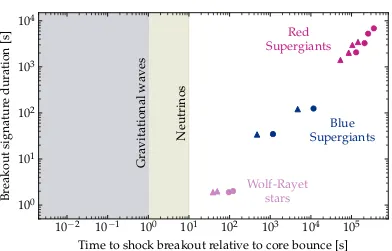
3.3 Time to shock breakout, relative to core bounce, against the duration of the UV shock breakout signature for a variety of Wolf-Rayet, blue supergiant, and red supergiant progenitor stars. 26
3.4 Relative orientation of the detector and source frames. . . 28
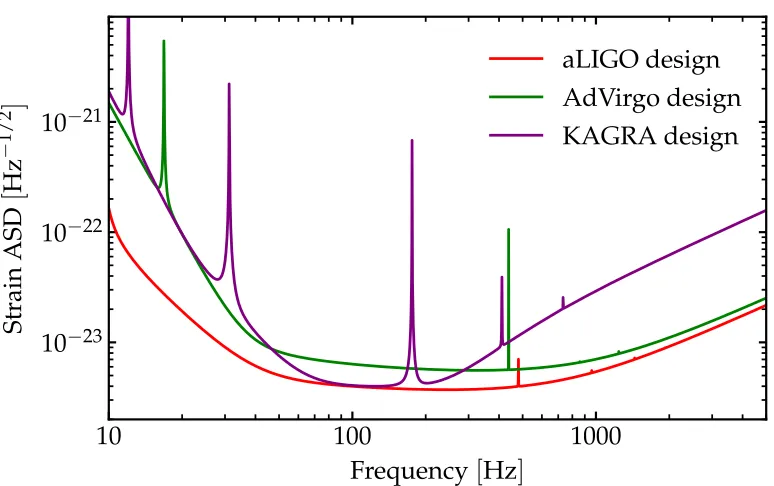
3.5 The amplitude spectral density (ASD) for aLIGO, AdVirgo, and KAGRA detectors at design sensitivity. . . 31
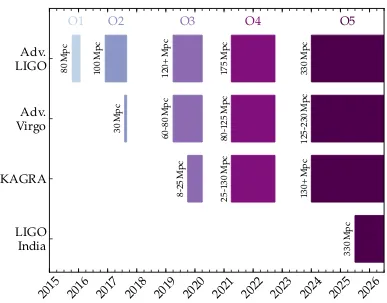
3.6 Timeline for observing runs O1 through O5 for aLIGO, Ad-Virgo, KAGRA, and LIGO India. . . 32
4.1 Variation of sum-squared antenna response 𝐹2 = 𝐹2+ + 𝐹2× for
the two aLIGO detectors and AdVirgo over one sidereal day for sources in the Galactic center, LMC, M31, and M82. . . 46
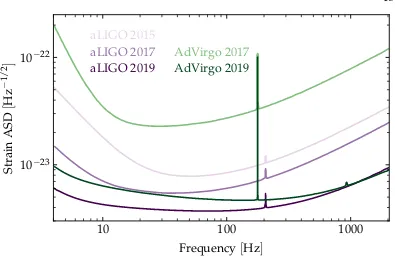
4.2 The predicted strain noise ASDs for the Advanced LIGO and Advanced Virgo detectors in the context of the HL 2015, HLV 2017, andHLV 2019networks considered. . . 48
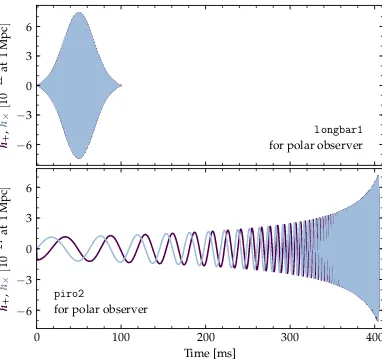
4.3 Time domain GW strain from resepresentative models of CC-SNe from non-rotating and rapidly rotating progenitor cores, as seen by an equatorial observer at10kpc. . . 51
4.5 Detection efficiency ℰ as a function of distance for numerical waveforms for hypothetical CCSNe directed towards the galac-tic center and LMC, in the context of a sixty second on-source window and three-detector network at design sensitivity.. . . . 67
4.6 Detection efficiency ℰ as a function of distance for analytical waveforms for hypothetical CCSNe directed towards M31 for a three-detector network at design sensitivity in the context of 61 minute and 51 hour on-source windows.. . . 71
4.7 Detection efficiency ℰ as a function of distance for analytical waveforms for hypothetical CCSNe directed towards M82 for a three-detector network at design sensitivity in the context of 24 hour 1 minute and 74 hour on-source windows. . . 72
4.8 Lower limit on GW energy detectable in sine-Gaussian bursts with a design sensitivity three-detector network for hypotheti-cal CCSNe located in the galactic center, LMC, M31, and M82, in the context of all considered on-source windows. . . 73
5.1 Time domain GW strain for waveforms drawn from theC&Sand
RotCCcatalogs. . . 83
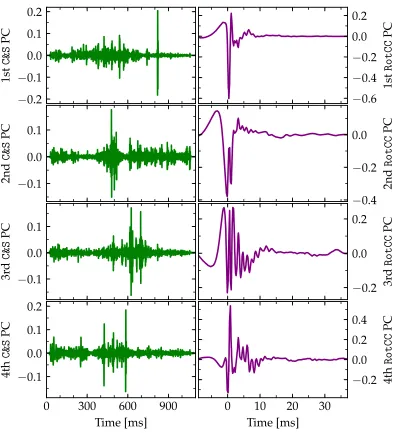
5.2 The first four PCs for theC&SandRotCCmodels. . . 84
5.3 log𝐵𝑆;𝑁 as a function of the number of PCs for the C&Sand RotCCmodels . . . 87
5.4 log𝐵𝑆;𝑁 forRotCCandC&Smodels as run on 1000 instances of
simulated Gaussian noise and recolored noise. . . 90
5.5 Histograms of log𝐵RotCC−C&Sfor catalog waveforms in the
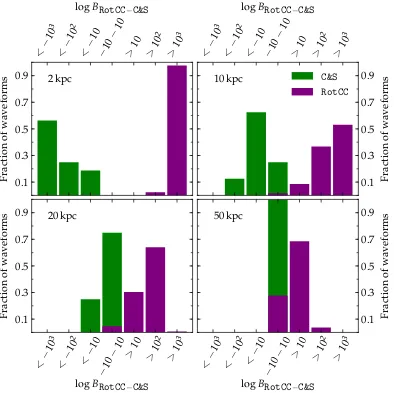
con-text of galactic sources at2kpc,10kpc, and20kpc, and sources at50kpc in the LMC.. . . 92
5.6 Histograms of log𝐵RotCC−C&S for non-catalog waveforms in the
context of galactic sources at 2kpc, 10kpc, and 20kpc, and sources at50kpc in the LMC. . . 94
6.1 RatioΩ/Ωcas a function of enclosed mass for𝐴 ∈ {𝐴1, … , 𝐴5}
as imposed on the s15WH07 progenitor model. . . 105
6.2 Evolution of 𝜌c, 𝛽ic, and ℎ+,eq at 10kpc with time for model
𝐴3𝑂6. . . 109
6.4 Central density𝜌c,b, mass of the inner core𝑀ic,b, and total
an-gular momentum of the inner core𝐽ic,bat bounce as a function
of𝛽ic,b for all models. . . 112
6.5 Time evolution of central density 𝜌c for three models (𝐴1𝑂9,
𝐴3𝑂6, and𝐴5𝑂5.5) with𝛽ic,b ∼ 0.1. . . 113
6.6 GW strain as seen by an equatorial observerℎ+,eqat10kpc for three models with moderate rotation 𝛽ic,b ∼ 0.05 and three models with rapid rotation𝛽ic,b ∼ 0.1. . . 115
6.7 Time evolution of the central density𝜌cand GW strain as seen by an equatorial observerℎ+,eqat10kpc for models𝐴1𝑂10.25,
𝐴1𝑂10.25𝑠,𝐴1𝑂10.25𝑚, and𝐴1𝑂10.25𝑝. . . 116
6.8 Measured𝛽ic,band fractional errorΔ𝛽ic,b/𝛽ic,bas a function of
true𝛽ic,bfor all injected waveforms. . . 119
6.9 log𝐵true;𝑗as a function of injected𝛽ic,bfor all injected waveforms.122
7.1 Cartoon diagram illustrating the excitation of gravity waves by convective instability in the PNS mantle in the context of our post-shock wave heating hypothesis. . . 134
7.2 Radial snapshots of the enclosed gravitational mass𝑚grav, loga-rithmic mass density log10𝜌, specific entropy𝑠, temperature𝑇, lepton fraction 𝑌L, and neutrino degeneracy parameter𝜂𝜈𝑒,eq
below the shock radius 𝑟sh, shown at 225ms, 349ms, 475ms,
and599ms post-bounce. . . 136
7.3 Colormap showing the temporal evolution of the radial profile of the scaled buoyancy frequency𝑁𝑝out to the shock between
200ms and660ms after core bounce. The temporal evolution of the wave luminosity 𝐿wave generated across the convective PNS mantle is also shown. . . 138
7.4 Temporal evolution of the convective velocity𝑣con, convective turnover frequency 𝜔con, maximum angular wavenumber of
the waves excitedℓ𝑐, and wave luminosity emitted per excited
angular mode𝐿wave, ℓ. . . 140
7.5 Propagation diagrams forℓ = 2gravito-acoustic waves at225ms,
7.6 Snapshots of the fraction of wave energy transmitted to the post-shock region 𝑇ℓ2 inℓ = 1 − 3 waves as a function of an-gular wave frequency𝜔at225ms,349ms,475ms, and599ms after core bounce. The convective turnover frequency 𝜔con is
overlaid. . . 142
7.7 Temporal evolution of the wave heating rates at the shock𝐿heat, ℓ
forℓ = 1 − 3waves. The total heating rate𝐿heat, summed over all excited angular wave modes, is overlaid. . . 143
7.8 Radial snapshots of the local damping rate from neutrino dif-fusion 𝛾𝜈, ℓ, and the cumulative damping incurred by waves
𝑥𝑟, ℓ while propagating out from the PNS core to radius𝑟, for
ℓ = 1 − 3 waves at 225ms, 349ms, 475ms, and 599ms post-bounce. . . 146
7.9 Temporal evolution of the fraction of wave luminosity not at-tenuated through neutrino damping exp[−𝑥𝑟sh,ℓ]forℓ = 1 − 3
waves. . . 147
7.10 Radial snapshots of dimensionless measure of wave non-linearity
|𝑘𝑟, ℓ𝜉𝑟, ℓ| for ℓ = 1 − 3 waves at 225ms, 349ms, 475ms, and
599ms post-bounce. . . 149
7.11 Temporal evolution of the net heating rates corrected for neu-trino damping 𝐿′heat, ℓ for ℓ = 1 − 3 waves, and the summed total 𝐿′heat. The ratio of wave pressure (summed over excited modes) to the total pressure𝑃wave/𝑃is also shown, measured
at shock radius𝑟shand where Mach numberℳ = 1.. . . 152
8.1 ASDs for LIGO Voyager, Einstein Telescope, and Cosmic Ex-plorer, alongside Advanced LIGO and Advanced LIGO+ for context. . . 165
8.2 GW strain for select waveform models from convection and SASI, rotating core collapse, GW memory, and BH formation. . 166
LIST OF TABLES
Number Page
4.1 Summary of the location (RA, Dec), distance, and host galaxy CCSN rate for the four hypothetical CCSNe. . . 43
4.2 Summary of the observational counterpart used to derive the on-source window, in addition to the associated on-source win-dow, for the four hypothetical CCSNe considered. . . 45
4.3 Key characteristics of waveforms from multidimensional CCSN simulations considered for this study. . . 52
4.4 Key characteristics of the considered waveforms from phenomeno-logical models. 𝐸GW is the energy emitted in GWs, ⟨ℎrss⟩ is the angle-averaged root-sum-square strain, and𝑓peak is the fre-quency at which the spectral GW energy density d𝐸GW/d𝑓 peaks. 56
4.5 Key characteristics of thead-hocsine-Gaussian waveforms em-ployed in this study. 𝑓0is the central frequency,𝑄is the quality
factor, and𝛼is the ellipticity. See Eq. (4.12) in Sec. 4.3 for details. 57
4.6 The distance in kpc at which 50% detection efficiency is at-tained, 𝑑50% for the numerical core-collapse emission models considered using theHL 2015,HLV 2017, andHLV 2019detector networks, for CCSNe in the direction of the Galactic center and the LMC.. . . 65
4.7 The distance in Mpc at which 50% detection efficiency is at-tained,𝑑50% for the extreme phenomenological emission mod-els considered using theHL 2015,HLV 2017, andHLV 2019detector networks in the context of a hypothetical CCSN in M31 using 61-minute and 51-hour on-source windows. . . 68
4.8 The distance in Mpc at which 50% detection efficiency is at-tained,𝑑50% for the extreme phenomenological emission mod-els considered using theHL 2015,HLV 2017, andHLV 2019detector networks in the context of a hypothetical CCSN in M82 using 24-hour 1-minute and 74-hour on-source windows. . . 69
6.1 Summary of key parameters defining our model sequences in differential rotation length scale𝐴and central angular velocity
8.1 Interferometer design parameters for Advanced LIGO, LIGO Voyager, Einstein Telescope, and Cosmic Explorer. . . 164
8.2 Angle-averaged SNRs for considered waveforms given a fidu-cial source distance of10kpc in the context of Advanced LIGO, Advanced LIGO+, LIGO Voyager, Einstein Telescope, and Cos-mic Explorer. . . 170
8.3 Fractional change in angle-averaged SNR for a source at10kpc
1 Introduction to core-collapse
supernovae
The nitrogen in our DNA, the calcium in our teeth, the iron in our blood, the carbon in our apple pies were made in the interiors of collapsing stars. We are made of star stuff.
—Carl Sagan,Cosmos
Core-collapse supernovae (CCSNe) have been observed throughout history, with the earliest recorded sightings of these magnificent stellar explosions preceding the invention of the modern telescope by over a millenium. Ac-companying the gravitational collapse of massive stars (greater than 8 − 10 𝑀⊙at birth) at the end of their nuclear burning lifetimes, CCSNe release some1053erg of energy across the electromagnetic (EM) spectrum, neutri-nos, and gravitational waves (GWs). From nuclear interactions and neutrino physics in the collapsing core to shock interaction with the stellar surface and circumstellar medium, CCSNe are fantasically complex multi-scale as-trophysical laboratories, with length scales associated with relevant physical processes spanning almost 20 orders of magnitude and encompassing all four fundamental forces. Computationally modelling CCSNe is thus, to no surprise, an involved task of Gordian proportions. In the absence of unlim-ited computational resources, even state-of-the-art simulations are beholden to approximate treatment of source physics. A problem arises, however, as many simulations fail to reproduce the stellar explosions observed, and thus known to occur, in nature. Could it be that our theoretical understanding of the mechanism through which collapsing massive stars explode be wrong?
is as follows. As a massive star evolves, a heavy, degenerate core is gradu-ally formed from the products of nuclear burning in the stellar interior. The core mass increases, with the central temperature soaring as the maximum (Chandrasekhar) mass supportable by electron degeneracy pressure grows near. Heavy nuclei in the centre of the core begin to break apart under the in-tense temperature and pressure there, driving electron capture on free pro-tons and accelerating gravitational collapse. The core, initially in free-fall, separates; the inner core (usually around 𝑀ic ∼ 0.6 − 0.8 𝑀⊙), which re-mains in sonic contact, collapses homologously1, while the outer core (typi-cally around𝑀oc ∼ 0.6 𝑀⊙) continues to infall subsonically. As the density of the inner core approaches that of nuclear matter, the nucleon-nucleon po-tential becomes repulsive, providing support against further gravitational collapse. The inner core rebounds, driving a shock wave outwards. As the shock travels through the outer core, it loses energy both through super-heating the infalling material (breaking up heavy nuclei into free nucleons) and through increased neutrino losses as high temperatures drive increased rates of electron capture. For all but the lightest stars (8 − 9 𝑀⊙ progeni-tors, for which the degenerate core is comprised of oxygen, magnesium, and neon), the shock stalls within50 − 100ms of core bounce (typically around 𝑟sh ∼ 150 − 250km), forming an accretion boundary supported against
col-lapse by thermal pressure and neutrino heating. The shock must then be “revived” to explode the progenitor star before accretion of infalling
mate-rial onto the PNS drives the nascent remnant’s mass above the maximum supportable against gravitational collapse, leading to black hole (BH) forma-tion on a timescale of∼ 1 − 3s. While it’s expected that some BHs formed via stellar collapse, many CCSNe (for which the inferred progenitor mass is larger than12 𝑀⊙) have been observed, suggesting that there is some mecha-nism through which the shock is revived (in a timely manner) to successfully explodes the star.
So what do we know about the CCSN explosion mechanism? It’s likely some complex interplay between neutrino heating, turbulent hydrodynam-ics, and fluid instabilities. Beneath the shock, again region(of order several tens of kilometres thick) develops, where net neutrino heating occurs. In contrast, a region of net cooling emerges above the the proto-neutron star
1i.e. velocity is proportional to the radius, and the collapse dynamics are effectively
(PNS) “surface”2as the PNS cools (via neutrinos) and contracts. Between the neutrino-cooled region above the PNS (which is, relatively speaking, fairly low entropy and lepton-poor) and the (shock-heated, lepton-rich) gain re-gion, neutrino-driven convection develops by ∼ 150 − 200ms post-bounce and rapidly becomes turbulent, contributing an additional source of pres-sure behind the shock and pushing it outwards. Large neutrino heating rates across the gain region persist only for a few hundreds of milliseconds, so this typically can’t revive the shock alone if an explosion isn’t seen within 500ms or so. Turbulent pressure behind the shock (due to vigorous con-vective motion across the gain region) can also contribute to shock revival, although this is subject to the caveat that much of the convective power here too dies down after around 500ms. The standing accretion-shock instabil-ity (SASI; see, e.g., [7]), where global fluid sloshing in the cavity between the PNS and the stalled shock is driven by acoustic waves coupling to “ad-vected waves” of entropy and vorticity perturbations produced at the shock (due to physical displacement) dragged down with the infalling accretion flow towards the PNS. Advective waves rapidly decelerate as they approach the PNS surface, generating outgoing acoustic waves that propagate to the shock, where they partially reflect and impart momentum upon the shock, driving it outwards and producing new pertubations which then in turn get advected down towards the PNS with the accretion flow. This “advective-acoustic” cycle can be a powerful feedback mechanism when the shock stalls at large radii, creating a larger cavity over which global fluid modes can de-velop without being (completely) disrupted by turbulent motion. Further-more, wave-driven energy transport from the convective PNS mantle out to the shock can contribute an important source of pressure behind the shock, and may favour development of the SASI by providing an additional source of outgoing acoustic flux from the PNS surface. PNS convection persists over several seconds as the PNS contracts and cools, so wave-driven energy transport from here can contribute heating and pressure behind the shock out to late times (long after neutrino heating and turbulent convection have calmed; see Chap. 7 for quantitative study on the impact of wave heating from PNS convection).
2Often taken very loosely to be where𝜌 ∼ 1011g cm−3. Theneutrinosphere, which is
Pragmatically, CCSN explosions are likely to be driven by some combination of these effects or, indeed, by something entirely different. While successful explosions are starting to be seen by state-of-the-art simulations, a consensus across the CCSN simulation community is a distant prospect likely decades away. Observationally, we are yet to constrain much as, despite routine ob-servation of CCSNe across the EM spectrum, we have yet to directly probe the CCSN central engine. EM emission originates far from the collapsed core, produced through nuclear decay and interaction of the SN shock with the circumstellar medium after it has broken through the surface of the pro-genitor star. As such, only second-hand information on what drives these stellar explosions is yielded by EM observations, limited for the most part to details on explosion asymmetry and outflow velocities. On the contrary, GWs and neutrinos are emitted from the very heart of the CCSN, offering an unparalleled opportunity to witness the birth of compact objects and the mechanism through which CCSN explosions are powered. The scant few neutrinos observed from SN1987A, a CCSN in the Large Magellanic Cloud (LMC) over thirty years ago, confirmed the basic theoretical picture of the so-called CCSN explosion mechanism established previously [8,9]. A more re-cent opportunity, however, to perform precision astronomy on CCSNe with neutrinos and GWs has yet to manifest.
The joint observation of GWs and light from a binary neutron star merger [6,
10] heralded the dawn of a new multi-messenger era including GWs. With the second-generation of GW detectors in place and the next galactic CCSN already exploded, the importance of the first joint observation of GWs, neu-trinos, and light from a CCSN cannot be overstated. An unprecented op-portunity to peer directly into the CCSN central engine, GW and neutrino observations will allow us to probe both the explosion mechanism and natal properties of compact objects. To truly harness the scientific potential of the next galactic CCSN, we must have a thorough understanding of how to opti-mally conduct a multi-messenger search for CCSNe, investigate the observa-tional prospects given existing detectors, and establish the astrophysical in-formation that can be inferred from post-detection analysis of observations.
Ex-plicitly, we aim to lay out a roadmap through detection, source inference, and development of a science case for next-generation observatories in the context of GWs from CCSNe for the budding astronomer interested, but per-haps not yet well-versed, in these brilliant cosmic explosions. To this end, we present a comprehensive search procedure which will later be released as open-source package of signal analysis tools that may be employed to not only reproduce the research presented here, but may also be further devel-oped to augment one’s own research by the interested reader.
2 Fundamental physics of
core-collapse supernovae
These violent delights have violent ends.
—Dolores Abernathy, Westworld
As prefaced in Chap.1, CCSNe are fantastically complicated phenomena; as-trophysical laboratories for a broad range of fundamental physics in extreme conditions. While here we seek to provide a more detailed discussion of only three topics particularly pertinent to the topics addressed in this thesis, we highly recommend Thorne & Blandford [11], Shapiro & Teukolsky [12], Creighton & Anderson [13], Chapters 1-3 of Sherwood Richers’ thesis [14], pretty much all of Evan Hall’s thesis [15], and the Ay190 Computational As-trophysics notes to the interested reader.
2.1 General relativity and gravitational waves
Background math
In general relativity, massive particles traverse paths in spacetime (a Rieman-nian manifold characterised by metric𝑔𝜇𝜈) along which their proper time𝜏 is extremised. Mathematically, this can be stated through an equation of motion, the geodesic equation, which can be solved for the set of allowed particle trajectories (known as geodesics)𝑥𝜇(𝒫(𝜏)).
In the absence of external forces, the geodesic equation takes the following form;
𝑑2𝑥𝜎 𝑑𝜏2 − Γ
𝜎 𝜇𝜈
𝑑 𝑥𝜇 𝑑 𝜏
𝑑 𝑥𝜈
where connection coefficientsΓ𝜎𝜇𝜈 are defined
Γ𝜎𝜇𝜈 = 1 2𝑔
𝜎𝜆(𝜕
𝜈𝑔𝜆𝜇+ 𝜕𝜇𝑔𝜆𝜈− 𝜕𝜆𝑔𝜇𝜈) , (2.2)
where the notation𝜕𝜇 = 𝜕/𝜕 𝑥𝜇is employed. External forces such as electro-magetism contribute to an additional source term on the right hand side of the geodesic equation.
The curvature of a spacetime manifold is encoded in the Riemann tensor 𝑅𝜎𝜇𝜌𝜈, defined as
𝑅𝜎𝜇𝜌𝜈 = 𝜕𝜌Γ𝜈𝜇𝜎 − 𝜕𝜈Γ𝜎𝜌𝜇+ Γ𝜎𝜌𝜆Γ𝜆𝜈𝜇− Γ𝜎𝜈𝜆Γ𝜆𝜌𝜇, (2.3)
Repeated contraction of the Riemann tensor yields the Ricci tensor𝑅𝜇𝜈 and scalar curvature𝑅;
𝑅𝜇𝜈 = 𝑅𝜆𝜇𝜆𝜈, (2.4)
𝑅 = 𝑅𝜈𝜈. (2.5)
In general relativity (GR), gravity manifests through spacetime curvature, which induces relative acceleration between initially parallel points in space. This acceleration can be quantified by considering two test particles, initially separated by space-like vector 𝑠𝜇, traversing geodesics with identical four-velocity𝑢𝜈 = 𝑑𝑥𝜈/𝑑𝜏. The relative acceleration between the two particles is given by the equation of geodesic deviation;
𝑑2𝑠𝜎 𝑑𝜏2 = 𝑅
𝜎
𝜇𝜆𝜈𝑢𝜇𝑢𝜆𝑠𝜈, (2.6)
which underscores the effect of spacetime curvature on particle trajectories.
Curvature is manifestly due to the distribution of matter and energy across spacetime. Given a distribution characterised by stress-energy tensor 𝑇𝜇𝜈, the resultant metric can be found by solving the Einstein field equations:
𝐺𝜇𝜈 + Λ 𝑔𝜇𝜈 = 8𝜋𝐺
𝑐4 𝑇𝜇𝜈, (2.7)
Linearised gravity and gravitational waves
In many terrestrial and astrophysical contexts (i.e. for a source that is slowly moving and non-relativistic), spacetime curvature is small, and approxima-tions to vastly simplify the Einstein equaapproxima-tions can be applied. In this weak field limit, the metric is approximately flat and can be written as a Minkowski background𝜂𝛼𝛽plus some small tensor perturbationℎ𝛼𝛽:
𝑔𝜇𝜈 = 𝜂𝜇𝜈 + ℎ𝜇𝜈+ 𝒪 (|ℎ|2) , (2.8)
where∣ℎ𝜇𝜈∣ = ∣𝑔𝜇𝜈 − 𝜂𝜇𝜈∣ ≪ 1.
Gauge freedom can be exploited to simplify the form of the equations to solve. Commonly employed is the Lorentz gauge condition;
𝜕𝜇ℎ𝜇𝜈 − 𝜕𝜈ℎ = 0 , (2.9)
where ℎ = ℎ𝛼𝛼 is the trace of the perturbation. Requiring further that we work in the transverse-traceless (TT) gauge, in whichℎ𝛼0= 0andℎ = 0, the Einstein equations in vacua (i.e𝑇𝜇𝜈 = 0) simplify to
□ℎ𝜇𝜈 = 0 , (2.10)
where □ is the d’Alembertian operator. This set of equations admits solu-tions of plane-wave formℎ𝑖𝑗(𝑡,x), denoted GWs. Two degrees of freedom in ℎ𝑖𝑗remain, which are typically interpreted as distinct polarisations, denoted +(plus) and×(cross);
ℎ𝑖𝑗 = ℎ+𝑒+𝑖𝑗 + ℎ×𝑒×𝑖𝑗. (2.11)
Here, the polarisation tensors are defined
e+ = ⃗𝑒
1⊗ ⃗𝑒1− ⃗𝑒2⊗ ⃗𝑒2, (2.12) e× = ⃗𝑒1⊗ ⃗𝑒2− ⃗𝑒2⊗ ⃗𝑒1, (2.13)
Numerical relativity
To solve for the dynamic evolution of a general-relativistic system, one must construct an initial value problem from the Einstein equations. In pursuit of this goal, a(3 + 1)-D spacetime decompositon is typically employed (see, e.g., [16]). In such a system, spatial coordinates𝑥𝑗 are defined on 3D space-like hypersurfacesΣ𝑡, where each hypersurface is specified by constant𝑡 = 𝑥0. For normal observers (i.e. those moving with four-velocity𝑛𝜇, where𝑛𝜇 is a timelike vector normal toΣ𝑡), the difference in time coordinate between the same spatial position on two hypersurfaces is given by
𝑑𝑡𝜇 = 𝑑𝜏 (𝛼𝑛𝜇+ 𝛽𝜇) . (2.14)
Here, the lapse function𝛼accounts for the different rates of change of coor-dinate time and proper time for observers, while the shift vector𝛽(tangent toΣ𝑡) allows the spatial coordinates to slide normally with𝑡between hyper-surfaces. On each hypersurface, the spatial metric𝛾𝜇𝜈 applies
𝛾𝜇𝜈 = 𝑔𝜇𝜈+ 𝑛𝜇𝑛𝜈, (2.15)
from which the Lorentz factor𝑊 and three-velocity𝑣𝑗 of an object moving with four-velocity𝑢𝜇measured by a normal observer can be obtained
𝑊 = 𝛼𝑢0,
𝑣𝑗 = 𝑢 𝑗
𝑊 + 𝛽𝑗
𝛼 . (2.16)
The extrinsic curvature 𝐾𝑖𝑗 describes how the hypersurfaces deform with coordinate time
𝐾𝑖𝑗 = ∇𝜈𝑛𝜇𝑒𝜇𝑖 𝑒𝜈𝑗 , (2.17)
where𝑒𝜇𝑖 are the spatial components of basis vector and∇𝜇 is the covariant derivative. Setting 𝛼and𝛽 through gauge choices, the evolution of𝛾𝑖𝑗, 𝐾𝑖𝑗, and the constraint equations must be solved for on each time slice [17];
𝜕𝑡𝛾𝑖𝑗 = − 2𝛼𝐾𝑖𝑗+ ∇𝑖𝛽𝑗+ ∇𝑗𝛽𝑖,
𝜕𝑡𝐾𝑖𝑗 = − ∇𝑖∇𝑗𝛼 + 𝛼 (𝑅𝑖𝑗− 2𝐾𝑖𝑘𝐾𝑗𝑘)
+ 𝛽𝑘∇𝑘𝐾𝑖𝑗+ 𝐾𝑖𝑘∇𝑗𝛽𝑘+ 𝐾𝑗𝑘∇𝑖𝛽𝑘− 8𝜋𝛼 (𝑆𝑖𝑗− 𝛾𝑖𝑗 2 (𝑆
𝑘
𝑘− 𝜌𝐻)) ,
0 = 𝑅 − 𝐾𝑖𝑗𝐾𝑖𝑗− 16𝜋𝜌𝐻,
Here,𝑆𝑗𝑘 are the spatial components of stress-energy tensor 𝑇𝜇𝜈, 𝑆𝑗 the mo-menta, and𝜌𝐻 = 𝛼2𝑇00/𝜌the total energy. We leave the specifics of stress-energy source terms from radiation hydrodynamics to Sec.2.2.
The conformal-flatness condition (CFC, also known as the Isenberg, Wilson, and Mathews condition; see, e.g., [18]) is often used to implement approx-imate general-relativistic effects in numerical studies. In this, the spatial 3-metric𝛾𝑖𝑗may be written as flat multiplied by some scalar factor;
𝛾𝑖𝑗 = 𝜓4𝜂𝑖𝑗. (2.19)
While satisfied irrespectively in spherical symmetry, the approximation is only valid in two or three spatial dimensions when gravitational waves are not present. While this may seem problematic to discuss in a thesis con-cerned with gravitational waves from core-collapse supernovae, it is often a good approximation for the general-relativistic behaviour of the hydrody-namics in systems (such as simulations of core-collapse supernovae in which black holes are not formed) without strong field effects [17,19]. This approx-imation greatly simplifies the numerical task to be solved, removing any ex-plicit time derivatives in the equations above, and reducing the problem to a set of elliptic equations. While GWs cannot be extracted from simulations using CFC, the signal expected can be estimated using the quadrupole ap-proximation [20]
ℎ𝑖𝑗(𝑡, 𝑟) ≈ 2𝐺 𝑐4𝑟 ̈𝐼
TT
𝑖𝑗 (𝑡 − 𝑟
𝑐) , (2.20)
where 𝑗𝑘TT̈𝐼 is the second time derivative of the quadrupole moment tensor in the transverse-traceless gauge, and
̈𝐼
𝑖𝑗 = 𝜕 𝜕𝑡∫ 𝑑
3𝑥 𝜌𝑊√𝛾 (𝑣
𝑖𝑥𝑗+ 𝑣𝑗𝑥𝑖− 𝛿𝑖𝑗𝑣𝑘𝑥𝑘) . (2.21)
2.2 Neutrino radiation hydrodynamics
General-relativistic hydrodynamics
It is typical in classical fluid dynamics to describe a fluid in terms of its mass density𝜌, three-velocity𝑣𝑗, pressure𝑃, and energy density𝑒. The hydrody-namic evolution of a relativistic perfect fluid is constrained by the set of local conservation equations for mass, momentum, and stress-energy;
∇𝜇(𝜌𝑢𝜇) = 0 ,
∇𝜇𝑇𝜇𝜈 = 0 , (2.22)
where𝑢𝜇is the fluid four-velocity and the stress-energy tensor𝑇𝜇𝜈takes the form
𝑇𝜇𝜈 = 𝜌ℎ𝑢𝜇𝑢𝜈+ 𝑃𝑔𝜇𝜈, (2.23)
andℎ = 1 + 𝑒 + 𝑃/𝜌is the specific enthalpy. For the purpose of solving these equations numerically, it is useful to recast them into conservative form. This is done by introducing a set of conserved variables (𝐷, 𝑆𝑗, 𝜏) in terms of primitive variables(𝜌, 𝑣𝑗, 𝑒)[22];
𝐷 = 𝜌𝑊 ,
𝑆𝑗 = 𝜌ℎ𝑊2𝑣𝑗,
𝜏 = 𝜌ℎ𝑊2− 𝑝 − 𝐷 , (2.24)
where𝐷, 𝑆𝑗, and𝜏 are the rest-mass density, 𝑗th component of the momen-tum, and total energy density minus rest-mass density, respectively. From the conserved variables, the evolution equations take the simple form
𝜕𝑡(√𝛾U) + 𝜕𝑗(√−𝑔F𝑗) = S, (2.25)
where state vectorU, flux vectorF𝑗, and source vectorSare defined
U= [𝐷, 𝑆𝑗, 𝜏] ,
F𝑖 = [𝐷 ̂𝑣𝑖, 𝑆
𝑗𝑣̂𝑖+ 𝛿𝑖𝑗𝑃, 𝜏 ̂𝑣𝑖+ 𝑃𝑣𝑖] ,
S= [0, 𝑇𝜇𝜈(𝜕𝜇𝑔𝜈𝑗− Γ𝜆𝜇𝜈𝑔𝜆𝑗) , 𝛼 (𝜕𝜇(log𝛼) − 𝑇𝜇𝜈Γ𝜇𝜈0 )] , (2.26)
is the specific entropy. In the case of core-collapse supernovae, the EOS must be valid over a large parameter space including (but not limited to) nuclear densities. This is a topic of active research and discussed in more depth in Sec.2.3.
Neutrino transport
According to the Standard Model, there are six species of neutrino;𝜈𝑒,𝜈𝑒̄ ,𝜈𝜇,
̄
𝜈𝜇,𝜈𝜏, and𝜈𝜏̄ , each of which are Dirac fermions. The distribution of energy and momentum within a population is dictated by the neutrino distribution function𝑓 (𝑥𝜇, 𝑝𝜇), which describes the number density of neutrinos in phase space;
𝑑𝑁 = − 1 ℎ𝑐 𝑝𝜇𝑢
𝜇𝑓 (𝑥𝜇, 𝑝𝜇) (𝑊√−𝑔𝑑3𝑥) ⎛⎜ ⎝
√−𝑔 −ℎ2
𝑑3𝑝
𝑝 ⎞⎟⎠ . (2.27)
Here, the expressions in the first and second sets of parentheses are the invariant volume element and invariant momentum-space element, respec-tively. The evolution of the neutrino distribution function is governed by the general-relativistic Boltzmann equation (also known as the Lindquist equa-tion) [23];
𝑝𝜇∇𝜇𝑓 = (𝑑𝑓
𝑑𝜆)coll , (2.28)
where 𝜆 is an affine parameter, and the collision term on the right hand side encompasses production and destruction of neutrinos from absorption, emission, and scattering processes. In core-collapse supernovae, the col-lision term is dominated by scattering of neutrinos off free nucleons and heavy nuclei, absorption of 𝜈𝑒 and 𝜈𝑒̄ on free nucleons, and pair produc-tion/annihilation and nucleon-nucleon bremsstrahlung. We discuss the de-tails of these processes with respect to calculation of neutrino opacities for supernova simulations in more detail in Sec.3.3.
The stress-energy tensor from neutrino radiation is given by
𝑇neutrinos𝜇𝜈 = ∫𝑑 3𝑝
𝑝 √−𝑔
−ℎ2𝑝
𝜇𝑝𝜈𝑓 , (2.29)
can be written in terms of the first three angular moments of the neutrino distribution function;
𝑇neutrinos𝜇𝜈 = 𝐸 𝑐2𝑢
𝜇𝑢𝜈+ 1 𝑐 (𝐹
𝜇𝑢𝜈+ 𝐹𝜈𝑢𝜇) + 𝑃𝜇𝜈. (2.30)
Here, energy-integrated moments𝑀are obtained from their energy-dependent counterparts𝑀(𝜖) using [14]
𝑀 = 1
(ℎ𝑐)3∫ 𝑑 ( 𝜖3
3 ) 𝑀(𝜖), (2.31)
and𝑀(𝜖)are defined
𝐸(𝜖) = 𝜖 ∫ 𝑑Ω 𝑓 ,
𝐹𝜇(𝜖) = 𝜖 ∫ 𝑑Ω 𝑓 𝑙𝜇,
𝑃𝜇𝜈(𝜖) = 𝜖 ∫ 𝑑Ω 𝑓 𝑙𝜇𝑙𝜈,
(2.32)
given vector𝑙𝜇 defined to separate the timelike and spacelike components of the neutrino momenta [14].
The evolution of the moments is dependent on higher order moments. State-of-the-art neutrino transport for core-collapse supernova simulations uses a local two-moment scheme which evolves only𝐸 and 𝐹𝜇, using a closure scheme to obtain radiation pressure 𝑃𝜇𝜈 and higher-order moments (see, e.g. [24–27]). In the simulation presented in Chap.7, the energy-dependent pressure tensor is obtained by interpolating between the optically thick and optically thin limits given in [28], and employs the closure scheme𝜒(𝜖)from [29];
𝑃𝑖𝑗(𝜖)= ⎡⎢ ⎣
3 (1 − 𝜒(𝜖)) 2 ⎤⎥⎦𝑃
𝑖𝑗
(𝜖),thick+ [
3𝜒(𝜖)− 1
2 ] 𝑃
𝑖𝑗
(𝜖),thin, (2.33)
𝜒(𝜖)= 1 3+
2 15𝜉
2
(𝜖)(3 − 𝜉(𝜖)+ 3𝜉(𝜖)2 ) , (2.34)
where𝜉(𝜖)= √F(𝜖)⋅F(𝜖)/𝐸2(𝜖) is the flux factor.
2.3 Nuclear matter equation of state
The equation of state (EOS) for matter at densities above the nuclear satura-tion density𝑛sat1is highly uncertain, not least because recreating such high
density environments in the laboratory is highly unfeasible. While such con-ditions are commonplace in neutron stars, opportunities to directly probe the nuclear matter EOS have been few and far between. Observations of neutron stars with inferred masses of∼ 2𝑀⊙(see, e.g., [30–32]) have set con-straints on the lower limit of the maximum mass supportable by the nuclear matter EOS, ruling out some of the more speculative propositions for nu-clear matter containing, for example, strange matter and free quarks. While we provide a brief overview of the dense matter EOS here as relevant to core-collapse supernovae, we direct the interested reader to [33–35] and ref-erences therein for in-depth and informative reviews.
The properties of the nuclear matter EOS are often discussed with respect to the internal energy density𝐸(𝑛B, 𝑌𝑒, 𝑇), as a function of the density, tem-perature and composition of the fluid. Here, 𝑛B is the number density of baryons, 𝑇 the temperature, and 𝑌𝑒 is the electron fraction. For the pur-poses of core-collapse supernova simulations, the EOS must be valid over the parameter space constrained by𝑛B ∈ [10−5, 10]fm−3, 𝑌𝑒 ∈ [0, 0.6], and 𝑇 ∈ [0, 150]MeV [33].
The binding energy per nucleon for cold (𝑇 = 0), symmetric (𝑌𝑒 = 0.5) mat-ter at𝑛𝐵 = 𝑛sat,𝐸0, is well constrained experimentally to𝐸0 ≈ 16MeV [36]. One way to approach this problem is to construct a functional in small changes from this point using a Taylor expansion. Given parameters𝑥 = (𝑛𝐵−𝑛0)/𝑛0 and 𝛽 = 1 − 2𝑌𝑒, the binding energy per nucleon for small𝑥and 𝛽 can be approximated
𝐸(𝑥, 𝛽) = −𝐸0+ 𝐾 18𝑥
2+ 𝐾′ 162𝑥
3+ … + 𝒮(𝑥, 𝛽) , (2.35)
where𝐾is the incompressibility of nuclear matter,𝐾′is skewness parameter, and 𝒮(𝑥, 𝛽) is the symmetry term, which encompasses EOS effects due to changes in composition:
𝒮(𝑥, 𝛽) = 𝒮2(𝑥)𝛽2+ 𝒪(𝛽4) . (2.36)
1𝑛
Here,
𝒮2(𝑥) = 𝐽 + 𝐿𝑥 + 𝒪(𝑥2) , (2.37)
where𝐽 is the symmetry energy at saturation, and𝐿is the symmetry slope parameter.
While an EOS for cold nuclear matter isn’t a great approximation for the hot proto-neutron star created after core collapse, it is physically relevant for many evolved neutron stars. Using this approximation, observations (indi-rect or di(indi-rect) of systems containing neutron stars can be used to put con-straints on the behaviour of matter at such densities. Commonly used for this purpose is the maximum neutron star mass that can be supported by a particular equation of state. In Fig. 2.1, we show the mass-vs-radius re-lations for cold neutron stars in neutrinoless 𝛽-equilibrium for a variety of EOS proposals as obtained fromCompOSE[37], overlaying observational con-straints on the maximum neutron star mass from PSR J0348+0432 [31] and PSR J1614+2230 [30].
10
12
14
16
R
[
km
]
0.5
1.0
1.5
2.0
M
grav[
M
]
PSR J0348+0432
[image:40.612.112.499.384.625.2]PSR J1614+2230
LS220
DD2
TMA
SFHx
SFHo
FSU2
3 Multimessenger astronomy and
the observational signatures of
core-collapse supernovae
Though my soul may set in darkness, it will rise in perfect light;
I have loved the stars too fondly to be fearful of the night.
—Sarah Williams,The Old Astronomer
3.1 Observational signatures
to shock breakout through the progenitor star, nuclear decay, and interac-tion of the shock with the circumstellar medium.
To put into context the various phases of GW and neutrino emission, we hereafter discuss phases of the dynamics governing core collapse and stellar explosion [38,39]:
• Onset of core collapse. The central temperature 𝑇𝑐 of the degener-ate core (formed at the centre of a massive star over its last nuclear burning stages; typical mass is between (1.3 − 2) 𝑀⊙and progenitor dependent.) increases as the core grows and slowly contracts. As 𝑇𝑐 → 1MeV, Fe-group nuclei begin to fall victim to partial dissocia-tion by thermal photons, producing𝛼particles and free nucleons. This reduces the effective adiabatic indexΓ1 < 4/3, which accelerates col-lapse. Increased Fermi energy renders electrons more susceptible to capture on nuclei (see, e.g., [40,41]). In these initial stages of collapse, 𝜈𝑒emission from electron capture is able to free-stream outwards and escape the collapsing core.
• Neutrino trapping in the core. Neutrinos become trapped in the col-lapsing core as the density approaches 1012g/cm3. This occurs pre-dominantly due to neutral current scattering on heavy nuclei as, at such densities, their nucleons interact coherently as a single body off which neutrinos scatter [38]. In this scenario, electron neutrinos pro-duced by electron capture cannot escape, and are instead dragged ever further inwards with gravitational collapse. The collapsing core sep-arates into two regions. The inner core, where most electrons have already captured on nucleons, is rich with entropy and lepton number due to trapping effects and collapses homologously. In the outer core, where electron capture (now for the most part onto free protons) pro-ceeds, collapse accelerates further still and approaches freefall (≲ 0.3𝑐).
in-ner core and rebounds. The mass of the inin-ner core is dependent on the electron fraction,𝑌𝑒 = 𝑛𝑒/𝑛B, where𝑛𝑒and𝑛Bare the number densities
of electrons and baryons respectively, and is approximately bounded by the instantaneous Chandrasekhar mass𝑀ch;
𝑀ch∼ 1.457(𝑌𝑒)2𝑀⊙, (3.1)
which is typically around0.5 𝑀⊙at the time of bounce.
• Shock propagation and breakout. The shock propagates outwards, driving through the ever-infalling outer core and buoyed by trapped neutrinos. Electron capture abounds in the post-shock region as the shock travels outwards through material where free protons still exist, producing𝜈𝑒in monumental numbers that remain trapped while the shock propagates faster than𝜈𝑒 can diffuse. As the shock breaks out into material where neutrinos are no longer trapped, an ultraluminous burst of 𝜈𝑒 is emitted (often called the neutrino burst at shock break-out), causing the lepton fraction 𝑌L = (𝑛𝜈 + 𝑛𝑒)/𝑛B, where 𝑛𝜈 is the number density of neutrinos, in the post-shock region to plummet.
• Stalling of the shock. The shock continues to propagate through the infalling outer core, behaving as a thermal transducer of sorts as it dissipates the kinetic energy of the infalling material into thermal en-ergy, causing rapid deceleration, compression, and heating of the post-shock flow. Heavy nuclei are dissociated into free nucleons as the shock passes through, draining the shock of its might. Assuming a pre-collapse core comprised of iron-group nuclei, the shock burns through some1051ergs for every tenth of a solar mass it passes through. Com-bined with reduced post-shock pressure following the prior escape of trapped neutrinos, the shock stalls around an enclosed mass of∼ 1 𝑀⊙ (typically between (100 − 150)km). The infalling outer core persists, feeding an accretion flow onto the PNS.
depen-dence of neutrino emission and absorption rates. Charged-current neutrino capture on free nucleons dominates energy deposition rates. Convective instability sets in between the stalled shock and PNS sur-face, driving overturn and turbulence there. Non-radial motions ex-pand the shock and increase the efficiency of neutrino heating. A com-bination of these effects, the so-called delayed neutrino-heating mech-anism, is thought to revive the shock and drive a successful explo-sion. While laid out here as canon, it is important to note that many questions relating to this process remain to be answered (see, e.g., [42,
43]). Confirmation of the CCSN explosion mechanism will require both observational evidence and assertion through robust computa-tional modelling, facets of which this thesis aims to address.
• PNS cooling and the neutrino-driven wind. Following shock revival, accretion onto the PNS can persist for several hundreds of millisec-onds, simultaneous to shock expansion. After accretion ends, the PNS undergoes Kelvin-Helmholtz cooling, during which any remaining grav-itational binding energy is radiated away over a neutrino diffusion timescale. Energetic neutrinos emitted near the neutrinosphere de-posit energy in the cooler, outer layers of the PNS (predominantly through charged-current absorption on free nucleons), driving dilute but persistent mass outflows (initially around∼ 10−2𝑀⊙/s from the surface of the nascent NS - a neutrino-driven wind.
We hereafter discuss the observational signatures of CCSNe.
Gravitational waves
The GW signatures of CCSNe are diverse, evidencing the complex physi-cal processes driving stellar explosions, and are strongly dependent on the properties of the progenitor stars from whence they came.
which increases quasi-linearly with time from∼ (100−200)Hz to over1kHz as the PNS accretes fallback material, contracts, and deleptonises, although it has been shown that a broad and complex spectrum of oscillations is typ-ically excited (see, e.g., [48–50]). GW emission from prompt convection, which develops within a few tens of milliseconds of core bounce but dies down before∼ 100ms has passed, is typically at frequencies100 − 300Hz due to the puffy nature of the PNS surface at these early times. Conversely, neutrino-driven convection in the gain region at later times sources GW emission between∼ 300 − 1000Hz (increasing with time) as it drives oscilla-tions of an ever-contracting PNS. Strong fluid downflows from development of the standing accretion-shock instability (SASI) can modify the accretion rate at the PNS, inducing quadrupolar oscillations around(100 − 200)Hz at later times (after a few hundred milliseconds), where the emission frequency is related to the characteristic frequency of the advective-acoustic cavity in which the SASI develops [25, 42, 44, 45]. While the frequency evolution of the GW signature is robust, it is perhaps not surprising that the phase is de-cidedly stochastic due to the chaotic nature of turbulent convection and the SASI (see, e.g., [51]).
For illustrative purposes, we show in Fig. 3.1, the time-domain GW strain and time-frequency evolution of the GW energy spectrum for model15_3.7 from Murphyet al.[44].
In precollapse cores with appreciable angular momentum, increased cen-trifugal support around equatorial regions leads to pronounced oblate de-formation of the inner PNS core as collapse proceeds. Strong quadrupole radiation is produced as the inner core rapidly decelerates and rebounds, resulting in a pronounced spike in the GW signal at core bounce, followed by ringdown of the PNS as it settles to its new equilibrium state (see, e.g., [52–
54] for a detailed discussion). Unsurprisingly, the GW signal is dependent on the mass of the inner core, its angular momentum distribution, and the equation of state of nuclear matter (see, e.g. [54–62]). In precollapse cores characterised by extremely rapid rotation and/or strong differential rota-tion, nonaxisymmetric rotational instabilities driven by rotational shear (see, e.g., [19,63–67]) may develop, resulting in a significant enhancement of GW emission after∼ 50ms or so post-bounce.
−
20 2 4
h+,eq
[
10 − 22 at 10 kpc]
Murphyet al.(2009)Model 15 3.7
Prompt convection GW memory Nonlinear SASI Neutrino-driven convection
0.0 0.2 0.4 0.6 0.8 1.0
[image:46.612.112.502.71.426.2]Time after core bounce [s] 200 600 1000 1400 Fr equency [Hz]
−
14−
13−
12−
11−
10−
9 log 10(
dE GW / d f)
/(
M c 2 / Hz)
−
13.729−
13.187−
12.644−
12.102−
11.560−
11.018−
10.476−
9.933−
9.391−
8.849 log 10 c 2Figure 3.1: In the context of an equatorial observer at10kpc , the time do-main strain (top panel) and time-frequency evolution of the spectral GW en-ergy (bottom panel) for model15_3.7from Murphyet al.[44]. We highlight regions where emission originates from prompt convection, neutrino-driven convection, non-linear SASI, and GW memory.
![Figure 2.1: Mass vs radius plot for cold neutron stars in neutrinoless beta-equilibrium for different EOSs as obtained from CompOSE [37].The con-straints placed on the maximum neutron star (NS) mass by observations ofPSR J0348+0432 [31] and PSR J1614+2230 [30] are indicated by shaded panelsin light gray and slate gray, respectively.](https://thumb-us.123doks.com/thumbv2/123dok_us/8816604.920608/40.612.112.499.384.625/neutrinoless-equilibrium-different-obtained-observations-indicated-panelsin-respectively.webp)
![Figure 3.1: In the context of an equatorial observer at et al. kpc , the time do-main strain (top panel) and time-frequency evolution of the spectral GW en-ergy (bottom panel) for model 15_3.7 from Murphy 10 [44]](https://thumb-us.123doks.com/thumbv2/123dok_us/8816604.920608/46.612.112.502.71.426/figure-context-equatorial-observer-frequency-evolution-spectral-murphy.webp)
![Figure 3.2: Temporal evolution of the neutrino luminosity (top panel) andmean neutrino energy (bottom panel) for the CCSN model presented inRoberts [79].](https://thumb-us.123doks.com/thumbv2/123dok_us/8816604.920608/48.612.111.502.244.603/figure-temporal-evolution-neutrino-luminosity-neutrino-presented-inroberts.webp)