A Single Image Haze Removal Algorithm Using Color
Attenuation Prior
Manjunath.V *, Revanasiddappa Phatate ** *
Computer Science and Engineering Dept., Veerappa Nisty Engineering college, Shorapur, India
**
Computer Science and Engineering Dept., Veerappa Nisty Engineering college, Shorapur, India
Abstract- Single image haze removal has been a
challengingproblem due to its ill-posed nature. In this paper, we propose a simple but powerful color attenuation prior for haze removal from a single input hazy image. By creating a linear model for modeling the scene depth of the hazy image under this novel prior and learning the parameters of the model with a supervised learning method, the depth information can be well recovered. With the depth map of the hazy image, we can easily estimate the transmission and restore the scene radiance via the atmospheric scattering model, and thus effectively remove the haze from a single image. Experimental results show that the proposed approach outperforms state-of-the-art haze removal algorithms in terms of both efficiency and the dehazing effect.
Index Terms- Dehazing, defog, image restoration,
depthrestoration.
I. INTRODUCTION
utdoor images taken in bad weather (e.g., foggy or hazy) usually lose contrast and fidelity, resulting from the fact that light is absorbed and scattered by the turbidmedium such as particles and water droplets in the atmosphere during the process of propagation. Moreover, most automatic systems, which strongly depend on the definition of the input images, fail to work normally caused by the degraded images. Therefore, improving the technique of image haze removal will benefit many image understanding and computer vision applications such as aerial imagery [1], image classification [2]– [5], image/video retrieval [6]– [8], remote sensing [9]–[11] and video analysis and recognition [12]–[14].
Since concentration of the haze is different from place to place and it is hard to detect in a hazy image, image dehazing is thus a challenging task. Early researchers use the traditional techniques of image processing to remove the haze from a single image (for instance, histogram-based dehazing methods [15]– [17]). However, the dehazing effect is limited, because a single hazy image can hardly provide much information. Later, researchers try to improve the dehazing performance with multiple images. In [18]– [20], polarization-based methods are used for dehazing with multiple images which are taken with different degrees of polarization.
Recently, significant progress has been made in single image dehazing based on the physical model. Under the assumption that the local contrast of the haze-free image is much higher than that in the hazy image.
a)
b)
c)
d)
Fig.1 An overview of the proposed dehazing method. a) Input hazy image. b) Restored depth map. c) Restored transmission
map. d) Dehazed image.
In this paper, we propose a novel color attenuation prior for single image dehazing. This simple and powerful prior can help to create a linear model for the scene depth of the hazy image. By learning the parameters of the linear model with a supervised learning method, the bridge between the hazy image and its corresponding depth map is built effectively. With the recovered depth information, we can easily remove the haze from a single hazy image. An overview of the proposed dehazing method is shown in Figure 1. The efficiency of this dehazing method is dramatically high and the dehazing effectiveness is also superior to that of prevailing dehazing algorithms.
II. COLORATTENUATIONPRIOR
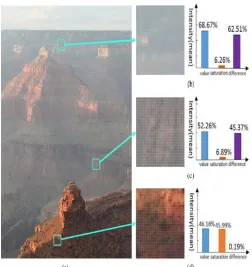
[image:2.612.60.275.57.225.2]To detect or remove the haze from a single image is a challenging task in computer vision, because little information about the scene structure is available. In spite of this, the human brain can quickly identify the hazy area from the natural scenery without any additional information. This inspired us to conduct a large number of experiments on various hazy images to find the statistics and seek a new prior for single image dehazing. Interestingly, we find that the brightness and the saturation of pixels in a hazy image vary sharply along with the change of the haze concentration.
Fig. 2. The concentration of the haze is positively correlated with the difference between the brightness and the saturation. (a) A hazy image. b) The close-up patch of a dense-haze region and its histogram. (c) The close-up patch of a moderately hazy region and its histogram. (d) The
close-up patch of a haze-free region and its histogram.
Figure 2 gives an example with a natural scene to show how the brightness and the saturation of pixels vary within a hazy image. As illustrated in Figure 2(d), in a haze-free region, the saturation of the scene is pretty high, the brightness is moderate and the difference between the brightness and the saturation is close to zero. But it is observed from Figure 2(c) that the saturation of the patch decreases sharply while the color of the scene fades under the influence of the haze, and the brightness increases at the same time producing the high value of the difference. Furthermore, Figure 2(b) shows that in a dense-haze region, it is more difficult for us to recognize the inherent color of the scene, and the difference is even higher than that in Figure 2(c). It seems that the three properties (the brightness, the saturation and the difference) are prone to vary regularly in a single hazy image.
III. HAZEREMOVALONIMAGE
the pre compression is gives better performance and fewer artifacts than the post compression.
[image:3.612.334.587.63.366.2]
Fig. 3 Block diagram for Haze removal.
IV. SCENEDEPTHRESTORATION
In the Figure 4 illustrates the imaging process. In the haze-free condition, the scene element reflects the energy that is from the illumination source (e.g., direct sunlight, diffuse skylight and light reflected by the ground), and little energy is lost when it reaches the imaging system. The imaging system collects the incoming energy reflected from the scene element and focuses it onto the image plane. Without the influence of the haze, outdoor images are usually with vivid color (see Figure 4(a)). In hazy weather, in contrast, the situation becomes more complex (see Figure 3(b)). There are two mechanisms (the direct attenuation and the airlight) in imaging under hazy weather. On one hand, the direct attenuation caused by the reduction in reflected energy leads to low intensity of the brightness. It reveals the fact that the intensity of the pixels within the image will decrease in a multiplicative manner.
So it turns out that the brightness tends to decrease under the influence of the direct attenuation. On the other hand, the white or gray airlight, which is formed by the scattering of the environmental illumination, enhances the brightness and reduces the saturation. It can be deduced from this term that the effect of the white or gray airlight on the observed values is additive. Thus, caused by the airlight, the brightness is increased while the saturation is decreased.
Since the airlight plays a more important role in most cases, hazy regions in the image are characterized by high brightness and low saturation. This allows us to utilize the difference between the brightness and the saturation to estimate the concentration of the haze.
Fig. 4 The process of imaging under different weather conditions. (a) The process of imaging in sunny weather. (b) The process of imaging in hazy weather.
In Figure 5, The difference increases along with the concentration of the haze in a hazy image, Since the concentration of the haze increases along with the change of the scene depth in general, we can make an assumption that the depth of the scene is positively correlated with the concentration of the haze.
a)
Input Haze
Image
JPEG
Compression
Dehazing
Techniques
Dehazing
Techniques
[image:3.612.327.564.483.714.2]b)
c)
[image:4.612.338.554.463.687.2]d)
Fig. 5 Difference between brightness and saturation increases along with the concentration of the haze. (a) and (b) A hazy
image. (c) and (d) Difference between brightness and saturation.
I. Experimental results
In figure 6, there are different types of Haze images. The input haze images are first applied the dehazing techniques after applying the JPEG compression now we get pre compressed dehaze image and the input haze images are applied the JPEG compression after that applying the dehazing techniques now we get post compressed dehazeimage(output image).
b)
c)
d)
f)
Fig. 6 Difference between the (a), (c) and (e) A hazy image (Input image). (b), (d) and (f) A dehaze image (Output image)
V. CONCLUSION
In this paper, we have proposed a novel linear color attenuation prior, based on the difference between the brightness and the saturation of the pixels within the hazy image. By creating a linear model for the scene depth of the hazy image with this simple but powerful prior and learning the parameters of the model using a supervised learning method, the depth information can be well recovered. By means of the depth map obtained by the proposed method, the scene radiance of the hazy image can be recovered easily. Experimental results show that the proposed approach achieves dramatically high efficiency and outstanding dehazing effects as well.
REFERENCES
[1] G. A. Woodell, D. J. Jobson, Z.-U. Rahman, and G. Hines, “Advanced image processing of aerial imagery,” Proc. SPIE, vol. 6246, p. 62460E, May 2006.
[2] L. Shao, L. Liu, and X. Li, “Feature learning for image classification via multiobjectivegenetic programming,” IEEE Trans. Neural Netw. Learn.Syst., vol. 25, no. 7, pp. 1359–1371, Jul. 2014.
[3] F. Zhu and L. Shao, “Weakly-supervised cross-domain dictionary learning for visual recognition,” Int. J. Comput. Vis., vol. 109, nos. 1–2, pp. 42–59, Aug. 2014.
[4] Y. Luo, T. Liu, D. Tao, and C. Xu, “Decomposition-based transfer distance metric learning for image classification,” IEEE Trans. ImageProcess., vol. 23, no. 9, pp. 3789–3801, Sep. 2014.
[5] D. Tao, X. Li, X. Wu, and S. J. Maybank, “Geometric mean for subspace selection,” IEEE Trans. Pattern Anal. Mach. Intell., vol. 31, no. 2, pp. 260– 274, Feb. 2009.
[6] J. Han et al., “Representing and retrieving video shots in human-centric brain imaging space,” IEEE Trans. Image Process., vol. 22, no. 7, pp. 2723– 2736, Jul. 2013.
[7] J. Han, K. Ngan, M. Li, and H.-J. Zhang, “A memory learning framework for effective image retrieval,” IEEE Trans. Image Process., vol. 14, no. 4, pp. 511–524, Apr. 2005.
[8] D. Tao, X. Tang, X. Li, and X. Wu, “Asymmetric bagging and random subspace for support vector machines-based relevance feedback in image retrieval,” IEEE Trans. Pattern Anal. Mach. Intell., vol. 28, no. 7, pp. 1088– 1099, Jul. 2006.
[9] J. Han, D. Zhang, G. Cheng, L. Guo, and J. Ren, “Object detection in optical remote sensing images based on weakly supervised learning and high-level feature learning,” IEEE Trans. Geosci. Remote Sens., vol. 53, no. 6, pp. 3325–3337, Jun. 2015.
[10] G. Cheng et al., “Object detection in remote sensing imagery using a discriminatively trained mixture model,” ISPRS J. Photogramm. RemoteSens., vol. 85, pp. 32–43, Nov. 2013.
[11] J. Han et al., “Efficient, simultaneous detection of multi-class geospatial targets based on visual saliency modeling and discriminative learning of sparse coding,” ISPRS J. Photogramm. Remote Sens., vol. 89, pp. 37–48, Mar. 2014.
[12] L. Liu and L. Shao, “Learning discriminative representations from RGB-D video data,” in Proc. Int. Joint Conf. Artif. Intell., Beijing, China, 2013, pp. 1493–1500.
[13] D. Tao, X. Li, X. Wu, and S. J. Maybank, “General tensor discriminant analysis and Gabor features for gait recognition,” IEEE Trans. PatternAnal. Mach. Intell., vol. 29, no. 10, pp. 1700 1715, Oct. 2007.
[14] Z. Zhang and D. Tao, “Slow feature analysis for human action recognition,” IEEE Trans. Pattern Anal. Mach. Intell., vol. 34, no. 3, pp. 436–450, Mar. 2012.
[15] T. K. Kim, J. K. Paik, and B. S. Kang, “Contrast enhancement system using spatially adaptive histogram equalization with temporal filtering,” IEEE Trans. Consum. Electron., vol. 44, no. 1, pp. 82–87, Feb. 1998.
[16] J. A. Stark, “Adaptive image contrast enhancement using generalizations of histogram equalization,” IEEE Trans. Image Process., vol. 9, no. 5, pp. 889–896, May 2000.
[17] J.-Y. Kim, L.-S. Kim, and S.-H. Hwang, “An advanced contrast enhancement using partially overlapped sub-block histogram equalization,” IEEETrans. Circuits Syst. Video Technol., vol. 11, no. 4, pp. 475–484, Apr. 2001.
[18] Y. Y. Schechner, S. G. Narasimhan, and S. K.Nayar, “Instant dehazingof images using polarization,” in Proc. IEEE Conf. Comput. Vis. PatternRecognit. (CVPR), 2001, pp. I-325–I 332.
[19] S. Shwartz, E. Namer, and Y. Y. Schechner, “Blind haze separation,” in Proc. IEEE Conf. Comput. Vis. Pattern Recognit. (CVPR), vol. 2. 2006, pp. 1984–1991.
[20] Y. Y. Schechner, S. G. Narasimhan, and S. K. Nayar, “Polarization-based vision through haze,” Appl. Opt., vol. 42, no. 3, pp. 511–525, 2003. [21] S. G. Narasimhan and S. K. Nayar, “Chromatic framework for vision in bad
weather,” in Proc. IEEE Conf. Comput. Vis. PatternRecognit. (CVPR), Jun. 2000, pp. 598–605.
[22] S. K. Nayar and S. G. Narasimhan, “Vision in bad weather,” in Proc. IEEE Int. Conf. Comput. Vis. (ICCV), vol. 2. Sep. 1999, pp. 820–827.
[23] S. G. Narasimhan and S. K. Nayar, “Contrast restoration of weather degraded images,” IEEE Trans. Pattern Anal. Mach. Intell., vol. 25, no. 6, pp. 713–724, Jun. 2003.
[24] S. G. Narasimhan and S. K. Nayar, “Interactive (de) weathering of an image using physical models,” in Proc. IEEE Workshop ColorPhotometric Methods Comput. Vis., vol. 6. France, 2003, p. 1.
[25] J. Kopf et al., “Deep photo: Model-based photograph enhancement and viewing,” ACM Trans. Graph., vol. 27, no. 5, p. 116, Dec. 2008.
AUTHORS
First Author – Manjunath.V, Computer Science and
Second Author – Revanasiddappa Phatate, Computer Science and Engineering Dept. Veerappa Nisty Engineering college,