ScholarWorks @ Georgia State University
Managerial Sciences Dissertations Department of Managerial Sciences
12-15-2016
Another negotiator's dilemma: Negotiating against
a counterpart with a bad reputation
Jeff Schatten
Georgia State University
Follow this and additional works at:https://scholarworks.gsu.edu/managerialsci_diss
This Dissertation is brought to you for free and open access by the Department of Managerial Sciences at ScholarWorks @ Georgia State University. It has been accepted for inclusion in Managerial Sciences Dissertations by an authorized administrator of ScholarWorks @ Georgia State University. For more information, please [email protected].
Recommended Citation
Schatten, Jeff, "Another negotiator's dilemma: Negotiating against a counterpart with a bad reputation." Dissertation, Georgia State University, 2016.
WITH A BAD REPUTATION
BY
JEFF SCHATTEN
A Dissertation Submitted in Partial Fulfillment of the Requirements for the Degree
Of
Doctor of Philosophy
In the Robinson College of Business
Of
Georgia State University
GEORGIA STATE UNIVERSITY ROBINSON COLLEGE OF BUSINESS
Copyright by Jeff Schatten
ACCEPTANCE
This dissertation was prepared under the direction of Jeff Schatten’s Dissertation
Committee. It has been approved and accepted by all members of that committee, and it has been accepted in partial fulfillment of the requirements for the degree of Doctor of Philosophy in Business Administration in the J. Mack Robinson College of Business of Georgia State University.
Richard Phillips, Dean
DISSERTATION COMMITTEE
TABLE OF CONTENTS
Chapter 1: Dissertation Abstract/Overview.………….………..………5
Chapter 2: Essay 1 Theory paper...……….9
Chapter 3: Essay 2 Empirical paper.……….………60
Chapter 4: Essay 3 Empirical paper….………….………..125
References………183
Appendix A………212
Appendix B………213
Appendix C………215
Appendix D………218
Appendix E………222
Appendix F………225
Appendix G………228
CHAPTER 1: ABSTRACT
ANOTHER NEGOTIATOR’S DILEMMA: NEGOTIATING AGAINST A COUNTERPART WITH A BAD REPUTATION
BY
JEFF SCHATTEN April 25, 2016
Committee Chair: Edward Miles
Major Academic Unit: Managerial Sciences
Since the publication of Albert Carr’s controversial article from 1968, “Is Business
Bluffing Ethical?” there has been a flurry of interest, both from researchers and
practitioners, into the use of deception in negotiation. Far from being a hypothetical
question, the use of deception in negotiation has been shown to be a common
negotiation tactic. Aquino and Becker (2005) suggest that deception occurs in 55% of
negotiations. Deception has been used in negotiation contexts as wide-ranging as
supply chain management, contracts, use car sales, mergers and acquisitions, and
trade agreements between sovereign nations.
Scholarly research has thus far established two streams of research to explain
when deception is likely to occur. The first line of inquiry claims that negotiator
authors point to personality characteristics, tendencies, and traits that are unique to
the individuals who use deception. This group of scholars point to evidence that certain
individuals, regardless of the situation, rely on deception to achieve their goals. A
second line of research has emerged that claims that the predominant factor is the
negotiation situation. Thus, departing from an individual characteristics angle, these
authors have argued that certain negotiations, such as when the stakes are high or
when one negotiator is far more powerful than the other, present dynamics in which
deception is more likely to take place. When considered together, these two research
streams give a rich account of deception in negotiation.
However, in this series of three essays, I argue that a third, equally valid
perspective ought to be explored: the role of a counterpart’s reputation. I explain that
the characteristics of one’s negotiation counterpart could be important factors in
explaining why someone might resort to deception. I argue that the most relevant
characteristic is that of a negative or bad reputation. To make these theoretical
contributions, I draw on equity theory and prisoner’s dilemma. I argue that a negative
reputation will lead a negotiator to believe that his or her counterpart might act in a
deceptive manner and that to restore this inequity, the negotiator might be more likely to
use deception. Further, I argue for important mediators and moderators in this process.
The first essay is a theoretical exploration of the relationship between a
counterpart’s reputation, the use of deception and negotiation outcomes. I look at the
role that deception plays in negotiation and how the threat of a counterpart’s use of
deception might impact how a negotiator thinks of deception. In this paper, I develop
main contributions of the theoretical piece is the movement away from the two current
theories that belie the current deception literature, negotiator characteristics and
negotiation situation. In this essay, I draw on equity theory to suggest that the drive to
make a negotiation equitable might best explain the phenomena. Further, I lay the
theoretical foundation for propositions that recommend that deception might lead to
positive distributive outcomes but negative integrative outcomes.
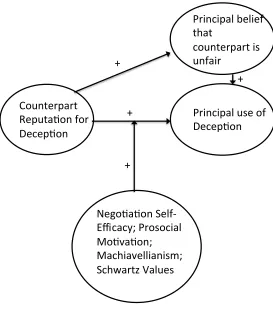
The second essay looks specifically at a model that tests the relationship
between counterpart reputation and the use of deception. In this essay, I develop a
moderated mediation model, in which counterpart reputation leads to the assessment of
unfairness and that this assessment leads to the use of deception. In my model, the
relationship between counterpart reputation and negotiator use of deception is
moderated by prosocial motivation, negotiation self-efficacy, Machiavellianism, and
Schwartz values. I report two different studies to test this model.
The third essay hones in on the relationship between principal use of deception
and negotiation outcomes. I use leakage theory, which suggests that some who use
deception inadvertently “leak” clues to the fact that they are acting deceptively, as a
basis to look at the relationship between the constructs. I argue that political skill and
emotional intelligence are key moderators of this process. I use a negotiation
experiment to test this model.
This three-essay dissertation achieves the goal of exploring a very important
aspect of deception in negotiation. As it stands, this gap in the literature presents a
picture of deception that is potentially missing an entire branch of causality: the role of
research and interest into understanding, more broadly, how a counterpart impacts
ethical or unethical decision making in negotiation. For practitioners, these studies
might be able to illustrate that the use of deception is not only about the one who
deceives. Rather, a negotiator must also understand how other people might illicit
behavior from the negotiator, both behaviors that are honest and deceptive. In addition,
the practitioner might be in a better position to understand how his or her own reputation
Chapter 2: Essay 1
ANOTHER NEGOTIATOR’S DILEMMA
ABSTRACT
Previous research has pointed to two factors, negotiator characteristics and
negotiation situation, to explain when deception occurs in negotiation. In this theoretical
development, I argue for the need for an analysis into the way in which a negotiator’s
use of deception is impacted by a counterpart’s reputation. I draw on equity theory and
prisoner’s dilemma to claim that, when a counterpart has a bad or negative reputation,
the primary negotiator is more likely to use deception. I also describe propositions for
“You must be a great liar and hypocrite. Men are so simple of mind and so much
dominated by their immediate needs, that a deceitful man will always find plenty who
are ready to be deceived.”
Machiavelli, The Prince
General Introduction
Because negotiators have conflicting interests and the ends that they desire are
interdependent, there are many opportunities for conflict and ultimately deception. Each
negotiator is interested in pursuing his or her own self-interests, which, if actualized, can
act as a direct detriment to the other party. The negotiation process is based on
information dependence, such that typically an effective negotiator must simultaneously
assess a counterpart’s ends and objectives and hide one’s own preferences (Kelley &
Thibaut, 1969). Thus, the extent to which a counterpart knows what a principal wants
and the bottom line reservation price that a principal is willing to accept, the more
disadvantaged the principal is. As a result, if a principal is too open or too honest, a
counterpart might have the opportunity to take advantage of the situation (Paese,
Schreiber & Taylor, 2003). Studies have shown that many negotiators use deception
precisely because they can do so without being detected (Schweitzer, DeChurch &
Gibson, 2005; Bond, 2006), and that those who successfully use deception do so to
leverage the subsequent information imbalance to increase their odds of achieving
Bazerman, Curhan, Moore & Valley, 2000). At its core, negotiation contains
elements of both competing and cooperating. Because each negotiator is uncertain
when the other is competing or cooperating, deception is inherently difficult to detect
(Lax & Sebenius, 1985). Lax and Sebenius (1985) refer to this difficulty as the
“Negotiator’s Dilemma.”
Research has, in great detail, documented the prevalence of deception. Broadly
speaking, DePaulo, Kashy, Kirkendol, Wyer, and Epstein (1996) found that the average
person tells between one to two lies per day. In terms of negotiation, when there were
high incentives to lie, researchers found that over 55% of negotiators use active forms
of deception (Aquino & Becker, 2005). Further, Murnighan, Babcock, Thompson, &
Pillutla (1999) found that over a third of negotiators with high levels of experience used
deception in a single negotiation. Deception has been found to exist in negotiations that
are as wide ranging as labor negotiations, corporate mergers, salary negotiations and
global climate change negotiations (Ma & Parks, 2012), just to name a few.
The social science literature has relied on two key theoretical perspectives to
explain deception in negotiation. The first stream of literature explains deception by
claiming that the situation drives behavior. Situational factors, such as when there is
one party who has more power (Olekalns, Horan, & Smith, 2014), one party faces
specific and unmet goals (Schweitzer & Croson, 1999), when a negotiator is negotiating
against a group rather than an individual (Lewicki, Poland, Minton, & Sheppard, 1997),
or when the stakes are high (Tenbrunsel, 1998), can lead to an increase in the use of
deception. Second, the literature points to individual characteristics as an explanation
(Olekalns et al., 2014), high anger (Tenbrunsel, 1998), envy (Moran & Schweitzer,
2008), low expectation of feeling guilty (Ruedy, Moore, Gino, & Schweitzer, 2013), or
personal standards (Perry and Nixon 2005).
However, largely absent from this important discussion has been the effects of a
counterpart reputation. One might think of reputation as the “combination of salient
personal characteristics and accomplishments, demonstrated behavior, and intended
images presented over some period of time” (Ferris, Treadway, Perrewe, Brouer,
Douglas, & Lux, 2007, p213). In social science research, an individual’s reputation has
been shown to have broad reaching effects. Drawing on social exchange theory, which
suggests that relationships operate similarly to economic exchange, in that they can be
seen in terms of their costs and benefits (Blau, 1964), Blickle, Schneider, Liu, and Ferris
(2011) argue that reputations are often leveraged to reap positive rewards from those in
authority or dominant positions. In this case, those with positive reputations are given
positive reinforcements and those with negative reputations are given negative
reinforcements. Reputation also has the capacity to showcase competence and garner
respect from others (Ferris et al., 2007). Reputation has a direct effect on the behavior
of others, but this occurs because reputation acts as a signaling mechanism that
reduces the uncertainty about the way in which another person might behave (Spence,
1974). In essence, a reputation is formed based on past behavior, which leads to a
cognitive shortcut in the belief about the way in which an individual will behave in the
future. A positive reputation can lead to lasting benefits such as high liking by others
(Johnson, Erez, Kiker, & Motowidlo, 2002), the perception of being skilled (Gioia &
Because of the centrality of reputation in understanding individual behavior in
general, there is a potentially important gap in the literature in explaining why some
people use deception in negotiation while others do not. By demonstrating that the
reputation of an opponent is a key driver in determining the use of deception,
researchers will have a far more full picture of what determines the use of deception.
Tinsley, O’Connor, & Sullivan (2002) noted that even though negotiators are aware of
their own reputations, the research literature understands “very little about the dynamics
of reputations’ influence on negotiation” (p. 622). The authors suggest that one reason
why there could be a low level of research into reputation could be a general lack of
interest into “social” information, as in negotiation factors that are social in nature such
as likeability, rapport or reputation. This research will help fill in this gap in the literature,
in pointing to the centrality of reputation in explaining deceptive practices. For
practitioners, this will be important because it might suggest that simply understanding
themselves as individuals (i.e. personality) and the negotiation scenario, will not be
enough to predict if they will be likely to engage in deception. Likewise, practitioners will
be better equipped to handle their own reputation, positive or negative, and how that
reputation might lead an opponent to use deception or to act in a more honest manner.
Finally, this research will allow negotiators to better predict when their reputation might
lead a counterpart to use deception.
In this research, I draw on the equity theory literature to show that principals
might choose to use deception or to tell the truth based on their counterpart’s
reputation. Specifically, I offer that when the counterpart has a reputation for what is
will use deception. I show how a principal might use deception or truth telling to
create a more balanced environment, one in which deception is more likely to be
matched with deception and honesty is more likely to be matched with honesty.
Further, as a second theoretical lens, I suggest that prisoner’s dilemma provides a
unique perspective to understand why individuals might choose to use deception. I also
suggest that personal values and individual characteristics act as moderators of this
process. Finally, I discuss some of the ethical considerations of this process.
Deception in Negotiation
Deceit is a common negotiation tactic that principals use to try and gain the
upper hand on a negotiation counterpart (Aquino, 1998; Giordano, Stoner, Brouer, &
George, 2007; Olekalns & Smith, 2007; Stawiski, Tindale, & Engblade, 2009). Some
have gone so far as to suggest that deceit and bluffing are fundamental parts of the
game of business—expecting principals to do otherwise is tantamount to asking football
players to refrain from tackling (Carr, 1968). Thus, it is not surprising that deceptive
practices have been noted to occur in arenas as wide-ranging as car sales, political
agreements, employee contracts, and nonprofit management (Gneezy, 2005), just to
name a few.
There has been a rich history of research that explains when someone might
engage or refrain from engaging in deception in negotiation. At its core, both honest
disclosure and deceit carry heavy risks to a negotiator. Divulging too much information
in a negotiation context can lead to information asymmetry, in which a principal stands
Thompson, & Pillutla, 1999). This can result in failed outcomes in which negotiation
objectives are not realized. On the other hand, if counterparts detect deception, they
can become hostile (Aquino & Becker, 2005) and distrustful (Olekalns, Horan & Smith,
2014). This too can lead to a breakdown in negotiation, leading to principals reaching
agreements that fail to reach optimal outcomes. For these reasons, we see principals in
a precarious situation in which the optimal strategy often involves nuanced approaches,
such as framing and partial disclosure, which results in the principal to using neither
outright deception nor telling “the truth, the whole truth, and nothing but the truth.”
Deception in negotiation is summed up appropriately by Rubin and Brown (1975,
p.14), “To the extent that the other party knows both what the first wants as well as the
least that he will accept, he (the other) will be able to develop a more effective, more
precise bargaining position than would be possible in the absence of this information
about the other’s preferences, while at the same time disclosing minimal (or misleading)
information about his own position.”
Research has largely explained the decision to tell the truth or use deception in
terms of pragmatism and self-interest, not as a question of ethics or morality.
Elangovan and Shapiro (1998) argue that should one’s opposition detect even a small
degree of dishonesty, the result could be detrimental to a principal’s long-term interests.
Counterparts who detect deception can act in an angry or retaliatory manner (Boles,
Croson, & Murnighan, 2000). Therefore, astute negotiation might warrant truth-telling
Negotiator Situation and Negotiator Characteristics
There have been two mature streams of research that predict the use of
deception in negotiation: negotiator situation and negotiator characteristics.
Negotiation researchers have traditionally distinguished between the way in
which individual differences and situational factors predict the use of deception. In this
first stream of research, the literature suggests that certain situations lead to the use of
deception. According to Olekalns et al. (2014), those who are high in power are more
likely to exploit their power by using deception, thus taking advantage of counterparts
who have lower power. In addition to power differentials, principal goals can also predict
deceptive behaviors. Schweitzer and Croson (1999) found that when principals have
goals that are both specific and unmet, they are less likely to be truthful and will use
deception to meet their goals. This occurs in such situations because negotiators feel
that without the use of deception they will fall short of their goals. The literature also
point to the importance of external forces. For example, outcome uncertainty and
negotiation with a group, as opposed to an individual, creates situations in which the
principal might feel that he or she is dealing with a more abstract entity, which can lead
to the use of deception. In contrast, when negotiating with an individual, the use of
deception decreases (Lewicki et al., 1997). Further, Tenbrunsel (1998) found that high
stakes can predict deception. In a controlled experiment, she found that people are
more likely to lie to win larger dollar values ($100) than smaller dollar values ($1).
Research has also shown that negotiator characteristics can help predict use of
deception in negotiation. Deception is used more frequently by those who, in general,
principals who are pro-self, rather than prosocial. Affective processes, such as anger
(Tenbrunsel, 1998) and envy (Moran & Schweitzer, 2008) help to predict deception. In
addition, one who expresses negative emotions during a dyadic negotiation can lead to
the use of deception (Olekalns & Smith, 2009). Finally, if a principal does not expect to
feel guilty about the use of deception, the chance of lying is increased (Ruedy et al.,
2013).
Characteristics of the Counterpart
To date, research has largely explained deception in terms of the negotiation
situation, and the individual characteristics of the negotiator. As discussed above,
negotiators are more likely to use deception when they feel that they have no other
option or if they perceive that the power differential is in their favor and they can take
advantage of the situation. In terms of individuals, research shows that certain personal
characteristics might lead one to use deception. However, little research has been
conducted in regards to the characteristics of the counterpart. For example, while
researchers have shown that deception can be triggered when a counterpart asks
indirect questions (for example, a potential buyer asks a used car salesman, “tell me
about the car?”), as opposed to direct questions (“Is there something wrong with the
transmission?”) (Schweitzer & Croson, 1999), such analysis still primarily investigates a
situational variable (indirect vs. direct questioning), but not a characteristic that is
intrinsic to the counterpart (i.e. counterpart affect or counterpart reputation).
As negotiation occurs between people, there is surprisingly little known about
research has ignored a potentially important variable, the reputation of one’s
counterpart. In my literature search, I could only find research that shows that a
principal is more likely to lie when the counterpart is wealthy (Gino & Pierce, 2009).
Yet there is reason to believe that counterpart reputation might have a significant
impact on negotiator behavior. The literature from the social sciences supports the idea
that reputations have a dramatic effect on how people perceive and ultimately act
toward those with a given reputation. Research suggests that positive reputations can
lead to higher levels of trust (Whitmeyer, 2002), and that higher trust can lead to better
integrative negotiation outcomes (Kong, Dirks & Ferrin, 2014; Kong, 2015). Individuals
use reputation as a cognitive shortcut to assess others and act on the basis of those
assessments. Thus, if I can show that counterpart reputation significantly contributes to
the use of deception, it will greatly enhance our understanding of this third pillar of the
literature. This will enable researchers to fill in an important void in the literature, and
practitioners will be in a better position to understand how their own reputation might
affect a counterpart’s decision to use deception and likewise how they might respond to
a counterpart’s reputation.
Theoretical Development
Use of Deception in Negotiation. The central quality that defines lying is the intent to deceive. Absent deceptive intention, a lie is reduced to something that was stated
incorrectly, or might be considered a mistake. Bok suggests that lying occurs when “the
intention to mislead is obvious, where the liar knows what he is communicating is not
(1978, p.16). Shapiro and Bies (1994) suggest that principals lie in order to tilt the
power differential in their favor. This occurs because information is at the center of
negotiation and information asymmetry can create an imbalance of power. Lewicki &
Hanke (2012) distinguish between six different types of potentially deceptive practices
within negotiation.
Competitive bargaining— not telling walkaway price, making an “inflated
opening offer.”
Emotional manipulation—pretending to be angry or disappointed.
Misrepresentation—giving false information.
Misrepresentation to peers—destroying a counterpart’s reputation.
Unethical information gathering—using bribes to get information.
Bluffing—making threats or promises on which an agent does not intend
to follow through.
For example, Lewicki and Litterer (1985) indicate that a common example of
deception in negotiation is of a representative who is prepared to pay union members
$15 an hour but explicitly states that all he can afford is $14. In this case, the
representative is deliberately misrepresenting information. In this study, I will only be
concerned with this type of deceit, misrepresentation of information. While the other
types of deceptive practices are interesting from a theoretical and practical standpoint, it
is important that I limit the scope of this inquiry. I chose to focus on misrepresentation
of information for several reasons. First, misrepresentation of information has been
misrepresentation, previous research has differentiated between passive and active
forms of deception (Olekalns & Smith, 2007), otherwise known as sins of omission and
sins of commission. Active deception (sins of commission) occurs when a negotiator
gives false information; whereas passive deception occurs when a negotiator withholds
information that would be pertinent to disclose (sins of omission). Second, the literature
has shown that misrepresentation of information is an important variable in negotiation,
and has been linked to an increase in power (Shapiro & Bies, 1994), negotiation
outcomes (Aquino, 1998), and information imbalance (Bazerman et al., 2000). Because
misrepresentation of information has the most real-world use, and its centrality to the
conversation thus far in the literature, I am choosing to use it as my focus for this
exploration.
In a study of MBA students, Robinson, Lewicki and Donahue (2000) found that
participants consider it acceptable for principals to use tactics that are deemed “tough
but fair,” such as stating that they have a small budget, or exaggerating their best
alternative to a negotiated agreement (BATNA). These “more acceptable” forms of
deception coincide with the above-mentioned concepts of competitive bargaining and
emotional manipulation. However, participants found it less acceptable to engage in
tactics that are considered outright lies, such as false promises and misrepresentation
of information. The authors suggest that the majority of negotiators do not expect their
counterparts to tell the whole truth and nothing but the truth, but they do expect their
counterparts to refrain from misrepresentation, misrepresentation to peers, unethical
While deception occurs frequently in negotiation, there is still no consensus as
to whether it is acceptable. As discussed previously, Carr (1968) suggested that
deception within negotiation is similar to bluffing in poker—that it is an integral part of
the game and not a violation of it. In contrast, some scholars have stated that one
ought to refrain from lying in negotiation (Dees & Cramton, 1991). Still, many have
distinguished between which types of lies are acceptable and which should be avoided.
For example, Strudler (1995) concludes that misrepresentation about one’s bottom line
price is not problematic, but deception concerning material facts crosses the line.
However, while the acceptability of deception is debated, the fact that it is commonly
used is not. In fact, in a study on undergraduate students, O’Connor and Carnevale
(1997) suggest that deception occurred 28% of the time in dyadic negotiations.
Specifically, the authors noted that deception was most likely to occur when negotiators
had motives that were individualistic in nature.
Distributive and integrative outcomes.
We must take a moment to distinguish between distributive and integrative
outcomes for the purpose of this discussion. Distributive negotiations are the type in
which there is a “win-lose” paradigm, such that one party’s gain is at the behest of a
counterpart’s loss. These types of negotiations are often once-off in nature, such as a
buyer-seller negotiation over a used bicycle, in whichever extra dollar gained by the
seller is a dollar lost by the buyer. In contrast, an integrative negotiation is one in which
there are opportunities for “win-win” tradeoffs, such that both parties are better off. An
values time off and the employer highly values offering a lower salary. In this, the job
applicant can push for more time off and the employer might meet the needs of the
prospective employee by negotiating a lower salary. In the end, by finding a mutually
agreeable solution, both parties are better off. Integrative negotiations are more
common in business, especially in supply chain negotiations and job offer negotiations.
The negotiation literature has paid careful attention to both distributive (for specific
articles, see the meta-analysis, Huffmeier, Freund, Zerres, Backhaus, & Hertel, 2014)
as well as integrative negotiations (De Dreu, Weingart & Kwon, 2000). For the purpose
of this paper, I will be interested in both distributive and integrative negotiations.
Once-off negotiations. While it is common to have negotiations that occur once and
negotiations that occur multiple times, for the purpose of this essay I will be focusing on
once-off negotiations. As once-off negotiations tends to be the standard in the literature
(see Olekalns & Smith, 2009; Miles & LaSalle, 2008; Fulmer, Barry & Long, 2008), I
have decided to limit the scope of this essay to considering deception in once-off
negotiations.
Ethical standpoint. The discussion in this essay will take an ethically neutral point of
view, one that centers on negotiator strategy, not negotiator ethical choice. To better
understand this, we should think of Cramton and Dees’ (1993) concept of a fictional
world called Metopia. In this world, everything is the exact same as our world, except
people only operate in pure self-interest. In Metopia we can understand if someone will
“an action is in a party’s self-interest if, given the party’s beliefs at the time of
decision, the action yields greater expected utility for the party than any other available
action.”
Does deception work? Schweitzer and Croson (1999) found that those who use sins
of omission in negotiation achieve greater distributive outcomes than those who refrain
from using deception. However, the authors suggest that those who use sins of
commission outperform both those who use sins of omission and those who act
honestly. This would suggest that the use of sins of commission would be the dominant
strategy in a single negotiation in which the parties will not enter into a recurring
negotiation relationship. On the whole, those who use deception have been shown to be
successful in negotiation, because their counterparts often do not find out that they have
been using deception (Lewicki & Hanke, 2012). Thus, people often use deception
because they correctly believe that it is more likely to generate what they want.
When caught, more skilled negotiators diffuse the potentially damaging situation
by using various verbal strategies to regain trust and prevent the negotiation from
failing. Lewicki and Hanke (2012) suggest that some deceivers will utilize verbal
strategies such as “It was an accident” or “I’m really sorry; I got carried away, and I will
never do this again.” If the deceiver convinces his counterpart to believe that such
apologies or explanations are genuine, then the damage to the deceiver might be
minimized. Interestingly, in multiple experiments, Kim, Ferrin, Cooper, & Dirks, (2004)
found that the dominant negotiation strategy for those caught in a lie was to accept
responsibility if there was any evidence of innocence. Further, the authors suggest
that negotiators ought to apologize for mistakes involving competency but deny fault for
integrity violations. Thus, the authors suggest that repairing trust after being caught in
deception is a difficult task—the strategies that one should use depends on the nature
of the misdeed and the amount of evidence present that the deception took place.
Reputation
Much of the social science literature has conceived of reputation as occurring at the
group level, either between organizations or between nations. For example, a recent
meta-analysis looked at the broad reaching consequences of corporate reputation (Ali,
Lynch, Melewar, & Jin., 2015). However, I want to ensure that the focus of this
discussion is on reputation as it operates at the individual level. As mentioned earlier,
for the purpose of this theoretical exploration, reputation will be thought of as the
“combination of salient personal characteristics and accomplishments, demonstrated
behavior, and intended images presented over some period of time” (Ferris, et al., 2007,
p. 213).
In general, people do not begin negotiation in a blank slate scenario, in which
one person is agnostic about trust in another. Rather, most people begin relationships
with a high level of default trust (Meyerson, Weick & Kramer, 1996), which varies based
on how each party assesses their counterpart’s reputation. In addition, genetics
(Sturgis, Hatemi, Zhu, Trull, Wright, & Martin, 2010) and individual orientation (Bianchi &
Reputation is the combined perception of others in regard to an individual’s
characteristics, accomplishments and behavioral tendencies (Ferris et al., 2003) and
can be thought of as, according to Sabater and Sierra (2005), “the opinion or view of
someone about something.” These assumed characteristics, assigned by a
combination of groups and individuals, serve as a cognitive shortcut in assessing the
totality of another person (Origgi, 2012). Reputation can exist for individuals, teams,
groups or ethnicities (Nakai, 2014). Ultimately, an individual’s reputation can act as a
substitute for actually knowing and assessing a person. As it is not possible to
understand all the component parts of someone else’s character and how that character
leads to behavior, reputation allows others to reduce a complex character into a certain
set of generalized behaviors. The lasting effects of reputation have been well
documented in the literature. Examining reputation through the lens of confirmation
bias, a recent study of student evaluations of their professors found that professor
reputation before the course began significantly impacted student’s experience of the
course and evaluation of the professor (McNatt, 2010). Baumeister and Jones (1978)
suggest that reputation acts in a cyclical manner: consistent behavior leads to
reputation, and reputation acts to solidify consistent behavior. In the end, reputation acts to reduce the uncertainty of other’s behavior (Spence, 1974). Interestingly, this ties
into Goffman’s concept of face theory (1967), in which he posits that reputation is
somewhat fluid, in that in some contexts an individual might be acting as a good friend,
while in another they might be playing the part of being an expert witness. It is not that
differently under different circumstances and how someone might ultimately attain a
different reputation among different groups.
In their examination of the reputation effect in negotiations, Tinsley, O’Connor,
and Sullivan (2002) found that those who maintain trustworthiness and reliability in a
negotiation will enjoy repeated interactions and maximized outcome potential.
Connected with agency theory, it has been suggested that having a positive reputation
leads others to trust the person more, and consequently, lower the amount of
monitoring that would otherwise take place (Whitmeyer, 2002), thus reducing the
transaction costs associated with business relationships. Also, by lowering costs and
increasing communication, a positive reputation can have a positive impact the
integrative outcomes of a negotiation (Tinsley et al., 2002). In the end, trust in one’s
negotiating counterpart can arise from the belief that the counterpart has acted honestly
in the past (Brockner & Siegel, 1996) and the belief that such past actions will predict
behavior in current negotiations.
In negotiations, both sides are aware that deception could be used by a
counterpart. Thus, the negotiator will look for insights or characteristics that might be
evidence that deception is more likely to be used. Reputation can act as a shortcut in
the assessment of potential deception.
How others respond to reputation. In social and business contexts, individuals use
the reputation of others in order to generalize expected behavior, and act on such
generalized assessments. Reputation acts as a time and attention-saving shortcut,
enabling individuals to avoid the limitless amount of information that is potentially
character. For those who deviate from social norms, the result can be a negative
reputation (Castelfranchi, Conte & Paolucci, 1998). Origgi (2012) suggests that the
Internet has made reputational assessments even more quick and efficient. As
reputation is inherently connected to sharing of information about another person, the
advent of Google and similar outlets has seen exponential growth in the capacity for
sharing reputation-relevant information. However, while digital access has enabled
individuals to establish quickly the reputation of others, it has also created the possibility
that false information can lead quickly to undeserved reputations. There is also the
issue that seemingly minor or irrelevant connections, issues or events can end up on
the first page of a Google search. Nonetheless, search engines such as Google have
been shown to be essential in the estimation of trust in others (Josang, Ismail & Boyd,
2006).
Equity Theory
In organizational research, equity theory posits that rather than focusing on
specific outcomes that come about from the result of work or effort, people instead hone
in on balancing the ratio of inputs and outcomes so that they are fair in comparison to
other individuals (Adams, 1963). For example, one should feel that their inputs (i.e.
quality of work, effort, time spent, etc.) reflects the outcomes that they receive (i.e.
payment, office location, job title, etc.) These results are compared to comparison
others, including people who are deemed comparable (i.e. coworkers). When equity is
out of sync, those who are overpaid or overcompensated will respond by reducing their
undercompensated will look to balance their equity situation by increasing their output
but decreasing the quality of their output (Griffeth, Vecchio & Logan Jr., 1989). People
have an innate desire to limit psychological tension (Festinger, 1957). Because inequity
creates an internal feeling of tension, the act of restoring equity can lead to a decrease
in felt tension (Harder, 1991). When someone feels that they have been taken
advantage of or manipulated, one way that the individual can restore equity is by
harming the one who the individual believes is responsible for the inequity (O’Leary &
Dengerink, 1973).
Research suggests that one important predictor of who will try to change an
inequitable situation is the degree to which an individual believes that his or her actions
will actually bring about the desired change (Mowday, 1991). For example, if someone
believes that they do not have the power or the influence to change an inequity, they
are unlikely to take the risk to do so (Cook & Hegtvedt, 1986). For example, in a study
of almost 5000 employees across various sectors, researchers found that employees
who felt that the company had taken advantage of them were more likely to engage in
counterproductive work behavior, such as theft, as a means to reverse the feeling of
perceived injustice (Hollinger & Clark, 1983). Such behaviors tilt the perceived balance
of power back into the hands of the individual and might lead to a feeling of restored
equity. The idea of restoring equity through retaliatory measures is not a new idea. In
the law literature, Shafer (1960) suggests that the drive to curb inequity through
retaliatory measures has been around as early as Hammurabi’s code, which gave us
In developing the idea of a mutual trust principle and addressing the violation
of trust, Dees and Cramton (1991) suggest that it might be justified to engage in what
would otherwise be considered unethical behavior if you believe your counterpart is
acting unethically. However, they suggest that one central goal in negotiation should be
the establishment of mutual trust, which can decrease the desire to use deception by
both parties. The authors acknowledge the limits of moral commitments, namely, that
they are dependent on a counterpart sharing such a commitment. Thus, when equity is
breached through deception, or the belief that one is being deceived, one would expect
that individuals would counter with deception. Dees and Crampton (1993) note that “a
sense of fair play can motivate individuals with strong ethical commitments to engage in
what they would otherwise consider unacceptable behavior” (p. 2).
Fairness heuristics. The process by which an individual assesses whether something
is fair or unfair has been explained as fairness heuristic theory (Van Den Bos, Lind &
Wilke, 2001). The theory stems from the proposition that trusting others or giving
authority over to others can result in opportunities for exploitation (Lind, Allen & Tyler,
1988). In response to this potential threat, people quickly and efficiently develop an
assessment of the fairness of the other party and act in alignment with this prognosis. If
the opposition appears to be acting in a manner that is exploitative in nature, the
principal is likely to disobey the wishes of the person in question or act in opposition to
him or her (Lind, Allen, & Tyler, 1988). Likewise, if a counterpart is acting in what
appears to be a legitimate or forthright manner, it is less likely that it will be interpreted
According to Van Den Bos, Lind, Vermunt, & Wike (1997), the development of
fairness assessment is information dependent, such that individuals will access only the
information that is available at the time that they go through the fairness assessment.
Thus, the fairness heuristic process can act as a cognitive shortcut to the fairness
assessment. Once fairness assessments have been established, they are used as a
heuristic, relied upon as a shortcut for the actor in question (Van den Bos et al., 1997).
As Rodell and Colquitt (2009) explain, the heuristic process acts as a “cognitive shortcut
used to help determine whether to cooperate” (p. 991) with someone who is or is not
acting in a perceived just manner. Such cognitive shortcuts allow an individual to
assess quickly fairness perceptions and establish fast responses to perceived
challenges (Lind, 2001). In fact, Loi, Yang & Diefendorff (2009) suggest that past
regular interactions provide cognitive shortcuts that allow individuals to engage in
behavioral responses that are not simply bound by affective states, such as emotions or
moods.
One of the most important elements that enables one to believe that outcomes
are fair is the ability to have a voice, or make an appeal, to an authority or to a
counterpart. When the information is taken into consideration and used to help change
or modify the process, the individual in the matter is more likely to interpret the overall
process as being fair (Lind, Kulik, Ambrose, & de Vera Park, 1993). However, in many
negotiation contexts, there is rarely such an opportunity. If the opposition is believed to
be dishonest, it is unlikely that the principal will be able to modify the process in
response to a belief that the other side is unscrupulous. Instead, one may merely back
not to end the relationship. In some negotiations, backing out is not an option or it
might be believed that doing so would be a strategic blunder. If this is the case, then
the principal might decide to take dramatic action, which might include the use of
deception. In this sense, the effects of the negative reputation will be even more
enhanced on account of fairness heuristics and equity theory. Fairness heuristic theory
posits that people want to know if they can trust other people who might have power or
influence over them. To make such assessments, an individual will look at whatever
information one has at his or her disposal (Arnadottir, 2002). Taking the above
information into consideration, I believe that counterpart negative reputation will impact
the principal, such that the principal will believe that equity theory is out of balance and
will thus view the counterpart as being an unfair negotiator.
Proposition 1: Principals negotiating against counterparts with a negative reputation are more likely to view their counterpart as an unfair negotiator than are principals negotiating against counterparts with a neutral reputation.
Revenge and preemptive strikes. There are many reasons why an individual who
thinks that he or she will be lied to, might choose, in turn, to act in a deceptive manner.
As discussed above, a feeling of leveling the playing field, attributed to equity theory,
can help explain why one might use deception. One further explanation comes from the
13). According to Cahn, we would expect to see both resulting (revenge) and
anticipatory (preemption) actions against a potential deceiver.
The doctrine of preemption has largely been developed in the realm of
international relations. For example, in 2002, President George W. Bush focused on
the notion of preemption as a justification for war against Iraq, claiming through The
Bush Doctrine, that the potential threat posed by Iraq warranted a “compelling the case
for taking anticipatory action to defend ourselves (White House Archives, 2002).”
Likewise, the phrase “preemptive war” was used in 1967 in the Six-Day War, in which
Israel attacked first against Egypt, sparking a conflict in which Israel doubled the size of
its territory.
Preemptive actions have not only occurred in the world of international affairs.
Such actions appear also to be relevant between individuals. In an interesting
economic investigation on preemptive strikes, Simunovic, Mifune and Yamagishi (2013)
set up a game-theory experiment in which two players have the opportunity to inflict
damage on one another, even though doing so would be a suboptimal strategy for both
themselves and their counterpart. However, by acting in a preemptive manner, the “first
mover” is able to block aggressive behaviors by his or her counterpart. Such behaviors
suggest that individuals, in fact, think of potential aggressors as legitimate threats,
which sometimes warrant preemptive action, or acting first in anticipation of aggressive
behaviors on the part of a counterpart. In competitive environments between
individuals, preemptive actions can occur, not just on the threat of attack in economic
affairs, but even when an individual feels that his or her honor might be under threat
A second explanation of deceptive action comes from a retaliatory perspective.
The extent to which someone believes that someone else is going to or has lied to the
principle agent, it is expected that the individual might want to retaliate and use
deception in response. It has been suggested that those who feel wronged or taken
advantage of in negotiation often feel manipulated or angry (Lewicki & Litterer, 1985).
When people believe that they have been wrongfully harmed, one of the ways that they
might react is by “getting even” through actions of revenge. In management contexts,
employees have sought revenge for perceived injustices, which can lead to a
restoration of self-esteem on the part of the aggrieved (Bies & Tripp, 1998). Revenge
behaviors have likewise been linked to a reversal in treatment to the aggrieved, such
that revenge can act as a means for restorative justice. Bies and Tripp (1997) suggest
that individuals often engage in acts of revenge anticipation of aggressive counterpart
behavior. In terms of this study, the most interesting form of revenge relates to revenge
enacted as a response to lies or deceit. Aquino, Tripp and Bies (2006) found that
individuals are more likely to seek revenge when they feel that rules are violated and
that the justice climate is unfair.
Prisoner’s Dilemma
As discussed previously, prior research, personal experience and intuition can
offer good reason why one might use deception in negotiation: it provides a potential
advantage for the one who uses it. This appears to be the case especially in once-off
negotiations, in which long-term trust or lengthy relationships are unlikely to occur. In
deception are minimal. As noted by Goffman (1967), in this context one does not
need to be concerned with presenting a face consistent with previous reputation or
consistent with a desired future reputation.
The prisoner’s dilemma has been used extensively to model cooperative and
competitive behavior in economics (Raiffa, 1982; Rasmusen, 1990) and psychology
(Dawes, 1980). Examples of prisoner’s dilemma have been suggested to include
oligopoly pricing, auction bidding, political bargaining and arms races (Rasmusen,
1990). Moreover, Gibson (2003) argues that prisoner’s dilemma can happen any time
you have a social interaction between two or more decision makers, in which the
outcome depends on the choices of all the players, and every player has preferences
among the possible outcomes.
The two-party version is the most common version used. Each party has to
choose independently between two options: cooperation or defection. In all versions of
prisoner’s dilemma, the payoff of one party depends upon the choice made by the other
party. In most standard prisoner’s dilemma examples, no matter what one party does,
the other can always increase her or his payoff by defection, choosing the option that
betrays or harms the counterpart.
The basic scenario is as follows (Campbell, 1985): You and a fellow criminal are
arrested on robbery charges and are brought into questioning. You and your
accomplice are split up into different rooms and are investigated separately. The
investigator tells you, “there is enough evidence that even if you both remain silent,
each of you will still spend a year in jail. However, if you confess to the crime, and help
confesses, then you will serve 10 years in jail and your accomplice will go free. If
both of you confess, then you will both spend 9 years in prison. So what will it be?”
[image:36.612.68.528.208.282.2]The decision is summed up here:
Table 1: Prisoner’s dilemma decision nexus
Accomplice stays silent Accomplice confesses You stay silent You-1 year;
Accomplice-1 year
You-10 years; Accomplice-go free
You confess You- go free;
Accomplice-10 years
You-9 years; Accomplice-9 years
In this classic economic thought experiment, no matter what the opposing side
does, each of the accused is better off confessing to the crime. In the condition that the
accomplice stays silent, you are better off confessing and going free. Should the
accomplice confess, you are better off confessing and serving 9 years in jail, instead of
10 years in jail. Likewise, the accomplice faces the same pay-off schedule, so he or
she is also better off confessing under both conditions. The result is a suboptimal result
for both, with both of the accused ending up with 9 years in prison, instead of both
facing just 1 year in prison, should both parties stay silent.
Deception in negotiation and prisoner’s dilemma. While prisoner’s dilemma was
established in the field of economics, the question remains whether we could use
prisoner’s dilemma to better understand deception in a negotiation context. Could it be
that, from a purely pragmatic perspective, that once-off negotiation is the perfect context
For this example, we should assume that both negotiators are expert deceivers, who
are certain not to be detected by their counterpart.
Let us suppose that there is a principal negotiator and counterpart. The principal
has been granted a job offer by the counterpart, and the two must negotiate salary. The
principal does not have any other job offers, but believes that he might negotiate a
higher salary if he says that he is considering other alternatives. The counterpart does
not have any other qualified candidates to choose from, but believes that she might
negotiate a lower salary if she says that she is choosing among several applicants.
Both the principal and counterpart consider the fact that their opposition might tell the
truth and that they might lie.
Considering the options, the principal thinks to himself, “Imagine that my
counterpart tells the truth, I will be at a distinct advantage if I use deception. However,
should my counterpart lie, I should certainly use deception myself, lest I be taken
advantage of. By deceiving, I will level the playing field.” Similarly, the counterpart will
face the same trade-off considerations, and will likely choose to use deception in either
[image:37.612.65.519.563.654.2]case.
Table 2: Prisoner’s dilemma as truth or lie
Counterpart tells the truth Counterpart lies
P Truth Neutral Principal- disadvantage;
Counterpart-advantage
P Lies Principal- advantage;
Counterpart- disadvantage
Neutral
As we can see, both the principal and the counterpart are at no point better off
deception. Should either the principal or the counterpart decide not to use deception,
he or she will be at a distinct disadvantage and will reach further suboptimal results.
Ethical decision making against an unethical counterpart
The crux of the issue for one deciding to use deception in negotiation or to act in
an honest manner can be thought of as a two-layered process, in which the individual
first considers what the counterpart might do, then decides how to respond. We can
imagine in a typical negotiation context that P might consider what the payoff structure
would be under 1) the counterpart lying or 2) the counterpart telling the truth. The
principal might consider, “If I think that my counterpart might lie, then I ought to lie,” or “If
I think that my counterpart might lie, I ought to tell the truth.” Likewise, the principal
might have a similar thought about the condition in which his or her counterpart tells the
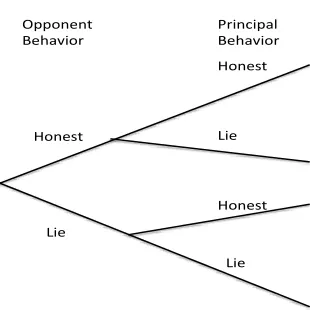
The saturated decision tree would thus look as follows:
Figure 1: Saturated decision tree
In this case we can imagine four different situations, in which the principal must
decide how he will respond if he thinks that the counterpart will be honest or if he
believes the counterpart will be truthful. However, the information and implications that
are associated with the negative reputation condition fundamentally changes the way in
which the principal is likely to approach the situation. How is the choice to use deception
different for someone who thinks the other will be lying (treatment) versus someone who
does not know one way or the other (control)? In traditional prisoner’s dilemma, both
individuals move at the same time, but their actions impact the result of their
counterpart. However, in this example, reputation effects alter the scenario, such that
the counterpart essentially moves first. In this, the principal, on the basis of a
counterpart’s reputation, is lead to believe that the counterpart will act in a certain
Opponent Behavior
Honest
Lie
Principal Behavior
Honest
Lie
manner. This prompts the negotiator’s response. Let us suppose that the principal
believes the counterpart will lie. The decision tree is thus changed as follows:
Figure 2: Decision tree when the principal believes the counterpart will lie
In this case, the principal has good reason to believe that the counterpart will lie
to him, and thus the principal’s ethical decision making comes from a very different
perspective. Might we expect that the principal will think it is appropriate to use
deception once he or she believes that the counterpart will be using it as well? In
prisoner’s dilemma, I argued that when the principal believes that the counterpart will
act in an aggressive manner (by defecting), the principal is more likely to defect.
Likewise, in negotiation, we might expect that the principal will act deceptively if the
principal believes that the counterpart is going to act in an unethical manner. However,
the decision tree might be reversed should the counterpart have a positive reputation.
The following is the decision tree for the principal, with the counterpart in the positive
reputation condition: Opponent Behavior
Lie
Principal Behavior Honest
Figure 3: Decision tree when the principal believes the counterpart will tell the truth
In the positive reputation condition, the principal is likely to believe that the
counterpart is going to act in an honest manner. Because of the fairness heuristic and
equity theory, the principal is more likely to act in an honest manner. However, some
will choose to defect to maximize their own benefit (Prisoner’s dilemma principle). This
is supported by Cox (1991) who found that individualist oriented people tend to act
opportunistically when they think the other party will cooperate in prisoner’s dilemma
games. Monteverde, Paschke, and Tedeschi (1974) claim people will punish others for
acting exploitatively. They found that individuals who claim, in a PD game, that they will
act cooperatively, who then act exploitatively, elicit revenge behavior from their
counterpart. Thus, an overarching fear in acting in a deceitful manner could be that
one’s opposition will act in a retaliatory manner.
Opponent Behavior
Honest
Principal Behavior
Honest
Taken together, previous theoretical development on equity theory, prisoner’s
dilemma and reputation imply:
Proposition 2: Principals who negotiate with a counterpart with a negative reputation will be more likely to use deception than principals who negotiate with counterparts with a neutral reputation.
Political science and prisoner’s dilemma. Much of the prisoner’s dilemma context
has been explored through the lens of political science and international relations. One
key theory has been developed, claiming that states have two preferences 1) to
maximize individual gains and 2) minimize gaps in gains favoring partners. Realist
theory states that states assess their own level of achievement in any domain of activity
by comparison to the performance of other states (Grieco, 1988). In such a competitive
environment, states don’t ask “will both of us gain” but “who will gain more?” (Waltz,
1979). For example, a nation might achieve preference 1 by growing its GDP by 4%
annually, but fail at achieving preference 2 if the nation’s competitor (e.g. United States
versus Russia) has GDP growth of 6%. This relativism streak is seen in corporate
competition as well, documented by the tendency of companies to look toward both the
bottom line and gaining market share (Porter, 1998).
Since there is no central authority to govern behavior in international relations, a
dynamic occurs in which individually rational behavior results in a collectively
suboptimal outcome (Busch & Reinhardt, 1993). For this reason, we often see
escalation of conflict. If enforceable binding agreements are not possible, states will
not cooperate (Snidal, 1985).
This connects to individual action through ultimatum games, in which party one is
able to set the distribution of money at their own choosing (i.e. party one gets $9, party
two gets $1). However, in ultimatum games the second party is able to reject the entire
offering for both parties. Guth, Schmittberger & Schwartz (1982) found that individuals
usually reject anything less than 20% offered in an ultimatum game, even though pure
rationality would suggest that the second party should accept whatever offer party one
makes. We can see from international relations and the results from ultimatum games
that actors will often act in an irrational manner, being willing to sabotage one’s own
best interests to prove a point.
Other Effects
At this point, I will move the discussion from the main effects that stem from the
relationship between counterpart reputation and the use of deception to that of
moderating factors that impacts this relationship.
Machiavellianism. Certain individual characteristics are likely to impact whether an
individual decides to act in a deceptive manner. I use the definition, established by
Wilson (1996), of Machiavellianism (Mach) as a “strategy of social conduct that involves
manipulating others for personal gain” (p. 295). It has been shown that high Machs
(individuals higher in this characteristic) are more likely to engage in criminal activity
and are more likely to be con artists (Tang, Chen & Sutarso, 2008). This damaging
and of deviating from the truth. High Machs are also more likely to be convincing and
avoiding detection when engaging in deception (Geis & Moon, 1981). Some of the
tendencies toward manipulation and lying stem from a “mistrust in human nature, lack of
conventional morality, opportunism, and lack of affect in interpersonal relationships”
(Drory & Gluskinos, 1980).
In an experiment that allowed individuals in a negotiation context to act in a
manipulative way, Christie and Geis (1970) found that those who are high in
Machiavellianism were found to be more likely to make attempts at manipulation and
endure at manipulation for longer periods. The authors distinguished between three
different elements that are central to Machiavellianism: cynicism about human nature,
manipulativeness, and detachment from norms and values. With regard to negotiating,
the most significant elements of the scale are connected with manipulation, which is
captured by items such as “The best way to handle people is tell them what they want to
hear,” “Never tell anyone the real reason you did something unless it is useful to do so,”
and “Honesty is the best policy in all cases” (reverse coded). They also found that
Machs acted more opportunistically in negotiation, were more likely to achieve higher
distributive outcomes, and to “take initiative” to ensure that they benefited from the
negotiation. In the study the authors used a bargaining game in which two people out of
a group of three will get to share $20. The results showed that high Machs averaged
$11.14, medium Machs averaged $6.28, while low Machs averaged $2.58. The authors
suggested that the high Machs’ overall success in the game was due to the unrelenting
high Machs are significantly more likely to believe that cheating is an acceptable
means to achieve one’s goals (Bloodgood, Turnley & Mudrack, 2008).
Interestingly, the pattern of Machiavellian behavior begins at a young age. In a
study on 10-year-old children, Braginsky (1970) offered to pay participants $0.05 for
each bitter cookie they could get another child to eat. High Machs averaged 6.46
cookies while low Machs averaged 2.79. The strategies that the high Machs employed
were lying, bribery and coercion, something that low Machs avoided.
From this pattern of findings, it should follow that those high in Machiavellianism
are more likely to use deception in negotiation.
Proposition 3: Negotiators who are high in Machiavellianism are more likely to use deception in negotiation than are those who are low in Machiavellianism.
Schwartz values. Schwartz set out to transform the conversation concerning
cross-cultural research from that of the group and group values to that of the individual. In
doing so he established that “values (a) are concepts or beliefs; (b) pertain to desirable
end states or behaviors; (c) transcend specific situations; (d) guide selection or
evaluation of behavior and events, and (e) are ordered by relative importance”
(Schwartz, 1992, p. 4). These values, which act as guiding principles in individuals’
lives, exist on a “circular motivational continuum” (Schwartz, 1992). Schwartz’s values
include Power, Achievement, Hedonism, Stimulation, Self-direction, Universalism,
– Individuals as biological organisms
– Coordinated social interaction
– Survival of groups
In delineating the tendencies of individuals to act in a enhancing or
self-transcendent manner, Schwartz suggested that individuals fall on a continuum between
self-transcendence and self-enhancement (Schwartz & Huisman, 1995). This
discrepancy represents an internal conflict in people between promoting one’s own
interests and the interests of others. According to Schwartz (1992, p.11)
self-transcendence is a cluster value that combines the two values of benevolence,
“preservation and enhancement of the welfare of people with whom one is in frequent
personal contact,” and universalism, “understanding, appreciation, tolerance and
protection for the welfare of all people and for nature.” This gives rise to individuals who
transcend self-enhancement and act to benefit other individuals and groups. In
contrast, self-enhancement is made up of the values achievement and power.
Individuals high in self-enhancement, value superiority, and esteem (Sawyerr, Strauss &
Yan, 2005) and act in a manner that serves their own self interest, even when doing so
comes at the expense of others. Those who are high in self-enhancement are more
likely to control and take power positions over others (Schwartz, 1992).
The distinction between self-transcendence and self-enhancement motivated
Roccas (2003) to test the relationship between these two value sets and how they
predict identification with group status. She found that those who are self-enhancement