Development of Teacher Education Curriculum and Challenges in Transaction
Vijay Dhamane Tilak College of Education, [email protected].
ABSTRACT :
“People in India have been slow to recognize that education is a profession for which intensive preparation is necessary as it is in any other profession!” So to prepare competent teachers for the modern India, the curriculum should be complete and competent. Regarding this issue this study focuses on the curriculum development and challenges in transaction of Teacher Education Programme.
Teacher Education refers to the policies and procedures designed to equip prospective teachers with knowledge, attitudes behavirous and skills which they require to perform. So while designing a curriculum of Teacher Education Programme the Feedback and expectation of concerns be considered. The national aspiration and need, cultural and social change should be reflected through curriculum. This study focuses on Teacher Education curriculum design and challenges during transaction.
university authority, expert will develop complete curriculum which empowers to face the emerged challenges.
Key words – Teacher Education Curriculum, Curriculum design, Challenge in transaction
1. INTRODUCTION
Teacher Education refers to the policies and procedures designed to equip prospective teachers with the knowledge, attitudes, behaviors and skills they require to perform their task effectively in the classroom, school and wider community.
Teachers ultimately determine our collective ability to innovate, to invent, to find solutions for tomorrow. Nothing will ever replace a good teacher. (Irina Bokava, UNESCO Director General)
“People in this country have been slow to recognize that education is a profession for which intensive preparation is necessary as it is any other profession.”
National Curriculum Framework for Teacher Education 2009 has been suggested a lot of changes for the future curriculum design. Now it is our duty to develop a complete curriculum and strengthen the system.
2. NEED OF THE STUDY
Being a teacher educator, its an experience that no any teacher education
curriculum or syllabus is a complete one. Day by day the expectation from Teacher Education Programme are increased. To study the same, it is necessary.
It is needful to Teacher Educator community to know the process of
developing the curriculum.
To know the forthcoming challenges in designing and transaction of teacher
education programme, this study is necessary.
It is need of teacher community, how to contribute in curriculum design, for
this a study is necessary.
3. IMPORTANCE OF THE STUDY
This study will be guideline for the development of teacher education
programme.
Teacher Educators will sensitize by knowing the challenges in designing and
transaction.
To design a complete curriculum this study will be helpful.
This study will be helpful to teacher educators to face the challenges in transaction of the curriculum.
By this study teacher educators will know the various ways to contribute in the
process of curriculum designing.
4. CURRICULUM DESIGNING
Curriculum includes all the learner’s experiences in or outside that are included in a program which has been devised to help him develop physically, emotionally, socially, spiritually and morally
than those things which the teacher does ! The curriculum is the process by which the students learn actively. In formal education system, curriculum is the soul of the system. So it is systematized.
4.1 CURRICULUM AS A PROCESS
The concept of the curriculum as a product is associated more and more with the concept of curriculum development. For this process various actors are playing their role at different levels : Politicians, experts, teachers and teacher educators at international, national, local and college level also ! The curriculum development process proceeds by two ways : Usually It is ‘top-down’ and rarely used is ‘bottom-up’ process. In our education system, ‘top-down’ model is used which is so called failure of our system. The ‘bottom-up’ model reflects actual need of the concerns.
The process of defining and organizing the components of curriculum into a logical pattern is known as curriculum design. The four component to be considered in design are content, teaching and learning strategies, practicum and evaluation process.
4.2 STEPS INVOLVED IN CURRICULUM DESIGN
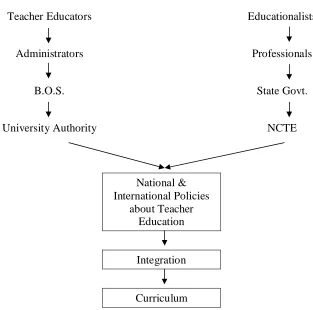
While designing the curriculum or syllabus the expectation of concerns should be considered. In teacher education, the expectation of the concerns in this modern technological era and globalized world should take into consideration. The curriculum of teacher education prepares a competent teacher through it So, what is the need of society ? What are the expectations about this modern teacher ? The answer of such questions should be covered in the curriculum.
Curriculum Design
Internal factors External Factors
Student Teacher Society
Teacher Educators Educationalists
Administrators Professionals
B.O.S. State Govt.
University Authority NCTE
National & International Policies
about Teacher Education
Integration
[image:5.612.173.486.61.371.2]Curriculum
Fig. 1 : Curriculum Design.
As shown in the Fig. 1 of curriculum design, the expectations of last beneficiary to higher authorities be considered. The feedback of current curriculum and expectations from the new curriculum are collected from all the internal and external factors.
4.3 INNOVATIVE WAYS TO CONTRIBUTE FOR CURRICULUM DEVELOPMENT
To develop a complete and competent curriculum it is necessary to involve the concerns by various ways. The valuable contribution will shape the curriculum. The concern may contribute by following way.
Organizing the Seminars
For curriculum development, the thoughts about future curriculum be shared through seminars. It could be arranged at college level to National level, in which the student-teacher, teachers, teacher-educators, experts and allumini could share their thoughts.
It would produce a definite outline of the curriculum design. The various aspects of the curriculum could be structured through the workshops at local to national level. The theoretical components, practical components, working with community be produced through such workshops.
Publishing the Newsletters
Newsletters is a sort of media. Its very effective medium to communicate. The would be curriculum frame work or structure and other component may be highlighted in the newsletters.
Use of Media
The on-line interviews could be conducted for knowing the expectation from the future curriculum of teacher education this may aware the people and sensitize the concern. The role of radio, T.V. is too important to contribute. The views, highlights about design may publish through NIE. Use of Social Networking
In the age of technology and fast communication to transform the views, expectations and feedback about curriculum design in teacher education. Facebook, blogs, twitter, U tube, e-survey could be used effectively. This media will give fastest fast feedback to the authority.
The complete curriculum will be that, in which there is involvement of all the concern. This will be the innovative practice for the design of curriculum.
4.4 DETERMINANTS FOR FUTURE CURRICULUM
Curriculum is not static , as it would ordinarily mean to many; it is dynamic and susceptible to change. The proposed change in the curriculum has to be change. The proposed change in the curriculum has to be examined and reexamined in the light of past and present experience. The following factors that determine the nature of curriculum being made :
National Aspirations and Needs
Culture
Curriculum and culture are closely interrelated. It has a marked effect on efforts to develop the curriculum. Gandhiji regarded culture as the foundation of primary thing which shows itself in the smallest detail of conduct and personal behaviour.
In the age of science, technology and globalization of education, teacher education should have cultural, technology based and humanistic studies.
Social Change
Society has a marked effect on efforts to develop the curriculum. Teacher Education institutions are social institutions specially setup for the preservation and transmission of culture by the society. Year by year social revolution takes place. In 21st century we have great effect of technology on society as well as on educational system. Computer and internet based curriculum be developed in Teacher Education.
5. CURRICULUM TRANSACTION
The quality of teacher preparation at all stages of education presents a serious challenge. Concerns of qualitative improvement in teacher education have persisted.
Curriculum transaction is to be viewed in the context of an emerging global trend and it is to be made responsive to individual needs in classrooms with wider range of abilities in the emerging Teacher Education Scenario.
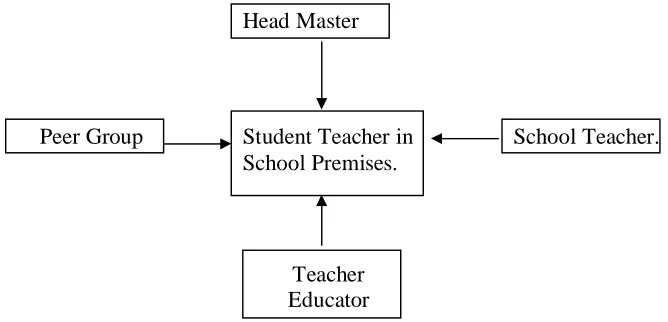
Head Master
Peer Group Student Teacher in School Teacher. School Premises.
[image:7.612.175.509.526.687.2]Teacher Educator
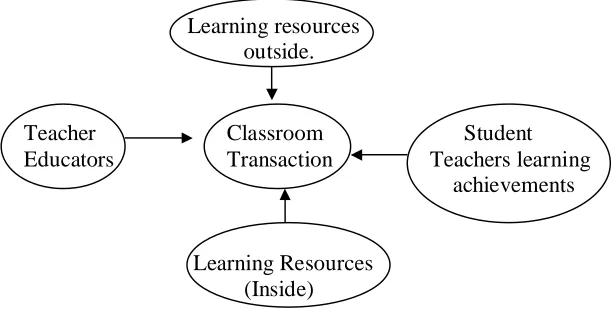
Learning resources outside.
Teacher Classroom Student Educators Transaction Teachers learning
achievements
Learning Resources
[image:8.612.183.490.109.264.2](Inside)
Fig. 3 : Transaction of Teacher Education Programme in Colleges
Fig. 2 show the method transaction of practice teaching and internship programme at Schools. Student teacher practices under the guidance of School Teacher in presence of Teacher Educators. Fig 3 shows transaction of theoretical and practical components in the college campus, with the help of inside and outside learning resources learner learns and achieve the skills.
6. CHALLENGES IN CURRICULUM DESIGN AND TRANSACTION
i) Academic inertia
Due to divergence of state, society and Judiciary and Education, there is institutional and academic inertia. The equation of qualified teacher educators and the numbers of teacher education institutes has been imbalanced. Due to large number of un-aided teacher education institutes academic inertia results. ii) Subject diversity
For education colleges the student teachers are from different educational background i.e. Arts, commerce, Science, Computer, I.T. Maths etc. The platform of all these student teacher for teacher education is different. It sreally difficult task to design such type of curriculum to integrate and mould this diversity within a year !
Though the curriculum for teacher education is designed to develop teaching skills, the skills like life skills, Techno-pedogogic skills, Techno-savvy skills, Emotional skills, Human development skills, Spiritual skills need to be integrated in Teacher Education program. Its a great challenge to integrate different skill in the curriculum having variety of background of student teacher.
iv) Rapid Social and Cultural Change
In the age of super modernization and technology there is rapid change is social and culture. There is impact of globalisation on the same, since society and culture are closely interrelated, the reflection of change in society and culture should be there in the curriculum. But day by day it is difficult to designer to reflect the expectations.
v) The changing school context and its demands
A teacher education curriculum needs to be in consonance with the curriculum for school education. A teacher needs to be prepared in relation to the needs and demands arising in the school context. The expectations of school system changes from time to time. The social, economic and political rapid changes burdens on the teacher education program.
vi) Contemporary context and concerns
In the future teacher education program a plenty of expectation are reserved in the NCFTE-2009. It is difficult to frame out the programme with Inclusive Education, Equitable & Sustainable Development, ICT, Research and Innovation, Human Rights, Life Skills Education, Peace Education etc.
vii) Evaluating the Developing Teacher
A glaring weakness of existing teacher education practices is the restricted scope of evaluation of student teachers and its excessively quantitative nature.
The qualitative dimensions of teacher education continuous comprehension professional capacities, attitudes and value are challengeable to evaluate within short period of time.
For transacting a curriculum, centralized and delayed process is the obstacle. It is very difficult task of all teacher education institute to transform the program within 6-7 months.
ix) Availability of School
Due to increase in number of teacher education institutes, the schools are not available in sufficient manner for practicing the teaching skills. Day by day the school environment is being changed. Its not positive to practice the skills. The approach of students teachers & admin education has been changed. Negation of school concerns results in poor preparation of student-teacher. x) Qualified staff
The Quality of education depends on the quality of school education, which ultimately depends on the quality of teachers, which is directly depend on the quality of Teacher Education which is totally maintained by Teacher Educators, Unfortunately the qualified faculty is not available at so many teacher education institutes. This affects on superiority of the transaction of program; which results in poor quality of teachers !
xi) Involvement of the Concern
The quality and successness depends on the involvement of the concern in the training. The involvement of students, teachers, administration of teacher education institutes and schools results into smooth transaction of programme. Unfortunately it does not happens. It is really challenge to co-ordinate in the present situation.
xii) Open and Distance learning
Open and distance learning trend has been emerged in teacher education programme. Which affects directly on the effective transaction of the same. Open and distance learning is a demand of the learner which will be harmful for quality assurance.
xiii) Emerging challenges
In the modern era, there is great demand from teacher education institutes. ICT in schooling, e-learning, techno-savvy teachers, inclusion of new perspective.
7. CONCLUSION
The Teacher Education has been struggling to strengthen its identity. After persistent struggle there is evident improvement, but still there is no end to perfection. There are issues and resolves, problems and solutions, puzzles and patways. To develop a complete curriculum and smooth transaction of it there should be open forums and public debates on Teacher Education programme. The integrated efforts of student – teacher, school teachers, school administration, Teacher Educators, College administration. Society, University Authority, Expert will develop complete curriculum which empowers to face the emerged challenges.
REFERENCES
B. D. Bhatt (1996), Curriculum Reform change and Continuity, Kanishka Publishers, New Delhi.
T. Mrunalini (2008), Curriculum Development, Neelkamal Publication Pvt. Ltd., Sultan Bazar, Hydrabad.
J. C. Aggarwal (2003), Handbook of Curriculum and Instruction, Doaba Book House, Nai Sarak, Delhi.
University News, Association of Indian Universities, Vol. 49, No. 38, Sep. 19-25, 2011.
National Curriculum Framework for Teacher Education, 2009, Member Secretary, NCTE, New Delhi.
www.teachertrainingindia.com.
www.teachereducationdesign.in.