Georgia State University
ScholarWorks @ Georgia State University
Public Health Theses School of Public Health
Spring 5-10-2018
Examining the Association Between Well Child
Care and Developmental and Behavioral Health
Conditions in Children
Alison M. Meyn
Georgia State University
Follow this and additional works at:https://scholarworks.gsu.edu/iph_theses
This Thesis is brought to you for free and open access by the School of Public Health at ScholarWorks @ Georgia State University. It has been accepted for inclusion in Public Health Theses by an authorized administrator of ScholarWorks @ Georgia State University. For more information, please contact
Recommended Citation
Meyn, Alison M., "Examining the Association Between Well Child Care and Developmental and Behavioral Health Conditions in Children." Thesis, Georgia State University, 2018.
1 | P a g e
ABSTRACT
Examining the Association Between Well Child Care and Developmental and
Behavioral Health Conditions in Children
By Alison M. Meyn
April 11, 2018
Background: Well child care visits (WCC) are critical preventive care visits that start at infancy. Currently, little is known about the association between WCC and parent report of developmental and behavioral health conditions in children. The purpose of this research was to examine if WCC contributes to developmental/behavioral health conditions reported by parents.
Methods: The 2016 National Health Interview Survey data were used for this research. Weighted estimates were calculated to assess the relationship between the receipt of WCC (yes or no response to receiving WCC in past 12 months) and presence of developmental/behavioral conditions; a Pearson’s chi square was used to determine bivariate associations between characteristics and WCC, followed by multivariable logistic regression to adjust for child sex, child age, healthcare access of parents, parent education level and parent income level.
Results: Among 2,453 children 3 years and younger 91.04% of these children had received WCC in the past 12 months. The weighted percent of children with any developmental/behavioral conditions was 7.78% in those receiving WCC and 4.62% in children not receiving WCC. Bivariate associations determined that the
statistically significant characteristics for determining whether a child receives WCC are: the child’s race/ethnicity, the number of office visits to their primary care (which are a combination of WCC and sick child visits), parent education level, and combined family income level. The logistic regression model evaluating
developmental and behavioral conditions adjusted for these variables that were statistically significant. In the adjusted model it was found that the number of office visits and parent education level were statistically significant in the detection of developmental and behavioral health conditions.
Conclusion: The number of office visits (which include WCC) are important
preventive clinical services for identifying developmental/behavioral conditions in young children. Parent education level is another significant factor that determines receipt of WCC and detection of developmental/behavioral conditions. By
2 | P a g e
Examining the Association Between Well Child Care and Developmental and
Behavioral Health Conditions in Children
by
Alison M. Meyn
B.S., Armstrong Atlantic State University
A Thesis Submitted to the Graduate Faculty of Georgia State University in Partial Fulfillment
of the
Requirements for the Degree MASTER OF PUBLIC HEALTH
3 | P a g e
APPROVAL PAGE
Examining the Association Between Well Child Care and Developmental and
Behavioral Health Conditions in Children
by
Alison M. Meyn
Approved:
DR. SHANTA R. DUBE PhD. Committee Chair
DR. JENNIFER M. ZUBLER MD. Committee Member
4 | P a g e
Acknowledgments
Thank you Dr. Dube for your continued support and unfailing kindness. Thank you Dr. Zubler for sharing your personal experiences and educational
background.
5 | P a g e
Author’s Statement Page
In presenting this thesis as a partial fulfillment of the requirements for an advanced degree from Georgia State University, I agree that the Library of the University shall make it available for inspection and circulation in accordance with its regulations governing materials of this type. I agree that permission to quote from, to copy from, or to publish this thesis may be granted by the author or, in his/her absence, by the professor under whose direction it was written, or in his/her absence, by the Associate Dean, School of Public Health. Such quoting, copying, or publishing must be solely for scholarly purposes and will not involve potential financial gain. It is understood that any copying from or publication of this dissertation which involves potential financial gain will not be allowed without written permission of the author.
6 | P a g e
TABLE OF CONTENTS
ACKNOWLEDGMENTS ...4
LIST OF TABLES……….7
CHAPTER 1 INTRODUCTION...8
1.1 Background 1.2 Defining the Research Gap 1.3 Research Question CHAPTER 2 REVIEW OF THE LITERATURE...10
2.1 Importance of Well Child Care.………...…….10
2.2 Quality of Pediatric Primary Care/WCC………..………..11
2.3 Access to Pediatric Primary Care/WCC………..12
2.4 Developmental Surveillance and Screening………13
2.5 Pediatric Primary Care/WCC Improvements for the Future...15
CHAPTER 3 MANUSCRIPT………..17 3.1 Abstract………..18 3.2 Introduction……….19 3.3 Methods……….21 3.4 Results……….23 3.5 Comments……….24
TABLES……….28-30
7 | P a g e
List of Tables
Table 1: Characteristics of Children 3 Years and Younger Receiving and Not Receiving Well Child
Care Page 28
Table 2: Characteristics of Children 3 Years and Younger With and Without Any
Developmental/Behavioral Conditions Page 29
Table 3: Adjusted and Unadjusted Logistic Regression Models for Developmental and Behavioral Conditions
8 | P a g e
Chapter One: Introduction
Government programs and parent’s insuring agencies provide children with
proper preventative care and medical care. The American Academy of Pediatrics
highly recommends well child care (WCC) visits as an important role in prevention,
proper development, and raising concerns for children (AAP, 2017). These visits are
important for monitoring not only the physical development of a child but the
cognitive development as well. These visits are where a child is screened for
developmental/behavioral delays and conditions.
Adherence to well child care (WCC) visits over time is not well understood,
especially when evaluated across racial groups, poverty status, parent education
status, and other subgroups (Abdus, et al. 2013). Child Preventive Care in
association with low-income households and long-term health benefits has not been
well studied. There has been very little research conducted on how adherence to
WCC affects child health outcomes. A study done on “Clinical Practice Redesign for
Serving Low Income Children” noted that measuring time the physician spends with
the parent and child is very important in determining the quality of these visits. The
study found that the more time the physician spent, the more likely the parent was
to recommend these visits to another parent as well as return for subsequent visits
(Coker, et al. 2014). It is important to note healthcare access as a limitation to well
child care as well. To improve healthcare access to low-income families Centering
Parenting has been considered a desirable model of group dyad care. This model
provides care for mothers and infants and has been considered a feasible option at
9 | P a g e
There has also not been adequate research done on how WCC visits
correspond to the detection of developmental and behavioral conditions. These
developmental and behavioral conditions are: ADHD, autism/autism spectrum
disorders, cerebral palsy, developmental delays, and intellectual disability. The
American Academy of Pediatrics recommends developmental/behavioral
assessment beginning at 9 months, reassessment at 18 months, and 30 months;
where after these time points assessment is done based on parent concern.
Developmental surveillance is done at each WCC visit and continues through age 21
years. Autism screening is done at 18 months of age and again at 24 months of age.
After these two recommended screenings for Autism, screening is conducted on an
individual basis and based on parent concern (AAP, 2017).
The main research question I propose to answer is, do parent-report of well
child care visits contribute to a greater proportion of reported diagnosed
developmental and behavioral health conditions? I hypothesize that reports of well
child care will be associated with developmental and behavioral health conditions.
The reason this question is of such high concern is due to the fact that children rely
on their parents and/or guardians to obtain quality care and determine the
outcomes of their care (Mangione-Smith, et al. 1998). It is thus important to
understand who receives these WCC visits and who does not. It is understood by the
American Academy of Pediatrics that children who receive these visits have better
health outcomes overall, and better developmental surveillance and
10 | P a g e
Chapter Two: Literature Review
The Importance of Well Child Care (WCC)
The importance of pediatric primary care cannot be overstated when in the 2014
National Health Interview Survey (NHIS) 16.2 percent of children did not receive a
WCC visit in the last 12 months when not sick or injured (CAHMI, 2017). In this
same year NHIS found that in children ages 0-5 years 24.2 percent of these children
received 0-1 office visits to their primary care pediatrician. The American Academy
of Pediatrics delivers “Recommendations for Preventive Pediatric Health Care”
guidelines that represent a consensus on comprehensive health supervision. These
guidelines represent a standard of care that pediatricians and parents refer to. In
the first year of life it is recommended that an infant receive seven office visits for
physical examination, immunizations, developmental assessment, sensory
screening, and body measurements by their pediatrician (AAP, 2017).
These WCC visits are the primary source of information and only opportunity
for parents to address concerns about their children’s health, behavioral, and
developmental issues (Coker, et al. 2015). WCC in the first three years of life is
critical for identifying these important health concerns before the child enters
preschool, to improve their learning experience (Mimila, et al. 2017). These visits
act as preventive care for children and primary sources of advocacy for parents.
When parents do not receive adequate WCC from providers they tend to feel their
concerns were unaddressed and seek emergency department care when health
11 | P a g e
If we are to reach the Maternal Infant and Child Health outcomes for Healthy
People 2020, WCC needs to be of the utmost importance. The objective of
importance for this research states: (1) Increase the proportion of young children
with autism spectrum disorder (ASD) and other developmental delays who are
screened, evaluated, and enrolled in special services in a timely manner. Where
baseline is: 22.6 percent of children aged 10 to 35 months were screened for Autism
Spectrum Disorder (ASD) and other developmental delays in the past year as
reported in 2007, and the future goal is a 10 percent improvement, with a target of
24.9 percent of children screened, evaluated, and enrolled.
These objectives are in hopes of detection, evaluation, and enrolling these children
in specialty services with the unique ability to address these chronic developmental
conditions (ODPHP, 2018).
Quality of Pediatric Primary Care/WCC
The quality of care received at WCC visits is worth mentioning because it sets
a tone for parent health seeking behaviors in the future for their child. If a parent
feels that their concerns were not addressed they are less likely to return to their
provider, which accounts for increased emergency department use for primary
pediatric care. A study done on “Clinical Practice Redesign for Serving Low Income
Children” noted that measuring time the physician spends with the parent and child
is very important in determining the quality of these visits. The study found that the
more time the physician spent, the more likely the parent was to recommend these
12 | P a g e
The quality of these visits is highly reliant on high level physicians, limited to the
physician decided direction of the visit, and time physician gives to the visit (Coker,
et al. 2015).
Another factor to consider in the quality of WCC is role of cultural
competence in the very culturally diverse United States. There are significant ethnic
disparities in how pediatric primary care is received. In a study that evaluated
Chinese and Vietnamese family attitudes and perspectives on WCC they found that
adherence to WCC visits were lower in these Asian populations and parents were
less likely to describe these visits as comprehensive and culturally sensitive. In
describing the quality of these visits half of the Asian parents thought WCC visits
were “too simple” and that they did not address concerns or thoroughly evaluate
their child’s health (Ragavan, et al. 2017). It is important to mention that in the
families measured for this study Asian children had the same rate of insurance
coverage as their Caucasian counterparts.
It has been identified in other studies that adherence is due to quality of
these visits and accessibility of WCC.
Access to Pediatric Primary Care/ WCC
Low-income families are at the greatest amount of risk for lack of healthcare
access. It is visible that socioeconomic status is closely correlated with access to
WCC and maternal care. The national supplemental nutrition program for Women,
Infants, and Children (WIC) provided to low socioeconomic status mothers has been
13 | P a g e
influence of WIC on healthcare utilization it was found that mother’s enrolled in WIC
had infants with shorter hospital stays after birth when compared to non-WIC
infants. These mothers were more likely to adhere to WCC visits and meet the
American Academy of Pediatrics’ guidelines for number of visits and vaccinations
(Bersak, et al. 2017).
The Affordable Care Act (ACA) made access to primary and preventive care
services more accessible for low-income families of all racial groups. The most
profound impact was seen on Hispanic/Latino children where the ACA increased
insurance coverage for this group substantially and resulted in increased adherence
to WCC and decrease in emergency department utilization (Ortega, et al. 2017).
There was a small decrease of the uninsured population among African American
families and a substantial decrease of emergency department utilization.
The organization Centering Parenting is a model of group dyad care that
offers maternal care and infant care. This model could improve quality, efficiency,
and access to healthcare for mothers and infants. By combining pre-natal care with
post-partum care mothers learn how to take care of their infant from belly to birth.
This model has improved access and utilization of pediatric primary care for
low-income families (Connor, et al. 2017).
Developmental Surveillance and Screening
The reason evaluating children from birth to three years of age is of such
critical importance is because this is a time of rapid brain development resulting in
14 | P a g e
detection of developmental and behavioral conditions including intervention is
important to child health outcomes. There is also the federal program called
Individuals with Disability Education Act (IDEA) that provides free or low cost early
intervention services under Part C for Infant and Toddlers less than 2 years of age
(King, et al. 2003). This is a publicly available option for families of all income
brackets.
It is estimated that 12-16% of children in the United States have
developmental and behavioral problems, but only 1.8% of children birth to two
years receive early intervention (Hix-Small, et al. 2007). The issue becomes the
physician’s ability to detect developmental and behavioral problems. The time a
physician spends with each pediatric patient only range between 15-30 minutes,
which is not viewed as adequate amount of time to conduct screening procedures. A
screening tool was created called the Ages and Stages Questionnaire (ASQ), which
allows the parent to fill it out prior to office visit, office staff to score the assessment,
and pass the score to the physician for evaluation. This screening tool takes parents
12-18 minutes to complete and is available in many different languages. The ASQ is
a general development screening tool that evaluates gross motor skills, fine motor
skills, problem solving, and communication. The American Academy of Pediatrics
(AAP) issued screening algorithms and methods including the use of standardized
parent proxy evaluations. Examples of these parent proxy evaluations include:
Parental Evaluation of Developmental Status (PEDS), Child Development
Inventories (CDI), and ASQ (Singh et al. 2016). The time points in which these
15 | P a g e
conclusion of the AAP is recommended standardized screenings at 9 months, 18
months, and 30 months (AAP, 2006). As well as these recommended screenings at
specific ages, individual screenings should also be done on an individual basis based
on physician and parental concern.
Developmental screening is important to children’s overall health outcomes
because early detection and intervention can provide parents and children the
necessary tools and skills to improve quality of life and improve developmental and
behavioral issues.
Pediatric Primary Care/ WCC Improvements for the Future
As mentioned early in this review, group dyad care has proved to be a
feasible option for low-income families and could be put in place at Federally
Qualified Health Centers (FQHC). This group dyad care has been named Centering
Parenting, which provides maternal and infant care, education, and resources. It has
broad community possibilities and could increase adherence to WCC (Connor, et al.
2017).
The United States Child and Maternal Health Bureau has recommended
better organization of preventive services within primary care practices and better
coordination between private practices and community practices (Margolis et al.
2001). In a study done to meet this recommendation intervention groups were set
at the community level, private practice level, and family level. The intervention for
these mothers began after they sought care at the community health center, then
16 | P a g e
Mother’s enrolled in the intervention group were more likely to have increased
numbers of WCC visits and provide a safe and stimulating home environment for
their child (Margolis et al. 2001). While home visits are not achievable for a larger
population, the collaboration between private and public practices is an important
feature that could have broad implications for future improvements to quality and
access to WCC. As well as collaboration there is a movement from physicians to
physician assistants and nurse practitioners as a multi-disciplinary team to share
the ever-growing responsibilities of primary care practice (Warmels, et al. 2017).
As the findings determined in the study done on WIC and healthcare
utilization, empowering families with information provides them with confidence
and better health seeking behaviors. This is important in the detection of
developmental and behavioral health conditions, because so often they are not
caught early due to lack of WCC access or lack of good quality WCC. These children
then fall between the cracks and tend to have poor long-term health outcomes
because they fall behind in school and feel isolated from social circles. There are low
cost programs in place to serve children with these conditions and provide early
intervention (King et al. 2003).
Children are the future, so it is of the utmost importance that we provide
children and their families with quality healthcare that provides support, tools, and
empowerment needed for families to be healthy and happy.
17 | P a g e
Chapter Three: Manuscript
Examining the Association Between Well Child Care and Developmental and
Behavioral Health Conditions in Children
Alison M. Meyn, MPH,a Shanta R. Dube, PhD, MPH,a Jennifer M. Zubler, MD
a Georgia State University, School of Public Health, Atlanta GA
Author: Alison M. Meyn
Address: 805 Winterset Pkwy Marietta GA 30067
Phone: (912) 401 4682
18 | P a g e
ABSTRACT
Background: Well child care visits (WCC) are critical preventive care visits that start at infancy. Currently, little is known about the association between WCC and parent report of developmental and behavioral health conditions in children. The purpose of this research was to examine if WCC contributes to developmental/behavioral health conditions reported by parents.
Methods: The 2016 NHIS data were used for this research. Weighted estimates were calculated to assess the relationship between the receipt of WCC (yes or no to
receipt in past 12 months) and presence of developmental/behavioral conditions; a Pearson’s chi square was used to determine bivariate associations between
characteristics and WCC, followed by multivariable logistic regression to adjust for child sex, age, healthcare access of parent, parent education level and parent income level.
Results: Among 2,453 children 3 years and younger 91.04% of these children had received WCC in the past 12 months. The weighted percent of children with any developmental/behavioral conditions was 7.78% in those receiving WCC and 4.62% in children not receiving WCC. Bivariate associations determined that the
statistically significant characteristics for receipt of WCC are: the child’s
race/ethnicity, the number of office visits (a combination of WCC and sick child visits), parent education level, combined family income, and ratio of income to poverty threshold. The logistic regression model evaluating developmental and behavioral conditions adjusted for variables that were statistically significant. The adjusted model found that the number of office visits and parent education level were statistically significant in the detection of developmental and behavioral health conditions.
Conclusion: The number of office visits (which include WCC) are important
preventive clinical services for identifying developmental/behavioral conditions in young children. Parent education level is another significant factor that determines receipt of WCC and detection of developmental/behavioral conditions. By
19 | P a g e
Introduction:
The American Academy of Pediatrics currently has the “Recommendations
for Preventive Pediatric Care” which lists recommended services every child should
receive starting from birth to 21 years of age. (AAP, 2017). It outlines a monthly
schedule for infants and a yearly schedule for children and adolescents. The purpose
of the AAP recommendations for well child care is to ensure children receive
preventative care, monitor proper development, and address parental concerns for
children (AAP, 2017). Well Child Care (WCC) has garnered much attention and is
recognized as the best-known pediatric preventive care in the United States.
The guidelines outlined in the AAP WCC recommendations represent a
standard of care for pediatricians and parents to follow. In the first year of life it is
recommended that an infant receive seven pediatric office visits for physical
examination, immunizations, developmental assessment, sensory screening, and
body measurements (AAP, 2017). These recommendations are created in
partnership with Bright Futures, a government funded agency established to
support primary care in providing child and adolescent well child care, to ensure
that every child has quality care and is being evaluated for more than physical
conditions but developmental and behavioral conditions as well.
Currently, in the United States, it is estimated that 12-16% of children have
developmental and behavioral problems, but only 1.8% of children birth to two
20 | P a g e
physician can spend during each patient-provider encounter, conducting
developmental screening can be difficult. To address this issue the Ages and Stages
Questionnaire (ASQ) developmental screening instrument comes in a
self-administered form, which allows the parents to fill it out prior to office visit or at the
time of office visit. The ASQ takes parents 12-18 minutes to complete and is
available in many different languages. The ASQ evaluates gross motor skills, fine
motor skills, problem solving, and communication at various ages from birth to
three. After the parent completes the ASQ the score is computed by the clinical staff
and provided to the physician for review and discussed with parents during patient
encounters.
The American Academy of Pediatrics (AAP) issued other screening
algorithms and methods including the use of standardized parent proxy evaluations.
Examples of these parent proxy evaluations are: Parental Evaluation of
Developmental Status (PEDS), Child Development Inventories (CDI), and ASQ (Singh
et al. 2016). The time points in which these developmental screenings are to be
done have been debated but the conclusion of the AAP is standardized
recommended screenings at 9 months, 18 months, and 30 months (AAP, 2006). It is
important to mention that developmental screenings differ from developmental
surveillance. Developmental surveillance occurs as on-going physician monitoring
and documentation of parent concerns over time. If surveillance reveals concerns
and it is not a screening visit, it is then recommended that a screener be done. If
surveillance and/or screening reveal that a child is at risk for delays, then the child
21 | P a g e
Previous research done on WCC does not evaluate the relationship between
parent report of pediatric preventive care and developmental and behavioral
conditions. The research question to be addressed is, do parent-report of at least
one well child care visit contribute to a greater proportion of parent reported
diagnosed developmental and behavioral health conditions? The purpose of this
study was to determine the association between parent reports of receiving WCC
and parent reports of doctor diagnosis of developmental and behavioral health
conditions in young children using the 2016 National Health Interview Survey
(NHIS) data.
Methods:
The 2016 National Health Interview Survey was used to conduct this research
analysis. This survey is done annually to examine health data among the U.S.
population, and is a cross-sectional, multistage probability design, designed to
prevent oversampling and weighted to be generalizable across the United States.
Exclusion criteria for this survey includes all people who are incarcerated, active
military as well as dependents, U.S. citizens living in foreign countries, and
individuals living in long-term care facilities. In the 2016 NHIS final merged data set
the study sample size was 11,107, which was narrowed down to children three
years and younger for a final sample size of 2,453. All data were measured at a
significance level of p=0.05.
22 | P a g e
The 2016 NHIS data includes a direct measure for WCC, which is measured by yes or
no to receiving WCC in the past 12 months. The number of office visits to their
primary care provider was utilized as well because the dataset defines these visits
as a combination of WCC and sick child care. These visits are measured by number
of times the child has gone to their primary care physician, 1, 2-3, 4-5, 6-7, and 8 or
more. All of the developmental and behavioral health conditions were consolidated
into one variable called “Behavior”; if any of the conditions were present then
presence would equal yes, and if none of the conditions were present then presence
would equal no. This was done due to very small sample sizes of children diagnosed
with these conditions.
The child’s age was included as birth-11months, 1 year, 2 years, and 3 years old. The
race of the child was consolidated into white and non-white due to small sample
sizes in non-white racial groups. The parent’s ability to access healthcare was
included by measuring change of healthcare place in the past 12 months (response
was yes or no), delayed healthcare in past 12 months due to long wait in physician’s
office (response was yes or no), and delayed healthcare in past 12 months due to
inability to make physician’s office hours (response was yes or no). The parent’s
highest level of education attained was also assessed in categories of education: 8th
grade or less, 9th-12th no diploma earned, GED, high school diploma earned, some
college, associate degree of arts at a technical or vocational school, associate of arts
at a college or university, bachelor’s degree, and master’s degree earned. The
parent’s income level was also assessed looking at income brackets of: 34,999 US
23 | P a g e
dollars annually, and 100,000 or more US dollars annually. The ratio of family
income to the poverty threshold was also assessed to account for family size
regarding income.
Analytic Procedures:
Bivariate analysis was conducted to assess the relationships between WCC and
developmental/behavioral conditions, as well as characteristics of the sample
population. Descriptive analytics on the data were collected to understand the
characteristics of children who receive WCC and of those who do not receive WCC.
In answering the initial research question, a Pearson’s chi square test for
dichotomous outcomes was conducted to evaluate the relationship between
presence of WCC and parent report of any developmental and behavioral conditions.
Following this analysis, a multivariable logistic regression was run on two models.
The unadjusted model evaluated bivariate associations between developmental and
behavioral health conditions and each of the predictors. The adjusted model
evaluating developmental and behavioral conditions adjusted for all of the
predictors: WCC, child’s race/ethnicity, the number of office visits to their primary
care (which are a combination of WCC and sick child visits), parent education level,
combined family income level, and ratio of family income to the poverty threshold.
Results:
It was found that of 2,453 children 3 years and younger 91.01% of these children
24 | P a g e
The weighted percent of children with any developmental/behavioral conditions
was 7.78% in those receiving WCC and 4.62% in children not receiving WCC in the
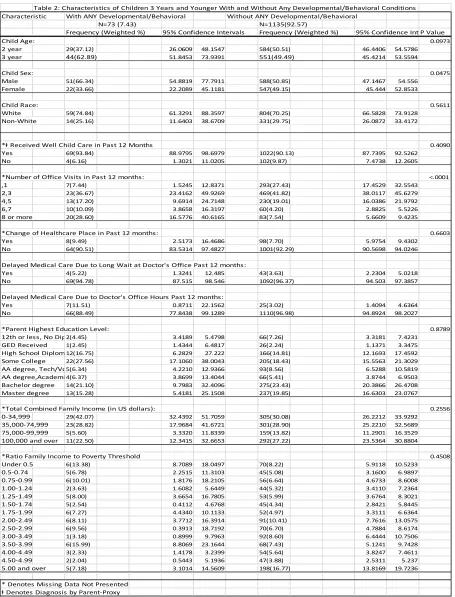
past 12 months (Refer to Table 1). Bivariate associations revealed that the
statistically significant characteristics for determining whether a child receives WCC
are: the child’s race/ethnicity, the number of office visits to their primary care
(which are a combination of WCC and sick child visits), parent education level,
combined family income level, and ratio of family income to the poverty threshold
(Refer to Table 1). Bivariate associations also determined that the statistically
significant characteristics for determining parent report of
developmental/behavioral health conditions in children three years and younger
are: child sex and number of office visits received (Refer to Table 2).
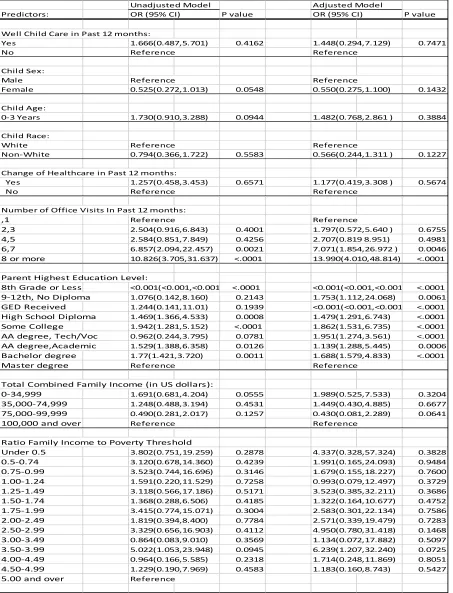
The logistic regression model evaluating developmental and behavioral conditions
adjusted for these variables that were statistically significant. In the adjusted model
it was found that the number of office visits (when 6 or more in the past 12 months)
and parent education level (at all levels) were statistically significant in parent
report of developmental and behavioral health conditions (Refer to Table 3).
Comments:
The data suggests that more research needs to be conducted on the topic to
determine what relationship exists between pediatric preventive care and parent
25 | P a g e
The proportion of children who have been diagnosed with developmental and
behavioral health conditions is much greater in those children who do receive WCC
than those who do not. It can be supported that WCC is important for detection of
developmental and behavioral health conditions in children. Parent health seeking
behaviors tend to be better in parents whose child does receive WCC in the past 12
months with statistically significant higher rates of office visits within this group.
Because previous data from other research studies suggest that lower
socioeconomic status of the parent plays a role in whether a child receives
preventive care; combined family income and ratio of family income to poverty
threshold were added to the model to determine the relationship between WCC and
income. It was found that family income and ratio of income to the poverty
threshold were statistically significant at p= <.0001. This finding supports previous
literature that has found an association between parent income and child receipt of
preventive care.
Limitations:
The 2016 National Health Interview Survey is cross-sectional, thereby this study is
observational and cannot make any casual inferences.
The NHIS is an all-encompassing survey of health that does not focus on
developmental/behavioral health conditions or well child care, instead evaluates all
aspects of health. Although NHIS is a representative sample, this survey does have
exclusion criteria for some subgroups such as: the incarcerated, active military as
well as dependents, U.S. citizens living in foreign countries, and individuals living in
26 | P a g e
The data collected is interview data, and reports for children are by parent-proxy,
which is subject to recall bias.
The overall sample size of children with any developmental and behavioral
conditions was very small and the office visits evaluated did combine routine care
with acute care, which makes it difficult to determine from the survey content how
many visits were well child care visits.
The survey did not include any questions for parents regarding whether their child’s
primary care physician gave them a developmental screener or asked them if they
had any concerns about their child in the past 12 months. This would be important
to include in future surveys, to know if children are receiving the recommended
surveillance and screening. The survey did not explicitly state whether the parent
had more than one child and which child the questions were being asked for. The
inclusion of parent age and sex as a separate variable in the child section of the data
set would improve collection of sociodemographic features in the future.
Conclusion:
The implications of this research suggest that more research is needed to
understand what type of interventions should be created to target parents based on
educational status and family income to improve receipt of well child care.
Empowering families with information could provide them with the confidence
27 | P a g e
detection of developmental and behavioral health conditions, because very often
these conditions are not caught early due to lack of information on importance of
preventive care and little understanding of these conditions (King et al. 2003).
It is important to reach children with developmental and behavioral conditions
before school-age, so they do not fall behind in school or feel isolated from social
circles (Mimila, et al. 2017). Early identification of developmental and behavioral
conditions by intervention could improve support for families and children, which is
28 | P a g e
Table 1: Characteristics of Children 3 and Younger with and without WCC
Table 1: Characteristics of Children 3 Years and Younger Receiving and Not Receiving Well Child Care
Characteristic Receiving Well Child Care in Past 12 months Not Receiving Well Child Care in Past 12 Months
N=2256 (91.04) N=197 (8.96)
Frequency (Weighted %) 95% Confidence Intervals Frequency (Weighted %) 95% Confidence IntervalsP Value
Child Age: 0.1302
Birth - 11 Months 580 (24.62) 22.4171 26.8163 53 (24.23) 16.2851 32.1739
1 year 580 (26.25) 23.8930 28.6100 38 (22.86) 14.6463 31.0782
2 year 570 (24.92) 22.5123 27.3191 41 (19.22) 12.6966 25.736
3 year 526 (24.22) 21.8138 26.6185 65 (33.69) 25.133 42.2509
Child Sex: 0.8793
Male 1179 (50.75) 47.9137 53.4675 100 (49.20) 40.1415 58.2649
Female 1077 (49.25) 46.5325 52.0863 97 (50.79) 41.7351 59.8585
Child Race: 0.0033
White 1668 (72.99) 70.4456 75.5349 134 (62.03) 52.8952 71.1626
Non-White 588 (27.01) 24.4651 29.5544 63 (37.97) 1.4151 28.4095
*ⱡ Report of Any Developmental and/or Behavioral Condition:
Yes 69 (7.78) 5.4861 10.0691 4 (4.82) 1.2431 10.4431 0.4090
No 1027 (92.22) 89.9307 94.5197 102 (95.18) 89.5569 100.00
*Number of Office Visits in Past 12 months: <.0001
,1 288 (13.89) 11.8842 15.8902 36 (15.65) 9.5573 21.7460
2,3 757 (35.01) 32.2426 37.5878 58 (27.18) 19.6688 34.7072
4,5 597 (25.37) 22.8818 27.8489 26 (12.35) 7.9011 16.7983
6,7 265 (10.25) 8.6878 11.8078 13 (6.11) 2.5250 9.7035
8 or more 297 (12.78) 11.0691 14.4985 18 (10.25) 4.9495 15.5564
*Change of Healthcare Place in Past 12 months: 0.5753
Yes 188 (7.65) 6.3973 8.9497 12 (6.24) 2.6829 9.8007
No 2025 (92.35) 91.0148 93.5688 162 (93.76) 90.1993 97.3171
Delayed Medical Care Due to Long Wait at Doctor's Office Past 12 months: 0.6350
Yes 74 (3.38) 2.3258 4.4349 8 (5.27) 1.0781 11.7074
No 2182 (96.62) 95.4351 97.5719 188 (94.53) 88.0912 100.00
Delayed Medical Care Due to Doctor's Office Hours Past 12 months: 0.3091
Yes 43 (2.34) 1.3051 3.3662 5 (3.92) 0.3296 7.5128
No 2213 (97.66) 96.5044 98.5921 192 (96.08) 92.4872 99.6704
*Parent Highest Education Level: <.0001
8th Grade or Less 28(1.61) 0.8858 2.3355 8(4.20) 0.1754 8.427
9-12th, No Diploma 88(5.26) 3.9408 6.5763 18(14.49) 6.9102 22.0659
GED Received 42(1.96) 1.1746 2.7505 5(2.30) 0.1120 5.5384
High School Diploma343(15.09) 13.2506 16.9371 41(25.35) 16.2221 34.4861
Some College 422(18.46) 16.3858 20.5404 42(20.70) 14.193 27.2131
AA degree, Tech/Voc187(8.65) 7.0825 10.2145 21(9.71) 5.0728 14.3399
AA degree,Academic115(4.87) 3.7715 5.9581 9(2.37) 0.6122 4.1365
Bachelor degree 556(23.93) 21.7515 26.1081 25(11.10) 6.4219 15.7813
Master degree 473(20.17) 17.9088 22.4278 27(9.77) 5.8302 13.7181
*Total Combined Family Income (in US dollars): <.0001
0-34,999 569(28.22) 25.5402 30.8965 74(46.77) 36.8401 56.7053
35,000-74,999 631(30.20) 27.5318 32.8657 60(33.26) 25.0146 41.5099
75,000-99,999 302(13.99) 12.1189 15.851 12(5.92) 1.5839 10.2567
100,000 and over 574(27.60) 25.0345 30.1614 32(14.05) 9.1101 18.9794
*Ratio Family Income to Poverty Threshold <.0001
Under 0.5 116(6.75) 5.2323 8.2718 16(13.24) 6.8338 19.6433
0.5-0.74 86(5.08) 3.772 6.3811 16(14.58) 6.744 22.4121
0.75-0.99 101(5.91) 4.5727 7.2513 13(10.61) 5.1935 16.0209
1.00-1.24 98(5.83) 4.3799 7.2705 13(7.16) 2.4658 11.8598
1.25-1.49 113(6.70) 5.1789 8.2295 10(7.77) 2.9436 12.5903
1.50-1.74 81(4.18) 3.0836 5.2738 8(4.35) 0.2802 8.4195
1.75-1.99 108(5.68) 4.3279 7.0408 12(6.94) 1.5254 12.3463
2.00-2.49 181(10.17) 8.2514 12.0818 17(9.10) 5.0082 13.1309
2.50-2.99 146(7.49) 6.0483 8.9314 9(3.10) 0.7997 5.4115
3.00-3.49 162(7.22) 5.7804 8.6574 14(9.20) 3.1373 15.2524
3.50-3.99 135(7.52) 5.97 9.077 4(0.944) 0.5221 2.0684
4.00-4.49 99(5.32) 4.0536 6.5938 6(3.60) 1.7133 5.4944
4.50-4.99 92(3.83) 2.958 4.6949 1(0.16) 0.1002 0.4721
5.00 and over 413(18.32) 16.1944 20.4417 20(9.28) 5.5294 13.0395
* Denotes Missing Data Not Presented
29 | P a g e
Table 2: Characteristics of Children 3 Years and Younger ANY Developmental/Behavioral Conditions
Table 2: Characteristics of Children 3 Years and Younger With and Without Any Developmental/Behavioral Conditions Characteristic With ANY Developmental/Behavioral Without ANY Developmental/Behavioral
N=73 (7.43) N=1135(92.57)
Frequency (Weighted %) 95% Confidence Intervals Frequency (Weighted %) 95% Confidence IntervalsP Value
Child Age: 0.0973
2 year 29(37.12) 26.0609 48.1547 584(50.51) 46.4406 54.5786
3 year 44(62.89) 51.8453 73.9391 551(49.49) 45.4214 53.5594
Child Sex: 0.0475
Male 51(66.34) 54.8819 77.7911 588(50.85) 47.1467 54.556
Female 22(33.66) 22.2089 45.1181 547(49.15) 45.444 52.8533
Child Race: 0.5611
White 59(74.84) 61.3291 88.3597 804(70.25) 66.5828 73.9128
Non-White 14(25.16) 11.6403 38.6709 331(29.75) 26.0872 33.4172
*ⱡ Received Well Child Care in Past 12 Months 0.4090
Yes 69(93.84) 88.9795 98.6979 1022(90.13) 87.7395 92.5262
No 4(6.16) 1.3021 11.0205 102(9.87) 7.4738 12.2605
*Number of Office Visits in Past 12 months: <.0001
,1 7(7.44) 1.5245 12.8371 293(27.43) 17.4529 32.5543
2,3 23(36.67) 23.4162 49.9269 469(41.82) 38.0117 45.6279
4,5 13(17.20) 9.6914 24.7148 230(19.01) 16.0386 21.9792
6,7 10(10.09) 3.8658 16.3197 60(4.20) 2.8825 5.5226
8 or more 20(28.60) 16.5776 40.6165 83(7.54) 5.6609 9.4235
*Change of Healthcare Place in Past 12 months: 0.6603
Yes 8(9.49) 2.5173 16.4686 98(7.70) 5.9754 9.4302
No 64(90.51) 83.5314 97.4827 1001(92.29) 90.5698 94.0246
Delayed Medical Care Due to Long Wait at Doctor's Office Past 12 months:
Yes 4(5.22) 1.3241 12.485 43(3.63) 2.2304 5.0218
No 69(94.78) 87.515 98.546 1092(96.37) 94.503 97.3857
Delayed Medical Care Due to Doctor's Office Hours Past 12 months:
Yes 7(11.51) 0.8711 22.1562 25(3.02) 1.4094 4.6364
No 66(88.49) 77.8438 99.1289 1110(96.98) 94.8924 98.2027
*Parent Highest Education Level: 0.8789
12th or less, No Diploma2(4.45) 3.4189 5.4798 66(7.26) 3.3181 7.4231
GED Received 1(2.45) 1.4344 6.4817 26(2.24) 1.1371 3.3475
High School Diploma12(16.75) 6.2829 27.222 166(14.81) 12.1693 17.4592
Some College 22(27.56) 17.1060 38.0043 205(18.43) 15.5563 21.3029
AA degree, Tech/Voc5(6.34) 4.2210 12.9366 93(8.56) 6.5288 10.5819
AA degree,Academic4(6.37) 3.8699 13.4044 66(5.41) 3.8744 6.9503
Bachelor degree 14(21.10) 9.7983 32.4096 275(23.43) 20.3866 26.4708
Master degree 13(15.28) 5.4181 25.1508 237(19.85) 16.6303 23.0767
*Total Combined Family Income (in US dollars): 0.2556
0-34,999 29(42.07) 32.4392 51.7059 305(30.08) 26.2212 33.9292
35,000-74,999 23(28.82) 17.9684 41.6721 301(28.90) 25.2210 32.5689
75,000-99,999 5(5.60) 3.3320 11.8339 159(13.82) 11.2901 16.3529
100,000 and over 11(22.50) 12.3415 32.6653 292(27.22) 23.5364 30.8804
*Ratio Family Income to Poverty Threshold 0.4508
Under 0.5 6(13.38) 8.7089 18.0497 70(8.22) 5.9118 10.5233
0.5-0.74 5(6.78) 2.2515 11.3103 45(5.08) 3.1600 6.9897
0.75-0.99 6(10.01) 1.8176 18.2105 56(6.64) 4.6733 8.6008
1.00-1.24 2(3.63) 1.6082 5.6449 44(5.32) 3.4110 7.2364
1.25-1.49 5(8.00) 3.6654 16.7805 53(5.99) 3.6764 8.3021
1.50-1.74 5(2.54) 0.4112 4.6768 45(4.34) 2.8421 5.8445
1.75-1.99 6(7.27) 4.4340 10.1133 52(4.97) 3.3111 6.6364
2.00-2.49 6(8.11) 3.7712 16.3914 91(10.41) 7.7616 13.0575
2.50-2.99 6(9.56) 0.3913 18.7192 70(6.70) 4.7884 8.6174
3.00-3.49 1(3.18) 0.8999 9.7963 92(8.60) 6.4444 10.7506
3.50-3.99 6(15.99) 8.8069 23.1644 68(7.43) 5.1241 9.7428
4.00-4.49 3(2.33) 1.4178 3.2399 54(5.64) 3.8247 7.4611
4.50-4.99 2(2.04) 0.5443 5.1936 47(3.88) 2.5311 5.237
5.00 and over 5(7.18) 3.1014 14.5609 198(16.77) 13.8169 19.7236
* Denotes Missing Data Not Presented
30 | P a g e
[image:31.612.91.544.110.703.2]Table 3: Logistic Regression Models for Developmental/Behavioral Conditions
Table 4: Adjusted and Unadjusted Logistic Regression Models for Developmental/Behavioral Conditions
Unadjusted Model Adjusted Model
Predictors: OR (95% CI) P value OR (95% CI) P value
Well Child Care in Past 12 months:
Yes 1.666(0.487,5.701) 0.4162 1.448(0.294,7.129) 0.7471
No Reference Reference
Child Sex:
Male Reference Reference
Female 0.525(0.272,1.013) 0.0548 0.550(0.275,1.100) 0.1432
Child Age:
0-3 Years 1.730(0.910,3.288) 0.0944 1.482(0.768,2.861 ) 0.3884
Child Race:
White Reference Reference
Non-White 0.794(0.366,1.722) 0.5583 0.566(0.244,1.311 ) 0.1227
Change of Healthcare in Past 12 months:
Yes 1.257(0.458,3.453) 0.6571 1.177(0.419,3.308 ) 0.5674
No Reference Reference
Number of Office Visits In Past 12 months:
,1 Reference Reference
2,3 2.504(0.916,6.843) 0.4001 1.797(0.572,5.640 ) 0.6755
4,5 2.584(0.851,7.849) 0.4256 2.707(0.819 8.951) 0.4981
6,7 6.857(2.094,22.457) 0.0021 7.071(1.854,26.972 ) 0.0046
8 or more 10.826(3.705,31.637) <.0001 13.990(4.010,48.814) <.0001
Parent Highest Education Level:
8th Grade or Less <0.001(<0.001,<0.001) <.0001 <0.001(<0.001,<0.001) <.0001
9-12th, No Diploma 1.076(0.142,8.160) 0.2143 1.753(1.112,24.068) 0.0061
GED Received 1.244(0.141,11.01) 0.1939 <0.001(<0.001,<0.001) <.0001
High School Diploma 1.469(1.366,4.533) 0.0008 1.479(1.291,6.743) <.0001
Some College 1.942(1.281,5.152) <.0001 1.862(1.531,6.735) <.0001
AA degree, Tech/Voc 0.962(0.244,3.795) 0.0781 1.951(1.274,3.561) <.0001
AA degree,Academic 1.529(1.388,6.358) 0.0126 1.139(1.288,5.445) 0.0006
Bachelor degree 1.77(1.421,3.720) 0.0011 1.688(1.579,4.833) <.0001
Master degree Reference Reference
Total Combined Family Income (in US dollars):
0-34,999 1.691(0.681,4.204) 0.0555 1.989(0.525,7.533) 0.3204
35,000-74,999 1.248(0.488,3.194) 0.4531 1.449(0.430,4.885) 0.6677
75,000-99,999 0.490(0.281,2.017) 0.1257 0.430(0.081,2.289) 0.0641
100,000 and over Reference Reference
Ratio Family Income to Poverty Threshold
Under 0.5 3.802(0.751,19.259) 0.2878 4.337(0.328,57.324) 0.3828
0.5-0.74 3.120(0.678,14.360) 0.4239 1.991(0.165,24.093) 0.9484
0.75-0.99 3.523(0.744,16.696) 0.3146 1.679(0.155,18.227) 0.7600
1.00-1.24 1.591(0.220,11.529) 0.7258 0.993(0.079,12.497) 0.3729
1.25-1.49 3.118(0.566,17.186) 0.5171 3.523(0.385,32.211) 0.3686
1.50-1.74 1.368(0.288,6.506) 0.4185 1.322(0.164,10.677) 0.4752
1.75-1.99 3.415(0.774,15.071) 0.3004 2.583(0.301,22.134) 0.7586
2.00-2.49 1.819(0.394,8.400) 0.7784 2.571(0.339,19.479) 0.7283
2.50-2.99 3.329(0.656,16.903) 0.4112 4.950(0.780,31.418) 0.1468
3.00-3.49 0.864(0.083,9.010) 0.3569 1.134(0.072,17.882) 0.5097
3.50-3.99 5.022(1.053,23.948) 0.0945 6.239(1.207,32.240) 0.0725
4.00-4.49 0.964(0.166,5.585) 0.2318 1.714(0.248,11.869) 0.8051
4.50-4.99 1.229(0.190,7.969) 0.4583 1.183(0.160,8.743) 0.5427
31 | P a g e
References:
Abdus, Salam & Selden, Thomas M. (2013). Adherence With Recommended Well-
Child Visits Has Grown, But Large Gaps Persist Among Various
Socioeconomic Groups. Health Affairs 32:3, 508-515.
American Academy of Pediatrics. (2017). Identifying Infants and Young Children
with Developmental Disorders in the Medical Home: An Algorithm for
Developmental Surveillance and Screening. Pediatrics 118(1). Doi:
10.1542/peds.2006-1231
American Academy of Pediatrics. (2017). AAP and Bright Futures Pediatric Primary
Care Guidelines.
Bersak, Tim & Sonchak, Lyudmyla. (2017). The Impact of WIC on Infant
Immunizations and Health Care Utilization. Health Services Research. Doi:
10.1111/1475-6773.12810
Children's Mental Health. (2018, March 15). Retrieved from
https://www.cdc.gov/childrensmentalhealth/data.html
Coker, Tumaini R. MD, MBA; Chacon Sandra, BA; Elliott, Marc N. PhD, et al. (2016). A
Parent Coach Model for Well-Child Care Among Low-Income Children: A
Randomized Controlled Trial. Pediatrics 137(3): e20153013
32 | P a g e
al. (2017). Feasibility of Implementing Group Well Baby/Well Woman Dyad
Care at Federally Qualified Health Centers. Academic Pediatric Association.
Hix-Small, Hollie PhD; Marks, Kevin MD; Squires, Jane PhD et al. (2007). Impact of
Implementing Developmental Screening at 12 and 24 months in a Pediatric
Practice. Pediatrics 120(2). Doi: 10.1542/peds.2006-3583
King, Tracy M. & Glascoe, Frances P. (2003). Developmental Surveillance of Infants
and Young Children in Pediatric Primary Care. Current Opinion in Pediatrics
15:624-629.
Mangione-Smith, Rita & Mcglynn, Elizabeth A. (1998). Assessing the Quality of
Healthcare Provided to Children. Health Services Research 33(4). Doi:
10.1998.
Margolis, Peter A. MD, PhD; Stevens, Rachel EdD, RN; Bordley, W. Clayton MD, MPH
et al. (2001). From Concept to Application: The Impact of a Community-wide
Intervention to Improve the Delivery of Preventive Services to Children.
Pediatrics 108(3).
Mimila, N. A., Chung, P. J., Elliott, M. N., Bethell, C. D., Chacon, Coker, T. R. et al.
(2017). Well-Child Care Redesign: A Mixed Methods Analysis of Parent
Experiences in the PARENT Trial. Academic Pediatrics,17(7), 747-754.
33 | P a g e
Ortega, Alexander N. PhD; McKenna, Ryan M. PhD; Chen, Jie PhD et al. (2017).
Insurance Coverage and Well Child Visits Improved for Youth Under
Affordable Care Act, but Latino Youth still Lag Behind. Academic Pediatric
Association 18(1):35-42.
Ragavan, Maya I. MD, MPH; Li, Wendy BS; Elwy, A. Rani PhD; et al. (2017). Chinese,
Vietnamese, and Asian Indian Parents’ Perspectives About Well-Child Visits:
A Qualitative Analysis. Academic Pediatrics 2017.
Riverin, B., Li, P., Rourke, L., Leduc, D., & Rourke, J. (2015). 35: Examining the
Evidence and Strength of Recommendations Behind the 2014 Rourke Baby
Record Preventive Care Guide. Paediatrics & Child Health,20(5).
doi:10.1093/pch/20.5.e45b
Rourke, L., Godwin, M., Rourke, J., Pearce, S., & Bean, J. (2009). The Rourke Baby
Record Infant/Child Maintenance Guide: do doctors use it, do they find it
useful, and does using it improve their well-baby visit records? BMC Family
Practice,10(1). doi:10.1186/1471-2296-10-28
Singh, A., Yeh, C. J., & Blanchard, S. B. (2017). Ages and Stages Questionnaire: a global
screening scale. Boletín Médico del Hospital Infantil de México,74(1), 5-12.
34 | P a g e
Thaiss, H, et al. (2010). Child health check-ups as an instrument in child welfare.
First results of compulsory check-up systems in German federal states.
Bundesgesundheitsblatt Gesundheitsforschung Gesundheitsschutz. 2010
Oct;53(10):1029-47. doi: 10.1007/s00103-010-1134-8.
Thomas, R. E., Spragins, W., Mazloum, G., Cronkhite, M., & Maru, G. (2016). Rates of
detection of developmental problems at the 18-month well-baby visit by
family physicians using four evidence-based screening tools compared to
usual care: a randomized controlled trial. Child: Care, Health and
Development,42(3), 382-393. doi:10.1111/cch.12333
Warmels, Grace; Johnston, Sharon & Turley, Jolanda. (2017). Improving Team Based
Care for Children: Shared well child care involving family practice nurses.
Primary Health care Research and Development 18:507-514.