BRAZIL: DEVELOPMENTS IN COLLECTIVE
BARGAINING IN RIO GRANDE DO SUL,
1978
-1991
Walter Arno Pichler
Supervisor: Doctor Stephen J. Wood
The London School of Economics and Political Science
Industrial Relations Department
Thesis Submitted for a degree of Doctor of Philosophy
All rights reserved
INFORMATION TO ALL USERS
The quality of this reproduction is dependent upon the quality of the copy submitted.
In the unlikely event that the author did not send a complete manuscript and there are missing pages, these will be noted. Also, if material had to be removed,
a note will indicate the deletion.
Dissertation Publishing
UMI U206436
Published by ProQuest LLC 2014. Copyright in the Dissertation held by the Author. Microform Edition © ProQuest LLC.
All rights reserved. This work is protected against unauthorized copying under Title 17, United States Code.
ProQuest LLC
789 East Eisenhower Parkway P.O. Box 1346
T
H
E S
F
ABSTRACT
In this research I am concerned with the nature of the evolution of industrial
relations in Brazil between 1978 and 1991. I test whether the state corporatist system
established in the thirties was dead by the early nineties and was replaced by a model
that was pluralist by nature, whether it was in transition toward pluralism, or whether it
was not dead. I am based on the assumption that key features of a system are expressed
in the role played by collective bargaining in the regulation of industrial relations The
specific question I address is whether or not, and to what extent, collective bargaining
developed in Rio Grande do Sul during the 1978-1991 period and what its significance
is. I also assess the impact of the changes in the political and economic environments on
the evolution of bargaining. I draw my conclusions from the analysis of the records
collected in the files of the Ministry of Labour, of the Labour Courts, as well as of
collective agreements established in the engineering industry of the Greater Porto
Alegre region. I also use statements collected in interviews held with representatives of
trade unions, of employer associations, of the Ministry of Labour, of the Labour Courts,
and of a union consultancy agency. The outcome of my research is that, in the early
nineties, Brazilian industrial relations could no longer be characterised as state
corporatist, and neither could it be defined as a pluralist system. Moreover, I have also
concluded that neither was it in transition towards pluralism. I rather decided that it
should be called statutory-bargained system. Another outcome of this study is that
although political liberalisation favoured the progress of negotiations, the economic
This thesis is dedicated to Carlos Pichler, my father.
ACKNOWLEDGEMENTS
I would like to thank the union directors, the employers’ association
representatives, the representatives of the Ministry of Labour and of the Labour Courts,
as well as the representative of DIEESE, for being so kind making their time available
for the interviews and for helping me to understand the reality of industrial relations and
collective bargaining.
The National Council for the Technological and Scientific Development
(Conselho Nacional de Desenvolvimento Cientffico e Tecnoldgico - CNPq) I am very
grateful for financing my doctoral studies. My deepest acknowledgements are also to
the Economy and Statistics Foundation (Fundagao de Economia e Estatfstica - FEE),
and the Vale dos Sinos University (Universidade do Vale do Rio dos Sinos
-UNISINOS), for the financial support and for granting me a leave for the completion of
this thesis.
I would like to express my especial thanks to my supervisor, Professor Stephen
J. Wood, for his encouragement, endless patience, continuous support and advice. He
provided excellent direction and I am indebted to him for his comments on the chapters
of this thesis and for his suggestions.
I am grateful for the colleagues in the Labour Studies Group (Nucleo de Estudos
do Trabalho - NET), of the Economy and Statistics Foundation, who supported me in
various ways during the phase I was writing up my thesis, namely, Guilherme Xavier
Sobrinho, Ilaine Zimmermann, Maria Isabel H. Jornada, Sheila S. W. Sternberg, and
me, and for her encouragement, helping me to overcome the difficulties I had to face
during this long journey. To Maurfcio and Guilherme, my sons, I would like to thank
for sharing with me every day the dream of this doctorate. I would also like to thank my
father and mother, as well as Saraivo J. Cortes and Maria Nadyr V. Cortes, my father
and mother in law, for their help and support.
I am also greatly indebted to a number of people which helped me in various
ways. Among these I would like to point out the following: Enno D. Liedke, Elida R.
Liedke, Arlindo Villaschi, Wrana M. Panizzi, Ricardo Brinco, Naira Lapis, Miriam De
Toni, Octavio Augusto C. Concei?ao, Julio Baldisserotto, Ingrid Finger, Nubia M. da
Silva, Paulo Albuquerque, Ana Mercedes Albuquerque Sarria, Jose Ivo Follmann, Lee
Pegler, John Benson, Delcio Caye, Marcia Mota, Carlos H. V. Horn, Sandra
Jovchelovitch, Martin Bauer, Sylvia Roesch, Sonia Laranjeira, Ana Paula Pichler,
Marcelo Gon9alves Galarreta, Rosalia Neumann Garcia, Jeferson Daniel de Matos,
TABLE OF CONTENTS
INTRODUCTION...14
INDUSTRIAL RELATIONS SYSTEMS AND COLLECTIVE BARGAINING 23 2.1 Industrial relations systems and the regulation of industrial relations... 24
2.2 A typology of industrial relations systems...30
2.3 Nature, features and determinants of collective bargaining... 39
Conclusion... 47
FEATURES OF THE INDUSTRIAL RELATIONS SYSTEM PRIOR TO 1978... 49
3.1 The Evolution of the Pre-1978 Broader Environment... 50
3.1.1 The political environment...50
3.1.2 The economic context...54
3.2 Unions and employers’ associations under corporatism...57
3.2.1 The corporatist arrangement... 57
3.2.2 The trade union organization... 67
3.2.3 Employers' Organisations...69
3.3 The regulation of industrial relations under state corporatism...72
3.3.1 The Ministry of Labour... 72
3.3.2 The Labour Courts... 73
3.3.3 The statutory regulations of the employment relationship...77
3.3.4 Collective bargaining regulations... 82
3.4 Collective Bargaining under state corporatism...84
3.4.1 The form of union-management relationships... 85
3.4.2 The bargaining scope...90
4.1 The political and economic environment...93
4.1.1 The political context...94
4.1.2 The economic context... 97
4.2 The rise of the trade union movement... 104
4.3 Changes in the legal environment... 113
4.3.1 The changes in the state-interest associations relationship...114
4.3.2 The changes in the regulations of the employment relationship...121
4.3.3 Wage Policies... 123
4.3.4 Collective Bargaining Regulations... 129
Conclusions... 129
CONTRASTING INTERPRETATIONS... 132
5.1 The Contrasting view s... 133
5.1.1 The corporatism-is-not dead view ... 133
5.1.2 The corporatism-is-in-decline view... 138
5.1.3 The corporatism-is-dead view ... 143
5.2 Reconstruction of the ideas of the authors...147
5.2.1 Benchmark...148
5.2.2 Criteria used to assess the evolution of industrial relations...154
5.2.3 Evidence used in the analysis... 158
5.2.4 Discussion...161
Conclusion... 167
RESEARCH DESIGN AND RESEARCH METHODOLOGY...169
6.1 The research design...170
6.1.3 The period under consideration...172
6.1.4 The Population... 173
6.1.5 The general analytical scheme... 176
6.1.6 Research hypothesis... 185
6.2 Evidence and Research Methodology...187
6.2.1 Type of data and sources of information... 187
6.2.2 Field work...188
6.2.3 Interviews... 189
6.2.4 Data analysis... 192
Conclusions... 198
THE DEVELOPMENT OF COLLECTIVE BARGAINING RELATIONSHIPS IN RIO GRANDE DO SUL: 1978 TO 1991... 201
7.1 The evolution of the procedures employed by the parties to solve their disputes of interests...204
7.2 Changing patterns of the union-management relationship... 210
7.2.1 The list of demands...212
7.2.2 The preparation for the negotiations...214
7.2.3 The negotiations... 216
7.3 The involvement of the Labour Courts in the resolution of labour disputes...221
7.3.1 The extent of Labour Courts’ involvement in negotiations... 222
7.3.2 The labour tribunals and the development of collective bargaining...227
7.4 Causes of the changes... 234
7.4.1 The impact of the political and economic environments...235
THE EVOLUTION OF THE SCOPE OF BARGAINING IN THE ENGINEERING
INDUSTRY OF GREATER PORTO ALEGRE 1978-1991... 248
8.1 The development of the bargaining scope... 249
8.1.1 Terms of Employment... 250
8.1.2 Conditions of Work...260
8.1.3 Labour-Management Relations...268
8.1.4 Trade Union Organisation... 273
8.2 Statistical analysis of the evolution of the bargaining scope...277
8.3 Discussion... 283
Conclusion... 288
CONCLUSION...291
9.1 The aim of this research...291
9.2 Main findings...298
9.3 Putting things into perspective...308
9.3.1 Brazil and Latin America...314
9.4 Future research...323
BIBLIOGRAPHY... 326
APPENDIX O N E... 340
APPENDIX TWO... 346
APPENDIX THREE...349
LIST OF TABLES
Table 1: Brazilian GDP per economic sectors, 1950-1970...56
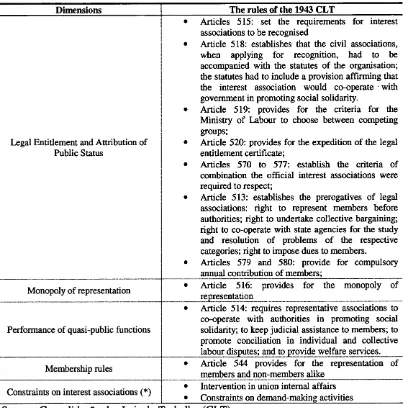
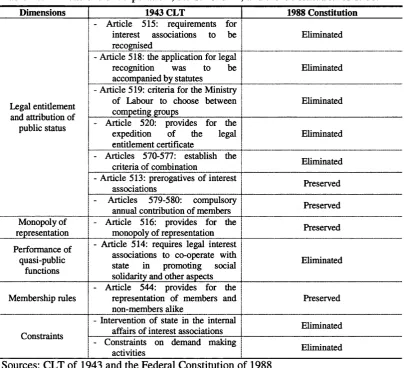
Table 2: Dimensions of corporatism expressed in the 1943 CLT... 59
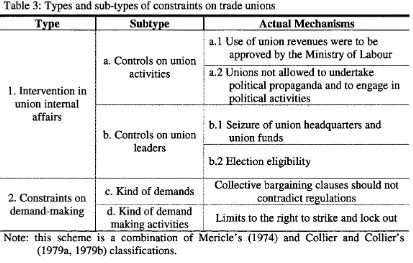
Table 3: Types and sub-types of constraints on trade unions... 64
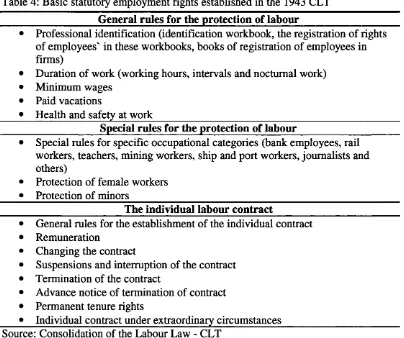
Table 4: Basic statutory employment rights established in the 1943 CLT...78
Table 5: Court cases and direct negotiations in Sao Paulo in 1964 and in 1971...87
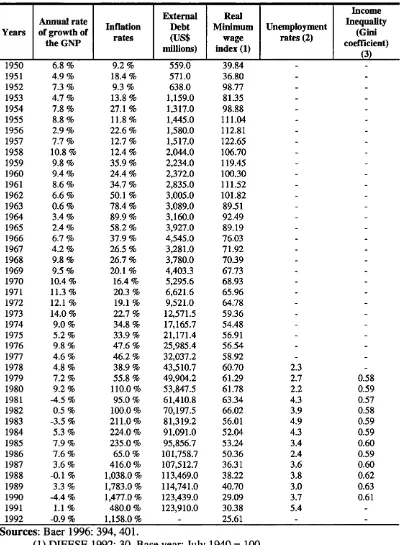
Table 6: Economic indicators Brazil, 1970-1992...101
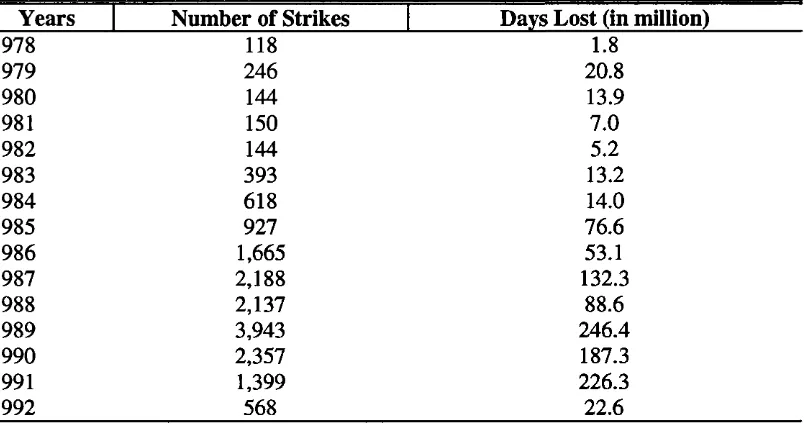
Table 7: Evolution of real minimum wages, number of strikes and number of days lost in strike activity, Brazil, 1978-1992... 105
Table 8: Number of workers per economic sector, Brazil, 1960-1991...110
Table 9: Number of unions and employers’ associations, ‘sindicato’ members, workforce and ‘sindicato’ members in the workforce, Brazil, 1950-1990 I l l Table 10: Dimensions of corporatism, the 1943 CLT, and the Constitution of 1988. .116 Table 11: Characteristics and the nature of the evolution of Brazilian industrial relations in the view of the three selected authors... 135
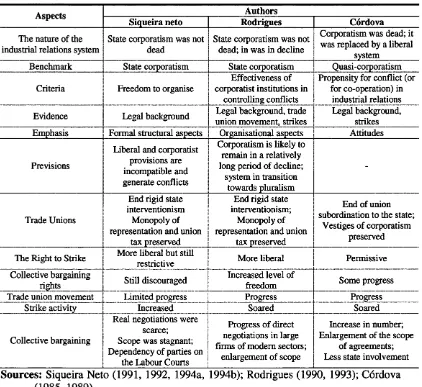
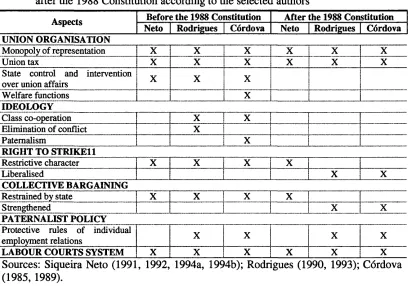
Table 12: Chief characteristics of the Brazilian industrial relations system before and after the 1988 Constitution according to the selected authors...149
Table 13: Dependent Variables...177
Table 14: The set of independent variables...184
Table 15: Summary of the research propositions...186
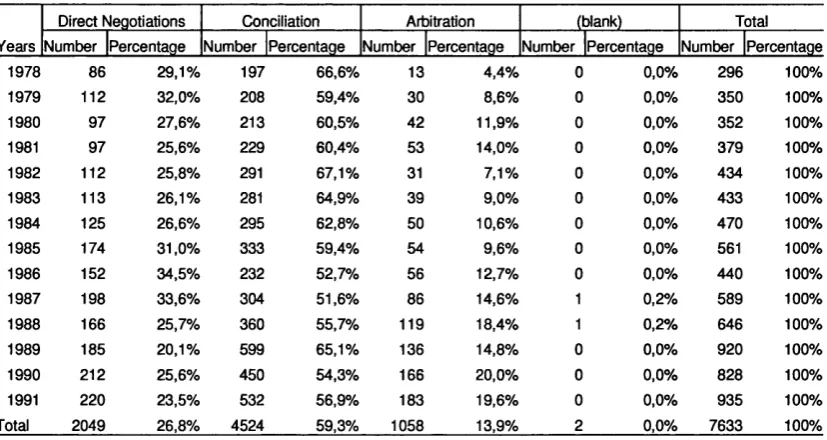
Table 16: Evolution of the annual amount of cases of dispute resolutions, per type and per year, in Rio Grande do Sul, 1978-1991... 206
period, expected values, significance, and value of Chi-Square test... 236
Table 19: Coefficients of determination, regression coefficients, F-test values, Durbin-Watson coefficient and significance of the impact of the economic environment on bargaining procedures, Rio Grande do Sul, 1978-1991... 238
Table 20: Coefficients of determination, regression coefficients, F-test values, and significance of the impact of aspects of the economic environment on bargaining procedures, Rio Grande do Sul, 1978-1991 ... 238
Table 21: Subtopics and clauses concerning ‘Wages’ ... 252
Table 22: Subtopics and clauses concerning ‘Hours of Work’ ... 253
Table 23: Sub-topics and clauses concerning ‘Paid Leave’ ... 254
Table 24: Sub-topics and clauses concerning ‘Social Security’... 255
Table 25: Sub-topics and clauses concerning ‘Security of Employment’ ... 256
Table 26: Evolution of the Bargaining Scope at the multi-employer level and at the firm-level, 1978-1991... 261
Table 27: Sub-topic and clauses concerning ‘Welfare’ ...264
Table 28: Sub-topics and clauses concerned with ‘Working Environment’ and ‘Prevention of Accidents’ ...265
Table 29: Sub-topics and clauses concerning 3.2 ‘Administrative Issues’ ... 269
Table 30: Sub-topics and clauses concerning ‘Training, Recruitment’ and ‘Consultation’ ...270
Table 31: Sub-topics and clauses concerned with Collective Disputes... 272
1991... 279
Table 34: Evolution of the amount of subtopics per type and per year, 1978-1991 .... 280
Table 35: Average amount of subtopics and average amount of new subtopics, per
political sub-period, value of t and the level of significance... 281
Table 36: Results of the regression analysis with results of relationship between rates of
economic growth and amount of new subtopics, 1978-1991... 282
LIST OF FIGURES
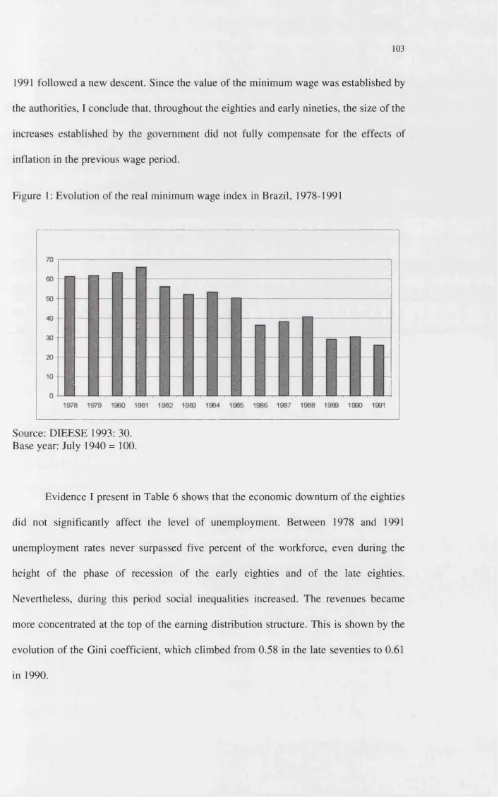
Figure 1: Evolution of the real minimum wage index in Brazil, 1978-1991... 103
Figure 2: Independent variables and dependent variable... 176
Figure 3: Evolution of the annual amount of cases of collective labour disputes in Rio
Grande do Sul, 1978-1991...207
Figure 4: Agreements per type as a proportion of the total, Rio Grande do Sul, 1978
-1991... 208
Figure 5: Evolution of the distribution of bargaining procedures, per type and per year,
1978-1991...209
Figure 6: Annual amount of subtopics, of new subtopics and of dead subtopics,
CHAPTER ONE
INTRODUCTION
Corporatism in Brazil, set up in the 1930s, has survived various political
regimes. In the early nineties, several authors maintained that corporatism had survived,
others posited that corporatism was in transition towards pluralism, and still others
speculated that the democratic attempt of the eighties had heralded a new industrial
relations. In this thesis I test such ideas and shed light on the extent o f changes in
industrial relations.
The period that runs from the thirties up to the late seventies was marked by the
industrialisation process of the Brazilian economy. It was a phase characterised by very
extensive state interventionism in industrial relations. This entailed the setting of an
authoritarian (or state) corporatist arrangement, which afforded the authorities a way
through which they could influence the behaviour of employers and employees with a
view to fit the needs of national development.
The institutions that were at the heart of the system were the official trade union
organisation, the official employers’ associations, the Ministry of Labour, the Labour
Courts, and the comprehensive set of regulations of the individual labour contract. The
rules that shaped the industrial relations system were established by the state in a far
ranging labour code. These regulations were amended throughout the years; however,
their fundamental nature remained the same until the mid-eighties.
A core feature of the Brazilian system of the period prior to 1978 was the
extensive state interventionism over the internal affairs of the interest associations of
employers and especially of employees. In return for being granted legal status, the
as interest groups. That is to say, they were hindered from furthering the interests and
needs of their members. In addition to having their freedom to organise constrained by
the state, unions were forbidden to go on strikes and to undertake industrial action,
while employers’ were forbidden to lock out. Deviant behaviour was severely punished,
especially during the height of the authoritarian political regimes, which lasted from
1930 until 1945 and from 1964 until 1985. The law became the main source of
employment rights, while collective bargaining evolved into an underdeveloped or
marginal means of regulation of industrial relations. Collective agreements used to be
very narrow in scope and the involvement of the authorities - through the Labour
Courts - in the resolution of labour disputes was very high. For further details on this
subject see Chapter Three.
From the late seventies onwards, however, new developments in Brazilian
society became noticeable. The first novelty was the end of political authoritarianism.
The military regime, in power since 1964, declined and democracy was restored in
1985. The political liberalisation process entailed the introduction of major changes in
the legal environment. In 1988 the government promulgated a new Constitution (Brasil
1992), which terminated the power of the state to intervene in the internal affairs of
legal unions and employers’ organisations, as well as eliminated the legal provisions
that required these organisations to co-operate with the state in promoting social
solidarity. Furthermore, the state also granted unions an extensive right to strike and
enlarged the existing set of statutory substantive employment rights.
The second novelty was the revival of the trade union movement, a process that
took place from 1978 onwards. After many years of repression, exercised by the
the working class around the struggle against authoritarianism both at the firm and at
broader political levels. Moreover, unions struggled for the right to strike and for the
right to undertake free collective bargaining. As a result, during the eighties, workers’
activism increased a great deal, which is expressed in the outstanding strike movement
that occurred between 1978 and 1991. The upsurge of the trade union movement
-which is referred to as ‘new unionism’ in the literature (Abramo 1991; Almeida 1996;
Antunes 1988, 1991; Boito Jr. 1991; Cardoso 1999; Gomes 1988; Humphrey 1982;
Keck 1989; Mangabeira 1991; Noronha 1991; Novaes 1991; Pastore and Skidmore
1985; Rodrigues 1990, 1991, 1993; and others) - is regarded by these authors as a
landmark in modem Brazilian industrial relations.
The third new development that occurred during the eighties was the decline of
the economic development model based on the import substitution of industrialised
goods strategy set up in the 1930s. This is expressed in the decline of the rates of
economic growth - in relation to the seventies -, in the rise of inflation rates, in the
decline of the purchasing power - indicated by the decline of real wages -, and in the
increase of unemployment rates. For a more comprehensive analysis of the changes of
the eighties see Chapter Four.
There have been a significant number of the studies concerned with
developments in industrial relations over the last decades. Some have focused on the
impact of the political liberalisation process on the legal background (Magano 1972;
Nascimento 1994). Others are concerned with the rise and the characteristics of the
trade union movement, and with ‘new unionism’ in particular (Abramo 1991; Almeida
1983, 1987; Boito Jr. 1991a, 1991b; Keck 1989; and others). Changes in the labour
a number of studies (Carleial and Valle 1997; Castro 1994; Fleury and Fischer 1987,
1989; Humphrey 1992; Jornada, Sternberg and Zimmermann 1999; Salerno 1987;
Liedke 1992; and others). Finally, developments in collective bargaining have been
focused in some researches (Aguirre 1985; Almeida 1981; Brandao 1991; Bronstein and
Cordova 1985; Cordova, Potobski, Bronstein and Morgado 1995; Gongalves 1994;
Horn 1992, 2003; Malan 1982; Pichler 1983; Pastore and Zylberstajn 1988; Silva 1988;
and others).
There have been, however, relatively few authors concerned with the
significance and extent of the changes experienced by the system during the eighties
and nineties (Siqueira Neto 1991, 1992, 1994a, 1994b; Rodrigues 1990, 1993; Cdrdova
1985, 1989; Boito Jr. 1991a, 1991b; Noronha 1998a, 1998b; Power and Doctor 2004).
The crucial point posed by these researchers is whether the former state corporatist
arrangement still remained, at least partially, or whether it was abolished. I decided to
analyse the works of Siqueira Neto (1991, 1992, 1994a, 1994b), Rodrigues (1990,
1993), and Cordova (1985, 1989) in depth since they are well-known and influential
authors, because their analysis is focused on the changes of the eighties and because of
their distinctive views. From this analysis, I have drawn the three hypotheses that guide
this research.
According to one appraisal in the early 1990s, state corporatism was not dead
(Siqueira Neto 1991, 1992, 1994a, 1994b); Rodrigues 1990, 1993). Neto claims that the
basic authoritarian features of the old corporatist model still remained. These were
embodied in the legal regulations of the trade union structure, of the Labour Courts
system, of the right to strike, and of collective bargaining. According to Rodrigues, state
corporatism was not dead because the trade union organisation set up in the thirties was
less effective in preventing both unions to set up independent organisations and strikes
from occurring, he concludes that the state corporatist system was starting to decline
and that it was in transition towards pluralism. Finally, according to the third author
(Cdrdova 1989), in the late eighties the Brazilian model could no longer be described as
a state corporatist system. He claims that the system was profoundly liberalised
although ‘vestiges’ of corporatism were preserved by the 1988 Constitution (Cordova
1989: 266). In Cordova’s view, state corporatism was characterised by a lack of
conflicts in the system. Since the amount of strikes soared in Brazilian industrial
relations during the eighties, the author concludes that the system set up in the thirties
had been eliminated. In my interpretation, this author concludes that the Brazilian
system became pluralist by nature.
The analysis of the papers of the selected authors shows that the different
assessments derive from their distinctive theoretical backgrounds, from the distinctive
aspects of industrial relations they emphasise, and from the distinctive criteria by which
they assess the changes that occurred. For a more detailed analysis of the studies of the
selected authors see Chapter Five. Despite the relevance of these researches, my view is
that they present some shortcomings. First, they fall short from analysing the form of
regulation of industrial relations that is, according to Dunlop (1993), the aspect that
defines the nature of a system of labour relations. Second, another shortcoming of these
studies is the way they define corporatism. They see it either as a cultural feature of this
type of social institution (embodied in a control and repression logic), which is the view
of Neto, as a form of organisation of unions and management, which is the view of
Rodrigues, or as a general character of labour relations - Cordova’s view. I rather
- that this type of social arrangement should be characterised as a form of relationship
between the state and interest associations of employers and employees that affect the
status of the actors in industrial relations. The definition of industrial relations system,
its elements, and the concept of corporatism are discussed in Chapter Two.
I am concerned with overcoming the limitations of the literature. More precisely,
my aim is to test to what extent the speculation of authors regarding the transformation
(or not) of the industrial relations system are confirmed, by analysing the patterns of
regulation of industrial relations. The specific question this research addresses is to what
extent collective bargaining developed and what its significance is. I also intend to
assess the extent of the impact of the political liberalisation process and of the economic
context on the evolution of the negotiations. The political liberalisation is likely to have
increased the opportunities for the negotiations, while the decline of the economic
context is likely to have hindered a further development of collective bargaining. These
aspects are further analysed in Chapters Seven and Eight.
I assume that the more independent the parties become, relative to the state, the
greater the opportunities for the development of collective bargaining. I posit that the
extent of development of collective bargaining indicates the extent of changes in the
system. The underlying issue addressed by my research is whether, and to what extent,
unions and management became more autonomous from the state for the settlement of
their labour disputes. The predominance of patterns of the past corresponds to the
preservation of the form of regulation of industrial relations that was typical to
corporatism, and vice versa.
The extent of the progress of collective bargaining is indicated by the form of
relationship between union and management and by the scope of the agreements. If
dispute resolutions, and of the progress of the bargaining scope, I then assume that a
break away from features of regulation of industrial relations, prevailing in the period
prior to 1978, occurred. If this is the case, the corporatism-is-dead hypothesis is
confirmed. In my view, a form of regulation in which employee representative
associations participate, at least to some extent, in the establishment of rules regulating
their relationship corresponds to a a new type of industrial relations. The assumption
that state corporatism was in a phase of transition towards pluralism is confirmed if
there is evidence of an uninterrupted increase both of the autonomy of unions and
management in relation to the state, and of the scope of the agreements. Moreover, the
last assumption is confirmed if collective bargaining regulations increased at the
expense of the decline of the statutory regulation.
The period under consideration in this research runs from 1978 up to 1991 since
it is a particularly important phase in recent Brazilian history. It was a period during
which the authoritarian military regime came to an end (in 1985) and was replaced by a
democratic political system. This period was also characterised by the rise of the trade
union movement and by an increase of conflicts in industrial relations. The landmark of
the rise of the strike movement is 1978. The period considered in this thesis also
coincides with the decline of the economic strategy of imports substitution
industrialisation set up in the thirties. A discussion of the characteristics of the evolution
of the political and of the economic environments, as well as of the characteristics of the
trade union movement, can be found in Chapter Four.
In this research I analyse the evolution of collective bargaining in Rio Grande do
Sul, the southernmost state of Brazil. This region was selected, firstly, because it is an
developed in the country. Secondly, this state is an area in which the trade union
movement that emerged in the late seventies was firmly entrenched. Some of the leaders
of the labour movement were union directors in this state during those years. Thirdly,
Rio Grande do Sul was the Brazilian state in which the amount of trade unions and
employers associations was almost as high as in the state of Sao Paulo, which is the
most populated and industrialised region of the country (IBGE 1992: 23).
The conclusions of this thesis are drawn from the analysis of a varied set of data.
The study of the evolution of the extent of state involvement in (or of the autonomy of
the parties in) dispute resolutions is based on records of the regional tribunal of the
Labour Courts and of the regional office of the Ministry of Labour. This is a
comprehensive set of data that covers all negotiations held in Rio Grande do Sul
between 1978 and 1991. The study of the form of relationship between the parties to the
negotiations is based on evidence collected in interviews carried out with leaders of
management and workers’ interest associations in a segment of the engineering industry
of the Greater Porto Alegre Region during the same time period. The study of the
bargaining scope is based on a sample of collective agreements and arbitration awards
established in the same micro-region. This area was chosen because it constitutes the
most industrialised and urbanised area in the state. The selected industrial segment has
the most powerful unions in Rio Grande do Sul. The interviews are supplementary
sources of evidence of the behaviour of the parties to the negotiations. The set of
respondents include trade union and employers association directors, representatives of
the regional tribunal of the Labour Courts and of the Ministry of Labour, as well as a
representative of a private agency for assistance to trade unions.
I have organised this thesis as follows. In Chapter Two I outline the theoretical
which the argument of the thesis is grounded. In Chapter Three I describe the basic
features of the Brazilian corporatist arrangement, the legal background of industrial
relations, and the characteristics of the practice of collective bargaining in the period
prior to 1978. In Chapter Four I describe the key developments in Brazilian society
between 1978 and 1991. I analyse the most salient changes that occurred during this
period in the legal, political and economic environments. In Chapter Five I am
concerned with the analysis of studies of the selected authors regarding the nature of the
evolution of the Brazilian industrial relations system during the eighties. In Chapter Six
I present the research design and the research methodology of this thesis. In Chapter
Seven I am concerned with the study of the evolution of the form of the
union-management relationship in Rio Grande do Sul during the period under consideration. I
focus on the extent of development of collective bargaining relationships in this region
of the country. In Chapter eight I am concerned with the evolution of the bargaining
scope. Finally, in the Conclusion I point out the most important findings of this study. I
state that the Brazilian system that emerged during the eighties is no longer state
corporatist. It should be classified as a statutory-bargained industrial relations model. In
this chapter I discuss the extent the conclusion of this research may be generalised to
Brazil, and even to Latin America and the nature of the changes in Brazilian industrial
CHAPTER TWO
INDUSTRIAL RELATIONS SYSTEM S AND COLLECTIVE
BARGAINING
In this chapter I outline the analytical framework for the study of the nature and
the evolution of industrial relations. I start from assumptions derived from Dunlop’s
systems theory, according to which different types of industrial relations systems could
be distinguished by analysing the way the rules that regulate the union-management
relationship are established. A crucial aspect that distinguishes one system from another
is the extent of development of collective bargaining. Hence, I assume that the study of
a given industrial relations system, and its changes through time, could concentrate on
studying this social institution, albeit in relation to other forms of regulation.
For a better understanding of the conditions that favour or hinder the
development of collective bargaining, I use the so called ‘corporatist theory’
(Williamson 1989). It sheds light on the social structures underlying labour relations
and on the implications of distinctive arrangements in shaping the different systems.
According to the studies of Schmitter (1974, 1985); Strinati (1979); Crouch (1977,
1979, 1983, and 1985); Crouch and Dore (1990); and Williamson (1989) some types of
relations between state and interest organisations foster the practice of collective
bargaining, while others favour the increase of the role of the state in labour relations
and hinder the progress of negotiations. These ideas are useful for the study of the
realities of developing countries, such as Brazil, characterised by high levels of state
In the first section of this chapter I concentrate on the regulation of industrial
relations. In the second section I distinguish and characterise the different types of
industrial relations systems. I analyse features of state-interest group arrangements and
on the role of collective bargaining in the regulation of the employment relationship.
The stress is placed on the characteristics of corporatism and on the types of corporatist
industrial relations systems. Finally, in the last section I focus on collective bargaining,
highlighting its nature, the conditions that favour or hinder its development, structural
characteristics, outcomes, and determinants.
2 .1 1ndustrial relations systems and the regulation of industrial relations
I start with the concept of industrial relations system. This is followed by a
discussion on the crucial aspects that were to be taken into account in studying
union-management relations. I place the stress on the way this social form of interaction is
regulated.
Industrial relations in a specific country or work community, in a given time
period, is viewed by Dunlop (1993:13) as a comprehensive whole of interrelated
elements. It is made up of three actors - management organisations, workers’
organisations and governmental agencies - that interact within an environment that
encompasses technology, labour and product markets, and the distribution of power in
the larger society. The system also includes an ideology, or shared understandings, held
by the actors that help to define their roles and to integrate the system. The output of the
system constitutes a web of rules. Changes either in the broader environment, in the
relationship of the actors, or in the shared understandings of the actors are expected to
affect the rules.
The web of rules, viewed as the dependent variable of the model, comprises
obligations (Edwards 1995: 13). They may be expressed in different forms, such as:
regulations and policies of the management hierarchy; laws of any worker hierarchy; the
regulations, decrees, decisions, awards, or orders of governmental agencies; rules and
decisions of specialised agencies created by management and worker hierarchies;
collective bargaining agreements, and customs and traditions of the work place and
work community (Dunlop 1993: 53).
We may also distinguish substantive rules from procedural rules. The first type
includes rules governing compensation in all its forms; duties and performance expected
from workers; and rules defining the rights of workers. The second category includes
procedures for establishing rules and procedures for deciding their application to
particular situations. The procedural rules are directly related to the distribution of
power in society, aspects that are decisive for defining the status of the actors (Dunlop
1993: 51-52; 107).
The procedures and the authority of the actors for establishing rules are crucial
aspects of an industrial relations system. They are “peculiarly the product of public
policies, including the history and traditions of a country” (Dunlop 1993: 109). The
author points out that these aspects are considerably uniform within a country and have
considerable stability over time (Dunlop 1993: 109; 129). He maintains, moreover, that
we can distinguish one system from another by identifying the way labour relations are
regulated within a given society (Dunlop 1993: 51).
The establishment of rules at the workplace and work community is a complex
social process that depends on the power, knowledge and organisation of the parties
(Edwards 1995: 13). The key element that defines the authority of the actors in the
Authority is defined as the legitimate use of power. The concept of power is here
employed in two senses. In one sense it is the ability of someone to control others, or to
impose directions or regulations upon others. In the other sense it is the ability to
influence another party’s decisions or actions. Influencing the decisions of others may
be either the ability to force a change in the other party’s decision, or the ability to
generate an implicit influence “which will form an integral part of the environment
which has to be taken into account by the other party in its decision-making process”
(Salamon 1998: 70, 72).
The authority of the employers, employees and agencies of government in rule
making is derived from the status of representative associations in the power structure.
According to Dunlop, the status of any of the actors in an industrial relations system is
defined as “the prescribed functions of that actor and the relations with the other actors
in the system” (Dunlop 1993: 110). The status o f workers and their representative
associations is characterised by the network of prescribed interrelations with the
management hierarchy, with rival or potentially rival organisations of workers, with
workers and their organisations and, finally, with government agencies. The status of
management is the network of interrelations with workers and their organisations, with
rival management organisations and with the government. The status of government is
characterised by its role in determining substantive rules directly, or by determining the
rules of the interaction between workers and managers (Dunlop 1993: 110, 121, 125).
We may conclude that since the power context defines the form of the
relationship between the actors, changes in the power distribution in the broader society,
in a given time period, are likely to affect the status of the actors and hence the patterns
form of regulation of industrial relations, changes in these relationships affect the
broader characteristics of an industrial relations system.
There are a number of methods of regulation - which could also be regarded as
different sources of employment rights. The most important ones are: unilateral
imposition of terms of employment by employers or by unions (or unilateral regulation);
government regulations and arbitration awards (or statutory regulation); and collective
bargaining. Other methods are individual bargaining, between employer and employee,
and informal work group arrangements (Beaumont 1990: 6, 104; Edwards 1995: 6-10;
Keenoy 1990: 96-148; Windmuller 1987: 7).
The sub-system of resolution of labour disputes is another source o f employment
rights. It is embodied in the facilities established and maintained by the state at public
expense. The major dispute settlement mechanisms this sub-system encompasses are:
judicial settlement or adjudication by courts of law; conciliation; mediation; and
arbitration (Bean 1991: 119; Daya 1989: 5; Salamon 1998:439-455). In all these cases a
third party intervenes in union-management relationships.
Adjudication is a procedure whereby ordinary courts, or special labour courts,
settle any disputes over rights and obligations (Daya 1989: 15). Conciliation and
mediation are those procedures whereby a “third party provides assistance to the parties
in the course of negotiations, or when negotiations have reached an impasse, with a
view to helping them to reach an agreement” (Daya 1989: 15). In conciliation hearings
the third party brings the parties to the negotiations together and encourages them to
find, on their own, the solution to the impasse. The responsibility for making decisions
and reaching a solution still remains in the hands of management and union. The
conciliator has no authority to compel or to impose a settlement (Salamon 1998: 439).
parties, going as far as submitting his own proposals for the settlement of the dispute
(Daya 1989: 15; Salamon 1998: 442-443). Finally, arbitration is a procedure whereby a
third party is empowered to make a decision which settles the dispute (Daya 1989: 15).
In these cases, the parties lose their power over the settlement entirely (Salamon 1998:
440). Arbitration awards are legally binding.
Dispute settlement mechanisms could be either voluntary or compulsory by
nature. The label voluntary “implies that management and union have complete
discretion to make, or not make, such ad hoc or permanent arrangements as they
consider necessary and appropriate for resolving any impasse” (Salamon 1998: 448). In
contrast, the label compulsory “implies a removal of management’s and union’s
freedom to determine their own affairs” (Salamon 1998: 448). The involvement of an
‘external’ to the dispute is imposed through legislation. In practice industrial relations
systems are characterised by a combination of voluntary and compulsory features (Daya
1989: 16, 17).
Varying degrees of authority of the actors in society correspond to distinctive
methods of regulation of industrial relations. There is unilateral regulation when rules
are set solely through the authority or power either of employers or of employees. This
concept is applied to describe those situations in which trade unions are either not
recognised or play only a minimal role in the regulation of employment (Keenoy 1990:
97). I assume that the predominance of management unilateral regulation - expressed
by a lack of negotiations - indicates a rather primitive form of employment relationship.
In the case of statutory regulation, it is the government that has the authority to set
employment rules. Finally, in the case of collective bargaining employers and
Different forms of regulation exist side-by-side even though one predominates
over the others. In all situations a combination of these methods may be found.
Statutory regulation determines the basic character of the employment contract
including health and safety rules. Other issues, such as the distribution of the profits,
tend to be established through unilateral regulation. There are no employment issues
over which collective bargaining enjoys exclusive domain (Keenoy 1990: 146).
According to Bellace (1994), in the most advanced industrialised market
economies a process of juridification of labour relations has taken place during the
twentieth century. This process corresponds to an enlargement of statutory regulation
and, hence to an enlargement of the role of the state. The author maintains that this
process entails, on the one hand, a more comprehensive web of legal regulations. Over
time, the law has increasingly covered a larger number of issues such as health and
safety, methods of payment, individual contractual arrangements - targeting the
‘abuses’ of the free market system -, occupational training, dismissals, discrimination
and other aspects. Furthermore, the law has covered regulations on unemployment
compensation, retirement, and social security as well. On the other hand, the process of
juridification encompasses a “portfolio of regulatory mechanisms including
administrative measures [and] ministerial decisions” (Bellace 1994: 26).
The advancement of juridification of labour relations was not made at the
expense of collective bargaining in the major industrialised market economies. That is
to say, negotiations and the law are not necessarily incompatible. In some cases - such
as in France - legislation is designed to encourage the spread of collective bargaining
(Adams 1994: 57). In others, such as in Germany, the law provides protective rules and
welfare provisions for individual workers (Bean 1991: 118). In this country collective
of rule setting. Achievements reached at the bargaining table may be incorporated into
the law and be extended and passed on to the entire labour force (Bean 1991: 119).
Since rule-making methods are sources of employment rights, we may assert
that one method predominates over the other when the regulation of industrial relations
depends more on one source than on the alternative. Thus, a specific form of
combination of methods of regulation defines a type of industrial relations. A given type
system corresponds to a crystallization of a peculiar power distribution in a given
society.
The point I have highlighted in this section is that the crucial aspect of an
industrial relations system is the form of regulation of industrial relations. Behind a
given form of regulation of industrial relations lies a power relationship between the
actors that is shaped by the power context. This aspect of the broader environment
defines the status of the actors and their authority in determining the conditions under
which work is performed. In the section below I will show how these relationships are
typically shaped in different industrialised societies and how they affect the form of
regulation of industrial relations.
2.2 A typology of industrial relations systems
In this section I outline a set of ideal types of industrial relations systems. In
addition to broadly characterising the different models, I go into further detail in the
analysis o f corporatism. Apart from characterising the different types of corporatist
arrangements, I am concerned with describing the nature of this sort of social structure.
The corporatist systems will be discussed more lengthily than the alternative types since
it is a crucial concept for the study of the Brazilian system.
Crouch (1985), Strinati (1979) and Salamon (1998) put forward one analytical
are the dominant political ideology, the types of power relationships between interests
associations of employers and employees and the autonomy of unions relative to the
state in different settings. The combination of these aspects is reflected in different
forms of regulation of industrial relations. The types of systems identified are, namely,
market individualism, pluralism (also referred to as liberal collectivism), bargained
corporatism (also referred to as societal corporatism or neo-corporatism), and state (or
authoritarian) corporatism.
Market individualism is a model that has been associated to the early stages of
industrialization in western societies. It is characterised by the dominance of a liberal or
‘laissez-faire’ ideology, and is a system in which labour is weak, unorganised and
subordinated to employers. The union-management relationship is, at best, paternalistic
or, at worst, exploitative. The role of government is largely passive and there is little
legislation to protect employees. In this model it is assumed that the employment
contract is primarily an economic relationship between two individuals (Salamon 1998:
271-272). In this system prevails management unilateral regulation of the employment
relationship. Since the economic function of unions is restricted, collective bargaining
tends to play a quite marginal role in the regulation of industrial relations.
Pluralism is defined, by Schmitter (1974: 96), as:
“a system o f interest representation in which the constituent units are organised into an unspecified number o f multiple, voluntary, competitive, non hierarchically ordered and self-determined (as to type or scope o f interest) categories which are not specially licensed, recognised, subsidised, created or otherwise controlled in leadership selection or interest articulation by the state and which do not exercise a monopoly of representational activity within their respective categories. ”
Schmitter stresses the form of organisation of workers and employers. He argues
no restraints to their proliferation. The associations compete among themselves to
attract members (Schmitter 1974: 97).
Salamon (1998) emphasises the form of the institutional relationship existent
between the state and interest groups. According to him pluralism implies that the state
upholds the principle of non-intervention in the disputes that arise in industrial relations.
In these cases, state regulation “is confined to creating a (modest) legal framework
within which private individuals and businesses can conclude agreements” (Salamon
1998: 272). Autonomous trade unions, which represent, negotiate and reconcile
conflicting interests with management through collective bargaining, are accepted.
Government regulation is supportive to union-management rule making. In this case
statutory regulation is a supplement to collective bargaining (Bean 1991: 100-122;
Salamon 1998: 272; Windmuller 1987: 3-8). This type of system includes official
conciliation and arbitration services that remain voluntary by nature (Strinati 1979:
207).
Pluralist industrial relations are those in which the ‘free collective bargaining
system’ prevails (Kochan 1980: 235). This is defined as the “right to negotiate a labour
agreement without the intervention of the government or some outside force” (Kochan
1980: 235). The freedom to contract requires the freedom to reject a contract offer and
the power to affect the course of events, which is expressed in the right to strike and to
undertake other industrial actions. That is to say, the right to negotiate comes alongside
with the right to strike (Kochan 1980: 236).
A basic condition for free collective bargaining to develop is that society accepts
the legitimacy of the conflict of interest between workers and employers. Kochan
(1980: 236) points out that the negotiation process is the “arena where the conflicting
interest associations of employers and employees have to be responsive to the interests
and expectations of their members and that they have to build organisations that
perform effectively in negotiations.
The contrasting type of industrial relations systems is
corporatism.
Schmitter (1974: 93-94) defines it as:“a system o f interest representation in which the constituent units are organised into a limited number o f singular, compulsory, non-competitive, hierarchically ordered and functionally differentiated categories, recognised or licensed (if not created) by the state and granted a deliberate representational monopoly within their respective categories in exchange fo r observing certain controls on their selection o f leaders and articulation o f demands and supports ” (Schmitter 1974: 93-94).
Williamson (1989) built a general model of corporatism distinguishing its main
components. The main features of this type of arrangement are, according to him, the
following:
First, in general, corporatism is a means of structuring the relationship between
state and interest associations of employers and employees, referred to as ‘producer
groups’ (Williamson 1989: 206). The arrangement affords the state a measure of
influence (or control) over societal groupings in the area of production. Such
developments can occur through voluntary processes or by imposition of state dictate
(Williamson 1989: 204-207, 223).
Second, interest associations are attributed with public status. The state can
supply representational, organisational and procedural attributes and resources to the
recognised groups - granting them with a measure of power. Nevertheless, according to
Williamson (1989: 207), “this separates the association from the interest, ideologies and
needs of its members, and makes the organisation more dependent upon the state”. By
over the organisational behaviour of strategic segments of society such as trade unions,
employers’ trade associations, and the professions (Dunleavy 1991: 27).
Third, an essential element is that the state can make demands and constraints on
the behaviour of the recognised organisations. The attribution of public status is
typically used as a “kind of licence with which to make demands upon the behaviour of
the association” (Williamson 1989: 207). The legally-entitled associations are expected
to act as intermediaries between the state and economic and social decision makers
(Williamson 1989: 30). These groups are not simply representative bodies but also
regulatory ones, acting on behalf of the state. In this sense, the interest associations
provide state authorities with mechanisms for intervention in the economy at large and
in industrial relations in particular (Williamson 1989,44).
Hence, a trade-off between state and licensed producer groups underlies
corporatist arrangements. The state supports the organisation in various ways in
exchange for some constraints in demand-making and leadership selection. Therefore,
we may say that “corporatism not only encompasses the attribution of status but also
that the status takes the form of a licence of behaviour” (Williamson 1989: 207).
Crouch and Dore (1990: 3) follow the same line of reasoning. They contend that
corporatism involves an implicit or explicit bargain, or trade-off, between the interest
groups and the state. According to these authors, one element in the bargain is that those
groups that entered into the arrangement “receive certain institutionalised or ad hoc
benefits in return for guarantees by the groups’ representatives that their members will
behave in certain ways considered to be in the public interest”. A crucial aspect of the
‘bargain’ between state and interest groups is that it requires a varying degree of
discipline of associated members of the respective organisations. This control may be
(Strinati 1979, 205-206). The essential element of any type of corporatist structure is
that there are restraints upon the actions and forms of organisation of employers and
employees. Corporatism affects the status of the actors in the power structure by
limiting the freedom of the parties- and hence the authority and the role - of the
respective groups to the arrangement in the regulation of industrial relations.
Fourth, the state grants monopoly (or near monopoly) of representation to the
recognised interest associations. This is a means by which the state can prevent
producer groups from escaping from corporatist structures of representation, and hence
from state controls or influence. Williamson (1989: 209) points out that alternative
associations may exist, providing they lack effectiveness. In other words, weak
associations may be acceptable. The author points out furthermore that the monopoly of
representation is taken as the principal indicator of corporatism. He maintains that this
has to do more with the relative ease with which corporatism can be assessed, rather
than with its overall significance. Thus the mere existence of monopoly of
representation does not indicate that a give system is corporatist, the other criteria being
attribution of public status, performance of quasi-public functions, compulsory
membership or authority to regulate members and non-members alike.
Fifth, corporatism involves the performance of quasi-public functions by the
interest organisations. The recognised groups can assume a variety of roles in
implementing public policies. The more the state hands over responsibility for the
performance of public functions, the more developed the form of corporatism is. Hence,
the recognised interest associations must have the authority and the power to gain the
compliance of the members to bargains reached with state authorities, which is the case
Sixth, the performance of a role in implementing public policies, by the
recognised interest associations, needs either compulsory membership or authority,
delegated from the state, to regulate members and non-members alike (Williamson
1989: 214).
Summing up, corporatism is essentially a means by which the state influences or
exerts control over the behaviour of interest groups, limiting their autonomy. It is
associated with state interventionism in the economy. In exchange for being attributed
public status, the organisations that enter into the arrangement are required to perform
public functions - handed over by the state. These functions correspond to the broader
social and political goals established by the rulers in power. The implication of this
trade-off is, that the representative function of interests associations is, to a varied
degree, distorted.
Bearing in mind the general characteristics of corporatism, we can return to the
description of the remaining types of industrial relations systems. The third model
identified by Crouch (1985), Strinati (1979) and Salamon (1998), is bargained
corporatism. This system is characterised by active state intervention in labour
relations, usually in consultation with the social partners, the legally-entitled interest
associations, and by active state support of these organisations (Salamon 1998: 273).
Under this form of corporatism the control of the state over the interest
associations is exerted indirectly. According to Crouch (1985: 457), the “participating
groups accept joint responsibility for the order and progress of the system as a whole
and undertake to help [governments] to guarantee the on-going commitment of their
members to co-operation”. The control of interest groups’ behaviour - or the discipline
of their members - is exerted by their own leadership. Government then becomes a
employees in bargaining, by their own industrial strength, such as social policy reforms,
workers’ rights, and changes in economic and fiscal policy (Salamon 1998: 273; Hill
1986: 255-256).
In a bargained corporatist arrangement, the parties - though somewhat restrained
in their autonomy - are expected to regulate their relationship through collective
bargaining. The state may assist them by establishing standards for the individual
employment contract that may be improved by negotiations. Since the relationship
between the parties still relies much on collective bargaining, this form of arrangement
may be considered a collective bargaining-based industrial relations system (Celia and
Treu 1991: 19-20).
The state corporatist type of industrial relations system is typically set up under
authoritarian rule. Authoritarian regimes are those in which the power is exerted solely
by a leader or by a governing group. Under authoritarianism, opposition to the ruling
elite is crushed and the autonomy and independence of interest organisations is severely
circumscribed. In these types of regimes, political party pluralism is either prohibited or
preserved to simulate democracy. The power position of the ruling elite is not to be
disturbed by opposing groups. In these situations the state plays a very active role in
conducting economic development (Stoppino 1986: 94-104).
The basic characteristic of the state corporatist institutional structure is that the
“different functional interests, but particularly labour, are suppressed or incorporated
into the political system” (Salamon 1998: 273). The concept of state corporatism is
especially applicable to societies where governments seek to impose a system of interest
representation. These systems are aimed at eliminating spontaneous group formation
and at establishing, from above, a “limited number of authoritatively recognised groups
1977: 4). The interest groups are organised in vertical functional categories and are
“obliged to interact with the state through the designated leaders of authoritatively
sanctioned interest associations” (Malloy 1977: 4). The setting up of an official
structure of associations for capital and labour - the ‘syndical’ system - under
authoritarian political regimes involves the crushing of autonomous trade unions and
employers’ organisations.
According to Williamson (1989: 36), the licensed labour ‘syndicates’ become a
very effective means for the subordination and disciplining of labour under state
control. In the countries in which this type of arrangement was set up “harassment,
intimidation and imprisonment helped to sustain this state of affairs and quelled any less
organised attempts by workers to protect their interests”. In this sort of arrangement the
control upon employers’ ‘syndicates’ is less strict. The state typically allows powerful
industrial, commercial and agricultural interests to dominate employers’ organisations.
Historically, the establishment of the ‘syndical’ system - in the mid-twentieth
century - was followed by a considerable increase of economic intervention. The
regulation of wages and other labour conditions was subjected to extensive interference
and guidance from state authorities. Moreover, the ‘syndical’ system was backed by
laws constraining union activities - strikes and other industrial actions were rendered
illegal - and by the setting up of a compulsory system of resolution of labour conflicts
(Williamson 1989: 37). The control of the state over interest organisation under
authoritarian rule made the legal ‘corporations’ turn out not to be “intermediary bodies,
but simply part of the state machinery proper” (Williamson 1989: 38).
The authoritarian corporatist arrangements imply that the actors are under the
control of the state. This means that their autonomy and authority in the regulation of
settings are very narrow and bargaining