Comparative Study on the Effect of Curing with Fresh Water and Sewage
Water on Structural Strength of Concrete
Akash Jaiswal
1Dr J N Vyas
21
P. G. Student
2Professor
1,2
Department of Civil Engineering
1,2
Mahakal Institute of Technology and Management, Ujjain (M.P.), India
Abstract— In this research work, the comparative study of effect of curing with sewage water and fresh water on concrete was investigated. This paper presents the result and findings of an experimental research on the effect of curing with sewage water and fresh water on compressive strength, flexural strength, split tensile strength of concrete. For this concrete cubes, beams, cylinders were cast and curing with fresh water and sewage water for a mix of 15, 20 & M-25 for the standard ratio. A total specimen of 18 cubes, 18 beams, and 18 cylinders including specimens for reference concrete were cast for given mixes and exposed to 7 days, 14 days and 28 days period of curing. The reference concrete was prepared with PPC using only fresh water and sewage water curing. Curing of concrete is the operation of maintaining humidity & temperature of freshly placed concrete during some definite period following placing, casting or finishing to assure satisfactory hydration of cement. When water is added to cement, sand & aggregate mix, the reaction between cement & water is exothermic. Hence lot of heat is evolved in reaction. This is known as heat of hydration. The heat of hydration results in evaporation of water from concrete that results in reduction of strength of concrete. Hence external application of water is required. This is ‘curing’. Efficient uninterrupted curing is the key to quality concrete. Proper curing of concrete is crucial to obtain design strength. The curing period depends on the required properties of concrete. Curing is designed primarily to keep the concrete moist by preventing the loss of moisture from the concrete during the period in which it is gaining strength curing may be applied in the number of ways & the most appropriate means of curing may be dictated by the site or the construction method. Various methods of curing are available. The existing study suggests that curing with fresh water is best suited for concrete. Hence the strength of concrete observed in laboratory is illusive & is not the real strength of concrete on site.
Keywords: Fresh Water, Sewage Water, Compressive
Strength, Flexural Strength, Split Tensile Strength, Curing
I. INTRODUCTION
In present scenario most of the construction done by concrete so proportion of concrete is important factor for strength as well as durability. Concrete is a single most extensively used man-made material in the world. It has been used for the construction of buildings, bridges, dams, pavements, tunnels, waste containment system. In 1999, Lambert corporation attempted to introduce that concrete curing is the treatment of newly placed concrete during the period in which it is hardening so that it retain enough moisture to immunize shrinkage & resist cracking. It has long been recognized that adequate curing is essential to obtain the desired structural & durability properties of concrete. Two main categories of
methods of curing concrete are: those that maintain availability of water & those that minimize the loss of mixing water from concrete by sealing its exposed surfaces. To determine which curing method(s) to adopt, it is necessary to consider factor such as the availability of curing material, the size & shape of structure, environmental condition etc. Traditionally, quality of concrete in construction work is calculated in terms of its 28 days compressive strength. If after 28 days, the quality of concrete is found to be dubious, it would have been buried by subsequent construction.
A. Curing of Concrete
Curing of concrete may be defined as the process of maintain the moisture and temperature condition of concrete by the hydration reaction to the normally so that concrete develop harden properties over time. The main components which need to be taken care are moisture, heat and time during the process.
Depending upon the site constraints, type of structure and other material parameters, different methods of curing are adopted at site. Methods of curing concrete fall into the following categories:
1) Water curing:
Water curing prevents the water loss from the concrete surface by uninterrupted wetting of the exposed surface of concrete. It’s done by spraying or sprinkling water or curing agents over the concrete surface to ensure that the concrete surface is continuously moist. Moisture from the body of concrete is retained from evaporating and contributes to the strength gain of concrete.
Water curing methods are: 1) Pounding
2) Sprinkling, fogging & mist curing 3) Wet covering
In the construction industry fresh water is used .but many part of world faces serious deficit in fresh water .the increase in the economic activities as well as the population grow caused a substantial increase in water demand. As the freshwater is becoming scarce it is important to reduce freshwater consumption in construction industry so it is essential to know the strength of concrete when curing with freshwater and sewage water. Hence the main objectives of the work are as follows:
1) This study compares the compressive strength on concrete by the curing with fresh water and with sewage 2) This study compares the tensile strength on concrete by
the curing with fresh water and with sewage
II. MATERIALS USED
A. Sand:
Sand is a naturally occurring coarse material collected of finely separated rock and mineral particles. It is defined by size, being finer than gravel and coarser than silt. Sand may also consign to a textural class of soil or soil type; i.e. a soil contain more than 85% sand-sized particle (by mass). In terms of particle size as used by geologists, sand particle range in diameter as of 0.0625 mm to 2 mm. An individual particle in this range size is termed a sand grain. Sand grains are among gravel (with particles ranging from 2 mm up to 64 mm) and silt (particles smaller than 0.0625 mm down to 0.004 mm). The dimension specification between sand and gravel has remained even for other than a century, but particle diameter as small as 0.02 mm be considered sand under the Albert Atterberg standard in utilize during the early on 20th century. A 1953 engineering standard published by the American Association of State Highway and Transportation Officials set the least sand size at 0.074 mm. A 1938 specification of the United States Department of Agriculture was 0.05 mm. Sand feel granular when rubbed between the fingers (silt, by comparison, feels like flour).
B. Cement:
Cement Ordinary Portland cement is used to prepare the mix design of M-15, M-20 and M-25 grade. The cement used was fresh and without any lumps water-cement ratio is 0.35 for this mix design using IS 456:2007.Cement is an extremely ground material having adhesive and cohesive properties which provide a binding medium for the discrete ingredients
C. Aggregate:
“Aggregate”, is a wide group of coarse particulate material used in construction, as well as sand, gravel, crushed stone, slag, recycled concrete and geo-synthetic aggregates. Aggregates are the mainly mine material in the world. Aggregates are an element of composite materials such as concrete and asphalt concrete; the aggregate serve as reinforcement to add strength to the overall combined material. Due to the comparatively high hydraulic conductivity value as compare to most soils, aggregates are generally used in drainage applications such as foundation and French drains, septic drain fields, retaining wall drains, and road side edge drains. Aggregates used as support material under foundations, roads, and railroads.
D. Sewage Water (Domestic Water):
Domestic sewage water consist of liquid waste from bathroom ,water closets ,kitchen sinks, wash basin etc of residential building In this research we used sewage water have following properties.
S.No. property value
1 PH 6.0
2 DO 5ppm
3 BOD 100ppm
4 TDS 320
Table 3.1: Chemical property of domestic water S.No. property Domestic water Tap water
1 PH 6.0 7.41
2 DO 5ppm 9ppm
3 BOD 100ppm 5ppm
4 TDS 320 150
Table 3.2: Compression of chemical analysis of sewage water and Tap water
III. EXPERIMENTAL ANALYSIS
A. Preparation of Concrete Cubes:
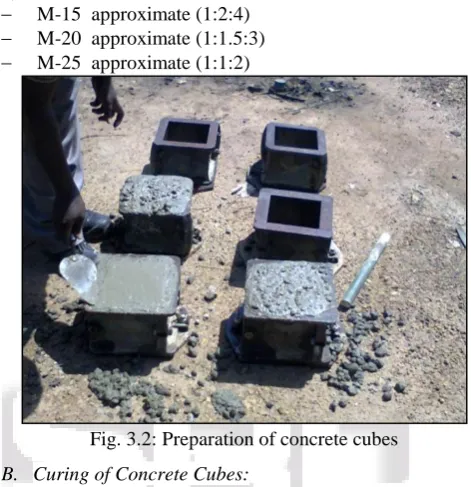
Concrete cubes are prepared on size 150mmX150mmX 150mm for different grades, and 300mmX150mm diameter cylinders and 100mmX100mmX500mm beam were cast.
M-15 approximate (1:2:4)
M-20 approximate (1:1.5:3)
[image:2.595.306.542.193.437.2] M-25 approximate (1:1:2)
Fig. 3.2: Preparation of concrete cubes
B. Curing of Concrete Cubes:
[image:2.595.312.541.474.655.2]Cube of concrete are taken in different grades (M-15, M-20 and M-25) are cured by the fresh water as well as by sewage water and the curing has been done for 7, 14 & 28 days.
Fig. 3.4: Curing of cubes with sewage water
C. Testing of Strength: 1) Compressive Strength:
Compressive Strength Test Specimens were then tested on 200 tones capacity Compression Testing Machine (CTM). The position of cubes were kept during testing at right angles to casting position. Axis of specimens was carefully aligned with the center of thrust of the spherically seated plates. The load was applied gradually without any shock and increased at a constant rate of 3.5 N/mm2 /minute until failure of specimen takes place. The average of three samples was taken as the representative value of compressive strength for each batch of concrete. The compressive strength was calculated by dividing the maximum compressive load by the cross sectional area of the cube specimens. Thus the compressive strength of different specimens was obtained. Curing The test specimens were stored in place which free from vibrations, in most air of at least 90% relative humidity and at a temperature of 270C for 24 hours from the time of addition of water to the dry ingredients. After this period, the specimens were marked and remove from the mould and immediately submerged in clean and fresh water or saturated lime solution and keep for required period just prior to test. The water or 26 solution in which the specimens were submerged, are renewed after every seven days and were maintained at a temperature of 270C. The specimens are not to be allowed to become dry at any time until they have been tested. The specimens are tested at 7, 14, and 28, days of curing.
2) Tensile Strength:
This test is carried out by placing a cylindrical specimen (150mm diameter and 300mm height) horizontally between the loading surfaces of a compression testing machine and load was applied gradually until failure of the cylinder take place along the vertical diameter. Specimens were taken out from curing tank at the age of 28 days of water curing and then tested on 200 tones capacity Compression Testing Machine (CTM) as per IS: 516 and 1199. The split tensile strength was determined by using the following formula. Split tensile Strength (MPa) = 2P / ΠDL P = Splitting Load in N D= diameter of cylinder sample (mm) L = length of cylinder sample (mm).
3) Flexural Strength:
All the beam specimens were tested on a Universal testing machine of 2000 kN capacity in the “Structural Engineering”
lab. The testing procedure of all the beam specimens was same. First the beams were cured for a period of 28 days, then its surface was cleaned with the help of sand paper. After this the specimens were given a white wash with an identification number. Such type of specimens enabled to detect cracks during testing.
4) Sulfate Attack Test:
Durability test on concrete cube is done by the placing the concrete cube in fresh water with mixture of 5% sulfate (SO4).so that one cube is kept in fresh water with mixture of
5% sulfate and another cube is kept in fresh water alone for 24 hours then the strength of both concrete cube strength is measured by CTM for all different grades concrete.
IV. RESULTS
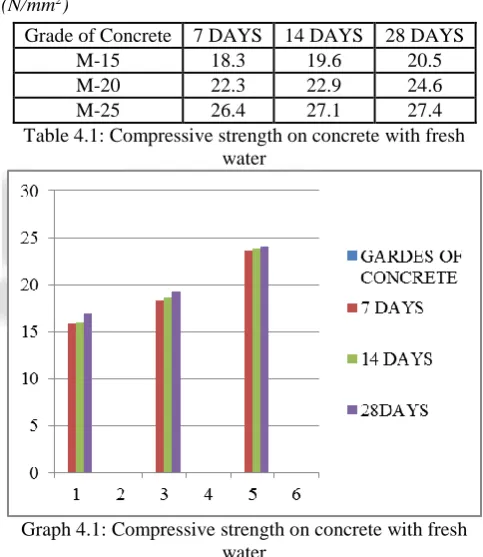
The different grades are concrete mix cube pounded in fresh water for 7 days, 14 days and 28 days compressive strength test are following results
A. Compressive Strength on Concrete with Fresh Water (N/mm2)
Grade of Concrete 7 DAYS 14 DAYS 28 DAYS
M-15 18.3 19.6 20.5
M-20 22.3 22.9 24.6
[image:3.595.306.548.300.579.2]M-25 26.4 27.1 27.4
Table 4.1: Compressive strength on concrete with fresh water
Graph 4.1: Compressive strength on concrete with fresh water
B. Compressive Strength on Concrete with Sewage Water (N/mm2)
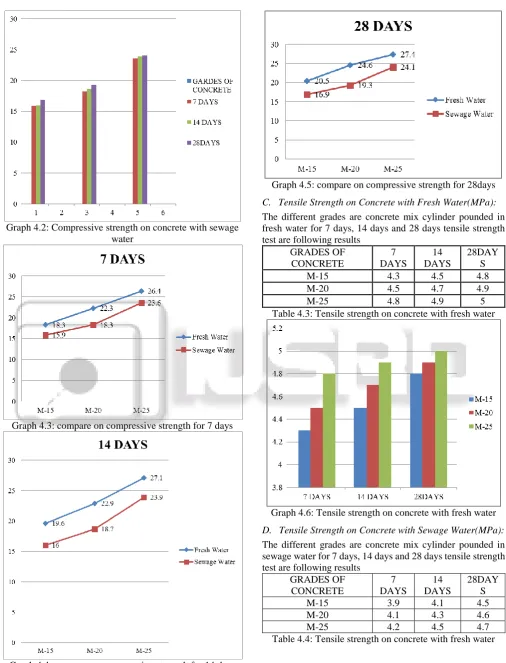
The different grades are concrete mix cube pounded in sewage water for 7 days, 14 days and 28 days compressive strength test are following results
GRADES OF CONCRETE
7 DAYS
14 DAYS
28 DAYS
M-15 15.9 16 16.9
M-20 18.3 18.7 19.3
M-25 23.6 23.9 24.1
[image:3.595.309.551.649.712.2]Graph 4.2: Compressive strength on concrete with sewage water
Graph 4.3: compare on compressive strength for 7 days
Graph 4.4: compare on compressive strength for 14 days
Graph 4.5: compare on compressive strength for 28days
C. Tensile Strength on Concrete with Fresh Water(MPa):
The different grades are concrete mix cylinder pounded in fresh water for 7 days, 14 days and 28 days tensile strength test are following results
GRADES OF CONCRETE
7 DAYS
14 DAYS
28DAY S
M-15 4.3 4.5 4.8
M-20 4.5 4.7 4.9
M-25 4.8 4.9 5
Table 4.3: Tensile strength on concrete with fresh water
Graph 4.6: Tensile strength on concrete with fresh water
D. Tensile Strength on Concrete with Sewage Water(MPa):
The different grades are concrete mix cylinder pounded in sewage water for 7 days, 14 days and 28 days tensile strength test are following results
GRADES OF CONCRETE
7 DAYS
14 DAYS
28DAY S
M-15 3.9 4.1 4.5
M-20 4.1 4.3 4.6
[image:4.595.44.551.57.721.2]M-25 4.2 4.5 4.7
Graph 4.7: Tensile strength on concrete with sewage water
Graph 4.8: compare on tensile strength for 7 days
Graph 4.9: compare on tensile strength for 14 days
Graph 4.10: compare on tensile strength for 28 days
E. Flexural Strength on Concrete with Fresh Water (MPa):
The different grades are concrete mix beam pounded in fresh water for 7 days, 14 days and 28 days flexural strength test are following result.
GRADES OF CONCRETE
7 DAYS
14 DAYS
28DAY S
M-15 4.5 4.7 4.8
M-20 4.7 4.8 4.8
M-25 4.7 4.9 5
Table 4.5: Flexural strength on concrete with fresh water
Graph 4.11: Flexural strength on concrete with fresh water
F. Flexural Strength on Concrete with Sewage Water(MPa):
The different grades are concrete mix cube pounded in sewage water for 7 days, 14 days and 28 days flexural strength test are following result.
GRADES OF CONCRETE
7 DAYS
14 DAYS
28 DAYS
M-15 4.3 4.5 4.6
M-25 4.5 4.6 4.8 Table 4.6: Flexural strength on concrete with fresh water
Graph 4.12: Flexural strength on concrete with sewage water
Graph 4.13: compare on flexural strength for 7 days
Graph 4.14: compare on flexural strength for 14 days
Graph 4.15: compare on flexural strength for 28 days
G. Durability Test on Concrete Cube:
Durability test on concrete cube is done by the placing the concrete cube in fresh water and fresh water with mixture of 5% sulfate (SO4)for 24 hours after that compressive strength
is checked by CTM for all different grades concrete. GRADES OF
CONCRETE
FRESH WATER
SALFATE WATER
M-15 15 13
M-20 18 15
M-25 23 20
Table 4.7: Durability Test (N/mm2)
Graph 4.16: Durability Test
V. CONCLUSIONS
These studies compare the compressive strength on concrete by the curing with fresh water and with sewage. strength will be more with fresh water.
For M-15= 2-3% strength will be more with fresh water For M-20= 2-3% strength will be more with fresh water For M-25= 2-3% strength will be more with fresh water
These studies compare the tensile strength on concrete by the curing with fresh water and with sewage. 2-3% strength will be more with fresh water.
For M-15= 2-3% strength will be more with fresh water For M-20= 2-3% strength will be more with fresh water For M-25= 2-3% strength will be more with fresh water
These studies compare the flexural strength on concrete by the curing with fresh water and with sewage. For M-15= 2-3% strength will be more with fresh water. For M-20= 2-3% strength will be more with fresh water. For M-25= 2-3% strength will be more with fresh water.
Difference between strength is within reasonably acceptable limit in all cases compared
After studying effect of curing with fresh water and sewage water on compressive strength, tensile strength and flexural strength of concrete it is found that all three strength is more in fresh water as compared to sewage water.
REFERENCES
[1] MUJAHED FS(1989), studied the properties of concrete mixed with red sea water and its effect on steel corrosion. Unpublished MS thesis Jordan university of science and technology, Jordan.
[2] CEBECI OZ and saatci AM(1989). effect of sewage as mixing water in concret ACI material Journal. 86(5), pp. 503-506
[3] NEVILLE A(2000), A studied water cinderlla ingredient of concrete. Concrete international. 22(9), pp. 66-71 [4] TAHA R, Al RAWAS A, Al-ORAIMI(2005), studied
the use of brackish and oil contaminated water in road construction. XI(2), pp. 74-150
[5] Al JABRI KS(2010),studied use of production and brackish water in concrete (IECHAR 2010. March 1-2, Al ahsa, kingdom of Saudi Arabia, pp. 127-132) [6] K.S. AL-JABRI (2011), Effect of using wastewater on
the properties of high strength concrete, pp.370-376 [7] RAKESH A. MORE(2014), Effect of Different Types of
Water on Compressive Strength of Concrete pp.40-50, ISSN NO. 09758364
[8] Akinwumi, i.i(2014), effects of curing condition and curing period on the compressive strength development of plain concrete international journal of civil and environmental research (ijcer) . Pp. 83-99, issn 2289-6279
[9] Kouslov Sorkor, Todesse M(2014), Curing of concrete with wastewater and curing compounds : Effect on strength and water absorption pp. 87-94
[10]P. Rama mohan rao(2014), effect of treated waste water on the properties of hardened concrete issn 0972-768x , pp. 155-162
[11]K. A. Olonade(2016) A Review of the effect oe wastewater on concrete structures, Vol. 35, pp. 234 – 241
[12]Ayoup M. Ghrair etal (2016), Influence of grey water on physical and mechanical properties of mortar and concrete mixes Ain Shams Engineering Journal, pp. 1-7.
[13]SHEHDEH MOHAMMAD GHANNAM (2016):- Use