AGENT-BASED OPEN CONNECTIVITY FOR
DECISION SUPPORT SYSTEMS
By
HAO LAN ZHANG
MInfoSys, Central Queensland University
MBA, Central Queensland University
A thesis submitted to in fulfilment of the requirements for the degree of
DOCTOR OF PHILOSOPHY
School of Computer Science and Mathematics
VICTORIA UNIVERSITY
DECLARATION
I, Hao Lan Zhang, declare that the PhD thesis entitled Agent-based Open Connectivity for Decision Support Systems is no more than 100,000 words in length including quotes and exclusive of tables, figures, appendices, bibliography, references and footnotes. This thesis contains no material that has been submitted previously, in whole or in part, for the award of any other academic degree or diploma. Except where otherwise indicated, this thesis is my own work.
It would have not been possible for me to finish this thesis without the help from many people. First, I would like to thank my principal supervisor, Professor Clement Leung, for his guidance, support, and valuable advice during the past three years. Our regular meetings guided me towards the right direction. This research work would have not been done without his insightful suggestions.
I am grateful to my current principal supervisor, Professor Yanchun Zhang, for his valuable comments, guidance, advice, support, and encouragement in the crucial stage of finalising my thesis. I would have not been able to finalise this thesis without his help. I also appreciate his advice and help in starting my academic career.
I would like to thank my co-supervisor, Dr. Gitesh Raikundalia, for his valuable comments, guidance, support, and assistance throughout my research study. I appreciate him for giving me the opportunity to work as the research assistant, which helped me gain the research experience.
I wish to thank Angela Rojter for correcting my English writing in my thesis. I highly appreciate her excellent work and friendly help that created a pleasant working environment for me.
Many thanks to the School of Computer Science and Mathematics at Victoria University for providing a high quality research environment, which include: providing me with several travel funds to attend conferences, and offering me the computing facilities for my research experiments. I am grateful to the Head of the School, A/Prof. Peter Cerone, for offering me the school scholarship although I took another scholarship in the end. Thanks also go to Victoria University for offering me the Victoria University Scholarship.
To all the staff members and students in the School of Computer Science and Mathematics at Victoria University, particularly, Dr. Bai-ling Zhang, Janet Grady, Ponnusamy Rajendran, Danh Ho, Mark Mojic, A/Prof. Yuan Miao, Ian Gomm, Michael Grubinger, A/Prof. Neil Barnett, Dr. Iwona Miliszewska, and Anne Venables.
I wish to express my deep gratitude to Dr. Jing He from the Chinese Academy of Sciences for her encouragement, help, and suggestions.
ABSTRACT
One of the major problems that discourages the development of Decision Support Systems (DSSs) is the un-standardised DSS environment. Computers that support modern business processes are no longer stand-alone systems, but have become tightly connected both with each other and their users. Therefore, having a standardised environment that allows different DSS applications to communicate and cooperate is crucial. The integration difficulty is the most crucial problem that affects the development of DSSs. Therefore, an open and standardised environment for integrating various DSSs is required.
Despite the critical need for an open architecture in the DSS designs, the present DSS architectural designs are unable to provide a fundamental solution to enhance the flexibility, connectivity, compatibility, and intelligence of a DSS.
The emergence of intelligent agent technology fulfils the requirements of developing innovative and efficient DSS applications as intelligent agents offer various advantages, such as mobility, flexibility, intelligence, etc., to tackle the major problems in existing DSSs. Although various agent-based DSS applications have been suggested, most of these applications are unable to balance manageability with flexibility. Moreover, most existing agent-based DSSs are based on agent-coordinated design mechanisms, and often overlook the living environment for agents. This could cause the difficulties in cooperating and upgrading agents because the agent-based coordination mechanisms have limited capabilities to provide agents with relatively comprehensive information about global system objectives.
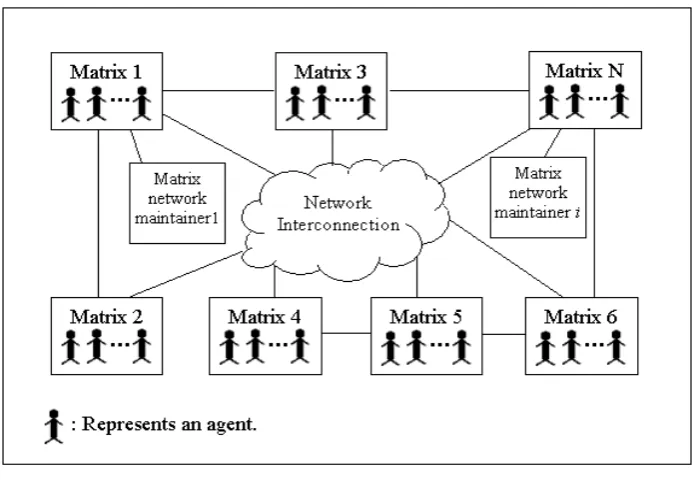
The thesis explores the detailed design of the AOCD framework and the major components employed in this framework including the Matrix, agents, and the unified Matrices structure. The proposed framework is able to enhance the system reusability and maximize the system performance. By using a set of interoperable autonomous agents, more creative decision-making can be accomplished in comparison with a hard-coded programmed approach.
In this research, we systematically classified the agent network topologies, and developed an experimental program to evaluate the system performance based on three different agent network topologies. The experimental results present the evidence that the hybrid topology is efficient in the AOCD framework design. Furthermore, a novel topological description language for agent networks (TDLA) has been introduced in this research work, which provides an efficient mechanism for agents to perceive the information about their interconnected network.
PUBLICATIONS
Refereed Journal Articles:
1. Zhang, H.L., Leung, C.H.C. and Raikundalia, G.K. (2008) “Topological Analysis of Agent Networks and Experimental Results based on the AOCD Architecture”, Journal of Computer and System Sciences, Vol. 74, No. 2, pp. 255 – 278, Elsevier Publication.
2. Zhang, H.L., Leung, C.H.C. and Raikundalia, G.K. (2006) “Matrix-Agent Framework: A Virtual Platform for Multi-agents”, Journal of System Sciences and Systems Engineering, Vol. 15, No. 4, pp. 436 - 456, Springer-Verlag Press.
3. Raikundalia, G.K. and Zhang, H.L. (2006) “Document-related Awareness Elements in Synchronous Collaborative Authoring”, Australian Journal of Intelligent Information Processing Systems, Vol. 9, No. 2, pp. 41 – 48.
Submitted Journal Articles:
4. Zhang, H.L., Leung, C.H.C., Zhang, Y., and Raikundalia, G.K. “A New Agent-Rank Algorithm for Agent Matching”, Submitted to IEEE Transactions on Systems, Man, and Cybernetics-Part A. 5. Zhang, H.L., Leung, C.H.C., and Raikundalia, G.K. “Application of Multi-agent Technology to
Information System: An Agent-based Design Architecture for Decision Support Systems”, Submitted to AJIS (in December 2006).
Refereed Conference and Workshop Papers:
6. Zhang, H.L., Leung, C.H.C. and Raikundalia, G.K. (2007) “Performance Evaluation of Agent Network Topologies Based on the AOCD Architecture”, Proc. of 21st International Conference on Advanced Information Networking and Applications Workshops (AINAW), Canada, pp. 605 – 610, IEEE CS Press.
7. Zhang, H.L., Leung, C.H.C. and Raikundalia, G.K. (2006) “Classification of Intelligent Agent Network Topologies and A New Topological Description Language for Agent Networks”, in: IFIP International Federation for Information Processing, Volume 228, Intelligent Information Processing III, Shi Z., Shimoharar K., Feng D. (eds.), Australia, pp. 21–31, Springer-Verlag Press.
8. Zhang, H.L., Leung, C.H.C. and Raikundalia, G.K. (2006) “Towards the Matrix Concept: A Virtual Platform for Intelligent Agent Application in Decision Support Systems”. Proc. of The 7th International Symposium on Knowledge and Systems Science, Beijing, China, pp. 115 – 122, Lecture Notes in Decision Sciences 8.
9. Zhang, H.L., Leung, C.H.C. and Raikundalia, G. K. (2006) “Performance Analysis of Network Topology in Agent-based Open Connectivity Architecture for DSS”, Proc. of 20th International Conference on Advanced Information Networking and Applications (AINA), Austria, Vol.2, pp. 257-261, IEEE CS Press.
10. Zhang, H.L., Leung, C.H.C. and Raikundalia, G. K. (2005) “AOCD: A Multi-agent Based Open Architecture for Decision Support Systems”, Proc. of International Conference on Computational Intelligence for Modelling, Control & Automation, Vienna, Austria, Vol. 2, pp. 295-300, IEEE CS Press.
Refereed Technical Reports:
TABLE OF CONTENTS
DECLARATION ………..…
ii
ACKNOWLEDGEMENTS ………. iii
ABSTRACT ……….
iv
PUBLICATIONS ……….………
vi
LIST OF FIGURES ………..
xi
LIST OF TABLES ………...
xv
CHAPTER 1. INTRODUCTION ………..…….. 1
1.1Problem Description and Motivation ………..… 2
1.1.1 Problems in traditional DSSs ………..… 3
1.1.2 Problems in current agent-based DSSs ………..…. 4
1.1.3 Motivations ……….
5
1.2Thesis Contributions ………..…. 6
1.2.1 Thesis Contributions ………... 6
1.2.2 Research Methodologies ……….… 7
1.3Thesis Outline ………. 8
2. LITERATURE REVIEW ………...
10
2.1Introduction ………..…. 10
2.2Development of Traditional DSSs and Agent-based DSSs ……….. 11
2.3Current Agent-based DSS ………. 13
2.3.1 Middle-Agent-based DSS ……….
14
2.3.2 Decentralised Agent-based DSS ……….…..
17
2.3.3 Web-based Intelligent DSS Utilising Agents ………...
20
2.4The Agent Society Concept and its Evolution ………..……… 22
2.5Agent Communication and Cooperation Design Methodologies ………….. 23
2.5.1 Agent Communication Language ……….. 24
2.5.2 Agent-Matching Methodologies ……….... 26
2.5.3 Agent Capability Description ………....
28
3. THE AOCD ARCHITECTURE ………. 33
3.1AOCD-based DSSs Vs Traditional DSSs ………. 33
3.2Components in the AOCD Framework ………. 36
3.3The Matrix Concept ………..
39
3.4The AOCD Framework: A hybrid network ………..
40
3.5A Case Study: Agent-Technology- A Solution to Modern DSS …………... 42
3.6Summary ………...
47
4. MATRIX DESIGN AND THE UNIFIED MATRICES STRUCTURE ………
48
4.1Matrix Structural Design ………..
49
4.1.1 Four-Layer Structure of the Matrix ………..
50
4.1.2 Matrix Control Panel ……….…... 54
4.1.3 Matrix Register ………. 56
4.1.4 The DSC Usage Centre and the Matrix Learning Centre ………….
57
4.1.5 Interfaces Between the Matrix and Agents ………... 67
4.2A Unified Matrices Structure for Matrices Cooperation ………... 68
4.2.1 An Overview of the Unified Matrices Structure ………... 69
4.2.2 Matrix Network Maintainer ………..
70
4.2.3 Matrix Searching Algorithm for Service-Provider Matrices ………
71
4.2.4 Super-node Model in the Matrices Cooperation ………..
75
4.2.5 Security Control in the Agent-Matrix Link Layer ……… 77
4.3Matrix Development Life Cycle ………... 78
4.4Summary ………... 79
5. AGENT DESIGN METHODOLOGIES ………
80
5.1Introduction ……….. 80
5.2Agent Architectural Design ………..
81
5.2.1 Agent Pattern Design in AOCD ………
83
5.2.2 The Domain Specific Component Design for Agents ………... 85
5.2.3 BDI Model in AOCD ………
87
5.2.4 Agent Mobility and Travel Control Centre (TCC) ……… 91
5.2.5 Agent Interface Design in AOCD ……….
94
5.3Agent Communication Methodologies ……….
95
5.3.1 AOCD Agent Communication Language ……….
96
5.4.2 A Top-down Tree for Classifying Agent Capabilities in AOCD … 107
5.4.3 Agent Roles in Agent Capability Descriptions ……… 108
5.5AOCD Agent Development Life Cycle ……….. 108
5.6Summary ……….…
111
6. AGENT MATCHING MECHANISMS ………... 113
6.1Background Review of Agent-Matching Methodologies ………...
113
6.2Agent-Matching Methodologies in AOCD ……….
116
6.3Part I: General-Ranking Algorithm in AR ……….. 117
6.3.1 Factors in the General-Ranking Process ……….
118
6.3.2 Composition of General Ranking ……… 121
6.4Part II: Request-Based-Ranking Process in AR ………..
122
6.4.1 Agent Capability Description Tree ……….. 124
6.4.2 RBR Similarity Calculation ………. 125
6.5Summary ……….
129
7. THEORETICAL ANALYSIS OF AGENT NETWORK TOPOLOGIES …...
131
7.1Background Review and Related Works ………. 132
7.1.1 Motivations ……….…. 132
7.1.2 Traditional Network Topological Theory ………...
134
7.1.3 Complex Agent Network Topological Theory ………...
135
7.2Classification of Agent Network Topologies ……….….
136
7.2.1 Simple Agent Network Topologies ……….
136
7.2.2 Complex Agent Network Topologies ……….. 142
7.2.3 Hybrid Agent Network Topologies ……….
146
7.2.4 Topological Description Language for Agent Networks …………
148
7.3Theoretical Analysis Based On Three Agent Network Topologies ……… 150
7.3.1 Analysis of Centralised Agent Network Topology …………..….. 151
7.3.2 Analysis of Decentralised Agent Network Topology ……….
153
7.3.3 Analysis of Hybrid Agent Network Topology ……….... 156
7.3.4 Overall Performance Analysis ………
158
7.4Summary ……….… 160
8. EXPERIMENTAL EVALUATION ………..……….…….. 162
8.1.2 Functionalities and Configurations of the Program……….... 165
8.1.3 Design Methodologies of the Experimental Program …………...
168
8.1.4 Experimental Results Based On the Program ……….…
171
8.2Experimental Computation of Agent-Rank Algorithm ………... 185
8.2.1 Results and Examples of the General Ranking Calculation ……… 185
8.2.2 Results and Examples of the RBR Calculation ………..….
188
8.2.3 Discussion ………...
195
8.3Summary ……….
196
9. CONCLUSIONS ………... 198
9.1Summary of Contributions .……….
198
9.2Discussion and Future Work …..……….
201
9.2.1 Discussion ………...
201
9.2.2 Future Work ………
202
LIST OF FIGURES
Figure Page
1.1 A Schematic View of Traditional DSSs ……….
3
2.1 General Framework of Agent-Based Hybrid Intelligent Systems …….
15
2.2 MASST framework for Stock-Trading DSS ……….. 16
2.3 Distributed DSS architecture ……….. 18
2.4 A Decentralised Multi-agent Traffic Control Architecture ………
18
2.5 The Open DSS Model Based On the Agent Grid ……….……..
19
2.6 System Framework of FWDSSG ……… 21
2.7 An Agent Federation ………...
23
2.8 Examples of KQML Messages ……… 25
2.9 A General Model of an InfoSleuth Application ……….. 27
2.10 Structure of LARKS ……… 29
2.11 Three Types of Knowledge Components and Their Main Features …… 30
2.12 JADE Agent Platform Distributed Over Several Containers …………..
31
2.13 Graphical Interfaces of JADE Tools ………...
31
3.1 A Conceptual View of the Matrix-agent Connection Structure ……….. 34
3.2 A Unified Matrices Structure ……….. 37
3.3 Updating an AOCD Agent’s Knowledge Base ………... 38
3.4 Average Processing Time Comparison ………...
41
3.5 Success Rate Comparison ………...
41
3.6 Two Companies’ AOCD-based Information Systems ………
44
3.7 New Company’s Information System (after merger) ……….
45
4.1 Conceptual View of Matrix ………
49
4.2 Four Layers in the Matrix Design ……….. 51
4.3 GUI Design for the External Cooperation Layer ………... 51
4.4 GUI Design for the Agent-Matrix Link Layer ………... 52
4.5 GUI Design for the DSC Usage Layer ………... 53
4.6 Matrix Control Panel Design ……….. 54
4.10 Dynamic Alteration Process ……….…... 62
4.11 Information Updating Process of the Matrix Learning Centre ………… 66
4.12 Agent Interface Allocation Process ……….. 67
4.13 A Schematic Diagram of the Matrix Network Maintainer Design …….. 70
4.14 Working Process of the Matrix Network Maintainer ……….. 71
4.15 Intersections of Matrices’ Capabilities ………
73
4.16 An Example Super-node-based Network ………
76
4.17 A Super-node Model in the Unified Matrices Structure ……….
76
5.1 General Agent Pattern Design based on AOCD ………. 84
5.2 DSC Slot Design ………. 85
5.3 Functionality Similarity Calculation ………... 86
5.4 BDI Model in AOCD Agent Design ………... 89
5.5 Mobile Agent Travelling in an Agent Network ……….
92
5.6 Agent-agent Interface Design ……….. 95
5.7 FIPA ACL Structure ……… 97
5.8 A Schematic View of the TCC Structure ……… 99
5.9 FIFO Principle in Itinerary Set in TCC ………... 100
5.10 Agent Network Diagram based on IAD, MAD, and OAD ………. 103
5.11 Destination Section Message After Completing One Round Travel ….. 104
5.12 Structure of the Multi-level Agent Capability Descriptions …………... 105
5.13 An Example of A Top-down Folding Tree ………. 107
5.14 Agent Life Cycle in Agent Society ……….. 109
5.15 Agent Life-cycle Defined by FIPA ………. 109
6.1 An Agent Association Graph ……….. 118
6.2 An RBR Semantic Extension Tree ……….. 122
6.3 Generating A Semantic Extension Tree ……….. 122
6.4 An Example of A Top-down Folding Tree ………. 124
7.1 Centralized Topology ……….. 137
7.2 Peer-to-peer Agent Network Topology ………... 138
7.3 Broadcasting Topology ………...
139
7.4 Closed-Loop Topology ………...
140
7.7 Overview of Three Complex Network Topologies ………. 144
7.8 Two Typical Hybrid Agent Network Topologies ………...
147
7.9 IAD for Individual Agent ……… 148
7.10 MAD for A Main Agent Group ……….. 149
7.11 OAD for Overall Agent Network ……… 150
7.12 Centralised Transmission Framework ………. 151
7.13 Waiting Time in A Queue ………... 152
7.14 Decentralised Transmission Framework ………. 154
7.15 Hybrid Transmission Framework ……….... 156
7.16 Total Transmission Time for The Three Topologies ………... 158
7.17 Total Waiting Time for The Three Topologies ……….... 159
8.1 The Main Interface of the AOCD Topological Experiments …………... 163
8.2 Delivering Agent Requests to Matrix ………... 164
8.3 Completion of Agent Matching Process ………...
165
8.4 Control Commander ……….. 166
8.5 Terminating Matching Process ……….. 167
8.6 Progress Indicator ………. 167
8.7 Program Structure of the AOCD Topological Experiments ……… 168
8.8 Comparisons of the Time Consumption in Hybrid and Centralised Topologies with Different Experimental Parameters ………... 172
8.9 Average Processing Time Affected by Success Rate in Hybrid Agent Networks ……… 173
8.10 Processing Time Affected by Request Number in Hybrid Agent Networks ……… 173
8.11 Processed Request Number and Success Rate in Hybrid Agent Networks ……… 174
8.12 Average Processing Time Affected by Success Rate in Centralised Networks ………...
175
8.13 Processing Time Affected by Request Number in Centralised Agent Networks ………. 176
8.14 Processing Time for Centralised and Hybrid Agent Networks ………….
177
8.15 Impact of Deadlock Parameter on Processing Time ………. 179
8.18 Relationship Between Success Rates and (PRV/PAN) in Hybrid
Topologies (Deadlock = 2) ……… 181
8.19 Relationship Between the Matrix’s Capacity and the Average Requests Processing Time ……….
181
8.20 Impact of the Matrix Capacity on the Average Success Rate …………... 182
8.21 Processing Time Affected by Request Volume in Centralised Topologies (DP = 2, MC = 3) ………... 183
8.22 Processing Time Affected by Request Volume in Centralised Topologies (DP = 2, MC = 5) ………... 183
8.23 Processing Time Affected by Request Volume in Hybrid Topologies (DP = 2, MC = 3) ………... 184
8.24 Processing Time Affected by Request Volume in Hybrid Topologies (DP = 2, MC = 5) ………... 184
8.25 A Case-based Agent Association Graph ………... 185
8.26 50 Loops of General Ranking Calculations ……….. 187
8.27 A Quasigroup Form of AAG ……….
187
8.28 An RBR Semantic Extension Tree From R-A ……….. 188
8.29 Agent Capability Description Tree of P-agent Candidate A1 …………... 190
8.30 Agent Capability Description Tree of P-agent Candidate A2 …………... 190
8.31 Agent Capability Description Tree of P-agent Candidate A6 …………... 191
8.32 Agent Capability Description Tree of P-agent Candidate A7 …………... 191
8.33 The GUI of the Computation Program for the General-ranking Calculation ……… 192
8.34 The GUI of the Computation Program for the RBR Calculation ………..
192
8.35 RBR Similarity Calculation Scores in Different Levels Between R-A Semantic Tree and P-agent A1 Tree ……….……..
193
8.36 RBR Similarity Calculation Scores in Different Levels Between R-A Semantic Tree and P-agent A2 Tree ………...
193
8.37 RBR Similarity Calculation Scores in Different Levels Between R-A Semantic Tree and P-agent A6 Tree ………..
194
LIST OF TABLES
Table Page
2.1 Brief Review of DSS Development History ……….
12
2.2 Major Agent Software Tools ……….
30
3.1 Comparison Between Traditional DSS and AOCD-based DSS …………
35
3.2 Comparison Between AOCD-based DSS and Other Agent-based DSS ...
35
3.3 The Core Components in the AOCD framework ……….. 36
4.1 An Example of the Matrix Register ………... 57
4.2 Matrix Capability Descriptions ……….
72
5.1 Detailed Process of Transferring An Agent in AOCD ………..
94
5.2 FIPA ACL Message Parameters ………
97
5.3 Agent Capability Description Language in AOCD ………... 106
5.4 AOCD Agent Development Life Cycle ………. 111
6.1 RBR Similarity Values for Set A and B ……… 128
7.1 IAD Routing Table ……… 149
7.2 Total Waiting Time for Processing 4 Requests (worst case) ………. 155
8.1 Results of 600 Sets of the AOCD topological Experiments ………...…... 184
8.2 The Example Values of the P-agents in An AAG ………. 185
8.3 Final General Ranking Scores of the Example ……….. 186
8.4 Similarity Relationships Used in the RBR Calculations ………... 188
CHAPTER 1
INTRODUCTION
Making decisions in the current dynamic environment is complicated and indefinite because of various unpredictable factors and large volumes of information. A solely human-based decision-making process is exceedingly insufficient in terms of computational capability, analytical accuracy, and memory capacity. Therefore, it has become a key issue for modern organisations to have efficient systems and tools to support rational decision-making in problem-solving processes, particularly, for problems with a lack of predefined structure.
A Decision Support System (DSS) provides information and data manipulation
tools to help make decisions in semi-structured and unstructured situations [3]; it is particularly efficient for dealing with complex problems. Existing DSS applications have been extensively applied to various areas, such as financial analysis, medical diagnosis, military, water resource planning, etc. Unfortunately, there is an obvious trend of a continuous decline of the DSS applications in practice [8, 27, 145], and it motivates a paradigm shift for DSSs [27, 145]. Various problems restrain the development of DSSs, which include: the lack of a standardised structure that allows various DSS applications to cooperate and communicate efficiently, and the lack of an active and intelligent methodology to support decision making in complex situation [27]. Researchers in the DSS area have realised the current situation and suggested several technologies, such as intelligent agents, to tackle existing problems.
Intelligent agents are an emerging technology in DSSs, which have been recognised as a flexible and efficient methodology to facilitate the development of DSSs [6, 145]. In this thesis, the term ‘agent’ refers to ‘intelligent agent’, which is described in [98] as: “autonomous agents are computational systems that inhabit some complex dynamic environment, sense and act autonomously in this environment, and by doing so realise a set of goals or tasks for which they are designed.”
benefits assure the underlying success of applying the agent technology to complex and distributed systems, i.e. DSSs.
The advantages of applying agents in the DSS field have been discussed in numerous literature studies [6, 24, 40, 145, 160], which basically can be summarised as: improving system intelligence (reasoning capabilities), enhancing connectivity and compatibility, improving flexibility and expandability, transforming a DSS from a passive tool to an active collaborator in decision-making, improving the capability of solving complex problems through agent cooperation, and etc. Meanwhile, various agent-based DSS applications have been developed [97, 114]. However, most of the current agent-based DSS applications have several vital limitations, such as the lack of standardisation, the lack of reusability and manageability, and the lack of efficient self-upgrading mechanisms for agents (see Chapter 2, Section 2.3).
This thesis aims to provide a novel agent-based framework for DSSs based on the analysis of the major problems in existing DSSs (see Section 1.1). The proposed
multi-agent-based framework, namely the Agent-based Open Connectivity for DSS
(AOCD) framework, provides an open, efficient, and flexible architecture for DSSs.
The AOCD framework design is based on existing agent-based DSS applications and mainly focuses on building an open and efficient framework for DSS applications. The AOCD framework overcomes the compatibility and connectivity problems in most traditional DSS applications, and provides a ‘living environment’ for agents, an issue which most existing agent-based DSS applications have not addressed. This living environment is provided by the Matrix, which allows agents to acquire information, self-upgrade, perform tasks, travel to other Matrices, and be reused. The AOCD framework offers several key features, such as the hybrid network structure, the Matrix design, the unified Matrices framework, agent self-upgrading mechanisms, etc., which could facilitate the development of agent technology in DSS applications.
The next section provides an analysis of the major problems in existing DSSs and clarifies the motivations of this thesis.
1.1.
Problem Description and Motivation
1.1.1 Problems in traditional DSSs
During the past decade, the successful applications of information systems in business processes have declined because of various obstacles. A survey provided by the Standish Group [142] shows that in U.S.A, 23% information systems failed outright and 49% systems were late and (or) went over-budget. Similar cases were also found, not only in U.S.A but also in U.K and other countries. Among the various obstacles, Alter [3] summarizes five major obstacles when developing an information system (especially a DSS) in the real world, which include:
(1) “Unrealistic expectations and techno-hype”;
(2) “Difficulty building and modifying IT-Based Systems”;
(3) “Difficulty integrating IT-based systems”;
(4) “Organisational inertia and problems of change”;
(5) “Genuine difficulty anticipating what will happen”.
Figure 1.1. A Schematic View of Traditional DSSs [144].
We find that most of these obstacles are caused by the structural problems in current information systems, particularly in DSSs. Figure 1.1 shows a schematic view of traditional DSSs. This figure shows that the system structures of traditional DSSs are closed and that causes various problems, such as lack of compatibility, lack of adaptability, lack of expandability, cost ineffectiveness in System Development Life
Other
computer-based systems Internet, intranets, extranets
Manager (user) Organizational KB
Data
management management Model External models
Knowledge-based subsystems
User interface Data: external
Cycle (SDLC), etc. The so-called closed structure is the typical structure that does not provide flexible integration process, such as plug-and-play, for external components. Oppositely, an open structure for DSS supports the plug-and-play integration process.
A recent research survey [9] indicates that there is a widening gap between DSS research and practice. Several researchers have been focusing on identifying the causes of this problem, which is motivating a paradigm shift for DSSs [9, 14, 42]. Based on the previous findings, we discovered an important factor that separates DSS research from practice, that is: the lack of a standardised and compatible structure for various DSS applications. This limitation causes the difficulties in finding an efficient method to evaluate the feasibility, efficiency, and accuracy among various DSS applications. Many efficient DSS design methodologies cannot be recognised in other design frameworks because of their incompatible design structures. Much existing DSS research suffers from this limitation, which affects numerous effective functional designs being extensively applied to various DSS applications.
The discipline coherence problem indicated in the same survey further reflects the above limitation. The survey shows that DSSs have marked disconnects between important sub-fields, such as group support system, intelligent DSS, and data warehousing [9]. Various DSS sub-fields have been established in the past three decades, however there is no such an open and standardised method to easily connect these sub-fields.
In these circumstances, agent technology is suggested as a desirable method to fulfil the demands for a paradigm shift for DSSs. Agent technology can be applied to existing systems in order to transform a DSS into an open system. Multi-agent technology is a superior solution that can enhance a system’s connectivity, extensibility, reusability, and manageability. The reasons for the success of multi-agent application in DSS are the features of an intelligent multi-agent, which are: goal-oriented, collaborative, flexible, self-starting, intelligent, mobile, and interactive (see Chapter 3, Section 3.1; and Chapter 5, Section 5.1).
1.1.2 Problems in current agent-based DSSs
methodology for building Belief-Desire-Intention (BDI) based distributed agent systems has been introduced in [116]. However, these systems require highly efficient concurrent control and synchronous communication mechanisms.
Unfortunately, current agent-based DSSs are not efficient enough, particularly, when they deal with large volumes of transactions because most of these systems are based on decentralised structures. Many decentralised multi-agent systems suffer from inefficient manageability [105], particularly, with respect to the difficulties of handling concurrent control and synchronous communication problems. The detailed analysis of agent network topological performances can be found in Chapters 7 and 8.
Moreover, existing agent-based DSSs tend to focus on individual agent or agent group design, such as agent-facilitator-based structure or agent-mediator-based structure. They often neglect the design of the supporting environment for agents or agent groups. This limitation causes the difficulties of agent self-upgrade and agent coordination in many existing DSS applications because a single agent has limited capabilities for acquiring information from a dynamic environment. In other words, an agent-based DSS application is not likely to be efficient in adapting to the dynamic world without offering an open and comprehensive framework for managing and coordinating agents. Therefore, creating an efficient environment to support agents’ activities, which include agent cooperation, agent matching, agent upgrade, etc., is the key to an agent-based DSS.
In brief, the major problems exist in current DSSs can be basically summarised as:
(a) The lack of system connectivity (particularly for traditional DSSs);
(b) The lack of a uniform design methodology;
(c) The lack of efficient system manageability;
(d) The lack of a competent supporting environment for agents to perform
activities such as self-upgrading, reuse, etc.
1.1.3 Motivations
Based on the above problems in existing DSSs, we summarise the major issues that motivate this research as follows:
(a) The requirement for an open and compatible framework for DSSs;
(b) The requirement for the standardisation of DSS developments;
(c) The requirement for intelligent and active DSSs [6, 85];
The next section further explains how this research contributes to fulfil the above motivations.
1.2.
Thesis Contributions and Research Methodologies
1.2.1. Thesis Contributions
The proposed AOCD framework aims to tackle the major problems described in the previous section. The major contributions of this thesis are:
¾ This thesis suggests an open framework for DSSs, i.e. the AOCD framework,
based on a Matrix-agent connection design (see Chapters 3 and 4). The use of Matrix-agent connection design in DSS applications could simplify current intelligent agent development procedures and improve the connectivity of a multi-agent system through adopting the plug-and-play design principle.
¾ An AOCD-based system solves a complex problem in an active and intelligent
way through deploying a number of agents (see Chapters 3, 4, 5). Each AOCD-based agent is able to actively seek the cooperation from other agents when it has difficulties in solving a problem. Thus, more creative and innovative decisions can be produced as a result of such cooperation and interaction.
¾ The novel Matrix concept proposed in this research provides a standardised
environment that allows various service-provider agents to be integrated into an AOCD-based system efficiently (see Chapters 3, 4). The Matrix design is standardised so as to allow external agents to be used in any Matrices in various organisations. This design is able to accelerate the standardisation process for various DSS applications. This research suggests a living environment for agents (see Chapters 4, 5). The Matrix plays an essential role in providing agents with a living environment. The Matrix not only acts as an agent facilitator or mediator that mainly deals with agent coordination, but also incorporates agents into its virtual space in which agents can obtain information, self-upgrade, and be reused.
¾ In this research study, a set of agent network topological experiments have been
network topology for a multi-agent system is essential to the success of system design. The hybrid topology adopted in the AOCD framework improves the system manageability and expandability through combining the centralised and decentralised topologies. Current work on agent network topologies is insufficient, which brings this part of work into prominence.
¾ Several new research mechanisms have been suggested in this thesis including the
agent-rank algorithm (see Chapters 6, 8) and the topological description language for agent networks (see Chapters 5, 7). The agent-rank algorithm provides efficient methodology to match a requesting agent amongst numerous service-provider agents. The novel topological description language for agent networks enables an individual agent to perceive the structural information about the network that the agent resides in.
1.2.2. Research Methodologies
To achieve the research objectives, various research mechanisms have been performed and applied to this project. Basically, this research project consists of five major stages, which are listed as follows:
¾ The first stage includes the problem analysis and literature review. In this stage,
the research problems were identified and an extensive review of relevant literature was conducted.
¾ The second stage mainly focuses on the infrastructure design of the AOCD
framework, which includes the analysis of agent network topologies, the evaluation of the agent network topological experimental results, and the design of the Matrix-agent connection. The performance analysis of various agent networks based on different topologies has been carried out in this stage. This analysis helps to conduct the comparison among the common agent network topologies, which enables the system designers to adopt an appropriate agent network topology for their agent framework. Based on the performance analysis, we developed an agent-topology-based experimental program to further evaluate the previous analysis. The design methodologies adopted in this stage underlie the principles of designing the backbone of the AOCD framework.
¾ The third stage involves the development of the Matrix and the unified Matrices
control panel design, and the reuse centre design. The unified Matrices structure further extends the AOCD framework, which allows various Matrices to work cooperatively. The Matrix design methodologies emphasise the development of an open environment for agents.
¾ The fourth stage provides the detailed agent design for the AOCD framework,
which includes the agent architectural design, agent interface design, agent communication language, and agent development life cycle. The agent design mechanisms are based on previous research studies and tailored for the AOCD framework, especially for the Matrix-agent connection.
¾ The last stage focuses on the agent cooperation in the AOCD framework. An
AOCD-based agent might constantly seek for an appropriate corresponding agent, thus an efficient agent matching mechanism is vital to the success of the AOCD framework. A novel agent-rank algorithm is developed for agent matching within the AOCD framework. Based on this algorithm, we developed a computational program to evaluate the final ranking results.
In brief, the AOCD framework is based on the research methodologies described in these five stages. Each stage has a high degree of independency but also interrelated with the other stages.
1.3.
Thesis Outline
This thesis consists of nine chapters. Following this chapter, Chapter 2, Literature
Review, reviews the previous studies on traditional DSSs and existing agent-based
DSSs. A brief introduction on the DSS development history and the future direction for DSSs are provided. An extensive study on existing agent-based DSSs has been conducted and the limitations of these DSSs have been analysed.
Chapter 3, Basic Structure of the AOCD Framework, clarifies the basic concept of
the AOCD framework and its major components. The Matrix and unified Matrices concepts are explained. The AOCD network structure is analysed based on the AOCD-based topological experiments. A case study is also provided in this chapter to further explain the efficiency of the AOCD framework.
Chapter 4, Matrix Design and the Unified Matrices Systems, describes the detailed
unified Matrices structure suggested in Chapter 4 allows various Matrices to work cooperatively. A novel searching algorithm and the super-node structure are deployed in this structure in order to improve the cooperation and coordination efficiency among numerous Matrices.
Chapter 5, Agent Design Methodologies, presents the detailed design of the
AOCD-based agents, including the agent architectural design, agent communication methodologies, agent capability descriptions, and the AOCD-based agent development life cycle. The AOCD-based agent design adopts previous agent design methodologies and specifically tailors them for the AOCD framework.
Chapter 6, Agent Matching Mechanisms, introduces the agent matching
mechanisms in the AOCD framework. An effective agent cooperation process is essential for the AOCD framework, thus the agent matching process is particularly important for the AOCD framework. A novel agent-rank algorithm is introduced to enhance the agent matching efficiency, especially in the AOCD framework. The two parts of the agent-rank algorithm are illustrated respectively.
Chapter 7, Agent Network Topologies and Theoretical Analysis, provides a
systematic analysis of agent network topologies. This is a major contribution of this thesis. Existing topological theories in the multi-agent area are inadequate. Therefore, the topological theories for agent networks are exceedingly important. This chapter classifies agent network topologies and analyses the performance of hybrid topology
in the AOCD framework. Furthermore, a novel Topological Description Language for
Agent networks (TDLA) is introduced in this chapter (the application of TDLA has
been described in Chapter 5). This novel language provides an agent with the information about how the agent network, where the agent resides in, is constructed. The use of TDLA allows agents to perceive the information on network structures before they travel to another site or search for a corresponding agent.
Chapter 8, Experimental Results Evaluation, illustrates the experimental results
based on the AOCD-based agent network topological experiments and the computational program for the agent-ranking algorithm. The experimental results evaluate the network performance of the AOCD framework, and demonstrate the agent-ranking scores according to a specific case.
Chapter 9, Conclusions, concludes the findings and contributions from this
CHAPTER 2
LITERATURE REVIEW
2.1.
Introduction
The traditional Decision Support System (DSS) presents a passive form of support that requires users to have good knowledge of how to use the relevant models, data sources, and other tools and take initiative to perform all necessary operations in a DSS effectively [148]. This problem plagues the development of DSS since its early
introduction by Gorry and Scott-Morton [65]. Moreover, many other limitations of
DSS also hold back its development in the real world (see Chapter 1 Section 1.1). The rising critiques of the inefficient performance of existing DSSs in the dynamic environment motivate a fundamental shift for DSS architecture design [6, 27].
The development of DSS has been through several stages, and a variety of DSS technologies have been applied extensively in many domains. From the earlier DSS software, such as Simscript and DENDRAL to current MicroStrategy and SAP BW, the research and development in DSS have made reasonable progress however future DSS are facing more complex problems, such as constant upgrade, unpredictable external factors, and frequent cooperation with external components. For example, a DSS application for stock market might need to constantly update its sub-functions.
2.2.
Development of Traditional DSSs and Agent-based DSSs
The history of computing programs for decision-making dates back to the early 1960s when various simulation packages, such as Simscript, were developed to solve the modelling problems.
The clear description of the term ‘Decision Support System’ was introduced by Gorry and Scott-Morton [65] in 1971. They described a DSS as “an interactive computer based system that helps decision makers utilize data and models to solve unstructured problems”. This definition is later improved by Alter [4] and Keen and Scott-Morton [86], who further expanded the DSS capabilities to solve semi-structured problems. A recent description of DSS has been given by Alter [3], which describes a DSS is “an interactive information system that provides information, models, data manipulation tools to help make decisions in semi-structured and unstructured situation where no one knows exactly how the decision should be made.”
The development of design and implementation technologies in DSS has come through different stages. According to Sen [129] during the period of 1980 to 1994, the Model Formulation System (MFS) architecture became one of the major DSS architectures. MFS architecture applies modelling techniques to integrate components into a DSS framework. In the early 1990s, AI’s control-oriented research led to the creation of the control-intensive MFS architecture. Such MFS architectures emphasize hierarchical and opportunistic control paradigms for model formulation [130]. Nevertheless, the MFS architecture focuses less on flexibility and intelligence. Apart from MFS, other novel architectures have been proposed in this period; for instance, Angehrn introduced the conversational framework for decision support, which is the basis of a new generation of active and intelligent decision support systems [6].
Several contributing disciplines in the DSS area have emerged since the 1990s [41]. These emerging areas include: MCDSS (Multiple Criteria Decision Support Systems), GDSS (Group Decision Support Systems), Web-based DSS, and intelligent-agent-based DSS. On-Line Analytical Processing (OLAP) is one of the most popular technologies in the DSS area since 1995. The data warehouse and data mining technologies are essential in many OLAP-based applications. OLAP enables users to retrieve data from the data warehouse for decision-support purposes.
conceptual framework for a distributed artificial intelligence (AI) system is a typical shift from traditional DSS to AI-based DSS. The applications of agent technology in DSS have been rising gradually in these years especially in the multi-agent area. The idea of multi-agent decision support evolves from Hewitt’s actor [73] concept to the modern concept of agents. This modern concept integrates a collection of functionalities, achieved by the interplay of both knowledge about certain problem types and about the environment in which the agent operates. In 1993, Angehrn described a new DSS framework, which utilizes intelligent agents. This approach transforms a DSS into a decision-making arena in which users define and explore their problems under the continuous stimulus of agents [6]. In 1999, the term of ‘multi-agent decision support’ was suggested [32]. In 2003, the concept of decision station was introduced [147]. After that, the multi-agent decision support system in transportation management has been proposed and implemented [114]. Nowadays, more and more DSSs have implemented or are starting to use intelligent agents in their implementations. Recent technical trends show that future DSSs will become more active, intelligent, and open. Many researchers in the DSS area have realised the significance of implementing agents in DSSs. Based on previous studies on the DSS history [3, 129, 132], the following table lists a brief review of the DSS history.
Table 2.1. Brief Review of DSS Development History (Major mechanisms).
Year DSS Development Taxonomy Software/Applications
Pre-1960s Procedural-code-based algorithms Operations research, statistics,
and forecasting applications.
1960s Package concept for decision-making GPSS, Simscript
1970s DSS concept suggested DENDRAL, MYCIN, SABRE.
1980s Group DSS, Model Formulation System RTCAL, Decision conference,
GROUP DECISION AID.
1990s OLAP, data mining, Web-based DSS Sagent, SAP BW,
MicroStrategy.
2000 onwards Active DSS, Intelligent DSS,
Agent-based DSS
(Emerging market….)
major development of Group DSS occurred in the 1980s. This taxonomy indicates the major development period of each mechanism; however the boundaries between any two stages in Table 2.1 are not strictly divided.
In recent years, the term ‘Intelligent DSS’ has been suggested in much literature work [30, 67]. More and more researchers believe future DSSs need to become more intelligent, active, and open to adapt to the dynamic environment. The emergence of agent-based technologies makes the realization of becoming intelligent, active and open much easier in a DSS. Moreover, the agent-based technologies exhibit the high efficiency in tackling various DSS problems. Undoubtedly, the agent-based DSS research will become a major or dominating area for future DSS.
2.3.
Current Agent-based DSS
Existing multi-agent technology has been implemented extensively in different applications in business processes and information systems. Modern business systems such as DSSs are becoming large, open and distributed. Current computing platforms supporting modern business processes are no longer stand-alone systems, but have become tightly connected both with each other and their users [158]. Moreover, current information systems such as DSS, require constant system updates that demand very flexible and reusable system architecture. To become more efficient and effective in a complicated environment, the systems have to be more independent, flexible and intelligent. Agent-based systems provide those technologies that are urgently needed for modern business systems especially DSS.
Multi-agent research is an emerging interdisciplinary research area, which offers a
promising future for DSS.The idea of multi-agent decision support has evolved from
applications: for instance, a multi-agent-based DSS for transportation management proposed and implemented in [114]; a multi-agent-based DSS for medicine
management has been suggested in [31]; and Gadomski et al [57] develop an
intelligent DSS for emergency response, etc. Existing agent-based DSSs, such as the above applications, improve system performances compared with traditional DSS. However, we discovered several vital limitations of these systems based on various literature studies and Section 2.
First, most of the above multi-agent-based DSS systems implement either a centralized topology or a decentralized topology [174], which are not efficient and robust enough to handle various problems in the complex environment. On the contrary, the problem can be avoided in our proposed AOCD architecture through using a unique structure that allows both central control and peer-to-peer connection. This structure eliminates the problems of concurrent control and synchronous communication and also enhances the communication efficiency through peer-to-peer connections.
Secondly, existing agent-based DSS applications lack compatibility and reusability [9, 14, 42] since there is no universal design standard. The cooperation and communications between two existing agent-based DSS are not efficient as their design methodologies are various and often incompatible. Thus, AOCD deploys the Matrix as the coordinating component that also provides the virtual living space for agents, instead of continuously using agents to coordinate multi-agent systems [169].
Thirdly, existing agent-based DSS often neglect the supporting environment of agents or agent groups [169]. In these circumstances, most existing agent-based DSSs are unable to provide a fundamental solution to enhance the manageability, connectivity, extensibility, and transferability of a multi-agent system. Thus, the concept of Matrix was suggested [169]. The Matrix concept adopts the agent society concept that allows agents to communicate with their environment and go through their life cycle in their virtual space.
The following sub-sections review some of the major agent-based DSSs to further explain their design methodologies.
2.3.1 Middle-Agent-based DSS
responsible for the cooperation and coordination between agents. These middle agents are also known as coordinating agents or agent facilitators. This is an efficient model in terms of manageability and adaptability. The following two typical middle-agent-based DSSs illustrate the basic design methodologies of middle-agent-middle-agent-based DSS.
In [174], an agent-based framework is suggested for solving complex problems as shown in Figure 2.1. The ‘Decision Making Agent’ in this framework also called as ‘Problem Solving Agent’. In this framework, an agent can join the system through registering its information with the middle agent, or leave the system by removing the registration information from the middle agent [174]. This framework exhibits high manageability in coordinating multi-agents to solve problems. All the agents in this framework need to communicate with the middle agent when they request cooperation from other agents. The planning agent is responsible for generating work plans for the tasks received from the interface agent, which is originally sent by users. The planning agent delivers its work plan to the middle agent for organising problem-solving agents to resolve the request. Based on this framework, agents are able to provide predictive features for decision-making since planning agents and aggregation agents are efficient in combining various factors. In [174], a financial system has been developed to predict the interest rate through using fuzzy logic and genetic algorithms to combine various financial factors such as GNP, CPI, etc.
Figure 2.1. General Framework of Agent-Based Hybrid Intelligent Systems [174]. Main Problem Solver
Interface Agent
Planning Agent
Aggregation Agent
Intelligent Technique Agent 1
Middle
Agent
Domain Specific Ontology
Intelligent Technique Agent 2
Intelligent Technique Agent 3
Intelligent Technique
Agent 4
Problem Solving Agent 1
Problem Solving Agent n
However, there are several crucial limitations in the framework. First, the probability of causing overload in the middle agent is high since the communications between agents mainly rely on the middle agent. Second, the lack of direct communication between problem-solving agents will cause inefficiency in solving a complex problem since the middle agent is involved all the time and that increases the time delay. Finally, the absence of a translation component will limit the variety of agent communication capabilities in the system. Current agent communication languages are various; different applications might adopt different agent communication languages. The above framework does not include a translation function, which could imply further limits to implementing various agent communication languages in this framework.
Another typical middle-agent-based DSS is called MASST (Multi-Agent System for Stock Trading), which employs a middle-layer agent system based on a coordinator agent as shown in Figure 2.2 [97].
Figure 2.2. MASST Framework for Stock-Trading DSS [97].
communicate with some other agents. It is similar to partially linked peer-to-peer agent network construction. In the AOCD framework, the connections between agents or Matrix-agent are more powerful, which is due to the combination of the centralised connections and fully linked peer-to-peer connections. Third, both frameworks can communicate with external systems. In the MASST framework, the communication between two different systems is mainly through the Communication agent. Some domain agents also can communicate with the external environment through the Internet. In the AOCD framework, the communication between local and external systems is through three different ways including Matrix-Matrix, agent-agent, and Matrix-agent. The AOCD framework deploys a more flexible and efficient external communication mechanism, which allows each component in the framework to communicate with the external environment efficiently.
Overall, the MASST framework is efficient for solving predictable problems in a specific domain. However, this framework has certain limitations including inefficiency in cooperation with external systems, the overload problem in the coordinator agent, and the absence of a self-upgrade mechanism for the coordinator agent. In the AOCD framework, the Matrix can perform self-upgrade through directly acquire information from the external environment, but the coordinator agent in the MASST framework has no direct connection with any databases or the external environment.
2.3.2 Decentralised Agent-based DSS
Existing decentralised systems have been applied extensively in many areas, such as the online peer-to-peer file sharing applications [77, 124], decentralised DSSs [55], decentralised multi-agent systems [74], etc. However, the applications of the decentralised model in agent-based DSSs have not been widely accepted. In this section, we briefly review existing decentralised DSSs and discuss the limitations of the decentralised agent-based DSS that hinder its development.
Gachet et al [55] have suggested a decentralised structure for DSS. Gachet’s DSS
Figure 2.3. Distributed DSS architecture (Revised based on [55]).
A distributed decision support system is described as “a collection of services that are organised in a dynamic, self-managed, and self-healing federation of hard- and software entities working cooperatively for supporting the solutions of semi- structured problems involving the contributions of several actors, for improved decision-making” [55]. In this distributed DSS architecture, the DSS users in different locations can access an external DSS working environment through a network. A
working environment represents a node (or peer) able to communicate with other
nodes (that is, other working environments) in a federation.
Numerous agent-based decentralised DSS frameworks have been suggested in previous literature studies, such as a decentralised multi-agent architecture for traffic control [32] and the Agent Grid Based Open DSS (AGBODSS) framework [29].
The decentralised multi-agent architecture for traffic control allows peer-to-peer communication in the traffic control DSS as shown in Figure 2.4. The adoption of the decentralised modes of coordination in this framework enhances communication and cooperation efficiency in the multi-agent framework.
In this decentralised multi-agent framework, each agent is responsible for a specific problem area and is able to cooperate with other agents for efficient traffic arrangements. This framework allows peer-to-peer communication between agents.
The agents in the AGBODSS framework are distributed and allocated in different groups. The agent groups are supported by the agent grid services and other lower level grid services, see Figure 2.5.
Figure 2.5. The Open DSS Model Based On the Agent Grid [29].
A DSS application in this framework consists of heterogenous agents and each agent has certain capabilities to solve problem in a specific domain. This concept is similar to the AOCD framework, in which a group of agents are organised by a Matrix
DSS 1
Agent Agent Agent
Agent Grid
Agent Group X
DSS 2
Agent Agent Agent
Agent Agent Agent
Agent Group Y
Agent Agent Agent
Agent Grid Service
Naming Brokerage Logging Visualisation … ….
Service Grid
Decision Service E-Market
Register Query Administer Trade … ….
Service1 Service2 Service3
to form a DSS application. Notwithstanding the claims of efficiency of the AGBODSS framework, the framework is not mature enough to verify its performance, particularly with respect to the agent cooperation and communication issues.
The above decentralised-DSSs have certain advantages, such as efficient cooperation and communication, superior extensibility, and reliable fault-tolerance. However, most of the decentralised systems are struggling with a major problem that is: the inefficient manageability. There are many factors that affect the manageability
in a decentralised agent-based DSS including (i) the difficulty in concurrency controls,
(ii) the communication barrier between two agents (since heterogenous agents may
adopt different agent languages yet it is not feasible for every agent to carry a
translator that recognises all the possible agent languages), and (iii) the inefficiency in
searching and matching processes (most of the searching and matching processes are based on individual agents because there is no centralised information for searching or matching in decentralised systems). These factors cause numerous problems for most of the decentralised applications, and sometimes even lead a decentralised system to complete failure.
2.3.3 Web-based Intelligent DSS Utilising Agents
The tremendous Internet revolution changed people’s daily life and also inspires many new technologies, such as web-based intelligent DSSs.
The Web-based intelligent DSS applications, such as OLAP, spread quickly to many areas since the Internet has become one of the world’s largest networks. The
major advantages of developing web-based DSS can be summarised as follows: (i)
improve cooperation efficiency as it is easy to share information in Web-based
systems; (ii) improve development efficiency, it is easy to design and maintain a
Web-based system since many Web-based software packages are easy to use and the
re-coding processes are also simplified; (iii) increase implementation feasibility,
Web-based technologies offer abundance developing tools, such as Java, HTML, ActiveX,
ASP, etc, to support system implementations; and (iv) provide superior reusability, the
The advantages of utilising the agent technology in Web-based DSSs have been
discussed in the previous literature [94, 153], which include (i) enhancing autonomy;
improving system reliability (overcoming the vulnerability of Web security
technologies), (ii) improving intelligence in reasoning processes, and (iii)
modularising system structures through replacing sub-systems by agents.
Figure 2.6 shows the system structure of a Flexible Web-Based Decision Support System Generator Utilizing Software Agents (FWDSSG) [35]. This framework consists of heterogenous agents; each agent takes responsibilities for several specific tasks and interacts with the other agents through the coordination of an agent manager. The user requests the agent manager to execute the tasks and obtains the results back from the agent manager. The DSS component resources located in various web sites and possessed by a number of agents including model agent, data agent, solver agent, visualisation agent, and control agent. Thus, a complex problem can be tackled through cooperating these component agents.
Similar frameworks also can be found in [36] and [153]. The rising demands of agent technology in Web-based DSSs indicate this mechanism is becoming a promising direction for future DSS development. However, we argue that the design of utilizing agents in Web-based DSSs needs to overcome the major problems in order to become a mainstream design in the DSS area. Current Web-based DSSs have limited consistency and security. Moreover, most existing Web-based systems are insufficient to solve complex problems as the low performance of computation and communication in Web-based systems.
2.4.
The Agent Society Concept and its Evolution
Agent society concept has been suggested in previous works of literature [76, 78]. However, this concept is still preliminary and has not been given a unified definition. To clarify this concept, we begin with the process of problem solving.
In order to solve a complex problem, an agent often cooperates and coordinates with other agents within a multi-agent framework. Therefore, agents do not function alone, rather they exist in an environment where they can interact and cooperate with each other. In [75], an agent society is described as: the societal construct that provides a common domain through which agents can act and communicate. This phenomena is very similar to human society, thus the term ‘society’ has been brought into the multi-agent area. The society of agents can be regarded as the environment where a group of agents reside, and each agent with different roles has social dependency on this environment, i.e. agent society.
Agent societies have several characteristics, which are listed as follows. First, an agent society has strong social commitments, which are the commitments of an agent to another agent. Second, an agent society contains a set of constraints imposing on
the behaviours of agents, i.e. social laws. Thirdly, an agent society should be an open
environment to support heterogenous agents and provide them with various information sources. Heterogenous agents in this thesis represent AOCD-based agents that have similar structures but various capabilities.
intermediary. As shown in Figure 2.7, the white agent situated at the edge of each federate is the delegated intermediary.
Figure 2.7. An Agent Federation [75].
The Matrix concept extends the agent federation concept. Each Matrix is similar to an agent federate that contains a number of agents. The Matrix plays a role as a virtual space or a virtual platform to agents. The agent federation does not provide such capabilities; it simply groups a number of agents and employs an intermedia agent to coordinate. Agents in the Matrix form an agent community or society in which agents play different roles to solve different tasks. The agent society concept described by Huhns and Stephens [76] does not specify the living environment for agents. Existing research work has already started to develop some agent-based virtual world applications, such as [99]. Nevertheless, the existing work in this area is rather preliminary and has very limited impact on DSS. The use of Matrix-agent connection design in DSS applications could simplify current intelligent agent development procedures. This Matrix concept improves the openness of a multi-agent system through providing a standardized platform, which incorporates the plug-and-play design. The Matrix concept extends the agent society concept by developing some
concrete design methodologies and uses a core component, called a Matrix control
panel. The previous work on the Matrix design includes the AOCD framework design
[167], the Matrix control panel design [169] and the agent topological analysis of three agent topologies based on the Matrix-agent connection design [170].
2.5.
Agent Communication and Cooperation Design Methodologies
2.5.1. Agent Communication Language
Agent Communication Language (ACL) is expressly tailored to support the collaboration, negotiation, and information transfer required in agent interactions [28]. For the past decade, ACL has been one of the most important issues in multi-agent area. Since 1990, ACLs have been developed based on various standards. Some of the standards make major contributions to the development of ACL, which include Knowledge Query and Manipulation Language (KQML) and Foundation for Intelligent Physical Agents (FIPA) ACL.
As with many natural languages like English, the emergence of ACL is to support communications between entities. The significant difference between natural languages and ACLs is that natural languages support human communications, whereas ACLs support the communications between agents, and ACLs are more abstract. Differing from many communication mechanisms for exchanging information and knowledge, most ACLs have the following two characteristics [92]:
(i) ACLs handle propositions, rules, and actions;
(ii) An ACL message describes a desired state in a declarative language instead
of a procedure or method.
ACLs have many specific designs for agents; however we could not ignore the contributions of natural languages to the development of ACLs. All the existing ACLs inherit the basic concept of the semantic logic of natural language. For instance, most ACLs employ subject-predicate-object structure. The future research work in the ACL area still needs to refer to the development of natural language as a major design guideline.
The Knowledge Sharing Effort (KES), which was initiated circa 1990 by the Defense Advanced Research Projects Agency of the US Department of Defense, is often regarded as the origin of ACLs in several literature works [92, 93, 120]. The KSE model adopts a three-part relationship between: an agent, a content-bearing proposition (e.g. it is cloudy), and a finite set of propositional attitudes in an agent related to the proposition (e.g. believing, asserting, fearing, etc.). The KSE model consists of three layers of representation including: specifying propositional attitudes, specifying propositions, and specifying the ontology of those propositions [92].
![Figure 1.1. A Schematic View of Traditional DSSs [144].](https://thumb-us.123doks.com/thumbv2/123dok_us/8026970.1335449/18.595.101.481.355.627/figure-schematic-view-traditional-dsss.webp)
![Figure 2.1. General Framework of Agent-Based Hybrid Intelligent Systems [174].](https://thumb-us.123doks.com/thumbv2/123dok_us/8026970.1335449/30.595.88.504.475.701/figure-general-framework-agent-based-hybrid-intelligent-systems.webp)
![Figure 2.2. MASST Framework for Stock-Trading DSS [97].](https://thumb-us.123doks.com/thumbv2/123dok_us/8026970.1335449/31.595.121.478.363.649/figure-masst-framework-stock-trading-dss.webp)
![Figure 2.3. Distributed DSS architecture (Revised based on [55]).](https://thumb-us.123doks.com/thumbv2/123dok_us/8026970.1335449/33.595.193.414.503.746/figure-distributed-dss-architecture-revised-based.webp)
![Figure 2.5. The Open DSS Model Based On the Agent Grid [29].](https://thumb-us.123doks.com/thumbv2/123dok_us/8026970.1335449/34.595.133.437.352.669/figure-open-dss-model-based-agent-grid.webp)
![Figure 2.6. System Framework of FWDSSG [35].](https://thumb-us.123doks.com/thumbv2/123dok_us/8026970.1335449/36.595.93.516.357.681/figure-system-framework-of-fwdssg.webp)
![Figure 2.7. An Agent Federation [75].](https://thumb-us.123doks.com/thumbv2/123dok_us/8026970.1335449/38.595.219.400.121.213/figure-an-agent-federation.webp)
![Figure 2.9. A General Model of an InfoSleuth Application [110].](https://thumb-us.123doks.com/thumbv2/123dok_us/8026970.1335449/42.595.105.503.302.546/figure-general-model-infosleuth-application.webp)
![Figure 2.12. JADE Agent Platform Distributed Over Several Containers [12].](https://thumb-us.123doks.com/thumbv2/123dok_us/8026970.1335449/46.595.107.496.420.729/figure-jade-agent-platform-distributed-containers.webp)