http://www.scirp.org/journal/jmp ISSN Online: 2153-120X ISSN Print: 2153-1196
New Expansion Dynamics Applied to the
Planar Structures of Satellite Galaxies
and Space Structuration
Jacques Fleuret
Independent Researcher, Antony, France
Abstract
Recent observations of Dwarf Satellite Galaxies (DSG) show that they have a clear tendency to stay in particular planes. Explanations with standard physics remain controversial. Recently, I proposed a new explanation of the galactic flat rotation curves, introducing a new cosmic acceleration due to expansion. In this paper, I ap-ply this new acceleration to the dynamics of DSG’s (without dark matter). I show that this new acceleration implies planar structures for the DSG trajectories. More generally, it is shown that this acceleration produces a space structuration around any massive center. It remains a candidate to explain several cosmic observations without dark matter.
Keywords
Dwarf Satellite Galaxies, Dark Matter, Expansion, Flat Rotation Curves, Galaxies, Structure, Gravitation, Symmetry
1. Introduction
Dwarf Satellite Galaxies (DSG) have been discovered in the vicinity of Milky Way, M31 [1]-[7] and also near low redshift galaxies [8]. Recent observations have shown that these DSG and other globular clusters tend to stay in thin plane structures [5][9][10], which seem to be co-rotating with the host galaxy [11] [12]. Most of these are ortho-gonal to the galactic plane, but some have been found with different angles [11]. In any case, they are clearly not isotropically distributed, and correlations are widespread [11].
Several attempts have been made to explain these observations, introducing tidal ef-fects [11], past accretion processes [4][10][11] [12], etc. But for several others, these observations seem to be inconsistent with the expected distributions deduced from How to cite this paper: Fleuret, J. (2016)
New Expansion Dynamics Applied to the Planar Structures of Satellite Galaxies and Space Structuration. Journal of Modern Phy- sics, 7, 2357-2365.
http://dx.doi.org/10.4236/jmp.2016.716204
Received: November 15, 2016 Accepted: December 20, 2016 Published: December 23, 2016
Copyright © 2016 by author and Scientific Research Publishing Inc. This work is licensed under the Creative Commons Attribution International License (CC BY 4.0).
classical standard cosmological models [5] [9][13] [14] [15]. More precisely, the as-sumption of quasi spherical Dark Matter (DM) around galaxies implies the presence of hundreds of DSG’s which should be isotropically distributed around large galaxies. This is in conflict with observations. Other proposals have also been imagined, such as DM haloes, filaments or “superhighways” [11][16][17] to attempt to answer the question. But is-it not too ad-hoc to suppose linear DM structures having similar patterns than the observed patterns to be explained?
The problem has also been addressed without Dark Matter by the MOND theory [15].
I propose here a new attempt to provide a model without DM.
2. Method
In a recent paper [18], I have introduced a new Expansion Cosmic Acceleration (ECA) to explain the galactic flat rotation curves. This acceleration is proportional to the local expansion rate and to the velocity:
r v r
=
γ (1)
Then I showed [19] that this acceleration can be seen as a consequence of a rest-mass erosion theory, where space, time and mass are inter-dependent. It can also be consi-dered as a consequence of SEC theory [20][21].
In the present paper, acceleration (1) is supposed to be applied to dwarf galaxies of a given host-galaxy. Solving the dynamics equations with this additional acceleration will give the DSG trajectories. It will then be seen that they remain in co-rotating thin plane structures. Finally, space structuration will be shown to result from the fundamental consequence of the ECA hypothesis, and is no more due to assumed DM structures.
3. The Dynamics Equations
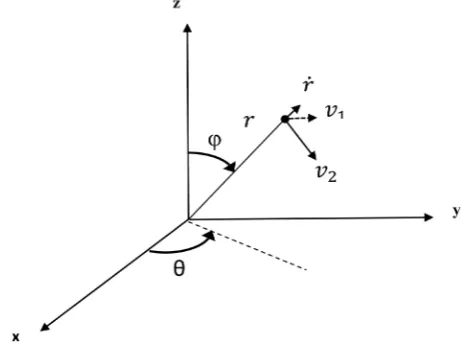
Let-us choose a classical 3D coordinate system, with the host (plane) galaxy centered in the x−y plane.
The velocity of a DSG located in r, ,
θ ϕ
is made of three components (Figure 1): -radial component: r-z-axial rotation:
1 sin
v =rθ ϕ (2)
-transverse rotation:
2
v =rϕ (3) Then the well-known 3D dynamics equations can be written, for a DSG submitted to both Newtonian gravitation and to the cosmic acceleration (1):
2
2 2 2
2
sin GM r
r r r
r r
ϕ
θ
ϕ
− − = − +
(4)
2
2r r r sin cos rr r
ϕ+ ϕ− θ ϕ ϕ= ϕ
(
)
,sin cos sin r sin
r r r r
r
θ ϕ+ θϕ ϕ+ θ ϕ = θ ϕ
(6)
The DSG is supposed to be far away from the center of the host galaxy and the total mass M, up to radius r, is approximately constant. Furthermore, attraction forces from other DSG’s are neglected here.
Obviously, the purely Newtonian equations (without the last terms in (4), (5) and (6)) lead to the classical elliptic orbits, with no reason to stay in single planar structures.
With the cosmic acceleration terms, Equations (5) and (6) can be rewritten as: 2
1
2 1 cos
tan
v v v
r
θ ϕ
ϕ
= =
(7)
1 2
1 2 cos
tan
v v
v v
r
θ
ϕ
ϕ
= − = −
(8)
We then observe that:
1 1 2 2 0
v v +v v = (9) Or equivalently:
2 2 2
1 2 0
v +v =v (10)
where v0 is constant.
Consequently, Equation (4) can be rewritten as:
2 2
0
GM
rr r v
r
− = −
(11)
This equation has the same form as the corresponding eq. for the trajectory of a star within the host galaxy plane, due to gravity and cosmic acceleration [18]. This “inside host-galaxy” case can be considered as a particular case of (11) when v2 =0 or
0 1
v =v = the flat rotation curve velocity.
[image:3.595.255.488.503.679.2]More generally, from (10), the two components of the constant velocity v0 depend on an angle
α
, such that:1 0cos
v =v α (12)
2 0sin
v =v α (13)
4. The DSG Trajectories
From (12), (13) and (2), (3):2 1 tan sin v v ϕ α θ ϕ
= = (14)
Then, derivating (13) and using the two Equations (7):
0cos cos tan v r
α
α θ
ϕ
ϕ
= =
(15)
The α ϕ− relationship can then be deduced from (12) and (3):
tan tan
ϕ
α
α
ϕ
= (16)
Whose integration leads to:
cosαsinϕ =C (17) where C is a constant ( 2
1
C ≤ ).
The
α
evolution can also be related to θ, from (15) and (17):(
)
2 2 1 1 cos C αθ ε ε
α
= = ±
−
(18)
Let us introduce a constant k such that:
2 2
1
k = −C (19) (18) can be integrated into:
sin
α ε
= ksinθ
(20) where the integration constant has been chosen in such a way that θ =0 corresponds to α =0.From (17) and (20), it is easy to obtain the
ϕ θ
− relationship:2
2 2 2 2
2
cos sin sin 1
sin
C k
α α θ
ϕ
+ = + = (21)
And, using (19), we get:
cos tan C
k
θ ϕ ε= (22)
Incidentally, we observe that not all angular values are valid. As an instance, we have:
0 π 0
ϕ ≤ ≤ −ϕ ϕ with sinϕ =0 C (23)
sin cos
x=r ϕ θ (24)
sin sin
y=r ϕ θ (25)
cos
z=r ϕ (26)
From (22), it can be immediately deduced: 0
kx−
ε
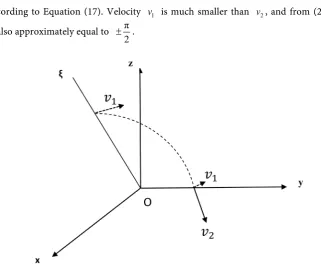
Cz= (27) Physically, Equation (27) means that the DSG’s stay in a plane, cutting the galaxy plane along Oy (Figure 2). Its apex lies in the xz plane, where θ α= =0, v2 =0,1 0
v =v is maximum, and ϕ ϕ= 0 is minimum (Equations (22)-(23)). When the DSG crosses the galaxy plane in Oy, v1=Cv0 is minimum, and v2=kv0 is maximum.
It results that any DSG must have its apex in the same plane (xz), and it must cross the galactic plane along the same line (Oy). All DSG trajectory planes must cut the ga-lactic plane in Oy.
In particular, two important cases can be considered, depending on the initial condi-tions:
1) C=1.
In this case, from (17), π 2
ϕ= and α =0. This describes the case of a star in the
galactic plane. Then, v2 =0 and v1 is the galactic flat rotation velocity. 2) C is small.
In this case, for a non-z coaxial trajectory (
ϕ
≠0), the angle α remains close to π 2 according to Equation (17). Velocity v1 is much smaller than v2, and from (20), θ is also approximately equal to π [image:5.595.205.527.397.661.2]2 ± .
Clearly, from (27), the DSG stays in a plane, which is quasi-perpendicular to the ga-lactic plane and intersects it along Oy.
An individual orbit is mainly driven by r and v2, but the small v1 velocity forces it to stay in a quasi-perpendicular plane to the host galaxy (Equation (27)).
Since v1 is much smaller than v2, the DSG will go thru the galactic plane. But the whole planar structure is seen to rotate with respect to the xy plane, with velocity v1, which is the galactic flat rotation velocity : the quasi-planar structure is co-rotating with the host galaxy.
Finally, the DSG orbit parameters r and ϕ can be deduced from (11), (3) and (17). As an instance, in the case:
2 2
0 2
GM
v v
r
≅ (28)
and if r
r
is supposed not to depend explicitly on time, Equation (11) can be written
as:
2 0 3
v
r r
r r r∂ ∂ = r
(29)
and integrated into:
0 0 0
Ch t
r v t
t
=
(30) (only valid for large r and large t, according to (28)).
Then, from (3) and (13):
0sin
v
r
α
ϕ= (31)
can be integrated, using Equations (17) and (19). In the simple case sin
α
≅1, we ob-tain :0
1 π
2 tan e 2
t t
ϕ≅ − −
(32)
which describes the falling motion of a DSG from
ϕ
=0 at time t=0 to π 2 ϕ= att= ∞.
More generally, Equation (27) describes a couple of planes, whose orientations de-pend on the C value.
To resume, there are several situations, depending on the initial ratio v v2 1. If v1 predominates, a spiral z-rotation will pull down the DSG into the host galactic plane. If v2 predominates, the DSG will fall towards the galactic plane. In any case, it stays in the planar structure (27), which is co-rotating with the galaxy at velocity v1.
6. Discussion
large r), the whole preceding development is the same “as if”’ the whole galactic mass M had been concentrated in its center. Then the question arises why preferential planar structures do happen? They do not happen in the purely Newtonian case.
In fact, introducing a cosmic force proportional to velocity creates a symmetry break (Figure 3).
The figure made of a probe mass m at a distance r from a centered mass M is highly symmetrical. But, when the velocity vector of m is added, the new figure is modified under planar symmetry: the probe mass does not turn in the same direction any more. (In the above development, changing ϕ into π−ϕ needs
α
to be changed intoα
− ,as shown by Equations (15) or (31)).
This symmetry break does not allow any motion: it tends to give a structure to space (planar structures as described by Equation (27), and forbidden orientations such as (23)).
This conclusion is not only valid for planar host-galaxies, but for any massive attrac-tive center. Consequently, our developments could be applied to any “small” massive objects in the vicinity of a huge massive center.
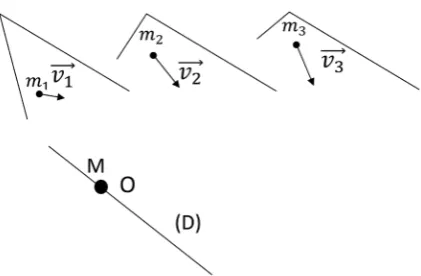
In this case, space structuration due to ECA can be seen in another way (Figure 4). Starting from a given unique massive center M placed at the point O, if a small probe mass m1 is added, with velocity v1, its trajectory will stay in the plane Ov1. A second probe mass m2, with another velocity v2, will stay in plane Ov2. These two planes intersect along a straight line D. Any further probe mass planar trajectory is no more allowed: all other orbit planes must include D.
Since planar structures are predicted in the vicinity of one “host” massive center, li-near filaments (2 plane intersects) should be obtained around two massive centers. And in the vicinity of more than two hosts, matter accumulation in spots should happen (plane and line intersect). Could it be that the new ECA give some insight to the struc-ture of the universe at larger scales?
[image:7.595.251.494.533.651.2]In any case, the ECA hypothesis engraves a fundamental structuration into space. Whenever, for the DM hypothesis, this structuration had to be assumed to come from the DM repartition itself.
Figure 4. Space structuration around a massive spot: the orbit plane of the 3rd mass does necessarily include the
in-tersection (D) of the two first orbit planes.
7. Conclusions
I have shown that the hypothesis of the new cosmic acceleration (1) not only explains the flat rotation curve problem, but also leads to the conclusion that the DSG’s do stay in co-rotating planes with the host galaxy. Whenever their “falling down” velocity (v2) is large, the planar structure is quasi-perpendicular to the host galaxy plane. This seems to be in correct agreement with most observations.
More generally, I have shown that the cosmic acceleration proportional to velocity introduces a symmetry break around any massive spot. This implies the formation of planar, linear or concentrated mass repartitions in space.
Of course, further observations and experiments will be needed to test the ECA hy-pothesis.
Close observations of DSG planes will have to be correlated with the proposed model. I also suggest introducing ECA into simulations of galaxy formation, galaxy collisions and also higher-level universe structures.
References
[1] Libeskind, N.I., et al. (2005) Monthly Notices of the Royal Astronomical Society, 363, 146- 152. https://doi.org/10.1111/j.1365-2966.2005.09425.x
[2] Belokurov, V., et al. (2006) The Astrophysical Journal, 647, L111-L114. https://doi.org/10.1086/507324
[3] Belokurov, V., et al. (2007) The Astrophysical Journal, 654, 897-906. https://doi.org/10.1086/509718
[4] Ibata, R.A. (2013) Nature, 62, 65.
[5] Conn, R., et al. (2013) The Astrophysical Journal, 766, 120-135. https://doi.org/10.1088/0004-637X/766/2/120
[6] Koposov, S.E., et al. (2015). https://doi.org/10.1088/0004-637X/805/2/130 [7] Drlica-Wagner, A. (2015) https://doi.org/10.1088/0004-637X/813/2/109
[10] Libeskind, N.I., et al. (2011) Monthly Notices of the Royal Astronomical Society, 411, 1525. https://doi.org/10.1111/j.1365-2966.2010.17786.x
[11] Libeskind, N.I., et al. (2015) Monthly Notices of the Royal Astronomical Society, 452, 1052- 1059.https://doi.org/10.1093/mnras/stv1302
[12] Ibata, R.A., et al. (2014) Astrophysical Journal Letters, 784, L6-L10. https://doi.org/10.1088/2041-8205/784/1/L6
[13] Pawlowski, M., Pflamm-Altenburg, J. and Kroupa, P. (2012) Monthly Notices of the Royal Astronomical Society, 423, 1109-1126.https://doi.org/10.1111/j.1365-2966.2012.20937.x [14] Pawlowski, M., Kroupa, P. and Jerjen, H. (2013) Monthly Notices of the Royal Astro-
nomical Society, 435, 1928-1957.https://doi.org/10.1093/mnras/stt1384 [15] Kroupa (2012) International Journal of Modern Physics D, 14-35.
[16] Lovell, M.R., Eke, V.R., Frenk, C.S. and Jenkins, A. (2011) Monthly Notices of the Royal Astronomical Society, 413, 3013-3021.https://doi.org/10.1111/j.1365-2966.2011.18377.x [17] Wang,J., Frenk, C.S., Navarro, J.F., Gao, L. and Sawala, T. (2012) Monthly Notices of the
Royal Astronomical Society, 424, 2715-2721. https://doi.org/10.1111/j.1365-2966.2012.21357.x
[18] Fleuret, J. (2014) Astrophysics and Space Science, 350, 769-775. https://doi.org/10.1007/s10509-014-1797-y
[19] Fleuret, J., (2015) Astrophysics and Space Science, 357-368. [20] Masreliez, J. C., (2012) The Progression of Time. Appendix III. [21] Masreliez, J.C. (2004) Apeiron, 11, 99.
Abbreviations
ECA = Expansion Cosmic Acceleration DSG = Dwarf Satellite Galaxy
Submit or recommend next manuscript to SCIRP and we will provide best service for you:
Accepting pre-submission inquiries through Email, Facebook, LinkedIn, Twitter, etc. A wide selection of journals (inclusive of 9 subjects, more than 200 journals)
Providing 24-hour high-quality service User-friendly online submission system Fair and swift peer-review system
Efficient typesetting and proofreading procedure
Display of the result of downloads and visits, as well as the number of cited articles Maximum dissemination of your research work
Submit your manuscript at: http://papersubmission.scirp.org/