Munich Personal RePEc Archive
Competition for procurement shares
Alcalde, Jose and Dahm, Matthias
University of Alicante, Universitat Rovira i Virgili
7 July 2011
Online at
https://mpra.ub.uni-muenchen.de/32078/
Competition for Procurement Shares
∗
Jos´
e Alcalde
†Matthias Dahm
‡July 7, 2011
Abstract
We propose a new procurement procedure which allocates shares of the total amount to be procured depending on the bids of suppliers. Among the properties of the mechanism are: (i) Bidders have an incentive to par-ticipate in the procurement procedure, as equilibrium payoffs are strictly positive. (ii) The mechanism allows to vary the extent to which affirma-tive action objecaffirma-tives, like promoting local industries, are pursued. (iii) Surprisingly, even accomplishing affirmative action goals, procurement ex-penditures might be lower than under a classical auction format.
Keywords: Procurement Auction, Affirmative Action.
JEL: C72, D44, H57
1
Introduction
Procurement through government contracts is an important part of economic activity. The OECD (2002) estimates that the ratio of government procurement markets to Gross Domestic Product is 19.96% for OECD countries and 14.48% for non-OECD countries. Public procurement has three main objectives1:
(a) minimization of public expenditures;
∗This paper supersedes all previous versions; in particular Alcalde and Dahm (2003) and
Alcalde and Dahm (2006). We wish to thank Miguel ´Angel Ballester, Luis Corch´on, Peter Eso, ´Angel Hernando-Veciana, Paul Klemperer, Christoph Kuzmics, Herv´e Moulin, J´ozsef S´akovics and Bego˜na Subiza for useful comments. This work is partially supported by the Instituto Valenciano de Investigaciones Econ´omicas. Dahm acknowledges the support of the Barcelona Graduate School of Economics and of the Government of Catalonia as well as of the Government of Spain under projects SEJ2007-67580-C02-01 and ECO2010-19733. Alcalde’s work is partially supported by the Government of Spain under project SEJ2007-62656/ECON. †Corresponding Author. IUDESP, University of Alicante, Ctra. San Vicente s/n, 03071
Alicante, Spain. [email protected]
‡Department d’Economia and CREIP, Universitat Rovira i Virgili, Av. de la Universitat
1, 43204 Reus, Spain. [email protected] 1
(b) provision of population needs; and
(c) promotion of affirmative action policies.
While objective (a) is uncontroversial, it is worth to discuss briefly the impor-tance of aims (b) and (c) as well as to point out some of their implications.
Effective provision of the needs of the population might require more than one provider, when there are advantages from multiple sourcing. A multiple sourcing strategy avoids that the buyer is “locked in” with one provider and experiences shortage in the case that this supplier cannot fulfill his obligations. For example, in the autumn of 2004, the U.S. experienced a severe influenza vaccine shortage because one of two suppliers (Chiron) failed to produce the ex-pected half of the necessary vaccines. In order to prevent similar problems in the future the supply of influenza vaccine is procured through multiple suppliers.2
In the U.S. government contracts have long been an important area of affir-mative action policies at the local, state, and federal level (see e.g. the Small Business Act from 1953). Targets of these policies are women-owned busi-nesses, minority-owned busibusi-nesses, small busibusi-nesses, disabled-owned busibusi-nesses, veteran-owned businesses and others. There are also policies that favor domes-tic producers: a legal preference for in-state bidders is provided by twenty-seven states; twenty-one states have “Buy American” laws that affect public procure-ment; and at the federal level the 2009 American Recovery and Reinvestment Act includes a “Buy American” provision.3 Many affirmative action policies
ac-cept that the targeted group is less efficient and establish certain market shares for these groups as explicit affirmative action goals.4
This implies that multiple sourcing and affirmative action might require to forgo economies of scale or to procure from several providers with different efficiency levels. For this reason conventional wisdom holds that there is a conflict between objective (a) on one hand, and aims (b) and (c), on the other. Following the language of the affirmative action literature we will refer to this in the sequel as the trade-off between expenditure minimization and minority representation. The main contribution of this paper is to propose a procurement mechanism that is able to reconcile these objectives.
As we will discuss later, other studies have identified particular situations of affirmative action policies for which the conventional wisdom is not true either
2
For instance, California supplies for this reason influenza vaccine through multiple sup-pliers, see Department of General Services (2009). For an overview of the 2004 influenza vaccine shortage, see for example the editorial “An Influenza Vaccine Debacle” in the New York Times, October 20, 2004.
3
The Act is available at http://publicservice.evendon.com/RecoveryBill1M.htm accessed on 03/03/2010. For an exposition and assessment of different affirmative action policies see Holzer and Neumark (2000). See also NASPO (2009).
4
(see e.g. the assessment in Holzer and Neumark, 2000). It is, however, impor-tant to understand the strategic incentives that can be induced through different bidding mechanisms in such a context. Moreover, as procurement markets are divers, it is important to identify a wide range of procurement mechanisms that can reconcile the objectives and assess their performance in different situations. Avoiding trade-offs between the objectives is important because it influences the political support for and the prevalence of affirmative action policies. Ayres and Cramton (1996), for example, report that various California ballot initia-tives tried to end state-sponsored affirmative action because of the concern that eliminating affirmative action could help to solve budge problems.
Many procurement procedures employed by public entities resemble roughly a first-price reverse auction: the buyer announces what kind of items she wishes to buy and how much can be spent (the budget constraint or reserve price); potential providers propose prices at which they are willing to provide the items (make their bids); and the provider proposing the lowest price is chosen.5 In
this article we modify this procedure in one crucial aspect: potential providers are assigned shares depending endogenously on the bids submitted.
We consider a simple model of two providers with heterogeneous costs. Hav-ing in mind affirmative action policies that favor domestic firms, the more effi-cient firm is called the foreign firm and the less effieffi-cient the domestic provider. This model is introduced in Section 3, where we also introduce a general for-mulation of procurement share auctions and discuss how different procurement outcomes are evaluated.
Section 4 considers the simplest possible framework and serves as a bench-mark: The buyer’s budget constraint is truthfully revealed, each seller is com-pletely informed about the cost structure of his rival, and a specific procurement auction, which we call contested procurement auction, is analyzed. Variations of this benchmark in each of these dimensions are considered successively in later sections. We show the existence of a unique pure strategy Nash equilib-rium in which the domestic high-cost supplier obtains a positive market share, providing him a strong incentive to participate in the auction.6 The section
concludes with the important result that when competition between suppliers is weak because of a large asymmetry in costs, then the contested procurement auction can increase competition and procure at lower costs than a standard auction. Competition is enhanced because the share auction introduces a new trade-off compared to a standard auction: increasing the price increases the mark-up over costs but it decreases the share.
5
Carpineti et al. (2006) report, based on a survey conducted in 2004 among a group of European and American Public Procurement Entities, that public procurement usually awards contracts based on a first-price sealed bid auction. Krasnokutskaya (2011) reports that the Michigan Department of Transportation conducts procurement auctions for construction and maintenance of most roads within Michigan through a first-price sealed-bid auction with reserve price for every project.
6
In Section 5 we explore the following modification of the benchmark Sec-tion 4. The buyer might have the possibility of hiring aninformed auctioneer
who knows the relevant market well and can determine the budged constraint strategically. We show that if all agents (the auctioneer, as well as the two providers) are completely informed about the cost structure of both sellers, there is a unique equilibrium and, thus, the buyer’s optimal budged constraint is also unique. Moreover, the result of the benchmark is strengthened: for any cost structure the buyer can determine the budget constraint in such a way that the procurement share auction allows to purchase at lower costs than a standard auction.
Section 6 extends the benchmark Section 4 in a different dimension, return-ing to the assumption that the buyer’s budget constraint is truthfully revealed. We generalize the contested procurement auction to a class of mechanisms pa-rameterized by a single parameter, determining the extent to which affirmative action objectives are pursued. This parameter can be interpreted as the price elasticity of a seller’s market share and adjusting it affects the trade-off between mark-up and share that providers face when they decide on their bids. The procurement auction generalizes the first-price reverse auction because the ex-treme values of zero and infinity for the elasticity yield the special cases of equal shares independently of bids and the first-price auction, respectively; the simple mechanism of Section 4 corresponds to the case in which the elasticity is one. Our strategic analysis reveals that for any elasticity there is a unique Nash equi-librium in pure strategies. Moreover, we show that this equiequi-librium is robust by relating the original game to a slightly modified game which can be solved by an iterative process of sequential elimination of dominated strategies (Moulin, 1979). Lastly, we investigate the optimal choice of the elasticity. We show that for any combination of supplier costs there exists always a mechanism under which the domestic firm has a positive market share and total procurement costs are lower than under a standard auction.
The analysis so far has considered the polar case in which providers are completely informed about each other’s characteristics. The complete informa-tion setting is considered appropriate for situainforma-tions in which sellers know each other well (Moldovanu and Sela, 2003), like the case of construction contracting (Bernheim and Whinston, 1986) or in “environments with stable technology” (Anton and Yao, 1992, p. 691). Our last extension in Section 7 relaxes this assumption supposing that at the beginning of the auction each provider has only information about his own cost structure. We propose acontinuous-time descending price auction in order to assign procurement shares. During the course of the auction all the relevant information is revealed so that at the unique equilibrium the providers’ actions coincide with those in the complete information environment of Section 6.
2
Literature
The present paper relates and contributes to several different strands of litera-ture.
2.1
Share auctions, contests and split award auctions
In his seminal paper on auctions for shares, Wilson (1979) studies a different bidding mechanism and symmetric bidders and finds the opposite result to ours: a share auction can yield a significantly lower sale price than a standard auction. Kremer and Nyborg (2004) have shown that this conclusion depends on the allocation rule (see also Bernheim and Whinston, 1986). Our setting differs from Wilson’s because we focus on asymmetric bidders.7
In a contest contenders exert effort in order to win an indivisible rent; the purpose of these models is thus different form ours. From a mathematical point of view, however, the central element of a contest, the so-called contest success function, is closely related to the concept of a procurement share auction pro-posed in the present paper. From this perspective, the present paper makes the following contribution to contest theory. Contest games are either specified as all-pay auctions (see Konrad, 2009) or as winner-pay contests (see Yates, 2011). The latter corresponds to the present paper. Epstein et al. (2011) consider an all-pay auction setting and a contest organizer whose payoff function is a weighted sum of contestants welfare and total effort. They establish that the organizer chooses the most deterministic contest success function which yields important support for the (deterministic) all-pay auction. Our results, however, indicate that in a winner-pay contest this result might be reversed (at least when the weight associated to total effort is high enough).8
A split-award auction divides procurement between two suppliers. In a sem-inal paper Anton and Yao (1989) have shown that sole-source procurement (or single sourcing) is more advantageous than a split-award (or multiple sourcing). Much of the subsequent literature has focused on conditions under which this conclusion is true (Anton and Yao, 1992; Perry and S´akovics, 2003; Inderst, 2008; Anton et al., 2010; Gong et al., 2011). Given that in a split-award auction the split is exogenous, while in our proposal the shares depend endogenously on bids, our results suggests that Anton and Yao’s conclusion might be sensitive to the assumption of an exogenous split.
7
Our model can easily be reformulated as a standard auction in which the organizer is a seller and participants are buyers. This would not affect most of our results.
8
2.2
Affirmative action in procurement
An important implication of our paper is that pursuing affirmative action and minimizing purchasing costs are not necessarily in conflict. This is an important finding because it implies that affirmative action policies are not necessarily costly and thus do not need to be justified (solely) on fairness grounds. Other affirmative action policies also have the potential to reconcile both objectives (see also the assessment in Holzer and Neumark, 2000).
Rothkopf et al. (2003) offer a model of asymmetric providers in a common value environment in order to analyze the effect of subsidies to a high-cost sup-plier. They show that subsidies can reduce procurement costs because they induce low-cost suppliers to bid more aggressively. While it is difficult to com-pare the performance of our mechanism to subsidies, the former seems to be more tractable. Rothkopf et al. (2003) restrict each bidder to bid a multiple of his cost estimate because the analysis of this asymmetric auction setting is challenging. In contrast, under complete information our mechanism is domi-nance solvable, while with private information the equilibrium is in dominant strategies.
Bid preferences also have the potential to foster competition between sup-pliers and reconcile both objectives. This has been shown in theoretical models of bid preferences for the Federal Communications Commission (FCC) auctions (Ayres and Cramton, 1996), government procurement from domestic and for-eign firms (McAfee and McMillan, 1989), and entry in procurement auctions (Hubbard and Paarsch, 2009).9 The share auction of the present paper offers
some advantages over bid preferences because the success of affirmative action does not depend on whether the cost difference between providers exceeds a threshold or not. To see this, suppose a bid preference of five percent and a large cost difference between two suppliers such that the equilibrium bid dif-ference is six percent. Here the market share of the “weak” bidder is zero. In contrast, our mechanism always assigns a positive share to the “weak” bidder.
2.3
Optimal auctions with asymmetric bidders
The bidding mechanism of the present paper assigns a positive share to the “weak” bidder. As a result competition increases and revenue is raised compared to a second price auction. This parallels findings in the literature on auctions for an indivisible object with asymmetric bidders, where competition and revenue can also be increased when the item is not always awarded to a bidder with the highest valuation.10 In Myerson (1981) the optimal auction may require to give
9
The empirical literature on bid preferences, however, yields mixed results. Support comes from experimental evidence (Corns and Schotter, 1999) and snow removal contracts in Mon-treal (Flambard and Perrigne, 2006), while studies of road construction contracts (Marion, 2007; Krasnokutskaya and Seim, 2011) do not find such an effect.
10
the object to a bidder whose valuation is not the highest. Maskin and Riley (2000) compare the sealed high-bid and “English” auctions and show that, even when the asymmetry between bidders is not so large that the “strong” bidder always preempts the “weak” bidder and the latter sometimes wins, expected revenue in the former may be higher than in the latter. In that literature, however, the auction choice depends on the asymmetry. In contrast, we show that for any degree of asymmetry the auction proposed can be modified such that it performs better than a standard auction.
2.4
Allocation of a divisible commodity
Bidding mechanisms have been proposed for the allocation of a variety of di-visible goods for which our mechanism might be interesting because revenue and non-revenue objectives might be in conflict. For instance, Morgan (1995) analyzes the management of fisheries and proposes to allocate fishing quotas through an auction in order to obtain revenues and to take into account other objectives, like protecting traditional, native users of the resource or meeting conservation goals. In the assignment of takeoff and landing rights at airports non-revenue considerations might include favoring domestic or small airlines and Grether et al. (1981) propose to auction off these rights.
Back and Zender (1993) and Swierzbinski and B¨orgers (2004) analyze Trea-sury bond auctions in which there is a concern that the bond market can be manipulated. This leads in some markets (including the U.S.) to the establish-ment of a limit on the amount a single buyer can purchase. Cramton (2002) discusses the virtues of spectrum auctions and reports a trade-off between gen-erating revenue for the Treasury and avoiding a collusive industry structure, which explains why regulators usually limit the amount of spectrum that a firm can hold in a geographic area.
Boycko et al. (1993) provide an account of the Russian privatization program which used voucher auctions for shares of firms. They report that political sup-port for privatization required that “weak” bidders (like workers in enterprises being privatized) obtained an important share of the firm. Dana and Spier (1994) characterize the optimal auction for production rights and stress that the choice between monopoly, duopoly or government production should be endogenous as a function of bids. They also discuss the trade-off between rev-enue of privatization and assigning several firms a positive market share which induces competition between firms.
3
Preliminaries
3.1
Agents
A buyer, which we denote with subindex 0, wishes to buy a certain quantity of a good. This good is perfectly divisible and the total amount to be procured is
normalized to 1. The buyer faces a budged constraintB0, which is considered
fixed throughout the paper.
There are two sellers (or providers) who are able to provide the buyer’s needs entirely or in part. LetI={d, f}denote the set of potential providers, where
drefers to thedomesticprovider andf to theforeign one. When providing the whole amount seller i ∈ I incurs (total) cost ci. We assume throughout the
paper that
0≤cf < cd< B0. (1)
Both firms are able to provide the whole amount at constant marginal costs without exceeding the buyer’s budget; and–given that we are interested in af-firmative action–the domestic firm is less efficient than the foreign provider.
3.2
Procurement Share Auctions
We start by proposing a general notion of procurement share auctions, that assigns procurement shares endogenously depending on a vector of bids P = (pd, pf). We interpretpi as the price of providing the procurer’s demand
com-pletely. Notice that the following definition a priori does not require positive minority representation.
Definition 1 A procurement share auction is a function
Ψ :R3+→R2+
such that for each budged constraint11 B
≥0, and any P∈R2+,
Ψd(B, P) + Ψf(B, P)∈ {0,1}.
We consider procurement auctions satisfying two requirements. On one hand, a feasibility condition: any provider proposing a price higher than the buyer’s budget constraint will not be a supplier. On the other hand, a mono-tonicity condition: the sellers’ shares are responsive to the prices announced. Formally,
(i) for eachi∈ I, ifB < pi then Ψi(B, P) = 0; and
(ii) for each P ∈ R2+, any i ∈ I, and j =6 i, if pi ≤ pj then Ψi(B, P) ≥
Ψj(B, P).
When seller i provides a procurement share Ψi of the total quantity, his
profits are
Ui(B, P) = Ψi(B, P) [pi−ci] . (2)
Given a procurement auction Ψ, and the budged constraint B0, we can
describe the normal form game Γ = {I,S,U, Ψ} in which the set of agents is I, each agent’s strategy space is the interval [0, B0] and provider i’s utility
follows expression (2) withB=B0.
11
3.3
Procurement Objectives
As explained in the Introduction, conventional wisdom holds that there exists a trade-off between expenditure minimization, on one hand, and minority rep-resentation, on the other. A main result of this paper is to show that such a trade-off does not need to exist. We derive this result under the assumption that the buyer only values expenditure minimization and show that this can justify assigning the domestic firm a positive share. Minority representation is realized as a byproduct. This assumption makes it more difficult to reconcile the objectives, and so makes our results more striking. We discuss different ways to model the benefits from minority representation in the concluding section.
In order to measure expenditure minimization consider a procurement share vectorψ = (ψd,ψf)≥0, withψd+ψf = 1; and a price vector P = (pf,pd).
The savings function associates to each pair (ψ,P) and budged constraintB, the value12
S0(B,ψ,P) =B−ψ·P=ψd(B−pd) +ψf(B−pf) . (3)
As already mentioned, procurement auctions are usually organized as first-price auctions. Therefore, we will compare the procurement costs of our mech-anism to the cost of the domestic firm, which is also the cost of a Vickrey auction.13 Throughout the paper we measure minority representation by the
share of the domestic provider.
4
Contested Procurement Auction
In this section we propose a procurement auction inspired in a classical proposal for bankruptcy situations: theContested Garment Principle. (See Dagan, 1996 for an analysis of this bankruptcy solution).14 From a normative point of view,
this auction fulfills not only the monotonicity condition proposed in the previous section, but is also continuous.15 From a positive point of view, we will see, that
it admits a unique Nash equilibrium.
12
To be fully precise, as equation (3) is maximized when there is no procurement, that is
ψd+ψf = 0, we postulate in this caseS0(B,ψ,P) = 0. 13
Given that we start by considering a complete information environment, there is the technical issue that the first-price sealed-bid auction mechanism under complete information does not possess a pure strategy Nash equilibrium. The focus on the cost of the domestic firm, however, can be justified as the limiting equilibrium of a modified game with smallest monetary unit when the grid size goes to zero and ties are randomly broken, see Alcalde and Dahm (2011a).
14
Following the contested garment principle a creditor (provider) receives half the estateE
plus half of the difference between his claimci and the opponent’s claim cj: (E/2 + (c1−
c2)/2, E/2 + (c2−c1)/2). To see the relationship to our procurement auction set the estate equal to one and define a claim as the savings that each provider offersci=B0−pi. Supposing
c1> c2, procurement shares are (1/2+(c1−c2)/(2c1),1/2+(c2−c1)/(2c1)). So the difference is that our procurement auction depends on the percentage mark-up (c1−c2)/c1rather than the absolute mark-upc1−c2. This implies homogeneity of degree zero in claims which seems to be a desirable property in the context of procurement auctions.
15
Definition 2 Given B0 and P = (pd, pf), the contested procurement auction
Ψcp associates to provideri the share
Ψcpi (B0, P) =
B0−2pi+ max{pd, pf}
2 [B0−min{pd, pf}]
.
To be fully precise, when pd = pf = B0 the auction assigns equal shares,
as required by the monotonicity condition. Remember also that the feasibility condition restricts providers to propose prices that do not exceed the budget
B0.
We refer to the game associated to Ψcp, namely Γcp =
{I,S,U, Ψcp
}, as contested procurement. Our first result determines the unique Nash equilibrium of this game. Since this result is a corollary of Theorem 3, its proof is omitted.
Theorem 1 GameΓcp has a unique Nash equilibrium, P∗
, described by
p∗
d =
B0+cd
2 , and
p∗
f = B0−
(B0−cf)
1 2 (B
0−cd)
1 2
2 .
Let us observe that, at equilibrium, the domestic provider obtains a positive profit. Moreover, the buyer’s expected savings are16
S0(B0, P∗) =B0−cd
4
"
2
B0−cf
B0−cd
12
+
B0−cd
B0−cf
12
−1
#
.
Note that, in particular, if
B0−cf
B0−cd
> 21
8 + 5 8
√
17
≈5.2019 (4)
it holds thatS0(B0, P∗)> B0−cd. This implies the following result.
Corollary 1 When the cost difference between providers is large enough, the buyer prefers contested procurement to a second-price reverse auction.
The intuition for this result is as follows. The domestic provider has a strong incentive to participate and propose a price pd below the budget B0, since
this guarantees strictly positive profits. As a result competition is enhanced because the foreign supplier faces a new trade-off compared to a standard auc-tion: increasing the price increases the mark-up over costs but it decreases the share. When competition is weak because the cost difference of providers is large, increasing the share is an important consideration for the foreign sup-plier. Consequently contested procurement performs better than a second-price reverse auction.
16
0.1 0.2 0.3 0.4
-0.2 -0.15 -0.1 -0.05 0.05
Relative procurement savings
[image:12.612.178.427.134.274.2]Minority representation
Figure 1: Cost savings relative to standard auction.
5
Contested Procurement with an Informed
Auc-tioneer
As we have seen in the previous section contested procurement has the potential to reconcile the aims of expenditures minimization and minority representation. This result hinges, however, on the cost difference between providers being large enough. In this section we investigate how the buyer can take advantage of an informed auctioneer who knows the relevant market well. Such an auctioneer has more information about the cost structure of the providers and can determine the budged constraint strategically.
We will assume the extreme case in which the auctioneer is completely in-formed about the providers’ cost. Notice, however, that even under the assump-tion that the aucassump-tioneer does not know the costs of suppliers, a reserve price can be determined. For instance, Krasnokutskaya (2011) reports that the Michigan Department of Transportation conducts procurement auctions for construction and maintenance of most roads within Michigan through a first-price sealed-bid auction. It also derives a reserve price for every project which is based on an engineer’s assessment of the work required to perform each task, prices derived from the winning bids for similar projects, adjustment through a price deflator and the requirement that the winning bid should be lower than 110% of the engineer’s estimate.
Before formalizing the strategic analysis of the auctioneer’s choice of the budged constraint, it is useful to describe the trade-off between expenditures minimization and minority representation further. Notice that when the de-clared budged constraint does not coincide with B0, expression (3) does not
measure the savings correctly. For this reason we measure expenditures mini-mization by total procurement cost of the contested auction.
minority representation. The latter is measured on the abscissa, while the ordi-nate indicates the cost difference between a standard auction and the contested procurement auction as a proportion of the cost difference of the providers. The figure shows that the contested procurement mechanism does not perform worse than a standard auction until a minority representation of roughly 22% is reached. Given that we assume that the buyer wishes to minimize procure-ment costs, she should choose the reserve priceB in such a way that minority representation is roughly 11% and procurement cost savings with respect to the sealed-bid first-price auction is roughly 5,5%.
It is, however, worth pointing out that in reality buyers with affirmative action goals accept to trade-off some procurement costs for minority represen-tation. The figure shows that higher minority representations, exceeding 11%, can only be reached when cost savings are lower (and eventually negative). How this trade-off is resolved depends on the preferences of the buyer and will vary with the context. For example, California’s Disabled Veteran Business Enter-prise and Small Business Certification Programs have with three percent and twenty-five percent, respectively, different aims for minority representation. No-tice that these values are close to those for which the contested procurement auction performs better than a standard auction.
We formalize now the auctioneer’s choice of the budged constraint. Consider the following sequential game:
(1)Budged Stage: The auctioneer selectsB∈[0, B0],17which becomes known
to the suppliers.
(2)Contest Stage: Providers choose simultaneously pricespi ∈[0, B)∪ {∅},
i ∈ I. Choosing pi = ∅ allows providers to reject supplying the buyer
when the budged is very low.18
Given the actions selected by all the players (B;pd, pf), the mechanism
pro-ceeds as follows:
(A) If there is a provideri∈ I such that pi =∅, then there is no procurement
and providers and auctioneer obtain zero payoffs.19
(B) Otherwise, i.e. if both providers propose a price not exceedingB, then the payoffs are:
17
We suppose for simplicity thatB≤B0. This makes sense when the auctioneer is required to document that the buyer is able to procure at this price. WhenB0is very low, there could be an incentive to chooseB > B0 but it is straightforward to take that into account in the proof of Theorem 2.
18
We exclude for simplicity thatpi=B. This assures that the domestic firm has a unique best reply whenB=cdand does not reduce the set of equilibria.
19
1.05 1.1 1.15 1.2 1.25 1.3 1.35
0.94 0.96 0.98 1.02
Procurement costs
[image:14.612.201.414.131.262.2]cd= 1 B
Figure 2: OptimalB whencf = 0 andcd = 1.
(a) For the auctioneer
S0(B0; Ψcp(B;P) ;P) =B0−pdΨcpd (B;pd, pf)−pfΨcpf (B;pd, pf).
(b) For each provideri∈ I
Πi(B0; Ψcp(B;P) ;P) = Ψicp(B;pd, pf) [pi−ci].
Let us denote by Γ2Scp the game previously described. Our solution concept
is Subgame Perfect Nash Equilibrium, SPNE henceforth. We also focus on undominated prices (in pure strategies) at the Contest Stage.
Theorem 2 GameΓ2Scp has a unique20 SPNE.
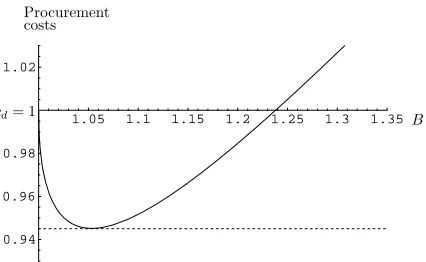
The proof of Theorem 2 is relegated to Appendix A but an intuition for this result can be gained with the help of Figure 2, which indicates procurement costs as a function of different budged choices, assuming thatcd= 1 andcf = 0.
Notice first that in order to obtain positive profits the auctioneer must propose a budged that is so high that both providers can submit a profitable bid. That is, the budged constraint must exceedcd. This implies by Theorem 1 that for each
budged the second stage has a unique Nash equilibrium. Moreover, procurement costs are a strictly convex function of the budged, and approachcd(from below)
asB tends tocd, see Figure 2. Therefore, at the first stage there is an optimal
value ˆB different from cd.
This has two implications. On the one hand, whenever B0 > Bˆ, the cost
of employing the contested procurement auction and revealing the budged con-strained truthfully exceeds the cost of the same auction when the budged is strategically chosen.
20
To be fully precise, there are several payoff-equivalent SPNE. The multiplicity arises because the foreign firm might choose any undominated bid when the auctioneer chooses a budged that lies between the costs of providers. On the equilibrium path such a budged is not chosen. Thus, there is a uniqueB∗;p∗
d,p ∗ f
Corollary 2 Let p∗
d,p
∗
f
be the unique Nash equilibrium for Γcp. Similarly,
letBˆ;pˆd,pˆf
be selected at a SPNE forΓ2Scp. Then
ˆ
pdΨcpd
ˆ
B; ˆpd,pˆf
+ ˆpfΨcpf
ˆ
B; ˆpd,pˆf
≤p∗
dΨ cp d B0;p
∗
d, p
∗
f
+p∗
fΨ cp f B0;p
∗
d, p
∗
f
.
On the other hand, the cost of a standard auction exceeds the cost of the contested procurement auction when the budged is strategically chosen. In the example of Figure 2 a standard auction implies procurement costs of 1. The contested procurement auction with a strategically chosen budged has costs of 0.945; the cost reduction is 5.5%, as mentioned before.
Corollary 3 The buyer prefers to employΨ2Scp and choose the budged strate-gically, rather than to have a second-price reverse auction.
6
Generalized Contested Procurement
For the remainder of the paper we return to the assumption that the buyer’s budget constraint is truthfully revealed. In this section we introduce a gener-alized version of contested procurement. This defines a family of procurement auctions characterized by a single parameter. We offer a strategic analysis of this family and investigate the buyer’s optimal choice of a member of this family.
6.1
Definition and Properties
Consider the following generalization of Definition 2.21
Definition 3 Letαbe a positive real number. GivenB0andP = (pd,pf), the generalized contested procurement auctionΨcpα is defined as
Ψcpα(B
0,P) =
2(B
0−pd)α−(B0−pf)α
2(B0−pd)α ,
(B0−pf)α
2(B0−pd)α
ifpd≤pf < B0
(B0−pd)α
2(B0−pf)α ,
2(B0−pf)α−(
B0−pd)α
2(B0−pf)α
ifpf ≤pd< B0
where the first component refers to the domestic and the second to the foreign provider.
Following Subsection 3.2, generalized contested procurement is defined as the game associated to Ψcpα, namely Γcpα ={I,S,U, Ψcpα}. Notice that this generalized mechanism fulfills several interesting properties.
On one hand, it defines a family of auctions characterized by a single param-eter. It is straightforward to verify that this parameter measures the elasticity of a supplier’s procurement share with regard to his price. Generalized contested
21
procurement generalizes the first-price reverse auction, because it encompasses it as a polar case (for α→ ∞; the other polar case is egalitarian assignment irrespective of bids forα→0). Contested procurement investigated in Section 4 is obtained forα= 1.
On the other hand, it can easily be verified that the auction fulfills the follow-ing desirable properties. First, it is anonymous so that shares are independent of providers’ labels and depend only on prices. Second, it is continuous.22 Third, the shares are monotonic in bids. Fourth, the assignment is homogeneous, that is, it is independent of the num´eraire employed.
6.2
Strategic Analysis
We establish now that the game Γcpα = {I, S,U, Ψcpα} has a unique Nash equilibrium. A proof of this result is relegated to Appendix B but it is instruc-tive to notice that the equilibrium prices of providers can be computed in a simple sequential way. First, the domestic provider computes his optimal price conditional on not being lower than the price of the foreign supplier
p′
d = arg max Ud(B0;pd, pf)
s.t. pf ≤pd.
(5)
It is important that it turns out that p′
d is independent of pf, except for the
fact that the latter must not be higher thanp′
d. Once the optimal price of the
domestic firm is anticipated, the foreign provider computes his optimal price, under the assumption not to exceedp′
d
p′
f = arg max Uf(B0;p′d, pf)
s.t. pf ≤p′d.
(6)
We have the following result.
Theorem 3 For eachα >0, game Γcpα={I,S,U,Ψcpα}has a unique Nash
equilibrium.
6.3
Robustness
We next offer a robustness analysis of the equilibrium. We show that an itera-tive procedure of deleting dominated strategies converges to a unique strategy for each player. This strategy is the one employed at the unique equilibrium in Theorem 3. Therefore, in the terminology of Moulin (1979) the game is dominance solvable.
This result requires an additional assumption. The reason for this assump-tion is technical; to avoid an open set problem at the starting point of the iterative procedure. This assumption is a mild strengthening of the feasibility condition in Subsection 3.2 and can be motivated as follows. Suppose there is a
22
smallest monetary unit and the convention that providers have to bid strictly be-low the budged constrainedB0. To fix ideas, imagine thatB0= $1,000,000.01,
and that no agent will ask for more than $1 million. Formally, any price above some threshold B′
, close to B0 implies that the
provider’s share is zero.23 Strengthening the feasibility condition in Subsection
3.2 in this way implies the following slight change to the generalized contested procurement auction Ψcpα from Definition 3. Let ΨcpαB′ be the function that to eachB0,P = (pd,pf) andB′< B0 associates the vector
ΨcpαB′(B
0;pd, pf) =
1− (B0−pf)α
2(B0−pd)α,
(B0−pf)α
2(B0−pd)α
ifpd≤pf ≤B′
(
B0−pd)α
2(B0−pf)α,1−
(B0−pd)α
2(B0−pf)α
ifpf ≤pd≤B′
(1,0) ifpd≤B
′
< pf
(0,1) ifpf ≤B′< pd
(0,0) ifB′
<min{pd, pf}.
As a consequence, the induced game ΓcpαB′ = n
I,S,U, ΨcpαB′ o
is a slight
modification of the original game Γcpα. Although the games Γcpα and ΓcpαB′ are not the same, provided that B′
is arbitrarily close to B0, the equilibrium
predictions for ΓcpαB′ should also be reasonable for the game Γcpα. With this in mind the implication of the next result, whose proof can be found in Appendix B, is that Theorem 3 is robust.
Theorem 4 For any α >0 and each B′
< B0, the gameΓcpαB
′
is dominance solvable.
6.4
Optimal Choice of the Elasticity
In this subsection we investigate the buyer’s optimal choice of the elasticity of the procurement auction. To do so we relate the buyer’s savings toα.
To gain an intuition notice that the solution of problem (5) is24
p′
d=
B0+αcd
α+ 1 (7) and that the solution of problem (6) must satisfy
B0−p′f
= 1 2
B0−p′d
B0−p′f
!α
B0+ (α−1)p′f−αcf
. (8)
Analyzing the polar cases yields the following intuitive facts:
23
Even though Theorem 4 is true for anyB′ < B
0, for interpretative purposes we will consider thatB′is very close toB
0. 24
(i) Whenα→0 the allocation procedure is perfectly inelastic and assigns half of the demand to each supplier independent of prices. The equilibrium converges to the one in a fair lottery with an indivisible prize and each procurer asks for the whole budged, i.e.
lim
α→0p
′
f(α) = lim α→0p
′
d(α) =B0.
(ii) Whenα→ ∞the allocation procedure is perfectly elastic and converges to afirst-price reverse auction, i.e.25
limα→∞p ′
f(α) = limα→∞p ′
d(α) =cd; and
limα→∞Ψ
cpα
f (B0;P
′
) = 1, limα→∞Ψ
cpα
d (B0;P
′
) = 0.
These two facts seem to indicate that any generalized contested procurement induces an average price higher than the second lowest cost. This intuition is reinforced by inspection of equation (7), because–although p′
d is a strictly
de-creasing function ofα–the domestic provider’s price is always higher than his costs. The foreign supplier could, thus, choose a price between the domestic provider’s price and costs. Nevertheless, as the next theorem shows, this intu-ition is not true. The reason is that for highαequation (8) introduces a concave relationship betweenp′
f andα. Taking into account the extreme values ofp
′
f –
i.e. B0forα→0, andcd forα→ ∞– this concavity implies the existence of a
value ˆαwhose associated p′
f is a minimum, and thus is lower thancd. It turns
out that the foreign supplier might be induced to make a very competitive bid. As a result, the following statement is true.
Theorem 5 There isα >0 such that, at equilibrium,S0(B0, P′)> B0−c2.
A formal proof of Theorem 5 can be found in Appendix B. The theorem indicates a trade-off in the selection of the elasticity. Given a pair of bids, lowering the elasticity raises the market share of the domestic supplier. This implies, on one hand, to pay for the total share of the domestic firm a relatively high price. But on the other hand, it forces the foreign supplier to bid lower than he otherwise would, driving down the payment for this market share. For moderate choices of the elasticity, the overall effect is to induce very competitive procurement. But for extreme values this is not true. With very egalitarian policies the share of the domestic firm is large and procurement becomes costly. When the elasticity is high, the foreign supplier wins a large share and does not need to bid very competitive, as in a standard auction.
25
7
Generalized Contested Procurement with
Pri-vate Information
The analysis so far has considered the polar case in which providers are com-pletely informed about each other’s characteristics. We relax this assumption now and focus on the other polar case in which each supplier only has (pri-vate) information about his own costs, but does not know the costs of his rival. We propose to implement generalized contested procurement by means of a (continuous-time) sequential mechanism. During the course of the auction in-formation about rivals is not needed because all the relevant inin-formation is revealed. As a result at the unique equilibrium the providers’ actions coincide with those in the complete information environment of Section 6.
For α given, the mechanism proceeds as follows. At any t ∈ [0, 1) each provideri knows his own costs ci and the messages selected by both sellers at
any t′
< t. This information structure is common knowledge. Both providers simultaneously select their messagesmi(t)∈ {0, 1}, where 0 is interpreted as
‘continuing’ and 1 as ‘stopping’. Att= 1 the auction is over and we interpret this as both sellers choosing messagemi(1) = 1. Given the providers’ message
functionsmi: [0, 1]→ {0, 1}, let ˜tibe the first time in whichi’s message is 1.26
With this the price paid for selleri’s share is
˜
pi= 1−˜tiB0.
Given the sellers’ prices ˜P = (˜pd,p˜f), procurement shares are assigned according
to Ψcpα, and thus provideri’s utility is
Πi= (˜pi−ci) Ψcpi α
B0; ˜P
.
Let Γctcpα denote the continuous time generalized contested procurement game above described. Let us observe that a strategy for provider i, say si,
must prescribe, for eacht ∈ [0, 1) a messagemi that should depend not only
ont, but also on the messages set by both providers at anyt′
< t.
We explore now the behavior of suppliers in this bidding game for a given
α. Consider seller i and suppose that his opponent’s message is 0 for any t
lower than some ¯t. This implies that seller i also selects, at time ¯t a message
mi(¯t) = 0, except if
(1−¯t)B0=
B0+αci
α+ 1 . (9)
The reason is that, given that his opponent has not yet fixed a price, by setting a message equal to 1, supplieribecomes the seller asking for the highest price. As we have seen in Section 6, when provider i asks for the highest price he selectspi as established in equation (9).
26
I.e. ˜tiis such thatm ˜ti
For ˆt given, let us assume that both agents have chosen messagemd(t) =
mf(t) = 0 for eacht <tˆ, and that providerjselectsmj ˆt
= 1. In such a case, any optimal decision for provideri6=j involves thatmi(t) = 0, for anyt <˘ti
andmi ˘ti
= 1, where27
˘
ti= arg max [(1−t)B0−ci] Ψcpf α B0; 1−ˆtB0,(1−t)B0
s.t. ˆt≤t≤1
(10)
Note that these arguments allow us to say that the strategies used by providers to select their messages are dominant strategies. The next theo-rem, whose proof is omitted,28 establishes the equivalence of the equilibrium
procurement shares under Γcpα and Γctcpα.
Theorem 6 Given a profile of strategiess′
d, s
′
f
forΓctcpα, let m′
i denote the selleri’s message function induced bys′
d, s
′
f
. Then,s′
d, s
′
f
is an equilibrium forΓctcpα, in dominant strategies, if, and only if,
(a) m′
d(t) = 0 for eacht < td, andm
′
d(td) = 1; and
(b) m′
f(t) = 0for each t < tf, andm′f(tf) = 1, where
td= αα+1
B0−cd
B0 , and
tf maximizes [(1−t)B0−cf] Ψcpf α(B0; (1−td)B0,(1−t)B0).
(11)
Note that, as a consequence of Theorem 6, we have the following.
Corollary 4 Let p′
d, p
′
f
be the equilibrium prices when agents play the game
Γcpα, and (ˆp
d,pˆf) those established when playing Γctcpα. Then,
p′
d, p
′
f
= (ˆpd,pˆf).
8
Conclusion
This paper is a step toward understanding under what conditions procurement can reconcile the conflicting aims of expenditures minimization and minority representation. Rather than reviewing our results, in this concluding section we discuss some of our assumptions most of which indicate questions for future research.
27
Note that, since Ψcpα is symmetric, i.e Ψcpα
d B0,pd,pf
= Ψcpα
f B0,pf,pd
, there is no loss of generality in considering that the supplier described in Expression (10) below is the foreign seller.
28
Practicability of an improvement over a standard auction
We have seen that the conflicting procurement objectives can be reconciled when the buyer or her auctioneer chooses either the budged constraint strategically (Section 5) or the elasticity of the procurement auction (Subsection 6). In both cases the optimal choice requires information on providers’ costs.
It is not unreasonable that some information can be obtained. We have already discussed that the Michigan Department of Transportation derives cost estimates for construction and maintenance of most roads within Michigan (see Krasnokutskaya, 2011 and Section 5). Also when procurement auctions take place repeatedly the buyer might have experience with the suppliers and choose a mechanism that performs well. In other instances, however, the buyer might have less reliable estimates of the bidders’ costs. But our findings are robust.
In the context of Section 5, imprecise estimates of providers’ costs combined with the desire “to be on the safe side” could lead to a budged choice that is higher than the optimal budged. It turns out, however, that procurement costs are lower than under a second price auction provided (3.2725cd−cf)/2.2725≥
B0 holds. This threshold is increasing in the cost difference that justifies
af-firmative action. In the extreme whencf = 0, the mechanism outperforms a
second-price reverse auction until the budget is 44% higher than the domestic firm’s cost.
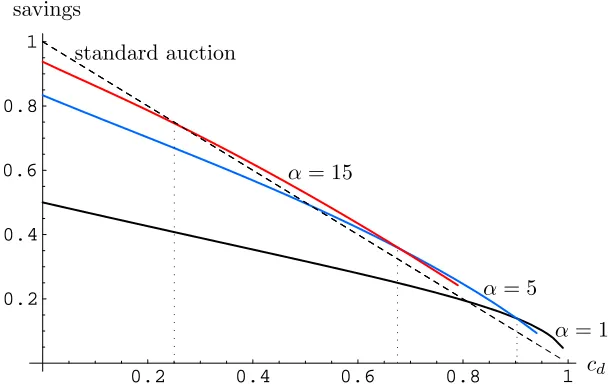
In Subsection 6 when the elasticity is selected,—rather than searching for the optimal value of the elasticity—the buyer might choose among a small set of elasticities and still improve upon a standard auction. Consider the following example in which againcf = 0 and the budged is normalized to 1. To make
affirmative action meaningful suppose that cd is larger than 0.25. It can be
shown that it is enough to choose among a low, intermediate and high elasticity. More precisely, it is enough to choose (roughly) for values between 0.25 and 0.65 an elasticity of 15, for values between 0.65 and 0.9 an elasticity of 5, and for values between 0.9 and 1 an elasticity of 1. Figure 3 shows on the abscissa the costs of the domestic provider. The ordinate displays the savings associated to a standard auction (dotted line) and to the contested procurement auction depending on the choice among these elasticities.
The multi-provider case
Our analysis restricts to two providers and a natural extension is to consider the multi-provider case. Alcalde and Dahm (2011b) explore such a setting and propose an extension of the procurement share auction which maintains the philosophy underlying the contested procurement auction. Alcalde and Dahm (2011b) show that when the sellers’ provision costs are relatively homogeneous but different the equilibrium might not be unique. As a consequence equilibrium prices might not be not accurately correlated with the cost of providers; i.e. it might be the case thatc1< c2< c3and, at some equilibrium, ˆp3<pˆ1<pˆ2. For
0.2 0.4 0.6 0.8 1 0.2
0.4 0.6 0.8 1
savings
standard auction
α
= 15
α
= 5
α
= 1
[image:22.612.152.458.130.326.2]c
dFigure 3: Example of savings forcf = 0 andB0= 1.
speaking the procedure is as follows. The potential providers fix prices and the two lowest bidders compete in a contested procurement auction in which the relevant budged constraint is endogenously determined through the prices of the remaining high bidders. From the perspective of the present paper the extension to multiple providers does not seem to yield new insights into the trade-off between expenditure minimization and minority representation.
More general cost structures
The optimal procurement share auction
We have proposed a particular procurement share auction and shown that it has remarkable properties. We have not derived an “optimal” procurement share auction. An interesting question is whether there are other procurement share auctions that have similar properties to the one analyzed here. From the outset it is clear that the basic trade-off that we introduce—increasing the price increases the mark-up over costs but it decreases the share—does not depend on the particular functional form of contested procurement. For a related class of forward auctions Yates (2011) establishes the existence of a unique equilibrium. His analysis, however, also seems to indicate that for other functional forms of share auctions the remarkable properties of tractability and robustness of contested procurement are lost.
Valuing minority representation
The present paper reaches stark results because contested procurement outper-forms standard auctions although the buyer does not put any value on minority representation. In reality, however, the seller will be willing to trade-off some savings for minority representation. For example, California’s Certification Pro-grams establish minimum market share goals for designated bidders, who are the target of the affirmative action.
A very simple way to extend our analysis to such a setting is to generalize equation (3) to a CES utility function, as in
U0(B0,Ψ, P) =
" n X
i=1
(Ψi(B0−pi))ρ
#1ρ
, where 0< ρ <1.
Here we defineρ= 1−1
σ, whereσ >1 is the (constant) elasticity of substitution.
Notice that whenσ → ∞, U0(B0, π, P) tends to S0(B0, π, P). On the other
hand, when σ is smaller, indifference curves are strictly convex. Therefore, for the same per capita saving, two providers with the same market share are preferred to only one. It can be shown that in the context of the example displayed in Figure 3 σ = 2 pushes the utility associated to α = 1 so much upwards that for any costs of the domestic provider contested procurement is preferred to a standard auction. Of course, this does not mean that this is the best the buyer could do and the optimal choice of the elasticity should depend on the cost structure of sellers.
When the buyer has no information on this cost structure, generalized con-tested procurement offers another practical way to trade-off the conflicting ob-jectives. As different values of the price elasticity of a suppliers market share solve the trade-off in different ways, the buyer might simply choose one value once and for all.
his obligations or the effects of successful affirmative action policies. Concern-ing the former, one might want to distConcern-inguish between situations in which one seller is not able to provide his share and the other is or is not able to increase his share on short notice. Also, it seems reasonable that the risk depends on the firm’s efficiency level, and it might be increasing in the firm’s market share. Concerning the latter, often the underlying idea is that a positive market share allows the domestic firm to learn by doing and to become more efficient over time. One might thus want to evaluate the success of affirmative action policies with a dynamic model of the evolution of the domestic firm’s efficiency. Denot-ing byct
d the cost of the domestic firm at timetone possibility is the following.
Assume that the foreign firm’s efficiency level is stable,ct f =ct
−1
f , and that for
eacht,ct
d≥cf implies Ψtd≤Ψtf. Learning by doing might be captured by
ct
d= 1−
Ψt−1
d
Ψt−1
f
! ct−1
d +
Ψt−1
d
Ψt−1
f
cf.
References
Albano, G.L., Dimitri, N., Perrigne, I., Piga, G., 2006. Fostering participa-tion, in: N. Dimitri, G.P., Spagnolo, G. (Eds.), Handbook of Procurement. Cambridge University Press, Cambridge, N.Y.
Alcalde, J., Dahm, M., 2003. Probabilistic auctions. Mimeo.
Alcalde, J., Dahm, M., 2006. Bidding for being a seller. Mimeo.
Alcalde, J., Dahm, M., 2007. Tullock and Hirshleifer: A meeting of the minds. Review of Economic Design 11, 101–124.
Alcalde, J., Dahm, M., 2011a. On the complete information first-price auction and its intuitive solution. International Game Theory Review , forthcoming.
Alcalde, J., Dahm, M., 2011b. Two’s company but three is a crowd? On the number of active bidders in procurement auctions. Mimeographed, Universi-tat Rovira i Virgili.
Anton, J.J., Brusco, S., Lopomo, G., 2010. Split-award procurement auctions with uncertain scale economies: Theory and data. Games and Economic Behavior 69, 24–41.
Anton, J.J., Yao, D.A., 1989. Split awards, procurement, and innovation. RAND Journal of Economics 20, 538–552.
Anton, J.J., Yao, D.A., 1992. Coordination in split-award auctions. Quarterly Journal of Economics CVII, 681–707.
Ayres, I., Cramton, P., 1996. Deficit reduction through diversity: How affirma-tive action at the FCC increased auction competition. Stanford Law Review 48, 761–815.
Back, K., Zender, J.F., 1993. Auctions of divisible goods: On the rationale for the treasury experiment. Review of Financial Studies 6, 733–64.
Bernheim, D.B., Whinston, M.D., 1986. Menu auctions, resource allocation, and economic influence. Quarterly Journal of Economics CI, 1–31.
Boycko, M., Shleifer, A., Vishny, R.W., 1993. Privatizing Russia. Brookings Papers on Economic Activity 24, 139–192.
Carpineti, L., Piga, G., Zanza, M., 2006. The variety of procurement practice: Evidence from public procurement, in: N. Dimitri, G.P., Spagnolo, G. (Eds.), Handbook of Procurement. Cambridge University Press, Cambridge, N.Y.
Cramton, P., 2002. Spectrum auctions, in: Cave, M., Majumdar, S., Vogelsang, I. (Eds.), Handbook of Telecommunications Economics. Elsevier Science B.V., Amsterdam.
Dagan, N., 1996. New characterizations of old bankruptcy rules. Social Choice and Welfare 13, 51–59.
Dana, J.J., Spier, K.E., 1994. Designing a private industry: Government auc-tions with endogenous market structure. Journal of Public Economics 53, 127–147.
Dimitri, N., Piga, G., Spagnolo, G., 2006. Introduction, in: N. Dimitri, G.P., Spagnolo, G. (Eds.), Handbook of Procurement. Cambridge University Press, Cambridge, N.Y.
Epstein, G.S., Mealem, Y., Nitzan, S., 2011. Political culture and discrimination in contests. Journal of Public Economics 95, 88 – 93.
Flambard, V., Perrigne, I., 2006. Asymmetry in procurement auctions: Evi-dence from snow removal contracts. Economic Journal 116, 1014–1036.
Department of General Services, P.D., 2009. The annual report to the legislature on procurement of pharmaceuticals. Avail-able at http://www.documents.dgs.ca.gov/Legi/Publications/ 2009LegislativeReports/PharmaceuticalReport.pdf, accessed on Feb. 21, 2010.
Gong, J., Li, J., McAfee, R.P., 2011. Split-award contracts with investment. Mimeo.
Grether, D.M., Isaac, R.M., Plott, C.R., 1981. The allocation of landing rights by unanimity among competitors. American Economic Review 71, 166–71.
Holzer, H., Neumark, D., 2000. Assessing affirmative action. Journal of Eco-nomic Literature 38, 483–568.
Hubbard, T.P., Paarsch, H.J., 2009. Investigating bid preferences at low-price, sealed-bid auctions with endogenous participation. International Journal of Industrial Organization 27, 1–14.
Inderst, R., 2008. Single sourcing versus multiple sourcing. RAND Journal of Economics 39, 199–213.
Konrad, K.A., 2009. Strategy and Dynamics in Contests. Oxford University Press.
Krasnokutskaya, E., 2011. Identification and estimation of auction models with unobserved heterogeneity. The Review of Economic Studies 78, 293–327.
Kremer, I., Nyborg, K.G., 2004. Divisible-good auctions: The role of allocation rules. RAND Journal of Economics 35, 147–159.
Marion, J., 2007. Are bid preferences benign? The effect of small business subsidies in highway procurement auctions. Journal of Public Economics 91, 1591–1624.
Maskin, E., Riley, J., 2000. Asymmetric auctions. Review of Economic Studies 67, 413–38.
McAfee, R.P., McMillan, J., 1989. Government procurement and international trade. Journal of International Economics 26, 291–308.
Moldovanu, B., Sela, A., 2003. Patent licensing to Bertrand competitors. Inter-national Journal of Industrial Organization 21, 1–13.
Morgan, G., 1995. Optimal fisheries quota allocation under a transferable quota (tq) management system. Marine Policy 19, 379–390.
Moulin, H., 1979. Dominance solvable voting schemes. Econometrica 47, 1337– 1351.
Moulin, H., Shenker, S., 1992. Serial cost sharing. Econometrica 60, 1009–1037.
Myerson, R.B., 1981. Optimal auction design. Mathematics of Operations Research 6, 58–73.
NASPO, 2009. Survey of state government purchasing practices. Available at
http://www.naspo.org/content.cfm/id/2009\_survey, accessed on April 03, 2010.
OECD, 2002. The size of government procurement markets, OECD 2002. Avail-able at http://www.oecd.org/dataoecd/34/14/1845927.pdf, accessed on April 03, 2011.
Perry, M.K., S´akovics, J., 2003. Auctions for split-award contracts. Journal of Industrial Economics 51, 215–242.
Rothkopf, M.H., Harstad, R.M., Fu, Y., 2003. Is subsidizing inefficient bidders actually costly? Management Science 49, 71–84.
Scherer, F., 2007. An industrial organization perspective on the influenza vac-cine shortage. Managerial and Decision Economics 28, 393–405.
Swierzbinski, J., B¨orgers, T., 2004. The design of treasury bond auctions some case studies, in: Jansen, M.C. (Ed.), Auctioning Public Assets: Analysis and Alternatives. Cambridge University Press, Cambridge.
Wilson, R., 1979. Auctions of shares. The Quarterly Journal of Economics 93, 675–89.
Appendix
A
Strategic Analysis of
Γ
2ScpThe aim of this appendix is to provide a formal analysis of the sequential game Γ2Scp in Section 5. We prove Theorem 2 applying backward induction
argu-ments. Note that Corollary 2 follows from the fact that the informed auctioneer is minimizing the buyer’s provision cost. Corollary 3 follows from equation (13) below.
Proof of Theorem 2
Denote byB the budged constraint selected by the auctioneer at the Budged Stage. Note that at the Contest Stage supplier i’s price pi is undominated if,
and only ifpi∈(ci, B) whenci< B andpi=∅otherwise.
Let us consider the following cases:
Case 1 B≤cd. Let us observe that the unique undominated price for the domestic
firm ispd=∅, implying that there is no procurement and the auctioneer
obtains zero payoffs.
Case 2 B > cd. By Theorem 1 we know that for each B each seller optimally
chooses
pd = B+2cd, and
pf = B−
(B−cf)12(B−cd)12
2 .
)
(12)
Moreover, we have that
S0(B0; Ψcp(B;P) ;P) = B0−pdΨdcp(B;pd, pf)−pfΨcpf (B;pd, pf)
≥ B0−
1
2(pd+pf)≥B0− 1
2(B+cd)
≥ 12(B0−cd)>0, asB0> cd.
Therefore, at the Budged Stage the auctioneer, anticipating the sellers’ op-timal decisions, selects a budgedB∗
> cd minimizing procurement cost
C(B;P) = B−pd 2 (B−pf)
pd+
1− B−pd 2 (B−pf)
pf.
Taking into account (12), this becomes
ˆ
C(B) =B−B−cd
4
"
2
B −cf
B−cd
12
+
B −cd
B−cf
12
−1
#
Note that its derivative, with respect toB is
dCˆ dB(B) =
1 4
"
5−5 2
B −cd
B−cf
12
− B
−cf
B−cd
12
+1 2
B −cd
B−cf
32#
.
The unique real root is reached at
B∗
≃ cd−0.0949343.050657cf
or, equivalently, when
B∗
−cf
B∗
−cd ≃
19.741.
Moreover, since
dCˆ
dB(B)<0 for anyB < B
∗
,
and
dCˆ
dB(B)>0 for anyB > B
∗
,
we obtain thatmin{B∗
B
Analysis of
Γ
cpαProof of Theorem 3
Throughout this proof we consider a fixed parameter α > 0. We proceed as follows. We first show in Lemma 1 that the generalized contested procurement function is continuously differentiable. Second, Lemma 2 shows that each seller’s utility function is strictly quasi-concave on the bidding space. Finally, we use a result by Moulin and Shenker (1992) to construct an equilibrium and to show that this equilibrium is unique.
Auxiliary Lemmas
Lemma 1 Let k be such that 0 < k < B0. The function φ : [0, B0] → R+
described by
φ(x) =
1 2
B0−x
B0−k
α
ifk < x≤B0 2(B0−x)α−(B
0−k)α
2(B0−x)α if 0≤x≤k
is continuously differentiable in(0, B0).
Proof. Note that, sinceφis polynomial for x6=k, we only need to check that
lim
x0→k− ∂φ
∂x(x0) = limx0→k+
∂φ ∂x(x0).
Now, taking into consideration that
∂φ ∂x(x0) =
( −α
2
(B0−x0)α−1
(B0−k)α ifk < x0< B0
−α
2
(B0−k)α
(B0−x0)α+1 if 0< x0< k
we conclude that
lim
x0→k− ∂φ
∂x(x0) = − α
2
(B0−k)α
(B0−k)α+1
=−2 (Bα
0−k)
, and
lim
x0→k+
∂φ
∂x(x0) = − α
2
(B0−k)α
−1
(B0−k)α
=−α
2 (B0−k)
−1
.
Lemma 2 For each k, 0 < k < B0 and any h in [0, B0] the function ϕ :
[0, B0]→Rdescribed by
ϕ(x) =
1 2
B0−x B0−k
α
(x−h) if k < x≤B0 2(B0−x)α−(B
0−k)α
2(B0−x)α (x−h) if 0≤x≤k
Proof. Letφbe the function explored in Lemma 1. Note that, givenh,ϕ
can be described as
ϕ(x) = (x−h)f(x).
This function is twice continuous differentiable forx6=k, and it is continuously differentiable forx=k. Let us consider the following cases:
(a) h < x0< k. Then
∂2ϕ
∂x2 (x0) =
1 2α
(B0−k)α
(B0−x0)2+α
(h+x0−2B0+hα−x0α).
Therefore,
sign ∂
2ϕ
∂x2(x0) =sign (h+x0−2B0+hα−x0α) . (14)
Sinceh≤x0< B0,
h+x0−2B0+hα−x0α=
(1 +α)h+ (1−α)x0−2B0≤2 (x0−B0)<0.
(b) k < x0< B0. Then
∂2ϕ
∂x2 (x0) =
1 2
α
(B0−x0)2
B
0−x0
B0−k
α
(h+x0−2B0−αh+αx0).
By (14) we have that ∂∂x2ϕ2 (x0)≥0 only ifh−B0≥B0−x0+α(h−x0).
But, since
∂ϕ ∂x(x0) =
(B0−x0)α
2(B0−k)α
1−αx0−h
B0−x0
=
(B0−x0)α
2(B0−k)α
B
0−x0+α(h−x0)
B0−x0
,
we have thatϕis decreasing atx0if it is not strictly concave.
Summing up, we have thatϕis strictly concave atx0 whenever
x0<
2B0+ (α−1)h
α+ 1 ,
and forx0 higher or equal the above, ifϕ is not strictly concave, it is strictly
decreasing. Thusϕmust be strictly quasi-concave.
The following lemma is equivalent to Lemma 2 in Moulin and Shenker (1992).
Lemma 3 Let u1(x) and u2(x) be two strictly quasi-concave functions from
[a, b]toRthat coincide fromc∈(a, b):
u1(x) =u2(x) for all x,c≤x≤b.
Then the (unique) maximizers ofui(x), denoted xi, are on the same side of c:
x1≥c⇔x2≥c;x1=c⇔x2=c.
Proof of Theorem 3
We first show that an equilibrium (in pure strategies) exists. Let ˆpd and ˆpf be
the solutions to
maxUd(B0; ˆpf, pd) s.t. ˆpf ≤ pd≤B0, and
maxUf(B0;pf,pˆd) s.t. cf ≤ pf ≤pˆd.
Note that the sellers’ strategies can be computed using the following sequential procedure:
(a) Calculate ˆpd by maximizing the function
md(pd) = (B0−pd)α(pd−cd)
on [cd, B0]. Note that this function is strictly quasi-concave on this
seg-ment. Moreover, any solution of the problem above also maximizes the function
(B0−pd)α
2 (B0−p˜f)α
(pd−cd)
which coincides withUd(B0; ˜pf, pd) when ˜pf ≤pd.
(b) Compute ˆpf by maximizing the function
mf(pf) =
2 (B0−pf)α−(B0−pˆd)α
2 (B0−pf)α
(pf−cf)
on [cf,pˆd]. Note that, sincemf is strictly quasi-concave, it must have a
unique maximizer.
Let us remark that (ˆpf,pˆd) is characterized by
ˆ
pd =
B0+αcd
α+ 1 , and ˆ
pf satisfies
(B0−pˆf) = (B0−αcf+ (α−1) ˆpf)
(B0−pˆd)α
2 (B0−pˆf)α
.
Now we show that (ˆpf,pˆd) described above constitutes an equilibrium for
the game induced by Ψcpα. First, note that ˜p
f, the unique maximizer of
uf(pf) =
(B0−pf)α
2 (B0−k)α(pf−cf)
is, for anyk < B0,
˜
pf =
B0+αcf