Munich Personal RePEc Archive
Customer satisfaction on e-banking;a
study with special reference to
mayiladuthurai
Swaminathan, J and Ananth, A.
A.V.C College of Engineering, India
August 2010
Online at
https://mpra.ub.uni-muenchen.de/39767/
Customer Satisfaction on E-Banking
(A Study With Special Reference To Mayiladuthurai)
J. Swaminathan, Lecturer, Department of Management Studies, A.V.C. College of Engineering, Mannampandal, Tamil Nadu.
A. Ananth, Assistant Professor, Department of Management Studies, Sri Jayaram Engineering College, Cuddalore, Tamil Nadu.
ABSTRACT
Electronic banking or e-banking is automated delivery of new and traditional banking products and services directly to the customer through electronic communication like computer, ATMs, and internet websites. The customer satisfaction level based on the analysis of data relating to 200 respondents indicates that there is significant correlation between age and occupation with other factors. In the analysis it was observed that particular age group have used these services, the satisfaction of the customer majorly influenced the convenience, awareness, and
responsiveness. In the present technology society, most of the banking customer prefer and switch to e-banking facilities. So the banker may improve their services, loyalty to customers and their retention by increasing awareness of other age groups and concentrating on the factors contributing customer satisfaction.
Key words – Customer satisfaction, Efficiency, Privacy of Information, Services
Introduction
Electronic banking or e-banking is defined as the automated delivery of new and traditional banking products and services directly to customer through electronic, interactive
communication channels like computers, ATM, internet websites etc. Electronic banking or e-banking is the term that describes all transactions that take place among companies, organization, and individuals and their banking institutions. First conceptualized in the mid -1970s, some banks offered customer electronic banking in 1985. In later 1990’s peoples were more comfortable with making transaction over the web. While financial institutions took steps to implement e-banking, the customers were hesitant to conduct monetary transaction over the web. In 2009 a report by Gartner Group estimated that 47 % people used these e-banking facilities. E-banking support services are Web linking, Account aggregation, Electronic authentication, Websites hosting, Payments and commerce, Bill payments and presentation, Wireless E-banking etc. Common e-E-banking services are Account Management, Cash management, Bill payment&presentment, New Account Opening, Consumer Wire Transfers, Commercial Wire Transfers, Small Business Loan (Applications, approvals & advances), Investment Brokerage Services, Business to business payments, Loan applications, Account aggregation and Employee benefit/Pension Administration are the common services provided by e-banking. Its channels are Internet banking, ATM (Automated Teller Machines), Credit cards, Debit cards etc
Internet Banking
Internet banking is any inquiry or transaction processed online, without any reference to the branch at any time.It involves use of internet for delivery of banking products and services. Its highlights are - Checking with no monthly fee, free bill payment and rebates on ATM
that your account information is protected from unauthorized access: Its key features are
-Firewalls and filtering routers ensure that only the legitimate Internet users are allowed to access the system, Encryption techniques used by the bank (including the sophisticated public key encryption) would ensure that privacy of data flowing between the browser and the infinity system is protected and Digital certification procedures provide the assurance that the data you receive is from the Infinity system.
ATM (Automated Teller Machines)
ATM network is available to customer from any bank for transaction.They can operate
irrespective of the banks in which they have their account. The ATM usage is increased and also helped by the fact that customer have now the flexibility of using the ATM. More people are moving towards using the automated teller machines for their banking needs. According to a survey by bank net India 95%, people prefer this modern channel to traditional mode of banking. Almost 60% of people use an ATM once a week. In mid 1980’s it was noticed that people continued to visit branches, though not as frequently so, that with the added costs of ATMs overall distribution costs were actually rising. Automated Teller Machines (ATMs) have gained prominence as a delivery channel for banking transactions in India. Banks have been deploying ATMs to increase their reach. At the end of December 2007, the number of ATMs deployed in India was 32,342. Customers use ATMs to recharge their mobile phone pre-paid connections, pay their utility bills, even mutual fund transactions – making them at par with flexibility
given in internet banking – only more secure of the value-added services provided at ATMs. Credit card and Debit Card
Credit Card is a plastic card that can be used to purchase goods and services or to obtain cash advances on a revolving line of credit. It is also called as charge card. In this contrast, a credit card allows the consumer to “revolve” their balance, at the cost of having interest charged. Most credit cards are of the same shape, size, as specified by the ISO 7810 standard. Debit card is used for purchasing goods and services or for obtaining advances for which payments is made from existing funds in a bank accounts. When one uses a debit cards, the issuing bank transfer funds from the holder’s account to the seller, electronically.
Scope of the Study
Nowadays the banking activities become fully automated. Through internet, customer can do their banking activities, from their home itself, giving better customer satisfaction. The project will analyze the customer satisfaction in the privacy of information, easiness to use, Efficiency, responsiveness, reliability, and convenience. By this the banker can identify in which dimension they lack and need to improve services to their customer in order to improve satisfaction.
Objectives of the Study
To measure the customer satisfaction in e-banking services.
To evaluate the awareness of internet banking among the customer of banks.
To study the internet banking facilities offered by the banks to its customers.
To state the present situation of the e-banking. Research Design
Data Analysis and Interpretations Table 1
Compiled Data (200 Respondents)
FACTORS SBI INDIAN BANK ICICI CUB Awareness 71.5 72.0 73.5 76.8
Easy To Use 68 64.8 69.8 63
Privacy Of Information
69.8 68 67.3 55.8
Efficiency 58.8 61.4 66.6 46.4 Responsiveness 41.2 46.8 60.8 48.8 Reliability 69.0 50.8 62.4 48.2 Convenience 50.6 52.0 60.2 43.4 Satisfaction
Level
[image:4.612.70.521.325.454.2]60.8 63.8 62.3 61.0 Average Scores 61.21 59.95 65.36 55.43
Table 2 Regression
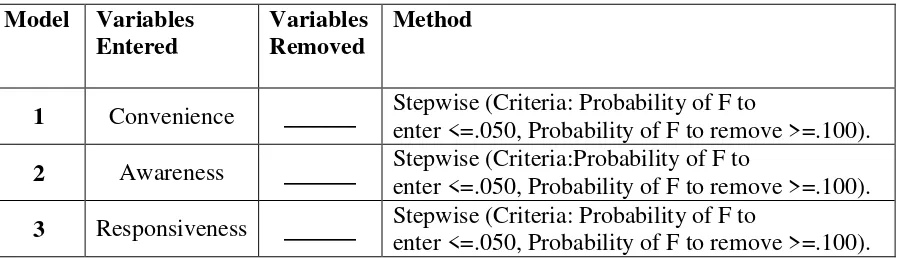
Table 2.1Variables Entered/ Removed (a)
Model Variables Entered
Variables Removed
Method
1 Convenience ______ Stepwise (Criteria: Probability of F to
enter <=.050, Probability of F to remove >=.100).
2 Awareness ______ Stepwise (Criteria:Probability of F to
enter <=.050, Probability of F to remove >=.100).
3 Responsiveness ______ Stepwise (Criteria: Probability of F to
enter <=.050, Probability of F to remove >=.100). a Dependent Variable: satisfactory level
Table 2.2
Model Summary
Model R R Square
Adjusted
R Square Std. Error of the Estimate
1 .555(a) .308 .304 .36510 2 .610(b) .372 .365 .34869 3 .638(c) .407 .398 .33954 a Predictors: (Constant), convenience
b Predictors: (Constant), convenience, awareness
c Predictors: (Constant), convenience, awareness, responsiveness
The adjusted R square value (.398) tells us that our model accounts for 39.8% of variance in the criterion variables. The model developed moderately fits into the population.
Table 2.3
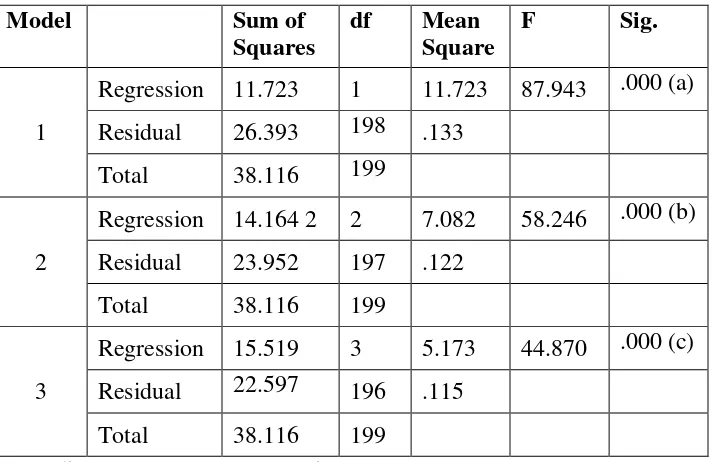
ANOVA (d)
Model Sum of
Squares
df Mean Square
F Sig.
1
Regression 11.723 1 11.723 87.943 .000 (a)
Residual 26.393 198 .133
Total 38.116 199
2
Regression 14.164 2 2 7.082 58.246 .000 (b)
Residual 23.952 197 .122
Total 38.116 199
3
Regression 15.519 3 5.173 44.870 .000 (c)
Residual 22.597 196 .115
Total 38.116 199
a Predictors: (Constant), convenience
b Predictors: (Constant), convenience, awareness
c Predictors: (Constant), convenience, awareness, responsiveness d Dependent Variable: satisfactory level
The result indicates that overall model is positively significant at f value=44.87 at 0.05 level of significance. This implies that the result is statistically significant.
Table 2.4
Coefficients (a)
Model Unstandardized
Coefficients
Standardized Coefficients
t Sig
B StdError Beta
1 (Constant) .737 .062 11.987 .000 convenience .508 .054 .555 9.378 .000 2 (Constant) .346 .105 3.283 .001 convenience .428 .055 .467 7.824 .000 awareness .317 .071 .268 4.481 .000 3 (Constant) .346 .103 3.377 .001 convenience .329 .061 .359 5.426 .000 awareness .250 .072 .211 3.484 .001 responsiveness .205 .060 .234 3.429 .001 a Dependent Variable: satisfactory level
[image:5.612.75.472.379.624.2]Table 2.5
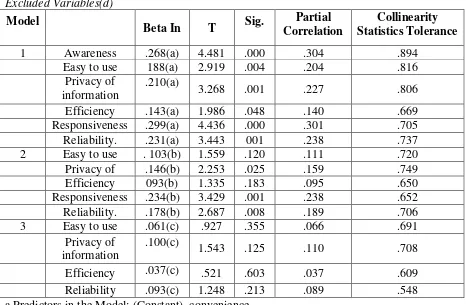
Excluded Variables(d)
Model
Beta In T Sig. CorrelationPartial Statistics ToleranceCollinearity
1 Awareness .268(a) 4.481 .000 .304 .894 Easy to use 188(a) 2.919 .004 .204 .816
Privacy of information
.210(a)
3.268 .001 .227 .806
Efficiency .143(a) 1.986 .048 .140 .669 Responsiveness .299(a) 4.436 .000 .301 .705 Reliability. .231(a) 3.443 001 .238 .737 2 Easy to use . 103(b) 1.559 .120 .111 .720
Privacy of information
.146(b) 2.253 .025 .159 .749 Efficiency 093(b) 1.335 .183 .095 .650 Responsiveness .234(b) 3.429 .001 .238 .652 Reliability. .178(b) 2.687 .008 .189 .706 3 Easy to use .061(c) .927 .355 .066 .691
Privacy of information
.100(c)
1.543 .125 .110 .708
Efficiency .037(c) .521 .603 .037 .609 Reliability .093(c) 1.248 .213 .089 .548 a Predictors in the Model: (Constant), convenience
b Predictors in the Model: (Constant), convenience, awareness
c Predictors in the Model: (Constant), convenience, awareness, responsiveness d Dependent Variable: satisfactory level
Table 3
Chi-square test:
Ho: There is no relationship between Age and Other factors. H1: There is relationship between Age and Other factors.
H2: There is no relationship between Occupation and Other factors. H3: There is relationship between Occupation and Other factors.
Age Occupation
Factors Significant value
Chi-square value
Chi-square value Awareness 0.05 0.615 0.014 Easy to use 0.05 0.084 0.250 Privacy of
information
0.05
0.852 0.024
[image:6.612.68.363.552.707.2]Convenience 0.05 0.005 0.325 Satisfactory
level 0.05 0.729
0.619
From the table the significant values is greater than 0.05 so the null hypothesis is
accepted. Hence we may conclude that the age has no relationship with other factors. From the table it is seen significant values is greater than 0.05 so the null hypothesis is accepted. Hence we may conclude that the occupation have no relationship with other factors expect efficiency. Only the efficiency factor value is lesser than 0.05, so the null hypothesis is not accepted. Therefore occupation has relationship with efficiency. That implies the occupation of the customer has inferred the perceived efficiency of e-banking.
ANOVA (One Way) and Correlation
Ho: All the factors equally influence the customer satisfaction level. H1: All the factors not equally influence the customer satisfaction level.
Using ANOVA, it was observed that the significant values is greater than the 0.05, so we accept the null hypothesis. That implies all the factors are equally influence the customer satisfaction level.
Ho: There is no relationship between age and other factors. H1: There is relationship between age and other factors.
Finding Correlation between Age and Other factors, awareness, responsiveness,
reliability, convenience are positively correlated with age and other are negatively correlated with age. It may be inferred that when age increase awareness, responsiveness, reliability, convenience also perceived as increasing the customer.
Ho: There is no relationship between occupation and other factors. H1: There is relationship between occupation and other factors.
Finding Correlation between Occupation and Other factors, only awareness is positively correlated with occupation and other are negatively correlated with occupation.
This implies the occupation has inferred the awareness level of the customer. Findings
The multi regression (step wise) analysis shows that the convenience, awareness and responsiveness together influences the satisfactory level at 80.4% whereas convenience alone by 55.5%. A unit change in this dimension will accounts for 80.4%
increases in customer satisfactory level.
The adjusted R square value (.398) tells that our model accounts for 39.8% of variance in the criterion variables. The model developed moderately fits into the population.
The researcher found that the age groups of 20-30 and 31-40 were more aware about e-banking. Similarly the business people and private employees were more aware about e-banking.
The hypothesis testing shows that the convenience is associated with the age. And also there is a relationship between occupation and efficiency. With the
increase of age, perceived convenience also increases and the occupation also has an impact on perceived efficiency.
There is a positive correlation between awareness and occupation. This shows that the business people and private employees were regular users of e-banking.
The analysis shows that all the factors equally influence the customer satisfaction. Suggestions
The banks may improve the satisfaction level by developing the technology to provide quick and fast access to their functions.
The public sector banks, may increase the satisfactory level by simplifying the process and the procedure in order to make easily understandable by all people, to meet the
competition from other banks,
The people less than 40 years of age are more aware about e-banking. As for elders the banks can create the awareness and clear their doubt and fear about the
e-banking process, so that they may get more depositors/customers to make their transaction through e-banking.
Mostly the business and private employees are using and aware about e-banking, so the banks can provide some additional/extra privilege to these customers.
The banks to get more number of customer to using e-banking, may advertise about the schemes and proper usage of the technology.
The banks may improve the satisfactory level in e-banking by introducing 24 hours customer services system. Through that system the customer can easily& immediately solve their problems.
Conclusion
The customer satisfaction is the major factor contributing to the success of service sectors. E -banking has become a major facility sought after by the existing and potential customers. The banks have to increase the awareness about e-banking technology, so that customers can get better service. The sufficient services available may be improved to give better customer
satisfaction leading to retention of existing customers and attracting new customers. All the service sectors depend on customer and their satisfaction and the banks are no exception. References
Hamlet(2000) “Community Banks go Online,” American Bankers Association. ABA Banking Journal, Vol. 92,
No. 3, pp 61-65
Journal of the Association for Information Systems,(2000) Vol. 1, pp. 1-42
Karjaluoto et al(2002), “Factors Underlying Attitude Formation towards Online Banking in Finland”, The
International Journal of Bank Marketing, Vol. 20, No. 6, pp. 261-272
Lassar et al(2005), “The Relationship between Consumer Innovativeness, Personal Characteristics, and Online
Banking Adoption,” International Journal of Bank Marketing, Vol. 23, No. 2, pp. 176-199. Martin(1998),”Goodbye to Bankers’ Hours”, Management Review, Vol. 87, No. 1, pp. 33-37. McGann(2005), “Online Banking Increased 47 Percent Since 2005”, article.php/3481976, September 23, 2005.
Mukherjee and Nath, “A Model of Trust in Online Relationship Banking”,
Pikkariaen et al. (2004), “Consumer Acceptance of Online Banking: an Extension of the Technology Acceptance
Rotchanakitumnuai and Speece (2004), “Corporate Customer Perspectives on Business Value of Thai Internet
Banking”, Journal of Electronic Commerce Research, Vol. 5, No. 4, pp. 270-286.
Tan and Teo(2003), “Factors Influencing the Adoption of Internet Banking,” The International Journal of Bank
Marketing, Vol. 21, No. 1, pp. 5-15.
Share Journal of Multidisciplinary Research and Studies Vol. 2 • No. 1 • Jan-Mar. 2011