
Munich Personal RePEc Archive
An Equilibrium Model of the Term
Structure of Interest Rates: Recursive
Preferences at Play
Gonzalez-Astudillo, Manuel
Escuela Superior Politecnica del Litoral
10 December 2009
Online at
https://mpra.ub.uni-muenchen.de/19153/
An Equilibrium Model of the Term Structure of Interest
Rates: Recursive Preferences at Play
Manuel Gonzalez-Astudillo
∗Department of Economics, Indiana University
December 10, 2009
Abstract
In this paper we analyze the performance of an equilibrium model of the term structure of the interest rate under Epstein-Zin/Weil preferences in which consumption growth and inflation follow a VAR process with logistic stochastic volatility. We find that the model can successfully reproduce the first moment of yields and their persistence, but fails to reproduce their standard deviation. The filtered stochastic volatility is a good indicator of crises and shows high persistence, but it is not enough to generate a slowly decaying volatility of yields with respect to maturity. Preference parameters are estimated to be about 4 for the coefficient of relative risk aversion and infinity for the elasticity of intertemporal substitution.
Keywords: Yield curve; Recursive preferences; Logistic stochastic volatility; Nonlinear Kalman filter; Quadrature-based methods.
JEL Classification Numbers: E43, G12, C32.
1
Introduction
The literature on equilibrium models of the term structure of interest rates has
empha-sized matching primarily three stylized facts of the yield curve as one way to evaluate the
performance of the models: 1) an upward sloping average term structure, 2) a slowly
de-caying volatility with respect to maturity, and 3) varying term premia. Examples include,
among others, Backus et al. (1989), Donaldson et al. (1990), Pennacchi (1991), Boudoukh
(1993), Backus and Zin (1994), Canova and Marrinan (1996), and, more recently, Piazzesi
and Schneider (2006), Wachter (2006), Gallmeyer et al. (2007), and Doh (2008). The more
recent literature focuses on incorporating alternative preferences with respect to the power
utility case. This study examines how good an equilibrium model of the term structure
of nominal interest rates is for reproducing the moments of yields under Epstein-Zin/Weil
preferences and persistent stochastic volatility in inflation.
We model consumption growth and inflation as a VAR(3) process with stochastic
volatil-ity in inflation (SV-VAR hereupon). We specify the lag order at three based on various
lag selection criteria, and justify volatility in inflation given the results of heteroscedasticity
tests performed on the homoscedastic version of the model. Volatility is modeled as a logistic
function of a unit root process like in Lee (2008). We estimate the model by maximum
like-lihood and, given the nonlinearity relating observables and non-observables, we numerically
integrate densities to obtain the likelihood function.
Park (2002) shows that a nonlinear nonstationary heteroscedasticity generated by an
asymptotically homogeneous function, like the logistic function, has a long memory. Another
property of this type of heteroscedasticity is that it generates sample kurtosis with truncated
supports, unlike an exponential stochastic volatility model in which volatility may explode
if the process is too persistent. By having this specification for volatility, we can incorporate
a persistent factor into the model to generate a slowly decaying volatility of yields with
respect to maturity, as pointed out by Gallmeyer, Hollifield, Palomino and Zin (2007) (GHPZ
Campbell and Shiller (1991). Given the form of the logistic function, volatility is bounded
between “high volatility” and “low volatility” regimes, with a transition stage corresponding
to a “middle volatility” regime in which agents can not anticipate with certainty where the
economy will end up. This setup is compatible with Epstein-Zin/Weil preferences, as noted
by Kim et al. (2008), because agents would prefer an early resolution of uncertainty under
certain value of preference parameters, as observed by Epstein and Zin (1991).
As noted in Piazzesi and Schneider (2006) (PS hereupon), negative linear relationships
between unanticipated inflation and consumption and between anticipated inflation and
consumption, along with recursive preferences, are needed to generate an upward sloping
yield curve. The SV-VAR is able to incorporate these possibilities, and results show a
negative correlation between unexpected inflation and consumption growth, as well as a
negative linear relationship between anticipated inflation and future consumption growth.
We feed the pricing kernel corresponding to Epstein-Zin/Weil preferences with estimates
from the SV-VAR to price bonds using the recursive pricing equation. Preference
param-eters, i.e., elasticity of intertemporal substitution and coefficient of relative risk aversion,
are estimated by the simulated method of moments where we use the average of historical
yields as moment conditions. Unlike previous studies where recursive preferences have been
incorporated, we do not assume an affine structure for the pricing kernel like in GHPZ and
Doh (2008), or a particular value for a preference parameter like in PS. In order to solve for
the conditional expectation to price bonds, we recur to numerically integrate this expression
using the approach shown in Tauchen and Hussey (1991).
Results show that the model can successfully reproduce the average term structure, the
10-year bond term premium, as well as the first order autocorrelation of yields, but fails to
reproduce their standard deviation. We argue that the reason for which the model does not
perform as expected with respect to the volatility of yields resides in the numerical
integra-tion technique. Since the integraintegra-tion uses Markov transiintegra-tion probabilities to compute the
pro-cess, these transition probabilities are dominated by the stationary component even though
the stochastic volatility process is highly persistent.
The structure of this document is as follows: Section 2 describes the model to price bonds
in equilibrium, Section 3 shows the estimation methodology of the SV-VAR and estimation
results, Section 4 explains the methodology to estimate preference parameters along with the
numerical integration technique, the way to simulate yields, and discusses results. Finally,
Section 5 concludes. Details of derivations are shown in an Appendix.
2
The Model
We consider an endowment economy populated by a representative investor in which
endowment (et) and inflation (πt) are exogenously given. This section illustrates the setup
for the valuation of real and nominal bonds under recursive preferences and under a stochastic
volatility VAR(p) specification for the exogenous processes.
2.1
Preferences
We assume an exchange economy in which a representative agent chooses her consumption
level to maximize the recursive utility function proposed by Epstein and Zin (1989). Given a
sequence of consumption {ct, ct+1, ct+2, ...} with random realizations of future consumption,
the intertemporal utility function, Ut, is the solution to the recursive equation,
Ut = [(1−β)cρt +βµt(Ut+1)ρ]1/ρ,
where 0< β < 1 is the discount factor,ρ61 is a preference parameter measuring the degree
of intertemporal substitution (the elasticity of intertemporal substitution, EIS hereupon, for
random future utility is
µ(Ut+1)≡Et[Utα+1]
1
α,
whereα 61 measures the risk aversion in a static framework (the coefficient of relative risk
aversion for static lotteries is 1−α). The intertemporal marginal rate of substitution, Mt+1,
is given by
Mt+1 =β
µ
ct+1
ct
¶ρ−1µ
Ut+1
µt(Ut+1)
¶α−ρ
. (1)
Notice that when the coefficient of relative risk aversion is equal to the inverse of the EIS,
i.e.,α =ρ, the marginal rate of substitution reduces to the one obtained under power utility.
2.2
Exogenous processes setup
We consider a VAR(p), with p finite, as the specification of the stochastic process for
the rate of growth of the endowment and inflation. We also introduce stochastic volatility
in the innovations of the VAR(p). Following Boudoukh (1993), we assume that there is
stochastic volatility in inflation only. This assumption is consistent with the analysis shown
in PS about expected and unexpected inflation being a carrier of bad news, and the effect
of inflation on bond prices. Denote
zt+1 =
gt+1
πt+1
.
Then our assumptions imply
zt+1 =Φ0+
p
X
l=1
Φlzt+1−l+ε∗
where Φ0 is a 2 × 1 vector of parameters, Φl is a 2 × 2 matrix of parameters for l = 1,2, . . . , p, andε∗t+1 = [ε∗g,t+1, ε∗π,t+1]′ are the innovations in endowment growth and inflation,
respectively. Here we assume that vart(ε∗
t+1) is not constant and that it depends on a non
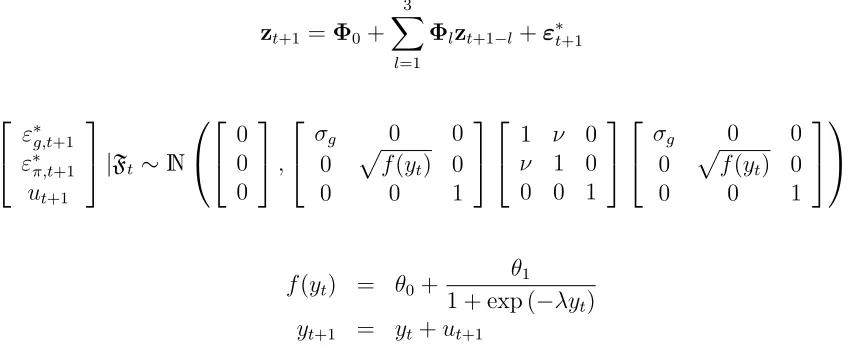
observable nonstationary factor. More specifically, we assume
F(yt) =
σg 0
0 pf(yt)
,
and follow Lee (2008) to make f(y) = θ0 + 1+exp (θ1−λy), with θ0 > 0, θ1 > 0, λ > 0, yt+1 =
yt+ut+1, and
εg,t+1
επ,t+1
ut+1
|Ft∼iidN
0 0 0 ,
1 ν 0
ν 1 0
0 0 1 , (2)
where ε∗t+1 = F(yt)εt+1, with εt+1 = [εg,t+1, επ,t+1]′, Ft = σ({zs}ts=0) is the information
available at time t, and |ν| ≤1.
Under this stochastic volatility setup, we model volatility as a logistic function of a unit
root process, which implies that volatility is bounded and has a smooth transition between
two regimes: low volatility (θ0) and high volatility (θ0 +θ1), while the smoothness of the
transition is measured by the coefficientλ. Lee (2008) mentions this characteristic as opposed
to what happens with an exponential stochastic volatility model, in which volatility would
explode if there is enough persistence in it. Also, the smooth transition along with the
nonstationary latent factor {yt} allow for volatility clustering. Additionally, Park (2002)
shows that this type of nonlinear heteroscedasticity has sample kurtosis with truncated
supports. On a related matter, Kim et al. (2008) points out that since agents dislike the
uncertainty that arises when volatility is in between of the two regimes, because they would
The SV-VAR has some advantages with respect to other models used in the literature of
term structure of interest rates with recursive preferences and/or stochastic volatility. First,
we assume that the lag order of the VAR is finite, as opposed to the invertible VARMA(1,1)
proposed by PS. Second, we allow for the lag order of SV-VAR to be greater than one,
extending the setup in Boudoukh (1993).
2.3
Pricing bonds
In this section we use the intertemporal marginal rate of substitution to price bonds
under the SV-VAR specification for endowment growth and inflation rates. It is important
to point out that we do not make any assumption about the value of the EIS, as opposed to
PS, who set this coefficient to unity.
2.3.1 Real bond pricing
Recalling the pricing equation for bonds, we have that if the price, in consumption units,
att of a bond of maturity n is denoted by Qn,t, then
Qn,t=Et(Mt+1Qn−1,t+1) (3)
In equilibrium, the real pricing kernel is given by (1) with ct=et and Vt being the value of
utility. Consequently, the (log of the) pricing kernel in equilibrium is given by
lnMt+1 = lnβ+ (ρ−1)gt+1+ (α−ρ) (lnVt+1−lnµt(Vt+1)), (4)
where gt+1 ≡ ln(et+1/et) is the endowment growth rate between t and t+ 1. To obtain a
fully parametric (and able to be simulated) expression for the (log of the) pricing kernel, we
follow GHPZ. We obtain the following result, whose derivation appears in the Appendix:
where the approximation follows because of the linear approximation that we made to the
logistic function. At is an expression that includes preference parameters, parameters from
the SV-VAR and variables at t. v1, w1 and vf are parameters from the (log of the scaled)
value function which, in turn, are functions of the preference parameters and parameters from
the SV-VAR. Again, if α = ρ, we return to the conventional real pricing kernel obtained
from a power utility setup.
2.3.2 Nominal bond pricing
Since the pricing equation (3) must hold for real prices of nominal bonds, we have
Q$
n,t
Pt
=Et
Ã
Mt+1
Q$n−1,t+1
Pt+1
!
,
whereQ$
n,tdenotes the nominal price attof a bond maturingnperiods ahead, andPtdenotes
the price of the consumption good at t. Therefore, we can write
Q$n,t=Et
¡
Mt$+1Q$n−1,t+1¢
, (6)
where the (log of the) nominal pricing kernel is given by
lnMt$+1 = lnMt+1−πt+1.
From the structures of the real and the nominal pricing kernels, we can see that the properties
of inflation influence the price of nominal bonds. Let us analyze the effects of inflation on
the real pricing kernel (5). First, under the power utility setup, the effect of inflation on
the pricing kernel is weighted by the EIS only (or the coefficient of relative risk aversion).
Second, under recursive preferences, inflation not only enters the pricing kernel weighted by
the EIS, but also by the difference between the coefficient of relative risk aversion and the
is determined by the difference between the coefficient of relative risk aversion and the EIS
too.
3
SV-VAR Estimation
In this section we proceed to estimate the parameters of the SV-VAR which will serve as
inputs for the estimation of preference parameters which, in turn, will allow us to simulate
the term structure of interest rates.
To estimate the model presented in section 2.2 we use annualized quarterly consumption
growth and inflation covering the period 1952:1 - 2008:3. We specify consumption as real
per capita consumption of nondurables and services as reported by the Bureau of Economic
Analysis. Data on the consumer price index (CPI) are from the Bureau of Labor Statistics
of the U.S. Department of Labor.
3.1
VAR lag selection and heteroscedasticity
In order to proceed with the estimation of the SV-VAR model we need to offer an adequate
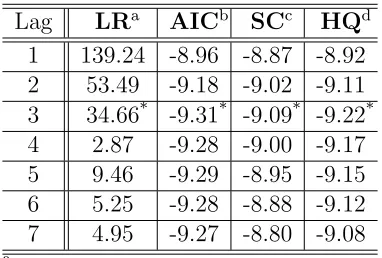
specification for the conditional mean vector of consumption growth and inflation. Table 1
reports values of four different lag order selection criteria of a homoscedastic VAR: Sequential
Modified LR, Akaike IC, Schwarz IC and Hannan-Quinn IC. The optimal lag order is 3,
according to all the criteria used. Additionally, with this lag order we do not reject the null
hypothesis of absence of serial correlation in the error term at the 1% level of significance.
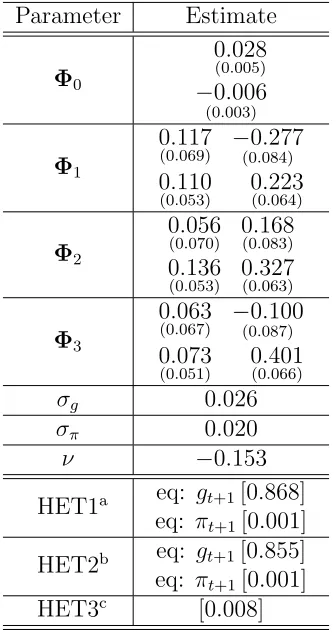
With the lag order set to 3 we proceed to estimate a homoscedastic VAR in order to
test for varying conditional variance. Table 2 shows results of the estimation as well as the
heteroscedasticity tests performed: ARCH LM test in each equation of the VAR,
single-equation White test, and joint White test. The first two tests reject the null hypothesis
of homoscedasticity in inflation but not in consumption growth at conventional significance
variance covariance matrix. All these results support our setup for the SV-VAR model with
respect to the assumption of including stochastic volatility in the inflation equation only.
3.2
Maximum likelihood estimation of the SV-VAR
We estimate parameters of the SV-VAR by maximum likelihood, using a nonlinear
Kalman filter to obtain the appropriate densities. Tanizaki (1996) shows how to construct
the prediction, updating and smoothing steps. First, notice that
zt+1|yt,Ft,Θ ∼ N
à Φ0+
3
X
l=1
Φlzt+1−l,Ω(yt)
!
(7)
yt|yt−1,Ft,Θ d
=yt|yt−1,Θ ∼ N(yt−1,1),
where Ω(yt) =F(yt)ΓF(yt), Θ is the parameter space, and Γ is the upper left 2×2 block of
the variance-covariance matrix in (2).
The maximum likelihood estimator is given by
ˆ
Θ = arg max
Θ
l(z1, . . . ,zn|Θ),
where l(z1, . . . ,zn|Θ) =
n
X
t=1
lnp(zt|Ft−1,Θ), and
p(zt|Ft−1,Θ) = Z
p(zt, yt−1|Ft−1,Θ)dyt−1
= Z
p(zt|yt−1,Ft−1,Θ)p(yt−1|Ft−1,Θ)dyt−1.
In order to integrate out the non observable and non stationary variableyt, we proceed to
numerically integrate the densities in which it appears. To that end, we apply the approach
used in Lee (2008) and described in extent in the Appendix along with details about the
prediction and updating steps of the filter. Results of the estimation are shown in Table 3.
are very similar to those obtained from the homoscedastic VAR(3) in Table 2. Regarding
parameters of the conditional volatility, all of them are statistically significant (positive) at
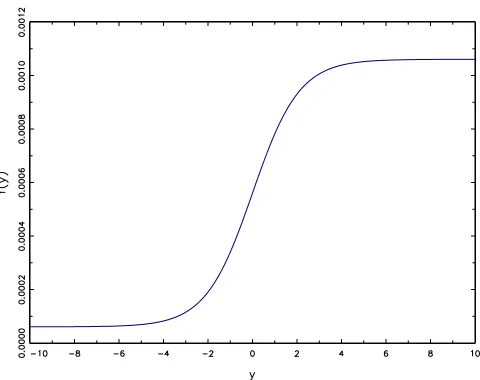
the 5% level of significance. In particular, given these estimates, the shape of the logistic
function is shown in Figure 1. The figure shows the smooth transition from the low volatility
regime to the high volatility one. The transition is determined by the parameter λ, which
is close to one, implying a transition smooth enough to make agents dislike a scenario of
moderate volatility because they do not know where the economy will end up, as mentioned
previously.
From the estimation of the SV-VAR, and by making use of a non linear Kalman filter,
we obtain the filtered volatility, which appears in Figure 2 along with the short rate and the
NBER recession periods. The graph shows that volatility is indeed highly persistent. It also
shows a highly volatile period between the second half of the 1970s and during the 1980s.
There is also a low volatility regime which corresponds to the period between the early 1990s
until the early 2000s. It is also evident an increase in volatility at the end of the present
decade due to the effects of the current crisis. In fact, volatility increases every time that a
recession affects the economy, except for one crisis episode at the beginning of the sample.
When comparing time series of the filtered volatility with those of the short-term nominal
interest rate, we can see that there is a positive covariation between them, except for the
period between the early 1990s and the mid 2000s. This is a sign that our volatility setup
could help capture salient features of interest rates 1 along with the other factors used here,
namely, consumption growth and inflation.
4
Implications for bond yields
We describe the methodology for preference parameters estimation as well as comparisons
with results in other studies of equilibrium modeling of the term structure in Section 4.1. In
Section 4.2 we discuss the term structure implications of the model. In Section 4.3 we show
the model performance with respect to reproducing time series characteristics of the short
term yield and the yield spread. Here we use yields of maturities 1, 4, 8, 12, 20, 28 and 40
quarters. Data up to 1991 are from McCulloch and Kwon (1993), then we use yields on U.S.
Treasury securities at constant maturities reported by the Federal Reserve Bank.
4.1
Preference parameter estimation
Besides parameters involving preferences towards risk (α) and preferences towards
in-tertemporal allocations of consumption (ρ), we have additional parameters involved in the
(log of the) pricing kernel. The parameters under discussion include the discount factor, β,
and other parameters related to the (log of the scaled) value function, namely, v1, w1, and
vf, as well as other that appear inAtand that are related to the value function too (they are
denoted v2, v3, w2, andw3). Given α and ρ, these eight additional parameters are obtained
from a system of nonlinear equations designed to match the mean of the short-term interest
rate. The system of equations is shown in detail in the Appendix.
Regarding the preference parameters α and ρ, we estimate them so that the mean of
the yields produced by our model match as closely as possible the observed average term
structure. To that end, we make use of the simulated method of moments firstly introduced
by Lee and Ingram (1991), and extended by Burnside (1993) to the numerical solution to
asset pricing models proposed by Tauchen and Hussey (1991).
Before proceeding to the estimation of preference parameters we notice that, given the
nature of the logistic function assumed for volatility, we can define the process{ft+1}∞t=−∞≡
{f(yt+1)}∞t=−∞ with a well defined conditional density function,p(ft+1|ft), since the Markov
property of the process {yt}∞t=−∞ is inherited by {ft+1}∞t=−∞ because f(·) is bijective. We
show the expression for p(ft+1|ft) in the Appendix. This step is important because it allows
us to restrict the range of an integration from (−∞,∞) to an integration on (θ0, θ0 +θ1),
which is bounded.
is a function of zt+1, ft+1, st, and ft, the nominal pricing kernel is also a function of these
variables. We write M$(z
t+1, ft+1,st, ft) to express the dependence of the nominal pricing
kernel on the mentioned variables. Therefore, the pricing equation (6) implies that nominal
bond prices are functions of st and ft only:
Q$n,t=Hn(st, ft),
with H0(st, ft) = 1 ∀t, and
Hn(st, ft) = EtM$(zt+1, ft+1,st, ft)Hn−1(st+1, ft+1) (8)
= Z ∞
−∞
Z θ0+θ1
θ0
M$(zt+1, ft+1,st, ft)Hn−1(st+1, ft+1)p(zt+1, ft+1|st, ft)dft+1dzt+1.
Further, we notice that the conditional density involved in the integration can be written as
follows:
p(zt+1, ft+1|st, ft) = p(zt+1|st, ft, ft+1)p(ft+1|st, ft)
= p(zt+1|st, ft)p(ft+1|ft),
where passing from the first to the second identity is done becausezt+1|Ft, ft is independent
of ft+1, as shown in (7), and because {ft+1}∞t=−∞ is first-order Markov.
We also point out that there is an integration across three dimensions involved in (8).
Tauchen and Hussey (1991) suggests using a Gaussian quadrature method to discretize the
space of the state variables in order to write
Hn(sj, fl) = Nz
X
i=1
Nf
X
k=1
with
Πji,l = Prob{zt+1 =zi|st=sj, ft=fl}
Πlk = Prob{ft+1 =fk|ft =fl},
where j = 1,2, . . . ,Nzˆ ,l = 1,2, . . . , Nf, and ˆNz =Nz3. Here Nf and ˆNz denote the number
of quadrature abscissa points.2 We assume the same number of abscissa points for each of the
variables in the VAR, which is 5, makingNz= 25 and ˆNz= 15,625. Furthermore, we assume
Nf = 6, making the total number of abscissa points ˆNz×Nf = 93,750. In the Appendix we
discuss the approach of Tauchen and Hussey to obtain the transition probabilities.
In order to obtain an extension from the discrete-space solution (9) to the
continuous-space solution, we use step functions. Burnside (1999) points out that any Gaussian
quadra-ture rule divides the real line for each of the variables into non-overlapping segments,
there-fore we can extend the discrete-space solution to any s ∈ R3 and f ∈ (θ0, θ0 +θ1). In the
Appendix we discuss how to obtain this result.
Once we are able to obtain yields for different maturities from the model, we proceed to
estimate preference parameters by the simulated method of moments whose setup is shown
in the Appendix. For the moments we choose the means of yields, that is, we have 7 moment
conditions. Results of the estimation are shown in Table 4.
These results imply that the coefficient of relative risk aversion is approximately 4, while
the EIS is infinite. As mentioned before, β is estimated to match the average short-term
interest rate. The value of the coefficient of risk aversion is lower (and significantly lower in
some cases) compared to those obtained in the literature of term structure modeling with
recursive preferences. Values range from 5-7 in GHPZ, 16-17 in Doh (2008), and 43-85 in
PS. The value of the coefficient of EIS in this study is the same as the one obtained in
2Notice that the value for the abscissa points as well as the weights of the quadrature depend on the
GHPZ, much higher than the unity coefficient assumed in PS, and the estimated coefficient
in Doh (2008), which is in the range 1.4-1.6. We notice that, since γ > 1
ψ, meaning that
agents prefer an early resolution of uncertainty, our volatility setup is compatible with the
preferences used in this study.
PS needs the risk aversion coefficient to be in the mentioned range because, given that
the EIS is set to unity, the only way to generate a positive expected excess return is by
giving an important weight to the negative covariance between inflation and expected future
consumption growth. The mechanism that allows PS and our work to have a positive excess
return has to do with the fact that higher inflation rates (that affect real payoffs of nominal
bonds, particularly long bonds) bring news about lower expected consumption growth rates
and, since the real payoff of long bonds is lower in bad times and agents prefer an early
resolution of uncertainty, the required premium on these bonds increases compared to short
bonds.
With respect to the EIS parameter, we point out that the higher it is, the less demand
for smoothing consumption over time. Increasing the EIS decreases the demand for
long-term real bonds to smooth consumption, leading to a higher required real premium on these
bonds. The fact that the EIS is high allows us to reproduce more satisfactorily the slope of
the term structure. Epstein and Zin (1991) mentions the infinite-elasticity case as the case
in which the C-CAPM reduces to the static CAPM, and points out that the static CAPM
emerges due to the perfect substitutability of consumption across time.
4.2
Term structure implications
We obtain time series for each of the yields with the same time horizon as the sample
data, 1952:1 to 2008:3, using the same step functions that allowed us to extend the
discrete-space solution to the continuous-discrete-space one. That is, we consider the consumption growth
rate, inflation rate and filtered volatility of a particular quarter and choose the yield for
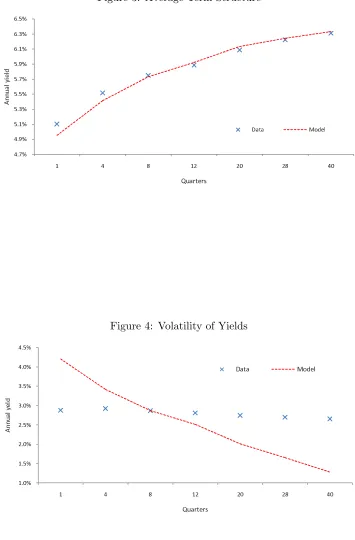
we show averages, standard deviations and first order autocorrelations of yields. The model
reproduces satisfactorily the average term structure but fails to reproduce the volatility of
yields. Particularly, the simulated yields’ volatilities decay in an exponential fashion with
respect to maturity, as opposed to the slowly decaying volatilities of observed yields. This
sharp decay is observed despite the introduction of a persistent factor for explaining yields,
which is the stochastic volatility. Figure 3 and Figure 4 show the average term structure and
the standard deviation of yields of both the observed and simulated data. The persistence of
the different yields, however, is satisfactorily reproduced by the model and here persistence
of the stochastic volatility process plays a fundamental role.
The reason for which the model is incapable of reproducing the slowly decaying
stan-dard errors of yields lies in the way the pricing equation (8) is computed. Here we use the
numerical integration technique suggested by Tauchen and Hussey (1991) and divided the
conditional density inside the integration into the product of two conditional densities: the
conditional density for the stationary processes, namely consumption growth and inflation,
and the conditional density for stochastic volatility, which is highly persistent. When
com-puting the numerical integral, we transform these densities into transition probabilities, and
the transition probabilities corresponding to consumption growth and inflation dominate the
transition probabilities for stochastic volatility, making the solution look like as if it came
from a purely stationary exogenous process. This situation can be more easily seen when
looking at equation (9), where the product of the two transition probabilities appears
explic-itly. Affine models of the term structure of interest rates under Epstein-Zin/Weil preferences
do not have this kind of problem because they can be solved explicitly by either assuming
that no correlation exists between consumption growth and inflation like in GHPZ, or by
4.3
Time series implications
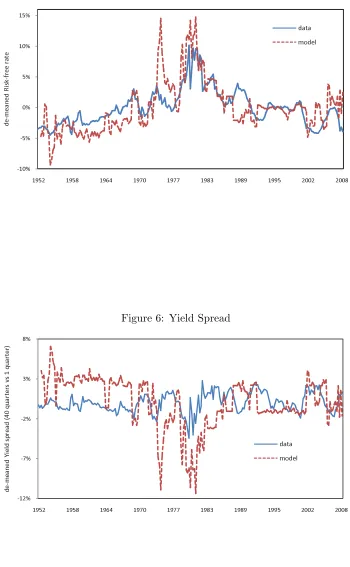
Figure 5 shows time series of the nominal yield on the three-month bond obtained from
the model and from observed data (both de-meaned). The simulated rate (dashed line) shows
more variability than the observed rate (solid line), but the model is able to satisfactorily
reproduce many of the movements in the short interest rate, except for a slight deviation
at the beginning of the 1990s and also at the end of the considered sample. The overall
correlation between the observed and the simulated rate is 0.73.
In Figure 6 we show the term spread of the 10-year bond with respect to the 3-month
bond. The simulated yield spread is more variable than the observed spread and the model
predicts a higher spread before the 1970s and a lower term spread during the 1970s than
what is observed. However, towards the end of the sample the model does a reasonable job
describing movements in the term spread. The overall correlation between the observed and
the simulated term spread is 0.14.
5
Conclusions
This paper presents an equilibrium model of the term structure of interest rates with
Epstein-Zin/Weil preferences and an exogenous process that includes logistic stochastic
volatility. The model’s performance is very reasonable with respect to matching the first
moment of the term structure of interest rates and the persistence of yields. The model,
however, is not good at reproducing the slowly decaying standard errors of yields with respect
to maturity. This last shortcoming occurs despite of the highly persistent stochastic
volatil-ity introduced as an additional factor to explain yields. The reason for the failure of the
model at explaining the standard deviation of yields lies in the way the numerical integration
to solve for the pricing equation is performed. Since the joint density inside the integration
can be split into the product of the conditional density for the stationary processes, namely
of the two is dominated by the first stationary conditional density, regardless of volatility’s
persistence.
The estimated preference parameters imply an infinite elasticity of substitution between
present and future consumption, whereas the coefficient of relative risk aversion toward static
lotteries is about 4. These estimates can be seen as an argument in favor of our volatility
specification (given that γ > ψ1), since agents prefer an early resolution of uncertainty and our volatility function does not reveal the ending state if the initial volatility state is of
medium uncertainty.
One future line of research is to consider a semi-affine specification for the pricing kernel,
in the line of Duarte (2004), which is a flexible form that would allow us to incorporate
the covariance between consumption growth and inflation and, at the same time, avoid a
numerical integration to price bonds.
Another future line of research is to incorporate specifications of monetary or fiscal policy
6
Appendix
6.1
Derivation of the pricing kernel
In order to obtain equation (5), we need to make a linear approximation of the logistic function around some value ¯f ∈(θ0, θ0+θ1). We obtain
f(yt+1)≈f(yt) + ¯θut+1,
where ¯θ= λ(f¯θ−1θ0) ¡
θ0+θ1−f¯
¢
> 0. Also
p
f(yt)≈
1 2
à q
¯
f+ fp(yt) ¯
f
!
.
From here on, we follow Gallmeyer et al. (2007) in the derivations. By homogeneity of
µt(·) we can write
Vt
et
= ·
(1−β) +βµt
µ
Vt+1
et+1
× et+1
et
¶ρ¸1ρ
.
Taking logs and defining vt= ln (Vt/et), we have
vt=
1
ρln [(1−β) +βexp (ρµ˜t)],
where ˜µt ≡ln (µt(exp (vt+1+gt+1))).
Approximating vt around ˜µt= ¯m yields
vt≈η0+η1µ˜t,
where
η0 =
1
ρln [(1−β) +βexp (ρm¯)]−
βexp (ρm¯)
1−β+βexp (ρm¯)m¯,
η1 =
βexp (ρm¯)
1−β+βexp (ρm¯), 0< η1 <1.
If we evaluate at ¯m= 0, these expressions imply η0 = 0, η1 =β.
In order to parameterize the log of the value function, conjecture that
which implies that
vt+1+gt+1 = ¯v+ (1 +v1)gt+1+v2gt+v3gt−1+w1πt+1+w2πt+w3πt−1+vff(yt+1) ≈ ¯v+ (1 +v1)gt+1+v2gt+v3gt−1+w1πt+1+w2πt+w3πt−1+ (11)
+vf
¡
f(yt) + ¯θut+1
¢
.
Taking conditional expectation and variance on (11), we obtain
Et(vt+1+gt+1) ≈ ¯v+ (1 +v1)Etgt+1+v2gt+v3gt−1 +w1Etπt+1+w2πt+w3πt−1+vff(yt),
vart(vt+1+gt+1) ≈ (1 +v1)2σg2+w12f(yt) + 2 (1 +v1)w1νσg
p
f(yt) +vf2θ¯2
≈ (1 +v1)2σg2+w12f(yt) + (1 +v1)w1νσg
à q
¯
f +fp(yt) ¯
f
!
+vf2θ¯2
= (1 +v1)2σg2+
Ã
w21+ (1 +vp1)w¯1νσg
f
!
f(yt) + (1 +v1)w1νσg
q ¯
f+vf2θ¯2.
Since vt+1+gt+1 is normally distributed conditional on the information available att, we
have
˜
µt=Et(vt+1+gt+1) +
α
2vart(vt+1+gt+1), then
˜
µt ≈ v¯+ (1 +v1) Φ01+w1Φ02+
α
2 ·
(1 +v1)2σ2g+ (1 +v1)w1νσg
q ¯
f +v2fθ¯2
¸ +
+h(1 +v1) Φ(1)11 +v2 +w1Φ(1)21
i
gt+
+h(1 +v1) Φ(2)11 +v3 +w1Φ(2)21
i
gt−1+
+h(1 +v1) Φ(3)11 +w1Φ(3)21
i
gt−2+
+h(1 +v1) Φ(1)12 +w1Φ(1)22 +w2
i
πt+
+h(1 +v1) Φ(2)12 +w1Φ(2)22 +w3
i
πt−1 +
+h(1 +v1) Φ(3)12 +w1Φ(3)22
i
πt−2+
+ "
vf +
α
2 Ã
w21+ (1 +vp1)¯w1νσg
f
!#
f(yt),
where Φ(ijl) is the element (i, j) ofΦl fori= 0,1,2, j = 1,2, andl = 0,1,2,3. Now, by using
vt ≈η0+η1µ˜t, (10), and η0 = 0, η1 =β, we can get ¯v, v1, v2,v3, w1, w2,w3.
Recall that
˜
µt ≈ v¯+ (1 +v1)Etgt+1+v2gt+v3gt−1+w1Etπt+1+w2πt+w3πt−1+vff(yt) +
+α 2
h
(1 +v1)2σg2+w21f(yt) + 2 (1 +v1)w1νσg
p
f(yt) +vf2θ¯2
i
and
lnVt+1−lnµt(Vt+1) =vt+1+gt+1−µ˜t,
therefore we have
lnVt+1−lnµt(Vt+1) ≈ (1 +v1) (gt+1−Etgt+1) +w1(πt+1−Etπt+1) +vf(f(yt+1)−f(yt))−
−α
2 h
(1 +v1)2σg2+w12f(yt) + 2 (1 +v1)w1νσg
p
f(yt) +v2fθ¯2
i
. (12)
Replacing (12) into (4) we obtain the real pricing kernel
lnMt+1 ≈ lnβ−(α−ρ)At+ [(ρ−1) + (α−ρ) (1 +v1)]gt+1+ (α−ρ) [w1πt+1+vff(yt+1)],
where
At = (1 +v1)Etgt+1+w1Etπt+1+vff(yt) +
+α 2
h
(1 +v1)2σ2g+w12f(yt) + 2 (1 +v1)w1νσg
p
f(yt) +vf2θ¯2
i
,
To obtain the nominal short-term interest rate, we need to get expressions forEt(lnMt+1−
πt+1) andvart(lnMt+1−πt+1) which, by the log-normality of the pricing kernel, allow us to
write
r$
t+1 ≈ −lnβ+ (1−ρ)Etgt+1+Etπt+1−
−1
2{σ˜
2
t −(α−ρ)α[(1 +v1)2σg2+w21f(yt) + 2(1 +v1)w1νσg
p
f(yt) +vf2θ¯2]},
where
˜
σt2 = [(ρ−1) + (α−ρ) (1 +v1)]2σ2g+ [(α−ρ)w1 −1]2f(yt) + (α−ρ)2vf2θ˜2+
+2 [(ρ−1) + (α−ρ) (1 +v1)] [(α−ρ)w1−1]νσg
p
f(yt).
6.2
Filtering procedure for the SV-VAR estimation
For the prediction step, we have3
p(yt|Ft,Θ) =
Z
p(yt, yt−1|Ft,Θ)dyt−1
= Z
p(yt|yt−1,Ft,Θ)p(yt−1|Ft,Θ)|, dyt−1
= Z
p(yt|yt−1,Θ)p(yt−1|Ft,Θ)dyt−1.
3Notice that, due to the nature of how the information is revealed,
p(yt|Ft) refers to the density of
the prediction, whilep(yt|Ft+1) is the density for the updating step, oncezt+1 (and its variance) has been
For the updating step, we have
p(yt|Ft+1,Θ) = p(yt|zt+1,Ft,Θ)
= p(yt,zt+1|Ft,Θ)
p(zt+1|Ft,Θ)
= p(zt+1|yt,Ft,Θ)p(yt|Ft,Θ)
p(zt+1|Ft,Θ)
.
Regarding the estimation strategy, we need to numerically integrate the densities in order to proceed to the maximization of the log-likelihood function. However, since the state variable may show high persistence, we will follow Lee (2008) to make the Gauss-Legendre quadrature rule depend on the previous value of the state. For the prediction step, we assume that p(yt−1|Ft) is being integrated over [−c+yt−1|t−1, c+yt−1|t−1] for some c > 0,
where yt−1|t−1 ≡E(yt−1|Ft−1) is the prediction ofyt−1. Then we have,
p(yt|Ft) =
Z
p(yt|yt−1)p(yt−1|Ft)dyt−1
≈
Z c+yt−1|t−1 −c+yt−1|t−1
p(yt|yt−1)p(yt−1|Ft)dyt−1
for t= 1, ..., n, with y0|1 to be estimated, andp(y0|F1) = 1 at y0|F1 =y0|1.
For the updating step we need p(zt+1|Ft), which can be approximated as follows:
p(zt+1|Ft) =
Z
p(zt+1|yt,Ft)p(yt|Ft)dyt
= Z Z
p(zt+1|ytFt)p(yt|yt−1)p(yt−1|Ft)dyt−1dyt
≈
Z c+yt|t
−c+yt|t
Z c+yt−1|t−1 −c+yt−1|t−1
p(zt+1|ytFt)p(yt|yt−1)p(yt−1|Ft)dyt−1dyt,
where yt|t =yt−1|t is the prediction of yt conditional on Ft. Now,
yt|t+1 ≈
Z c+yt|t
−c+yt|t
ytp(yt|Ft+1)dyt,
with p(yt|Ft+1) = p(zt+1|yt,
Ft)p(yt|Ft)
p(zt+1|Ft) .
We obtain the filtered stochastic volatility from
ft|t=
Z c+yt|t
−c+yt|t
6.3
Nonlinear system of equations
The nonlinear system of equations is given by
v1 =
β
1−βΦ(1)gg
h
Φ(1)11 +v2+w1Φ(1)21
i
v2 = β
h
(1 +v1) Φ(2)11 +v3+w1Φ(2)21
i
v3 = β
h
(1 +v1) Φ(3)11 +w1Φ(3)21
i
w1 =
β
1−βΦ(1)22 h
(1 +v1) Φ(1)12 +w2
i
w2 = β
h
(1 +v1) Φ(2)12 +w1Φ(2)22 +w3
i
w3 = β
h
(1 +v1) Φ(3)12 +w1Φ(3)22
i
vf =
β
1−β α
2 Ã
w12+(1 +vp1)¯w1νσg
f
!
¯
r$ = −lnβ+ (1−ρ)hΦ 01+
³
Φ(1)11 + Φ(2)11 + Φ(3)11´¯g+³Φ(1)12 + Φ(2)12 + Φ(3)12´π¯i+
+Φ02+
³
Φ(1)21 + Φ(2)21 + Φ(3)21´¯g+³Φ(1)22 + Φ(2)22 + Φ(3)22´π¯−
−1 2
[(ρ−1) + (α−ρ) (1 +v1)]2σ2g+ [(α−ρ)w1−1]2f¯+ (α−ρ)2v2fθ¯2+
+2 [(ρ−1) + (α−ρ) (1 +v1)] [(α−ρ)w1−1]νσg
p ¯
f− −(α−ρ)αh(1 +v1)2σg2+w12f¯+ 2 (1 +v1)w1νσg
p ¯
f +v2
fθ¯2
i ,
where ¯r$, ¯gand ¯πare the sample means of the short-term nominal interest rate, consumption
growth and inflation, respectively. For ¯f we take the median of the filtered {ft} because of
the existence of the two specified volatility regimes.
6.4
Stochastic volatility’s transition density
The transition density for the stochastic volatility process is given by
p(ft+1|ft) =
1 √ 2πλ ³ 1
ft+1−θ0 +
1
θ1+θ0−ft+1
´ exp
Ã
−21λ2
µ ln
ft+1−θ0
θ1+θ0−ft+1
ft−θ0
θ1+θ0−ft
¶2!
if θ0 < ft+1 < θ0+θ1
0 o.w.
6.5
Transition probabilities
Assume that integration is performed against the densityp(zt+1|st, ft)p(ft+1|ft). Tauchen
the states for the stochastic volatility, the normalization is performed as follows:
Πji,l =
p(zi|sj, fl)
p(zi|µs, fl) wz
i,l
az
j,l
,
Πlk =
p(fk|fl)
afl w
f k, where az j,l = Nz X i=1
p(zi|sj, fl)
p(zi|µs, fl)
wz
i,l,
afl =
Nf
X
k=1
p(fk|fl)wfk,
wz
i,l, for i= 1,2, . . . , Nz, denote the weights given by the Gauss-Hermite quadrature;w f k, for
k = 1,2, . . . , Nf, denote the weights given by the Gauss-Lebesgue quadrature, and µs is the
unconditional mean of {zt}∞
t=−∞.
6.6
Continuous-space solution from discrete-space solution
We can extend the discrete-space solution to the continuous-space solution by letting
Hn(s, f) =
ˆ Nz X j=1 Nf X l=1
Hn(sj, fl)1j,l(s)1l(f),
where 1j,l(s) =1l(z1)1l(z2)1l(z3), and
1l(zi) =
(
1, if zi ∈(xz
j−1,l,x
z
j,l)
0, otherwise,
1l(f) =
(
1, if f ∈(xfl−1, xfl) 0, otherwise,
with xz
j,l = µz+ chol(Ω(fl))xj,l, where xj,l is the solution to wj,lz =
Rxj,l
xj−1,lexp (−v
′v)dv,
x0,l =−∞,xNz,l =∞, andwz
j,l are the weights given by the Gauss-Hermite quadrature rule.
In a similar reasoning, xfl = xfl−1+ 12θ1wfl, where x f
0 = θ0, xfNf = θ0+θ1, and w
f
l are the
weights given by the Gauss-Lebesgue quadrature rule.
6.7
Simulated method of moments estimation
The estimators are defined, for Υ ≡ {(−∞,1),(−∞,1)}, as
{α,ˆ ρˆ}= arg min
{α,ρ}∈Υ
where, forrt denoting the vector of yields for the different maturities considered,
mT(α, ρ) =
1
T
T
X
t=1
ψ(rt, α0, ρ0)−µT(α, ρ),
and α0 and ρ0 are the true preference parameters. For the estimation we choose the means
of the yields, which give us 8 moment conditions, that is, we choose ψ(·) to be the identity function. For DT we use the inverse of a HAC variance-covariance matrix of the method of
References
Backus, D., and S.E. Zin (1994) ‘Reverse engineering the yield curve.’NBER Working Paper No. 4676
Backus, D.K., A.W. Gregory, and S.E. Zin (1989) ‘Risk premiums in the term structure: Evidence from artificial economies.’ Journal of Monetary Economics24(3), 371–99
Boudoukh, J. (1993) ‘An equilibrium model of nominal bond prices with inflation-output correlation and stochastic volatility.’Journal of Money, Credit and Banking25(3), 636–65
Burnside, C. (1993) ‘Consistency of a method of moments estimator based on numerical solutions to asset pricing models.’ Econometric Theory 9(4), 602–32
(1999) ‘Discrete state-space methods for the study of dynamic economies.’Computational Methods for the Study of Dynamic Economies (Oxford University Press, New York, NY)
Campbell, J.Y., and R.J. Shiller (1991) ‘Yield spreads and interest rate movements: A bird’s eye view.’Review of Economic Studies 58(3), 495–514
Canova, F., and J. Marrinan (1996) ‘Reconciling the term structure of interest rates with the consumption-based ICAP model.’Journal of Economic Dynamics and Control20(4), 709– 50
Doh, T. (2008) ‘Long Run Risks in the Term Structure of Interest Rates: Estimation.’ The Federal Bank of Kansas City RWP 08-11
Donaldson, J.B., T. Johnsen, and R. Mehra (1990) ‘On the term structure of interest rates.’
Journal of Economic Dynamics and Control 14(3), 571–96
Duarte, J. (2004) ‘Evaluating an alternative risk preference in affine term structure models.’
Review of Financial Studies 17(2), 379–404
Epstein, L.G., and S.E. Zin (1989) ‘Substitution, risk aversion, and the temporal behavior of consumption and asset returns: A theoretical framework.’ Econometrica 57(4), 937–69
(1991) ‘Substitution, risk aversion, and the temporal behavior of consumption and asset returns: An empirical analysis.’ The Journal of Political Economy99(2), 263–86
Gallmeyer, M.F., B. Hollifield, F. Palomino, and S.E. Zin (2007) ‘Arbitrage free bond pric-ing with dynamic macroeconomic models.’ The Federal Reserve Bank of St Louis Review
89(4), 305–26
Kim, H., H.I. Lee, J.Y. Park, and H. Yeo (2008) ‘Macroeconomic Uncertainty and Asset Prices: A Stochastic Volatility Model.’ Technical Report, Working Paper
Lee, H.I. (2008) ‘Stochastic volatility models with persistent latent factors: theory and its applications to asset prices.’ PhD dissertation, Texas A&M University
McCulloch, J.H., and H.C. Kwon (1993) ‘US term structure data, 1947-1991.’ Technical Report, Working Paper No. 93-6, The Ohio State University
Park, J.Y. (2002) ‘Nonstationary nonlinear heteroskedasticity.’ Journal of econometrics
110(2), 383–415
Pennacchi, G.G. (1991) ‘Identifying the dynamics of real interest rates and inflation: Evi-dence using survey data.’The review of financial studies 4(1), 53–86
Piazzesi, M., and M. Schneider (2006) ‘Equilibrium yield curves.’ NBER Macroeconomics Annual 21(1), 389–42
Tanizaki, H. (1996) Nonlinear filters: estimation and applications(Springer Verlag)
Tauchen, G., and R. Hussey (1991) ‘Quadrature-based methods for obtaining approximate solutions to nonlinear asset pricing models.’Econometrica 59(2), 371–96
Wachter, J.A. (2006) ‘A consumption-based model of the term structure of interest rates.’
Table 1: Lag order selection of the VAR
Lag LRa AICb SCc HQd 1 139.24 -8.96 -8.87 -8.92 2 53.49 -9.18 -9.02 -9.11 3 34.66* -9.31* -9.09* -9.22*
4 2.87 -9.28 -9.00 -9.17 5 9.46 -9.29 -8.95 -9.15 6 5.25 -9.28 -8.88 -9.12 7 4.95 -9.27 -8.80 -9.08
aSequential modified LR test statistic.
b
Akaike information criterion.
c
Schwarz information criterion.
dHannan-Quinn information criterion. *
Lag order selected by the criterion.
Table 2: Consumption Growth and Inflation VAR
Parameter Estimate
Φ0
0.028
(0.005) −0.006
(0.003)
Φ1
0.117
(0.069) −(00..084)277
0.110
(0.053) 0(0..223064)
Φ2
0.056
(0.070) 0(0..168083)
0.136
(0.053) 0(0..327063)
Φ3
0.063
(0.067) −(00..087)100
0.073
(0.051) 0(0..401066)
σg 0.026
σπ 0.020
ν −0.153
HET1a eq: gt+1[0.868]
eq: πt+1[0.001]
HET2b eq: gt+1[0.855]
eq: πt+1[0.001]
HET3c [0.008]
Values in parenthesis denote standard errors. Values in square brakets denote p-values.
a
ARCH LM test.
b
White heteroskedasticity test with cross terms for individual equations.
cJoint White heteroskedasticity test with cross
terms.
zt+1 =Φ0 +
3
X
l=1
Φlzt+1−l+εt+1
·
εg,t+1
επ,t+1
¸
|Ft∼iidN
µ· 0 0
¸
,
·
σg 0
0 σπ
¸ · 1 ν ν 1
¸ ·
σg 0
0 σπ
Table 3: Estimates of the SV-VAR
Parameter Estimate
Φ0
0.030
(0.004) −0.007
(0.002)
Φ1
0.108
(0.067) −(00..082)302
0.105
(0.040) 0(0..186069)
Φ2
0.050
(0.068) 0(0..158083)
0.123
(0.042) 0(0..356068)
Φ3
0.066
(0.066) −(00..085)078
0.089
(0.039) 0(0..402065)
σg 0.026
(0.001)
θ0 6.05×10⁻⁵ (2.15×10⁻⁵)
θ1 0.001 (3.6×10⁻⁴)
λ 0.950
(0.403)
ν −0.175
(0.067)
Values in parenthesis denote standard errors.
zt+1 =Φ0 +
3
X
l=1
Φlzt+1−l+ε∗t+1
ε∗ g,t+1 ε∗ π,t+1
ut+1
|Ft∼N 0 0 0 ,
σg 0 0
0 pf(yt) 0
0 0 1
1 ν 0
ν 1 0 0 0 1
σg 0 0
0 pf(yt) 0
0 0 1
f(yt) = θ0+
θ1
1 + exp (−λyt)
Table 4: Estimates of α,
ρ, and β
Parameter Estimate
α −3.014
(0.050)
ρ 0.999
(0.016)
β 0.982
Values in parenthesis denote standard errors.
βcomes from the solution to the non-linear system of equations.
Table 5: Moments of the Yield Curve
E(y1
t) E(yt4) E(yt8) E(y12t ) E(yt20) E(yt28) E(y40t )
data 5.100 5.514 5.748 5.885 6.085 6.222 6.311
model 4.953 5.412 5.731 5.922 6.133 6.242 6.332
σ(y1
t) σ(yt4) σ(yt8) σ(yt12) σ(yt20) σ(y28t ) σ(yt40)
data 2.877 2.922 2.866 2.812 2.743 2.700 2.653
model 4.203 3.414 2.868 2.512 2.007 1.649 1.279
ρ(y1
t, y1t−1) ρ(yt4, y4t−1) ρ(yt8, y8t−1) ρ(yt12, yt12−1) ρ(y20t , yt20−1) ρ(yt28, yt28−1) ρ(yt40, y40t−1)
data 0.926 0.935 0.942 0.948 0.958 0.963 0.968
model 0.882 0.912 0.922 0.925 0.927 0.927 0.927
Numbers are annual percentages, except for autocorrelations.
Figure 1: Implied Logistic Function
Figure 2: Filtered Logistic Volatility
[image:34.612.186.426.96.286.2]Figure 3: Average Term Structure
✁✂ ✄ ✁☎ ✄ ✆ ✁✝ ✄ ✆ ✁✞ ✄ ✆ ✁✆ ✄ ✆ ✁✂ ✄ ✆ ✁☎ ✄ ✟ ✁✝ ✄ ✟ ✁✞ ✄ ✟ ✁✆ ✄
✝ ✠ ✝✡ ✡ ☛ ✡✠ ☛
☞✌
✌
✍✎
✏
✑
✒✓
✏✔
✕ ✖✗ ✘ ✙✚✘✛
✜ ✢ ✣✢
✤✥✦✧★
Figure 4: Volatility of Yields
✁✂ ✄ ✁☎ ✄ ✆ ✁✂ ✄ ✆ ✁☎ ✄ ✝ ✁✂ ✄ ✝ ✁☎ ✄ ✞ ✁✂ ✄ ✞ ✁☎ ✄
✞ ✟ ✆ ✆✂ ✆ ✟ ✞ ✂
✠✡
✡
☛☞
✌
✍✎
✌✏
✑ ✒✓ ✔✕ ✖✔✗
✘
✓ ✕ ✓ ✙✚
✛ ✖
[image:35.612.130.481.150.331.2]Figure 5: Risk-free Rate ✁ ✂ ✄ ☎ ✄ ✂ ✄ ☎ ✄ ✁ ✂ ✄ ✁ ☎ ✄ ✁ ✆☎ ✝ ✁ ✆☎ ✞ ✁ ✆✟ ✠ ✁ ✆✡ ✂ ✁ ✆✡ ✡ ✁ ✆✞ ☛ ✁ ✆✞ ✆ ✁ ✆✆ ☎ ✝ ✂✂ ✝ ✝ ✂✂ ✞ ☞✌ ✍ ✎✌ ✏✑ ✌ ☞ ✒✓✔ ✕ ✍ ✖✗ ✌ ✌ ✗ ✏ ✘✌ ✙ ✚ ✛✚ ✜✢ ✙ ✣ ✤
Figure 6: Yield Spread

![[W204.Ebook] PDF Download Giadas Family Dinners By Giada De Laurentiis.pdf](data:image/gif;base64,R0lGODlhAQABAIAAAP///wAAACH5BAEAAAAALAAAAAABAAEAAAICRAEAOw==)