ISSN: 1992-8645 www.jatit.org E-ISSN: 1817-3195
ENHANCED WATERMARK DETECTION MODEL BASED
ECHO HIDING TECHNIQUE
1
MOHAMED TARHDA, 1,2 RACHID EL GOURI, 1,3 LAAMARI HLOU
1Laboratory of Electrical Engineering & Energy Systems, Faculty of Science, IBN TOFAIL University,
Kenitra, Morocco
2 National School of Applied Sciences (ENSA), Kenitra, Morocco
E-mail: 1 [email protected] , 2 [email protected], [email protected]
ABSTRACT
Initially, Internet was a tool in the world of research and science. Information was exchanged between universities and institutions and contributed to deepen our knowledge. Today, the explosion of popularity of the World Wide Web has accelerated the development of the Internet as an information and communication resource for consumers and businesses. It has become a great way to communicate exchange, work, meet, learn and even trade. However, Piracy has also grown and causes much more harm to the intellectual property owners, who found themselves losing the revenue that would have been gained if they had the legitimate product been purchased.
To fight piracy and contribute to intellectual properties protection digital watermarking researchers develop many techniques to hide special signals into original digital content in such a way that it would be used as a proof to support ownership claims. These techniques are related to text, image, video and audio contents.
In this paper, we completed a non-blind audio watermarking design based on echo hiding technique. To achieve this, the audio signal of a music recording, an audio book or a commercial is slightly modified by introducing echoes with appropriate delays. In detection process, we used polynomial-based scheme as an alternative to cepstrum-based one that is commonly used in literature [1]. In our method, the quality of watermarked audio tracks is enhanced as the echo is much more attenuated in comparison to the classical echo hiding approaches. The bit rate of the embedded information is increased as both attenuations and delays could be used for embedding watermarks. Simulations show good detection results.
Keywords: Audio watermarking, Echo hiding technique, Cepstrum, Polynomial approach, Delay.
1 INTRODUCTION
This According to The Institute for Policy Innovation (IPI) : “As a consequence of global and U.S.-based piracy of sound recordings, the U.S. economy loses $12.5 billion in total output annually”. It “loses 71,060 jobs”. Furthermore, “U.S. workers lose $2.7 billion in earnings annually”. And “U.S. federal, state and local governments lose a minimum of $422 million in tax revenues annually”
Similar statistics are presented by The International Federation of the Phonograph Industry (IFPI) who advises the use of watermarking techniques in order to support copyright claims and even transmit hidden identifier. [2]
Audio watermarks are special signals embedded into digital audio. These signals are extracted by detection mechanisms and decoded. Audio watermarking schemes rely on the imperfection of the human auditory system. The embedded data should be inaudible to the human ear and should be statistically undetectable and resistant to malicious manipulations. However, human ear is much more sensitive than other sensory motors. Thus, good audio watermarking schemes are difficult to design [3]. There are many applications of audio watermarking techniques as copyright protection, data authentication, copy protection, etc.
ISSN: 1992-8645 www.jatit.org E-ISSN: 1817-3195 discrete wavelet transform (DWT), cepstrum, etc.
[4].
Watermarking digital media has received a great interest in the research community. All of them try to roll out methods that can be effective enough to be used in real life applications [5-7].
Among these methods, we find echo hiding technique which is one of the most popular audio watermarking techniques. It has many interesting applications as copyright protection and data authentication. However it is known for its complexity in detection because of cepstrum computation.
In our work, we present a new approach to watermark detection based echo hiding technique. Actually, the general goal of this paper is to present a promising method of embedding and extracting watermarks using a non-blind echo hiding based-scheme and polynomial manipulation. As first step, our method presents a good detection process response. Furthermore, bit rate is increased in comparison to classical echo hiding methods as information could be hidden in both attenuations and delays.
2 AUDIO WATERMARKING SYSTEMS
2.1 Basic scheme of watermarking system
Two blocks can represent a basic scheme of audio watermarking system: an audio watermark embedding system, and an audio watermark detection system (Fig. 1). In the first block, audio watermarks are mixed with the original signal to create a watermarked signal. A key is eventually used to increase security. In the second block, a key and/or original signal is used to recover the embedded data.
Figure 1: Basic watermarking scheme
2.2 Fundamental properties of a
watermarking system
The most important properties of audio watermarking systems are robustness, imperceptibility, bit rate, security and computational complexity [3]. It can be stated that an ideal watermarking scheme will possess all of these features (Fig. 2). However, in practice, a trade-off should be found between them [8]. Despite numerous techniques and methodologies being rolled out for digital audio file copyright protection, the success recorded for real life application has been low [3]
Figure 2: Fundamental properties of a watermarking system
In summary, a watermarking system should present the following properties:
• The watermark should be imperceptible. The audio watermark embedding should not be accompanied with loss of audio quality. In other terms, a complete inaudibility of the embedded signal is needed in an audio watermark scheme. • The watermark should be robust against
degradation. So it should be recoverable even after various signal processing operations and hostile attacks.
• The audio watermarking scheme should allow an acceptable bit rate. This property refers to the quantity of bits that can be embedded per second.
• The watermark should be secure. In order to prevent that an unauthorized user manipulates or erases the watermark, a secret key should be used for embedding and recovery processes. Ensuring security should be done by using a secret key rather than by relying on keeping algorithm secret.
ISSN: 1992-8645 www.jatit.org E-ISSN: 1817-3195 Depending on the application, a compromise
should be found between the quantity of embedded data and the degree of immunity to host signal modification, as the increase of one decreases the other. Furthermore, in order to resist to manipulation and malicious attacks, the coding techniques used must be immune to a wide variety of possible modifications.
3 ECHO HIDING TECHNIQUE
3.1 Presentation
Watermarking technology appeared in order to protect the intellectual property and to fight the piracy. It consists in embedding data like copyright labels inside a data source without changing its perceptual quality. In audio domain, watermarking techniques rely on the imperfection of the human auditory system in order to embed data. There are many audio watermarking methods. The most popular of them are: Low bit method, Spread spectrum method, Phase coding method, Time scale modification method and Echo hiding method. We choose to complete a design based on the last method and implement it in MATLAB.
Actually, echo hiding method is one of the most popular audio watermarking techniques. It has many interesting applications as copyright protection and data authentication. The basic idea is to hide watermark into echo. In fact, due to human auditory system characteristics, echo is not audible if the delay between the original signal and its echo is below a certain limit. Practically, this limit is about 2.5 milliseconds. Echo hiding is robust to multitude attacks, in particular to lossy data compression algorithms. In addition to this, using redundancy may make the echo more robust to removal attacks [9].
3.2 Watermarks Encoding
In Echo hiding method, we embed the watermark value by changing the delay between the original signal and its echo . The watermarked signal is expressed as the following formula:
∗
(1)
The data are hidden by varying three parameters of the echo: initial amplitude, decay rate which is a relative volume of the echo compared to the original signal, and the offset which is the delay between the original signal and the echo. Thus, we use different delays to embed different binaries. All
used delay times should be below the threshold at which the human can resolve the echo. In order to encode more than one bit, the original signal is divided into smaller portions. Then each segment can be echoed with a specific delay depending on the data we want to embed.
3.3 Watermarks detection: Classical
approach through cepstrum analysis The largely used method to extract the embedded data is through cepstrum and autoceptrum functions. In fact, cepstrum analysis is a non-linear signal processing technique with a variety of applications in areas such as speech processing. The term cepstrum was first introduced by Bogert et al. and has come to be accepted terminology for the inverse Fourier transform of the logarithm of the power spectrum of a signal [10]. The complex cepstrum for a sequence x can be decomposed into a canonical representation consisting of a cascade of three individual systems. These three systems are the Fourier transform, the complex logarithm and the inverse Fourier transform as shown in Fig. 3.
Figure 3: Canonical representation of a cepstrum
The complex cepstrum transformation is central to the theory and application of homomorphic systems. This method is used particularly in an echo detection application. In fact, Bogert, Healy and Tukey (1963) observed in their paper "The Quefrency Analysis of Time Series for Echoes: Cepstrum, Pseudoautocovariance, Cross-Cepstrum, and Saphe Cracking." that the logarithm of the power spectrum of a signal, containing an echo has an additive periodic component due to the echo, and thus the Fourier transform of the logarithm of the power spectrum should exhibit a peak at the echo delay [10].
ISSN: 1992-8645 www.jatit.org E-ISSN: 1817-3195 modifications are linear. After squaring operation,
the Inverse Fourier Transform places us back in the time domain. Fig. 4 shows a canonical representation of the autocepstrum function. [9]
Figure 4: Canonical representation of the autocepstrum
Considering all this, the autocorrelation function, the cepstrum function and the autocepstrum function can be used to separate the original signal from its echo and thus detecting the delay between two echoes. However, these
functions have different performances and are computationally complex. In our case, we have used a polynomial approach faster and less complex.
4 ALTERNATIVE DETECTION
APPROACH USING POLYNOMIAL EQUATIONS
4.1 Polynomial-based scheme
In our case, we design a non-blind scheme using a new approach for information detection as shown in Fig. 5.
Figure 5: Audio watermarking scheme using polynomial approach
ISSN: 1992-8645 www.jatit.org E-ISSN: 1817-3195 In the present chapter, we introduce the
mathematical formulas used to construct our detection process.
We consider original signal and the watermarked one. Using echo hiding method the relation between the two signals:
, 1 , 1 ∗ , 1
(2)
Where
: Watermarked Signal
: Original Signal
: Applied attenuation
: Delay between the original signal and its echo
So:
, 1 , 1 ∗ , 1
, 1 , 1 ∗ 2 ∗ , 1
2 ∗ , 1 2 ∗ , 1 ∗ 3 ∗ , 1 3 ∗ , 1 3 ∗ , 1 ∗ 4 ∗ , 1 …….
…….
(3)
…….
∗ , 1 ∗ , 1 ∗ 1 ∗ , 1
Thus:
, 1 , 1 ∗ , 1
(4)
, 1 , 1 ∗ , 1 ∗ 2 ∗ , 1
, 1 , 1 ∗ , 1 ଶ∗ 2 ∗ , 1
……
, 1 1∗ ∗ ∗ , 1
ୀ
1∗ ∗ ∗
Having
0 1
If is big enough then≅ 0
Thus1∗ ∗ ∗ ≅ 0
We obtain then
, 1 1∗ ∗ ∗ , 1
ୀ
If we go further in this analysis then we obtain
1∗ ∗ ∗ , 1
ୀ
, 1 0
1∗ ∗ , 1 ∗
ୀ
, 1 0 5
1∗ ∗ , 1 ∗
ୀଵ
, 1 , 1 0
We consider that
1∗ ∗ , 1
and
, 1 , 1
We obtain the polynomial equation:
∗
ୀଵ
0 6
Where are Polynomial coefficients and are its roots
If attenuation is small enough, this approximation become acceptable for n 4. Thus, we will resolve a quartic equation. These equations were resolved in Ludovico Ferrari’s Method and in Rene Descartes’ Method
At this step we can consider several scenarios to embed data.
4.2.1 Scenario 1
We use different attenuations
ଵ, ଶ, ଷ, … , to encode the data and just
one delay for echo.
As a delay is known, the resolution of the quartic equation permits to find the appropriate attenuation and so the inserted bits.
4.2.2 Scenario 2
We use different delays ଵ, ଶ, ଷ, … ,
to
encode the data having a pre-fixed attenuation. So in detection process, we should find which of the following equation is true
1∗ ∗
ଵ,1 ∗
ୀଵ
, 1 , 1 0
1∗ ∗
ଶ, 1 ∗
ୀଵ
, 1 , 1 0 …
… …
1∗ ∗
, 1 ∗
ୀଵ
, 1 , 1 0 7
As is known then the applied is the delay that make the polynomial equation true.
ISSN: 1992-8645 www.jatit.org E-ISSN: 1817-3195 We use different delays ଵ, ଶ, ଷ, … ,
to encode
the data and a random attenuation, having0 1
Asis not known, in detection process we should find real roots for each equation
1∗ ∗
ଵ, 1 ∗
ୀଵ
, 1 , 1 0
1∗ ∗
ଶ, 1 ∗
ୀଵ
, 1 , 1 0 …
… …
1∗ ∗
, 1 ∗
ୀଵ
, 1 , 1 0 8
We find the couple
,
corresponding on the most occurrences of
.
We conclude that the information encoded is corresponding to 4.2.4 Scenario 4
We use a set of attenuations
ଵ, ଶ, ଷ, … ,
and a set of delays
ଵ, ଶ, ଷ, … ,
to encode the data.
Having so, the bit rate of hidden date has largely increased.
4.3 Performance Studies
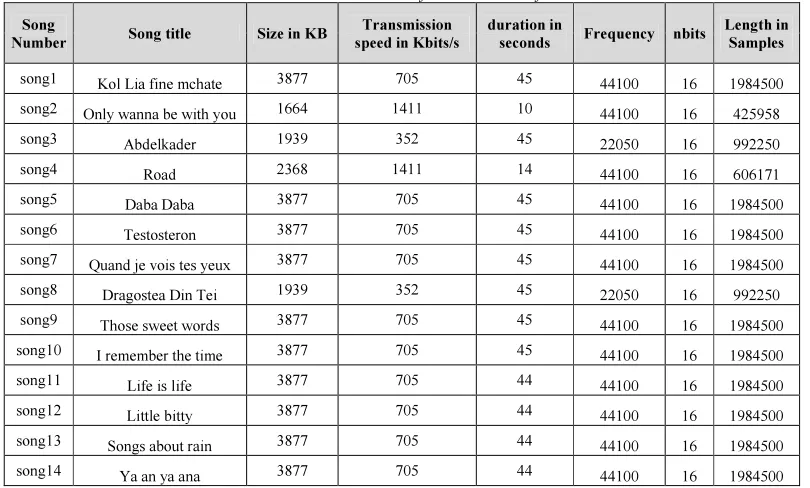
[image:6.595.97.502.380.624.2]In order to test our approaches, we used fourteen music recordings collected from several CD with different spectral characteristics. Audio signals are sampled at 44.1 kHz or 22.05 kHz at 16-bit resolution. Table 1 presents the properties of the used files.
Table 1: Characteristics of the used audio files
Song
Number Song title Size in KB
Transmission speed in Kbits/s
duration in
seconds Frequency nbits
Length in Samples
song1 Kol Lia fine mchate 3877 705 45 44100 16 1984500
song2 Only wanna be with you 1664 1411 10 44100 16 425958
song3 Abdelkader 1939 352 45 22050 16 992250
song4 Road 2368 1411 14 44100 16 606171
song5 Daba Daba 3877 705 45 44100 16 1984500
song6 Testosteron 3877 705 45 44100 16 1984500
song7 Quand je vois tes yeux 3877 705 45 44100 16 1984500
song8 Dragostea Din Tei 1939 352 45 22050 16 992250
song9 Those sweet words 3877 705 45 44100 16 1984500
song10 I remember the time 3877 705 45 44100 16 1984500
song11 Life is life 3877 705 44 44100 16 1984500
song12 Little bitty 3877 705 44 44100 16 1984500
song13 Songs about rain 3877 705 44 44100 16 1984500
song14 Ya an ya ana 3877 705 44 44100 16 1984500
Using these files, we have randomly inserted a word of maximum of ten characters. In the embedding process, we used four delays which represent {00, 01, 10, 11.} digits and each character was encoded using 8-bits ASCII code. Four scenarios described in the section before were considered. For each scenario, each file was submitted to embedding and extracting processes one hundred times. Table 2 shows that the proposed
scheme demonstrates a very low error. Each time, we check the bit error rate and the segment error rate. By bit error rate, we mean the ratio of incorrect extracted bits to the total number of the embedded bits. Segment error rate is the ratio of the incorrect extracted watermark information to the total number of the embedded words.
ISSN: 1992-8645 www.jatit.org E-ISSN: 1817-3195
Scenario 1 Scenario 2 Scenario 3 Scenario 4
Song Number
Coding by attenuation Coding by delay with
known attenuation
Coding by delay with unknown attenuation
Double-Way Coding using delays and
attenuations
Bit Error rate
Segment Error rate
Bit Error rate
Segment Error rate
Bit Error rate
Segment Error rate
Bit Error rate
Segment Error rate
song1 0% 0% 0% 0% 0% 0% 3,15% 2,24%
song2 0% 0% 0% 0% 0% 0% 5,88% 3,24%
song3 0% 0% 0% 0% 0% 0% 1,26% 0,56%
song4 0% 0% 0% 0% 0% 0% 3,72% 2,56%
song5 0% 0% 0% 0% 0% 0% 2,02% 0,72%
song6 0% 0% 0% 0% 0% 0% 0,13% 0,32%
song7 0% 0% 0% 0% 0% 0% 3,15% 5,77%
song8 0% 0% 0% 0% 0% 0% 4,80% 1,08%
song9 0% 0% 0% 0% 0% 0% 1,77% 3,21%
song10 0,10% 2,15% 0,10% 2,34% 0% 0% 1,77% 3,92%
song11 0% 0% 0% 0% 0% 0% 3,53% 1,80%
song12 0% 0% 0% 0% 0% 0% 0,76% 1,92%
song13 0% 0% 0% 0% 0% 0% 0,50% 0,96%
song14 0% 0% 0% 0% 0% 0% 3,03% 1,68%
We remark that polynomial approach offers a good detection results. Unlike, Ceptrum Analysis which need larger used embedding segment in order to improve detection results, polynomial approach is more lenient. Limit in segment length depends only on the perceived quality of the watermarked signal. Thus, we can have better bit rate of the hidden data.
We note also that the hidden information is always recoverable by our detection algorithm. And, having the possibility to hide watermarks in both attenuations and delays makes the bit rate of hidden data larger. Furthermore, polynomial approach is less complex than ceptrum one and detection process is faster.
Next step in our researches will be to test algorithm response against common processing attacks.
5 CONCLUSION
The detection approach used in this paper offer good results. In comparison to cepstrum-based scheme largely used in echo hiding methods, it is less complex and faster. In addition to this, bit rate
is increased in comparison to classical echo hiding methods as information could be hidden in both attenuations and delays.
However, in order to be used in real life applications, it should withstand a series of intentional and unintentional alterations. Our next researches will focus on making our method resistant to common attacks. We will also, using polynomial approach, transform our algorithm from a non-blind watermarking system to a blind one.
REFRENCES:
[1] M. TARHDA, R. ELGOURI, L. HLOU, “Audio Watermarking Systems - Design, Implementation and Evaluation of an Echo Hiding Scheme Using Subjective Tests and Common Distortions”, International Journal of Recent Contributions from Engineering, Science & IT (iJES). Vol 1, No 2, 2013, pp 31-40
[2] Stephen E. Siwek, “The True Cost of Sound Recording Piracy to the U.S. Economy”, POLICY REPORT 188, AUGUST 2007 [3] Goenka, M. K. V., & Patil, M. P. K. “Overview
ISSN: 1992-8645 www.jatit.org E-ISSN: 1817-3195 International Journal of Emerging Technology
and Advanced Engineering. ISSN 2250-2459, Volume 2, Issue 2, February 2012
[4] Hwai-Tsu Hu, Wei-Hsi Chen, “A dual cepstrum-based watermarking scheme with self-synchronization”, Signal Processing, vol. 92(4): pp. 1109-1116, April 2012.
[5] SHUKLA, Dolley et SHARMA, Manisha. “Watermarking Schemes For Copy Protection: A Survey”. International Journal of Computer Science & Engineering Survey (IJCSES) Vol, February 2012, vol. 3.
[6] HOOLEY, Abbey. “Survey on different level of audio watermarking techniques.” American Journal of Electrical Systems, 2013, vol. 3, no 2, p. 58-70.
[7] RAO, Smitha et JYOTHSNA, A. N. “Digital Watermarking: Applications, Techniques and
Attacks.” International Journal of Computer Applications (0975-8887), April 2012, vol. 44, no 7, p. 29-34
[8] Arnold M., “Audio Watermarking: Features, Applications and Algorithms” Proceedings of the IEEE International Conference on Multimedia and Expo (ICME 2000), New York, July 2000.
[9] Bender W., Gruhl D., and Lu A., “Echo Hiding”, Book Information Hiding - First International Workshop Cambridge, U.K., Springer Berlin Heidelberg, 1996. p. 295-315. [10] Rabiner L. R., and Schafer R. W., Book