
734
THE CORELATION BETWEEN BUSINESS STRATEGYAND
INFORMATION SYSTEM STRATEGIES FOR EDUCATION
INSTITUTION: CONCEPT AND DESIGN
TANTY OKTAVIA
Bina Nusantara University, School of Information Systems, Jakarta – 11480, Indonesia
E-mail: [email protected]
ABSTRACT
The strategic planning for information systems is part of the most important aspects in order to specify the objective in the organization. With a proper strategic planning, the business process of an organization can keep along with the vision and mission that has been decided in the beginning. Strategic planning for education institution has a substantial part to aligning the goals which to be achieved by that institution. Nowadays, a rivalry in education industry is very tight, institutions be charged to have a proper strategic planning of each division that influenced againts business process. According to this condition, the study aimed to evaluate business strategy with information system strategy in order to map competitiveness value of institution compared to the competitor. This study begins with analyse data collection by conducting surveys and questionnaires to several sample education institutions in Indonesia. After that, all of data were simulated into strategic information map to show the relationship from many derived variable perspective. As a result, it creates a blueprint model to solve common problems that exist in general education institutions. In summary, education institution can establish a positive contribution to the development and achievement the goal in the institution particularly by implementing a good governance of strategic planning of information systems.
Keywords: Strategic Planning, Information System Strategy, Educational Institution
1. INTRODUCTION
The growth of modern technologies creates a competitive environment of industry filled with innovation to provide the best service to the
customer. Even today, implementation of
information technology has spread out into many kind functional of business, it caused a institution be charged to specify an opportunities and to evaluate it against current business model, then finally to pursue any measure that suitable with business strategy and business objectives. Strategic decisions about implementation of technology both directly and indirectly affect to the continuance of a company in short or long term.
As part of Information Technology, Information Systems (IS) nowadays are integrated with almost every functional of business line because it can accommodate to simplify company activities and increasing effective and efficiency process. While early IS implementations were clearly focused on the automation of clerical and repetitive task, it continuous to grow in other business process, such as strategically process. Collaborating IS in
functional business process, requires the ability of IS leader to collaborate and reorganize it extensively in order to achieve maximum advantages. Besides that, it also must be aligned with the organizations perspective toward business model. If the company’s IS failed to support its organizational process, the impact is misalignment of the resources needed to achieve its goals [1]. For that reason, information system strategy should be compatible with its organization strategy that consists of fundamental elements of business.
735
Figure 1 Information Systems Strategy Triangle [1]
Business strategy consists of vision, mission, objective, purpose, and goals to indicate what
direction to accomplish by institution.
Organizational strategy includes people, work process environment, organizational structure, and planning to achieve business goals. Then, Information systems strategy is the plan to implement information services in accordance with business process. Those strategies must be
collaborated to establish enterprise wide
architecture that can support business functional.
The development of the education functional is
rapidly stimulating the education business
struggling to maintain or even increase the competitive value in the same industry [2]. This condition impact the information system role emerged as an important discipline to support daily operational and to help management take the proper decisions that take effect in an educational institution. The main goal of education institution is to provide service for student in academic field and generate an outstanding student that ready to work. With elaborate this objective and information technology, it enable education institution to form business strategy reach performance targets that can help to ensure an organization is accomplishing its mission. The mission or vision statement in organization may be relevant for short and long term period, until it appears unattainable or
insufficiently challenging in changing
circumstances.
In the planning process requires socialization with all staff to achieve mutual understanding about business process and institutional strategic. Deciding what the right tools to use in the planning process is not a simple process. Most planning processes use situation analysis to analyze the internal and external influences against institution strategic. The intended result of the planning process is to attain IS Strategy [3]. The benefit of achieving strategic fit is that it should ensure IT can add valued to product or services, which turn on management efficiency through cost control and competitive position [4]. Because of that focus, a company can reinforce the standard and procedures across different division.
Definition strategy is a set of coordinated actions to achieve anything they need to be implemented, such as objectives, purpose, and goal [5]. Strategy requires adequate resources are obtained and
allocated effectively with the appropriate
organization and responsibilities. There is a difference between having an IS strategy and an IT strategy that is making a contribution to the initialization of business value for organization. The IT strategy is concerned with outlining the vision of how the organization’s demand for information and systems will be supported by
technology, but IS strategy defines the
organization’s requirement or demand for
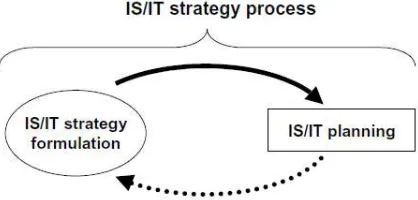
information and system to support the overall strategy of the business functional [5]. Once that strategy has been combined, an implementation plan can then be build into IS/IT planning. The IS/IT strategy refers to both planning and formulation of technology. The IS/IT strategy determine IS/IT planning. The process does not always occur sequentially but there may be overlap. Large organization in different businesses of functions may be at different order.
Figure 2 Is/It Strategy Process
Many organizations have adopted a combination of planning techniques to support their planning process [3]. The most popular planning techniques that can be used are stages of growth, Critical Success Factor, Competitive Forces Model, Value Chain Analysis, Three Emerging Forces, E-Business Value Matrix, Linkage Analysis Planning, and Scenario Planning [6]. For this study using competitive forces model and value chain analysis to support strategically analysis.
2. MATERIALS & METHODS
[image:2.595.332.541.403.503.2]736 organizations utilize a collaboration of approaches to get a single best approach and nearly impossible to be implemented [3]. The planning strategy process can become complicated to realization. For this study follows an empirical study approach. Data were collected in a questioner to members of education institution, with relevant parties that involved (Academic and IT Staff, lecture, and student). This method enabled us to explore information about organizational structure and situation. After that, we map the questioner result into IS/IT strategic model to identify the right option and a business process that must be linkage in organizational with a substantial part of sophistication in information management.
The governance arrangements for the strategic planning that proper with company profile, a wide range observation and research must be adopted to retain control and responsibility of the IS. The result of the planning process is Information System strategy that concerned with applications
and platforms to be implemented. The
implementation strategy will describe what organizational change will be needed to deploy IS strategy successfully. The most common aims organizations implementing an IS/IT strategy process are [5]:
Aligning IS/IT with the business process to identify where IS/IT major contributes and determine priorities for investment
Obtaining competitive advantage from
business opportunities created by using IS/IT application
Building a cost effective, with implementation of technology infrastructure for the future
Sharing knowledge to the appropriate
resources and competencies to deploy IS/IT successfully across the organization.
If IS/IT strategy-formulation process has not become established, it need to undertake initiatives to build awareness through the deliberate application of IS/IT in support of its critical business needs. The process should introduce the required discipline thus define planning resource requirement. However, the IS/IT strategy process needs to become an integral part of the development of business strategy.
When developing framework for transforming business strategy into architecture and then into infrastructure these basic components should be considered [1]:
Hardware : The physical components that handle process, such as computation, storage, or transmission of data
Software : The programs that run on hardware to enable work to be performed
Network : It consist of software and hardware components that support communication and data sharing
Data: The representation of the numbers and text.
Any good architecture is based on a set of principles, or fundamental procedures about how the architecture should function optimally to generate the values of the enterprise as well as with the technology used in the infrastructure.
3. RESULT AND DISCUSSION
The extremely changing environment of IS includes numerous issues and challenges that must be considered from internal and external level. These changes need supporting potential competencies from IS leaders to specify what leveraging process as competitive advantage properly. One perspective that every decision maker needs to be understand is that there is pervasive ambiguity throughout strategic decision making because the environment is dynamic this caused strategic managers are less capable of making precise forecasts about the future development [7]. Because of that a company requires the right strategic planning to focus on vision and mission of institution. In this study, we try to explore education institution as an object research.
Education institutions involved in this study both of private and public institution. For each institutions data was collected in questionnaire according to identify corporate strategic planning, including
vision, mission, involvement of IS, and
management.
The stages of strategy formulation for effective utilization of IS/IT is not simple. Strategy drives architecture, which drives infrastructure as well. It needs to satisfy critical functional that are probably include in strategic systems. Model of strategic planning for information systems and information technology in this study is divided into [5]:
1. Internal business environment
Internal business environment consists of:
current business strategy, resources,
737 analysis. The value chain model divided into the main activities and the support activities that add values into business segment. The main activity is the activity that is directly related to the core business of the institution. The support activities are activities that complement the main activity to be realistic. All of education institution generally has the same activities, begin with admission then continued with the academic process.
We have classified the activities in education institutions into several main activities, there are:
Admission system, this activity includes the following sub activities : registration for new students, qualification test, payment of registration fee
Academic activities : Academic data management, include : lecture data, student data, staff data, scheduling, examination, report of student academic
Collaboration and partnership:
Cooperation with industry, alumni
association, government scholarship,
professional services, corporate
governance, etc.
Lecture resources management : Lecture recruitment, training and workshop, and assessment
Community services: Counseling to small and medium enterprises (SMEs), training to community, workshop new technology.
Financial management : Payment
registration, monitoring budget, and
financial reporting.
Information technology : Infrastructure, hardware, software, information system, and network
Procurement: Monitoring of inventory, supply of inventory.
Human resources management :
Employment, managing personnel data, attendance report, reward and benefit, and individual development plan.
According to the classification of main and
support activity, the following are
segmentation of the activity in education
institution commonly based on
questionnaire results: Major Activities
Admission system, academic activities, collaboration and partnership, lecture resources management, and community services
Supporting Activities
Financial management, procurement,
human resources management, and
information technology
2. External business environment
The factors that include in this aspect are
economic conditions, industrial
environment, government policy,
competition among institution, partnership in education institution.
3. Internal IS/IT environment
The configuration for IS/IT architecture from many perspective in the business, maturity, scope of business, contribution,
skills, resources, and technological
infrastructure.
4. External IS/IT environment
It consists of technology trends and
opportunities and the function of
information system and information
technology to others, especially student as
customer, lecture, competitors, and
suppliers.
5. Business strategy
This aspect describes about how IS/IT to support business objectives and application portfolio for the business unit and business models in education institutions. IT not only change organizations structured, it also profoundly affect the way to
translation business goals to IT
architecture. Management control systems must respond to the objective of organizations. Measurements must be taken periodically to achieve the best performance. Generally, IS have three important roles in management control process [1]:
Data collection. This data helps managers determine realization of the organization’s mission as reflected in its stated objective.
Evaluation. IS provides the analysis of
information that compares current
738 Communication. The flow of information can be delivered as fast as user need. This allows the analysis of the situation to be real and up to date fit to actual environment.
6. IS/IT Management strategy
This element of the strategy to ensure a
consistent policy to apply IS/IT.
According to the analysis in several
education institutions, management
strategies can be simulated as follows: Corporate contribution
In conducting business process activities, education institution must be realized about how to organize budget and manage corporate saving to generate maximum benefits to the business.
User orientation
Given the complex nature of IT in the enterprise, the role of the IS user in
developing, maintaining, and
communicating standards. User has the important role to enhance a capability of system in order to accomplish their job.
Operational excellence
The system must be able to guarantee the security and privacy of data and
degradation of vital business
functions. Furthermore, effectiveness and efficiency of IT infrastructure also have to consider in order improving the quality of service. Future orientation
Expanding options of technology supply for future time such as
software as a service, cloud
computing, grid infrastructure, and capacity on demand.
Knowledge and experience is the precious thing in company to
maximize the performance
management. Aside from concerns
about intellectual property and
proprietary knowledge, once
knowledge has been produces, it must be used or shared to be of value in institution. Therefore need to be built a system that collects it, as an
example knowledge management system.
7. Information Technology strategy
[image:5.595.290.543.100.534.2]It consists of policies and strategies in the management of technology and specialist resources. For an example create of a user right, procedure to operate the system, standard operation, system documentation, etc.
Figure 3 The IS/IT Strategic Model [5]
Frameworks guide the translation from business strategy to IS strategy by categorizing components into infrastructure, which make up both IT architecture and infrastructure.
739 The accumulated criteria of business IS demand is convert into recommendations for the development of IS/IT planning both short term and long term. The outputs can be delivered from this study: Short term planning
Increasing service of quality and best practice for any area of core business process. The key point that creates the capabilities of the company uses to implement operating model and create market opportunities.
Development of human resources (staff, lecture, etc) both technical skill and soft skill and how they can adapt with the new system. Documentation for all application system It needs to keep documentation of application that developed in institution because it possible to enhance the application in the future need. A large number of technical issues should also be considered when the system lost their documentation.
Training for user
User is an important role to control system
compatible with business process in
organization. Therefore, users need to be trained as well their job, so they can easily operate the new system.
Research and Development Business Process. The huge number of IT options available with the incredible speed of technology advances, makes the user to research IT infrastructure that suitable with the institution.
Reward and Benefit System
A company needs an employee to achieve vision and mission, but we must realize about reward and benefit that comply with them so as to provide their motivation.
Utilization of social media and forum that allows member to create public account with their interests, posting news/status, sharing with their friend whom connected, playing game, and view other account. Popular social media services are Linked In, twitter, facebook, Path, Instagram etc.
Medium & Long term planning Cloud computing
There are several significant advantages by this cloud process to support main activities. All participants can upload and keep the information anywhere dan access it whenever they want. There is a time saving feature to facilitate the process properly.
Mobile Computing
Mobile computing is one of technology driven approaches, help organization with speed, efficiency, and communication that integrate with mobile network.
Cooperation in research with external
companies
Cooperation between companies often lead to strategic advantage. It should be recognize the fact that technologies facilitate relationships, whether the relationship with internal or external participant. In this way, IS support level the competitive for partnership in research area.
Development Adaptive Platform
The increasing use of information systems responsible for the developing the adaptive
infrastructure platform that can help
organizations fit with business process. Apply to Certification ISO 177799 : 27002 Standardization of ISO can help institution to organize and monitor the structure of company properly and suitable with the procedure in ISO procedure.
4. CONCLUSION
Information revolution refers to increased use of information and communication to build, deliver, and use the Information System (IS) to support the business process. Most organizations now realized that IS has an important role in today’s business environment because the rapidly changing of technology development and highly competition in education area. Devising a strategy combine with IS/IT in this era is accepted as a major issues to automate planning tools and connected into strategic system developments. To guide education institution have the proper information system to support business process is that the planning details process must be aligned with organizational and business plan in that organization. When education institution wants to create information system strategic planning, they should have frameworks that contain the planning techniques in dynamic and adaptable to achieve the objective [8]. The
frameworks organize business aspects that
740 decides the appropriate strategy to implement. The implementation should be systematic with an understanding of the circumstances and the global environment as direct impact we live in a global competitive environment.
REFERENCES
[1] Pearlson, K. E., & Saunders, C. S. (2009).
Strategic Management of Information Systems.
USA: John Wiley & Sons.
[2] Gufroni, A. I. (2011). Information Systems
Strategic Planning At the Siliwangi University
Tasikmalaya. International Journal Of
Advanced Engineering Sciences and
Technologies (IJAEST) , 053-059.
[3] Pollack, T. A. (2010). Strategic Information
Systems Planning. ASCUE Proceedings.
[4] Wilkin, C. L., & Cerpa, N. (2012). Strategic
Information Systems Planning: An Empirical
Evaluation of Its Dimensions. Journal of
Technology Management & Innovation .
[5] Ward, J., & Peppard, J. (2002). Strategic
Planning for Information Systems. Great
Britain: John Wiley & Sons Ltd.
[6] McNurlin, B., Sprague, R., & Bui, T. (2009).
Information Systems Management in Practice.
Upper Saddle River, New Jersey: Prentice Hall.
[7] Gaines, C., Hoover, D., Foxx, W., Matuszek,
T., & Morrison, R. (s.f.). Information systems as a strategic partner in organizational
performance. Journal of Management and
Marketing Research .
[8] Basahel, A., & Irani, Z. (2009). Evaluation Of
![Figure 3 The IS/IT Strategic Model [5]](https://thumb-us.123doks.com/thumbv2/123dok_us/8912197.959901/5.595.290.543.100.534/figure-strategic-model.webp)
